🚨 Your brain shuts down in time intervals.
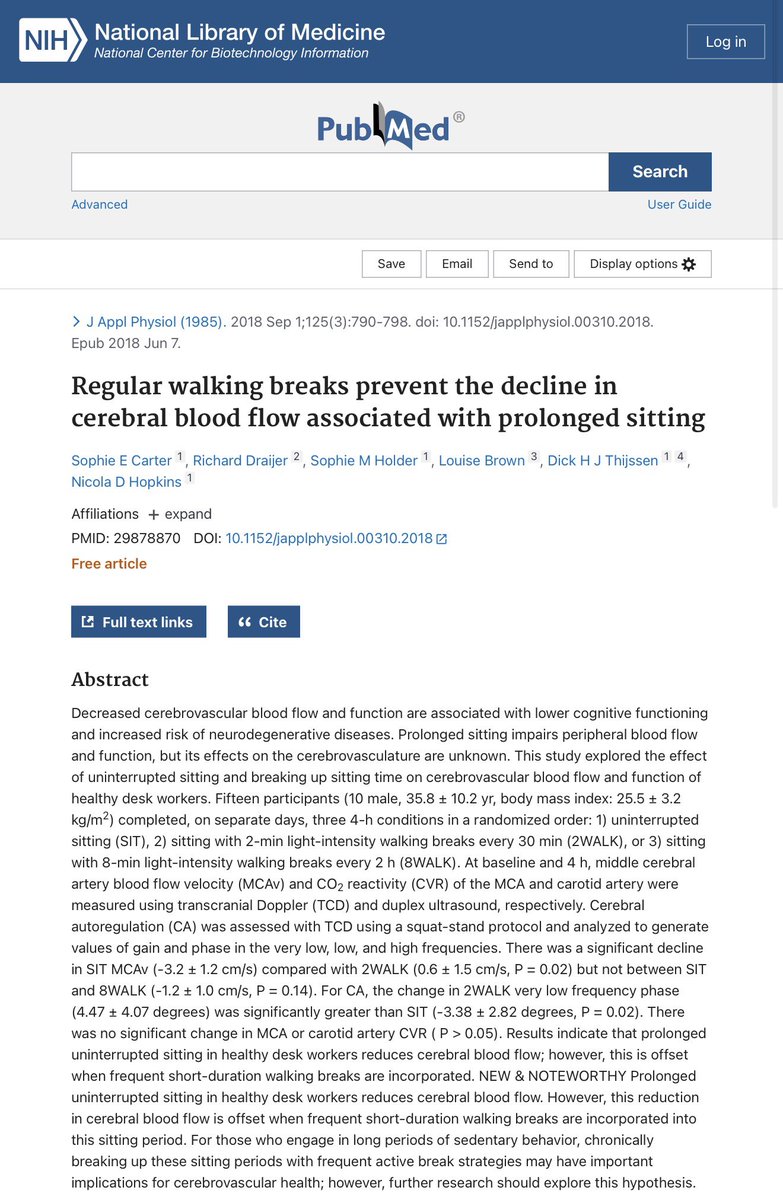
New research tracked cerebral blood flow in desk workers using transcranial Doppler imaging. What they discovered changes how we should think about cognitive performance during work.
Sitting for 30 minutes measurably reduces blood velocity to your middle cerebral artery. Your prefrontal cortex begins operating on restricted fuel. The decline happens predictably, like clockwork, every half hour.
But walking for just 2 minutes every 30 minutes completely reversed the effect. Not walking for 8 minutes every 2 hours. Short, frequent interruptions.
The timing reveals something crucial about how your cardiovascular system operates under sedentary stress. Blood doesn’t pool gradually. It pools in waves. Your circulation hits specific failure points at regular intervals when movement stops. The 30 minute mark appears to be a biological threshold where your calf muscle pumps lose their ability to maintain adequate venous return.
Think about every important decision you’ve made sitting at a desk after 30 minutes of stillness. Every creative problem you’ve tried to solve. Every complex analysis you’ve attempted. You were operating with diminished blood flow to the exact brain regions responsible for higher order thinking.
The implications extend beyond productivity. Prolonged periods of reduced cerebral blood flow accelerate cognitive decline. The same vascular mechanisms that impair thinking in real time contribute to neurodegeneration over decades. Office workers aren’t just experiencing temporary mental fatigue. They’re participating in a daily pattern that systematically starves neural tissue.
What makes this particularly disturbing is how perfectly our work culture aligns with the worst possible timing. Meetings scheduled for an hour. Focus blocks planned for 90 minutes. Deep work sessions extending for multiple hours. We’ve organized professional life around intervals that guarantee cognitive impairment.
The solution sounds absurd until you understand the physiology.
Stand up and walk for 2 minutes every 30 minutes. Not stretch. Not shift in your chair. Walk. Activate the muscle pumps in your calves. Force blood back toward your brain.
Every knowledge worker should treat this like a medical prescription. Your cognitive capacity depends on maintaining cerebral blood flow. Your long term brain health depends on preventing chronic vascular stress. Movement every 30 minutes isn’t a productivity hack. It’s basic cardiovascular maintenance for an organ system that requires constant circulation to function.
Your brain runs on blood flow, not willpower.
Starve it for 30 minutes and watch your intelligence evaporate in real time.
Your brain goes dark when you sit still.
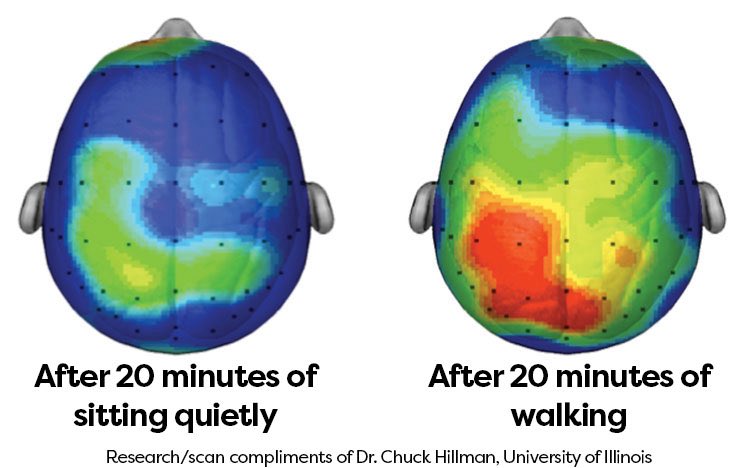
Dr. Chuck Hillman at the University of Illinois put people in brain scanners and measured neural activity after 20 minutes of sitting versus 20 minutes of walking. The difference was notable. The sitting brain showed lower activation in key cognitive control areas. The walking brain showed increased activity across attention and executive networks.
Twenty minutes. Same people. Completely different brain responses.
What you’re seeing in these scans reveals something unsettling about modern life. We’ve built a world that systematically limits optimal brain function. Every chair, every car ride, every hour spent motionless is missed neurological enhancement happening in real time.
The enhanced zones in the walking scan represent areas responsible for executive function, spatial processing, memory formation, and creative problem solving. These regions show stronger engagement when you move. Movement doesn’t just change your body. Movement turns on your mind.
The implications go far beyond fitness. Every major decision you make while sitting is being made without the full acute boost that prior movement can provide. Every problem you try to solve from a desk is being processed with cognitive resources that benefit from activity. Every creative project you attempt while sedentary is running with added support available from movement.
Think about where our most important mental work happens. Board meetings around conference tables. Students taking exams in classroom chairs. Writers staring at screens. Programmers debugging code. Therapists conducting sessions. All of it happening in environments designed to minimize movement.
Hillman’s research suggests we’ve accidentally limited cognitive potential through environmental design. The walking brain and the sitting brain show meaningful functional differences. One operates with enhanced cognitive control. The other runs without that acute boost.
Ancient humans walked 12 miles daily while thinking, planning, and problem solving. Their brains evolved under constant movement. Our brains carry the same neural architecture but we’ve imprisoned it in furniture.
The most productive people throughout history understood this instinctively. Aristotle taught while walking. Darwin took daily thinking walks. Dickens walked 30 miles through London every night. Tesla walked 10 miles daily to stimulate ideas. They weren’t just exercising. They were unlocking cognitive potential that remains less activated when stationary.
The business world talks endlessly about optimizing performance through better tools, systems, and strategies. Meanwhile, the most powerful cognitive enhancer costs nothing and requires no equipment. Just get up and move.
Every step triggers a neurochemical cascade that increases BDNF, boosts dopamine, and activates neural networks that show less engagement during stillness. The effect peaks around 20 minutes and persists for hours afterward.
You can literally watch improvements in cognitive performance turn on and off depending on whether you’re moving or sitting.
The next time you face a difficult decision, a creative block, or a complex problem, pay attention to your position. If you’re sitting, your brain may be operating without the full acute boost available. The solution might require neural resources enhanced by activity.
Stand up. Walk around. Let the enhanced zones activate.
Your best thinking happens when your brain has the support of movement.