Preparing for the end.
Joined May 2022
- Tweets 645
- Following 402
- Followers 4,988
- Likes 9,270
71 Photos and videos






HashingZap ✝️ retweeted

This is excellent work.
Your elastic crustal response model makes a rapid ECDO-style flip far more survivable than most people assume, exactly the kind of mechanism needed for pockets of survivors in high refugia I posit.
In my research, this lines up in my model exploring the cataclysm that ended the earlier Saturn polar configuration [sheath collapse tether snap etc].
[here]👇
x.com/TartariaLives/status/2…
The physics you're showing helps explain how enough people and knowledge made it through to reboot afterward.
Really well done.
The animation is one of the best visualizations I've seen of how these fast tilts could actually happen without total extinction.
Appreciate the work.
Jun 13

Well, I certainly didn't expect to smack into Saturn in my Tartarian story-arch over these years, but here I am.
I get this a lot.
My Saturn Polar Configuration describes the long, stable baseline, a Golden Age lasting potentially tens of thousands of years. Earth tidally locked to Saturn at the Hudson Bay pole, inside a plasma sheath [purple dawn], Birkeland current column, no visible full starry sky, constant far-red light, higher effective oxygen/pressure, and reduced effective gravity on the facing land bulge.
This👆is the environment that allowed giants, megaflora, and abundance with no seasons.
The '6k/12k Year Disaster Cycle' describes recurring cataclysms in the current solar system [Younger Dryas ~12.9kya, 536 AD, etc.]. It explains the repeated resets after the big change.
My Saturn model gives the cycle theory its origin story [and finale'], really. One major Saturn-era ending event [read: ~12–13kya sheath collapse ECDO crustal flip etc.] was the last big one, after which we entered the current solar configuration with its smaller, periodic instabilities.
The moons capture insures any further 'flips'
You're right, however, current gravity makes sustained 8–12 foot humans extremely difficult [heart strain, bone loading, circulation etc].
The Saturn configuration solves this cleanly.
Lower effective gravity on the tidal-locked bulge facing Saturn due to electromagnetic buoyancy or levitation effects from the intense Birkeland current and plasma sheath. [think, lighter blocks as well]
Also Centrifugal reduction from the locked rotation and Higher atmospheric density under the enclosure.
This matches what we see in the fossil and mythic record, with all of the oversized tools, giant skeletons [or reports of them], massive flora, and long-lived 'first peoples'.
After the flip, gravity normalized, the sheath collapsed, oxygen/pressure dropped, and biology downsized rapidly.
The giants became the 'age of heroes' that faded into legend.
This is one of the hardest parts of mainstream history to explain without a major environmental shift. The Saturn model provides the mechanism and the disaster cycle provides the timing and aftershocks.
In short, my Saturn configuration doesn't replace the disaster cycle, really, it explains why the world before the big reset was so radically different [giants, megaflora, stationary purple sky etc]
The cycle theory then covers the ongoing instability in our current solar setup.
One long Golden Age under Saturn leads to one catastrophic flip leads to smaller cycles afterward.
The giant evidence fits the Saturn baseline better than anything else.
And after the big ECDO-style crustal displacement and sheath collapse, Earth was left wobbling and unstable in its new orientation. [see ancient wrotongs]
Here's the kicker. The Moons capture stops any further flips. [also recorded in ancient texts] and acted like a gyroscopic stabilizer.
It gravitationally 'locked in' the new 23.4degree axial tilt.
It dampened wild precession and polar wander.
It created the regular tidal forces and seasonal cycles we have today. [and added 5 days to the original Sumerian/Mayan calendars to account for the torque]
In plasma/electric universe terms, the Moon also helped discharge residual electrical instability left over from the Saturn tether snapping.
[It was originally one of the famed [7-wonderers]
[here]👇
x.com/TartariaLives/status/2…
The Moon is a great time-marker.
In the Pre-Moon era, myths from multiple cultures [read: Aboriginal Australians, some African and South American tribes, parts of the Vedas, etc.] explicitly describe a time 'before the Moon', with no monthly cycles, different tides, different biology etc.
[here]👇
x.com/TartariaLives/status/1…
In Post-Moon era, the lunar calendar [adding those 5 days], menstrual cycle synchronization, added moon-markers on monuments, tidal records, first 'moon' paintings, and eclipse lore all kick in.
This gives us a hard chronological boundary for the Saturn configuration collapse.
The stone monuments remember
👇
x.com/TartariaLives/status/2…
The Moon wasn't here during the Saturn polar configuration. Its capture after the big flip was the 'reset button' that finally stabilized Earth's new tilt and stopped future major crustal flips.
That single event is one of the best time-markers we have, it explains why so many ancient traditions remember a world 'before the Moon', and why we haven't had another full pole-shift cataclysm on the same scale since.
I imagine early post-cataclysm peoples would have experienced dramatic daily rises and falls in sea level for the first time, which lines up with the sudden appearance of lunar-tide awareness in later ancient records [read: Pytheas ~325 BC onward linking Moon phases to tides].
It would have felt like the new sky god [the Moon, Selene was actively 'breathing' on the waters.. seems it would be a powerful, observable sign that everything had changed.
I digress...
1
2
373
HashingZap ✝️ retweeted

Somebody doing the work that geophysicists are institutionally "blocked" or banned from doing.
Simple calculations with good explanations. 👍🌐

1
1
7
276
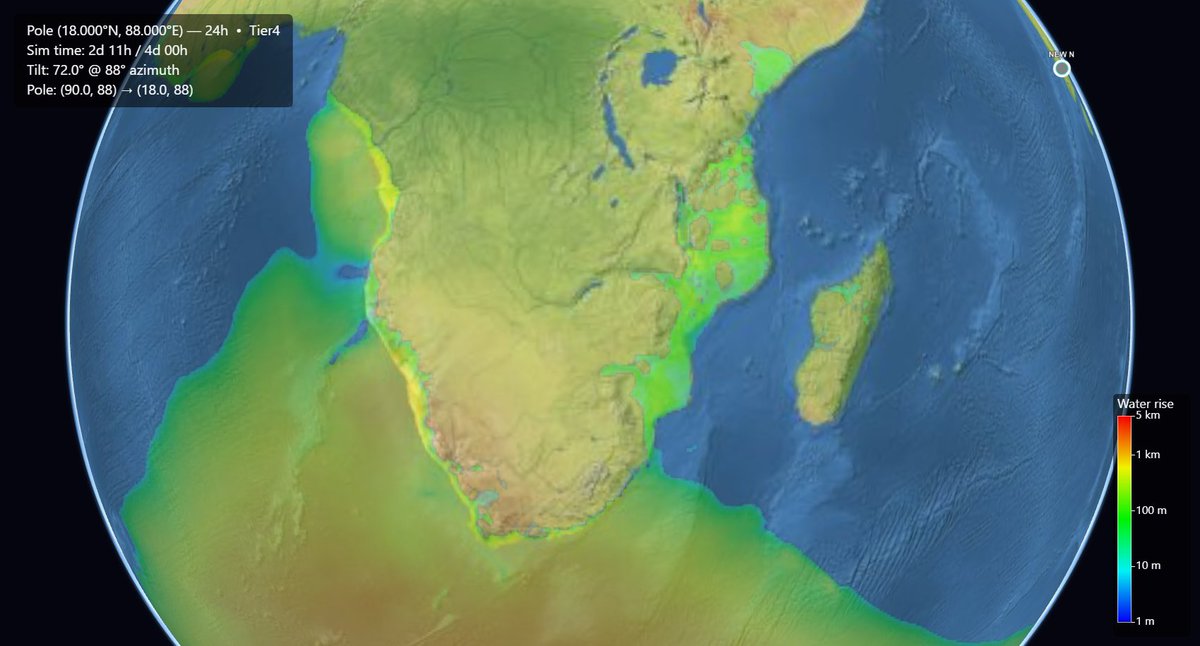
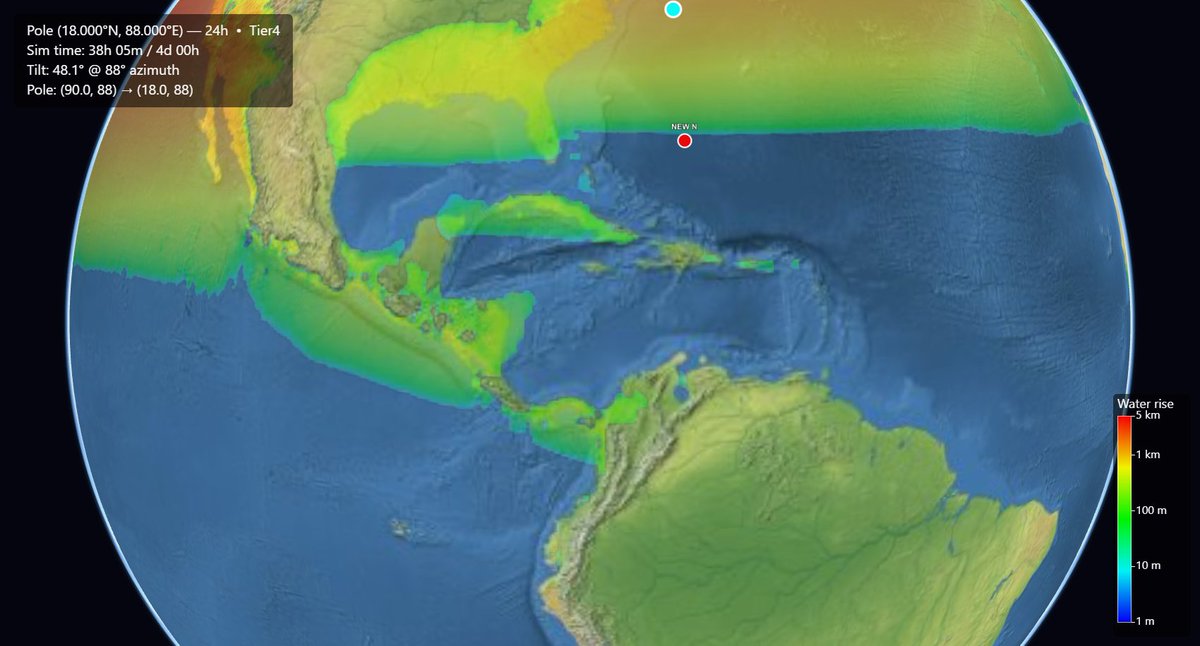
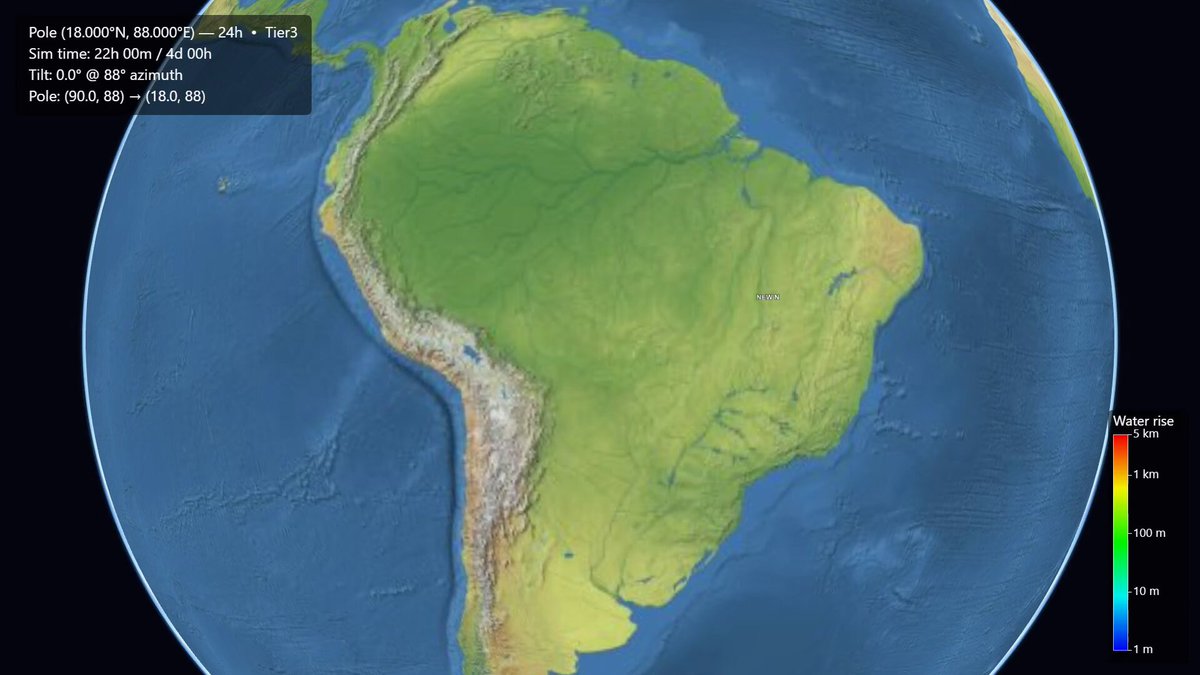
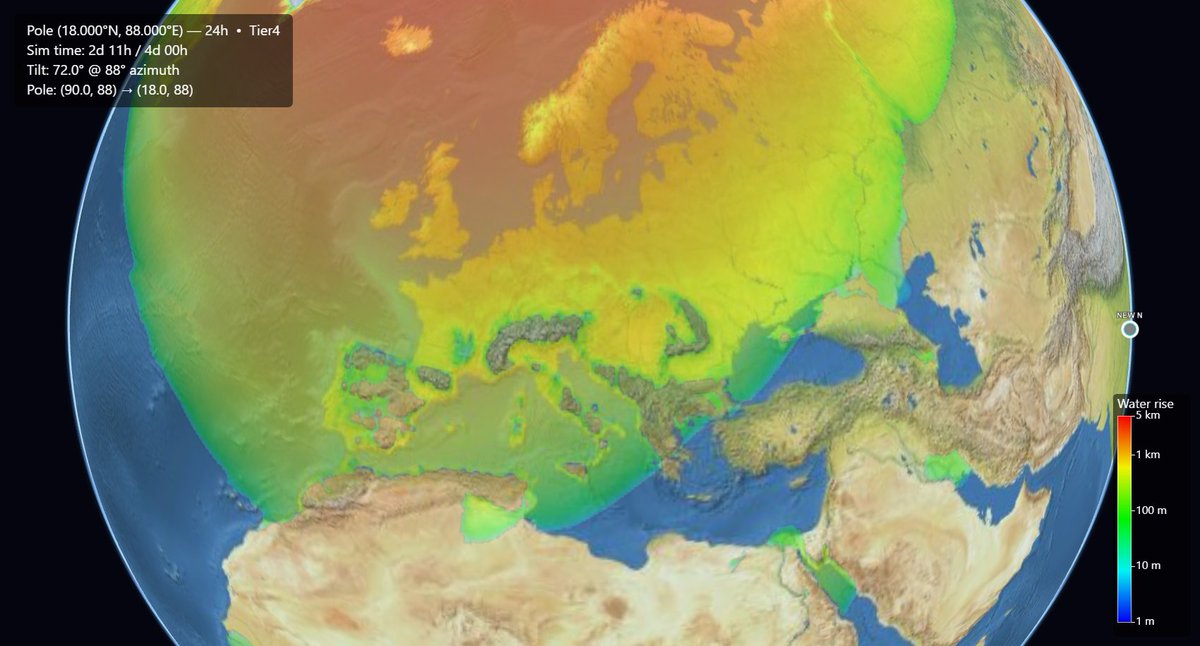
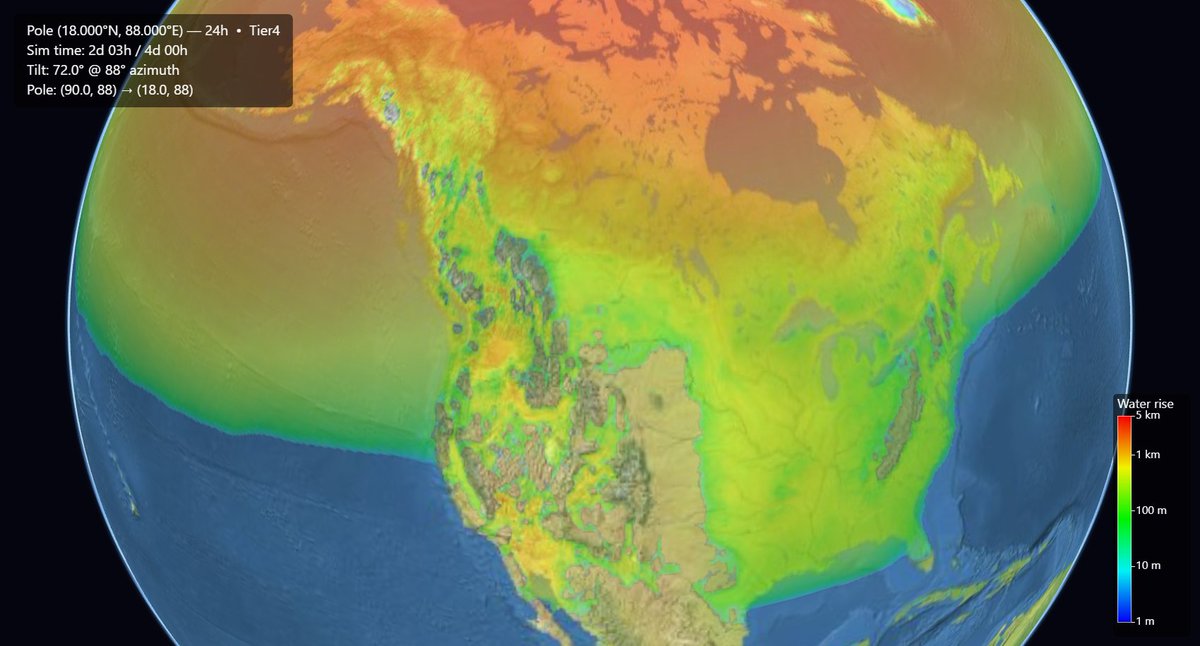
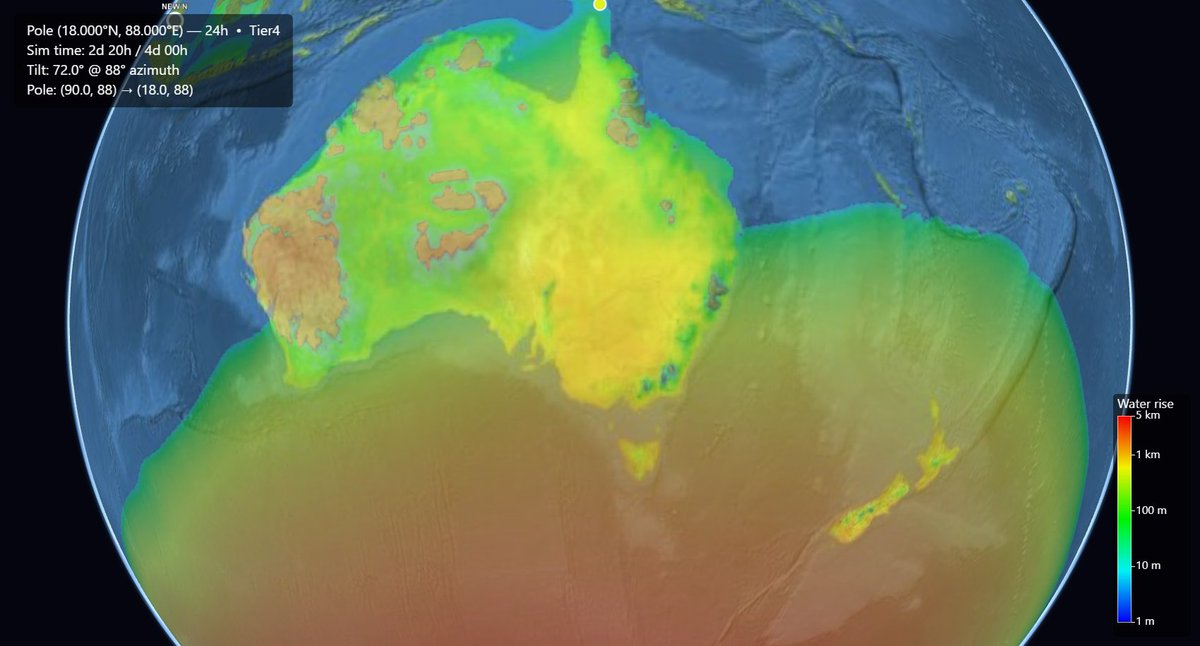
Screenshots from close to max inundation levels from @SunWeatherMan's pole shift theory. This is from the highest simulation resolution at .01° and I'll post the videos of each continent later... got a family thing I must attend for a while first. 😅
17
5
111
6,327
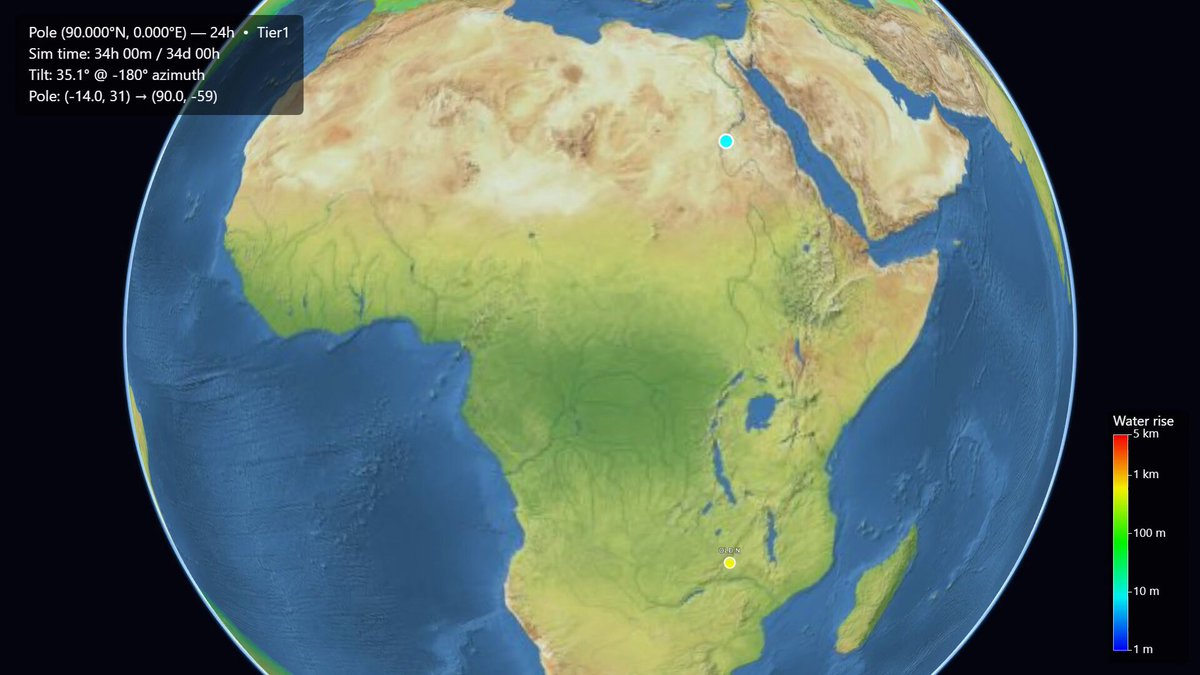
Had a request for South Africa. Here is a zoom in screenshot of the max inundation point for Ben's pole shift move. Africa, in general, doesn't get hit very hard in this model.
6
5
798
I'm a bit out of my element with this one, but I had to figure out what was missing from the pole shift simulation program I've built. I do believe I found the answer here within this article and so far things seem to match on the geological evidence side of things with the simulations I'm running now.
I'll be publishing an updated simulation version of Ben Davidson's and ECDO's hypothesized shift later today.
6
6
80
3,609

Jun 12
Will be posting some new simulations this weekend in its final form. Still no zoom capabilities or state lines, but I am finally wrapping up the physics and data side of things. I can now work on my long list of "nice to haves". 🫡
9
3
50
1,431
Jun 12
Though today, I did wake up to a failed simulation run at the highest resolution. I did not realize each of these ate up 150gb in storage. Never checked that side of things. 😂
Of the hundred or more simulations I've run at the lower resolutions, those totaled 300GB for all. Each one I run now will cost 150GB in storage. Gotta do it though to get the highest resolution data for the things I plan to build next.
This will get interesting when I build out the interactive web interface... my hosting provider is going to want me to upgrade. Will have to worry about that later. lol
3
19
518
HashingZap ✝️ retweeted

Jun 11
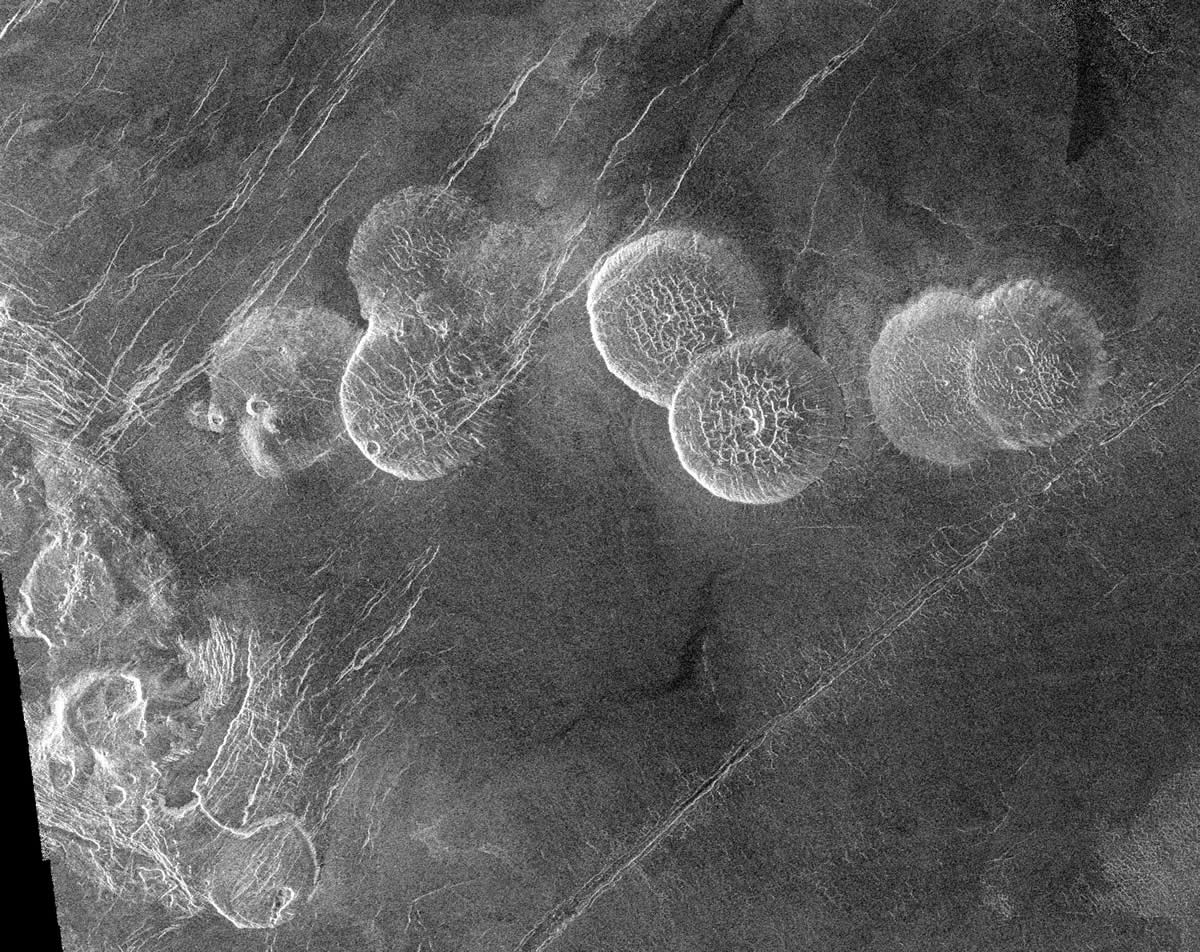
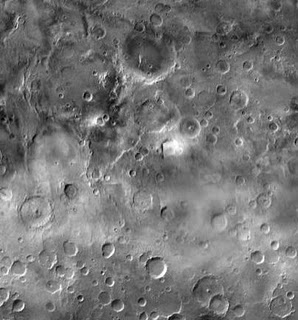
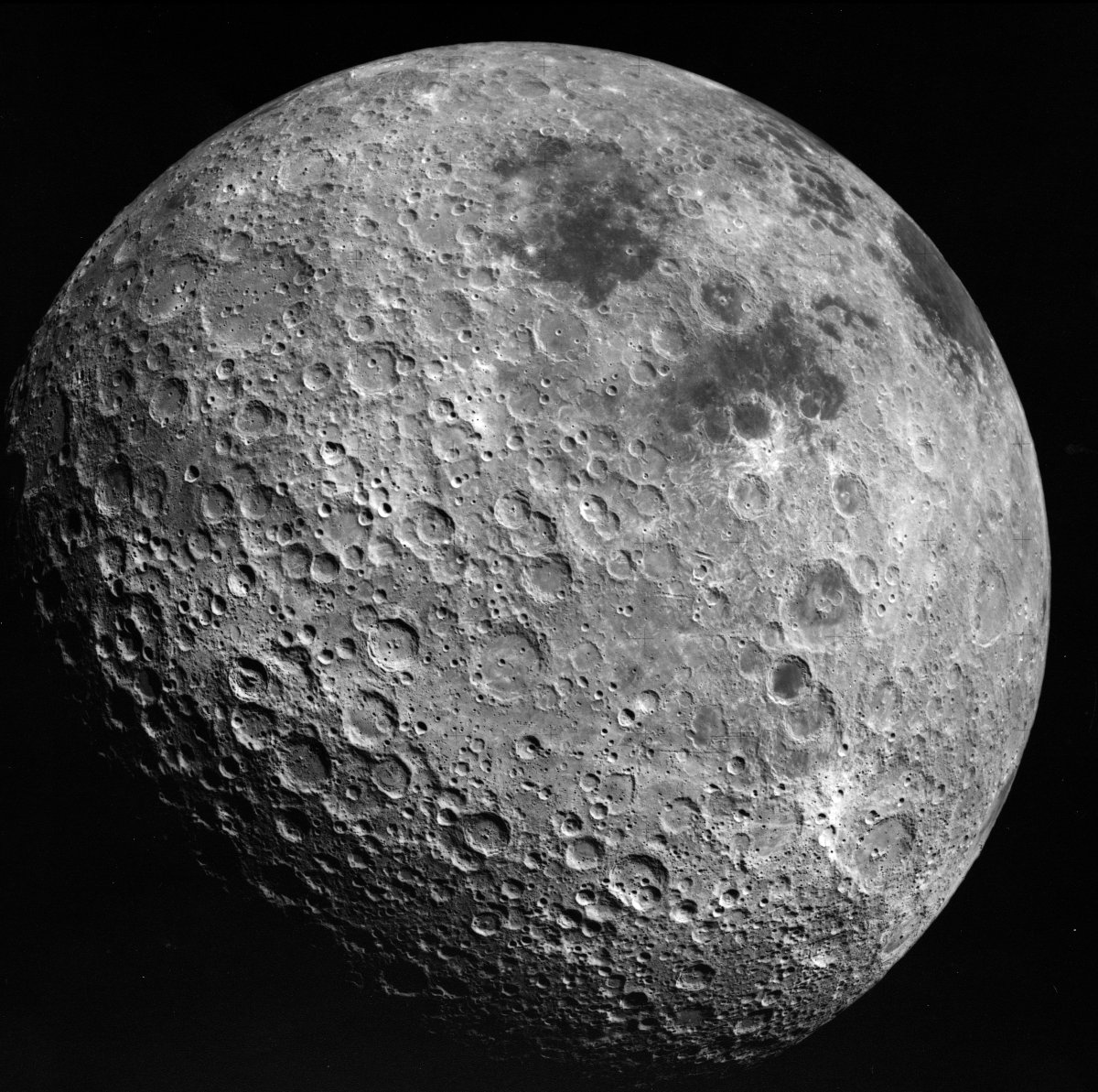
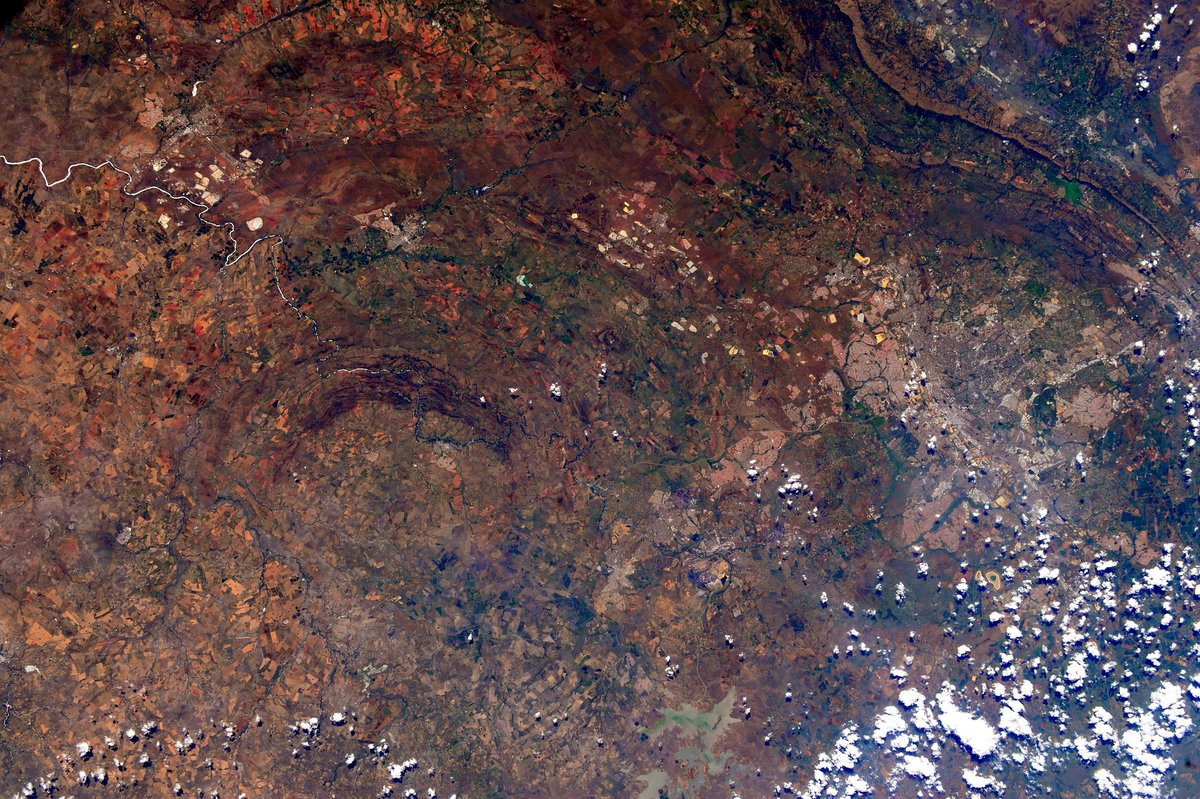
Earth is different in that 200 million years of atmosphere, sediment and water have erased almost all of the evidence which peppers the surfaces of most rocky worlds. Images are Venus, Mars, Moon (far side) and the Vredefort Dome/Reitz Structure region in Southern Africa.
7
6
95
7,527
HashingZap ✝️ retweeted

Jun 10
4
3
20
4,806
HashingZap ✝️ retweeted

Jun 11
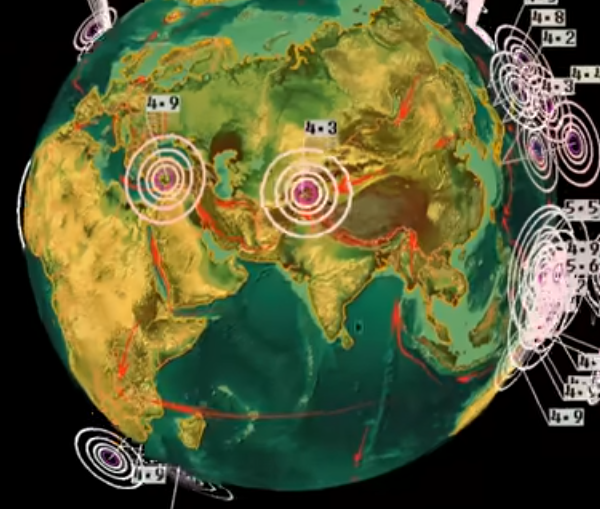
Some of my followers might be familiar with @RealDutchsinse . He is the earthquake forecasting guy- not in the sense of some spiritual premonition that one is coming, but he observers patterns in their propagation. Deep ones precede shallower ones. There are preferred propagation paths- typically along plate boundaries or along the edge of the NA Craton. These paths have reliable termination points- often the Mid Atlantic Ridge, with a couple odd exceptions like Np' (he does not call it that, in fact I don't think he has ever heard of ECDO. He just notes that there is a termination point near the southern edge of the East African Rift). He also observes that mechanical breakages (fracking) or magnetic sources (power generation) can help channel smaller earthquakes (not cause them, slightly influence WHERE they propagate).
That Np' should be a termination point is curious. And while the whole west coast of the Americas is seismically active, he does observe one location near Bolivia as being a frequent origin point of deeper earthquakes. This is doubly curious.
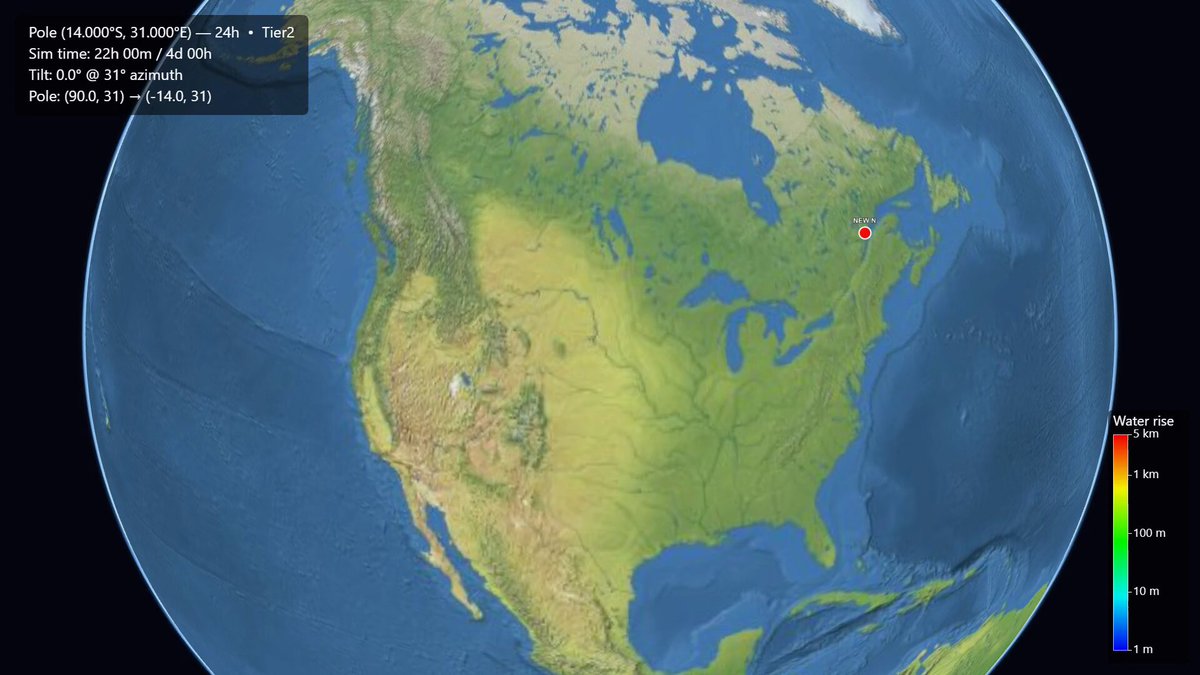
Np' is the true N Pole best documented under ECDO theory. I believe that the 5ka event made an uncommon 'selection' of ~Bolivia as the N Pole, per this quadrupole article: x.com/EcdoPrep/status/205935…
The time over which the mantle 'forgets' magnetic character is likely on the order of ~10k years. Enough to have some distant memory of the 14ka ECDO event (Np', 31 E) and a more recent memory of the 5ka Bolivia event. That would still give some shape to the magnetic lines and Lorentz forces we see driving things today.
This is a very, very long way of saying that I am ruminating on the idea that we have underestimated the contribution of what you might call 'long term magnetic memory' in both our discussions of earthquake propagation and ECDO dynamics.
Image credit: @RealDutchsinse

14
20
182
10,971
Jun 10
Ancient Sumerian texts is a rabbit hole worth falling into imo.

2
1
28
2,414

HashingZap ✝️ retweeted

Jun 10
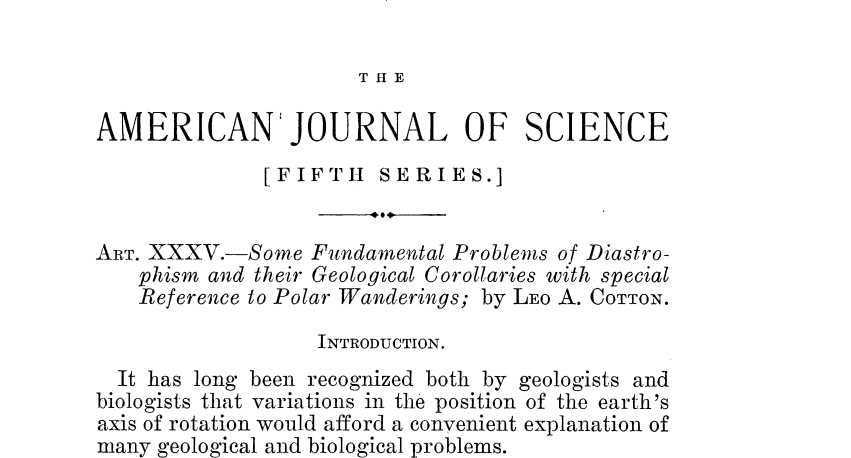
Cotton(1923) opens by establishing that the possibility of polar wandering had long attracted serious geological and biological attention, noting that variations in the position of the earth's axis of rotation would afford a convenient explanation of many geological and biological problems. The article sets out to challenge the mathematical orthodoxy of a certain paradigm of the Royal Society, which had effectively closed the door on polar wandering as a viable hypothesis and to reopen it through a fresh examination of what was then known about the earth's interior.
Drawing on mathematical theory from Newton onward, seismological evidence, and what was then the fashionable speculation that the earth behaves as a "visco-solid" under applied stress, Cotton builds a cumulative case that large mass displacements within the earth's interior may well be of much greater magnitude than those previously postulated, opening the door considerably wider than prior investigators had allowed.
The convergence of mathematical, geodetic, seismological and geological evidence leads Cotton to his central conclusion, stated with carefully measured force: "It would, therefore, appear that after all, in spite of what has usually been quoted to the contrary, the mathematical analysis of the problem renders it highly probable that the pole may have moved very considerably." The acceptance of polar wandering as a working hypothesis then unlocks what Cotton regards as its most consequential geological evidence.
On climate, Cotton is unequivocal: "It is obvious that any considerable change in the position of the pole would result in very profound climatic changes," stating that the polar ice-caps would be transferred to other latitudes. "Barrell has pointed out that there appear to be well-marked rhythms in sedimentation due to oscillations of sea-level. Many such oscillations might well find an explanation in terms of polar wanderings." Cotton then turns to the full breadth of geological consequence, writing in his own words: "A detailed study of the glacial epochs, particularly of the Pleistocene, should furnish criteria for testing the probable influence of polar wanderings in connection with this difficult problem.
But the inquiry need not be limited only to glacial epochs. The desert regions of the world today lie approximately along the zones occupied by the belts of high atmospheric pressure. These are determined by the atmospheric circulation conditioned by a rotating earth. A polar displacement would necessarily change the position of the high pressure belts and hence would cause a displacement of the mid-world deserts. The examination of the distribution of 'fossil' deserts would form an interesting investigation from this point of view. The changing climatic conditions arising from a polar displacement would naturally give rise to migration of the fauna and flora. The problems of the distribution and migration of fauna and flora might therefore find an explanation in terms of polar displacements. It appears indeed difficult to offer any other very satisfactory explanation for the occurrence of coal deposits in latitudes beyond 80 degrees north and south, such as are known to occur."
The oceans themselves are drawn into the picture: "A detailed study and correlation of the greatest transgressions and regressions of the oceans, particularly of the Pacific Ocean, might well indicate that the phenomena were in part, at all events, due to polar wanderings." Cotton then broadens his corollaries into a single sweeping statement: "Climatic changes too, would naturally attend any considerable displacement of the poles, and such changes might find, in part at least, their explanation in this hypothesis. The glacial and desert climates of the geological past, by virtue of their abundant record should prove an interesting field of investigation from this point of view. Again, it has long been pointed out by geologists and biologists that the hypothesis of a wandering pole would provide a convenient explanation of many difficult problems in distribution, migration and extinction of faunas and floras."
Cotton closes with both a summary and a call to arms: "The mathematical investigation actually supports the view that polar wanderings are not only possible but probable. The acceptance of the theory of polar wanderings as a working hypothesis leads to a number of geological corollaries which are of great interest and importance." And finally: "We are therefore no longer justified in setting this hypothesis to one side on mathematical grounds; and in view of its possible applications to many geological problems, it would seem desirable to keep it in mind in any investigation into which such a theory may enter."
Some Fundamental Problems of Diastrophism and their Geological Corollaries with Special Reference to Polar Wanderings Leo A. Cotton, American Journal of Science, Fifth Series, Vol. VI, No. 36, 1923
ajsonline.org/article/135552…
4
9
47
2,671
HashingZap ✝️ retweeted
Isn’t it frustrating having to wait for publications? I can tell you that for the first couple years I just reported the paper contents without larger context and it was basically useless. 70% of job is filling in the background and the blanks
4
7
117
3,362
Jun 7
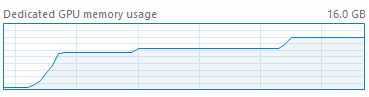
Looks like that 16 GB of VRAM is juuuuust enough for the job. It only took 5 days of my life to find stability just below crash levels. 😅
Now the long wait for the first simulation run to complete... or fail.
Jun 3
Tomorrow, I begin testing tilt simulations at .01° resolution. The increase here from my best resolution sim is going from 5.5 million cube cells to nearly 140 million. Massive leap in detail and compute.
As such, it'll either be a thing of beauty or a multi-day nightmare. I expect the latter, so here is to a pleasant surprise by tomorrow evening... 😂
7
4
111
4,907
HashingZap ✝️ retweeted

7 Nov 2025
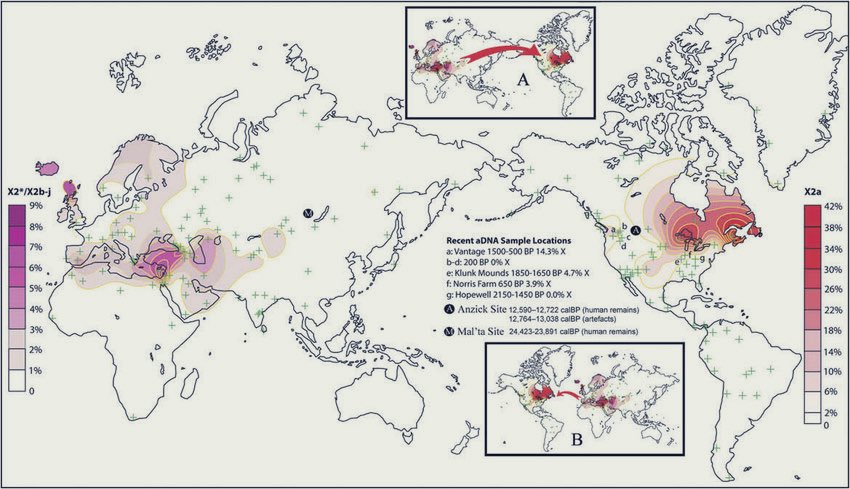
In the DNA of certain First Peoples across North America, there’s a lineage that appears nowhere else on Earth.
It’s called Haplogroup X2a.
Unlike other X lineages, it’s absent in Asia. It doesn’t match Europe, or the Near East, or Siberia.
So where did X2a begin?
85
92
783
54,773

HashingZap ✝️ retweeted
Jun 7
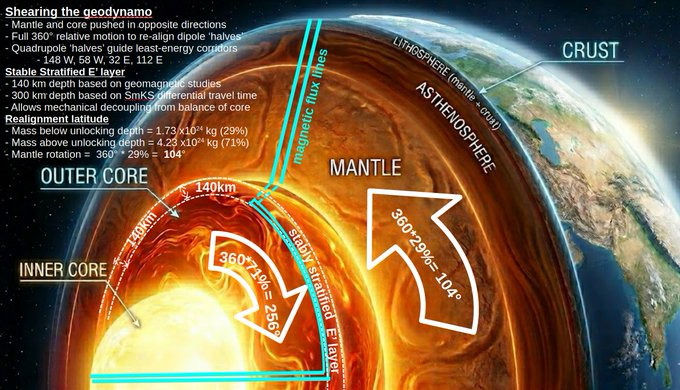
Where does the 104 degree latitudinal displacement observed in an ECDO event come from? From the relative masses above and below where the outer core is sheared.
Why there? Because the outer core shows stable stratification, and the Lortentz forces are too strong to shear the balance of it. nature.com/articles/nature13…
71% of earth's mass is above this level.
29% is below.
Equal but opposite magnetic forces push during the climax of the Dzhanibekov flip.
Mantle crust rotate 360*29%=104 degrees.
6
33
194
6,431
Jun 6
I have to say, @eBay is literally the worst user experience as a seller. I wish someone would put them out of business or buy them, because whoever runs that corporation is an absolute moron. It's like the website was built on Fiverr one $5 job at a time.
5
16
1,361