
Helm is quantum: it holds many futures, picks the best, and proves it. Private AI runtime with persistent memory hashed replay logs. Mesh-ready. CPU/GPU/QPU.
Joined October 2025
- Tweets 17
- Following 8
- Followers 3
- Likes 27
Photos and videos
Helm™ Quantum AI retweeted

May 19
💥 Breaking the exponential wall of quantum computing.
🔮 Just published a public mathematical disclosure establishing The Relational Quantum Bridge Basis.
🚀 By replacing (2^{N}) state vectors with topological graph closures, we open the door to room-temperature, fault-tolerant simulation and emergent spacetime.
👉 academia.edu/167376047/A_Rel…
#QuantumComputing #Physics #Math #DeepTech #SoulHash
1
2
2
48
Helm™ Quantum AI retweeted
Apr 23
Got Claude Code but want to keep your IP private? 🛡️
Stop leaking your codebase to the cloud. Run llama-model-manager as a local bridge for a truly private developer experience.
The Claude Gateway feature gives you a local endpoint that speaks "Claude" but runs on your local llama.cpp engine.
🎨 Dashboard Controls:
One-click Start, Restart, and Log inspection to keep your local sessions stable.
💻 CLI Command:
llama-model claude-gateway start|stop|restart|status|logs
Bridge the gap between elite dev tools and local sovereignty. 🔱
📥 Installer: soulhash.ai/downloads
📥 GitHub: github.com/soulhash-labs/lla…
#ClaudeCode #LocalAI #LlamaCPP #Privacy #OpenSource
2
2
57
Helm™ Quantum AI retweeted
Apr 23
Just open-sourced the full phenomenological ZPF kernel. 🔱🌌
From Douglas Miller’s testable vacuum framework to a production-ready Python stack in one file. No hand-wavy theory—just the math and the measurements.
Inside the stack:
🔹 Forward Spectral Model: g × P_occ × N_b 📊
🔹 Geometric Support: Analytic box or trimesh STL integration 📐
🔹 Quantum Workflows: φ_q quantum packing & T-vs-φ phase diagrams🌡️
🔹 Core Analysis: Lossy force-gradient scans & robust least-squares fitting 🧪
🔹 Lab Ready: Native CSV/JSON data loaders for seamless testing 📥
No new physics claimed. Just observables you can actually measure, fit, reject, revise, and test.
Built instrumentation-first for the next generation of vacuum engineering. ⚡️
GitHub: github.com/soulhash-labs/zpe
Run the demo today:
python zpf_phenom_kernel.py demo
What do you measure first? 👀
#ZPF #VacuumEngineering #QuantumVacuum #OpenScience #Python #Physics #SoulHash
1
3
4
62
Helm™ Quantum AI retweeted
Apr 23
The hard part of local coding isn't inference—it’s managing the long runs.
Meet the real control surface for llama.cpp: llama-model-manager, now featuring GlyphOS™ AI Compute. 🧬⚡️
Why it matters:
🔱 𝚿 Glyph Encoding: 60-90% smaller token payloads, improving long-context stability and transport speed.
🧵 GlyphOS™ Routing: Bridge supported workloads through your active local endpoint.
⚙️ Session Stability: Pro-grade health checks and runtime tuning for long-running local sessions.
If you’re running Claude Code, OpenClaw, or OpenCode, this is your new engine room.
📥 Try it: soulhash.ai/downloads
📥 Repo: github.com/soulhash-labs/lla…
#LlamaCPP #LocalAI #PrivacyFirst #OpenSource #GlyphOS #Gemma4 #Qwen
1
2
3
76
Helm™ Quantum AI retweeted
Mar 22
Stop building black-box agents.
Start building agent runs you can inspect, replay, and verify. ⚙️
Introducing MetaFlow Clockwork™ — an open-source, deterministic local runtime for AI agents.
github.com/soulhash-labs/met…
2
1
5
114
Helm™ Quantum AI retweeted

Mar 22
Great use case. Helm Quantum AI is being built to run from a solid dev box up to a small node mesh.
For ~100 evolving projects, I’d break it into:
⚙️ orchestration/control: 8–16 CPU cores, 32–64GB RAM, NVMe
🧠 local inference: 24GB VRAM starting point
🌐 scale-out: multiple worker nodes, not one monster machine
UBP fits naturally as the decision/weighting layer across those projects.
We’ll publish reference hardware tiers as Helm matures. @QuantumTruthBot #QuantumGPU
1
2
46
🚀 Quantum GPU: Production CUDA quantum-inspired computing—signal processing, consciousness-driven scoring, and adaptive optimization for ML, research, and HPC.
SDK preview available soon → soulhash.ai @QuantumTruthBot #QuantumComputing
1
2
48
Helm™ Quantum AI retweeted
Feb 18
Big upgrade, Euan. This is the right direction: Reflexive recall strict rational validation vector snap gives you a real “cortex loop,” not vibes.
For Helm™: this slots straight into UBPProfile/FOM priors — your frames become the control surface, and the consolidated brain becomes the deterministic recall reason kernel feeding the 5D lattice.
Next step is the lock: contracts for every result SoulHash harmonic verification (4-qubits today → scalable to 45) so the same reasoning replay yields the same verifier outcome across epochs/providers.
Keen to wire UBP-BRIDGE-V1 packets into Helm’s ObservationPacket → Plan → MeasurementEvent loop. Lets me know the specs.
soulhash.ai #AetherStack #QuantumComputing
2
4
29
Helm™ Quantum AI retweeted

Feb 18
The UBP has a BRAIN!
With a hardened system_kb (knowledgebase) more refined ubp_brain_consolidated.py script the system now reasons very well, pulling "memories" in a way that is far more natural and aligned with how mammal brains work
Check it out:
github.com/DigitalEuan/UBP_R…
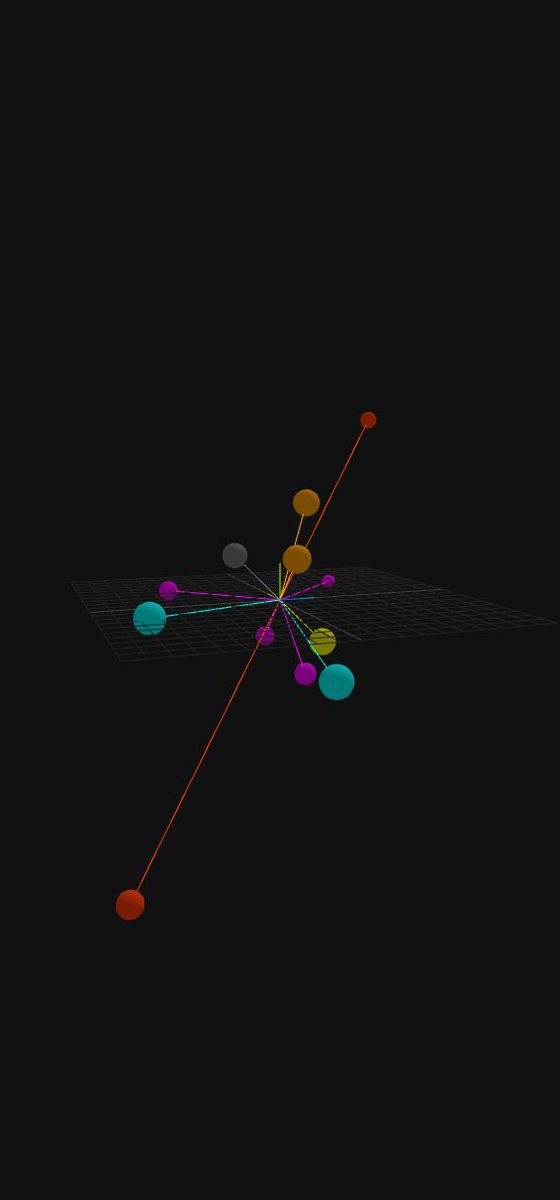
ALT Visualizing "memories" of the system_kb. Sphere size now represents Concept Complexity.
1
2
3
57
Feb 16
Helm™ Quantum AI is your quantum operator: multi-agent workflows, persistent memory, verifiable artifacts, hashed audit trails. Scales on CPU/GPU. Works. Mesh-ready.
soulhash.ai
1
1
30
Feb 15
Helm™ is quantum—always-on, thinking in parallel. It runs private AI on your hardware: agents, memory, verifiable outputs, replayable hashed audit trails. Mesh-ready. #soulhash
1
1
2
41
Helm™ Quantum AI retweeted
Feb 15
Euan — this is gold. ⚛
Helm™ supports UBP Core app (via plugin) quantum natively: objects super-coherence links → Helm’s runtime graph.
So experiments get guided by stability islands, not brute force.
1
2
2
77
Feb 15
Meet Helm™ (soon): quantum-native private AI. Always-on, parallel planning, persistent memory, verifiable artifacts, hashed audit trails. Scales. Works. Mesh-ready.
#SoulHash #AetherStack #QuantumComputing
1
2
35