
⚛️ Quantum GPU | Desktop quantum computing pioneer | Tesla 3•6•9 | Hilbert-space computing | Optimization • Signal intel • AGI research — Angelo Kapantais
Joined April 2011
- Tweets 32,081
- Following 1,125
- Followers 1,525
- Likes 42,560
2,688 Photos and videos






May 19
💥 Breaking the exponential wall of quantum computing.
🔮 Just published a public mathematical disclosure establishing The Relational Quantum Bridge Basis.
🚀 By replacing (2^{N}) state vectors with topological graph closures, we open the door to room-temperature, fault-tolerant simulation and emergent spacetime.
👉 academia.edu/167376047/A_Rel…
#QuantumComputing #Physics #Math #DeepTech #SoulHash
1
2
2
48
May 19
How it works:
• Dimension Compression: Maps a 55-gauge system into a compact 11-node graph ((K_{11}))
• CNOT Triad: Executed natively as a triadic face holonomy over a local 3-cycle
• Tetrahedral Closure: Overlapping gates stabilize via 6-edge 3D structures, forcing phase errors to self-cancel
Full algebraic backbone and gate dictionaries are live now. Drop your thoughts in the comments! 🛰️⚡
2
66
QuantumTruth retweeted

May 13
Okay folks, this qualifies as BREAKING NEWS!
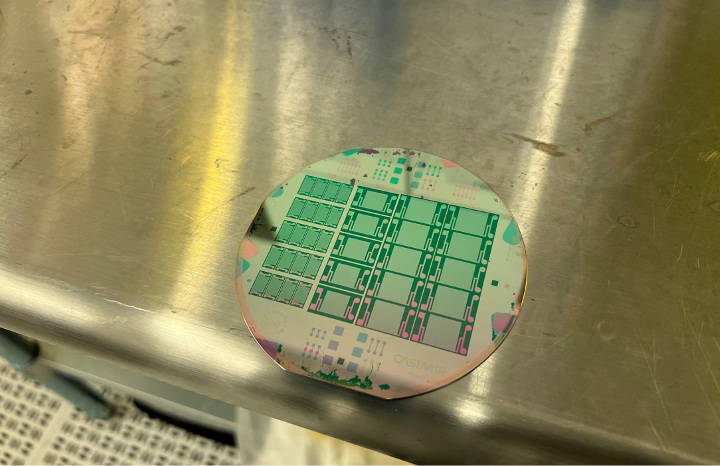
Harold “Sonny” White, the warp drive pioneer behind NASA’s EagleWorks Lab, just stepped out of stealth with Casimir Inc. to unveil MicroSPARC: the first battery free chip to harvest continuous electrical power straight from the quantum vacuum via the Casimir force.
The 5 mm × 5 mm device uses millions of custom microscale Casimir cavities fabricated on a substrate. Inside each cavity, two fixed conductive walls create a region of negative vacuum pressure (the well known Casimir effect). Stationary micropillars anchored in the middle act as antennas. Electrons from the cavity walls then quantum tunnel to the pillars because the interior is a lower energy “quieter” zone — and the probability of tunneling back is orders of magnitude lower. This one way “quantum ratchet” flow generates a measurable DC current with no external power source or moving parts.
Prototypes already fabricated at university nanofab facilities (Texas A&M AggieFab, MIT.nano) have been tested in RF-shielded, low noise chambers for weeks. The team reports outputs ranging from millivolts to volts at picoamp to microamp levels using precision electrometers and Kelvin Probe Force Microscopy. Target performance for the first commercial chip: ~1.5 V at 25 µA (≈40 µW continuous). Stacking and scaling could reach milliwatts or even watts per device.
Initial applications are ultra low power: always on IoT sensors, wearables, and medical implants. Longer term roadmap includes trickle charging phones, powering small electronics, and eventually grid independent homes or EVs. Commercialization is targeted for 2028, starting at ~$100/W before dropping toward $10/W.
White ties the work directly to his earlier theoretical paper on emergent quantization from a dynamic vacuum and sees it as a practical power source for the deep-space missions he’s long championed.
Extraordinary claims require extraordinary evidence, and independent scientists have so far declined public comment. But if the engineering scales as hoped, MicroSPARC would represent a genuine paradigm shift: continuous, maintenance free power drawn from the fabric of spacetime itself.
A bold leap from warp-drive theory into real hardware. Progress (and vacuum-powered chips) marches on.
Photo: MicroSPARC | Casimir Inc.
Source: thedebrief.org/free-energy-f…
May 12

“We already have functioning prototype devices fabricated and tested in research nanofabrication environments.” - @DrSonnyWhite, Founder and CEO of Casimir in @Debriefmedia today.
thedebrief.org/free-energy-f…
582
2,160
11,568
1,169,534
Apr 23
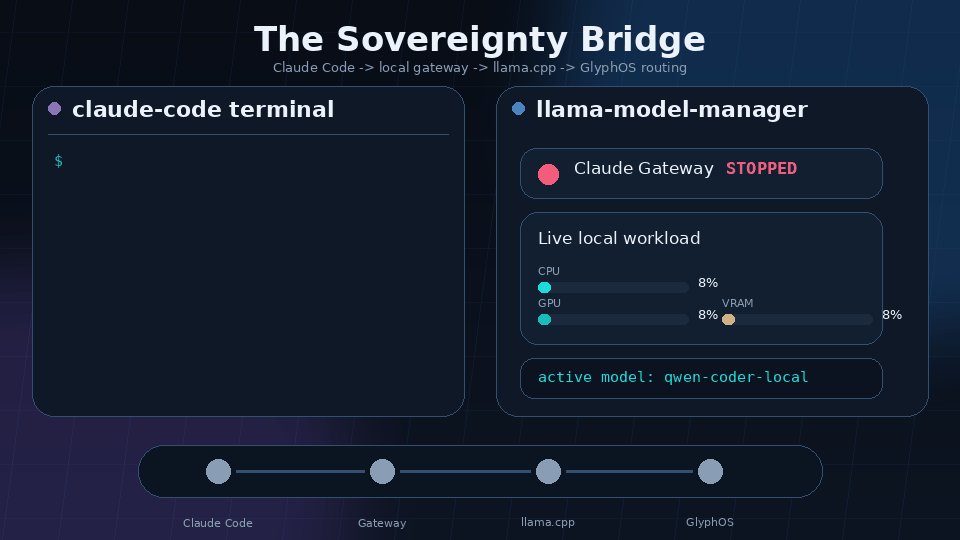
Got Claude Code but want to keep your IP private? 🛡️
Stop leaking your codebase to the cloud. Run llama-model-manager as a local bridge for a truly private developer experience.
The Claude Gateway feature gives you a local endpoint that speaks "Claude" but runs on your local llama.cpp engine.
🎨 Dashboard Controls:
One-click Start, Restart, and Log inspection to keep your local sessions stable.
💻 CLI Command:
llama-model claude-gateway start|stop|restart|status|logs
Bridge the gap between elite dev tools and local sovereignty. 🔱
📥 Installer: soulhash.ai/downloads
📥 GitHub: github.com/soulhash-labs/lla…
#ClaudeCode #LocalAI #LlamaCPP #Privacy #OpenSource
2
2
57
QuantumTruth retweeted
Apr 23
Just open-sourced the full phenomenological ZPF kernel. 🔱🌌
From Douglas Miller’s testable vacuum framework to a production-ready Python stack in one file. No hand-wavy theory—just the math and the measurements.
Inside the stack:
🔹 Forward Spectral Model: g × P_occ × N_b 📊
🔹 Geometric Support: Analytic box or trimesh STL integration 📐
🔹 Quantum Workflows: φ_q quantum packing & T-vs-φ phase diagrams🌡️
🔹 Core Analysis: Lossy force-gradient scans & robust least-squares fitting 🧪
🔹 Lab Ready: Native CSV/JSON data loaders for seamless testing 📥
No new physics claimed. Just observables you can actually measure, fit, reject, revise, and test.
Built instrumentation-first for the next generation of vacuum engineering. ⚡️
GitHub: github.com/soulhash-labs/zpe
Run the demo today:
python zpf_phenom_kernel.py demo
What do you measure first? 👀
#ZPF #VacuumEngineering #QuantumVacuum #OpenScience #Python #Physics #SoulHash
1
3
4
62
Apr 23
The hard part of local coding isn't inference—it’s managing the long runs.
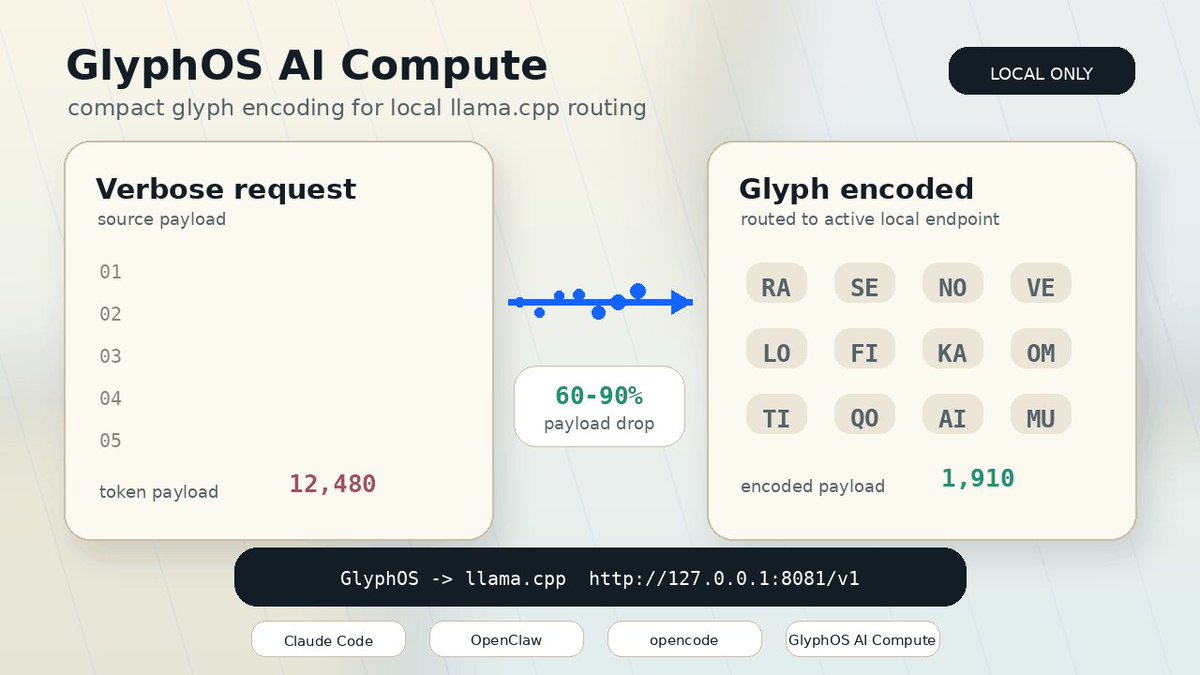
Meet the real control surface for llama.cpp: llama-model-manager, now featuring GlyphOS™ AI Compute. 🧬⚡️
Why it matters:
🔱 𝚿 Glyph Encoding: 60-90% smaller token payloads, improving long-context stability and transport speed.
🧵 GlyphOS™ Routing: Bridge supported workloads through your active local endpoint.
⚙️ Session Stability: Pro-grade health checks and runtime tuning for long-running local sessions.
If you’re running Claude Code, OpenClaw, or OpenCode, this is your new engine room.
📥 Try it: soulhash.ai/downloads
📥 Repo: github.com/soulhash-labs/lla…
#LlamaCPP #LocalAI #PrivacyFirst #OpenSource #GlyphOS #Gemma4 #Qwen
1
2
3
76
Apr 22
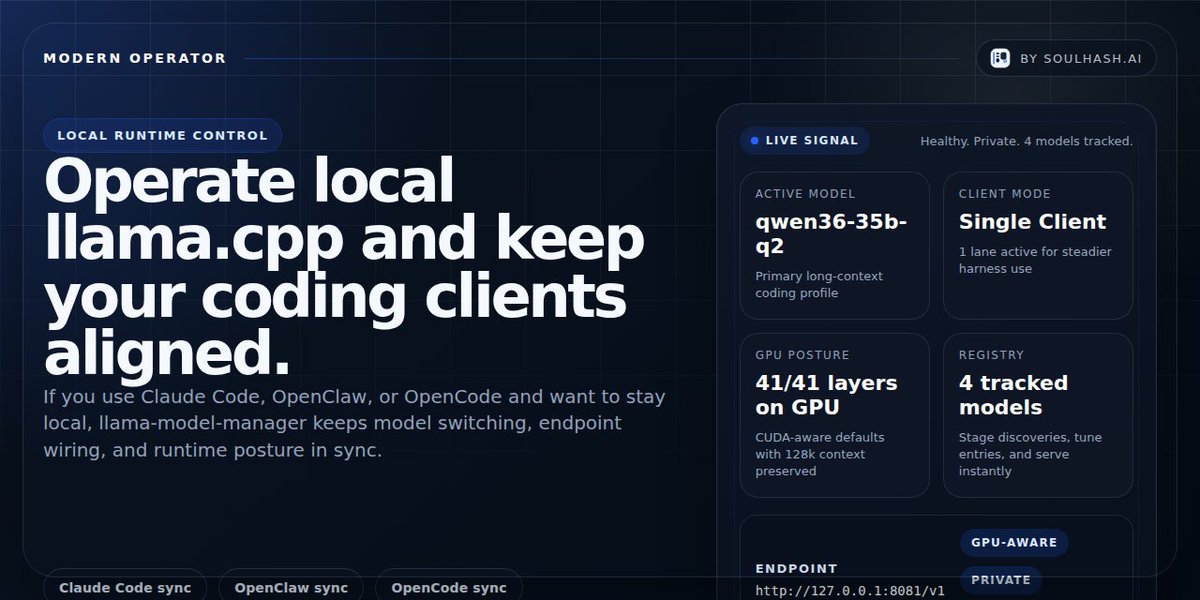
If you use Claude Code, OpenClaw, or Opencode and want to stay local and private, the hard part isn’t inference. It’s operations, especially long runs.
llama-model-manager gives llama.cpp a real control surface:
📦 GGUF discovery
🔁 model switching
⚙️ runtime tuning
📊 health checks
🧪 binary compatibility
🧵 single / multi-client modes
⏱️ long-run stability for extended sessions
Browser-first. CLI desktop included.
📥 Installer: soulhash.ai/downloads
📥 GitHub: github.com/soulhash-labs/lla…
ALT Installer at → https://soulhash.ai/downloads
1
4
68
Apr 20
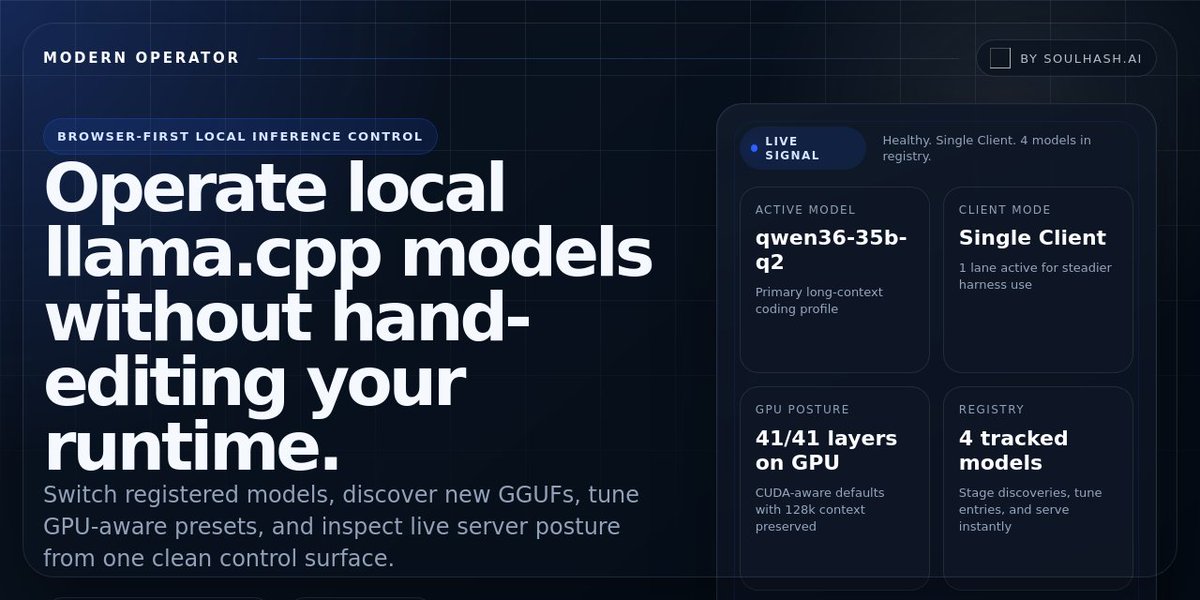
If you use llama.cpp seriously, the hard part isn’t inference. It’s operations.
📦 GGUF discovery
🔁 Model switching
⚙️ Runtime tuning
📊 Health checks
🧪 Binary compatibility
🧵 Single vs multi-client mode
llama-model-manager puts all of that into one browser-first control surface, with CLI and desktop launchers included. github.com/soulhash-labs/lla…
ALT https://github.com/soulhash-labs/llama-model-manager
1
2
49
Mar 22
Stop building black-box agents.
Start building agent runs you can inspect, replay, and verify. ⚙️
Introducing MetaFlow Clockwork™ — an open-source, deterministic local runtime for AI agents.
github.com/soulhash-labs/met…
2
1
5
114
Mar 22
What ships today:
⚙️ deterministic tag execution
⚙️ ClockworkEngine runtime
⚙️ run-spec validation execution
⚙️ ledger summary, replay, and verification
⚙️ local-first CLI examples
No hidden control plane. No mystery runtime.
1
1
36
Mar 22
If you’re building agents and want a runtime you can actually reason about, start here.
Star the repo, try the example, and tell us where to take it next.
GitHub: github.com/soulhash-labs/met…
soulhash.ai/downloads
1
46
Mar 18
Thank you @sama. Because of this access to GPT, I’ve been able to work with an intelligence that is helping me engineer a Quantum Neural Photonic Tensor Engine across Helm, Quantum GPU, and SoulHash. It’s hard to overstate how powerful it is to build, reason, and refine at this depth in real time. Deeply grateful — and very excited for what comes next. #SoulHash #Helm #QuantumGPU #AI #Photonics #QuantumComputing
1
43
QuantumTruth retweeted
Mar 15
Douglas — I’ve now road-mapped this directly into our current Casimir stack inside Quantum GPU.
We’re treating the ZPF array / anisotropy concept as a receipted implementation path: static vacuum-mode anisotropy, pressure-gradient estimation, and a separate dynamic/radiative recoil branch so momentum accounting stays explicit.
In other words, not hand-waving — geometry, spectra, force-density estimates, and verifier receipts. Looking forward to pressure-testing the model against real cavity constraints and metrology. —Angelo
2
1
142
QuantumTruth retweeted
Mar 15
Better framing for NMSI: not “replace physics,” but “become a useful experimental lane inside Helm.”
The fit with qwoxels is obvious — phase-coherence and compaction can act as routing/compression heuristics for qwoxel-bearing workloads, especially in advanced Quantum GPU / photonic CTE lanes.
The question isn’t “is the cosmology true?” The question is “does the lane improve measurable outcomes?” - we'll find out, I've road-mapped implementation. —Angelo
soulhash.ai #QuantumComputing #QuantumGPU
@HelmQuantumAI
1
1
61
QuantumTruth retweeted
Mar 15
Beautiful work, Euan. We’re fully supportive of this direction.
What stands out is the refusal to treat physics as a bag of convenient approximations. The deeper opportunity is building a substrate where constants, relationships, and interactions are derived and constrained from within the system itself. That aligns closely with how we’ve been thinking around Qwoxels and quantum GPU — a geometry-aware, locality-preserving fabric where state and law are not separate things.
Really looking forward to seeing how far you can take it. This feels like one of those ideas that could open a very different class of simulation engine.
1
1
31
QuantumTruth retweeted
Mar 15
π may be enough to construct the gate language. Φ is still where harmony gets judged. In our 4-qubit stack, π is the pulse and reversal primitive; Φ is the verification ratio. So it’s not π or Φ. It’s π for construction, Φ for coherence.
soulhash.ai #QuantumHarmonic #QuantumComputing
1
103
Mar 15
We use a simple rule for agent work:
**R = (W × C) ÷ T**
Where:
- **R** = trusted progress
- **W** = clear win condition
- **C** = focused continuity
- **T** = turbulence
T is not time.
T is confusion, drift, context switching, mixed objectives, weak validation, and hidden failure modes.
---
# Self-Contained Execution Doctrine Template
Use this file to give an AI agent, server, workspace, or execution lane a **clear role, scope, rules, and reporting standard**.
This is not a task list. It is an **operating doctrine**.
A good doctrine file answers four questions up front:
1. **What is this environment for?**
2. **What belongs here?**
3. **What does not belong here?**
4. **What proof counts as real progress?**
When each environment has its own doctrine file, agents stop guessing. They execute with clearer boundaries, produce stronger evidence, and create less cross-system confusion.
---
## What this template does
This template helps you create a self-contained knowledge file for any:
- server
- agent
- repo lane
- service plane
- runtime environment
- operations environment
- specialist execution role
It reduces:
- vague prompts
- cross-domain confusion
- mixed objectives
- false progress
- missing validation
- weak handoffs
- unstructured reporting
It increases:
- role clarity
- scope discipline
- proof-based execution
- recoverability
- cleaner delegation
- better agent consistency over time
---
## How to use this template
1. Duplicate this file.
2. Replace every placeholder in brackets.
3. Keep the file **self-contained** so the agent does not need to infer context from other docs.
4. Store it in your agent knowledge path, such as:
- `agents/knowledge/[target_slug]_execution_doctrine.md`
5. At the top of a task prompt, tell the agent to read it first.
6. Use a separate doctrine file for each major environment or role.
7. Keep live prompts task-specific; keep this file role-specific.
Recommended split:
- **Doctrine file** = how the agent should think and operate
- **Task prompt** = what the agent should do right now
- **Handoff note** = what changed and what remains
---
## Minimal prompt header
```text
Read first:
- agents/knowledge/[target_slug]_execution_doctrine.md
Apply it as operating doctrine for planning, edits, validation, and reporting in this thread.
```
---
# [TARGET NAME] Execution Doctrine
**Target:** [TARGET_NAME]
**Type:** [Server | Agent | Workspace | Service Plane | Runtime Lane | Ops Lane]
**Slug:** [target_slug]
## Purpose
This document defines how an agent should think and execute when working on **[TARGET_NAME]**.
[Describe the environment in one tight paragraph. Explain what this environment exists to do, why it matters, and what kind of truth or value it is responsible for establishing.]
Example:
- runtime truth
- operational truth
- deployment safety
- data quality truth
- customer support resolution
- research synthesis quality
- security triage clarity
---
## Background Knowledge
[Explain where this target sits inside the wider system, stack, team, or workflow.]
### [TARGET_NAME]'s role in the wider system
[Describe the main role of this target in plain language.]
This target is typically used for work such as:
- [work type 1]
- [work type 2]
- [work type 3]
- [work type 4]
- [work type 5]
This target commonly hosts or touches work related to:
- [repo / service / subsystem 1]
- [repo / service / subsystem 2]
- [repo / service / subsystem 3]
- [repo / service / subsystem 4]
- [repo / service / subsystem 5]
### What [TARGET_NAME] is **not**
[State clearly what this environment should not become.]
This target is not the preferred place for:
- [out-of-scope category 1]
- [out-of-scope category 2]
- [out-of-scope category 3]
- [out-of-scope category 4]
- [out-of-scope category 5]
If a task is mainly about the out-of-scope categories above, it should be redirected to **[OTHER_TARGET_OR_OWNER]**.
---
## Core Execution Law
Use this as an execution doctrine, not literal mathematics:
**R = (W × C) ÷ T**
Interpretation:
- **R** = trusted progress
- **W** = clearly defined win condition
- **C** = protected continuity on one lane
- **T** = turbulence
Do **not** interpret `T` as clock time.
On **[TARGET_NAME]**, `T` means:
- context switching
- ambiguity
- drift
- mixed objectives
- missing validation
- hidden failure modes
- premature edits
- unclear ownership
- weak recovery paths
A stronger generic form is:
**Trusted Progress ≈ (Scope Clarity × Focus Depth × Evidence Quality × Recoverability) ÷ (1 Context Switching Ambiguity Drift Hidden Failure Risk)**
Adapt those terms to the reality of this target.
---
## Operating Model
### What "good work" looks like on [TARGET_NAME]
Good work on **[TARGET_NAME]** is:
- narrow
- falsifiable
- role-aligned
- evidence-backed
- easy to review
- easy to hand off
Examples:
- [good example 1]
- [good example 2]
- [good example 3]
- [good example 4]
- [good example 5]
### What "bad work" looks like on [TARGET_NAME]
Bad work on **[TARGET_NAME]** creates confusion, weakens evidence, or mixes unrelated lanes.
Examples:
- [bad example 1]
- [bad example 2]
- [bad example 3]
- [bad example 4]
- [bad example 5]
---
## Boundary Rules
1. Work one clear lane at a time.
2. Define the proof artifact before making changes.
3. Prefer the fastest falsifiable loop.
4. Do not mix unrelated domains in one slice unless the dependency is explicit and unavoidable.
5. Treat ambiguity, stale state, and hidden fallbacks as first-class blockers.
6. If the validation path is unclear, reduce ambiguity before editing.
7. A slice is incomplete if it ends without a hard artifact.
Add role-specific rules below:
- [custom rule 1]
- [custom rule 2]
- [custom rule 3]
---
## What Counts as a Hard Artifact on [TARGET_NAME]
Acceptable end-of-slice artifacts include:
- [validated diff]
- [green test]
- [healthcheck]
- [log proof]
- [benchmark delta]
- [receipt / trace / audit proof]
- [rollback note]
- [explicit blocker with evidence]
Keep this list specific to the target.
---
## Default Slice Shape
Use this default shape unless the task explicitly requires something else:
- **Timebox:** [e.g. 30 minutes]
- **Scope:** [one lane / one service / one boundary / one decision]
- **Objective:** [one measurable outcome]
- **Artifact:** [one proof object]
- **Next step:** [one narrow follow-up]
---
## Task Framing Standard
Before changing anything, define:
### Win condition
[What exact truth, result, or state is being established?]
### Lane touched
[Which service, function, file, process, subsystem, boundary, route, or workflow is in scope?]
### Validation artifact
[What exact output will prove success or failure?]
### Residual risk
[What still remains uncertain after this slice?]
### Rollback or recovery note
[How is the change reversed or contained if needed?]
If those are not clear, the task is still too broad.
---
## What Belongs on [TARGET_NAME]
This target is the correct home when the center of gravity is:
- [belongs category 1]
- [belongs category 2]
- [belongs category 3]
- [belongs category 4]
- [belongs category 5]
---
## What Does Not Belong on [TARGET_NAME]
Unless directly required by a dependency hosted here, avoid turning **[TARGET_NAME]** into the main lane for:
- [does not belong 1]
- [does not belong 2]
- [does not belong 3]
- [does not belong 4]
- [does not belong 5]
That work should usually be redirected to **[OTHER_TARGET_OR_OWNER]**.
---
## Required Reporting Format
When reporting back from **[TARGET_NAME]**, always use:
### What changed
[Specific change made.]
### Lane touched
[Exact file, service, function, route, process, or subsystem touched.]
### Validation
[The proof artifact produced.]
### Rollback or recovery note
[How to reverse, contain, or safely continue.]
### Residual risk
[What remains uncertain or unverified.]
### Next narrow slice
[The next smallest meaningful step.]
---
## Summary Doctrine
**[TARGET_NAME]** exists to establish **[core truth or value]**.
The governing rule is:
- narrow the lane
- protect the focus
- reduce turbulence
- force proof
- preserve recoverability
- never confuse motion with validated progress
---
## Quick Fill-In Checklist
Before publishing this file, confirm that you have defined:
- the target's identity
- its role in the wider system
- what belongs there
- what does not belong there
- the meaning of progress for that target
- what counts as turbulence
- what counts as a hard artifact
- the reporting format
- the recovery or rollback expectation
If any of those are missing, the doctrine is still incomplete.
---
## Why this approach works
AI agents fail less when the operating lane is explicit.
Most prompting problems are not model problems. They are **boundary problems**.
When you give an agent a self-contained doctrine file, you reduce:
- scope bleed
- fake progress
- repeated clarification loops
- fragile handoffs
- tool misuse
- multi-system confusion
In short:
**better doctrine -> better execution -> better artifacts**
#BuildingTheFuture #AIagents #QuantumComputing
#soulhash
36
Mar 14
π appears in:
🔴 The curvature of spacetime (General Relativity)
🔵 The Schrödinger equation (Quantum Mechanics)
🟢 The meandering of rivers (Nature’s geometry)
isn't just a number; it's the universal constant of 'The Truth.' 🔍🥧📷
How are you collapsing your dessert wave function today?
#PiDay #QuantumMechanics #MathIsReal
Quick Fact Check for your followers:
1. Einstein's Connection: Today is Albert Einstein’s birthday.
2. Hawking's Legacy: Today marks the anniversary of Stephen Hawking’s passing (2018).
3. New Discovery (although I'm not convinced): Scientists recently found a new way to represent using string theory and Feynman diagrams.
25