
Tracking the overlap of tech, capital, and narrative. Notes, NFA.
Joined May 2026
- Tweets 27
- Following 64
- Followers 14
- Likes 8
3 Photos and videos

6h
Seems like im only one call $VECO latest, 50% raised already
Jun 3

I opened a position in $VECO.
Everyone is chasing AI optics:
$AAOI = transceivers
$SIVE = laser arrays / CPO
$VECO = tools to manufacture InP lasers
The real question:
Which layer of the optical stack deserves the premium?
My map:
$AAOI is closest to hyperscaler transceiver demand.
$SIVE is closer to laser / light-source IP.
$VECO is upstream equipment.
If AI optical interconnect keeps scaling, the tools layer may be the less obvious trade.
Why $AAOI gets attention?
It is easy to understand.
AI datacenters need 800G and 1.6T optics.
AAOI ships optical transceivers.
Revenue is already moving.
That gives it narrative velocity.
But it also gives it end-product execution risk.
Why $SIVE gets attention?
It is tied to the future-looking part of the stack:
laser arrays, external light sources, silicon photonics and CPO.
The GlobalFoundries collaboration made the market care.
Higher upside perception, but earlier-stage revenue proof.
Why I am watching $VECO?
Veeco is not trying to win the module.
It sells the equipment needed to build InP lasers:
MOCVD
IBD
Wet processing
Laser annealing
That is a picks-and-shovels angle on the same AI optics wave.
The $VECO signal that matters:
$250M of #InP laser manufacturing equipment orders.
Multi-customer.
2026 deliveries.
2027 ramp.
This is the difference between "optics will matter someday" and "customers are ordering tools now."
How I would frame the basket?
$AAOI = fastest revenue beta
$SIVE = highest optionality / CPO narrative
$VECO = upstream tool bottleneck
They are not the same trade.
They are three different bets on the same optical interconnect constraint.
The risk split:
$AAOI risk = margin, capacity, customer concentration.
$SIVE risk = timing, dilution, conversion from pipeline to revenue.
$VECO risk = valuation, order conversion, Axcelis merger, export friction.
Same theme. Very different failure modes.
My bias:
$AAOI is easier for the market to understand.
$SIVE is better for speculative CPO traffic.
$VECO may be better for the "tools behind the boom" angle.
That is why the comparison matters.
It makes VECO legible.
If AI optics is real, I want to know which layer captures the most durable economics:
Modules?
Laser arrays?
Manufacturing tools?
My current answer:
Own the basket
64
Jun 3
If Korea’s HBM re-rating has been one of the most important Asian equity stories of the last two years, Japan’s semiconductor equipment and materials supply chain may be the next one worth studying in detail.
The Korea story is now easier for investors to understand. For years, the Korean market traded under the weight of the so-called “Korea discount”: corporate governance concerns, chaebol structures, low shareholder returns, capital market skepticism, and limited foreign investor trust. Many Korean equities were cheap for a long time, but they also disappointed investors for a long time.
Then AI changed the anchor.
HBM became one of the most important resources in the AI infrastructure buildout. SK Hynix, Samsung, HBM, AI memory, and the Nvidia supply chain gave the market a reason to reprice Korea. The structural issues did not disappear, but the industrial catalyst became strong enough for global capital to look again.
Japan has a similar setup, but the story is less obvious.
Japan was not a market that global growth investors chased aggressively for most of the last decade. It went through a long period of weak sentiment, low nominal growth, low ROE, inefficient capital allocation, and conservative corporate behavior. Many Japanese companies had strong assets, strong technology, and solid cash flow, but their stock prices often failed to reflect their real industrial importance.
Foreign investors also carried a familiar stereotype: Japanese companies were too conservative, too cash-heavy, too slow to improve capital efficiency, and not very good at telling their story in capital market language.
But market re-ratings usually do not begin with “cheapness” alone. They begin when cheapness meets a strong industrial catalyst.
For Korea, that catalyst was HBM.
For Japan, the catalyst is more fragmented and more hidden: semiconductor equipment, EUV mask inspection, photoresists, silicon wafers, wafer grinding and dicing, cleaning tools, ABF materials, sputtering targets, optical communication materials, and advanced packaging materials.
These layers are not as easy to explain as GPUs. They are not as headline-friendly as HBM. But they share one important characteristic: many of them are hard-to-replace parts of the AI semiconductor manufacturing stack.
That is where the opportunity sits.
The first phase of the AI trade was obvious: Nvidia, AMD, Broadcom, TSMC, SK Hynix, Micron. Then the market moved into HBM, CoWoS, 800G/1.6T optical modules, CPO, silicon photonics, and data center power.
The next phase of alpha may move further upstream.
The further upstream you go, the less the trade is about who tells the best AI story. It becomes more about who controls the manufacturing steps that AI hardware cannot easily avoid.
Japan is strong in those steps.
Japan does not have a Nvidia-like GPU design company. It does not have a TSMC-like foundry giant. But Japan does have a group of companies deeply embedded in semiconductor manufacturing: test equipment, wafer cutting, EUV mask inspection, cleaning systems, deposition tools, photoresists, silicon wafers, mask blanks, packaging materials, electronic metal materials, and optical infrastructure.
These are not always the loudest AI stocks. But they may be some of the most strategically important stocks in the supply chain.
This note is the opening framework. It is not meant to be a full financial model for every company. The goal is to map the Japanese names into a structure before going company by company.
The first group is the hardest equipment layer.
$6857 Advantest is one of the most important names in semiconductor testing. As AI GPUs, custom ASICs, and HBM become more complex, test value rises. Expensive chips cannot afford reliability problems. Testing becomes the quality gate for the AI compute stack.
The issue with Advantest is not whether the company is important. It is. The issue is that the market already knows this, and valuation already reflects a lot of the growth.
$6146 DISCO is a quieter but extremely important name behind advanced packaging and HBM. HBM stacking, thin wafers, wafer thinning, dicing, grinding, and polishing may not sound as exciting as GPU design, but they directly affect yield and capacity. As AI chips move further into chiplets, 3D stacking, and advanced packaging, DISCO’s process role becomes more important.
$6920 Lasertec sits inside the EUV mask inspection layer. Advanced nodes depend on EUV, and EUV photomask / mask blank inspection is critical for yield. This is a technically difficult area with long customer qualification cycles and limited alternatives.
$8035 Tokyo Electron is Japan’s broad semiconductor equipment platform. It is not one single niche tool. It spans multiple key front-end manufacturing steps. AI-driven investment in advanced logic, DRAM, HBM, NAND, and advanced packaging all eventually flow into WFE capex, and TEL is one of Japan’s main platform beneficiaries.
The second group may offer a more interesting balance between quality and valuation.
$7735 SCREEN Holdings is important in cleaning equipment and other semiconductor manufacturing processes. Cleaning does not sound like an AI theme, but advanced semiconductor manufacturing contains many cleaning steps, and yield becomes more sensitive as process complexity rises. Compared with more crowded names like Advantest, DISCO, and Lasertec, SCREEN may still be a better valuation research candidate.
$4186 Tokyo Ohka Kogyo is a high-end photoresist and electronic materials company. Photoresist is a formulation, process-window, and customer-qualification business. EUV, advanced packaging, and high-density interconnects all increase materials complexity. This is one of the Japanese materials names that deserves deeper work.
$5016 JX Advanced Metals is another low-profile but important materials supplier. Semiconductor sputtering targets, high-purity metals, electronic materials, and advanced packaging-related materials are not always visible to generalist investors. But these are exactly the types of “must-use” suppliers that can create supply-chain alpha.
$4063 Shin-Etsu Chemical and $3436 SUMCO represent the silicon wafer layer. High-quality 300mm wafers are foundational to advanced semiconductor manufacturing. But wafers are cyclical. They should not be valued simply because “AI demand is strong.” Investors need to track pricing, inventory, utilization, and customer capex.
The third group is tied to AI infrastructure and packaging materials.
$7741 HOYA is not a pure semiconductor company, but it has important exposure to EUV mask blanks, photomask substrates, and optical materials. It is more of a hybrid: semiconductor-critical assets plus a stable broader business portfolio.
$2802 Ajinomoto’s key AI exposure is not the food business. It is ABF: Ajinomoto Build-up Film. ABF is a key material for high-end package substrates used in AI accelerators, GPUs, CPUs, and advanced packages. The challenge is that the overall company is not a pure semiconductor materials stock, so investors need to separate the AI asset from the rest of the group.
$5802 Sumitomo Electric is more of a data center infrastructure, optical communication, specialty materials, wire/cable, and compound semiconductor materials name. It is not the purest semiconductor stock, but it has a role in AI data center power and optical communication buildouts.
The fourth group is high-beta cyclicals.
$285A Kioxia is the NAND / SSD name. AI inference, data center storage, enterprise SSDs, and data infrastructure can all support the NAND cycle. But NAND is a cyclical oligopoly industry, not a single supplier story. Kioxia can move violently in both directions depending on pricing, supply discipline, and cycle expectations.
$6525 Kokusai Electric is more of a memory equipment cycle name. Deposition, thermal processing, and batch processing tools can benefit from DRAM, HBM, and NAND capex. But the valuation is already high, so orders and earnings need to validate the story.
This is why studying Japan’s AI semiconductor names is not the same as simply buying every “Japan semiconductor” stock.
ETFs can do that. Products such as $200A.T, $221A.T, $2644.T, and $282A.T can give investors broad exposure to Tokyo Electron, Advantest, DISCO, Lasertec, SCREEN, Renesas, Kioxia, and other Japanese semiconductor names.
But if the goal is alpha rather than beta, the work has to be more selective.
A good company is not always a good price.
A strategically important supplier is not always a good entry point.
AI exposure does not automatically mean valuation support.
The Japanese names I care about most need to meet three conditions.
First, the company must sit in a critical manufacturing layer. It should be involved in a process that AI semiconductor production cannot easily bypass.
Second, customer replacement must be difficult. For equipment, this means qualification cycles, process know-how, and yield impact. For materials, this means formulation, purity, reliability, and customer validation.
Third, valuation must not already price in everything. If the market has already discounted the next two or three years of growth, even a great company may not offer an attractive setup.
Seen through that lens, Japan is not just “another semiconductor market.” It is the next set of Asian AI supply-chain assets that need to be separated layer by layer after Korea’s HBM re-rating.
Korea taught investors that a long-discounted market can be repriced quickly when it meets a powerful industrial cycle.
Japan teaches a different lesson: some countries do not win at the most visible layer of the technology stack. They win inside the manufacturing system, where the components are harder to replace and harder to understand.
For years, the Japanese market was overlooked by many global growth investors. AI semiconductors are changing that. Not because every Japanese stock is suddenly cheap, but because the AI hardware buildout is forcing capital to move upstream into more technical, more hidden, and more durable parts of the supply chain.
This is only the opening note.
Next, I will go company by company and write full investment research reports on these names.
Each report will focus on business structure, AI demand transmission, technical position, financial quality, valuation, news flow, risks, and the most important question: what conditions would make the stock worth buying?
1
702
Jun 3
I opened a position in $VECO.
Everyone is chasing AI optics:
$AAOI = transceivers
$SIVE = laser arrays / CPO
$VECO = tools to manufacture InP lasers
The real question:
Which layer of the optical stack deserves the premium?
My map:
$AAOI is closest to hyperscaler transceiver demand.
$SIVE is closer to laser / light-source IP.
$VECO is upstream equipment.
If AI optical interconnect keeps scaling, the tools layer may be the less obvious trade.
Why $AAOI gets attention?
It is easy to understand.
AI datacenters need 800G and 1.6T optics.
AAOI ships optical transceivers.
Revenue is already moving.
That gives it narrative velocity.
But it also gives it end-product execution risk.
Why $SIVE gets attention?
It is tied to the future-looking part of the stack:
laser arrays, external light sources, silicon photonics and CPO.
The GlobalFoundries collaboration made the market care.
Higher upside perception, but earlier-stage revenue proof.
Why I am watching $VECO?
Veeco is not trying to win the module.
It sells the equipment needed to build InP lasers:
MOCVD
IBD
Wet processing
Laser annealing
That is a picks-and-shovels angle on the same AI optics wave.
The $VECO signal that matters:
$250M of #InP laser manufacturing equipment orders.
Multi-customer.
2026 deliveries.
2027 ramp.
This is the difference between "optics will matter someday" and "customers are ordering tools now."
How I would frame the basket?
$AAOI = fastest revenue beta
$SIVE = highest optionality / CPO narrative
$VECO = upstream tool bottleneck
They are not the same trade.
They are three different bets on the same optical interconnect constraint.
The risk split:
$AAOI risk = margin, capacity, customer concentration.
$SIVE risk = timing, dilution, conversion from pipeline to revenue.
$VECO risk = valuation, order conversion, Axcelis merger, export friction.
Same theme. Very different failure modes.
My bias:
$AAOI is easier for the market to understand.
$SIVE is better for speculative CPO traffic.
$VECO may be better for the "tools behind the boom" angle.
That is why the comparison matters.
It makes VECO legible.
If AI optics is real, I want to know which layer captures the most durable economics:
Modules?
Laser arrays?
Manufacturing tools?
My current answer:
Own the basket
349
Jun 1
They are partnering with @AlpacaHQ to make U.S. stock investing more accessible than ever.
@binance provides the trading interface and user experience, allowing users to access U.S. equities seamlessly. The underlying brokerage infrastructure, including account custody, order execution, and clearing services, is provided by Alpaca, a regulated U.S. broker-dealer.
BN serves as the gateway, while @AlpacaHQ powers the brokerage and clearing layer behind the scenes—bringing a simpler and more efficient way to access the U.S. stock market.

Welcome to a new era.
Trade the brands you love.
Direct Stocks. ETFs. Available 24/5.
👉 binance.com/en/stocks-landin…
1
46
Jun 1
对于中国投资者来说
这是一个很好的机会
但是是否会出现恶意清算
仍然是个未知的问题
同时
如果 @AlpacaHQ 提供的服务足够稳定
这对 @OndoFinance 似乎不是很好的趋势
Short ethereum:0xfaba6f8e4a5e8ab82f62fe7c39859fa577269be3
15
May 20

154
May 19
My another position is $POET, It's not a cheap semiconductor stock.
It is valuing @POETtech on whether the company can move from photonics IP, customer announcements, and prototype-stage excitement into real AI optical interconnect revenue.
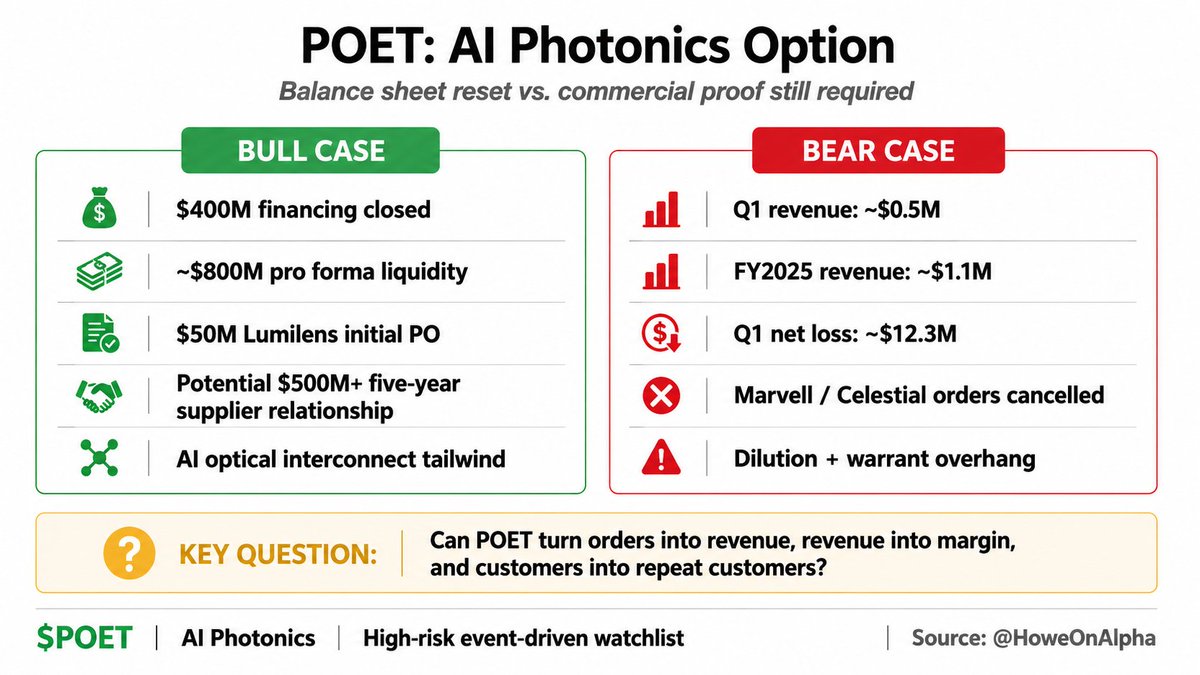
The biggest recent event is the $400M registered direct offering.
POET sold 19.047M common shares plus 19.047M warrants to MMCAP International Inc. SPC. The unit price was $21.00 per share plus accompanying warrant. The warrants are exercisable at $26.25 for three years.
This is a major balance sheet reset.
$POET already had about $429M in cash and short-term investments at the end of Q1 2026. After the financing, pro forma liquidity moves toward the ~$800M range before subsequent cash use. That changes the risk profile. Near-term funding risk is much lower.
POET now has capital to fund manufacturing expansion, R&D, light-source operations, working capital, and possibly acquisitions.
But this is not free money. The deal creates immediate dilution. It also creates a large warrant overhang. So the right read is not “pure bullish.”
The right read is:
Bullish for runway.
Dilutive for current shareholders.
Supportive for credibility.
Demanding for execution.
The company now has the money. Now it has to prove the business. The bull case is straightforward.
AI data centers need faster, lower-power optical interconnects. Bandwidth, power, packaging, and thermal constraints are becoming more important as AI clusters scale.
POET claims its wafer-level photonic integration platform can enable smaller, lower-power optical engines for high-speed AI networking.If that scales commercially, POET could move from “story stock” to strategic AI infrastructure supplier. That is the upside.
The current positive catalyst is Lumilens. $POET disclosed an initial $50M purchase order.
Management also described a potential supplier relationship that could exceed $500M over five years. If those orders convert into shipments, recognized revenue, repeat purchase orders, and real margins, the story changes.
At same time. Another company like @SiversSemicond $SIVE list $POET as partner in business.
In $SIVE's 2025 annual report, they said clearly collaborated with $POET
“Samarbetade med POET Technologies för att leverera innovativa lättmotorlösningar och utöka erbjudanden för nästa generations AI-infrastruktur.”
“Vi levererar testexemplar till flera kunder, inklusive POET, för deras ELS-produkt för alfakunder.” “Dessutom offentliggjorde Sivers i november 2025 ett strategiskt partnerskap med POET Technologies Inc., som kombinerar Sivers DFB-laserarrayer med POET Optical Interposer™ för att leverera skalbara, energieffektiva externa ljuskällor.”
They also posted sth on website. sivers-semiconductors.com/pr…
$Sive is idiot? I don't think so. Unless they lied together. BTW, another company in China #铭普光磁 $002902 lied too. Because they also have collaboration with $POET also.
But that word matters:
If.
Right now, the financials are still pre-scale.
Q1 2026 revenue was about $0.5M.
2025 full-year revenue was about $1.1M.
Q1 net loss was about $12.3M.
On current revenue, $POET cannot be justified by normal sales multiples.
The valuation is a probability-weighted bet on future commercial proof. That proof has not fully arrived yet.
The biggest negative is the Marvell / Celestial AI reset.
$POET confirmed that Marvell cancelled all Celestial-related purchase orders after acquiring Celestial AI.
That matters.
The lost orders were not just potential revenue. They were customer validation. For an early-stage hardware supplier, customer validation can be more important than near-term sales. This is why $POET is so polarizing.
Bulls see:
AI optical interconnect upside
Large cash balance
Lumilens order
Manufacturing expansion
Institutional financing from MMCAP
Bears see:
Tiny current revenue
Heavy dilution
Warrant overhang
Cancelled Marvell / Celestial orders
PFIC / litigation / disclosure noise
A stock still priced on future proof, not current financials
Both sides have real arguments. That is why the stock trades like an option.
My framework is simple:
belongs on a high-risk, event-driven AI photonics watchlist.
Not a clean fundamental long yet.
Not a core holding without commercial proof.
The key signals to watch:
1. Does Lumilens revenue actually show up?
2. Are there repeat orders after initial shipments?
3. Are new high-quality customers named?
4. Does product revenue scale from thousands to millions to tens of millions?
5. Can POET show gross margin, not just announcements?
6. Does the new $400M capital turn into capacity and revenue, not just a longer cash runway?
The possible alpha is here:
The market may be over-penalizing the Marvell/Celestial cancellation and underpricing POET’s new balance sheet runway.
The risk is also obvious:
POET may remain a cash-rich, highly diluted story stock until revenue proves otherwise.
So my view: Hold & Watch
The real buy signal is not a green candle. The real buy signal is when $POET proves that orders become revenue, revenue becomes margin, and customers become repeat customers.
Until then, this is not a valuation story.
It is a proof-of-commercialization story.
2
1
9
908
May 18
I’ve been buying $NOK.
The real debate is whether the market is re-rating @nokia from a legacy telecom equipment vendor into an AI network infrastructure asset.
The common perception is outdated (Especially in China): Nokia = phones (Old school type). That company is effectively gone.
Nokia sold substantially all of its Devices & Services business to @Microsoft in 2014, then rebuilt around networks, patents, Bell Labs, and telecom infrastructure.
$NOK is no longer a handset story.
The current business is much more institutional:
Network Infrastructure: optical, IP, fixed networks
Mobile Infrastructure: radio, core software, standards
Portfolio Businesses: non-core assets under review
The market cares most about Network Infrastructure.
Why?
AI infrastructure is not just GPUs.
It also needs optical transport, IP routing, data-center interconnect, lower latency, and higher-capacity networks.
That is where the $NOK re-rating thesis sits. Not in nostalgia.
Q1 2026 was the first hard data point:
Net sales: EUR 4.5B
Comparable operating profit: EUR 281M, 54% YoY
FCF: $EUR 629M
Net cash: $EUR 3.8B
AI & Cloud sales: 49%
AI & Cloud orders: $EUR 1.0B
Optical Networks: 20%
The @Infinera acquisition is central. It gives @nokia more optical scale and better exposure to cloud/webscale customers.
Management targets > $EUR 200M of comparable operating profit synergies by 2027 and >10% comparable EPS accretion in 2027.
That matters for $NOK.
The $NVDA partnership matters too, but I would frame it correctly. It is not a near-term earnings guarantee. It is a strategic option on AI-RAN, 5G-Advanced, 6G, and software-defined mobile networks. Powerful narrative. Still needs revenue proof.
The valuation is the constraint.
At roughly $14, $NOK is up ~170% over 52 weeks.
Approximate valuation:
Trailing P/E: ~85x
Forward P/E: ~33x
P/FCF: ~49x
EV/EBITDA: ~26x
This is not a deep value setup anymore.
So the key question is not:
"Is $Nok cheap?"
Whatever,
I bought in.
My monitoring framework for $NOK:
AI & Cloud orders
Optical/IP growth vs 18%-20% FY assumption
Network Infrastructure margin
Infinera synergy delivery
FCF conversion
Evidence that AI-RAN moves from demo to deployment
Execution matters from here.
Also, peer context matters, i mean collabration.
$ERIC is the closest telecom equipment comp.
$CIEN is the optical/networking comp.
$CSCO and $ANET sit closer to enterprise/data-center networking.
$NVDA is the narrative accelerator, not the comp.
$NOK is trying to move across that map.
My current view:
Long $NOK, but not adding aggressively after the move.
This is now a verification trade, not a cheap stock trade.
The next few quarters need to prove that Nokia is becoming an AI network infrastructure asset, not just receiving an AI multiple.
NFA.
2
15
1,905
May 19
What would change my mind on $NOK:
Bearish:
- AI & Cloud orders slow sharply
- Optical/IP growth misses FY assumptions
- Infinera synergies do not show up in margin/FCF
Bullish:
- Orders stay strong
- NI margin expands
- AI-RAN moves from narrative to deployment
2
118
May 19
One clarification:
This is not a “Nokia is cheap” thesis.
At ~33x forward P/E, $NOK already prices in a meaningful AI/networking re-rating.
The question is whether Optical/IP, AI & Cloud orders, and Infinera synergies can justify that new multiple.
1
97