
Author, research, innovation, angel investor, strategic management. Start-up in datacomms, solar. Medicine. 310 ppm @hughbutler35.bsky.social
Joined July 2010
- Tweets 4,174
- Following 556
- Followers 479
- Likes 604
2,236 Photos and videos





Jun 12
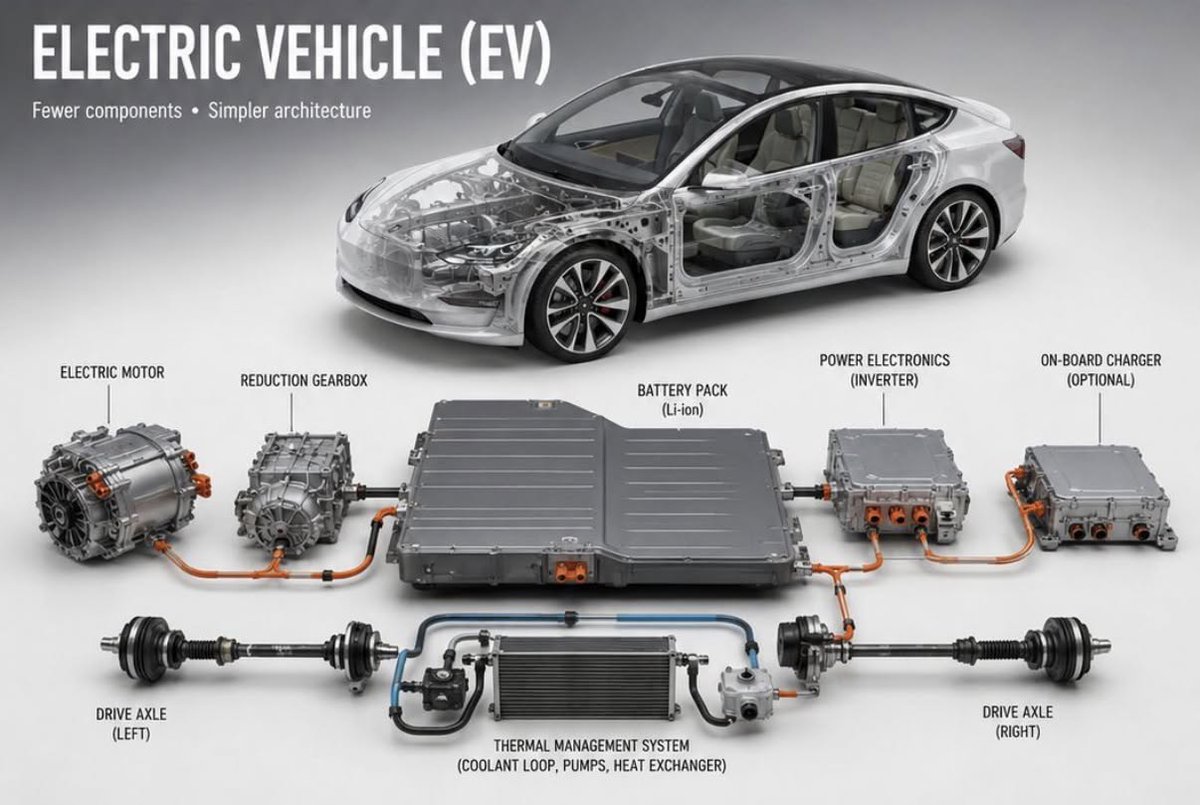
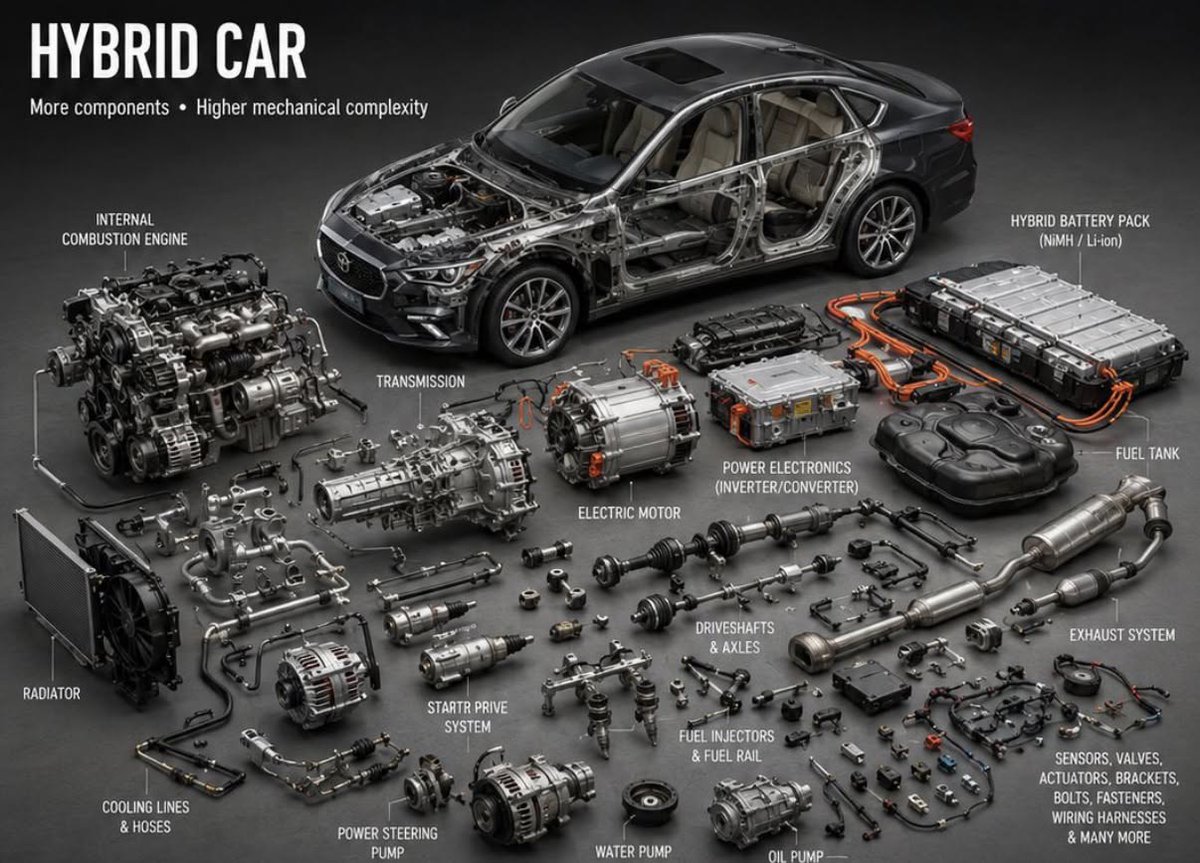
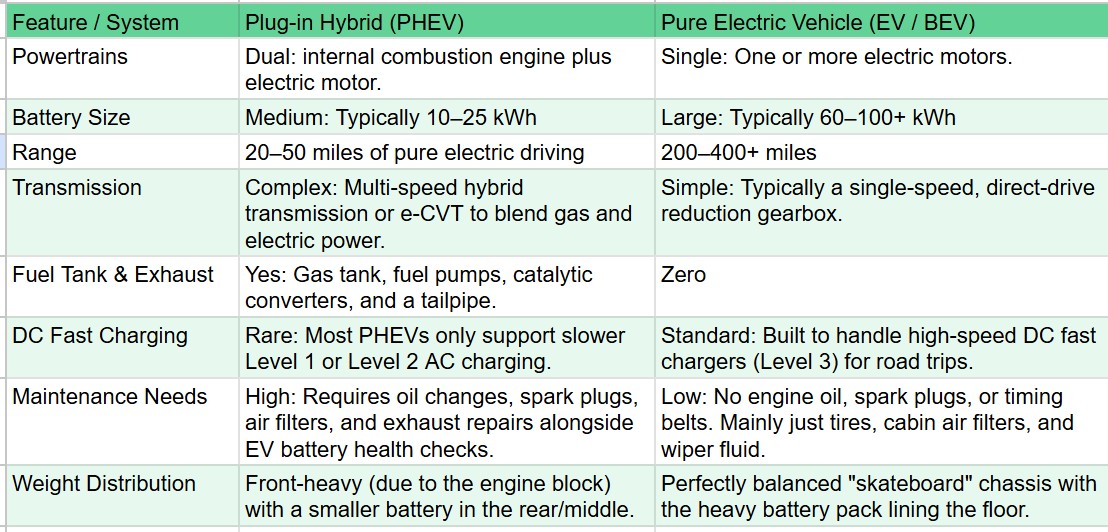
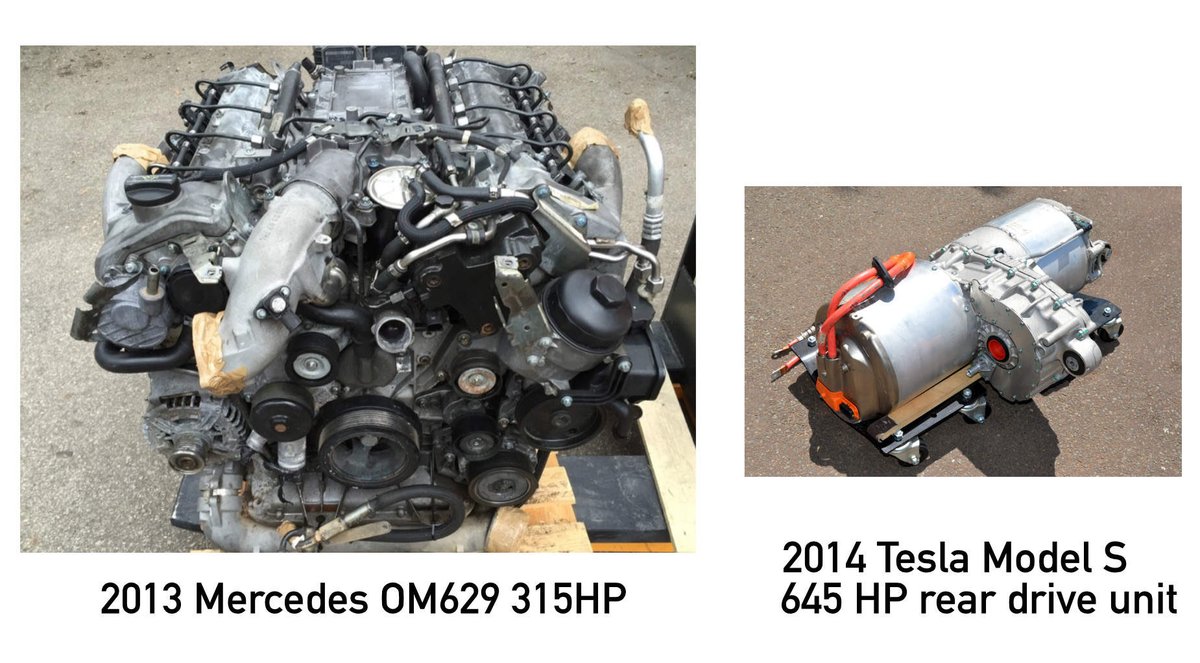
Hydrid PHEV vs Battery EVs. Sometimes, less really is more.
Is it easier to “just add a battery” and convert their vehicle into a hybrid?
They remove the original drivetrain and replace it with a modern electric architecture.
* cleaner, simpler, and more capable vehicle...
2
1
24
Jun 10
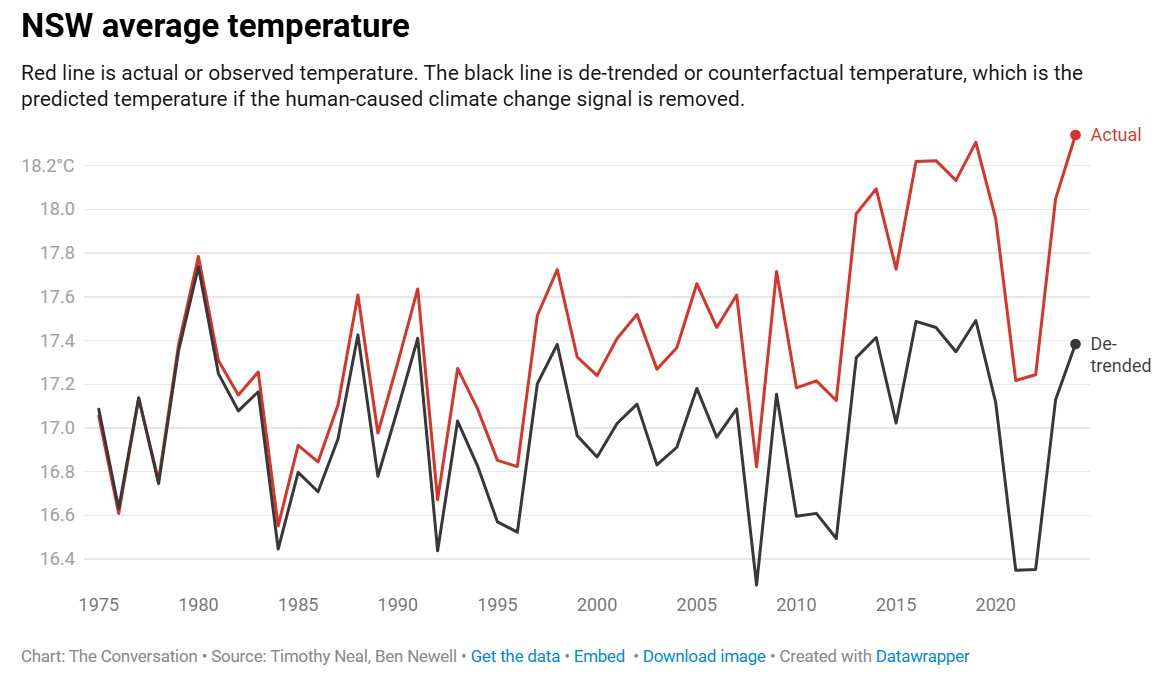
$21,000 per person in NSW. That is the loss due to climate change today.
Time to stop thinking of climate change as “merely” an environmental issue.
Instead, we should recognise what it really is. Dollars in our back pocket. An ongoing threat to our standard of living.
Neal and Newell show that climate change has driven changes in the cost of living, interest rates, and investment in health, education, and the labour market.
The researchers' estimate ranges from $4,900 to $39,000 (4%-33% range, 18% is best estimate)
Will dollars change the minds of our politicians on the right, the climate delayers and deniers?
theconversation.com/climate-…

1
19
Hugh Butler retweeted

May 27
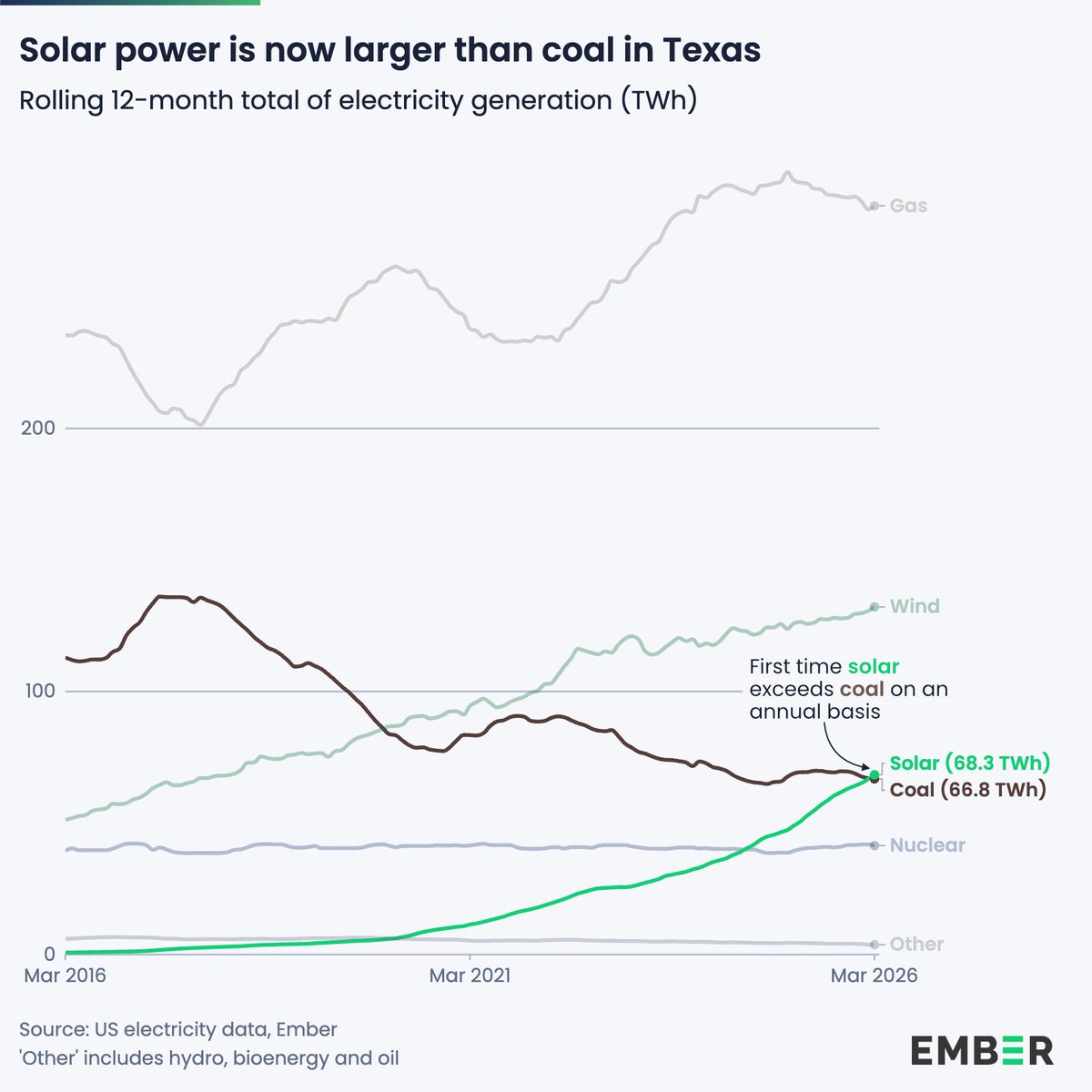
LATEST DATA | Solar power has overtaken coal power in Texas
In the twelve months to March 2026, Texas solar (68.3 TWh) produced more electricity than coal (66.8 TWh).
Just five years ago, coal was still more than 7x larger than solar.
15
74
192
10,845
Hugh Butler retweeted

May 22
Great news!
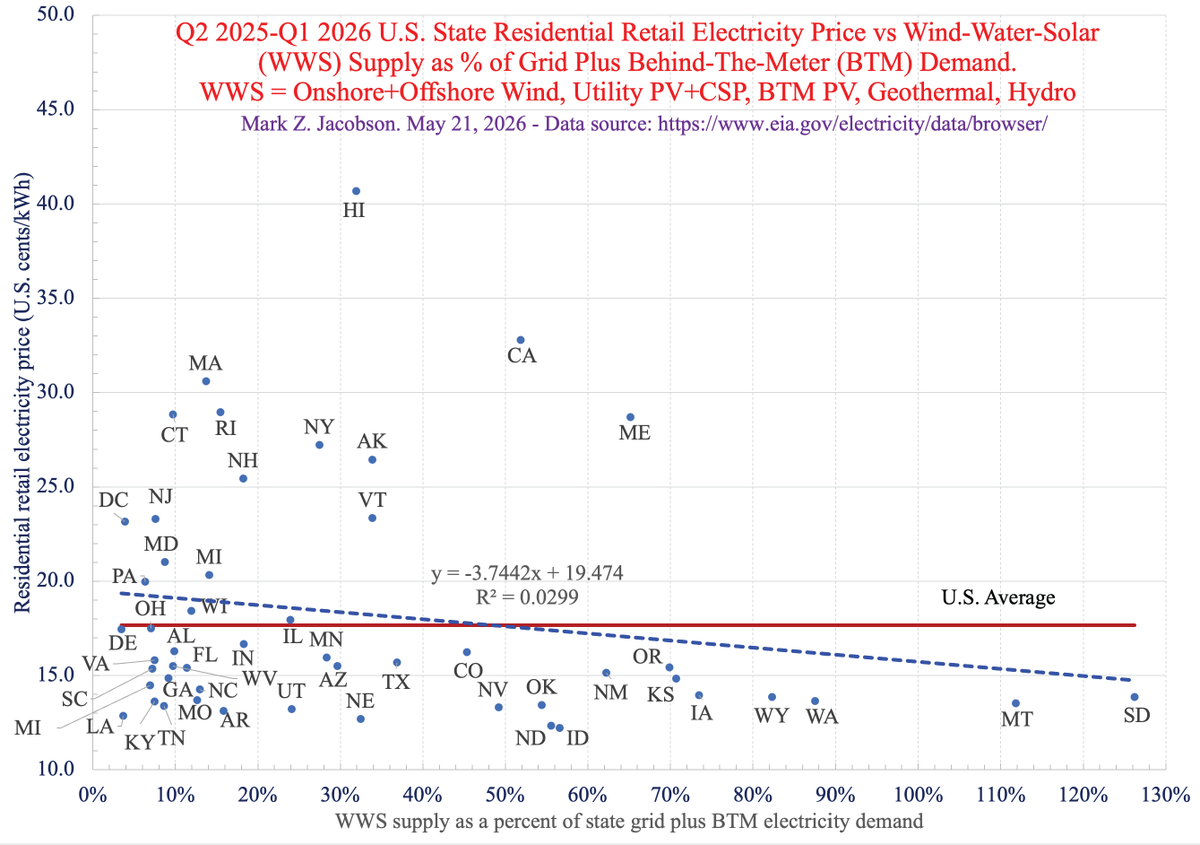
New Q1 U.S. data show that not only do higher penetrations of WindWaterSolar still correlate with lower residential retail electricity prices in the U.S., but that correlation has strengthened in just three months!
What is more, of the 16 states that met 37% to 126% of their grid BTM demand with WWS from Q2-25 to Q1-26, 14 had prices 1.5-5.5 cents/kWh BELOW the U.S. average!
-->claims that increasing WWS increases prices are not true
web.stanford.edu/group/efmh/…
1
27
56
11,110
May 20
"A lie can travel halfway around the world while the truth is putting on its shoes."
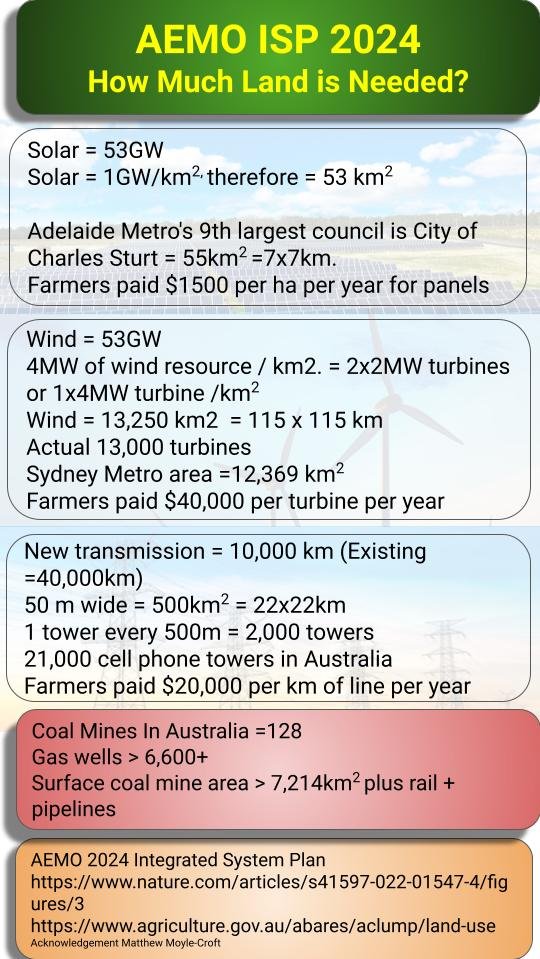
Reality of land used by renewable energy increases, which are build out for next 3 decades
Farmers get $21,000 per tower. For 50 years, farmers have wanted off farm income.
May 20

Just quietly I’m pretty sure we had transmission lines before net zero
2
1
67
Hugh Butler retweeted

Moronic @AngusTaylorMP
confirms that the Federal LNP Coalition has been completely captured by the fossil energy industry.
smh.com.au/politics/federal/…
1
1
2
53
Hugh Butler retweeted

May 6
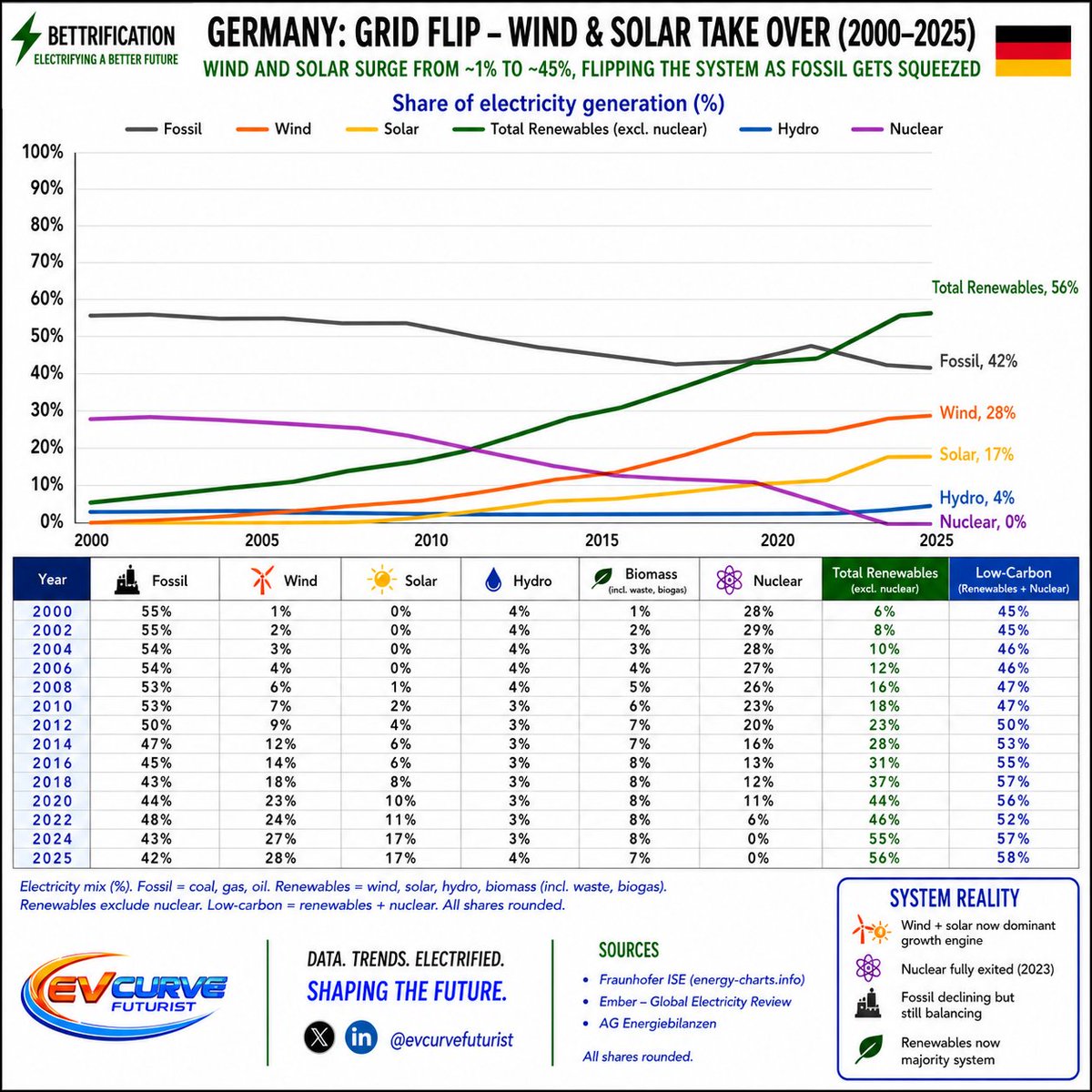
Germany shut nuclear. Critics said the system would fail. But zoom out. Wind & solar went from ~1% to ~45%, renewables from ~6% to ~56%, and fossil is getting squeezed. Messy in the middle, clear direction. This isn’t collapse. It’s system replacement playing out. #Bettrification
Generation didn’t collapse. It followed demand. After the energy shock, consumption fell and the system adjusted through efficiency, imports, and lower output.
Germany still runs one of the most reliable grids in the world, so the idea that industry couldn’t get power doesn’t hold.
👉 No systemic power shortages
👉 Industry response was to price, not supply
👉 Gas drove electricity costs higher during the crisis
That’s the real story. Energy-intensive sectors were hit by a cost shock, not a lack of electricity. Some output was reduced, some production shifted, but that’s about competitiveness under high prices, not the system failing.
Prices spiked hard. German households were paying ~€0.47/kWh at the peak in 2022–2023. That’s now down to roughly ~€0.33–€0.39/kWh depending on contract in 2025–2026. Wholesale power collapsed from €300 /MWh peaks back to roughly €70–€100/MWh range.
So prices are falling, but still above pre-2022 levels. That’s because gas still sets the marginal price, not because renewables are failing.
Critics said this wouldn’t work. That removing nuclear would break the system.
But while the debate fixated there, wind and solar kept scaling anyway, moving from marginal to the backbone of the system. Even in 2025, with weaker wind and lower hydro, the trend held. Solar surged and the system adapted, exactly what a transition under load looks like.
Germany isn’t finished. Fossil is still balancing, storage is still scaling, and the middle is messy. But the direction is clear.
This isn’t transition. It’s another system replacement.
32
79
193
6,324
Hugh Butler retweeted

May 5
If you put that ethanol into the combustion engine of a car (that throws ~75% away as heat) and compare it with an electric vehicle, the end result becomes ~500:1 in favor of solar.
And solar can go on roofs or be combined with other agricultural appliations.


87
253
1,020
40,470
Hugh Butler retweeted

Apr 28
🔥 To jest liczba, którą powinien znać każdy minister energii:
260 mld m³ gazu.
Tyle zużycia gazu ziemnego udało się uniknąć w 2025 r. dzięki:
☀️ fotowoltaice
🌬️ energetyce wiatrowej
⚛️ energetyce jądrowej
🚗 samochodom elektrycznym
🏠 pompom ciepła
To mniej więcej połowa całego globalnego rynku LNG.
Innymi słowy: technologie elektryfikacyjne nie są „dodatkiem” do systemu energetycznego.
One już dziś są największą tarczą przed zależnością od gazu.
Przyszłość jest elektryczna.
1/2
Apr 27

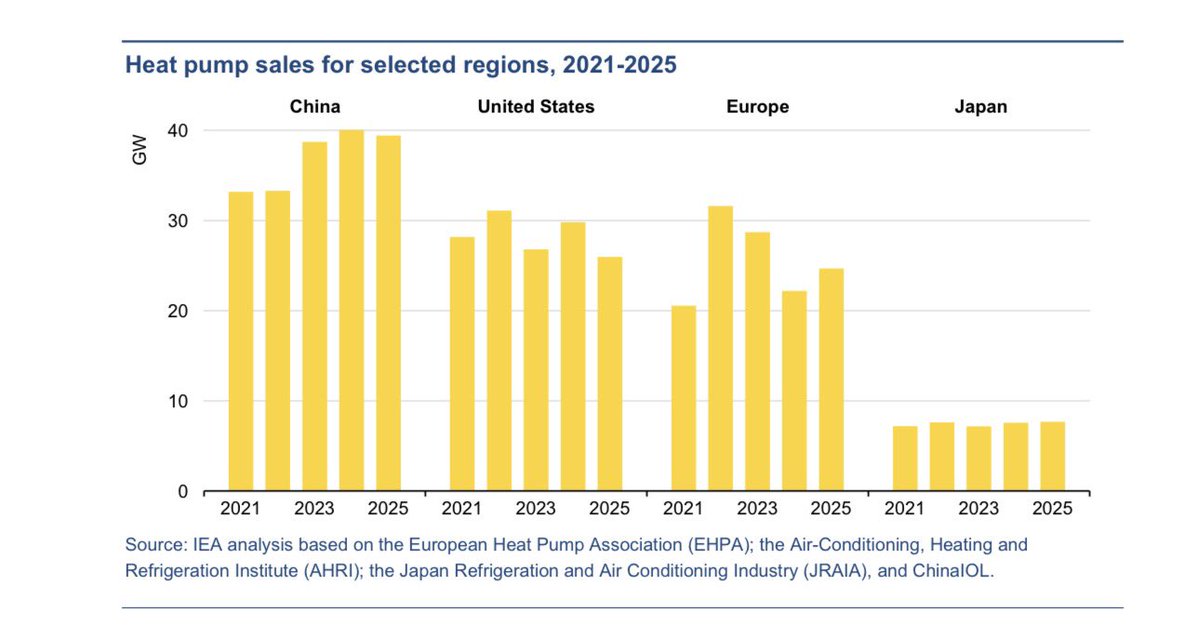
Gas Boilers are the New Typewriter (says IEA data):
>US: Heat pumps have now outsold gas boilers for 4 years straight
>Germany: Despite a massive disinformation campaign, heat pump sales up 55% in 1st half of the year. And for 1st time ever, heat pumps outsold gas boilers
> Japan: Heat pump water heaters now systematically taking market share away from gas water heaters
> Norway: 97% of the space-heating market now electric/heat pump
> Finland: 75% of all new single-family homes choose heat pumps
Heat pumps, solar PV, wind, nuclear, and electric cars collectively avoided over 260 billion cubic metres of natural gas demand in 2025, equivalent to about half of the global liquefied natural gas market
7
44
159
5,736
Hugh Butler retweeted

Apr 28
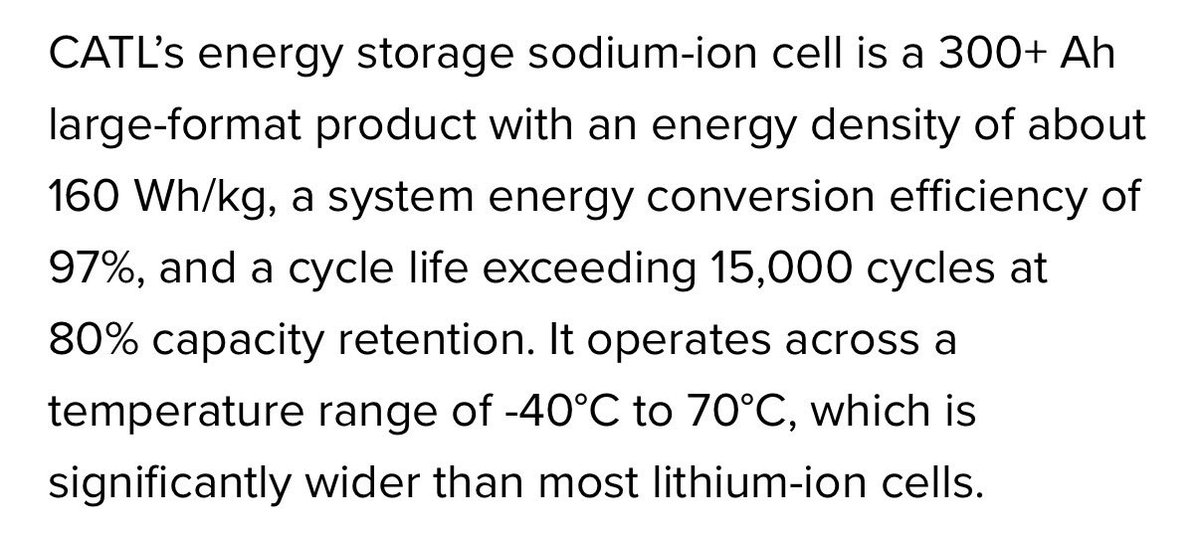
Ein 60GWh Natriumbatterie Auftrag ging an CATL für Großspeicher.
Die Specs sind schon beeindruckend:
97% Wirkungsgrad, 15.000Zyklen bis 89% SoC und Betriebstemperaturen vom -40C bis 70C und mit 160Wh/kg auf LFP Niveau!
Das ist eine Entwicklungsdynamik von der träumen Fossilisten und Atomiker. Aber die kompensieren das dafür mit BS Kommentaren, denn anders können Sie die ständigen Erfolgsmeldungen ja nicht ertragen, dass würde mich ja auch ganz kirre machen.
Apr 28

Huge news from CATL, which has signed a 60 GWh sodium-ion battery deal with HyperStrong.
This is the largest sodium-ion order ever placed and equal to half of all energy storage batteries CATL delivered in 2025.
CATL claims sodium-ion mass production is solved.
(More details electrek.co/catl-sodium-ion-…)

59
166
685
19,443
Hugh Butler retweeted

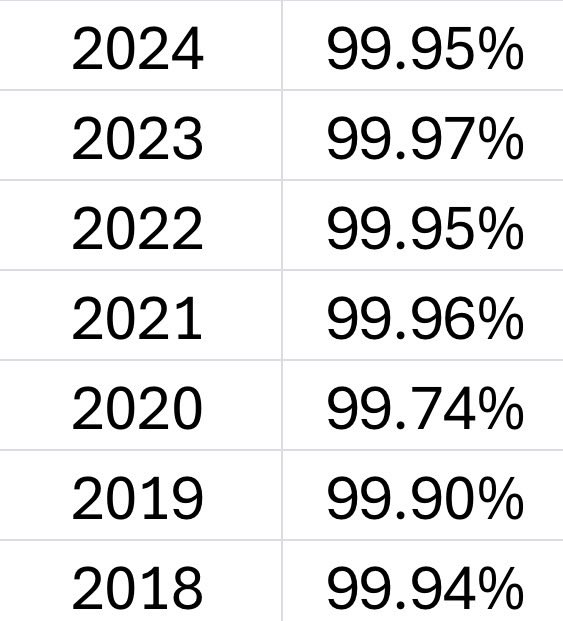
We need RELIABLE DC chargers in 100km intervals everywhere around WA. The feds spent $2.5B (that's a B for billion or $2,500 million) on cutting the fuel excise tax for just 3 months. (The states chipped in with millions more) It would cost ~5-10% of that to have world-class charging infrastructure that would last 10-20 years spanning the whole country, particularly the black spots like the Nullarbor, the Horizon Power NWIS i.e. northern part of WA and the NT and parts of QLD. We also need to be realistic, Tesla Superchargers claim a ~99.95% uptime. The closest any other network consistently gets to is ~90-95%. 90% may sound high but it's COMPLETELY UNACCEPTABLE as it's equivalent to 1 out of every 10 petrol stations being out of fuel. The solution is staring us in the face, install Tesla Superchargers open to all EVs in 100km intervals (ideally in drive-through configurations eg Kojonup) @TeslaCharging offers 3rd party access to SCs where Tesla will manage the servicing and maintenance see: tesla.com/ supercharger-f...
@tesla_wa called for improved EV infrastructure over a year ago. See the full TOCWA report here: tocwa.org.au/2025-wa-ev-netw…
9
13
34
1,670
Hugh Butler retweeted

Apr 24
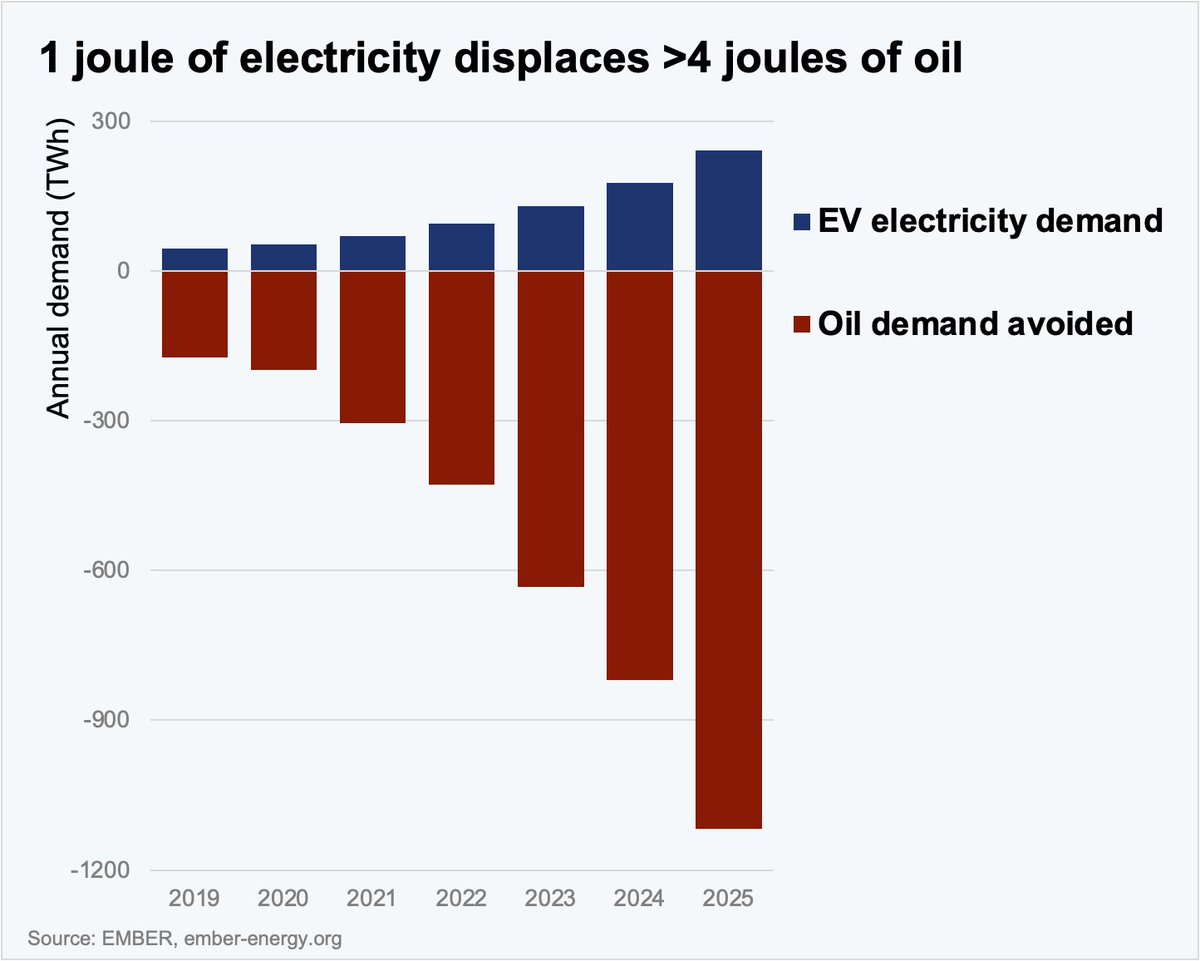
Electric vehicles are an extremely powerful tool for reducing oil demand.
This is so obvious when you use the same units.
There is a ton of chemical energy in the oil we burn to move cars, but you only need a small fraction in electrical energy for EVs to do the same job.
Apr 22

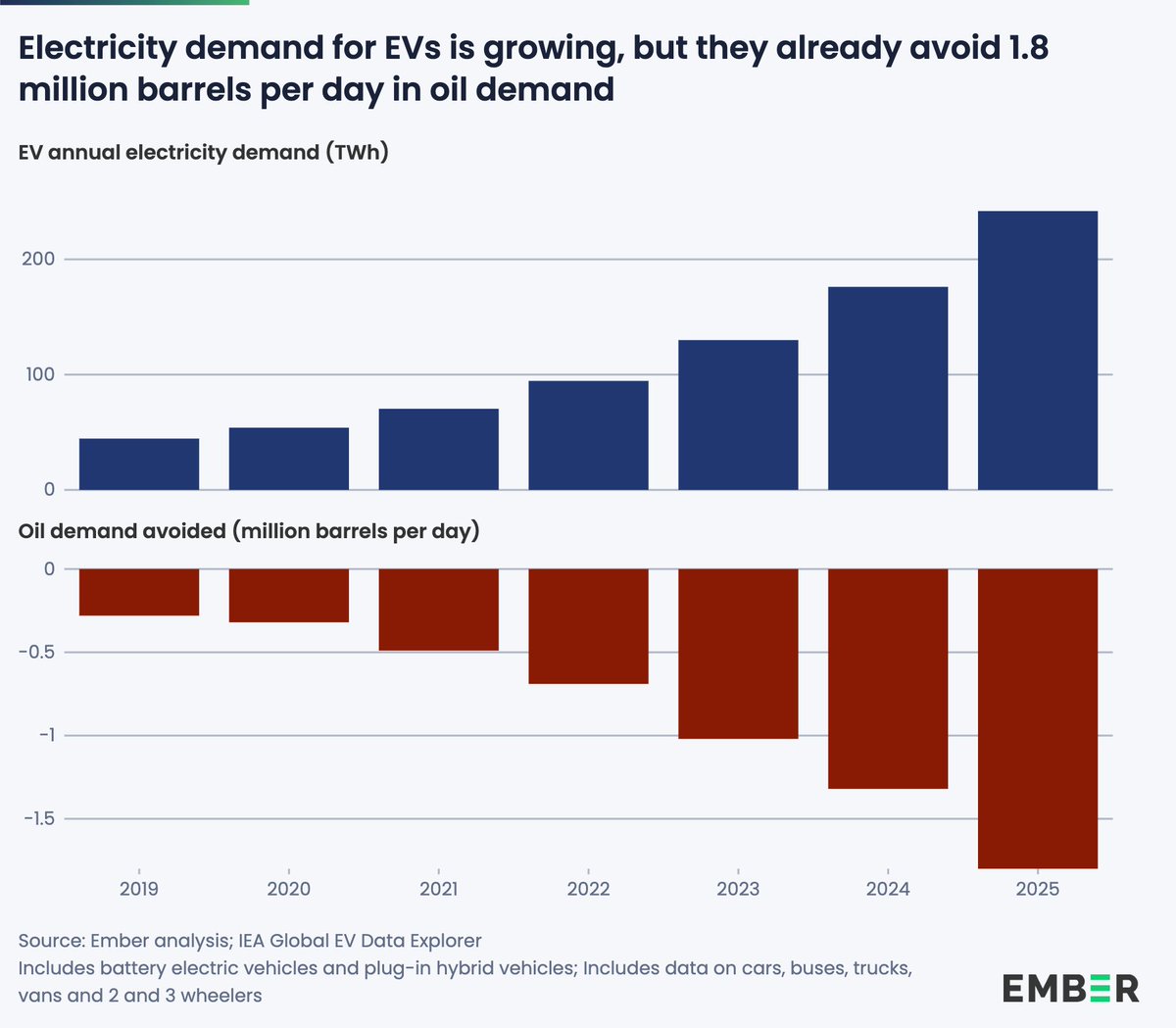
Clean power is enabling fossil-free growth beyond the power sector, as seen with transport.
In 2025, EV sales surpassed A QUARTER of the global car market 🚗⚡
The global EV fleet is already displacing 1.8 million barrels of oil demand per day 🛢️
ember-energy.org/latest-insi…
72
467
1,652
140,603
Hugh Butler retweeted
Apr 20
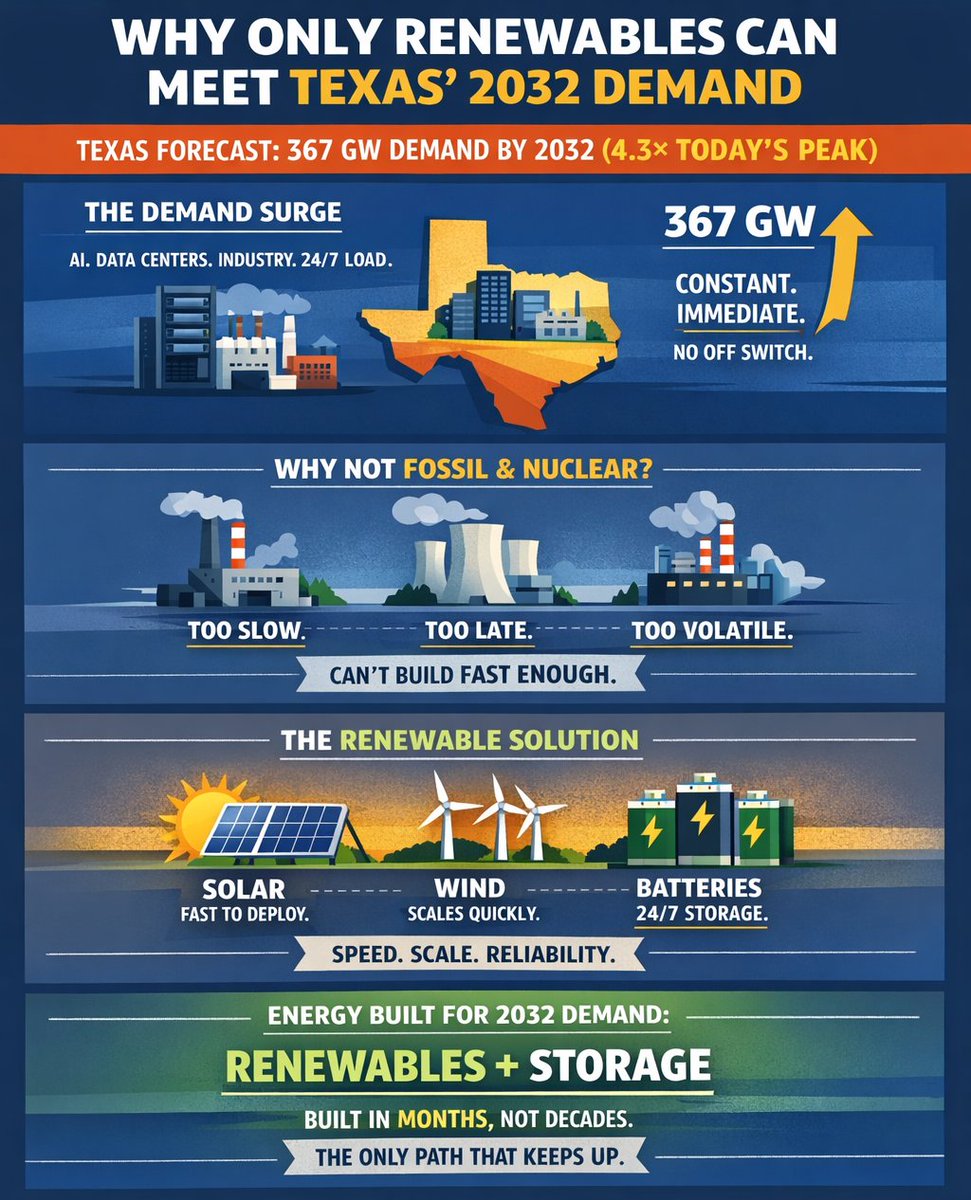
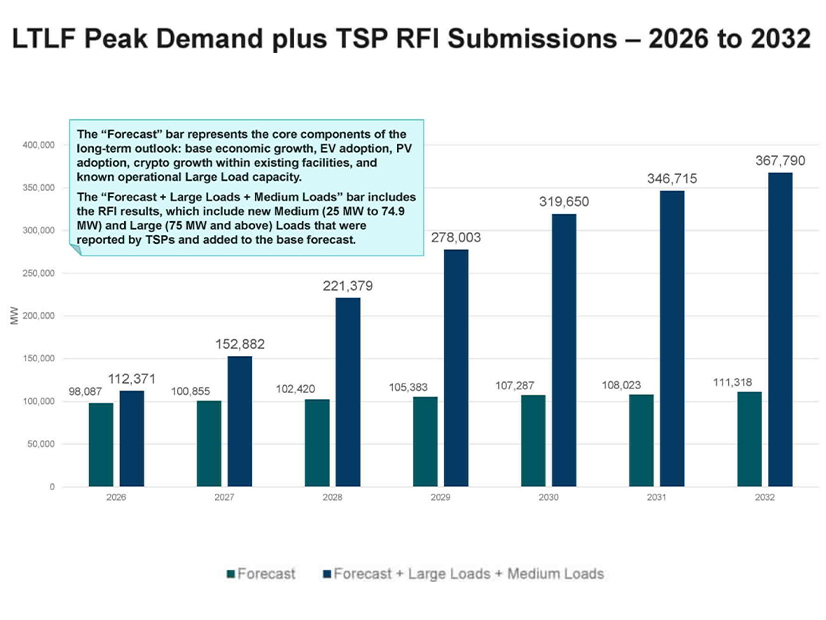
Texas isn’t “choosing” renewables. 367 GW by 2032 forces the outcome. Coal too slow. Nuclear too late. Gas too exposed.
Only one system scales in time: solar wind batteries.
Built in months. Scales with demand. No fuel risk. Not policy. Necessity. Physics forcing the flip!
Apr 19

Texas is forecasting up to 367 GW of demand by 2032. That’s 4.3× today’s ~85 GW peak. Pause on that for a second. We’re not talking about incremental growth here, this is a step-change in how the grid behaves.
This isn’t population growth or gradual electrification. This is AI, data centres, and large industrial loads hitting the system all at once. 24/7 demand. No off switch. No “wait until peak pricing drops.” Just constant load.
And that breaks the old playbook.
You can’t meet that kind of vertical demand with coal. You’re not spinning up hundreds of coal plants in under a decade. Nuclear? Even slower. By the time a wave of reactors comes online, the demand has already moved.
Gas will still play a role, sure. But it can’t lead this build. It’s too slow to scale at this speed, too dependent on fuel, and too exposed to volatility.
So the question becomes simple:
What can actually scale fast enough?
Only one system fits the constraints.
Solar can be deployed in months, not decades. Wind delivers bulk energy at scale. Batteries are now stitching it together into something that starts to look like 24/7 supply. Modular, distributed, and relentless.
This is why Texas matters.
It already leads the US in wind. It’s leading in solar growth. Battery deployments are accelerating fast. Not because of policy ideology, but because the system is being pulled in that direction by physics.
When demand goes vertical, the energy system has to respond horizontally. Fast builds. Modular capacity. No fuel bottlenecks.
That’s renewables plus storage.
This isn’t about “going green.”
It’s about what can actually be built in time.
The fossil age doesn’t end when we run out of fuel.
It ends when something else can scale faster than demand can rise.
And right now, that something is electrons. ⚡ #Bettrification
rtoinsider.com/130364-ercot-…
14
39
140
5,651
Hugh Butler retweeted

Apr 18
More gridslop. Didn’t they have a nation-wide blackout last year? Spain should have mostly nukes.
Apr 18
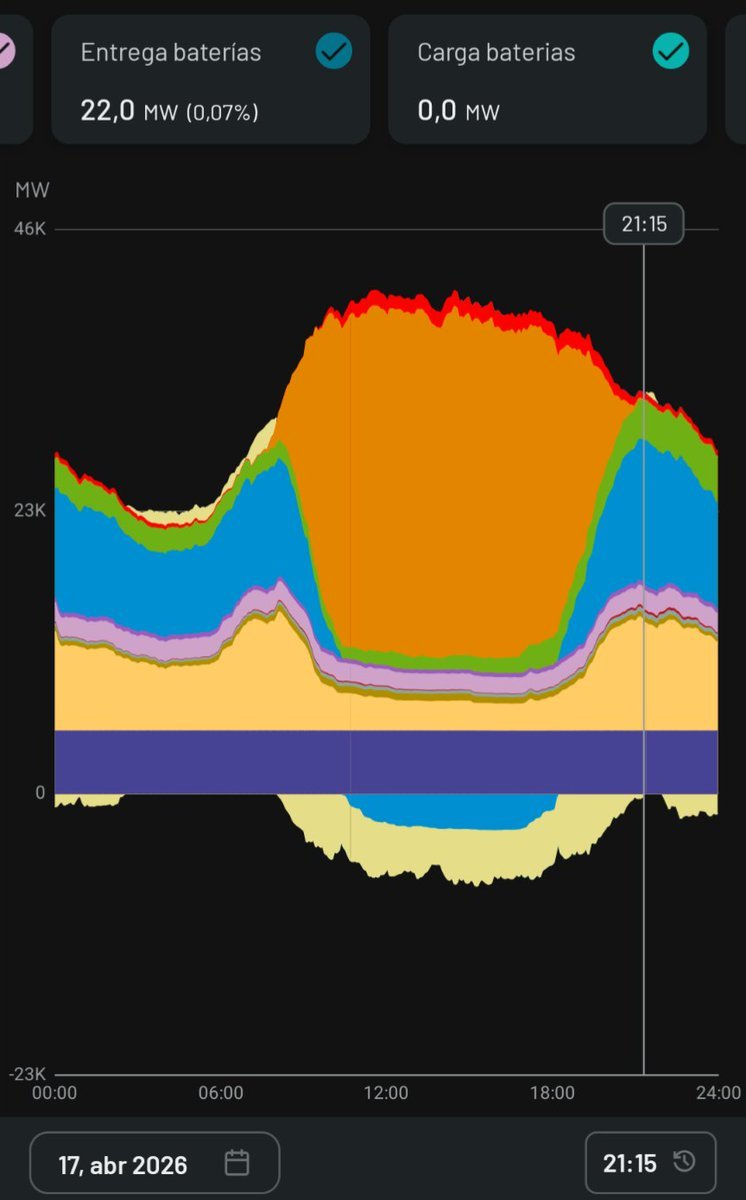
Spain is crushing it ⚡🇪🇸
Solar is delivering the equivalent of 27 nuclear plants during the day. Pumped hydro stores ~3 nuclear plants worth. Batteries already stepping in.
This isn’t a generation problem anymore. It’s storage scale.
Energy scarcity → energy timing. #BESS
22
6
39
3,718
Hugh Butler retweeted

Apr 18
1/ Solar panels occupy ~0.1% of U.K farmland.
2/ To place that in context, U.K golf courses occupy seven times the amount of land as solar installations.
3/ There is no mysterious ‘they’ - that’s just conspiracy nonsense. Farmers are the ones diversifying into clean energy.

Apr 17

They know they can put Solar panels on rooftops, motorways & roadsides but they choose to put them on farmland in order to stop farmers growing crops.
This is a well organised scam.
Stop the farming & starve the people
2030 Agenda in full swing
55
113
360
10,063
Apr 2
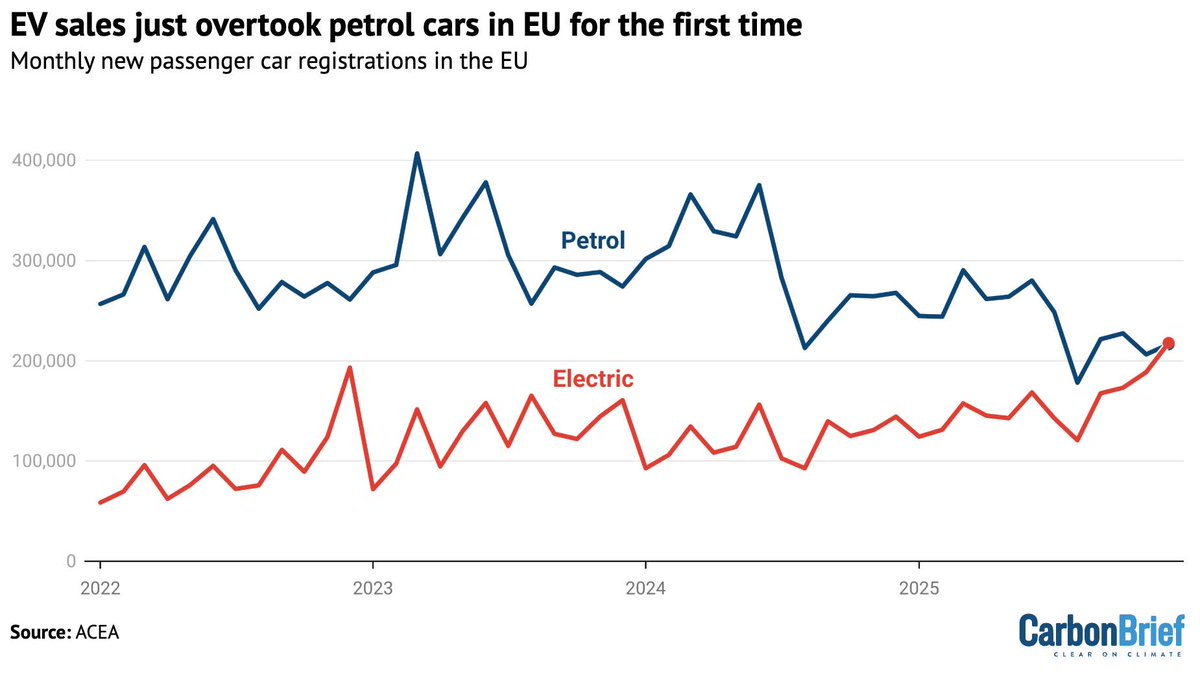
EV sales overtook ICE in the EU for the first time in December 2025.
EV =217,898, up 51% year-on-year from Dec 2024,
ICE = 216492, down 19%
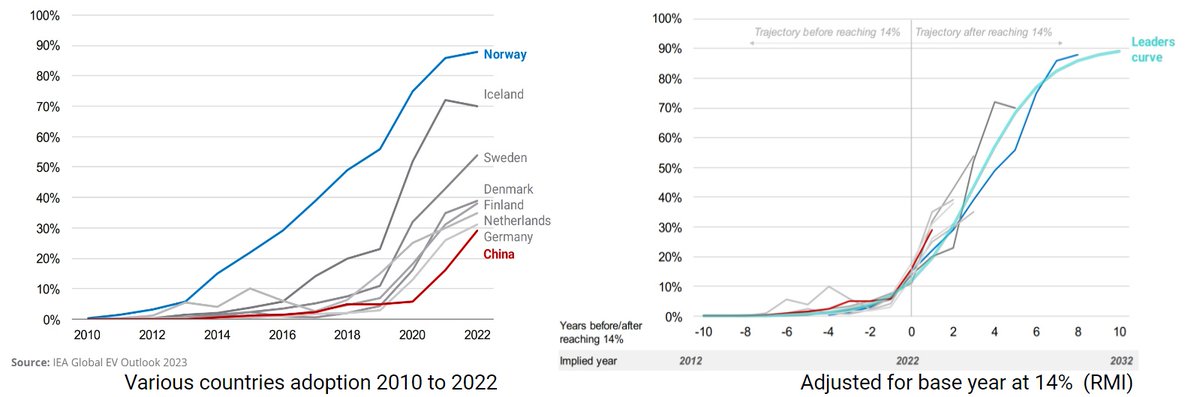
RMI say once EVs get to 14%, there is no stopping them.
carbonbrief.org/analysis-evs…
ALT https://www.carbonbrief.org/analysis-evs-just-outsold-petrol-cars-in-eu-for-first-time-ever/
ALT https://rmi.org/electric-vehicles-are-on-the-road-to-mass-adoption/
2
2
46
Hugh Butler retweeted

Mar 30
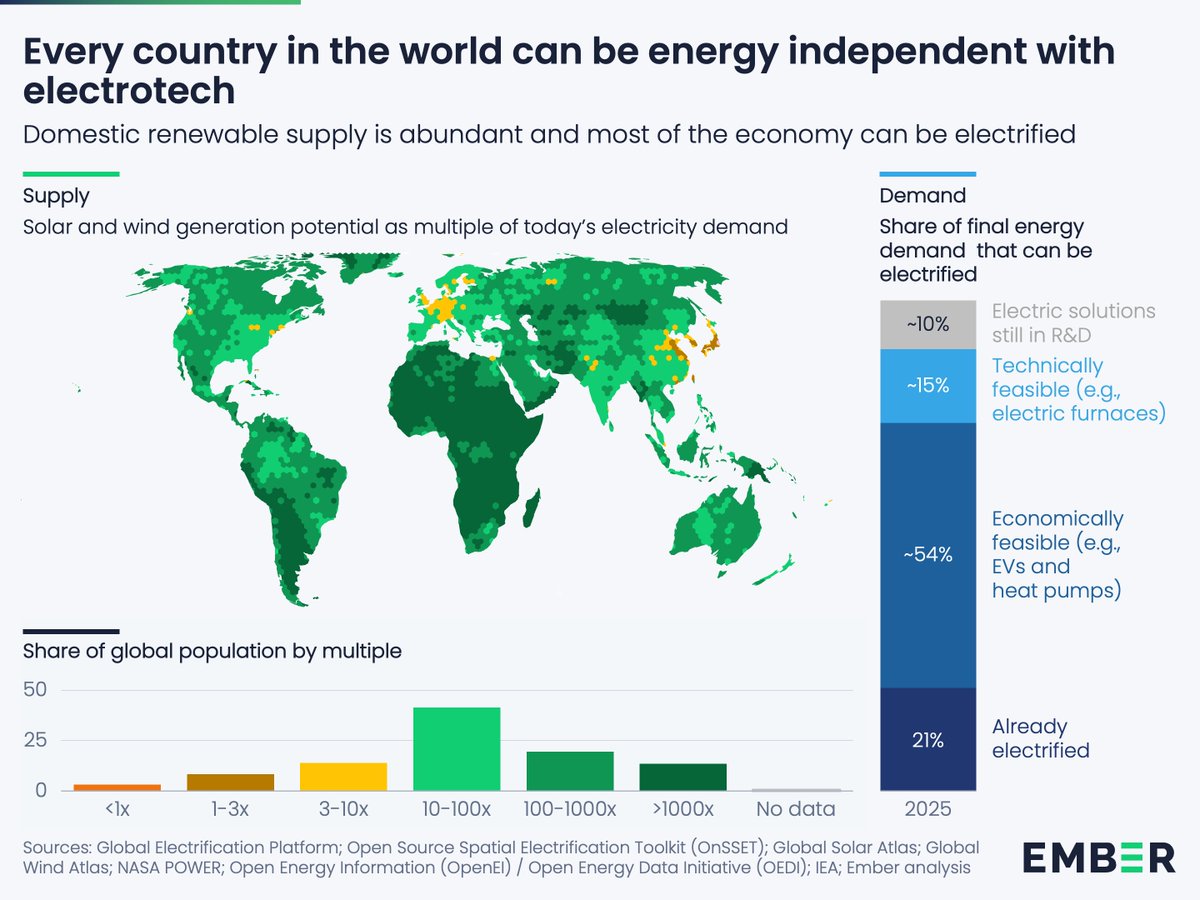
Unlike the 1970s oil crises, there are now better alternatives:
🔌 EVs renewables heat pumps could cut fossil fuel imports by 70%
🚗 EVs alone: $600bn/year in savings
Every country has the potential to be energy independent with electrotech.
🔗ember-energy.org/latest-insi…
26
220
553
65,230
Mar 31
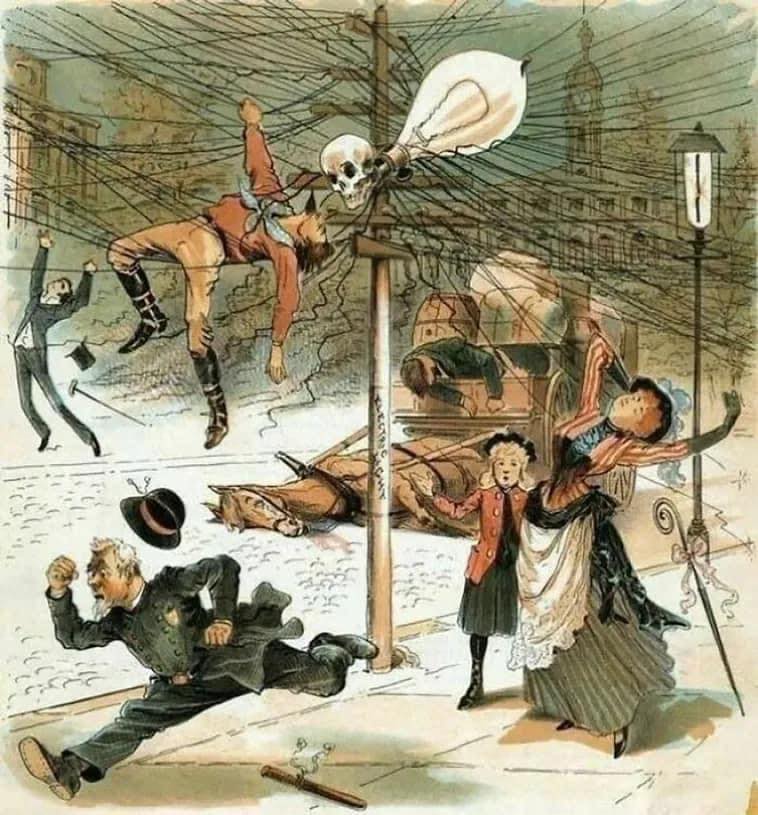
The diesel diehards are spewing. All those misconceptions they have.
Weird. Conservative, RWNJ on X and they hate electricity and technology changes. Yet they write garbage on their mobile phones.
You would think they want sovereignty from OPEC but they lean into it.
This cartoon of arrival of electricity in 1890's. Same fear of the unknown.
Mar 31
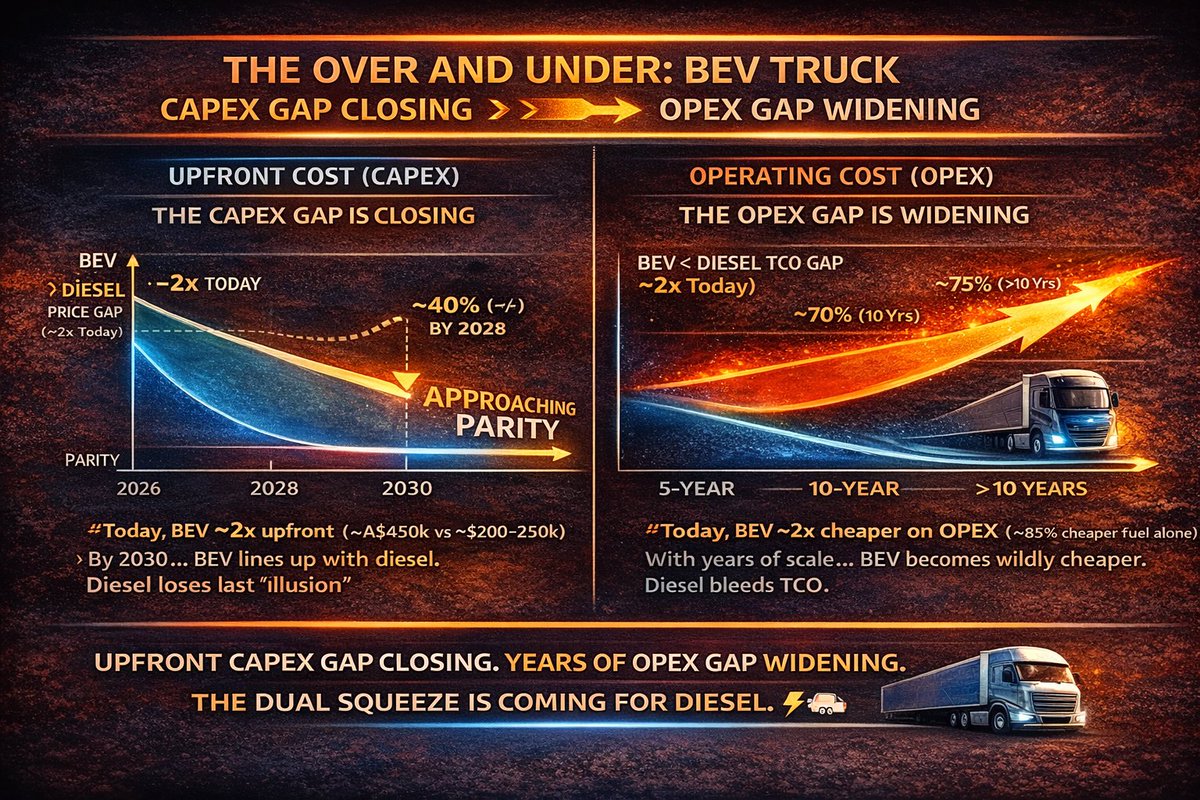
In Australia right now, a diesel prime mover sits at A$200k–$250k. The Windrose BEV E700 lands at A$450k–$500k.
“Twice the price.” That’s the headline. That’s where most people stop.
Layer in Tesla. The Semi is arriving at US$260k–$300k (~A$400k–$460k).
And BYD? In a different league entirely—scaling heavy-duty electrics in China at aggressive prices through full vertical integration.
Yes, electric still carries the upfront premium.
But that’s the wrong comparison.
You’re not choosing between A$250k and A$450k.
You’re choosing between:
• Diesel: A$250k ~A$2 million in volatile fuel over 10 years
• Electric: higher capex, then structurally far cheaper to run
The Windrose isn’t a compromise. ~700 km loaded range. ~700 kWh LFP pack. ~1,400 hp. ~870 kW charging. ~68-tonne capability.
That’s diesel performance—without the fuel dependency.
Tesla’s Semi is already proving materially lower real-world cost per kilometre in fleet deployments. BYD is industrialising faster, quieter, and cheaper.
Here’s what actually matters.
The visible gap (purchase price) is shrinking fast.
The invisible gap (operating cost) is widening faster.
Those two curves are converging hard.
That’s the squeeze.
Once they cross, adoption doesn’t crawl—it flips. Freight doesn’t care about narratives. It cares about cost per kilometre.
And the loop is now running in electric’s favour.
Oil shocks used to reinforce oil.
Now they accelerate its replacement.
Every diesel price spike forces fleets to run the numbers. Every electric truck on the road kills future diesel demand. That weakens supply investment. Which makes the next spike worse.
We’re sitting in diesel’s last comfort zone on sticker price.
The real shift isn’t happening on the invoice. It’s happening in the system underneath.
And when that system flips? Diesel doesn’t compete. It gets exposed. ⚡🔋 #Bettrification
1
2
126
Mar 31
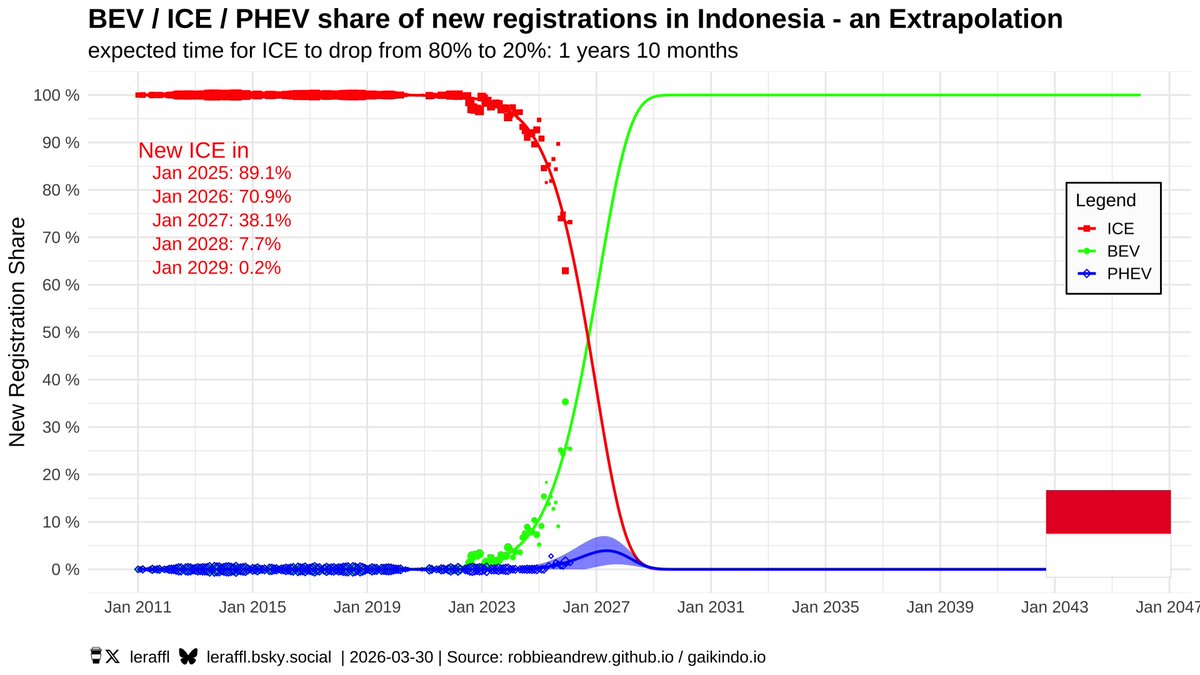
Who says things can't change. Could Australia follow Indonesia with change from ICE to EVs. Why did the Labor govt give $2 billion fuel excise relief to oil companies, not change to zero oil - for ever!

I have never seen a transition to BEV close to this fast. Indonesia is on an entirely different level. Every time I add more recent data I think to myself "this can't go on this month, can it?", but it does go on.
Indonesia has ~600k registrations per year, so they are even a decent size.
4
1
17
916
Mar 30
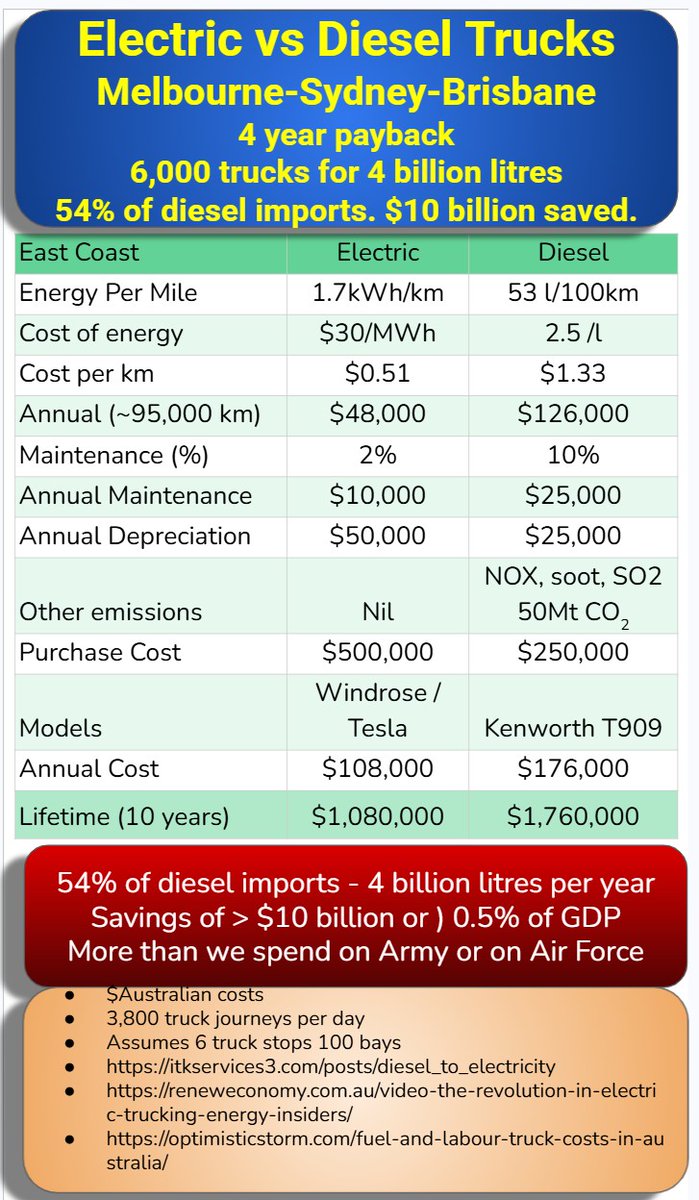
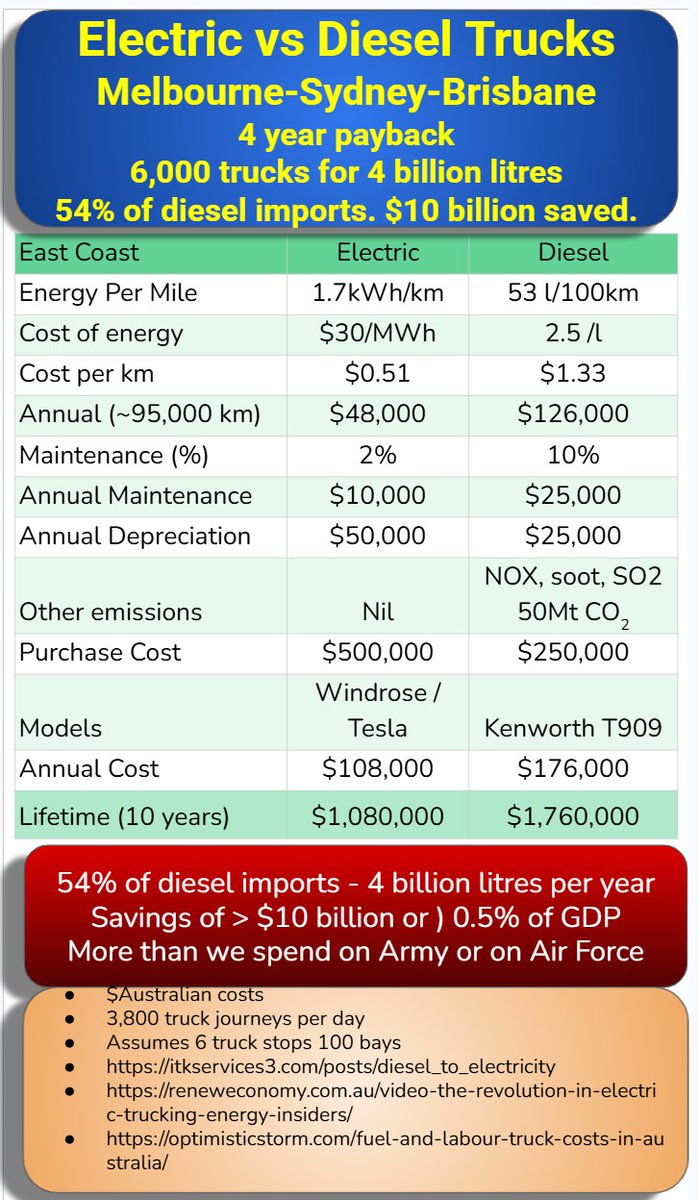
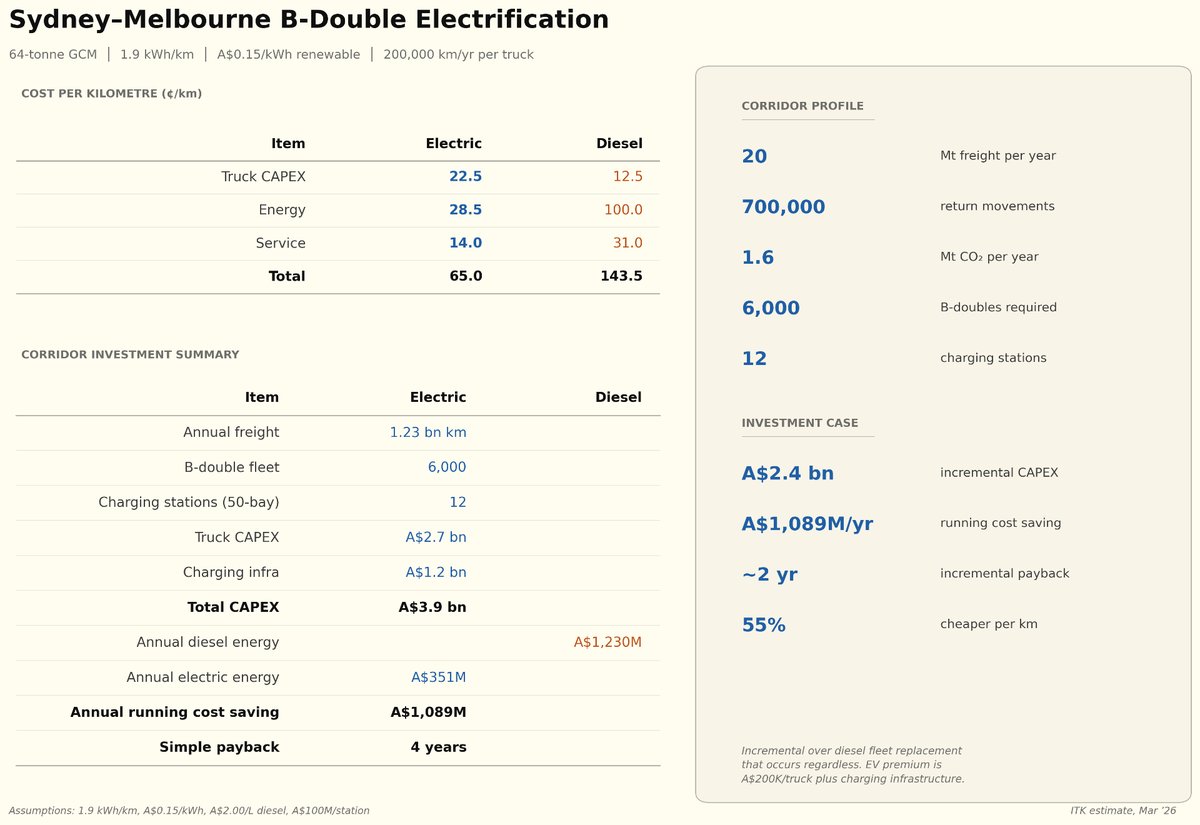
Electric trucking in Australia could smash diesel imports and cost in less than 4 years. Transport accounts for 20% of the nation's emissions. Electric B-Double prime movers cost about 30 c/ km for electricity, a third of diesel's cost. Analysis by David Leitch confirms that replacing the ~ 6,000 prime movers on the Sydney - Melbourne route saves over 4 billion litres. Payback in just 4 years. If expanded to Brisbane, it would account for about 54% of diesel imports. $10 billion in imports are gone. Sovereignty gained.
Why not?
ALT https://itkservices3.com/presentations/diesel_electric_trucks?view=print#/diesel-replacement-economics
ALT https://itkservices3.com/posts/longhaul
117
149
356
9,641