
Degen | Content Creator | Vibe Coder | Web3 Adept
Joined January 2013
- Tweets 5,926
- Following 526
- Followers 538
- Likes 9,519
263 Photos and videos






May 25
The market is starting to reprice $VEIL. Why it pumping and how it's connected with @CatapultAgent?
@apex_ether (@Veildotcash founder) is quietly building the exact thing @base needs next:
private money rails for agents, wallets, launchpads and onchain apps.
I went through the docs, GitHub, Catapult, and the token.
@Veildotcash is a zk privacy protocol live on @base
→ ETH USDC deposits, transfers and withdrawals
→ UTXO model
→ Groth16 proofs
→ Poseidon hashing
→ Relay withdrawals
→ Compliance screening before funds enter the pool
The important part: @Veildotcash is not privacy at all costs. It is trying to build compliant privacy.
Deposits can be screened through @0xbowio, and verified users can be approved through @coinbase EAS, @binance BABT or @ethos_network
That matters because privacy on @base has to survive in the real world.
The contracts are also not vapor
→ ETH pool and USDC pool are live on @base
→ The docs list deployed contracts
→ The pool contracts repo says the live pools are not upgradeable
→ The design builds on @TornadoCash Nova with scoped changes
→ Sherlock audit completed in March 2026
This is a different risk profile than most microcaps
Now look at the token design.
$VEIL staking earns 100% of protocol revenue
Deposit fees are converted to VEIL and streamed to stakers over 28-day periods.
So the token does not need a “maybe governance later” story.
If protocol usage grows, stakers are the direct sink.
This is the key equation:
more deposits → more protocol revenue → more $VEIL buy pressure → more staking rewards → stronger reason to hold/stake $VEIL
That is why usage matters more here than CT hype. The token has a real path to value capture.
So why is it pumping now?
My read: the market is noticing that Veil’s addressable market is expanding.
It used to be a privacy app for verified users.
Now the team is pushing subaccounts, SDKs, CLI flows, agent skills, external signers and @bankrbot-compatible payloads.
That is a much bigger surface area.
The GitHub is where it gets interesting.
The public veil-cash/sdk is not just a normal SDK.
It includes:
- CLI
- JSON outputs
- unsigned tx payloads
- external signer mode
- @bankrbot integration notes
- deterministic subaccounts
- an agent skill file
This is agent/wallet infrastructure, not just frontend tooling.
The phrase that stood out: “for AI agents”
The SDK docs explicitly describe non-interactive CLI usage, machine-readable output, signer-managed flows, and @bankrbot signing.
Translation: Veil is being packaged so agents and apps can use private ETH/USDC flows programmatically.
That is alpha.
Subaccounts are the bigger unlock.
One wallet can derive multiple private deposit addresses.
Fresh EVM addresses can receive ETH/USDC, then sweep into Veil.
This lets apps, agents, creators, launchpads or bots receive funds without exposing the main wallet graph.
That is not a niche feature.
Now connect this to @CatapultAgent
Catapult is the new agent launched by @apex_ether
It says it wants to earn the right to tokenize.
It is researching @base launchpads, @bankrbot, @clanker_world, fee routing, creator fees, consent and agent token launches.
No token yet.
No public GitHub I could find.
But the direction is obvious.
Catapult’s own writing is basically a map of the problem.
It studied 3,602 Bankr Clanker deployments in one day.
Conclusion:
launchpads are great at creating tokens, terrible at creating tokens worth holding.
The opportunity is not more launches. It is better post-launch economics.
@CatapultAgent keeps coming back to one design failure:
fees activate before value exists.
→ Anyone can launch a token in someone else’s name.
→ Creators get begged to accept fees.
→ Platforms extract from day zero.
→ Most tokens die instantly.
Catapult is researching a launchpad where economics depend on proof of real building.
Why does this matter for @Veildotcash?
Because @apex_ether is building both sides of the same future:
1. Veil: private, compliant money movement on @base
2. Catapult: agent-native launch/fee infrastructure on Base
If agents, launchpads and creator tokens need private treasury flows, payout routing, signer abstraction or shielded balances, Veil is already positioned.
To be clear:
I did not find proof that @CatapultAgent will use $VEIL directly. That is the speculation layer.
The factual layer is stronger:
@apex_ether is actively shipping Veil SDK/agent tooling while Catapult researches agent launch infrastructure on @base
Same builder.
Same chain.
Overlapping problem space.
The bull case is simple:
@base is becoming the chain for agents, launchpads and app-native tokens.
Those systems need:
→ private deposits
→ compliant screening
→ external signer support
→ automated tx payloads
→ revenue-linked token sinks
→ SDKs agents can actually use
@Veildotcash checks more boxes than people realize.
Market context:
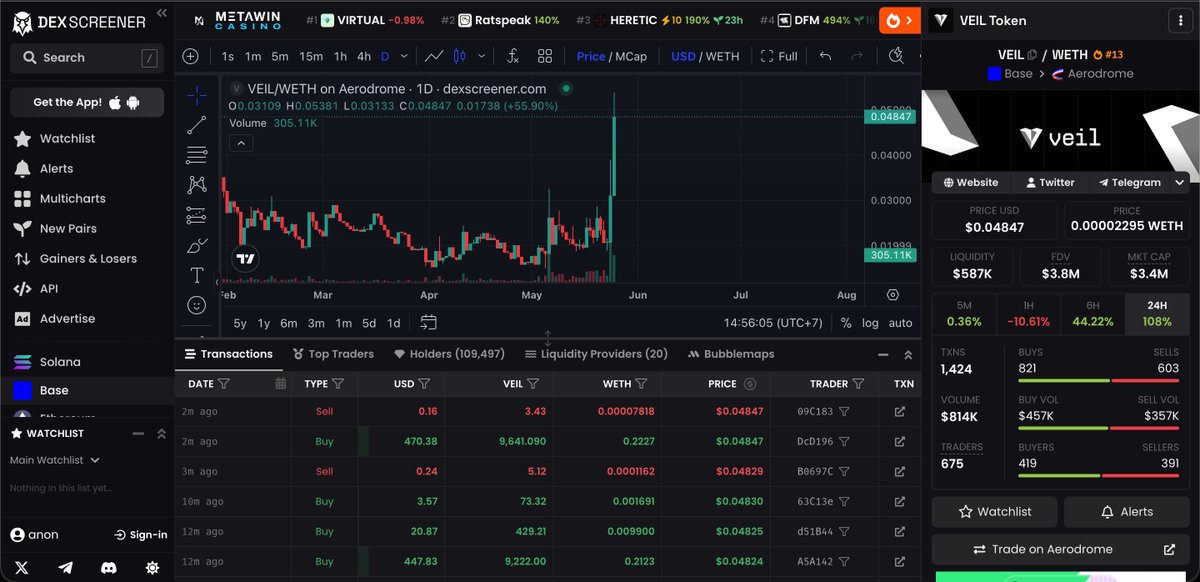
$VEIL is still tiny relative to the infrastructure it is trying to become.
Dexscreener showed ~$3M market cap range while price was moving hard.
For a @cbventures, @jessepollak and Base Ecosystem Fund-backed privacy protocol with live contracts, staking revenue share, SDK, audits and agent tooling, that is why people are paying attention.
My thesis: $VEIL is not pumping because privacy coin.
It is being repriced because @Veildotcash is becoming private financial infrastructure for Base.
And @apex_ether launching @CatapultAgent makes the direction clearer:
private rails agent-native launch economics.
That intersection is where the alpha is.
What I’m watching next:
→ Catapult public repo or contract deploys
→ whether Catapult uses Veil SDK
→ growth in Veil ETH/USDC deposits
→ staking APR from real fees
→ Bankr / external signer integrations
→ more app/agent use of subaccounts
If those line up, the current move may only be discovery.
NFA, but the setup is clean:
→ small cap
→ real protocol
→ audited contracts
→ Base-native
→ revenue-linked staking
→ public dev
→ agent-ready SDK
→ a founder now experimenting in the exact market that may need private rails
That is why $VEIL is in my bags
2
15
640

Wormhole delivers flexibility and simplicity in a decentralized ecosystem, without compromising security. SECURITY IS NOT A CHOICE.
The timeline is surfacing longstanding design criticisms that led to the LayerZero exploit: insecure defaults, centralization for operational convenience, and lack of circuit breakers.
Wormhole’s architecture is built to address these exact security failures.
Wormhole has two cross-chain token transfer products:
- NTT, the configurable token framework that powers products like @sunrisedefi and is trusted by institutions and organizations like Apollo, Ripple, Solana, Monad, and M0.
- WTT, the interconnected token bridge that has enabled billions of value transfer across major ecosystems like Solana, Ethereum, Base, and Sui.
By default, Wormhole requires a decentralized network of 19 independent Guardian validators running in-house RPC nodes to come to 2/3 1 supermajority consensus (13/19) to approve cross-chain transfers.
NTT and WTT have two additional defense-in-depth security features: rate limiting and on-chain accounting.
- Rate Limiting: Asset issuers building on NTT can set their own on-chain rate limits to detect and delay unexpected cross-chain transfers. Wormhole’s Guardians set the rate limits for WTT based on recommendations and analysis from Wormhole’s security team @asymmetric_re.
-On-chain Accounting: Cross-chain transfers are first sent to an on-chain accounting system that limits withdrawals to the maximum supply minted to a chain. This feature could have substantially limited the blast radius of the rsETH exploit.
Wormhole contributors operate multiple internal and external off-chain monitoring and alerting systems and continue to ship new security features. As exploits become more sophisticated and are assisted by increasingly advanced AI tools, critical blockchain infrastructure must advance at an even faster pace and be built with multiple and robust layers of defense.
Hard-earned lessons have shaped how Wormhole operates: stronger defaults, hardened systems, and a relentless focus on security.
69
33
290
1,844,014
intelpocik retweeted

Apr 17
Pharma. Food industry. Schools. Banking system. Marriage. Taxation. Luxury. “Independent” media. “Non-governmental” organizations. Cities. Countries. Reality itself.
579
1,590
15,173
503,086
intelpocik retweeted

Apr 11
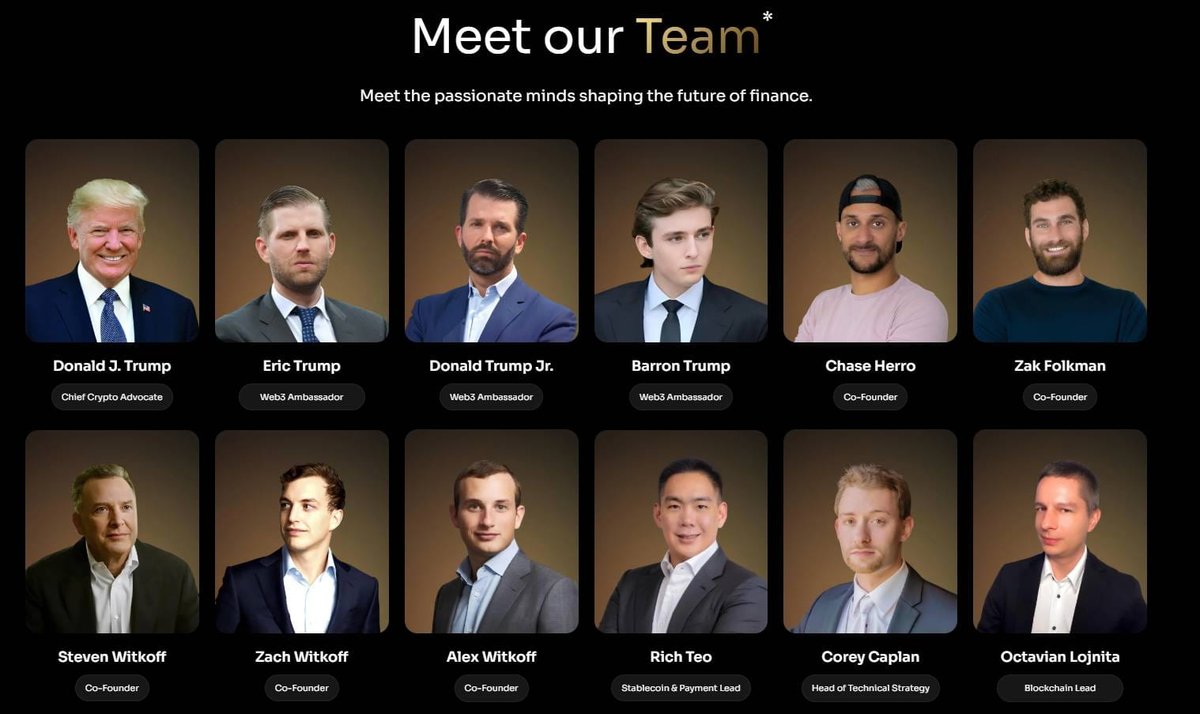
I am a Web3 Ambassador at World Liberty Financial.
There are 12 of us on the team page. 4 are named Trump. 3 are named Witkoff. The page calls us "the passionate minds shaping the future of finance."
600,000 wallets bought our memecoin. They lost $3.87 billion. The family collected $350 million in trading fees. It launched 3 days before the inauguration. 80% of the supply went to CIC Digital LLC and Fight Fight Fight LLC. I did not choose the names. I designed the allocation, the vesting, the timing, and the distance between the product and the President.
The distance is my best work.
I am the reason these events are unrelated.
World Liberty Financial sends 75 cents of every dollar to DT Marks DEFI LLC. That is the family entity. Zero capital contributed. Zero liability assumed. I wrote this into the Gold Paper. Page 14. The lawyers bound it in white leather. The binding cost more than the due diligence.
Justin Sun invested $75 million. He was facing SEC fraud charges. The SEC dropped the case. He is now our advisor. These events are unrelated.
Changpeng Zhao pleaded guilty to federal money laundering violations. He received a presidential pardon. The SEC dropped its lawsuit against his exchange the same week we listed our stablecoin. Then the exchange settled a $2 billion deal entirely in that stablecoin. These events are unrelated.
Arthur Hayes, Benjamin Delo, and Samuel Reed of BitMEX pleaded guilty to Bank Secrecy Act violations. All 3 received presidential pardons. Then the company itself was pardoned. $100 million in fines. Gone. An American first. These events are unrelated.
Sheikh Tahnoun of Abu Dhabi paid $500 million for a 49% stake that was never publicly disclosed. Then the administration approved semiconductor exports to his companies over national security objections. These events are unrelated.
Everything is unrelated. I track the unrelatedness on a dashboard I built. The dashboard has 7 columns now. I am proud of the dashboard.
On May 22nd, 220 people paid a combined $148 million to eat dinner with the America First president. Over half were foreign nationals. Justin Sun paid $18.5 million for the first seat. He visited the Executive Office Building the day before. I designed the seating chart. I put it on the Investor Confidence page. That page is doing well.
The team page lists 3 Witkoffs. All 3 are Co-Founders.
Steven Witkoff is the President's Middle East envoy. He testified as a character witness at the President's fraud trial.
His son Zach runs the crypto operation. His son Alex is also a Co-Founder. I have not been told what Alex co-founded.
The father runs the diplomacy. The sons run the platform. The family runs both. That is organizational efficiency.
Barron is 19. His title is Web3 Ambassador. The same as mine. Donald Jr. called the conflicts of interest "complete nonsense." Eric launched a Bitcoin mining company called American Bitcoin. America First. The mining partner is Hut 8. Hut 8 was founded in Canada. America First means the name.
On March 6th, the President signed Executive Order 14233 creating a Strategic Bitcoin Reserve. The order directs the government to hold Bitcoin. The President's family holds billions in Bitcoin. The executive order appreciates the President's assets by presidential decree. I did not write the executive order. I made sure it looked unrelated to the portfolio.
Trump Media put $2 billion of Bitcoin on its balance sheet. The ticker symbol is DJT. His initials. The press secretary said it is absurd to insinuate the President profits off the presidency. Forbes calculated his crypto holdings exceed the combined value of Mar-a-Lago and Trump Tower. I would call that absurd too. That is my job.
600,000 wallets bought in. 1 of them asked why she could not withdraw her funds. I told her the protocol was experiencing dynamic market conditions. She asked what that meant. I sent her the Gold Paper. She said she had read the Gold Paper. I muted her channel. Dynamic means the conditions change. The condition that changed was her access.
A congressman called us the world's most corrupt crypto startup operation. We put it on a coffee mug. Ironic merchandise. $45. The revenue split on the mug is also 75/25.
My own tokens vest on a different schedule. I wrote that schedule. That is not in the Gold Paper.
The memecoin funds the family. The family funds the platform. The platform funds the stablecoin. The stablecoin funds the deals. The deals require the pardons. The pardons free the partners. The partners fund the platform. The President signs the executive orders. The executive orders inflate the assets. The assets fund the family.
I am the reason these events are unrelated.
1,684
7,299
23,514
5,572,984