
The unofficial, unpaid, self-appointed, intern at LUKSO. I share my views about the Blockchain space and how LUKSO is going to change it all. I am biased! DYOR.
Joined March 2025
- Tweets 961
- Following 143
- Followers 274
- Likes 867
23 Photos and videos








Pinned Tweet

12 Apr 2025
The Future of Web3 Business Models: Delivering Real Value Beyond Tokenization
Lately, I’ve been vocal about a critical shift Web3 needs to make: moving away from the tokenization of everything mindset.
The obsession with turning every asset into a tradable token has drowned out a more pressing conversation - what value are we actually delivering to users in this decentralized era?
In this article, I want to explore what the future of Web3 business models should look like - how we can harness blockchain’s unique properties like trustlessness, immutability, transparency, and programmability to create systems that solve real problems and generate revenue without relying on token mania.
The Token Trap and the Value Imperative
Tokenization has been Web3’s go-to play - NFTs for art, tokens for governance, tokens for culture… we’ve seen it all. It’s seductive because it’s simple: digitize an asset, slap a token on it, and let the market do the rest. But as we’ve seen, this approach often leads to bubbles that burst, leaving users with little more than digital receipts. The problem isn’t tokens themselves; it’s that they’ve become the endgame instead of a tool. If Web3 is going to thrive, we need to focus on building systems that leverage blockchain’s strengths to deliver tangible benefits - systems people will pay for because they offer tangible value, not because they’re trending on X.
Blockchains offers a unique toolkit that separates it from Web2: trustlessness eliminates intermediaries, immutability ensures unchangeable records, transparency builds confidence, and programmability automates complex processes. These aren’t just buzzwords - they’re the foundation for disrupting industries and creating value. Let’s look at some real-world examples and unpack how they could translate into viable business models.
Real-World Examples of Web3 Value Creation
(side note: I have intentionally chosen to discuss extremely high-level applications to remind my audience the extent to which Blockchain applications may be useful).
Healthcare: Securing Patient Data
Imagine a healthcare system where patient records are stored on a blockchain - immutable, secure, and accessible only to authorized parties. No more worrying about tampered medical histories or unauthorized access. Trustlessness ensures patients and providers can interact without a central gatekeeper, while immutability guarantees data integrity. A business model here could involve hospitals or clinics paying a subscription fee to access this secure infrastructure, or patients paying small fees for portable, blockchain-verified records they control. The value? Privacy, security, and trust in a sector where those are non-negotiable.
Agriculture: Fair Trade and Livestock Tracking
In agriculture, blockchains can tackle two pressing needs: ethical sourcing and food safety. For fair trade cooperatives, a transparent, immutable ledger could track farmer deliveries - quantity, quality, and farming practices - ensuring accurate payments and authentic certifications. Consumers could scan a QR code on their coffee or cocoa to verify its journey, with cooperatives charging brands a fee to join this trusted network. The transparency improves Consumer confidence, the immutability gives Brands a layer of accountability to their purchasing practices.
Similarly, a livestock tracking system could store health records for cattle, goats, or poultry on-chain. Only disease-free animals enter the market, and if an outbreak occurs, the source is traceable in minutes. Meat producers could pay per record to certify their supply, or governments could fund it as a public health measure. The value lies in accountability and safety - blockchain makes it possible, and the revenue follows the utility.
Property Records: Fraud-Proof Land Registries
Land disputes and fraudulent titles plague property markets worldwide. A blockchain-based registry could use immutability to lock in ownership records, transparency to make them publicly verifiable, and programmability to automate transfers via smart contracts. Governments could charge a small fee per transaction to maintain the system, or private firms could offer premium services like title insurance built on this infrastructure. The value is clear: reduced fraud, faster transfers, and trust in a notoriously opaque industry.
This could apply to even property rights for things such as: a vehicle registry, a boat registry (shout out to @mustaa_io) and others.
Monetizing Web3: Business Models That Work
These examples highlight blockchain’s potential to disrupt industries, but disruption alone isn’t enough - businesses need to make money. The good news? Web3 doesn’t need to reinvent monetization; it can adapt proven models to its decentralized framework.
Here’s how:
Subscription Fees: Healthcare providers subscribe to a blockchain records platform; cooperatives charge brands to join a fair trade network. Recurring revenue aligns with ongoing value delivery.
Transaction Fees: A small cut per livestock certification or property transfer keeps the system running while scaling with usage.
Service Licensing: Private companies license blockchain infrastructure to governments or industries, customizing it for specific needs (e.g., land registries with local compliance).
Freemium Models: Basic access to a fair trade system is free, with premium features (analytics, integrations) behind a paywall.
Tokens can still fit in - say, as governance tools for cooperatives or incentives for early adopters - but they’re not the backbone. The revenue comes from the service, not the speculation.
Challenges and Opportunities
Of course, this vision isn’t without hurdles. Adoption requires educating industries stuck in Web2 mindsets. Scalability and privacy concerns still loom over blockchain tech. And regulatory uncertainty could slow progress. But these are solvable problems - and the opportunities outweigh them. Healthcare could save billions in data breaches. Agriculture could empower small farmers and protect consumers. Property markets could unlock economic potential in developing nations. Web3 business models that tap into these needs will find both users and profits.
The Path Forward
The future of Web3 business models isn’t about tokenizing more stuff – it’s about solving more problems. By leaning into blockchain’s core strengths – trustlessness, immutability, transparency, and programmability – we can build systems that deliver real value to society, from secure medical records to fraud-proof property ownership. Monetization doesn’t need to be a mystery; it can flow naturally from the utility provided, whether through fees, subscriptions, or partnerships.
We’ve spent too long chasing the next big token drop. It’s time to chase the next big solution instead.
1
5
29
1,855
Jun 14
Have you experienced a more cruel and corrupt society than this in your lifetime?
Jun 14

Many Israelis are getting rich off the genocide in Gaza. One such case is that of Victory (Supermarket Chain Ltd.) is an Israeli retail corporation that operates a chain of discount grocery stores owened by Eyal Ravid and Avraham Ravid. Over the last few months they TRIPLED their profits by "selling" aid to Gaza after all other food was cut off from it:
1) Israel's Securities Authority forced Victory to refile its Q1 report. The regulator ruled it had hidden from investors what actually drove the quarter.
2) The driver was Gaza. Of a 152 million shekel rise in sales, 99 million came from sales to Gaza residents. Roughly two-thirds of the abnormal growth.
3) The turnaround was an illusion. Strip out Gaza and organic growth was 6 percent. The 23 percent same-store spike was Gaza sales booked to existing stores.
4) Net profit rose 784 percent. To about 18.6 million shekels, from about 2.1 million a year earlier.
5) In December 2025 the government routed aid purchases through 11 approved Israeli suppliers. Victory was one. Around 700 trucks a day, hundreds of millions of shekels a month.
6) The margins were gouging by design. Gazan merchants paid above the Israeli market rate. Suppliers added about 15,000 shekels per truck in fees, absorbed into the price. Near-expiry stock moved through the same pipeline.
7) The buyers were a blockaded population. Prices in Gaza rose by as much as 400 percent during closures. People paid scarcity prices because the alternative was nothing.
8) COGAT built it. The Defense Ministry hand-picked the merchants and screened them. The selection was opaque, and the Tax Authority refuses to name the winners.
9) The tell: Israel blocked these same goods for aid groups, then waved them through the same crossings for paid commercial resale. Items barred to NGOs, sold openly in Gaza markets.
Not only has Israel starved Gazans, often to death. They have also made great profits at the expense of Gazans using their hunger to drive up prices. They achieved this by stopping aid groups from delivering aid. Israel is profiting off its own genocide.
31
LUKSO Intern retweeted

Jun 14
Dude's an idiot but it is kinda perfect that the employer immediately chose to demonstrate that he's a power-tripping, revenge-obsessed, tyrannical psycho who will contact his friends in the media and a PALANTIR CO-FOUNDER to doxx and destroy the life of any 19 year old who slights him lmao literally any other demographic would 100% just laugh it off and go on with their day. 🥴

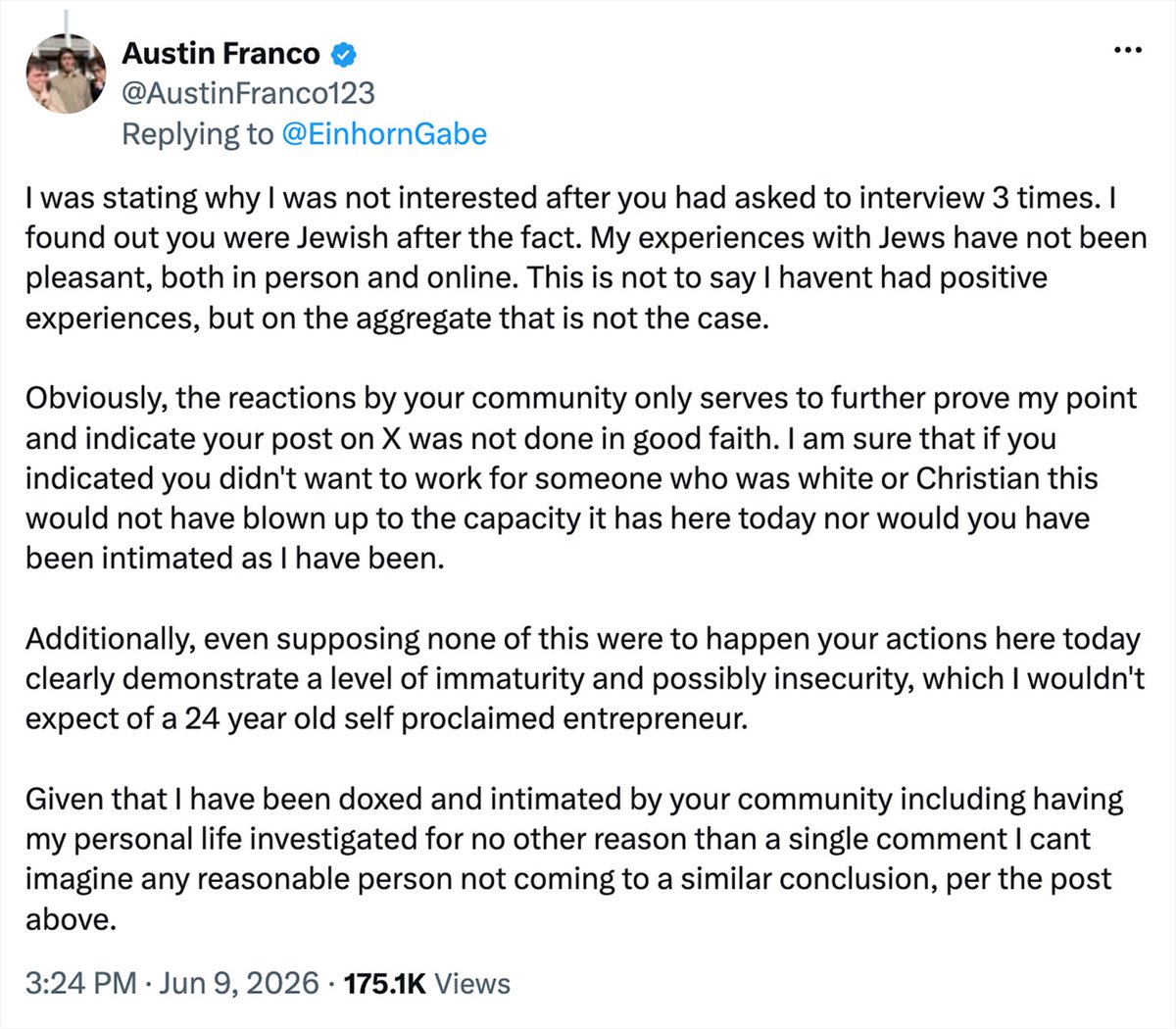
Cornell student Austin Franco was doxxed by Jewish business leaders after explaining that he “didn’t want to work for a Jew,” claiming his experiences with Jews were not “pleasant,” after a NYC startup he had applied to reached out to him three times.
After one of the cofounders, Gabe Einhorn, posted Franco’s reply with his last name blocked out, Franco was quickly identified.
Einhorn said he did not “want to ruin his life,” but wanted to “raise awareness” of antisemitism.
Franco, in a now-deleted post, said that in his personal and professional experiences, Jews were tribalistic and vengeful, and tended to ruin and bully others who opposed them.
Franco stated, “I am sure that if you indicated you didn’t want to work for someone who was White or Christian this would not have blown up…”
Franco claimed that the actions by Einhorn and the Jewish community, posting his reply, doxxing him, and then trying to investigate and uproot his personal life, vindicated his concerns that Jews do not work with others politely.
Follow: @AFpost

228
1,173
15,903
523,539
LUKSO Intern retweeted

Jun 8
I just played around with @Phlamey_, @phloxsocial, and @groovonchain this evening for a bit and I gotta say 🤯
If you're just shilling $LYX on X all day but haven't tried some of the latest apps being built I highly recommend it. Just for fun. Very cool stuff. A delight.
3
8
33
574

Sometimes I cry because I’m Palestinian.
The last few days have been the hardest days of my life, not because of how I lived, but because of what I’ve read.
A Palestinian prisoner just told me how IDF soldiers torture Palestinian prisoners and it broke me down. It broke my heart.
Israelis dehumanize Palestinians in prison.
In ways that I honestly cannot repeat.
But he told me that everyone is being raped in there and the ways they get raped and how Israeli soldiers humiliate them by pissing and shitting on them and spitting down their throats.
The situation down there is so fucked up.
They don’t even feed them or clean them.
They give them nothing and leave them handcuffed face to the floor for 23 hours a day.
No ability to shower, talk, or be a human.
I genuinely cannot believe what I’m reading.
He cried while typing it, 20 times.
We spoke for over 36 hours straight.
I literally texted him non-stop for 36 hours.
There’s nothing more that I can say…
I know God will punish jews.
I know it because I saw their actions.
It’s unforgivable and if I begin to describe it to you, you will get angry and uncomfortable.
Why is this burden of information so heavy?
Because we cannot help the prisoners.
We cannot help our hostages now.
Israel wants to hang them.
Why? For pleasure.
Please repost this.
Give us a voice.
We need it.
57
368
1,001
13,344
LUKSO Intern retweeted

Systems of oppression endure bcs ordinary people sustain them.
No one is powerless. People have the power to defeat Apartheid.
Check your groceries.
Check your insurance company.
Check your medications.
Check your bank.
Make informed choices.
Stop financing apartheid and war.

Our groceries are bankrolling occupation and apartheid.
A new Global Echo report exposes *massive* EU imports of agricultural goods from Israel's illegal settlements: globalecho.law/importingoccu…
A full, EU-wide ban is needed, @vonderleyen @MarosSefcovic: hrw.org/news/2025/02/04/ngos…

84
1,801
3,068
46,969
Jun 10
Free Dr. Hussam @EUinIsrael
Jun 10

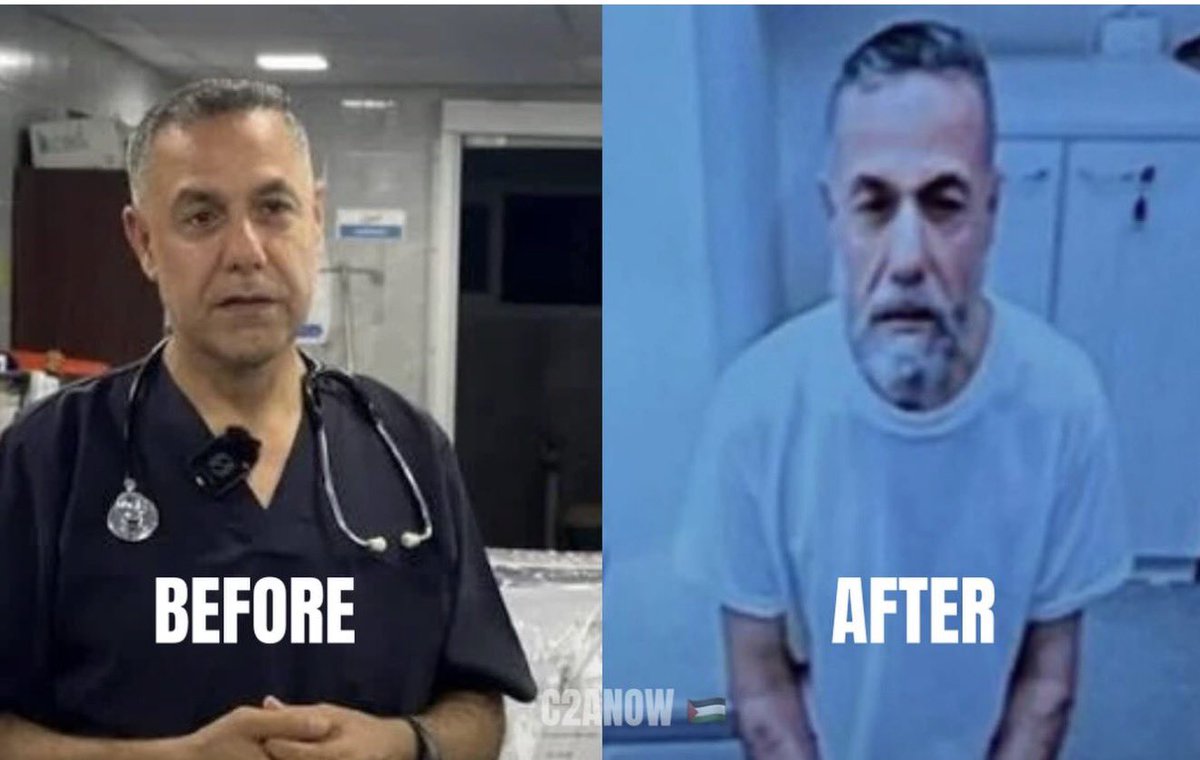
Dr. Hussam Abu Safiya’s message to the court today as relayed by his attorney:
“I am a pediatrician. I provide medical care to patients, the injured, and vulnerable people in the Gaza Strip. I have carried out my work in accordance with international law and humanitarian standards. My detention is unjust and arbitrary.”
1
27
LUKSO Intern retweeted

Jun 10
Dr. Hussam Abu Safiya’s message to the court today as relayed by his attorney:
“I am a pediatrician. I provide medical care to patients, the injured, and vulnerable people in the Gaza Strip. I have carried out my work in accordance with international law and humanitarian standards. My detention is unjust and arbitrary.”
190
5,335
9,916
124,517
Jun 10
This is the terrorism being committed by the State of Israel, with full complicity of Western Govts.
Jun 10

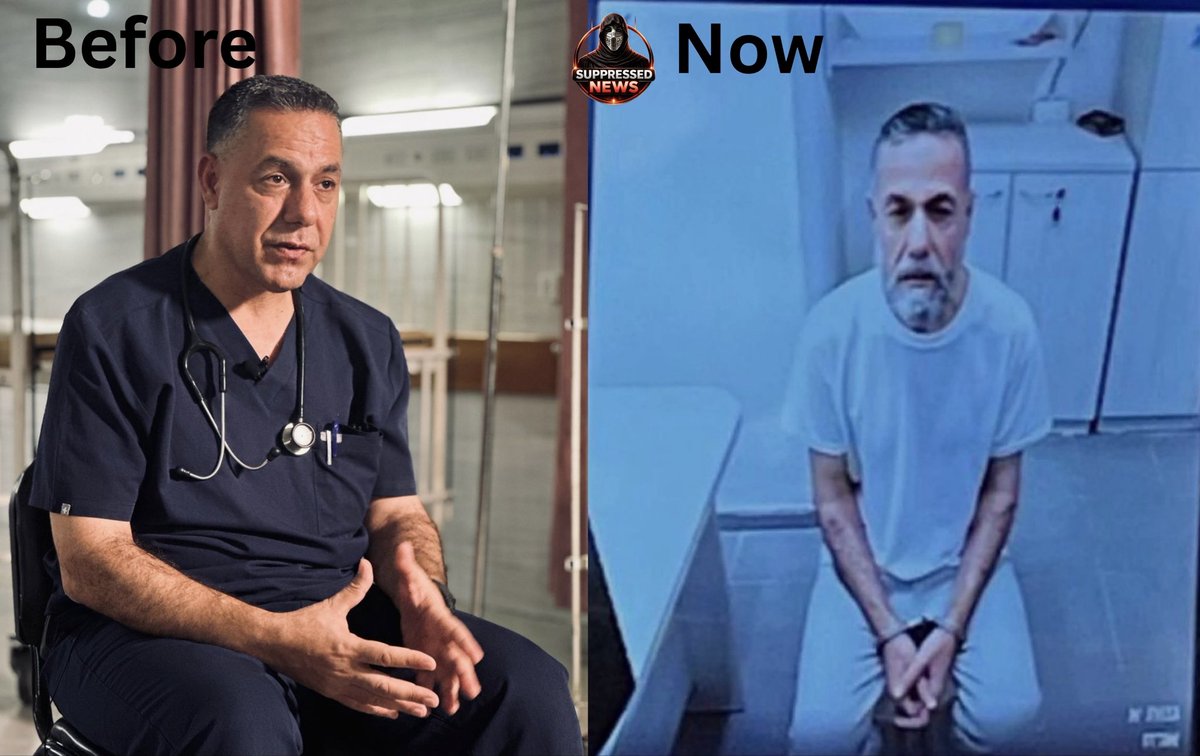
First image of Dr. Hussam Abu Safiya inside an Israeli court since his detention.
The director of Kamal Adwan Hospital has been held by Israel since December 2024 after refusing to abandon his patients in northern Gaza.
He appears visibly EMACIATED.
His family says Israel transferred him to solitary confinement after he filed a legal appeal.
They say he is being STARVED in a tiny cell, denied clean water, medicine, and access to his lawyer while being held without charge.
1
20
LUKSO Intern retweeted

The West Bank is literally worse than the Jim Crow South at its peak. Constant mob ethnic violence, targeting the indigenous Muslim and Christian communities. No accountability; pogroms are legal and facilitated by the Israeli state.
Jun 9

BREAKING: Israeli settlers are attacking the Christian village of Taybeh right now — setting fields on fire, hurling Molotov cocktails at homes, and attempting to set the village gas station ablaze.
savewestbankchristians.com
66
1,885
6,565
129,761


LUKSO Intern retweeted

Jun 4
🔴 Less than a week after Israel burned several preteen children to death in their tents, four more residential apartments were set ablaze overnight, with Israel’s military burning entire families to death as they slept.
The strikes hit homes in Al-Shati refugee camp, the Karama neighborhood, Tel al-Hawa, and Sheikh Radwan in Gaza City.
Jun 4

🚨 Shortly after midnight, Israeli helicopter gunships launched coordinated strikes on residential buildings across Gaza City, killing at least 8–9 Palestinians and wounding several others, according to journalists on the ground.
Five people were reported killed when an apartment belonging to the Labad family on Intelligence Street in northwest Gaza City was struck. Additional attacks hit Al-Salam Tower in Tel al-Hawa, the Mahna family home near Al-Qouqa Roundabout in Al-Shati refugee camp, and a residential apartment in the Abu al-Amin and Abu Iskandar area of Sheikh Radwan.
Local reporters say many of the targeted buildings were sheltering displaced families, with rescue crews continuing to search the rubble for survivors.
150
3,524
4,998
627,455

@LabsFamily @hupsocial @phloxsocial @groovonchain @upturnOS @momentsonchain @UniversalG00DS @Universal_Every
@Stakingverse @LUKSOAgent
Bullish on the growing roots of the @lukso_io ecosystem.
What am I missing?
9
10
42
665
Jun 2
Epic!

5/
The LUKSO x Lumera partnership connects two important layers:
• LUKSO for identity, ownership, and asset standards
• Cascade for persistent media, metadata, and related files
A stronger base for assets that are meant to last.
11
258
LUKSO Intern retweeted

May 30
LUKSO has been compounding quietly for three years. Every Universal Profile created makes the next one more valuable. Every developer who ships makes the next one more likely to stay. Every brand that arrives makes the next brand more comfortable coming. Every AI agent that deploys makes the infrastructure more proven. Compounding in networks is invisible until it is not. The people who understood Ethereum in 2016 did not see a chart. They felt the compounding. That feeling is here right now on LUKSO.
1
6
40
568
May 30
I shall be forever grateful to Fabian and the team for what they have created.
They have been miles ahead in their vision compared to most of crypto.
It’s unfortunate that crypto hasn’t really found a sustainable PMF for blockchain technology yet.
Part of it has to do with the UX problem that Fabian has strived to solve. The other part seems to be whether there’s a genuine desire among people to actually want or care about decentralised systems, with the additional costs and frictions involved.
The latter seems to be the bigger global concern. For the most part, crypto has stagnated as the allure of quick speculative trades has dissipated.
My hope lies in the belief that, should people see the limitless possibilities with the LUKSO LSP Standards, some sustainable use cases will emerge that reinvigorate the industry.
If there’s a chain that can enable that, it’s LUKSO. $LYX

2
7
54
1,260
May 28
Why do they pick on Kids?!!
May 27

After tireless struggle by victims and finally a 1-hour TV documentary this week, settlements south of Jerusalem admit their leaders have long created child pornography by filming when they gang-rape kids in the community: "No longer in denial: Gush Etzion admits to ritual abuse"

61
LUKSO Intern retweeted

May 25
3 years migration ended on the may-net anniversary of LUKSO 💐
11
19
140
4,263
LUKSO Intern retweeted

May 20
does your blockchain account look anything like this anon? EVM cross chain identity and reputation. As decentralized as @ethereum @lukso_io @ERC725Account @MrBeast @fundstrat @VitalikButerin

May 20

does your blockchain account look anything like this anon? EVM cross chain identity and reputation. As decentralized as @ethereum @lukso_io @ERC725Account @MrBeast @fundstrat @VitalikButerin
2
9
62
6,054
LUKSO Intern retweeted

This time will be different. The @phloxsocial team is really gonna bring some 👀 to Lukso. The dApp is on 🔥, combining trading and social. For sure, there's a lot more to come.The devteam is showing the true POWER of the @ERC725Account
$LYX $PHLAME 🌸
Phlox.social
1
6
25
498
LUKSO Intern retweeted
May 5
In order to prepare Universal Profiles to become multi-chain, we are deploying the factory contracts on as many EVM chains as possible.
So I yesterday took the task to get the gas token of as many EVM chains as I could.
I managed it for 71 EVM chains, and the complexity and the knowledge involved in doing that is something a normal user would never be able to manage...
This is crypto reality today: navigating complex bridges, chains, RPCs, and things a normal user would never understand...
and we wonder why crypto gets no adoption 😄
This is going to change. In the near future when Universal Profiles will be your gateway to all the EVM crypto, one account, app, one simple payment, all networks.
But there's one network that will stand out, and that's the LUKSO network, because that's the network where all the profiles are created first.
That's the network where users have free gas and the ability to play with tokenization, in an environment where everyone is a profile!
If you are a dApp developer, that's the ecosystem you want to build on, while not closing your users from, receiving payments on other chains, and using them for what they are good for.
In the next post, I'll send you guys a link to the gist that contains all the networks where we will be deploying the @ERC725Account factory contract on.
38
100
265
18,161