
Phd. Economics. Universitat Autonoma de Barcelona.
Joined October 2021
- Tweets 188
- Following 348
- Followers 32
- Likes 338
3 Photos and videos

IsabelBusom retweeted

May 28
Reposting with correct link and apologies:
For those who may have missed earlier tweets. Pascal Lamy, Enrico Letta, Beatrice Weder di Mauro, and I have launched a Europe 2050 project, asking a number of experts and policy makers where they want Europe to be in 2050 and how , concretely, how we can get from here to there. We put the contributions on the web as they come. The page cepr.org/europe-2050-geometr… has, so far, postings by Alan Wolff, Enrico Letta, Yuriy Goronidchenko, and Eric Lombard. As well as important background contributions by Mario Draghi, Mark Carney, Pascal Lamy, Anne Applebaum. And a manifesto discussing the project. Many more contributions to come. I shall tweet them as they do.
3
19
65
9,542
IsabelBusom retweeted

May 26
✏️Lean a los dos tipos que más saben de educación en España: @lucas_gortazar y @jmontalbancas en este excelente Policy Brief de #EsadeEcPol
Resumen: la reducción de ratios es una muy ineficiente política educativa (¡hagan tutorías en pequeños grupos, que es mucho más rentable y efectivo!) 👇🏻

1/11 🧵 Hoy con @jmontalbancas publicamos nuestra valoración económica de la Ley de reducción de ratios y horas lectivas en Primaria y Secundaria, ahora en tramitación parlamentaria. Es la legislación reciente que más presupuesto movilizará a medio y largo plazo. 👇
4
15
28
7,232
IsabelBusom retweeted

May 26
A post about Pope Leo XIV's encyclical on AI. Why the Pope is right, but perhaps not right enough.
Artificial intelligence is reshaping the world in front of our eyes: how we communicate, how we access information, how we work, how income and status are distributed among us, and soon how we fight and kill each other. Yet the public conversation about AI remains stuck on the minutiae of competition between labs, or on a false dichotomy between AI as a “stochastic parrot” with no real capabilities and AI as an alien superintelligence poised to take command of humanity.
The more important questions are about what we want from AI, and whether our current mindset, institutions, and control mechanisms are equal to the task of steering it toward our welfare.
It is refreshing, then, that a bold and powerful voice has weighed into this debate: Pope Leo XIV. As an economist who has long argued that technology is a matter of choice rather than fate, I find Leo’s intervention welcome and, on most points, on target. But on the most consequential question of what AI should actually be designed to do, Leo stops short.
Secular readers may bristle at the encyclical’s opening invocation of the Tower of Babel. They would be mistaken to stop reading there. Leo goes much further than most pundits, journalists and policymakers in the United States by recognizing that what happens to AI, and hence to humanity, is a under our control. There are multiple possible paths for AI, and which one we take will have sweeping consequences. He is also ahead of many commentators when he writes forcefully and unequivocally that “technology is never neutral, because it takes on the characteristics of those who devise, finance, regulate, and use it.”
These were the central themes of the book I wrote with Simon Johnson, Power and Progress: Our Thousand-Year Struggle over Technology and Prosperity. It is heartening to hear them taken up by a voice with Leo's reach.
The Pope is also right to question the current trajectory of AI in warfare and law enforcement. What was taboo only a few years ago – AI-driven mass surveillance, algorithms selecting targets for killing – has become routine. Many in Silicon Valley are now calling openly for a new military-algorithmic complex centered on AI as an instrument of American hard power. Leo captures something deep and too often ignored: “Any technology that facilitates attacks without seeing the face of human beings lowers the moral threshold of conflict.”
His call for the “disarmament of AI” follows directly from these observations. As he explains, disarming AI means “freeing it from the mentality of ‘armed’ competition, which today is not limited simply to the military context, but is also an economic and cognitive phenomenon.” His moral clarity in stating that “there is no algorithm that can make war morally acceptable” should be a warning to technologists rushing to design new weapons of mass destruction.
Underneath these specific concerns lies a more fundamental claim: that what is technically feasible is not the same as what is good for humanity, and that the difference depends on who controls the technology and what ideology and interests guide them.
Leo edges toward what I take to be the most important point about AI's future when he observes that “while AI promises to boost productivity by taking over mundane tasks, it frequently forces workers to adapt to the speed and demands of machines, rather than designing machines to work with those who work.”
But here he does not go far enough. He stops short of questioning the prevailing design philosophy of AI itself: a philosophy centered on mimicking human capabilities and automating human tasks, with the ultimate goal of artificial general intelligence (AGI) that can do everything a person can.
This philosophy rests on a mistake. It assumes that artificial intelligence and humanintelligence are fundamentally similar, and therefore machines should naturally take over whatever humans currently do. Yet these intelligences are fundamentally different.
Humans are “one-shot” learners. We form hypotheses from a few examples, mentally simulate possibilities, and refine our understanding through a social process of trial and error. This is how children learn language - imitating a few words, generalizing, and adjusting based on how others respond. We are not, however, very good at absorbing massive volumes of information or sifting through unstructured data for relevant patterns.
AI models are almost the opposite. They thrive on enormous training sets and excel at pattern recognition at scale. But they have, as yet, no genuine creativity, no real-world embodiment, and no capacity for trial-and-error learning grounded in interaction with the physical and social world.
When two things are different – you shouldn’t, and typically you couldn’t – use one to mimic the other. If you did, you would end up with suboptimal, disappointing results. It would have been a colossal mistake, and the Chicago Bulls’s legendary coach Phil Jackson would have gone down in the annals of basketball as one of the worst coaches in history, if he decided in the 1990s that because Michael Jordan was the better player, Jordan should mimic everything that Scottie Pippen and Dennis Rodman were doing in the team. The team went from championship to championship because these players worked together and complemented each other.
The same applies to AI and human skills.
The more productive path is complementarity – using AI to do what humans cannot, so that humans can do what they do best. An electrician aided by AI diagnostics, a nurse supported by AI in interpreting symptoms, a teacher using AI to personalize instruction for each student; these are the contours of a different AI future, one that raises rather than displaces human capability.
Optimists and industry insiders will respond that automation-first AI can still benefit everyone, provided redistributive policy keeps pace. But this argument has a poor track record. Forty years of digital automation have already concentrated gains at the top, hollowed out middle-skill work, and produced disappointing aggregate productivity growth. There is little reason to expect that an even more powerful round of automation, deployed by even more concentrated firms, will end differently. We can and must demand a different design.
The global stakes from the future of AI are even larger than those we can see around us in the United States. For the developing world, where billions still depend on the prospect of decent jobs as a path out of poverty, an automation-centric AI agenda is not merely suboptimal. It is simply transferring to foreclose the most important route to broad-based prosperity.
The biggest failing of today's AI industry is its refusal to recognize any of this. It is guided instead by an ideology of control (the industry’s own over humanity) and by a conviction that machines are uniformly better than humans.
As Leo rightly notes, this failure is enabled by the fact that a handful of companies now command the future of AI.
What we need is a combination of moral clarity and a serious, society-wide debate about what AI can do and what we want it to do. That debate must move beyond exhortation toward concrete choices: antitrust action against the dominant platforms, public investment in human-complementary AI, regulation of surveillance and autonomous weapons, and meaningful rights for workers and citizens over the data on which these systems are built.
The Pope's intervention makes such a debate a little more likely today than it was before.
It is now up to the rest of us to carry it further than he was willing to go.
40
333
945
136,742
IsabelBusom retweeted

May 16
Cuando doy un paso atrás me alucina que en España se hayan formado 1,2 millones de nuevos hogares, construido menos de medio millón de viviendas para ellos... y tengamos el debate supuestamente progresista entregado a qué pasa con 12.000 licencias turísticas casi todas en Barcelona centro, o en si hay más o menos propietarios con 2, 3 o 4 pisos.
La MAGNITUD del problema no se calibra desde Arganzuela o Gràcia. Se calibra en las periferias de nuestras ciudades en las que la nueva demanda tiene que subdividirse un espacio disponible que es casi fijo porque la oferta es incapaz de responder. Yo de verdad sabéis que veo la vivienda como un problema complejl que necesita de soluciones ajustadas a cada problema, a cada zona. Me gustan ideas como impuestos bien diseñados para vivienda turística en zonas saturadas o agresivos a la vivienda vacía o de bajo uso.
Pero todo eso debería ser totalmente secundario ante la enormidad del déficit, y sobre todo a quienes más está afectando, que no somos ni tú ni yo.
Primero y ante todo, construir. Eso es lo progresista para mí.
42
174
476
39,320
IsabelBusom retweeted
May 13
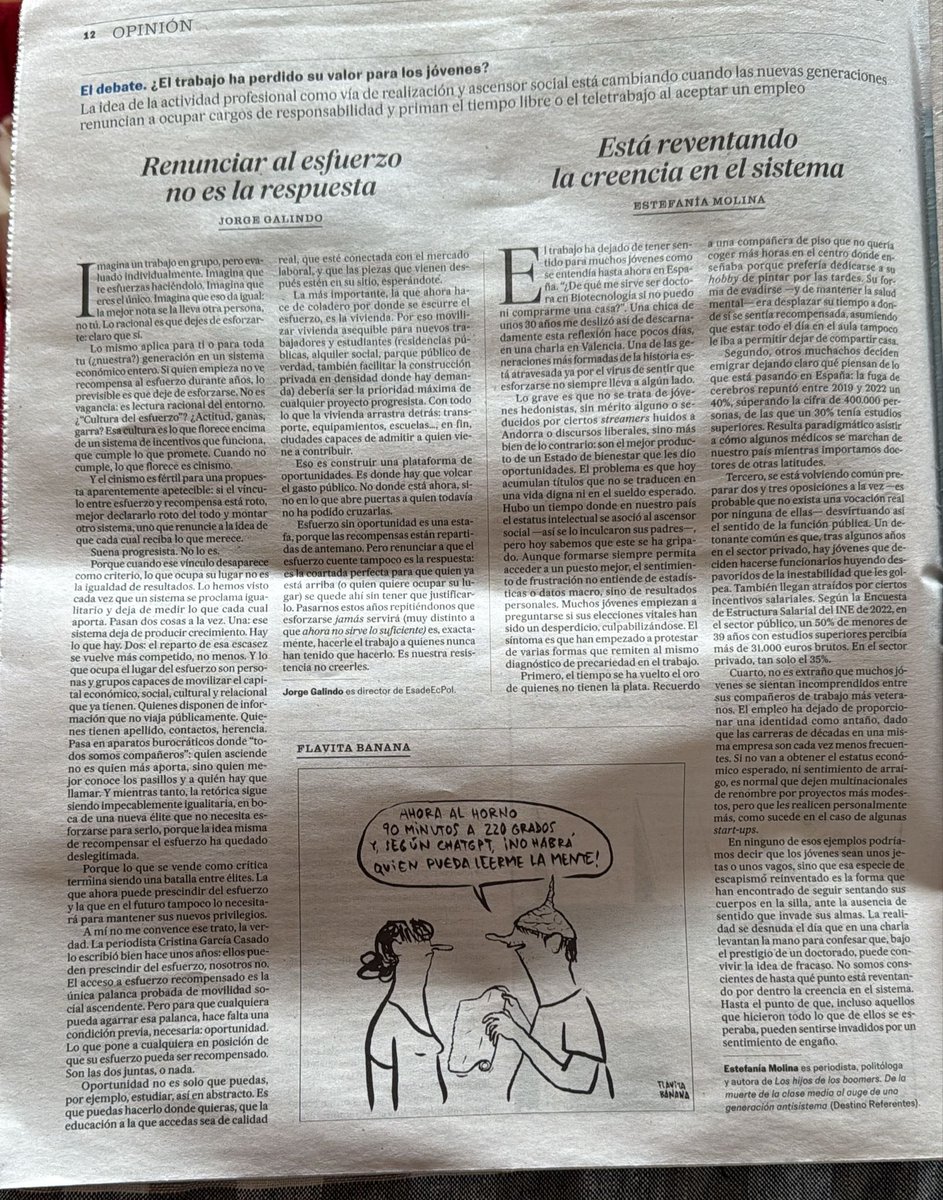
Hoy comparto página con @EstefMolina_ para decir cosas, creo, complementarias.
Mi punto: renunciar a recompensar el esfuerzo es una trampa. Esfuerzo recompensado oportunidades accesibles = la única fórmula que facilita de verdad la movilidad social ascendente.
3
13
38
5,586
IsabelBusom retweeted

Buena explicación.

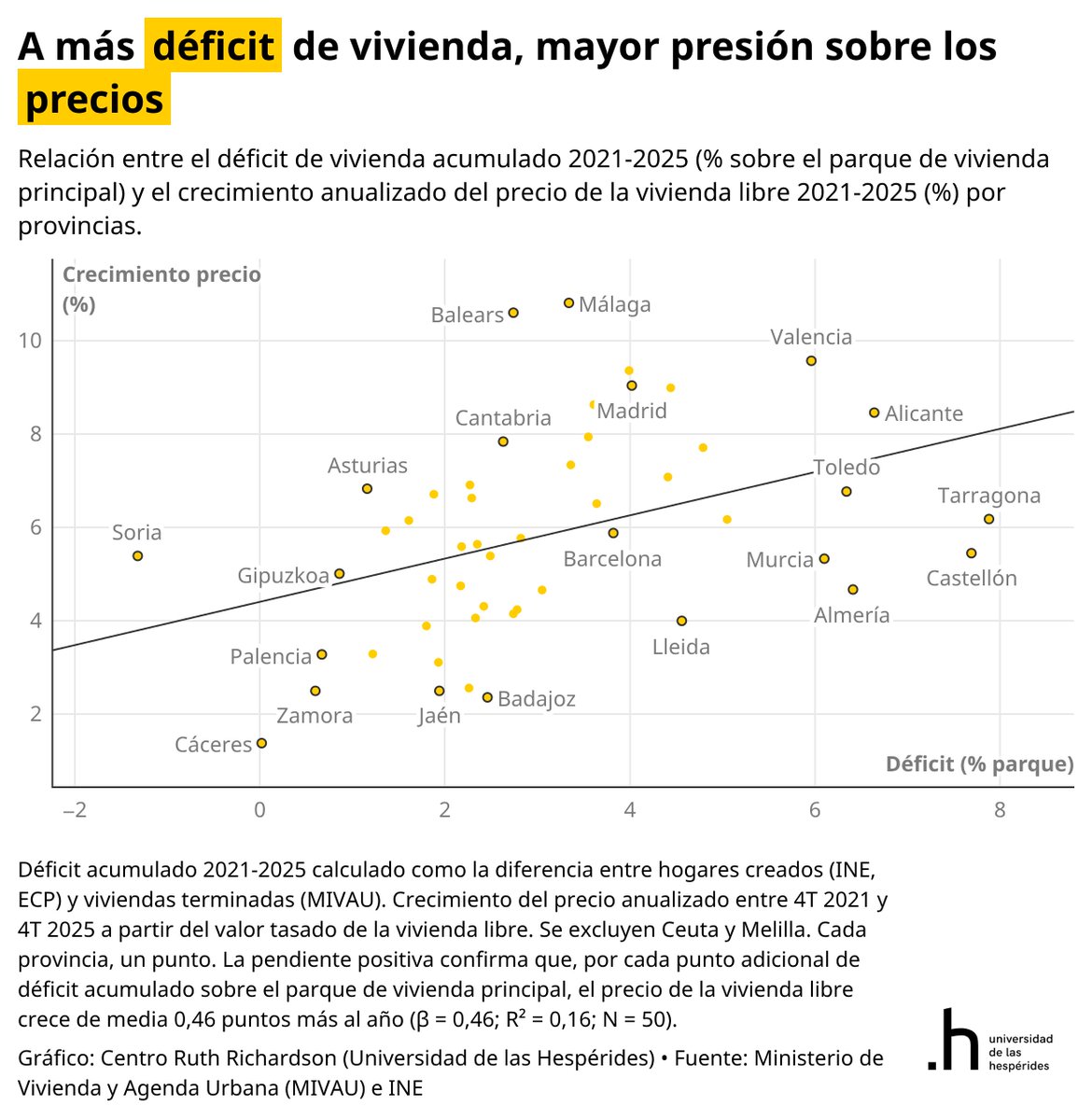
Se ha extendido la idea de que el problema de la vivienda es el rentismo: que da igual cuánto se construya, los precios suben porque "unos pocos" acaparan y especulan. Los datos provinciales no cuentan esa historia.
Si cruzamos el déficit acumulado 2021-2025 (oferta nueva insuficiente respecto a hogares creados) con el crecimiento del precio de la vivienda libre. La correlación es positiva y robusta: por cada punto adicional de déficit sobre el parque, el precio sube 0,46 puntos más al año.
Las provincias donde más se ha tensionado la oferta son también las que registran las mayores subidas de precio.
Si la pregunta es por qué sube el precio de la vivienda en España, la respuesta empírica más robusta sigue siendo la más sencilla: faltan viviendas donde más se necesitan.
1
41
IsabelBusom retweeted
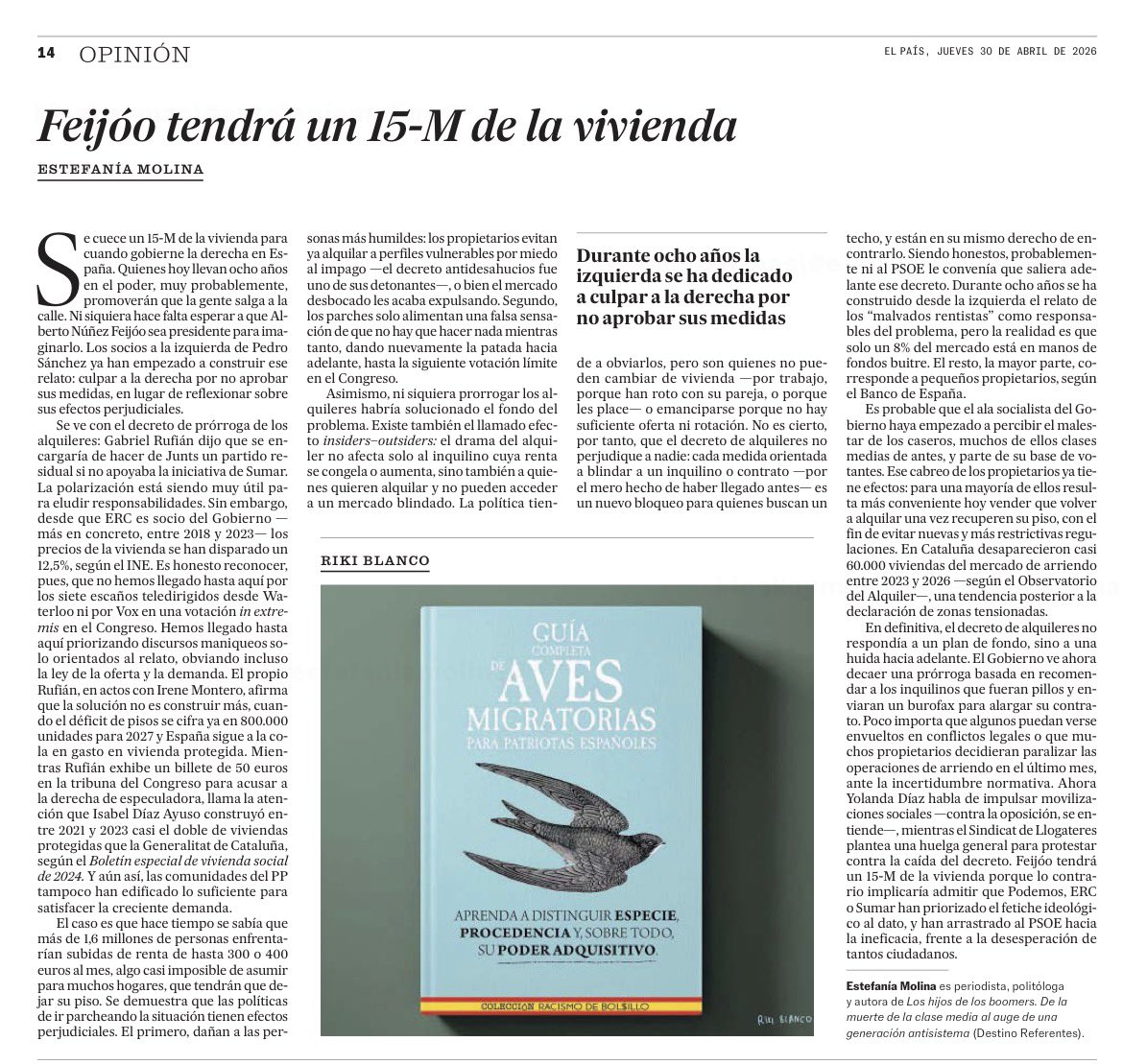
.@gabrielrufian jamás ha respondido ni a uno de mis tuits o artículos explicando por qué sus políticas sobre vivienda están siendo muy perjudiciales para la gente humilde en España. En cambio, hoy retuitea supuestas críticas a mi libro, por tener de prologuista a otro ciudadano que no se dedica a la política, con independencia de cual sea su trabajo. Jamás usaré esos métodos porque yo tengo argumentos para defender mis tesis. Es el periodismo en el que creo, el de datos y razonamientos. Mi respuesta es esta, Gabriel. Encantada de debatirlo cuando quieras, desde el respeto. Ahora dime si hay un solo dato falso. O quizás esto solo va del quién, no del qué.
96
251
995
47,021

"No poner que tienes una empresa no es un error, es una ocultación". @Perestupinya y Javier Sampedro (@padreoms) sobre por qué la retirada del estudio de Barbacid sobre el cáncer de páncreas por conflicto de intereses refleja una mala práctica.
6
76
268
32,220
IsabelBusom retweeted

Apr 26
Así es. Se puede ser de izquierdas o de derechas sin tener que hacer las cuentas mal.
Se puede llegar a acuerdos entre gentes de izquierdas y derechas que hacen las cuentas bien.
Mientras no entendamos eso, gobernarán unos y otros dependiendo de los que no saben hacer cuentas.
2
3
10
1,106
IsabelBusom retweeted
Apr 26
Hay que inundar, literalmente llenar, colmar, de evidencia sólida, rigurosa, analíticamente relevante el debate de las cosas que importan. Vivienda, crecimiento, desigualdades, pensiones, pobreza, educación, sanidad, demografía.
Hay que hacerlo. Una contraofensiva.

#LoMásLeído📰 Jon González: «El debate público está dominado por la narrativa, no por datos y evidencia reales» abc.es/economia/jon-gonzalez…
23
243
770
37,358
IsabelBusom retweeted
Apr 24
Honestamente, Eduardo: lo que es inadmisible es que sigáis argumentando que "ojo con construir porque cuidado con quién se lo queda" con CERO evidencia detrás... y a cambio esa mucha gente se queda sin acceder a su primera vivienda PRECISAMENTE PORQUE NO QUERÉIS QUE EXISTAN.
Apr 24

Es alucinante ver las acrobacias que hacen algunos para defender lo indefendible.
Que una minoría acapare tantísimas viviendas y se hagan de oro con ello mientras mucha gente no puede acceder a su primera vivienda es inadmisible, se mire como se mire.
17
100
384
30,459
IsabelBusom retweeted

Últimamente no he colgado nada en español porque la situación en España me deprime bastante.
Un ejemplo es este anuncio del PP sobre ocho medidas si llega al gobierno, que aquí incluyo.
Fijémonos en estas ocho medidas. Una, la ley sobre ELA, afecta a una minoría muy pequeña del país. Sí, tener esta enfermedad es una desgracia, pero estamos hablando de 900 casos al año en un país que se acerca ya a los 50 millones de habitantes. Es “buenismo” en su manifestación más mediocre. Otra, bajar el IVA de los productos básicos, es demagógica y en contra de la teoría económica básica. Modificar la Ley Presupuestaria para que haya un mayor control sobre el gasto en defensa y seguridad resulta irrelevante. Y las otras varían entre lo necesario pero no muy importante (la independencia del CIS) y lo esperpéntico (modificar la Ley de Costas).
España tiene cuatro problemas existenciales:
1) Fecundidad.
2) Inmigración.
3) Falta de crecimiento de los salarios reales.
4) Vivienda.
Ni una de estas medidas tiene nada que ver con 1)-4) (excepto, de pasada, la ley antiocupación). ¿Por qué? Porque cualquier cosa que de verdad contribuya a la solución de 1)-4) implicaría sacrificios para los votantes del PP: personas de más de 55 años que quieren dejar todo como está. De hecho, la ley antiocupación se menciona porque protege los derechos de propiedad de los mayores.
Feijóo y el PP, más en general, tienen la idea del futuro de España de una ameba porque a sus votantes el futuro de España les trae el fresco mientras su pensión se pague y el precio de su piso no caiga.
Y nada de lo que yo (o cualquier otro) pueda decir será capaz de mover ese macizo carpetovetónico.

242
1,846
5,383
403,572
IsabelBusom retweeted

Apr 22
🏠 ¿Por qué no se soluciona realmente el problema de la vivienda en España? Para empezar, porque el debate público está tomado por discursos y mitos, no sustentados en ningún dato, pero que algunos gurús —y políticos— repiten a diario. Desmonto a continuación (y en el vídeo):
❌ “Construir es especulador (y facha)”.
✅ La realidad: la escasez de vivienda está provocando chabolismo en la gente humilde por encarecimiento brutal de la vivienda.
❌“No hay que construir más”.
✅ La realidad: a 2026 teníamos un déficit de 700.000 pisos, llegan 500.000 personas al año, se crean 200.000 familias al año. No salen los números.
❌ Los pisos ya existen en algún lugar.”
✅ La realidad: el INE calculó esas supuestas 3,8 millones de viviendas a partir del censo de la luz, pero varios estudios lo desmontan (la propia Colau lo reconoció en el caso de Barcelona, que no había ni el 1% de las viviendas esperadas).
❌ “En la crisis inmobiliaria se construía mucho y no bajaban los precios.”
✅ La realidad: la burbuja no vino por la oferta en sí, sino por la burbuja de crédito.
❌ “Hay pueblos que pierden población y no bajan los precios.”
✅ La realidad: obvio, población no es demanda directamente. Puede bajar lo primero y subir lo segundo (gente se emancipa, nuevos hogares, etc).
❌ “El problema son los pisos turísticos.”
✅ La realidad: son el 1,3% del parque de alquiler en Barcelona. Poco relevante.
❌ “El problema son los fondos buitre.”
✅ La realidad: España es un país de pequeños propietarios y la propiedad no está concentrada. Los fondos buitre solo poseen el 8% del parque de alquiler.
¿Por qué no se construye?
⚫️ Los baby-boomers tienen casa en propiedad en más de un 90%, por tanto, al bipartidismo no le hace perder esos votos, los que realmente le importan.
⚫️ La gente ha invertido en España mayoritariamente sus ahorros en la vivienda, nadie quiere que bajen los precios.
⚫️ Muchas familias no están empobrecidas gracias a la segunda residencia que ponen en alquiler. Es un complemento para la clase media hundida.
⚫️ Líos del sector y la regulación.
⚫️ Es caro para el Estado y las CCAA, y a muchas empresas no les sale rentable.
⚫️ Discursos anuméricos solo orientados a batallas culturales para distraer la atención.
Gracias al podcast Educa tu dinero por dejarme expresarlo.
151
796
1,857
199,377
IsabelBusom retweeted
Apr 13
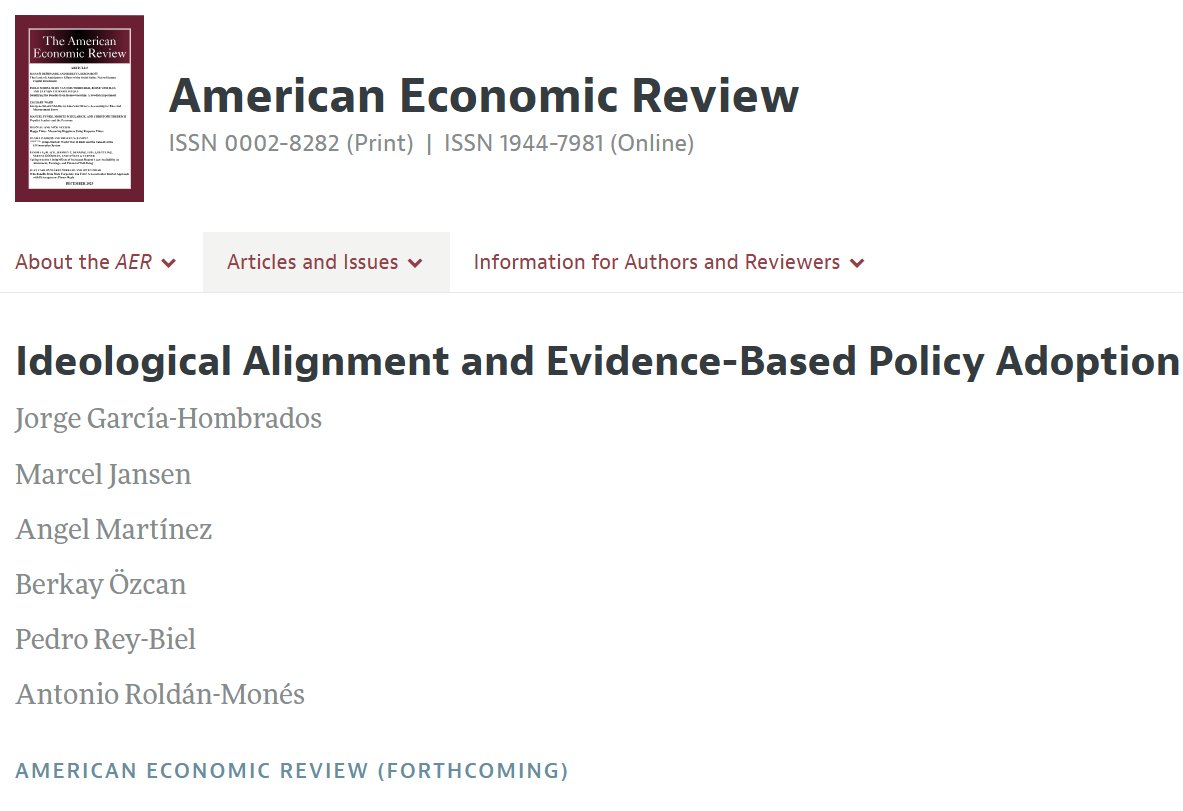
I am very happy to share that our paper, “Ideological Alignment and Evidence-Based Policy Adoption,” is now published in the American Economic Review (#AER). This is a hugely ambitious project that has taken more than four years of work together with an amazing team of co-authors.
We conducted a nationwide #RCT involving over 5,000 real local politicians, as well as national think tanks, newspapers, and a leading global academic institution, to answer a simple but very important question: does the political “colour” of the messenger influence policy implementation?
One of the central challenges of the #evidence-based policy agenda is turning evidence into actual policy. From my experience in politics, this is far from straightforward: evidence has limited value if it does not translate into policies that improve people’s lives. Why is it so difficult to persuade policymakers to adopt policies with strong empirical backing? If the evidence is there, why are these policies so rarely implemented?
🔬 In our study, we address this by sending identical information about an evidence-based policy to local policymakers, introducing variation only in the #messenger of the policy: a non-ideological research institution versus think tanks and newspapers with clear ideological leanings. The policy itself is a recommendation - strongly supported by evidence- that improving a municipality’s Wikipedia page increases tourism.
We find that policy adoption increases by 65% when the information comes from a source perceived as ideologically aligned with the policymaker. In contrast, ideologically opposed institutions have no effect.
Publishing in what is arguably the world’s leading academic journal is a dream for any economist. For me - having stepped away from academia for politics - the joy is even greater.
🙏 I am deeply grateful to all my incredble co-authors for their generosity of offering me the opportunity to share this project with them, and for everything I have learned throughout this process. I also want to thank all the collaborators and RAs that have contributed, as well as across institutions, including eldiario.es, El Mundo, Alternativas, FAES, and FEMP, as well as the support from the Social Research Call of La Caixa and the Wikimedia Foundation.
aeaweb.org/articles?id=10.12…
@IEuniversity @iespega @EnricoLetta @manuelmunizv @Borjamonde @JuanSantalo
10
86
335
48,350
IsabelBusom retweeted
Apr 14
🤔🔘 ¿Qué efectos cabe esperar de la regularización migratoria aprobada hoy?
📊 La evidencia internacional y española muestra que las regularizaciones mejoran la integración laboral, aumentan la contribución fiscal y no perjudican a los trabajadores nativos.
🇪🇸 La regularización de 2005 (~600.000 personas) no generó «efecto llamada», aumentó el empleo formal y la recaudación (~4.000€/año por trabajador), sin incremento significativo del gasto en sanidad o educación.
⚖️ No cayeron los salarios nativos, aunque algunos trabajadores informales de baja cualificación sí perdieron empleo: de ahí la importancia de acompañarla con inspección laboral y programas de transición.
🏛️ El éxito dependerá de la capacidad administrativa: reforzar oficinas de extranjería, mejorar sistemas digitales y coordinar entre administraciones.
39
37
83
13,010
IsabelBusom retweeted

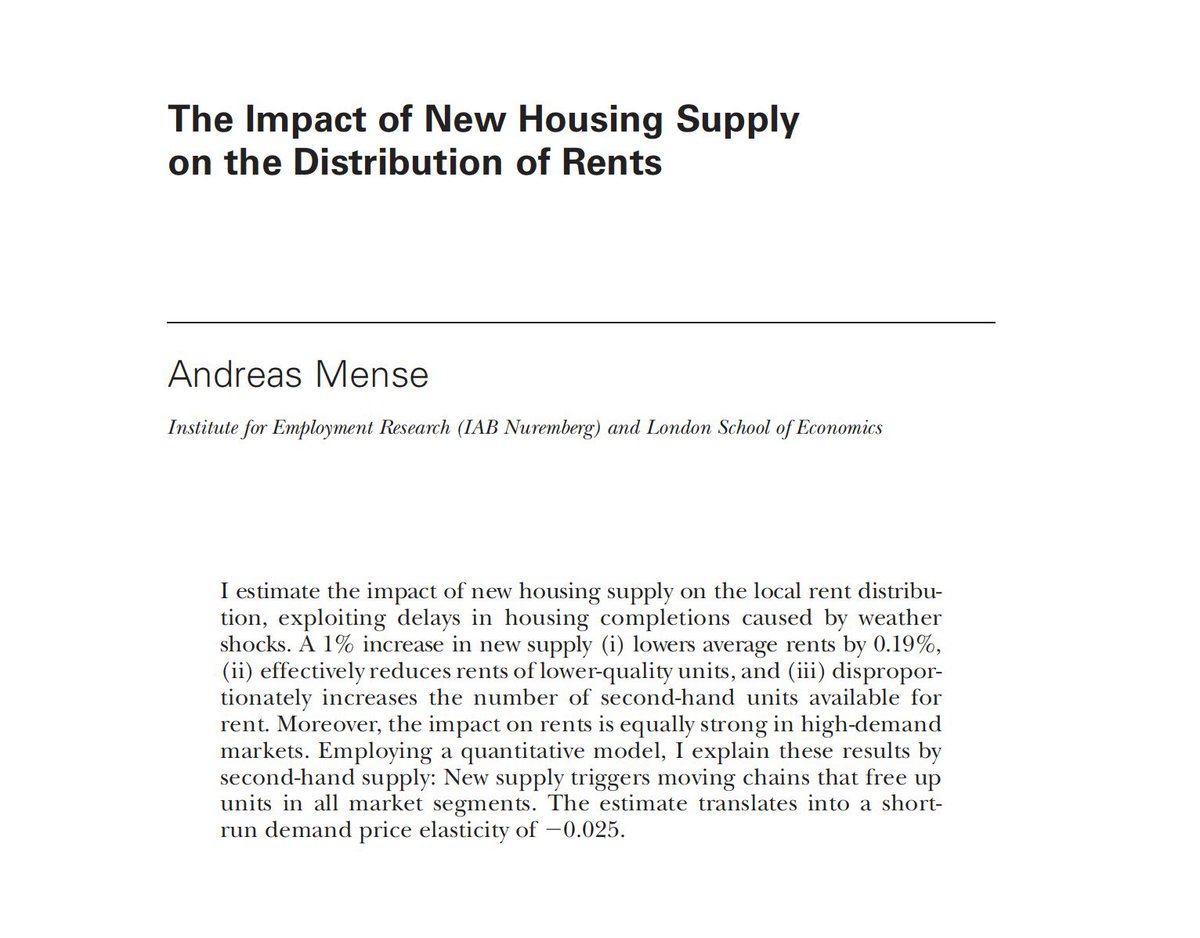
Recordatorio de que aumentar la oferta de vivienda reduce precios de alquileres. Estimaciones causales para Alemania (2010-2018) concluyen que:
✅Aumento 1% oferta reduce 0,19% precio alquiler medio.
✅Disminuye alquileres en todos niveles de precios.
journals.uchicago.edu/doi/fu…
4
36
63
6,255
IsabelBusom retweeted

Mar 18
Hot take for the future of peer review: Journals should start asking for a lightweight AI-based replication check (e.g., via Claude) at submission.
Not to replace reviewers, but to catch coding errors, logic inconsistencies, and reproducibility issues before a paper reaches them. At this point, many of these checks are fast, cheap, and automatable. There’s little reason to rely solely on human detection.
Even with restricted data, this is feasible. Authors can generate simulated datasets that preserve structure and run identical pipelines. The goal is just basic verification.
More broadly, we need to rethink how we use reviewer time. Not every submission needs 3 full human reviews. A more efficient pipeline might look like: editorial triage, AI-assisted checks/review, targeted human evaluation where it matters most. If done well, this could raise standards while reducing burden on the system.
13
13
133
30,040
IsabelBusom retweeted
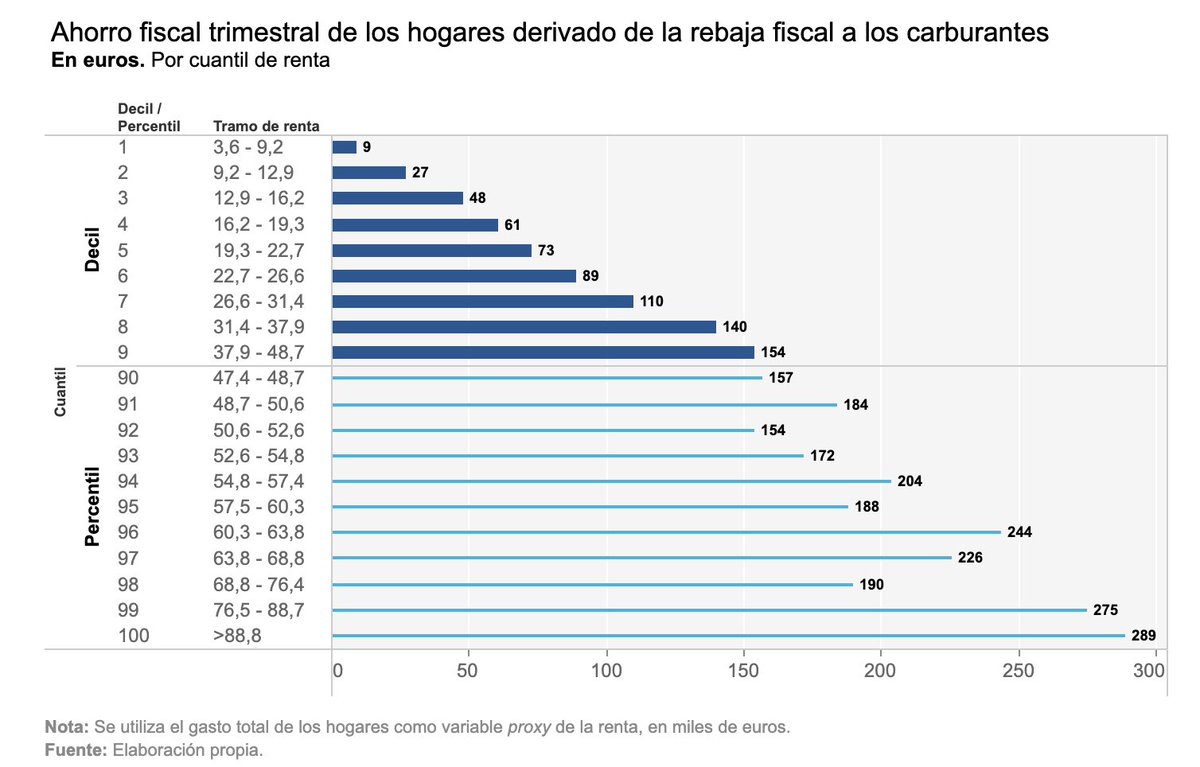
La rebaja impositiva a combustibles en España permitirá ahorrar una media de 90€ por hogar hasta junio (suponiendo que se traslade íntegramente a precios).
No obstante, la medida beneficia más cuanto mayor sea la renta, ahorrándose el triple las rentas altas (289€).
3
21
43
10,672
IsabelBusom retweeted
Mar 27
Firman: Antonio Cabrales y Samuel Bentolila. 💛 nadaesgratis.es/cabrales/el-…

1
5
16
2,498