
Professor of Economics at Yale SOM
Joined April 2009
- Tweets 13,440
- Following 490
- Followers 16,038
- Likes 5,631
276 Photos and videos
Pinned Tweet

22 Aug 2022
I thought I'd try to reconstruct Bryan's discussion with a 13-year-old about the minimum wage based on the below tweet:
(@bryan_caplan let me know if anything is inaccurate)
17 Aug 2022

Took me under 5 minutes to turn a normal, smart 13-year-old against the minimum wage.
Contrary to almost everyone, the textbook argument IS intuitive.
It's just emotionally unappealing.
40
458
2,733
*Unless/until architectures become vastly more efficient
Jun 13

I don’t think this is going to result in more open weights models, as I wrote before the Anthropic news, if Mythos-level models are considered risky, China will also not want them to be open. And you can’t build a Mythos-class model without a very regulatable compute footprint
3
1,432
Jason Abaluck retweeted

Jun 12
Lasted 20 months
Revisit mathematicians’ predictions to calibrate
Jun 12

FrontierMath: Tiers 1–4 is now approaching saturation. We believe the future of math benchmarking lies in open problems drawn from real research, like those we’ve collected in FrontierMath: Open Problems.
epoch.ai/frontiermath/open-p…
1
3
69
9,156
Jun 12
How the median company currently uses AI:
"We were worried about Anthropic seeing our IP, so our current workflow is John Searle in a locked room with a TI-83, a printed copy of the Llama 2 weights, and a fax machine."
2
5
46
16,400
Jun 11
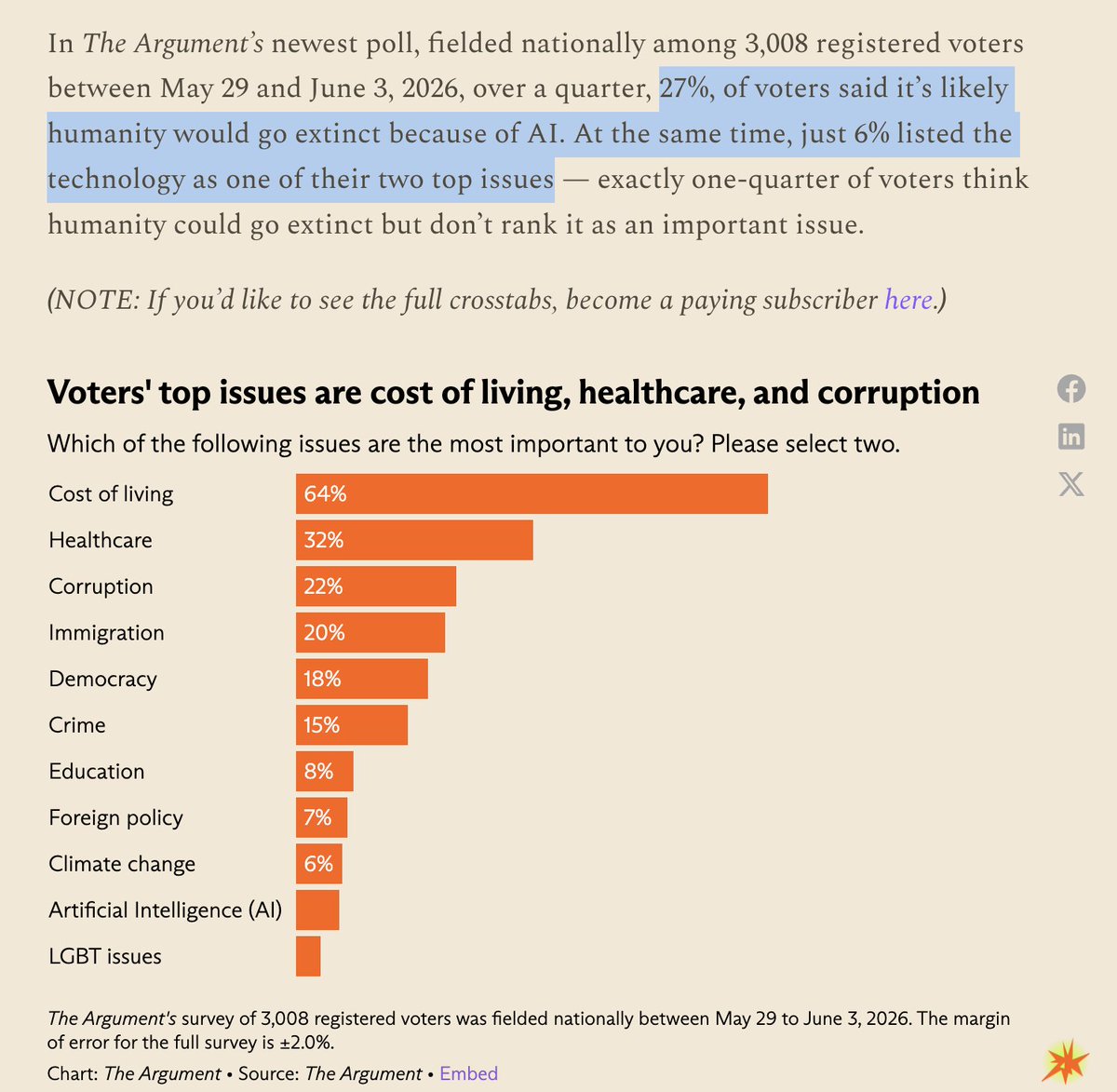
I think it's reasonably likely that, in 12 months, AI is at or near the top of this list.
I'd say maybe 50% odds? Still predicting that AI dominates the next Presidential election cycle.

4
5
26
2,724
Jun 11
To be clear, this isn't true. Acemoglu gets plenty of deserved criticism despite his many brilliant papers. He has absolutely bonkers views on AI.
Like an Aztec sage who says, "We must be wary of the Europeans. They must be made to promote the interest of Texcoco, not Tlacopan!"

BTW when political scientists suggest Econ may be more hierarchical than is strictly optimal, the fact that there is an "emperor" who other Econs dare not openly critique on intellectual matters is the sort of thing they have in mind
5
8
123
36,869
Jun 10
A nice but fleeting feature of the current moment: the amount of intelligence available to you depends only weakly on how much money you have.
4
1,023
Jun 9
Very interesting that social media is generally positive about AI!
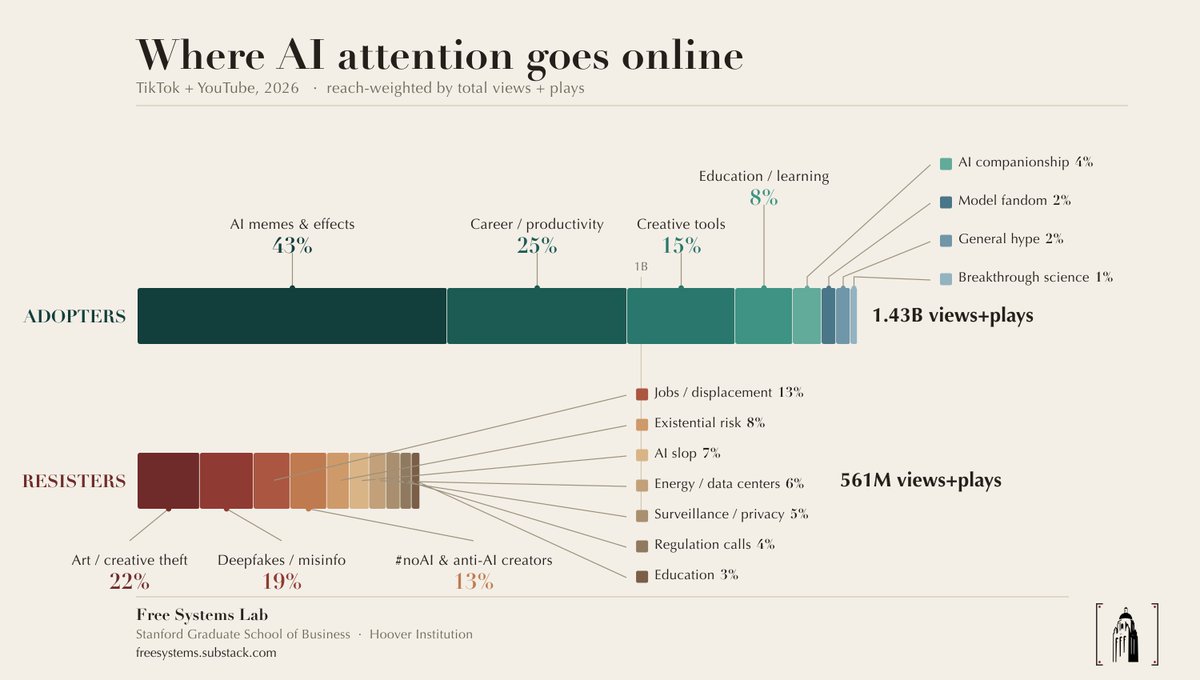
I interpret the creative theft / art movement as backlash against job loss -- this is driven by people who want to be paid to do art and might now be paid less or not at all because AI can do art @ahall_research
Jun 9

The popular conversation around AI in America looks nothing like the narratives the elites are driving.
For our new research, we analyzed 25,000 TikTok and YouTube videos about AI---and watched thousands of them ourselves---to understand how Americans are encountering AI in their everyday lives.
Despite an elite conversation focused largely on backlash, AI videos embracing AI outnumber videos about resisting AI 3 to 1.
These "adopter" videos don't focus on the things elites talk about: they talk about funny memes and effects AI can help make and ways you can use AI to help you with your job search.
There is a significant and organized social media community focused on resisting AI, but surprisingly, it's not mainly about job loss, data centers, or existential risk. Instead, it's about creative theft and the erosion of human-made art. This has all the hallmarks of a genuine movement---with organized efforts to support human artists, to report AI-generated content, and to oppose the technology in the real world.
All in all, when we look past the efforts of the labs and the media to impose a top-down narrative around job loss and existential risk, we find everyday Americans having a far different and in many ways more "normal" conversation (@random_walker)---one in which AI offers immediate and personal opportunities and challenges all at the same time.
Check out the full research piece, which is loaded with interesting real example videos, here:
freesystems.substack.com/p/m…
3
1
4
2,011
Jun 9
I expect that politics and political parties in the next few years will realign along this axis, with the central conflict between "an alliance of tech companies & people who benefit from this tech" vs. "people concerned about AI risk & people whose jobs are threatened."
3
740
Jun 8
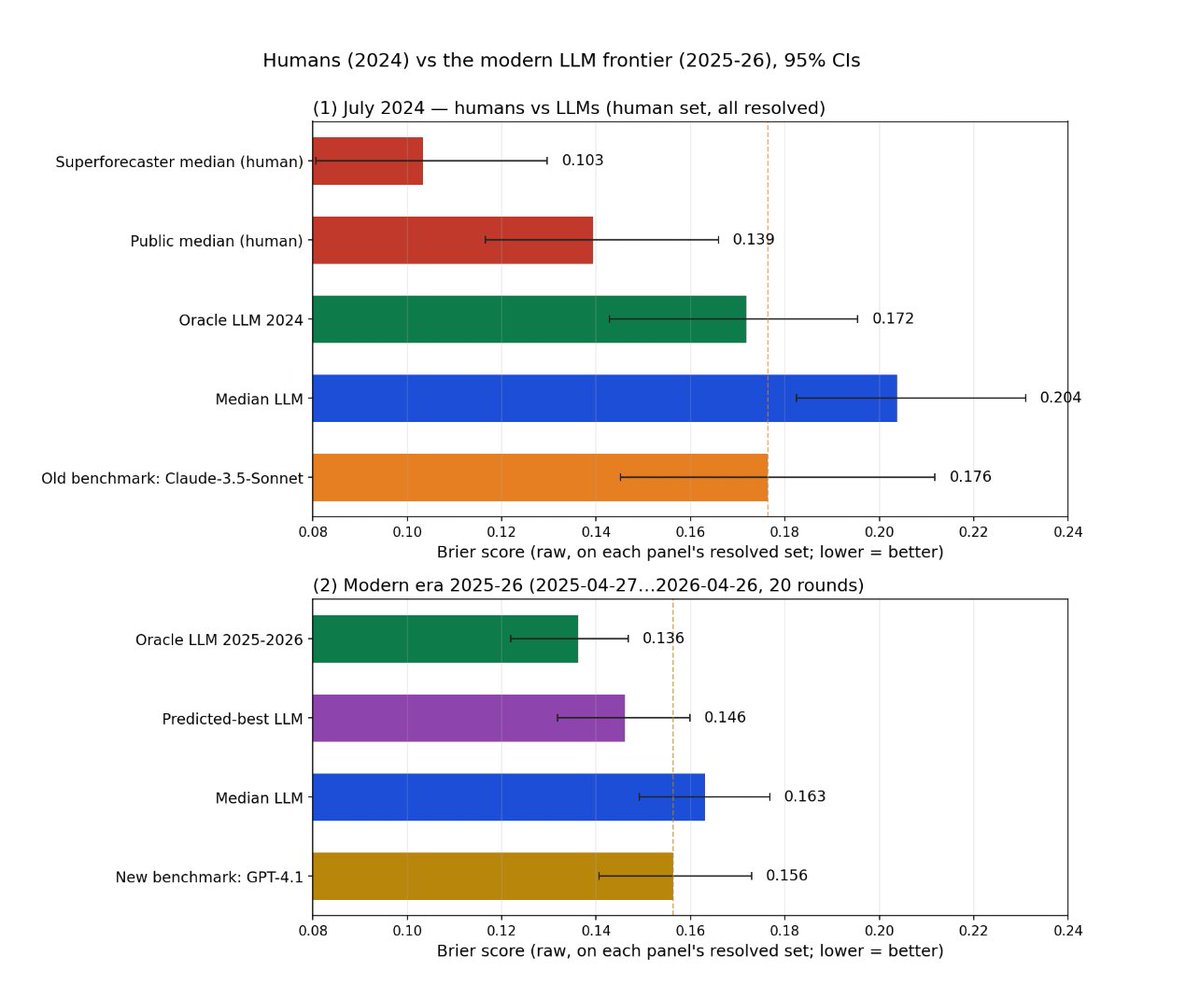
Models are improving at forecasting (new analysis linked below).
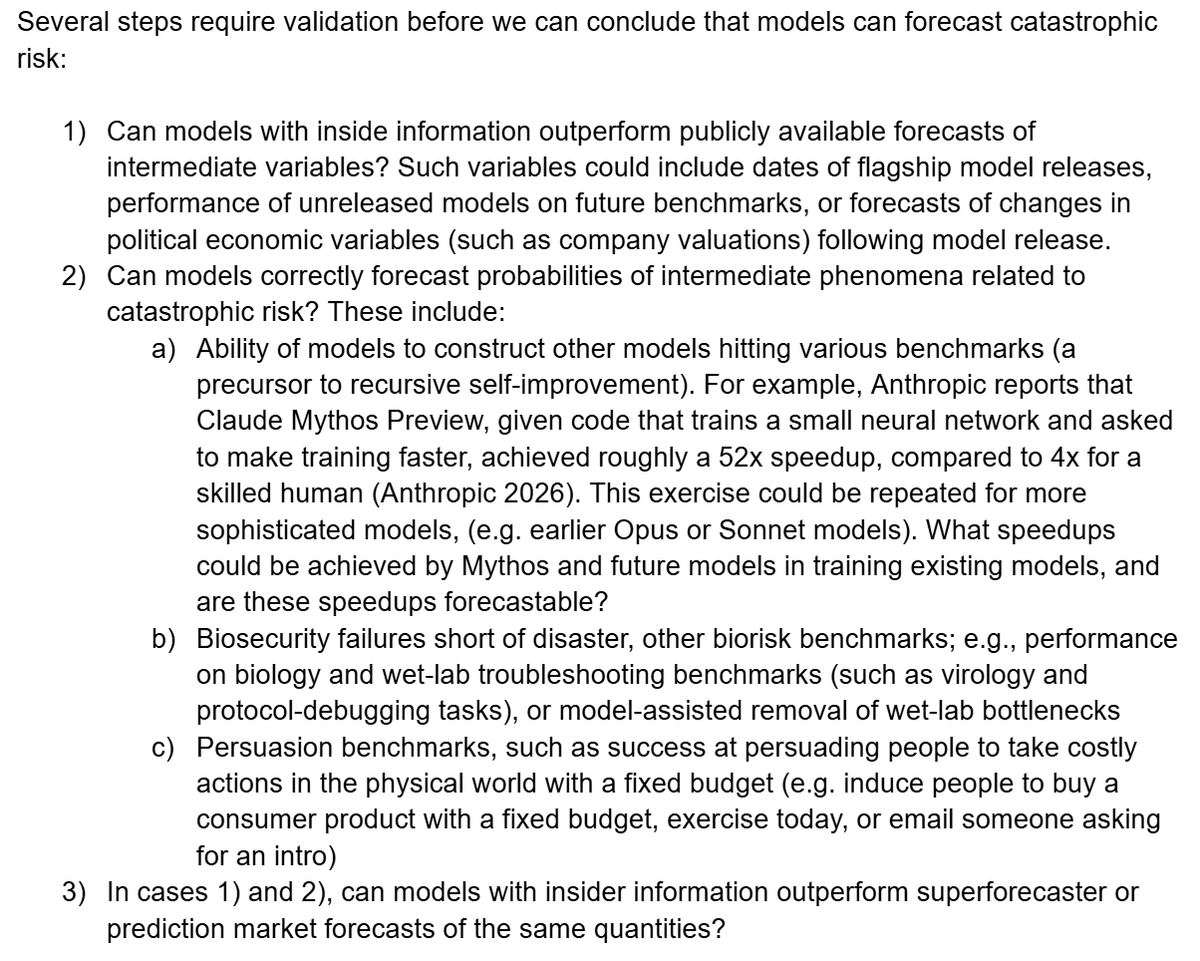
To regulate frontier labs, we should pilot "evaluator" models to review internal code and forecast catastrophic (conditional) risk over time, with mitigations tied to risk once forecasting ability is validated.
1
4
16
6,511
Jun 8
This is a variant of @robinhanson 's old futarchy proposal (mason.gmu.edu/~rhanson/futar…), substituting model forecasts w/ insider information for prediction markets (which, incidentally, are also sorely needed here -- substack.com/home/post/p-197…)
2
2
305
Jun 8
The proposal here gives many more details: jabaluck.github.io/condition…, including discussions of model collusion, protecting proprietary information, and gaming.
1
2
288
Jun 7
If more decisions are delegated to agents, products will be designed and marketed to appeal to intelligence.
This could be a radical improvement over the status quo.
3
3
24
4,920
Jun 7
Intermediaries like Consumer Reports don't solve this problem because they lack the technical sophistication to distinguish misleading statistical comparisons from compelling causal evidence.
1
2
382
Jun 7
But if people delegate their purchasing decisions to (smarter) agents, incentives shift, and suddenly companies need to prove that their products actually work to the smartest auditors around.
3
370