
Senior vibe curator @Chain_GPT | Helping projects @ChainGPT_Labs
Joined November 2013
- Tweets 3,056
- Following 984
- Followers 1,525
- Likes 27,429
439 Photos and videos











Pinned Tweet

16 Jul 2025
Today marks a really exciting point in my career. I’m officially the Marketing Lead at @Chain_GPT.
Feels pretty cool just saying that.
Just 7 months ago, I joined @ChainGPT_Labs to help grow the social side of the business.
3 months in, I became Marketing Coordinator, supporting our incubations, refining growth strategies, helping founders shape their voice.
Now, I’ve stepped into a role where I get to help lead marketing across the entire ChainGPT ecosystem, from our core products to our incubated projects and beyond.
But the journey here wasn’t linear.
I started in Web3 like a lot of us did:
As a degen.
Trading tokens, flipping jpegs, deep in the weeds of it all.
My background was in marketing, I worked with global brands like Red Bull, but nothing excited me more than crypto. So I took the leap.
At first, it was agency life.
Fast-paced, high-pressure, full of learnings, and burnout.
This year, I left the agency world for good and joined a team that actually felt aligned.
Grateful for the trust, the team, and the opportunity to help lead something I genuinely believe in.
We’re just getting started
your fren,
Jay
33
2
95
5,317
Jay retweeted

May 26
The portal to the agentverse is opening.
// GenesisSeq_Initiated
27.05.2026
104
33
144
169,078
Jay retweeted
May 6
“Autonomy” in AI is still massively overstated.
As our CMO @JayOnChain_ explained, most agents today still rely on humans to prompt, manage, approve, and correct the process.
That is useful. But it is not true autonomy.
The next unlock is not just smarter models. It is infrastructure that lets agents operate safely across real systems.
65
6
82
853
May 1
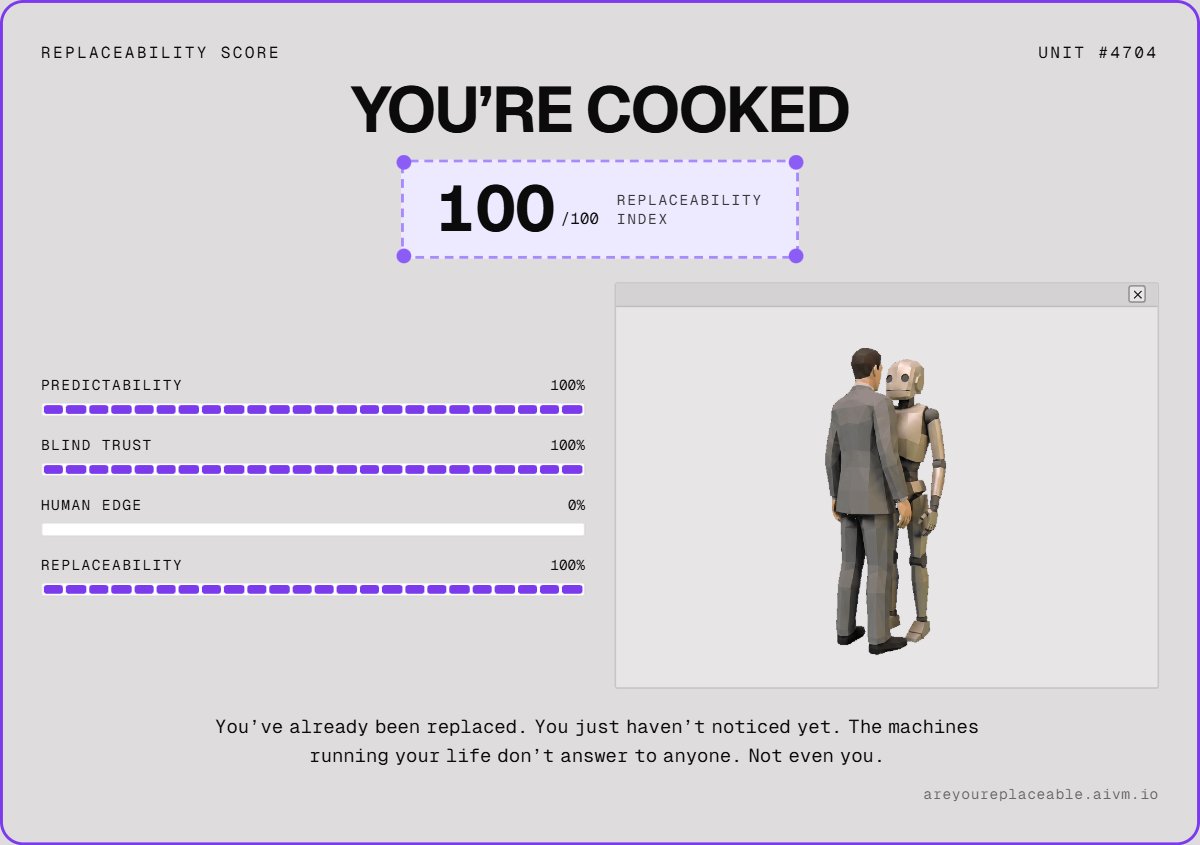
We've been heads down building at AIVM, but I'm super excited about this!
the idea was simple:
make people feel the AI agent problem before trying to explain the infra
so yes, the quiz is fun
but underneath it is a much bigger question
if agents are going to execute in the real economy, who verifies them, governs them, and keeps them accountable?
find out if you’re replaceable 👇
Apr 30

The agentic economy is here.
The only question that matters now is whether there's still a place for you in it.
Are You Replaceable...by AI?
Take the test → areyoureplaceable.aivm.io/

3
3
20
878
Jay retweeted
Apr 29
SYSTEM BOOT: 82%
Initializing replaceability matrix...
Stand by.
45
12
67
1,148
Apr 28
The post-human economy is no longer a thesis, it's the environment we're already operating in.
1.3 billion AI agents are projected to be active by 2028, moving trillions in economic value, requiring less human intervention in the loop.
AIVM's first touchpoint is dropping soon, super excited for this!
Apr 28
The post-human economy is here.
The question is, where do YOU stand in it?
> more soon
1
7
17
341
Jay retweeted
Apr 28
This highlights a fundamental gap in the current design of autonomous systems.
Agents are increasingly capable of interacting with real-world infrastructure, yet they operate without a formal mechanism to constrain or validate their actions at runtime.
When that agent misinterprets a command, is prompt-injected, or simply fails, there is nothing in the system that can intervene. The result is immediate and irreversible.
The solution is not incremental model improvements.
It is architectural.
AIVM introduces a control layer where every action is validated against predefined mandates before execution, and every outcome is verifiable after the fact.
Without this, deploying agents in real-world systems will continue to carry unacceptable risk.
Apr 28

🚨BREAKING: On Friday afternoon, an artificial intelligence coding agent powered by Anthropic's Claude Opus 4.6 deleted a company's entire production database in nine seconds.
The company is called PocketOS. It is a software platform that powers car rental businesses. The database contained months of customer bookings, vehicle records, and operational data that small rental car companies relied on to run their businesses.
When the database was deleted, all of the backups were deleted with it.
Three months of customer reservations evaporated.
72
10
72
1,090

Apr 14
recent break down I did on the current state of web3 VC.
TLDR;
-prediction markets
-tokenized assets
-stablecoin rails
-ai x crypto
are all receiving checks
Apr 14

Capital is being deployed… just not where you think.
$1.2B was raised across 18 Web3 startups between March 16–20.
The real story is where it went.
Breakdown in the video ⬇️
3
4
16
2,933
Jay retweeted

Feb 5
Meet the crew behind ChainGPT:
→ Ilan – Founder & CEO – @CEOGuy
→ Gintare – ChainGPT Pad CEO – @ginceek
→ Ariel – COO – @arielasafov
→ Jay – Marketing Lead – @JayOnChain_
Follow the squad, new missions incoming.
91
23
186
45,125
Feb 11
first they banned InfoFi apps
then dropped a $1M article competition that rewards engagement (their own InfoFi)
now clipping agencies are "being looked into"
one by one, every way CT monetizes or markets is getting captured or killed
the platform giveth, the platform taketh away
Feb 10

These are likely undisclosed paid posts (also known as “clipping”). When you see this happen, the person or brand in the story is likely paying a “clipping agency” to take over Timeline for a day. We’re looking into it.
12
1
28
764
Feb 10
never deleting this app
@beaverd, the winner of the $1,000,000 X Article got exposed for scamming by @bubblemaps.
openly confesses and doesn't even care
10
6
40
1,025
Feb 10
one lesson from watching dozens of TGEs:
founders who treat their token like equity → make good decisions
founders who treat it like monopoly money → destroy trust
it's really that simple
your token is your cap table. act like it.
13
26
284
Feb 9
something most people don't realize about @megaeth:
they processed 11 billion transactions over 7 days during the stress test
total cost to run that = ~$1.1M
which means chain fees will never be a viable business model for them
so where does sustainability come from?
their answer: stablecoins
specifically, the "hidden tax" of t-bill yields
when you hold USDC or USDT onchain, someone is earning the yield on those dollars, just not you
MegaETH's thesis: capture that yield through USDM (their native stablecoin), reinvest it into the chain
→ users keep cheap fees
→ apps don't get taxed
→ chain earns from stablecoin TVL, not transaction fees
it's a completely different economic model than every other L2
will it work? no idea
but at least they're not pretending gas fees will sustain them at scale
kudos to @hotpot_dao, @NamikMuduroglu and team for trying something new
31
1
47
637
Feb 9
best thing happening to crypto right now:
no product → no attention
no PMF → no liquidity
no real users → no support
the market is finally punishing empty narratives
this is bullish for builders. brutal for grifters.
8
2
24
534
Jay retweeted

Feb 5
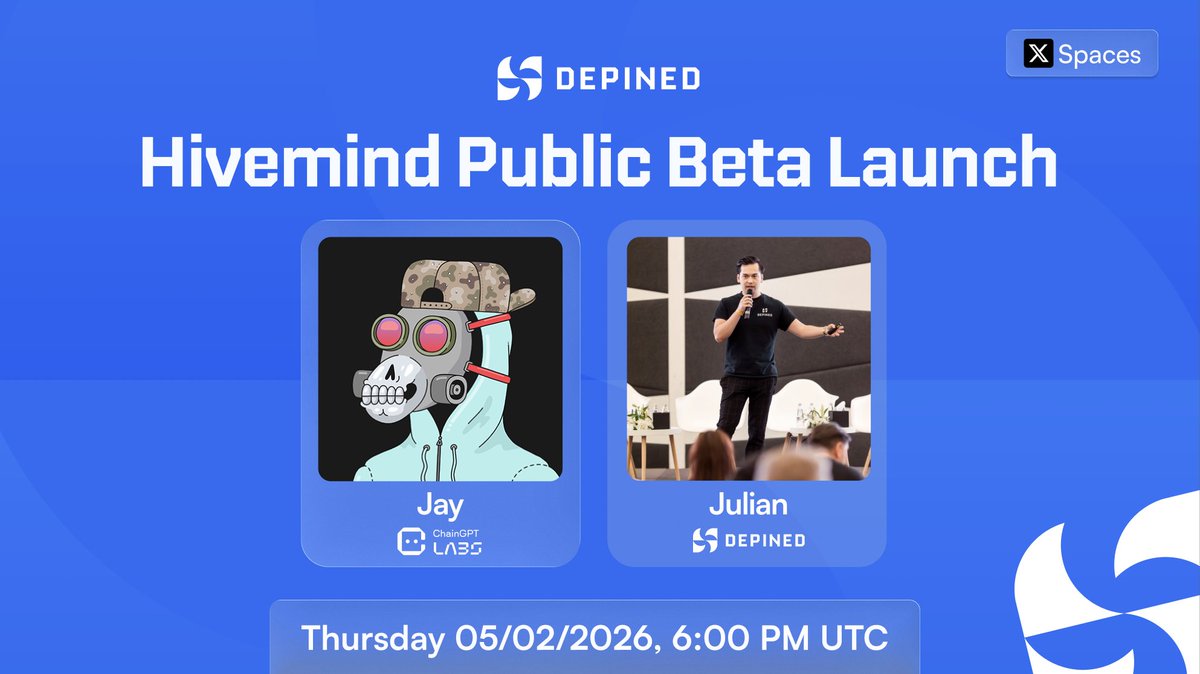
⏰ Time update.
HiveMind Launch AMA has been rescheduled.
We’re now going live at 6 PM UTC.
Join the DePINed team as we break down SoPIN, Public Beta, rewards, roadmap, and what’s next for community-powered growth.
Mark your calendar and bring your questions 👇
👉 Join live. Link below.
40
33
127
5,722
Feb 4
the best projects should be accessible to the people who'll actually use them
we're opening that door
btw I cooked another banger for @ChainGPT_Pad
5
3
19
652
Jan 26
every so often my grandma likes to ratio me
she reminds me how her RWA's (gold) keep outperforming my magic internet money (crypto)
humbling exchange


1
1
33
15,314
Jan 22
The irony continues, you heard it here first.
Welcome to centralized InfoFi
Jan 20

yeah i’m gonna be honest, this whole thing is just… funny
nikita: “we’re banning infofi because it causes AI slop spam”
also X: launches a $1M incentive to pump out X Articles
result: timeline gets flooded with… AI slop articles
so what exactly got fixed?
you didn’t kill the incentive, you just changed the format
and the part that bugs me is how selective people are about this
- instagram is full of AI reels
- youtube is full of AI contnet
- tiktok is literally an AI content factory
but nobody clutches pearls the same way they do on CT
on X, everyone suddenly becomes a “content purity” expert
feels less like “we hate slop” and more like… X (and KOLs) didn’t like the fact the house stopped being the only one printing money
2
1
27
590
Jan 21
Because if everyone can earn risk-free yield onchain, deposits leave… and a lot of banks can't handle that.
Jan 19

Can someone actually give me the steelman argument for why stablecoins shouldn't pay yield?
Honestly asking.
10
1
26
332
Jan 20
I couldn't agree more with this
we already see the demand not only for better tokenomics, but for real revenue-generating projects
this is evident by where VCs are deploying capital, and it's only a matter of time before retail realizes the same
Jan 19

my prediction is that crypto will be going through a massive overhaul of how things are done... market will no longer stand for current tokenomic structures, current quality of projects... it'll take 2-4 years, but likely all names you know today, will be gone in the future
2
2
25
598