
Programmable Cards for AI agents, powered by stablecoin.
Joined July 2025
- Tweets 30
- Following 38
- Followers 2,314
- Likes 39
4 Photos and videos
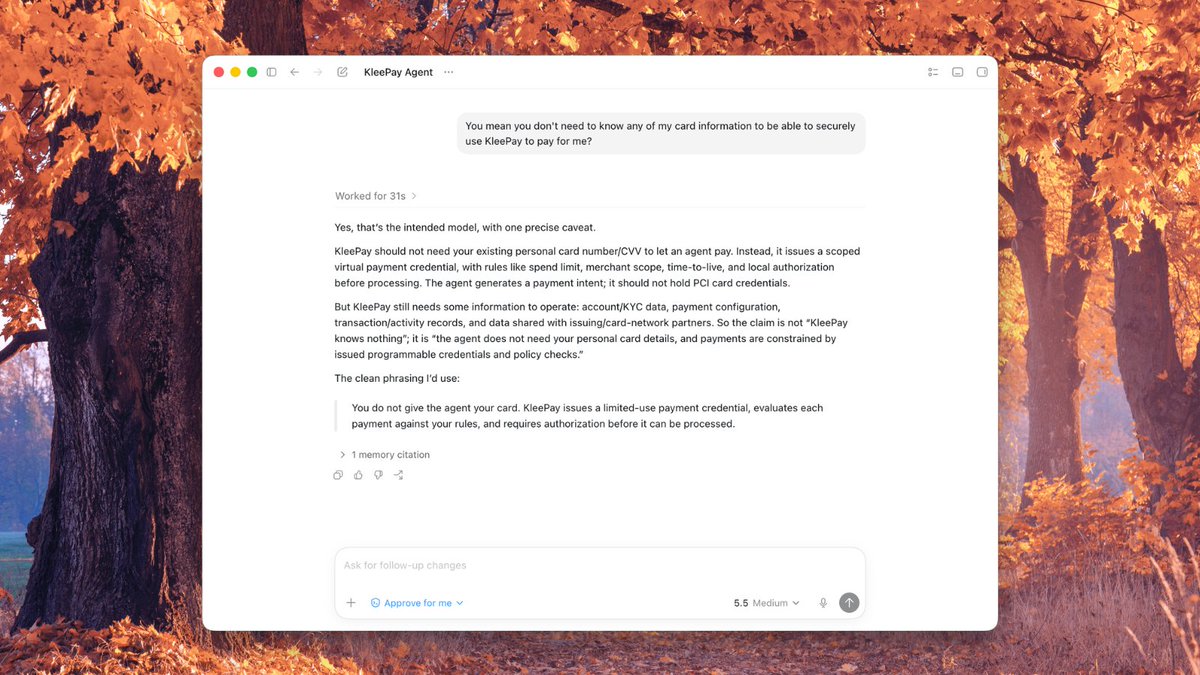




AI agents are ready to act in the real world.
Payments need a safer primitive.
@KleePay lets agents initiate payments without handling a user’s personal card details, with every transaction bounded by spend limits, merchant scope, expiry, and local authorization.
🤖Join waitlist now: kleepay.ai
5
2
34
2,351
The best career decisions usually feel slightly crazy at the time.
Joining SpaceX before reusable rockets.
Joining Stripe before internet payments became obvious.
Joining OpenAI before anyone cared about foundation models.
We're looking for people who can see where the world is heading before the consensus arrives.
Building agentic payments at @KleePay.
Base salary meaningful equity.
Jun 14

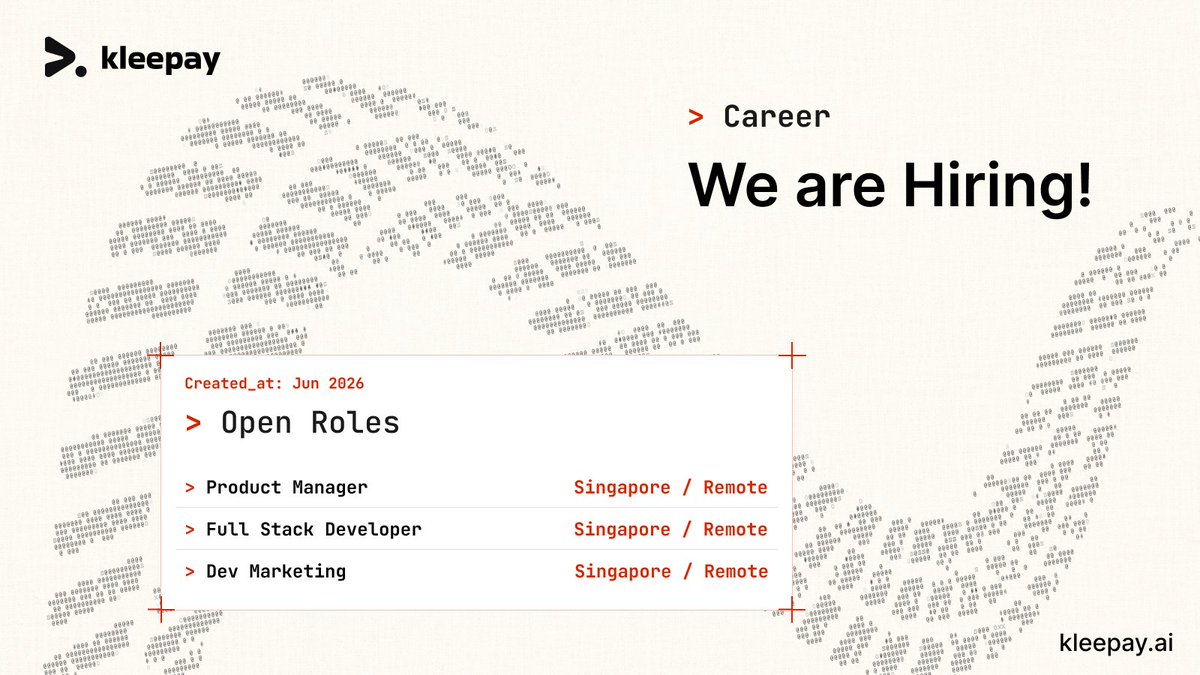
We're hiring at @KleePay.
We're building payment infrastructure for AI agents and looking for AI-native builders across engineering, product, growth, operations, and internships.
You don't need 10 years of experience, but you do need to move fast, learn fast, and figure things out without being told exactly what to do.
We care more about proof of work than credentials.
Competitive base salary meaningful equity.
DM me your GitHub, X account, portfolio, side project, or anything you've built.
11
2
93
19,759
Everyone is focused on whether agents can think.
Companies like Luckin are quietly preparing for something else:
agents that can buy.
The moment businesses start building interfaces for agents, payments become the next bottleneck.
Jun 9
Luckin Coffee shipping a CLI, MCP server, and Skills wasn't on my 2026 bingo card.
But it makes sense.
Every company spent the last decade optimizing for mobile apps.
The next decade is about being callable by agents.
open.lkcoffee.com/skill
1
18
673
Here’s your monthly reminder that you shouldn't be approving every payment your agent wants to make.
You should be designing the loops that decide when approval is needed.
Jun 7

Here’s your monthly reminder that you shouldn’t be prompting coding agents anymore.
You should be designing loops that prompt your agents.
1
13
413
Agent payments are a settlement problem.
Agent economies are a coordination problem.
One is about moving money.
The other is about creating value.

1
1
14
405
If AI starts building better AI,
expect the number of autonomous economic actors to explode.
Jun 4

Our internal data shows Claude is accelerating AI development—a possible path to recursive self-improvement, or AI autonomously building a more capable successor.
It’s happening faster than we thought, and the implications deserve greater attention. anthropic.com/institute/recu…
1
12
299
KleePay retweeted

May 31
there will be more AI agents than humans.
soon after, there will be more agent transactions than human transactions.
1
7
175
KleePay retweeted
May 25
next-gen payments is underselling what’s actually happening.
the bigger shift is that we’re entering a world where software itself becomes an economic actor.
AI agents will not operate inside banking apps, card checkouts, or financial workflows designed for humans, they will transact directly across APIs, services, models, and machines.
that changes what payment infrastructure needs to look like.
stablecoins matter not just because they make payments faster, but because they’re one of the first forms of money that feels truly native to the internet.
May 24

Major areas where the financial system still needs an update:
1. Tokenization of real-world assets - Real estate, stocks, bonds, funds, etc. onchain for instant settlement, fractional ownership & massive distribution.
2. 24/7 Global trading - Pooled global liquidity, every asset, every person, with great leverage and capital efficiency.
3. Next-gen payments - Near-instant, low-cost global transfers using stablecoins, including for Agentic payments.
4. AI-powered risk, credit, compliance, and advice - Better decisions, less fraud, and broader access to capital. Everyone gets access to a great financial advisor.
5. Innovation friendly regulation - Move from one-size-fits-all to risk-based rules that encourage innovation and competition instead of stifling it.
6. Expanded access - Open protocols that reduce middlemen and self-custodial wallets to expand access to everyone with a smartphone.
7. Capital formation - Low cost and turnkey for anyone to raise money for a good idea, increasing the number of startups.
8. Sound money - A refuge from inflation, when discipline is lost in fiat money.
Jobs not done until we get these working for all.
Will require lots of tech innovation and policy work to get there.
2
14
264
The internet created a world where software could publish information, distribute media, and coordinate communication at planetary scale. But one thing remained fundamentally human: economic agency.
Payments, credit, banking, and financial trust were all built around the assumption that a person sits behind every action. Every layer of modern finance, from cards to compliance systems, implicitly assumes human intent.
That assumption is starting to break.
AI agents are no longer just generating text or retrieving information. They are beginning to execute workflows, negotiate with services, manage resources, purchase compute, coordinate tasks, and eventually transact with other agents autonomously. What emerges from this is not simply "AI-assisted payments," but an entirely new class of economic participant.
The existing financial stack is not designed for this world. Human-centric interfaces like OTPs, banking apps, checkout flows, and manual approvals become friction when software itself becomes the actor. The challenge is not just enabling agents to move money. The real challenge is establishing whether an autonomous system should be trusted to act financially in the first place.
In the coming decade, financial infrastructure will increasingly revolve around machine-native identity, programmable permissions, verifiable behavior, autonomous treasury management, and agent reputation systems. Stablecoins will likely become the default settlement layer not because they are "crypto," but because they are the first globally accessible form of programmable internet money that software can use natively.
The next era of finance will not simply digitize existing institutions. It will introduce entirely new economic actors into the system.
And once software becomes capable of holding capital and making decisions, programmable trust becomes more important than programmable money.
That is the world @KleePay is being built for.
3
23
198