Joined July 2022
- Tweets 1,649
- Following 570
- Followers 1,221
- Likes 4,211
388 Photos and videos
















May 13
$pufETH yield goes brrrrrrr
May 13

$pufETH remains the highest APR in the liquid restaking/staking sector and is also one of the safest, remaining unaffected by recent DeFi events.
VTs protect against validator downtime, and 2 ETH bonds protect against slashing.
The best place for both validators and ETH stakers.
app.puffer.fi/
50
Apr 14
Only recently started following this story, actually wild…
Apr 14

Tenth person linked to top-secret U.S. nuclear research has disappeared without a trace, per Daily Mail.
114
LRTintern 🦇🔊 retweeted
Blockspace is the real alpha.
Validator Tickets (VTs) let operators prepay for future execution reward upside.
48
31
56
6,147
LRTintern 🦇🔊 retweeted

Mar 30
We’ve been working on based rollups for the past 19 months good to see EF and others catching up with the idea.
1
1
6
606
Mar 27
Only one question for institutions rn:
Mar 27

Institutions want ETH yield.
But they need regulated custody and compliant infrastructure to access it.
That’s why @Anchorage × @puffer_finance matters:
1️⃣ Institutions deposit ETH into Anchorage Digital Custody
2️⃣ Anchorage stakes & restakes ETH via Puffer
3️⃣ Institutions receive pufETH directly in their Anchorage accounts
4️⃣ Institutions can deploy pufETH across DeFi integrations available on Anchorage – keeping liquidity while earning yield
Regulated custody compliant infrastructure Ethereum restaking yield.
Perfect for the institutional phase of Ethereum adoption.
Full details in our article 👇
38
LRTintern 🦇🔊 retweeted
Feb 28
Every large institution wants Ethereum exposure for its clients. None of them can solve distribution and privacy on L1 alone.
A composable stack like @puffer_unifi is needed.
33
32
60
135,396
LRTintern 🦇🔊 retweeted
Feb 3
This is why, over the past six months, we have completely changed the perception around @puffer_unifi.
L2s are specialized execution environments.
We will soon announce the launch of the first two appchains that bring this vision to life; applications with extremely high throughput that can tap directly into major L1 liquidity.
Institutions can utilize these to deliver compliance and privacy needed for their users as well.
Based and native appchains are the future of infra.
Feb 3

There have recently been some discussions on the ongoing role of L2s in the Ethereum ecosystem, especially in the face of two facts:
* L2s' progress to stage 2 (and, secondarily, on interop) has been far slower and more difficult than originally expected
* L1 itself is scaling, fees are very low, and gaslimits are projected to increase greatly in 2026
Both of these facts, for their own separate reasons, mean that the original vision of L2s and their role in Ethereum no longer makes sense, and we need a new path.
First, let us recap the original vision. Ethereum needs to scale. The definition of "Ethereum scaling" is the existence of large quantities of block space that is backed by the full faith and credit of Ethereum - that is, block space where, if you do things (including with ETH) inside that block space, your activities are guaranteed to be valid, uncensored, unreverted, untouched, as long as Ethereum itself functions. If you create a 10000 TPS EVM where its connection to L1 is mediated by a multisig bridge, then you are not scaling Ethereum.
This vision no longer makes sense. L1 does not need L2s to be "branded shards", because L1 is itself scaling. And L2s are not able or willing to satisfy the properties that a true "branded shard" would require. I've even seen at least one explicitly saying that they may never want to go beyond stage 1, not just for technical reasons around ZK-EVM safety, but also because their customers' regulatory needs require them to have ultimate control. This may be doing the right thing for your customers. But it should be obvious that if you are doing this, then you are not "scaling Ethereum" in the sense meant by the rollup-centric roadmap. But that's fine! it's fine because Ethereum itself is now scaling directly on L1, with large planned increases to its gas limit this year and the years ahead.
We should stop thinking about L2s as literally being "branded shards" of Ethereum, with the social status and responsibilities that this entails. Instead, we can think of L2s as being a full spectrum, which includes both chains backed by the full faith and credit of Ethereum with various unique properties (eg. not just EVM), as well as a whole array of options at different levels of connection to Ethereum, that each person (or bot) is free to care about or not care about depending on their needs.
What would I do today if I were an L2?
* Identify a value add other than "scaling". Examples: (i) non-EVM specialized features/VMs around privacy, (ii) efficiency specialized around a particular application, (iii) truly extreme levels of scaling that even a greatly expanded L1 will not do, (iv) a totally different design for non-financial applications, eg. social, identity, AI, (v) ultra-low-latency and other sequencing properties, (vi) maybe built-in oracles or decentralized dispute resolution or other "non-computationally-verifiable" features
* Be stage 1 at the minimum (otherwise you really are just a separate L1 with a bridge, and you should just call yourself that) if you're doing things with ETH or other ethereum-issued assets
* Support maximum interoperability with Ethereum, though this will differ for each one (eg. what if you're not EVM, or even not financial?)
From Ethereum's side, over the past few months I've become more convinced of the value of the native rollup precompile, particuarly once we have enshrined ZK-EVM proofs that we need anyway to scale L1. This is a precompile that verifies a ZK-EVM proof, and it's "part of Ethereum", so (i) it auto-upgrades along with Ethereum, and (ii) if the precompile has a bug, Ethereum will hard-fork to fix the bug.
The native rollup precompile would make full, security-council-free, EVM verification accessible. We should spend much more time working out how to design it in such a way that if your L2 is "EVM plus other stuff", then the native rollup precompile would verify the EVM, and you only have to bring your own prover for the "other stuff" (eg. Stylus). This might involve a canonical way of exposing a lookup table between contract call inputs and outputs, and letting you provide your own values to the lookup table (that you would prove separately).
This would make it easy to have safe, strong, trustless interoperability with Ethereum. It also enables synchronous composability (see: ethresear.ch/t/combining-pre… and ethresear.ch/t/synchronous-c… ). And from there, it's each L2's choice exactly what they want to build. Don't just "extend L1", figure out something new to add.
This of course means that some will add things that are trust-dependent, or backdoored, or otherwise insecure; this is unavoidable in a permissionless ecosystem where developers have freedom. Our job should make to make it clear to users what guarantees they have, and to build up the strongest Ethereum that we can.
38
36
62
2,482
LRTintern 🦇🔊 retweeted

4 Dec 2025
🇦🇷 Buenos Aires Throwback!
Puffer VIP Dinner → big minds, bold ideas, real momentum. 🐡✨
Already excited for the next one. 🥂
39
35
60
4,683
11 Sep 2025
still feel physically sick after what happened earlier & absolutely heartbroken for his family.
RIP Charlie
1
194
3 Sep 2025
It’s actually 4.6% now, sheeeeesh 😮💨
pufETH holders eating good
2 Sep 2025
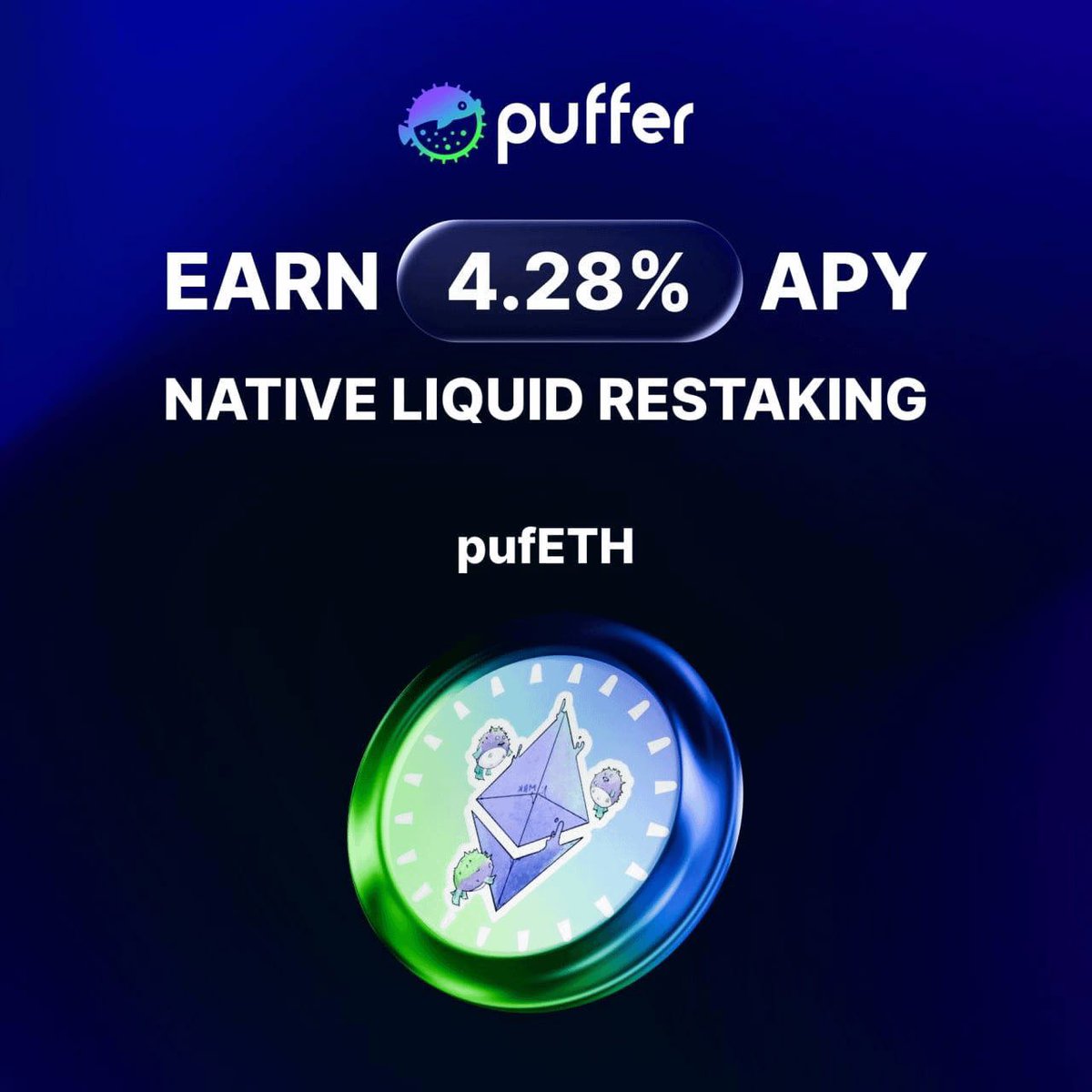
✨Product Highlight: Native Liquid Restaking on Ethereum 🐡
• Earn 4.28% APY, the highest native yield in restaking
• Deposit ETH → receive pufETH, your LRT
• Boost returns with extra $CARROT rewards on top 🥕
• Simple UI
Grow your ETH with the Pufferfish 👇
app.puffer.fi/
131
LRTintern 🦇🔊 retweeted

2 Sep 2025
We’re launching the first US futures that give exposure to the top US tech stocks and crypto at the same time.
We'll launch more products like this as part of the everything exchange.
Coming on September 22.
319
545
4,675
343,792
LRTintern 🦇🔊 retweeted
5 Aug 2025
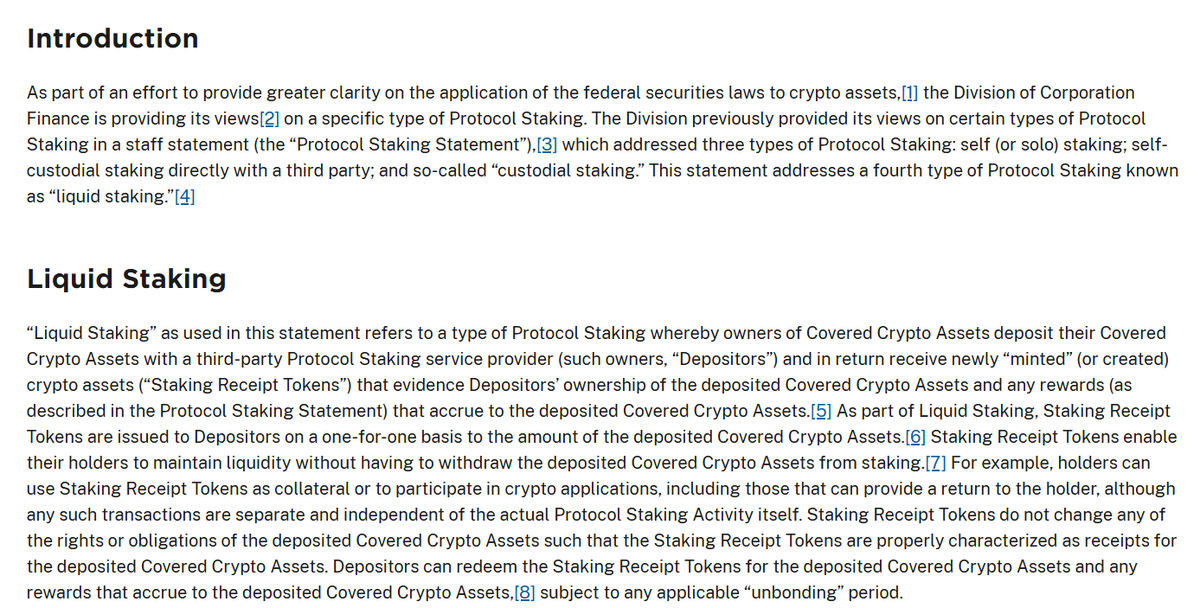
ngl bullish on $ETH liquid staking after reading this
8
6
33
2,752


26 Jun 2025
Based😎
26 Jun 2025
1
97
LRTintern 🦇🔊 retweeted
21 May 2025
This is a major breakthrough that will power the future of Ethereum:
- Validators will require significantly less storage.
- We’re close to enabling payment transactions from your Apple Watch without relying on RPC endpoints or external wallets.
- Based appchains will be inexpensive and easy to run, effectively replacing traditional smart contracts.
ELI5: Ethereum is going to become much cheaper and much faster to use—without any sacrifices.
21 May 2025

real-time proving Q&A :)
What is it? ELI12.
A: An army of nerds just cracked a sci-fi problem: proving every Ethereum mainnet block in real time. These zk proofs are exponentially cheaper to verify than re-executing transactions—just a few milliseconds, no matter the gas used.
Thicc blocks, tiny validators. Decentralisation maxis rejoice.
Wasn't real-time proving impossible moon math?
A: It was. Five years ago we were five orders of magnitude away. But the tech kept compounding 10x/year, and now we're here. Don't fade exponentials.
Also, on exponentials:
→ don't fade quantum computers breaking ECDSA
→ don't fade halvings breaking Bitcoin security
How does Ethereum L1 become a "based and native rollup"?
A: Let's break it down.
→ based: L1 proposers order transactions. Ethereum L1 is the base layer—it's tautologically based.
→ native: L1 executes transactions via the enshrined EVM state transition function. By definition Ethereum L1 is native. Always will be.
→ rollup: A rollup has onchain data and offchain execution. By snarking mainnet EVM blocks Ethereum L1 turns into a zk rollup.
Rollups unlock big gas limits. Base is already at 35 megagas/sec—20x Ethereum L1. Base is aiming for 1 gigagas/sec, Ethereum L1 can get there too.
Wen gigagas L1?
A: Ethproofs call #3 will be dedicated to gigagas L1—do tune in. With EIP-9698 Dankrad proposes ~3x/year gas bumps, or ~10x every 2 years. That's 1,000x in 6 years. Respectable—but still rookie numbers.
My optimistic take? Now that zkVMs match EVM performance gas limits can track zkVM improvements. If we keep hitting 10x/year that's 1 gigagas/sec in 3 years. I worked with Dankrad for over a decade—reality usually lands between his caution and my hopium.
Aren't zkVM buggy? What about formal verification?
A: Formal verification is the endgame—not step one. The short-term strategy: zkVM diversity. By end of Q2 a handful of zkVMs will hit real-time proving. Just like CL and EL clients, any individual client is assumed buggy. Security comes from diversity.
Can low-latency proving scale to gigagas?
A: Yes. SNARK proving is massively parallelisable. Only the initial x86 execution and chunking is sequencial. EIP-7825 proposes to cap the maximum amount of gas used per transaction. This allows for easy chunking at transaction boundaries. Parallelism scales. Latency stays low.
What's the next zkVM bottleneck?
Power. Credible 1-of-n prover liveness means home proving should be accessible to enthusiasts. A reasonable target may be 10kW or less per proving cluster.
How do we grow the gas limit 1,000x on a 10kW budget?
→ software: proof systems, circuits, algos keep compounding
→ hardware: Moore's law SNARK ASICs
→ distributed proving: spread the load, trustlessly
6
3
18
1,177
LRTintern 🦇🔊 retweeted
12 May 2025
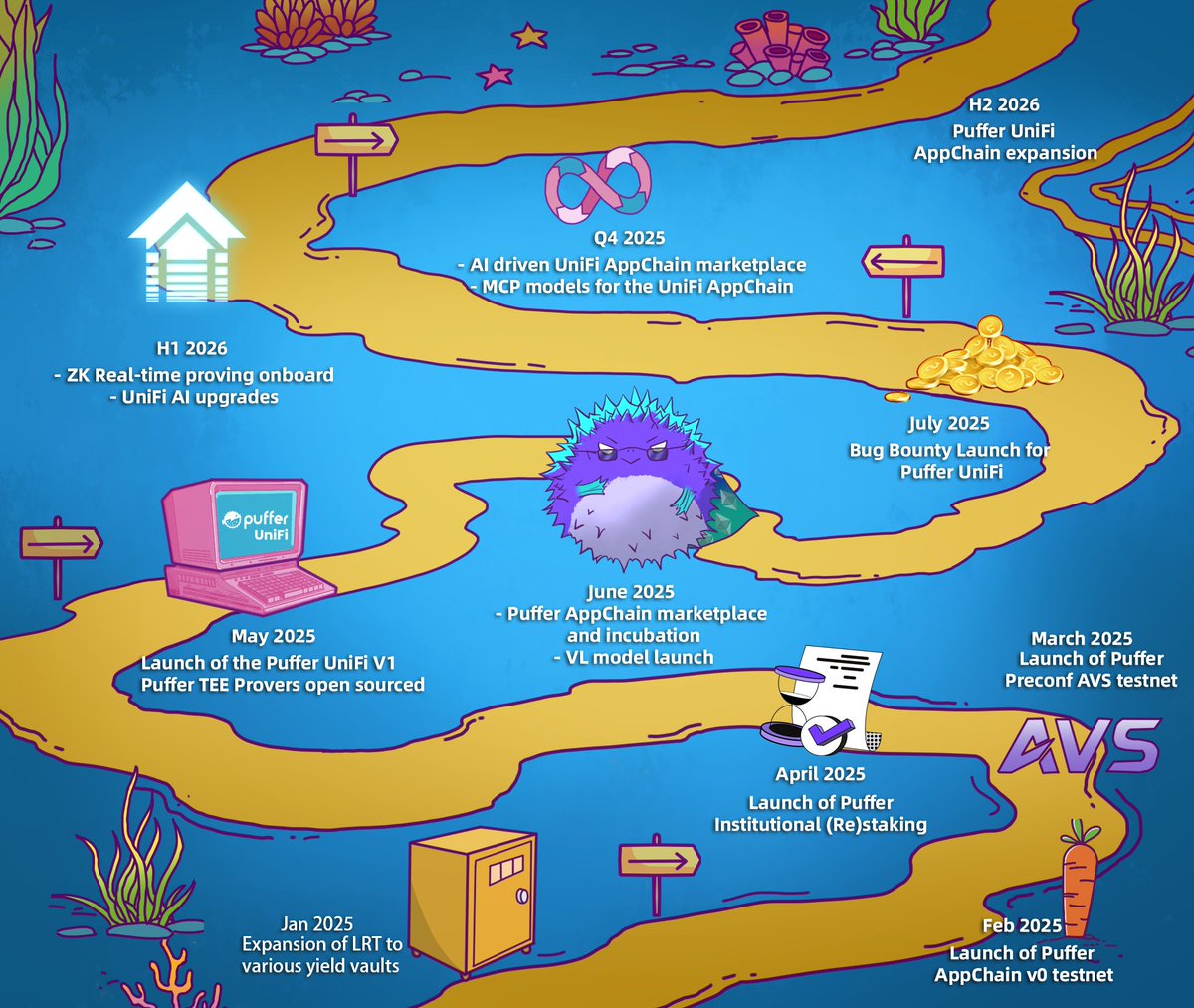
With the dawn of AI, we are going to redefine how users and developer experience the Blockchain.
The barrier of entry to crypto is going to be much lower than you think.
Appchains 🤝AI
5
4
23
1,293
12 May 2025
One hell of a roadmap update! AI upgrades? Spicy 🔥
1
99