The RCN through @NASAAstrobio focused on developing the science and technology needed to search for life on other worlds. Not an official NASA account.
Our next #AskAstrobio guest has been studying the state of astrobiology throughout history.
What do you think is the most important finding in this field from the past century? Cast your vote today: youtube.com/post/Ugkxjk8bf3G…
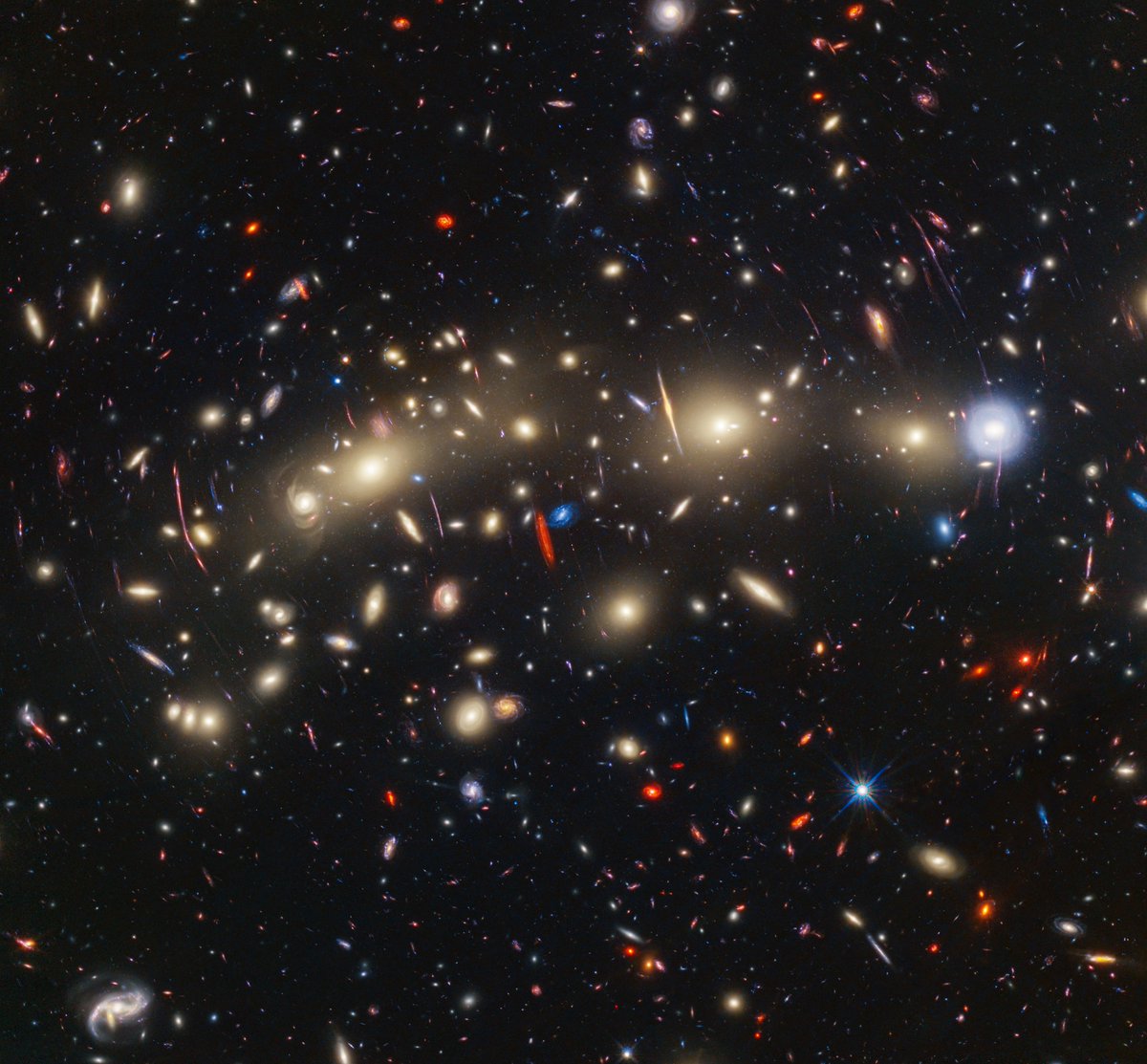
ALT This panchromatic view of galaxy cluster MACS0416 was created by combining infrared observations from NASA’s James Webb Space Telescope with visible-light data from NASA’s Hubble Space Telescope. The resulting wavelength coverage, from 0.4 to 5 microns, reveals a vivid landscape of galaxies whose colors give clues to galaxy distances: The bluest galaxies are relatively nearby and often show intense star formation, as best detected by Hubble, while the redder galaxies tend to be more distant, or else contain copious amount of dust, as detected by Webb. The image reveals a wealth of details that are only possible to capture by combining the power of both space telescopes. In this image, blue represents data at wavelengths of 0.435 and 0.606 microns (Hubble filters F435W and F606W); cyan is 0.814, 0.9, and 1.05 microns (Hubble filters F814W, and F105W and Webb filter F090W); green is 1.15, 1.25, 1.4, 1.5, and 1.6 microns (Hubble filters F125W, F140W, and F160W, and Webb filters
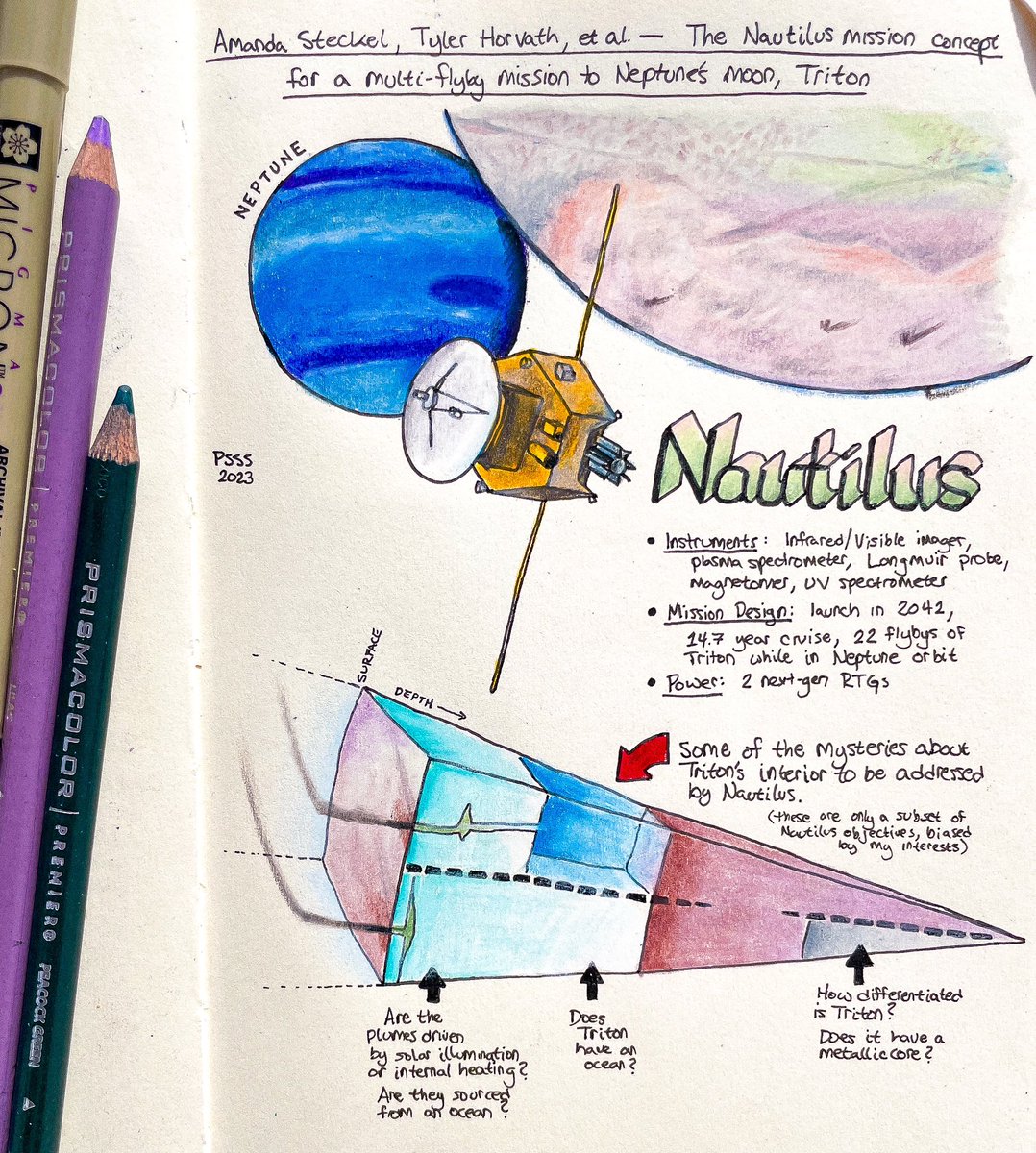
Fantastic work depicting a New Frontiers concept mission to Triton. Great work, James! We love effective visualizations for science communication and gorgeous space artwork 🚀🌠
Amanda Steckel @steckel_avs & Tyler Horvath @Planetary_Tyler—Nautilus is a New Frontiers concept to explore Neptune’s moon, Triton! It would address a lot of outstanding questions, including the origin of Triton’s plumes, and whether Triton has an ocean and/or core #AGU23
ALT A sketch of the Nautilus mission concept posters at AGU23. It shows a spacecraft, in gold (center), flying by Neptune’s large moon, Triton (top right). A deep blue Neptune looms in the background (top left). The sketch includes some text describing the instrument suite (Vis/IR camera, plasma/mag suite, UV spectrometer), mission design (long cruise to Neptune orbit), and power system (2 RTGs). The bottom of the sketch shows a wedge of Triton’s interior lying on its side, with the surface on the left and core on the right. The wedge is broken down into a few different hypotheses, including: whether the plumes are shallowly sourced or come from the ocean; whether there is or is not an ocean; and whether Triton has a metallic core.
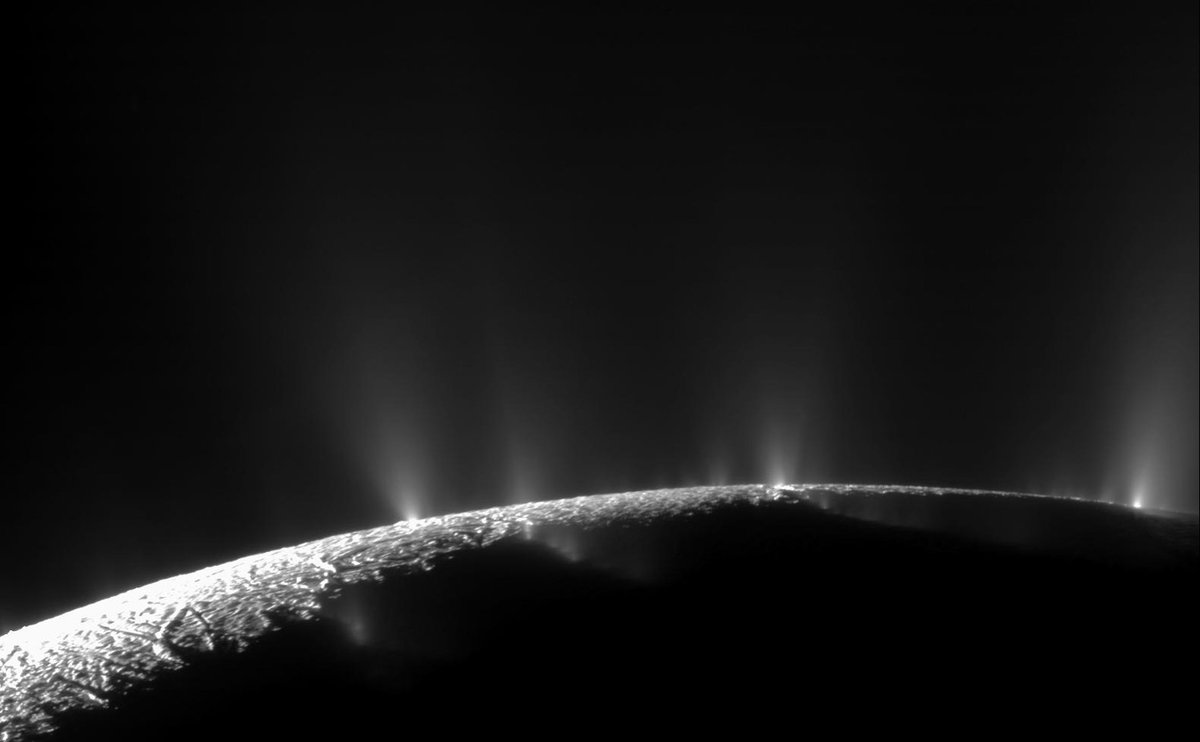
Exciting news for the potential habitability of Enceladus! A study zooms in on Cassini mission data gathered at Saturn’s icy moon and finds confirming evidence of hydrogen cyanide, a molecule needed to spark life as we know it and a supercharged chemical energy source to fuel it.
ALT Dramatic plumes (cloudy, white areas), both large and small, spray water ice out from many locations along the famed "tiger stripes" near the south pole of Saturn's moon Enceladus. The tiger stripes are fissures that spray icy particles, water vapor and organic compounds. More than 30 individual jets of different sizes can be seen in this image and more than 20 of them had not been identified before. This mosaic was created from two high-resolution images that were captured by the narrow-angle camera when NASA’s Cassini spacecraft flew past Enceladus and through the jets on Nov. 21, 2009.
Have you seen our most recent #NfoLD nugget on endogenous ice on Europa? Check it out here: nfold.org/nuggets
Thanks to @DevyaniJambhul4 @catmaggiori Kaitlin Harrison and Brook Nunn for putting this nugget together!
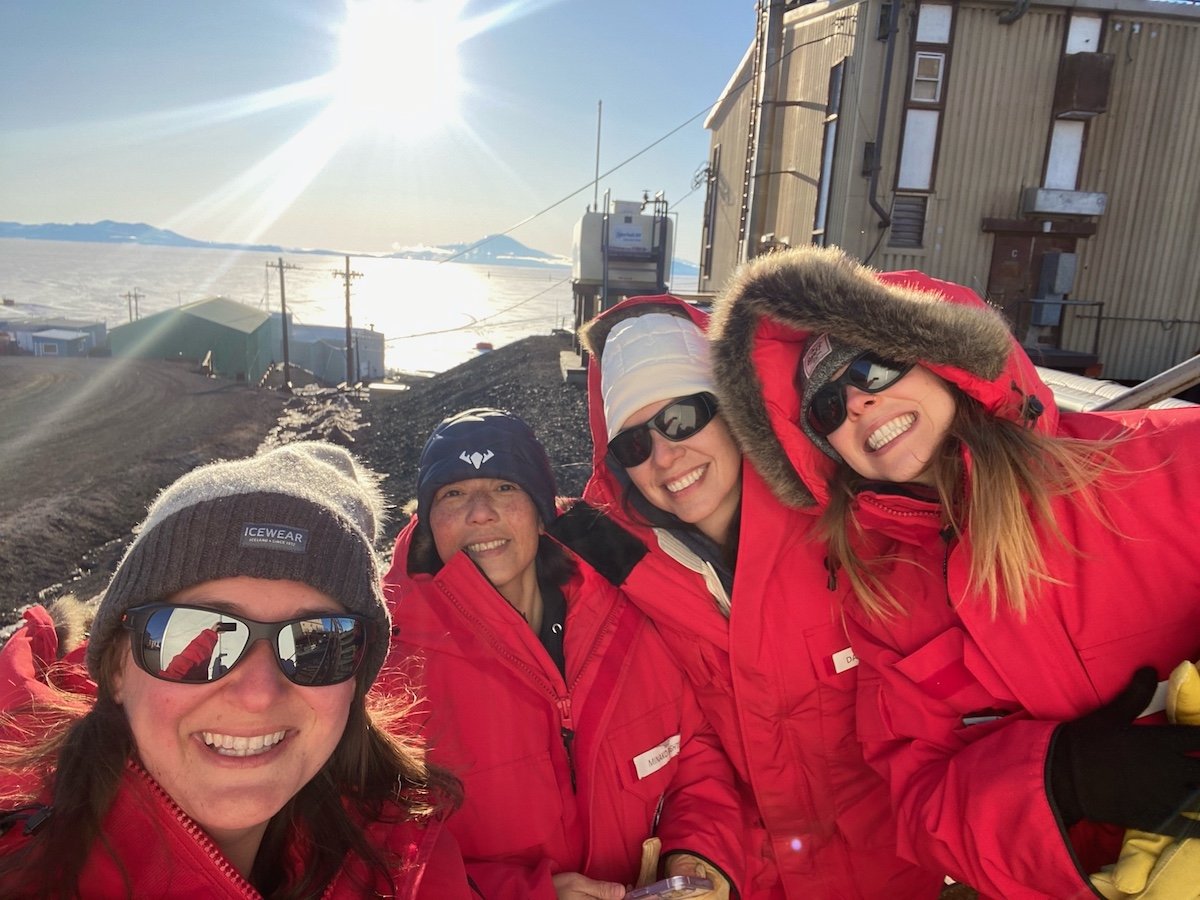
The midnight sun shining gloriously over McMurdo station!!
The ANSMET team has had a pretty spectacular welcome to Antarctica and I'm very quickly falling in love with these mountain views 🗻 (I am already smitten with my Big Red coat!)
Follow along: caslabs.case.edu/ansmet/2023…
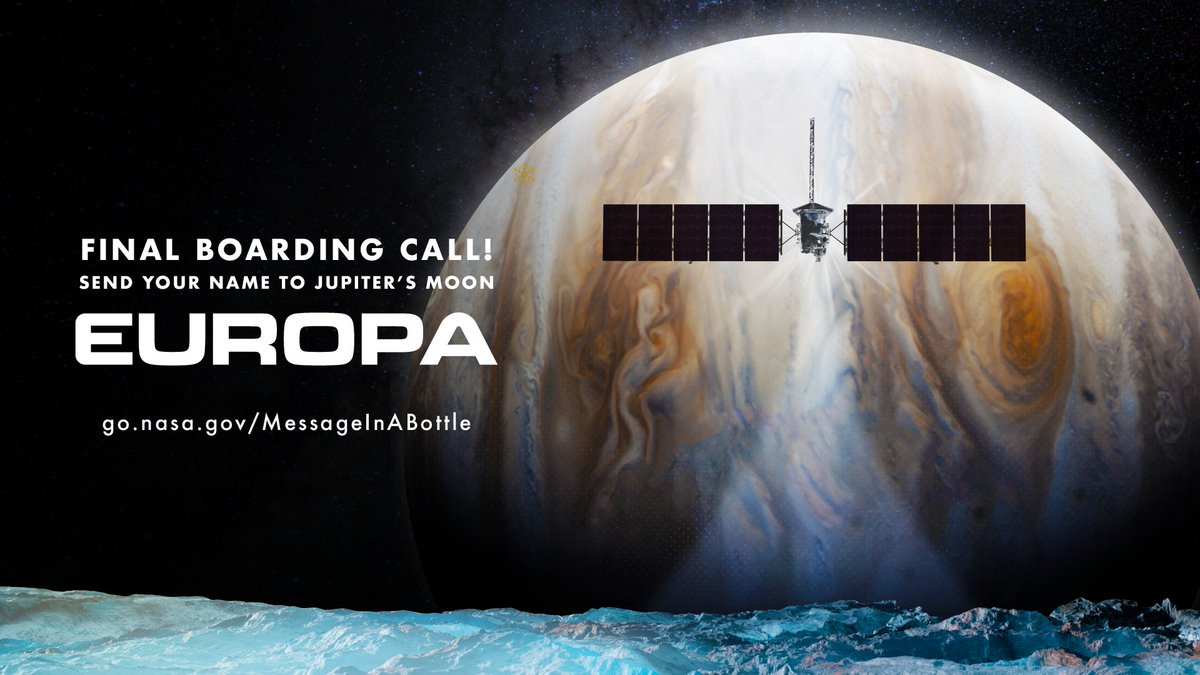
It will take years for @EuropaClipper to reach one of Jupiter’s icy moons, Europa. But, it only takes a moment to submit your name to be engraved on a chip aboard the spacecraft before its 1.8-billion-mile journey. Don’t miss out! go.nasa.gov/3FTUbyy
ALT Illustration showing the surface of Europa, one of Jupiter's icy moons. Europa takes up the bottom portion of the image, with blue-black ridges and canyons stretching off into the horizon. Jupiter looms in the background with its Great Red Spot visible. The Europa Clipper spacecraft transits above the surface of Europa. White text reads "Final Boarding Call! Send your name to Jupiter's moon Europa. go.nasa.gov/MessageInABottle." Credit: NASA/JPL-Caltech
An all new #AskAstrobio is coming this Wednesday, and features Dr. Bonnie Teece (@astrobonology) of NASA JPL.
Set up your notifications now on the YouTube live landing page here: youtube.com/watch?v=JnWHOdnW…
Come join us on Wednesday for a chat with @AstroBonology about her life and career for #AskAstrobio!
Link to the YouTube live landing page coming soon, but check out the @NASAAstrobio YouTube channel now to subscribe and get info on when the live page drops.
Dear Followers!
Have you already seen our range of events, seminars and working groups? Feel free to take a look at our website:
europeanastrobiology.eu/
We're stoked to partner with the Polish Astrobiology Society (@PTAstrobio) for their 3rd Life and Space Conference, this December.
Learn more and register for the meeting here: astrobio.pl/las2023/
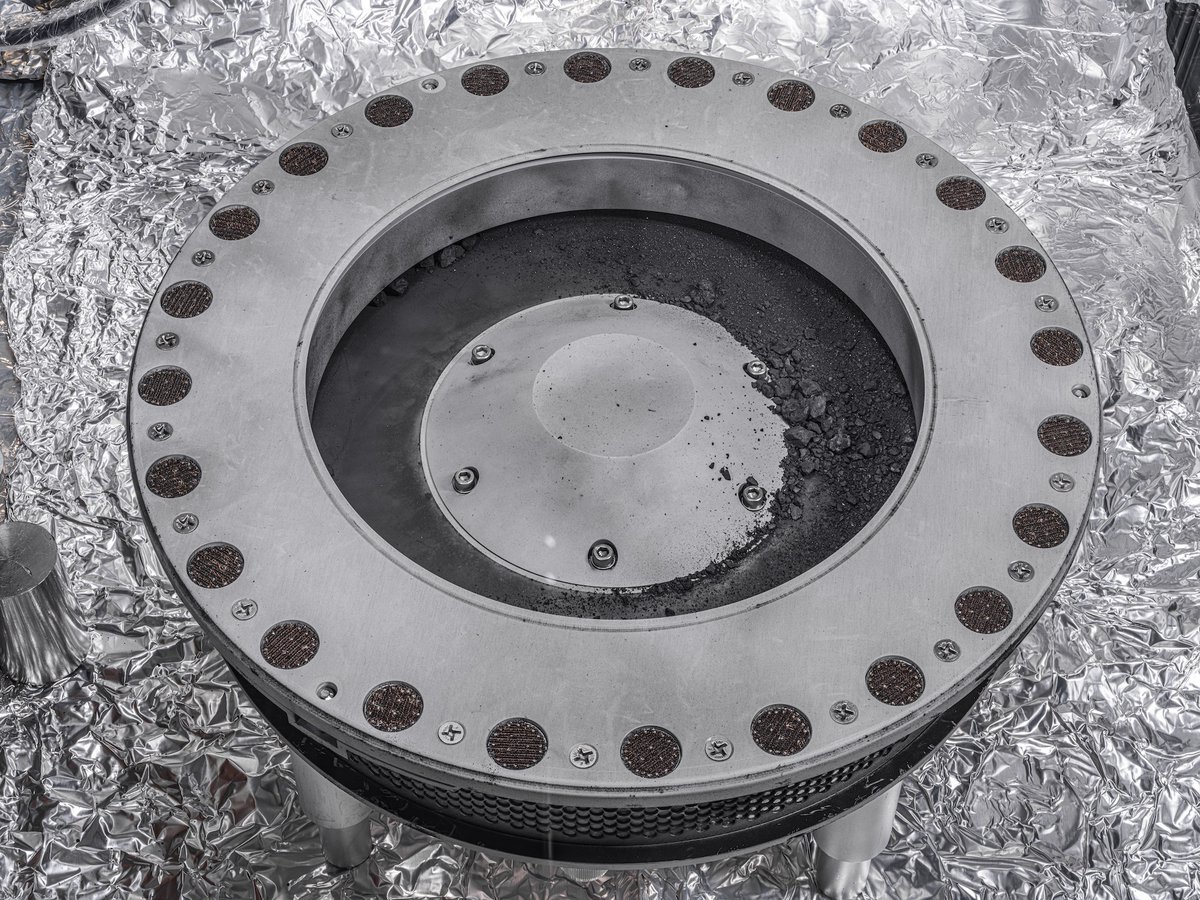
Asteroids are the building blocks of our solar system, and this asteroid contains the building blocks of life. Our initial analysis of the 4.5-billion-year-old rocks from asteroid Bennu delivered to Earth by #OSIRISREx shows evidence of carbon and water.
nasa.gov/news-release/nasas-…
ALT Circular metallic instrument of concentric circles on aluminum foil, the TAGSAM head from the OSIRIS-REx spacecraft. The outer ring contains many small circles containing small particles of black dust. The inner circle contains small rocks.
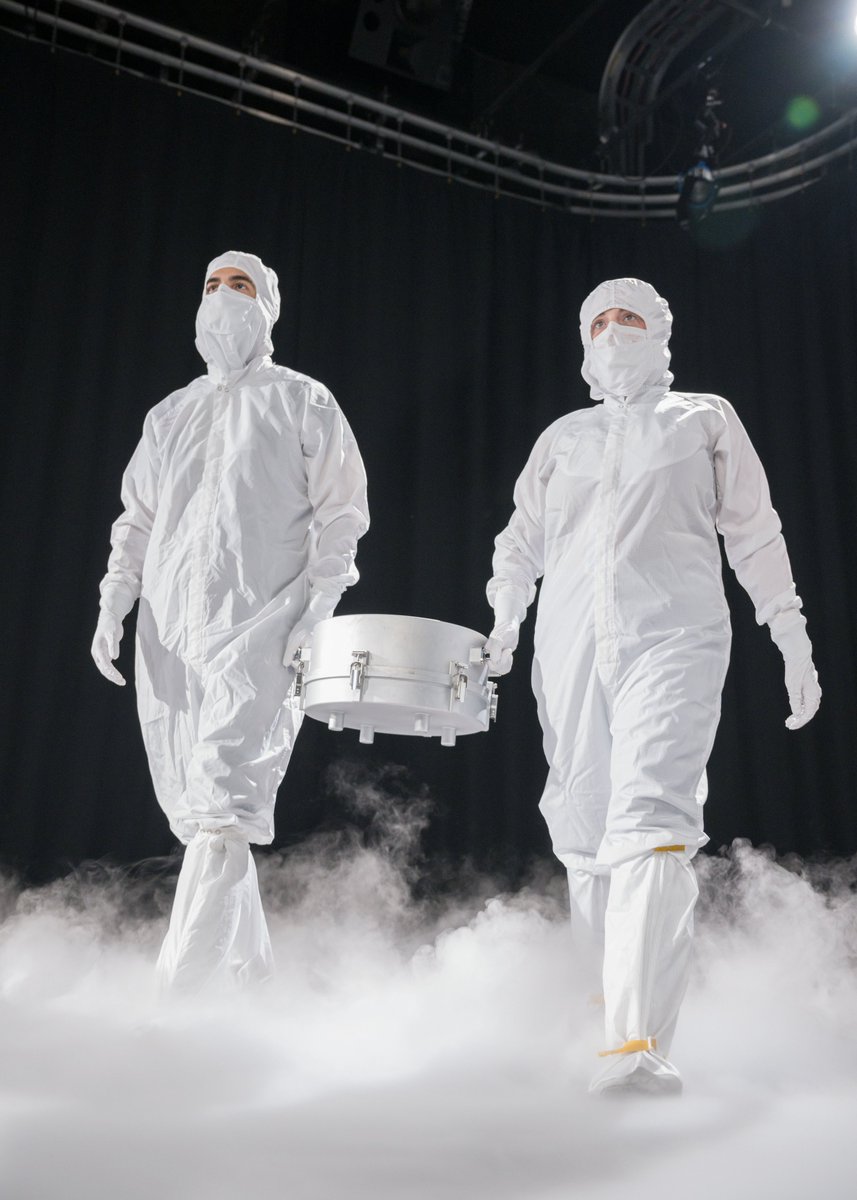
On Oct. 11 at 11am ET, @NASA unveils the #OSIRISREx asteroid sample to the world at @NASA_Johnson!
Don't miss the action. Set a reminder to learn the results from an initial analysis of the 4.5 billion-year-old material: youtube.com/live/oFvIuSpACQA…
ALT A staged photo shoot of the OSIRIS-REx container that was used to carry the Bennu asteroid sample. At NASA's Johnson Space Center, the participants are holding the container and are pictured in white clean room outfits.
OPAG, NASA's community-based forum designed to provide science input for planning and prioritizing outer planet exploration activities for the next several decades, will have its next meeting November 28-30. More information: ow.ly/ZRy150PQeUP
A fantastic article just dropped on the amazing work NfoLD and @nexssinfo did on creating a Standards of Evidence for Life Detection, and why it is important. It's such an important topic, and I highly recommend checking it out.
aeon.co/essays/alien-life-mi…#NfoLD#Astrobiology
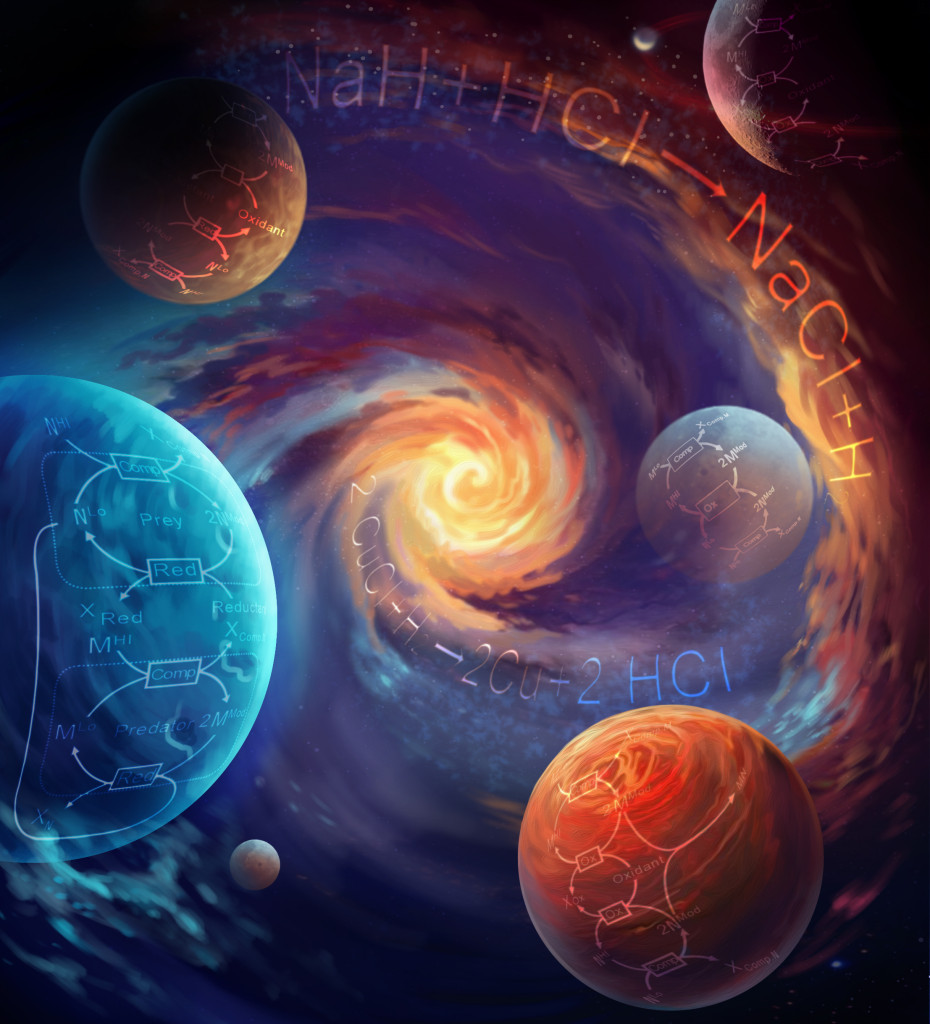
NASA-supported astrobiologists create a “cookbook” of chemical recipes that could aid in our search for life. 📖
Using this ingredient list, we can test different planetary conditions to understand where and how processes known to sustain life can arise: go.nasa.gov/46hSnLs
ALT An array of autocatalytic reaction diagrams, superimposed on the surfaces of a variety of colored planets that are rotating around a central swirling nebula of gases. Artist: Ella Maru.
The 2023 International @SpaceApps Challenge is coming up on Oct. 7-8! Join our global hackathon to explore #OpenScience and create solutions to real-world challenges.
Everyone is welcome. Register now: spaceappschallenge.org/
ALT A gif showing Earth below as seen from the windows of the space station's cupola. Clouds pass by.
Our friends at @nexssinfo have released their latest recording from the Professional Advancement Workshop Series. This month's topic was Faculty Jobs at R1 Universities. You can get all the info on the panel, and watch the recording here: nexss.info/paws-16-faculty-j…#NfoLD