
Men Welfare Trust (80G Regd.) is a Trust working towards bringing Harmony, Peace, Upliftment, Rights, Education, Health for Men. Helpline : 8882498498
Joined January 2017
- Tweets 1,861
- Following 106
- Followers 13,675
- Likes 608
705 Photos and videos
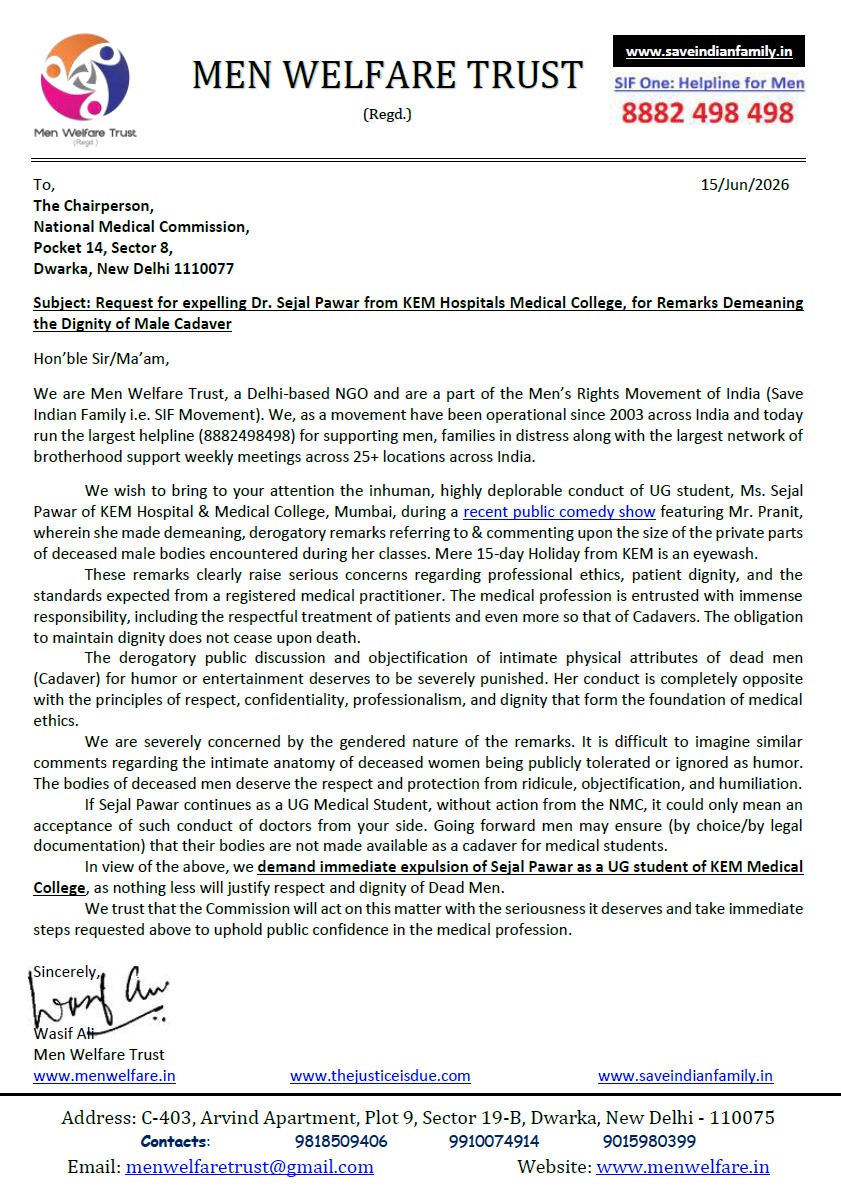

We hereby request direct intervention and immediate action of expulsion of the UG Student, Ms. Sejal by @NMC_IND since @KEMHOSPITAL has chosen just a 15 day holiday for derogatory remarks of the student against Male Cadaver.
Any apology won't work here since the comment was about a very generic approach that Ma. Sejal has for male dead bodies.
This is the time where the Medical fraternity is at the crossroads of either favoring a gender or the risk of men adding, No Cadaver clause to their last wishes!!
We hope to have swift and appropriate action and not an eyewash.
19
122
310
4,814

Jun 13
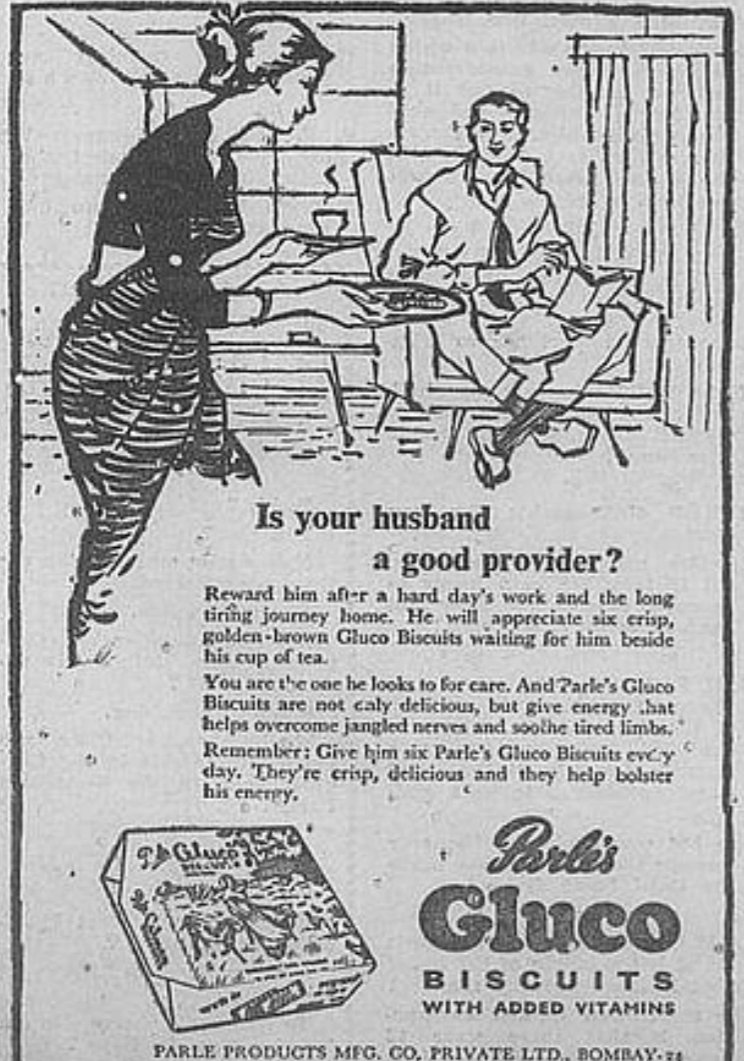
17/Oct/1959 Blitz Newspaper
For those, who live in the hoax of "priviledge" of men.
Men were only n only looked and even marketed as the Protector and Provider.
Has this expectation changed even for a minute till date??
Feminists have made the society believe on #PatriarchyHoax
Men were openly marketed as a Protector and Provider by companies, feminists and society since the time unknown. CaveMEN were only out fighting deadly animals, collecting food for women and children inside the caves.
@officialparleg
#MensRights #FeministHoax #FeminismIsCancer
1
8
13
494
Men Welfare Trust retweeted

Jun 7
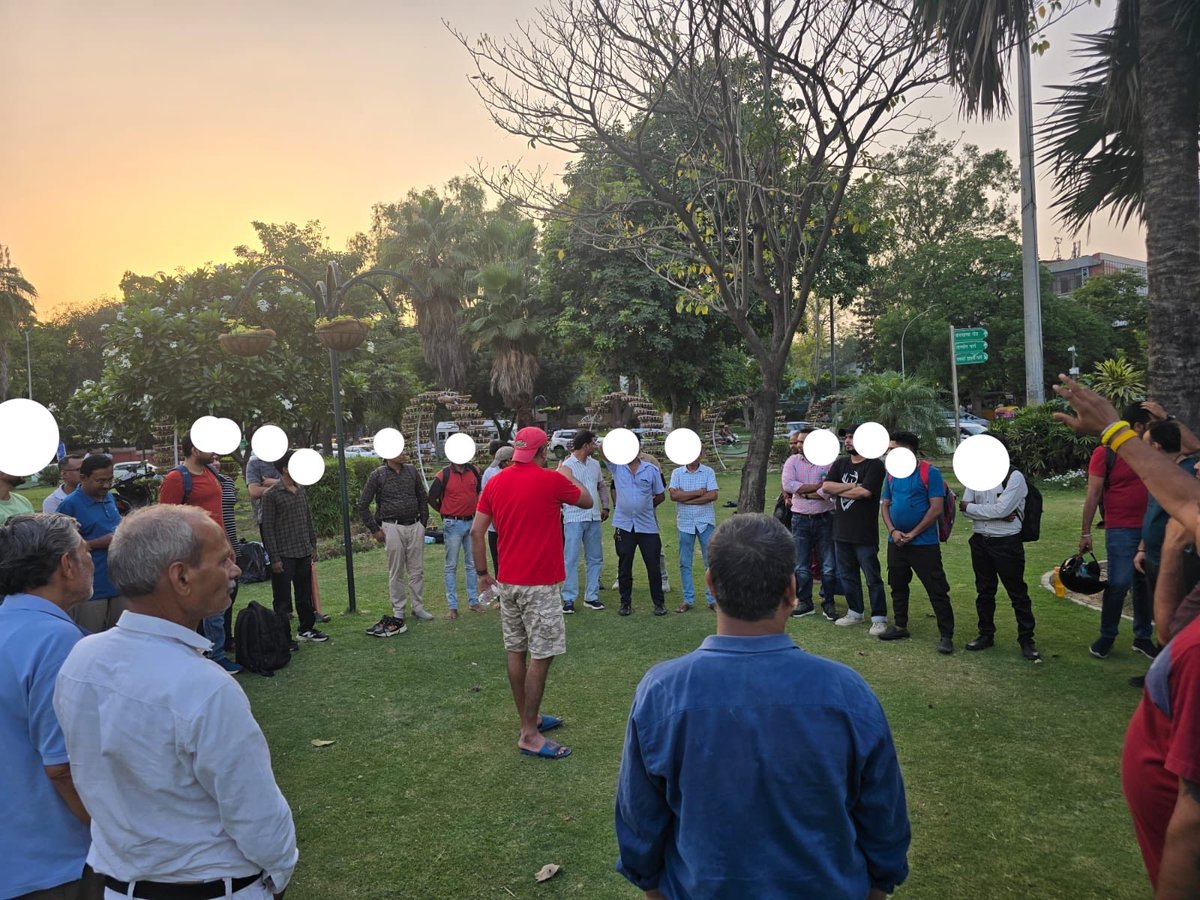
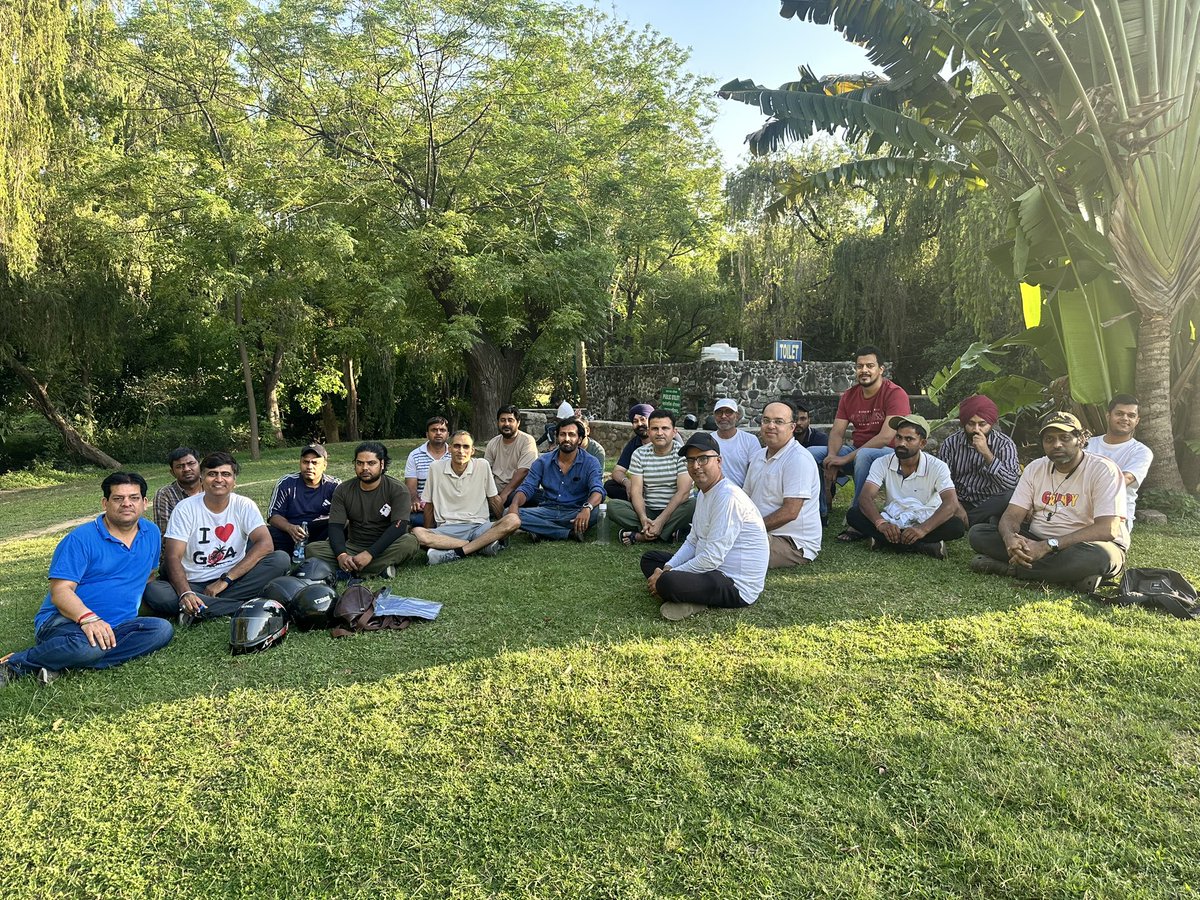
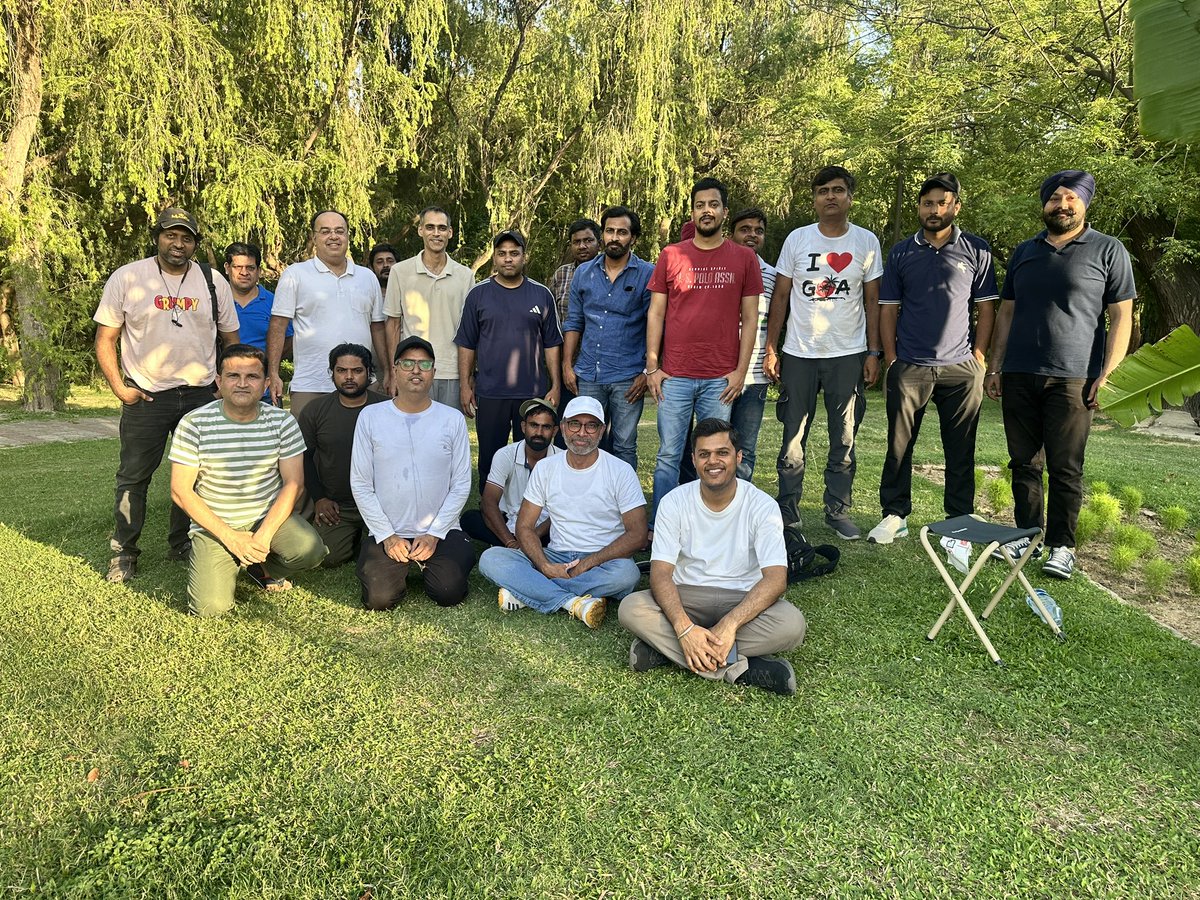
In a country where many men struggle without a dedicated support system, our weekly support meetings provide legal guidance, motivation, strength and solidarity.
We listen, we support and we strengthen. Because no man should have to face life's toughest battles alone.
#MensRightsAreHumanRights
#MenToo
18
30
386
Jun 6
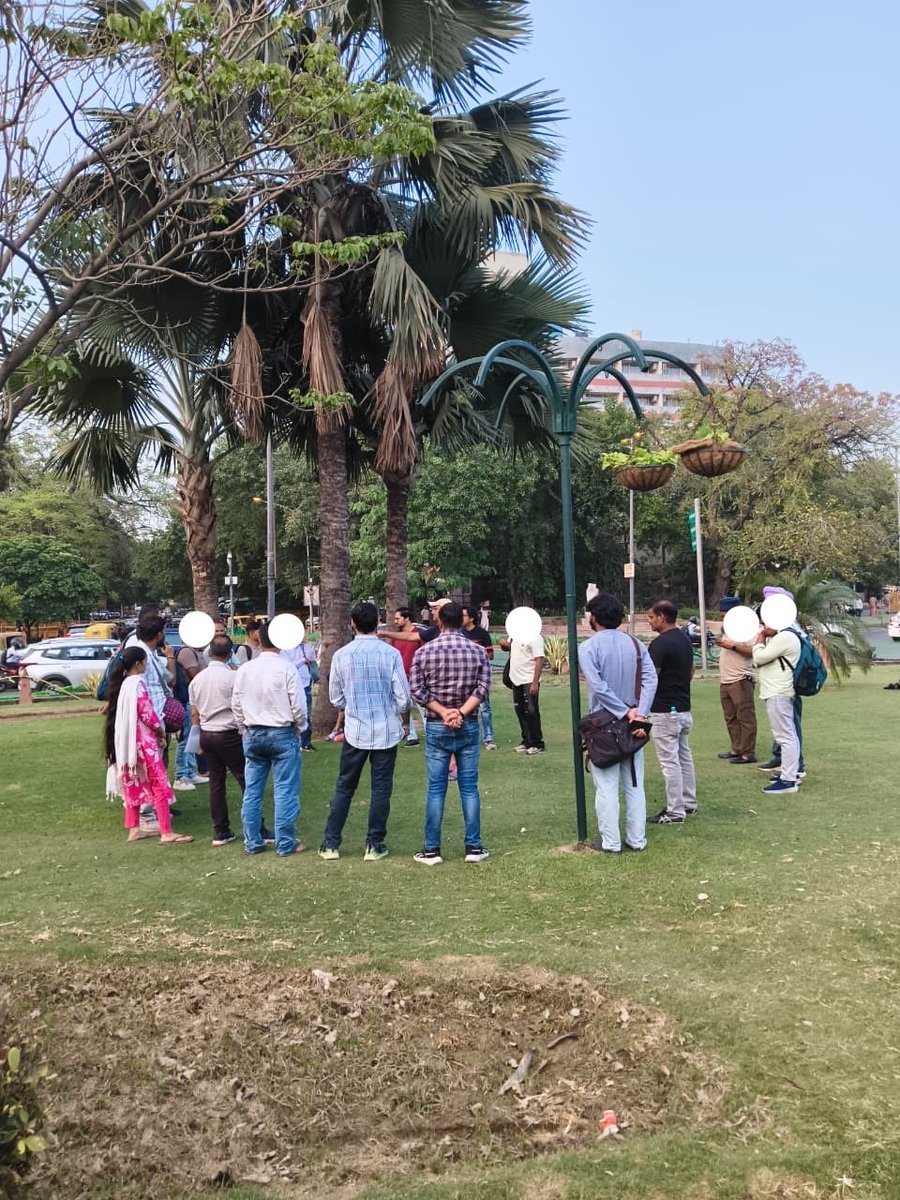
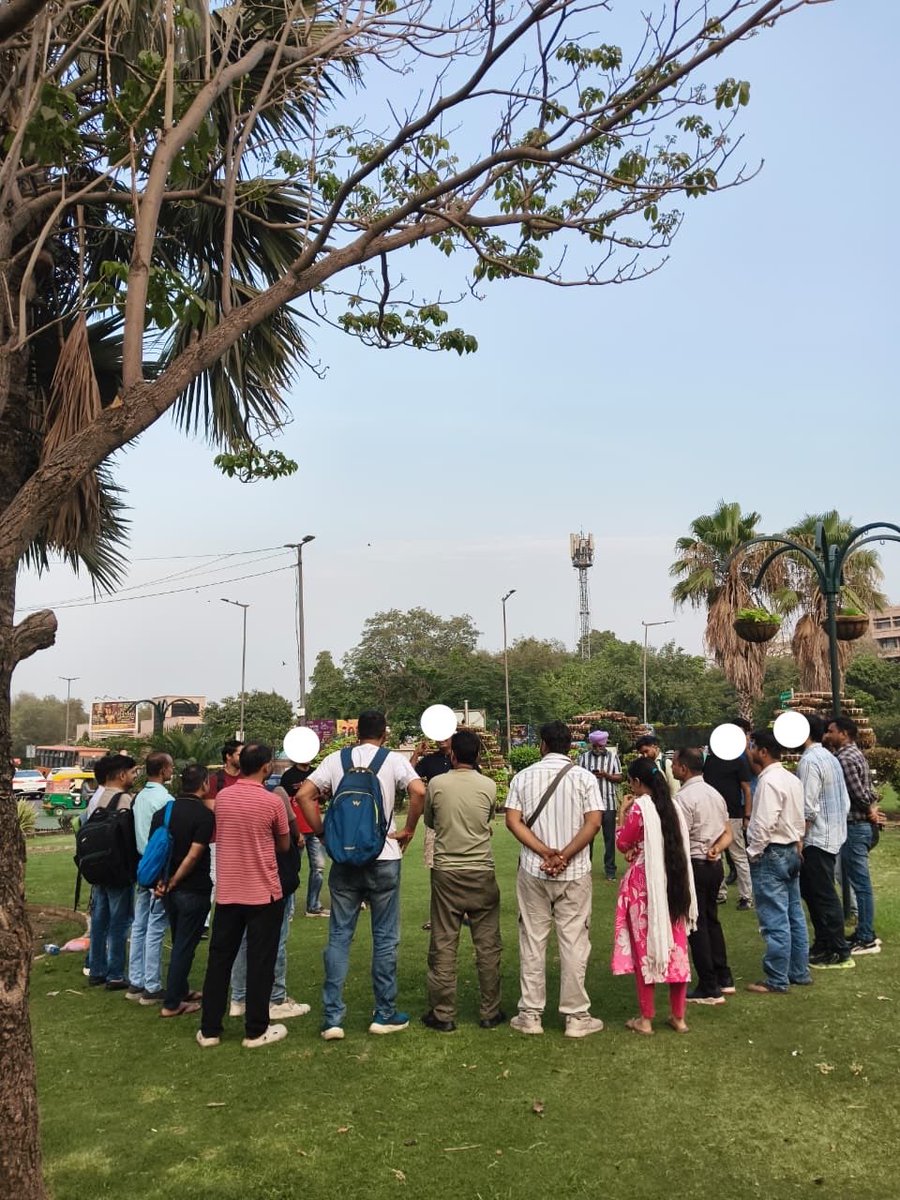
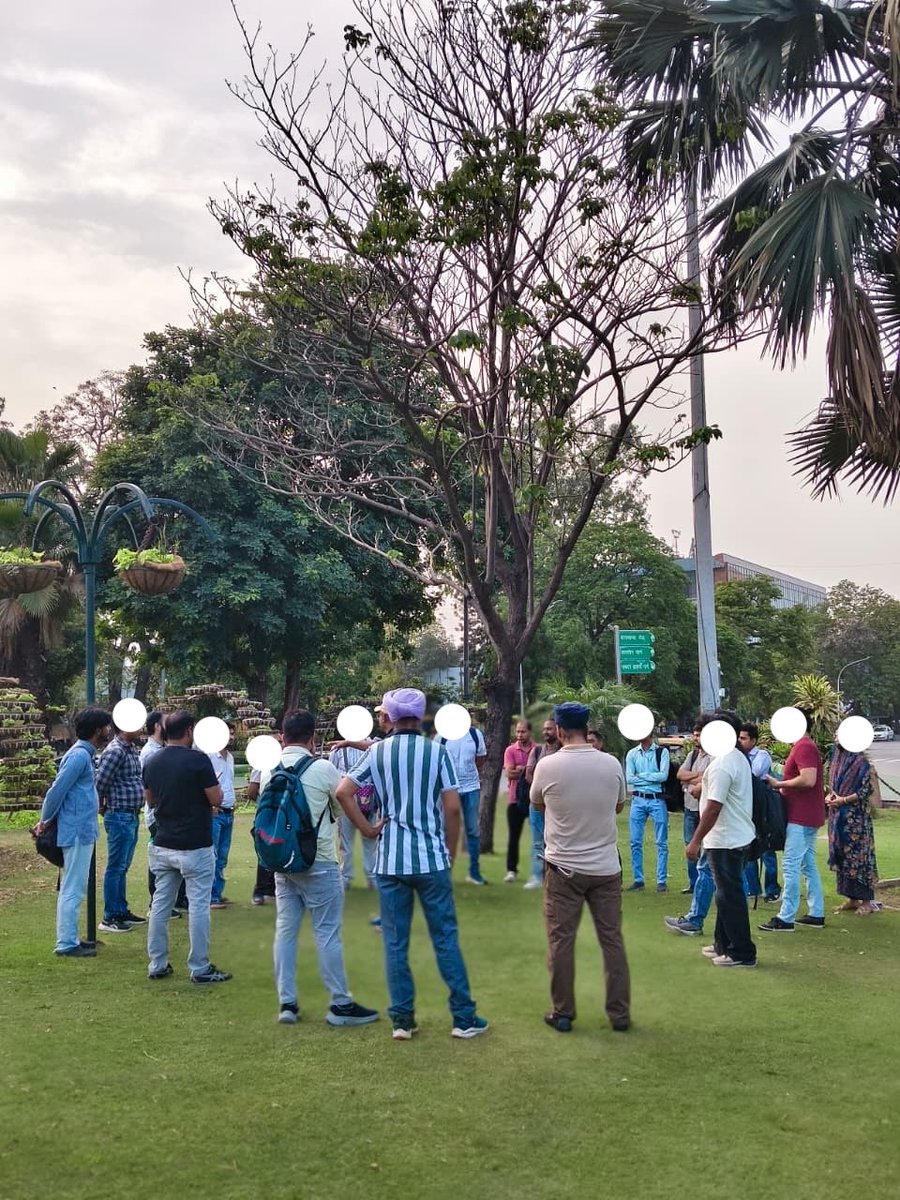
Weekly Meeting
Date : June 6, 2026
Never push a man to a corner.
2
16
23
323

Bandar Review | Bobby Deol Film Explores How False Accusations Make A ‘Monkey’ Out Of Justice
news.abplive.com/movie-revie…
#Bandar #BobbyDeol #AnuragKashyap
3
7
770
Men Welfare Trust retweeted

Jun 4
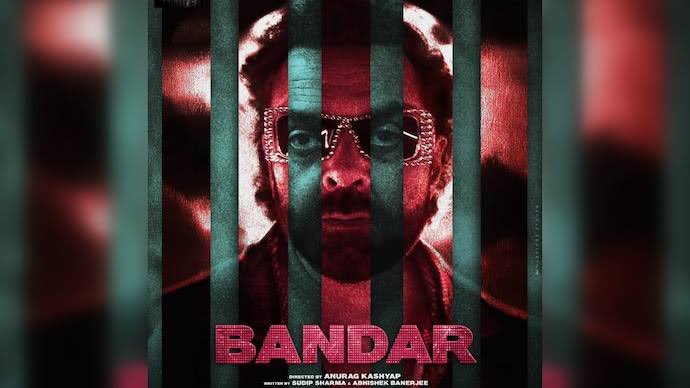
#Bandar Review: EXCEPTIONAL
Rating: ⭐⭐⭐⭐½/5
Just watched #Bandar.... and I genuinely believe this is one of the most NECESSARY films of our time (From Hindi Cinema).
The film addresses a subject that society can no longer afford to ignore. It explores how "gender-biased laws".. their misuse and the resulting legal battles can affect individuals, families, careers and even the justice system itself. While the film draws inspiration from real-world issues that continue to be debated, what impressed me most is that it doesn't merely take sides... it starts a conversation. 👍🏻
Real change begins when awareness spreads, discussions happen and society is willing to confront uncomfortable questions. I believe Bandar has the POTENTIAL to do exactly that. The director @anuragkashyap72
Is back.
From the very first frame to the last.. the film is incredibly engaging.. Yes it is. It constantly pushes the audience to think about how laws designed to protect can sometimes be misused. At the same time, the film is careful not to reduce the issue to a one-sided argument. Har sikke ke do pahli bhi hote hai.
The experiences of both the accused (Bobby Deol) and the accuser (Sapna Pabbi) are given space within the narrative, making the film far more layered and mature than a typical courtroom or social drama.
In an era where stories about dating-app scams, extortion, personal vendettas, false Section 376 allegations, DV and the complexities of legal disputes frequently make headlines, #BandarMovie touches upon these realities with remarkable honesty. It reflects a side of society that is often discussed in private but rarely explored on screen with such conviction.
The film's tagline, "Hum sab apni zindagi ke circus ke Bandar hai" perfectly captures its essence. So cool.
Throughout the narrative, the Hero (who is actually a loser) struggle within systems, circumstances, and situations larger than themselves, making the metaphor surprisingly powerful.
One of the film's greatest strengths is its authenticity. Whether it's the police station sequences, the court moments or the prison environment, everything feels grounded and believable. In fact, this may be one of the most authentic depictions of PRISON LIFE I have seen in an Indian film. Wo Navi Mumbai ka Taloja jail bhai.... The barracks, the inmates, the atmosphere, the hierarchy and the emotional weight of confinement (worst) all feel painfully real.
At the center of it all is #BobbyDeol, who delivers one of the finest performances of his career. He begins as a charming, ordinary man but a celebrity whose life suddenly spirals out of control after being accused of 376.. and BOMB 💣 The panic, confusion, humiliation, despair and emotional breakdown that follow are portrayed with remarkable sincerity. Watching his gradual transformation, especially after entering prison is both heartbreaking and compelling.
Directorially, the film is exceptionally confident. The storytelling feels clean, focused, and realistic, allowing the audience to become fully immersed in the world of the film. A special mention must be made of the decision to use the 1.85:1 aspect ratio screen frame. It subtly enhances the feeling of confinement and emotional entrapment, making the audience feel closer to the characters and their struggles.
The supporting cast is equally impressive. Every actor, from the prison inmates to the police officers, contributes to the realism of the film. The actor playing Inspector Devre deserves particular praise for delivering a powerful and memorable performance.
More than anything else, I hope Bandar succeeds in starting a larger social conversation. Cinema has always been a mirror to society and this film embraces that responsibility with courage and conviction.
Films like Bandar are important not because they provide easy answers, but because they force us to ask difficult questions. And sometimes that is exactly what great cinema is meant to do.
#BandarReview
13
123
1,007
191,163
Men Welfare Trust retweeted

Jun 4
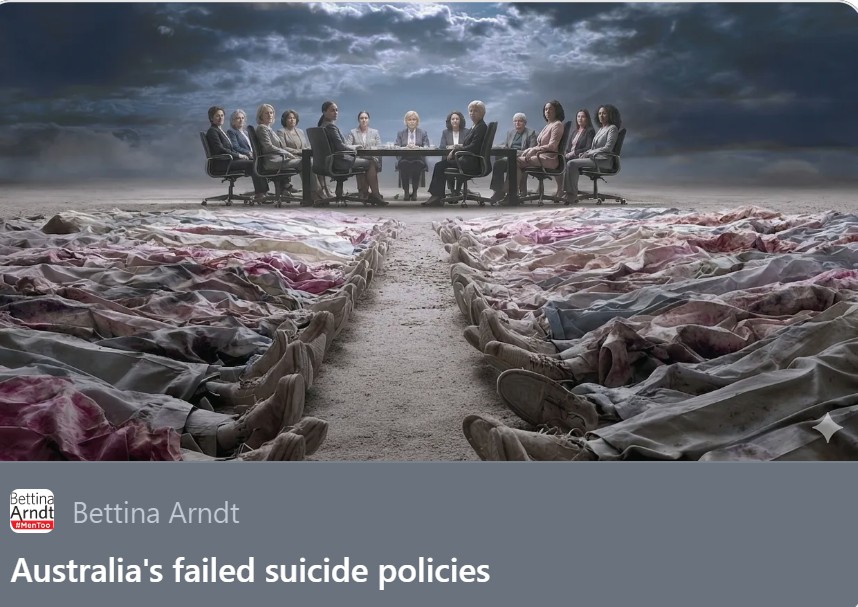
Seven men die from suicide every day in Australia. Read about the feminist takeover of our national suicide policies - a grim development bound to do nothing to protect our most vulnerable men. Please promote Bettina's important new blog.
Australia's failed suicide policies open.substack.com/pub/bettin…
2
17
36
604
Men Welfare Trust retweeted

Jun 3
#Lucknow | Caught Wife In Compromising Position At Home. Then, He Woke Up Blind: How UP Love Marriage Turned Into Acid Attack
news18.com/cities/lucknow-ne…
12
58
106
16,723
Jun 3
The Silent Crisis: Why the Rise in Male Suicides Demands National Attention
The case of Twisha Sharma has reignited discussions around gender-based violence and suicides in India. As expected, much of the public discourse and media coverage has focused on allegations against the husband and his family. However, amid the sensationalism and trial by media, a larger and far more disturbing reality of growing epidemic of male suicides in India remains largely ignored.
Every day, 4.5 mts men take their own lives or become victims of violence in intimate relationships. Yet these incidents rarely evoke the same level of public outrage, media attention, or societal introspection as cases involving female victims. The result is a dangerous blind spot in our understanding of gender, victimhood, and mental health.
In 2024, India recorded approximately 1,70,694 suicides. Of these, 1,25,449—or 73.5%—were men.
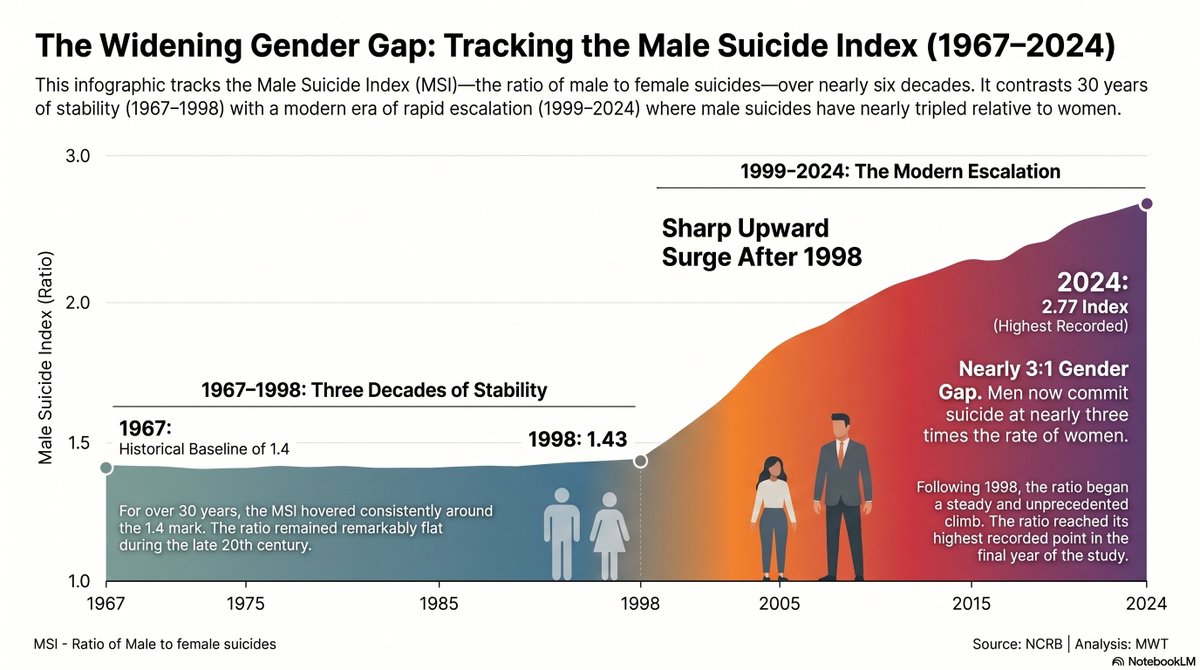
Report by the National Crime Records Bureau (NCRB) since 1967 reveals an alarming trend. For more than three decades, from 1967 to 1999, the Male Suicide Index (MSI)—the ratio of male to female suicides—remained relatively stable at around 1.4. In other words, male suicides were about 40% higher than female suicides.
However, beginning in the late 1990s, a structural shift occurred. The ratio started rising steadily and has now reached an unprecedented 2.77. Today, nearly three men die by suicide for every woman (Refer graph :“Tracking the Male Suicide Index”).
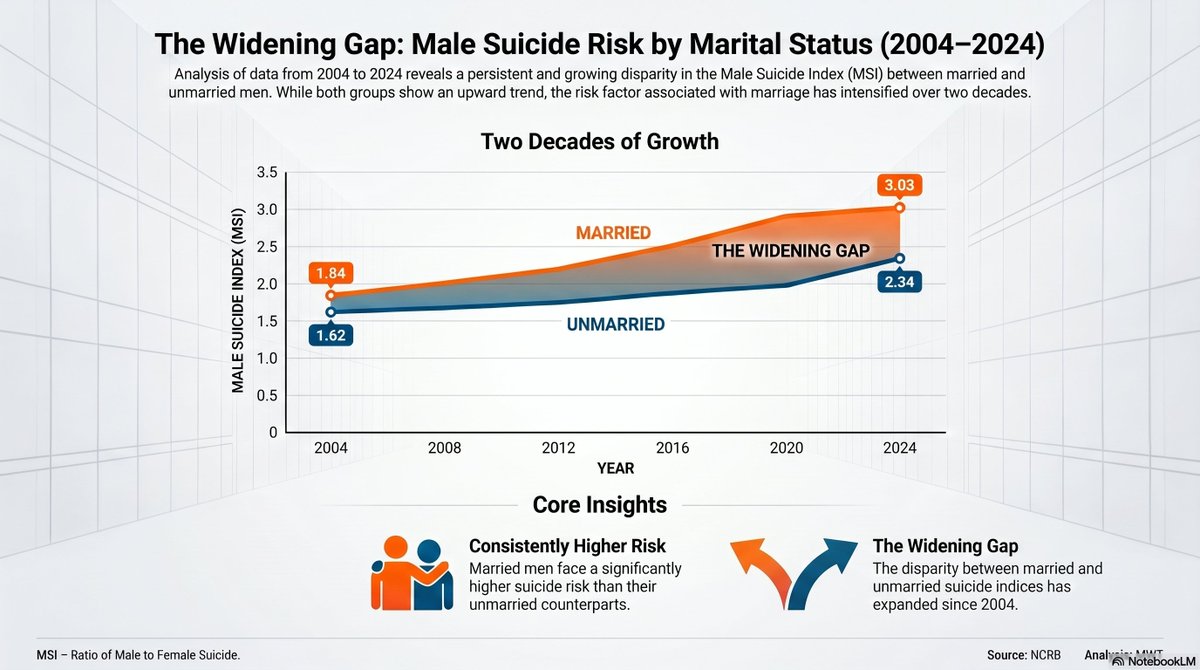
The situation becomes even more concerning when marital status is considered. Data indicate that married men face a higher risk of suicide than unmarried men, and their suicide risk is significantly higher than that of married women. (Refer graph: “Male Suicide Risk by Marital Status”)
What Changed After the 1990s?
The timing of this shift raises important questions.
India's economic liberalization in 1991 transformed not only the economy but also the social fabric of the country. Globalization, rapid urbanization, changing family structures, evolving gender norms, and the growth of women institutions have all reshaped interpersonal relationships and social expectations.
Whether these developments directly contributed to the surge in male suicides remains a matter for rigorous research. However, one fact stands out: female suicides have remained broadly stable at around 45,000 annually since the late 1990s, while male suicides have continued to rise sharply, suggesting that the widening gap is driven primarily by increasing male vulnerability.
Men in Their Most Productive Years Are the Most Vulnerable
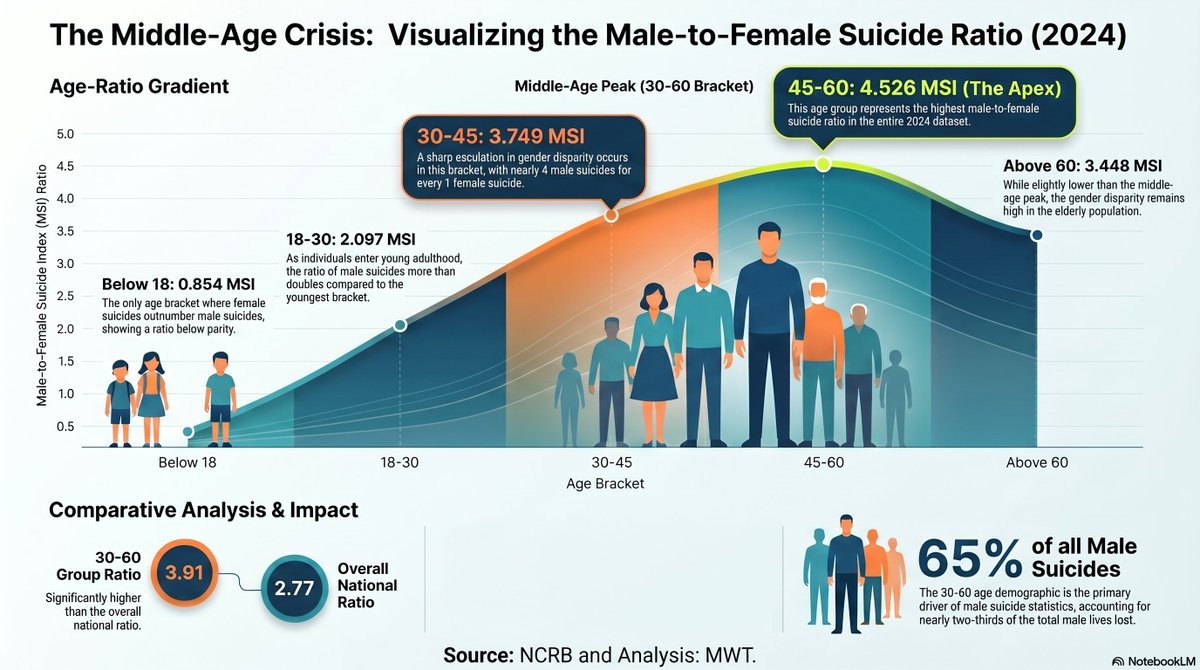
The burden of suicide falls disproportionately on men in the age group of 30–60 years—the very years during which men are expected to shoulder the responsibilities of earning, supporting families, caring for children and aging parents, and meeting societal expectations of success.
Approximately 65% of all male suicides occur within this age bracket.
The Male Suicide Index in this group is 3.91, meaning nearly four men die by suicide for every woman.
The disparity is even greater in the 45–60 age group, where the MSI reaches 4.53.
These figures should deeply concern policymakers, mental health professionals, and society at large. (Refer graph: “The Middle Age Crisis”)
Family Problems: The Largest Driver of Male Suicides
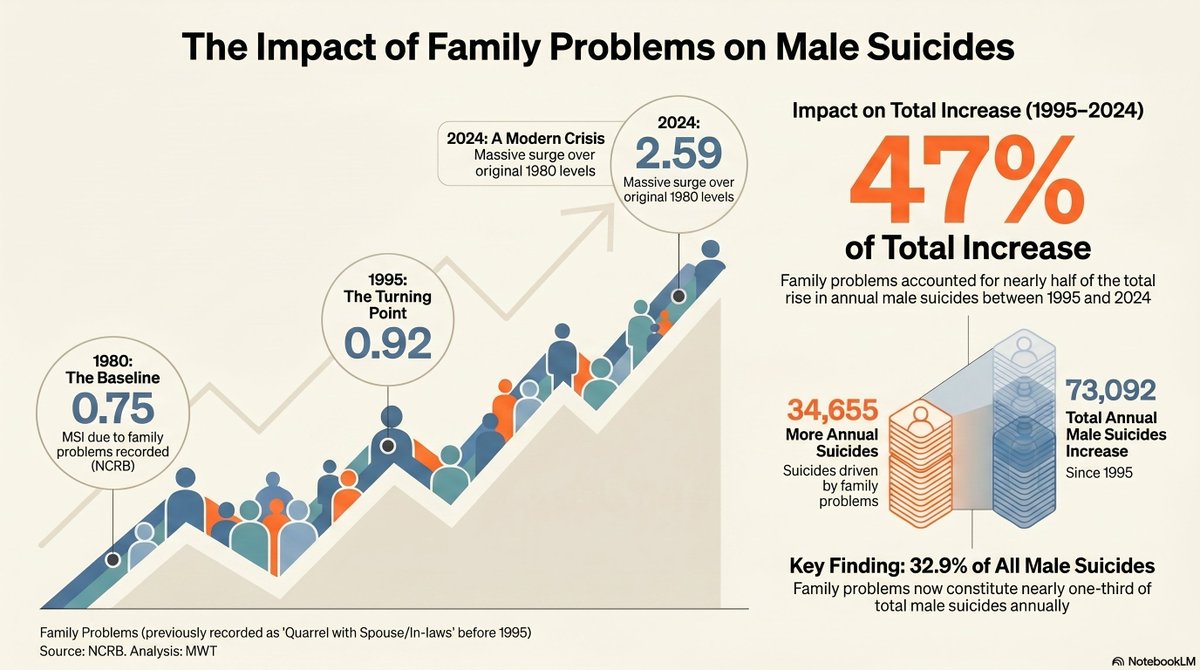
According to NCRB data, the single largest recorded cause of suicide is "Family Problems," accounting for 33% of all suicides.
Prior to 1995, NCRB separately recorded causes such as "Quarrel with Spouse" and "Quarrel with In-Laws." After 1995, these categories were merged into the broader category of "Family Problems." As a result, a substantial portion of marital conflict-related suicides is now embedded within the family problems category. This dispels the notion that marital conflict related suicides is captured under “Marriage related issues” (this captures issues directly related to event of marriage or divorce, non-settlement of marriage, dowry dispute etc).
The Male Suicide Index for suicides attributed to family problems was 0.92 in 1995. By 2024, it had risen to 2.59.
Even more strikingly, of the approximately 73,000 additional male suicides recorded annually since 1995, nearly 47% can be attributed to the increase in suicides linked to family problems.
This suggests that relationship and family-related stress is a major contributor to the rise in male suicides. (Refer graph: “Impact of Family Problems on Male Suicides”)
Need for National Commission for Men
The steady rise in male suicides is not merely a men's issue—it is a national public health concern. With men accounting for nearly three-fourths of all suicide deaths, the scale of the crisis demands focused attention and policy intervention.
A National Commission for Men could provide an institutional framework to study the causes of male distress, identify policy gaps, and recommend measures to address issues such as mental health, family-related stress, and suicide prevention.
The existence of the problem is no longer in question. The data is clear. What remains to be seen is how long society can afford to ignore it.
3
17
19
1,339
Men Welfare Trust retweeted

Jun 1
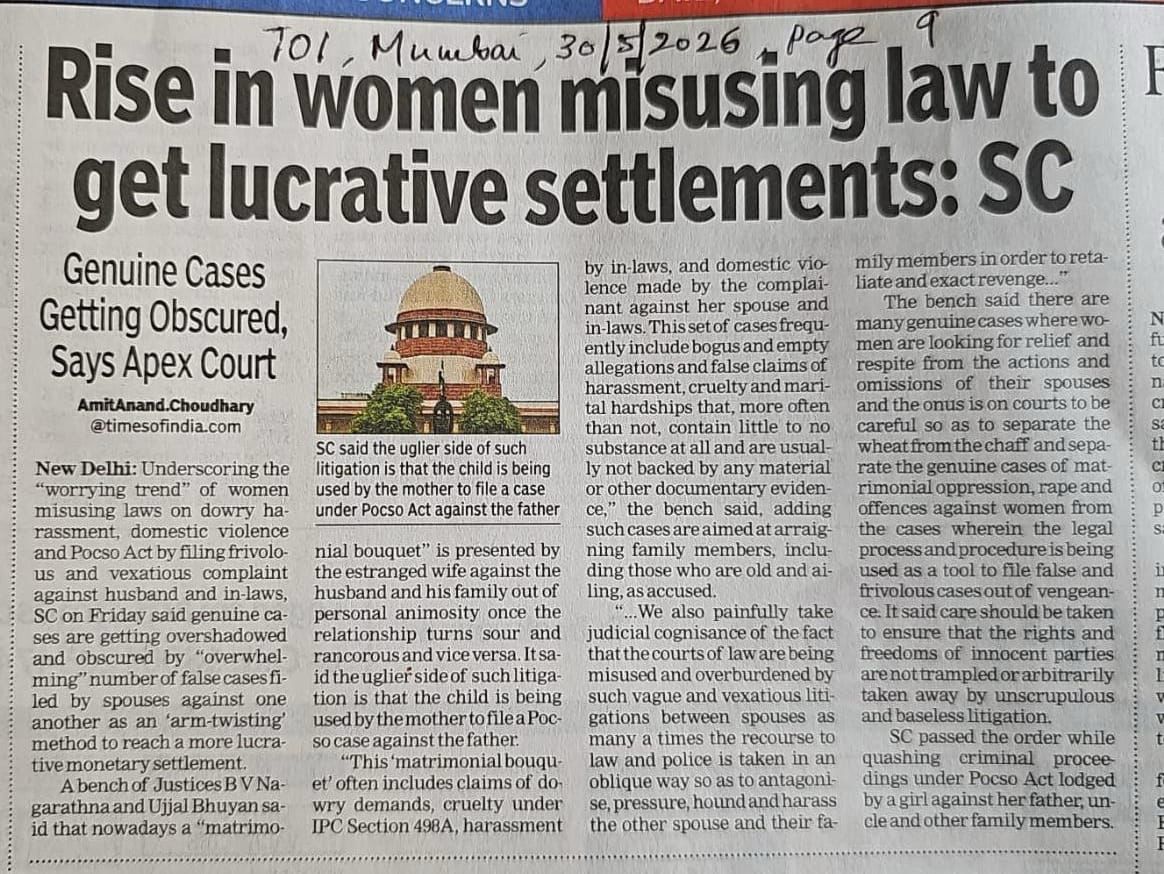
Supreme Court flags false cases used as tools by women to persecute men. Men face discrimination in laws and courts. Change is needed — for fairness & to get #HumanRights4Men
#MensRights #LegalReforms
3
54
69
935
May 30
May 30

False POCSO cases being used as a weapon against husbands: Supreme Court
report by @RitwikinCourt
barandbench.com/news/false-p…
6
8
484
May 30
> Justice Nagarathna to our good surprise has waged a war against frivolous , false and vexatious cases by disgruntled wives.
> In a judgement dated May 29, 2026 she quashed a POCSO and other criminal charges initiated against husband/father and his family - mother , brother and his wife.
> She applied the law carefully and minutely and came to the conclusion that complaint filed by wife/mother (complainant) and daughter (prosecutrix) can’t be believed and prosecutrix was tutored.
> There was already a history of litigation between parties owing to matrimonial dispute.
> She notes following while commenting on rising trend in vexatious litigation:
>> A man is a sum total of his reputation and how he is perceived in the society. Such perception cannot be distorted by a mere casual invocation of law that has the potential of ruining his reputation, social status and public image.
>> One particular offshoot or a species of vexatious and frivolous litigation is in family disputes, particularly, a ‘matrimonial bouquet’ that is presented by the estranged wife against the husband and his family out of personal animosity and spite once the relationship turns sour and rancorous and vice versa. This ‘matrimonial bouquet’ often includes claims of dowry demands; cruelty under 498A IPC; harassment by in-laws and domestic violence, made by the complainant against her spouse and in-laws.
>> In this regard, we would be remiss to not highlight the recent upswing in the false and frivolous matrimonial cases which have unfortunately brought to the fore the uglier side of litigation. A recent trend in this regard is when the wife resorts to filing false complaints and cases under POCSO Act alleging that the husband, who is also the father of the minor child, has committed wanton acts which are sexual in nature especially against the minor daughter. At the centre of this sort of litigation is a child who is often used by her mother against her father, against her will and wishes, so as to make false and vexatious complaints against her father and other male members of her paternal family in order to exact revenge or as an arm-twisting tactic to obtain a higher monetary settlement or to simply harass.
>> We are also cognisant of the fact that a genre of matrimonial litigation is on the rise in this country which inevitably includes, within its ambit, a rise in filing of false, frivolous and vexatious cases with a mala fide intent and ulterior motive to wreck havoc and vengeance on the spouse and in the bargain seek the best compromise. Therefore, the Courts have to exercise utmost caution
and restraint while entertaining such suits and criminal proceedings as any misstep and overreach can have a cascading effect on the health, both mental and physical, of the parties
involved and the sanctity of the institution of marriage itself.
> We highly recommend to all MRAs to go through the judgment.
> Link to judgement is 👇
#Man #Vexatious #Frivolous #Disgruntled #Wife #Husband #Family
4
14
13
653
May 30
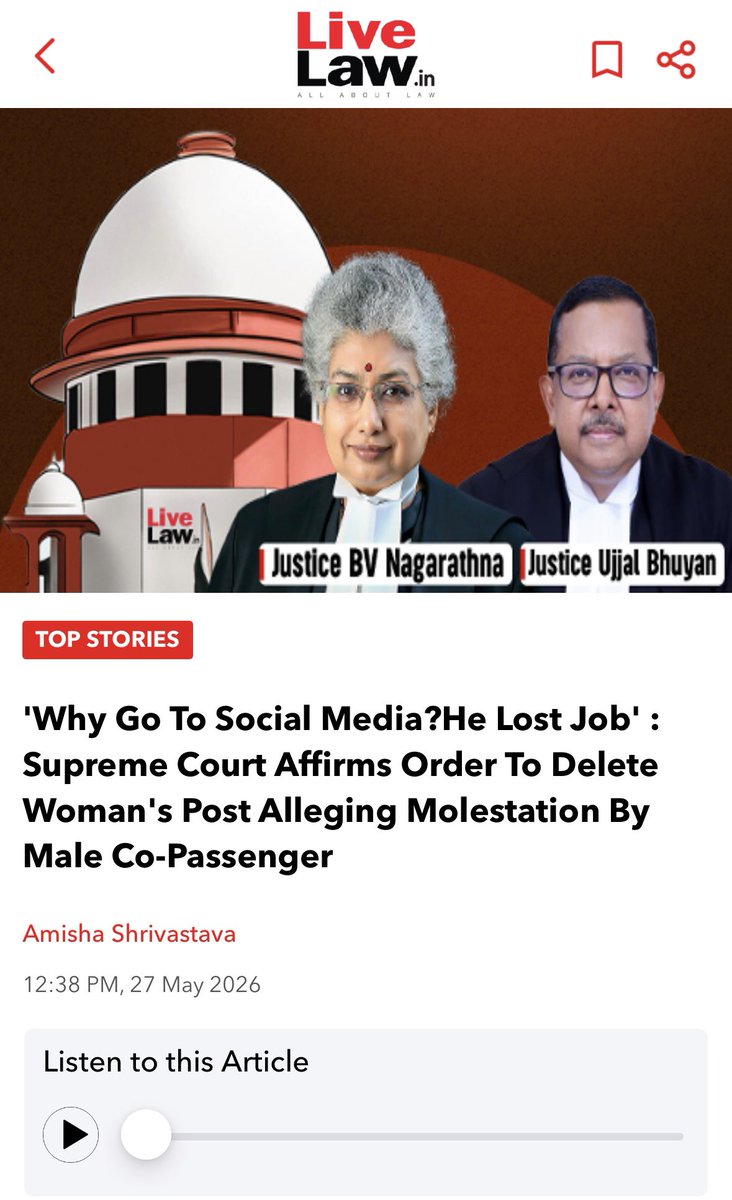
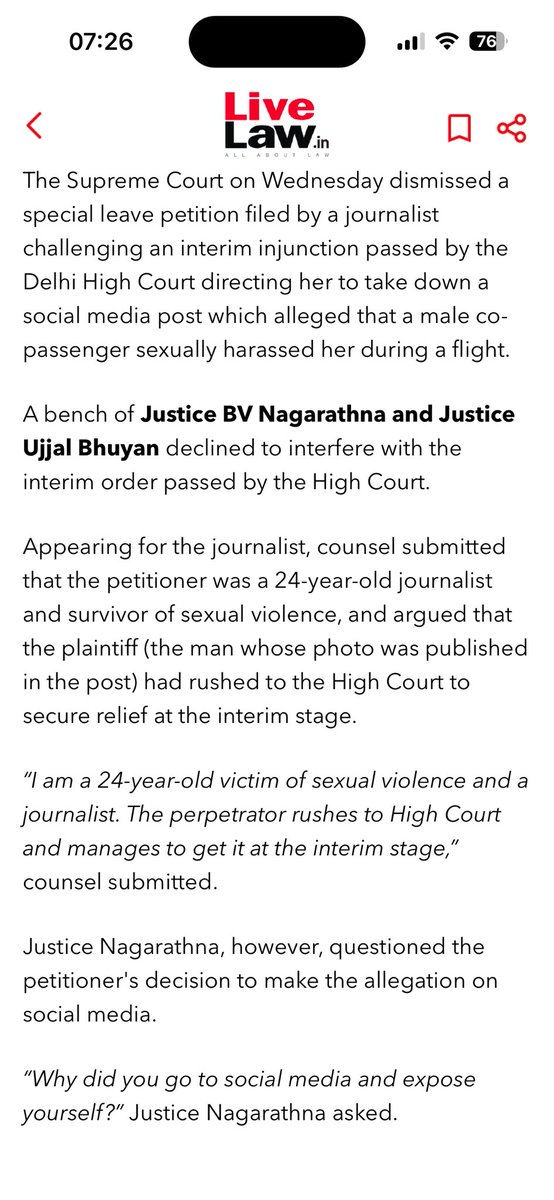
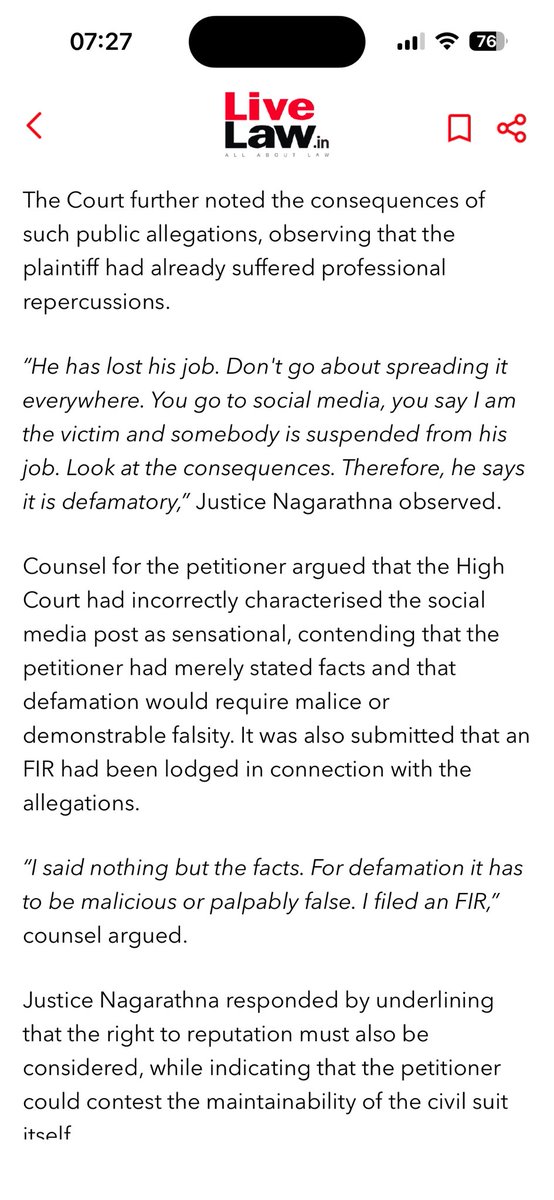
> An interesting case came up in-front of bench headed by Justice Nagarathna in Supreme Court of India.
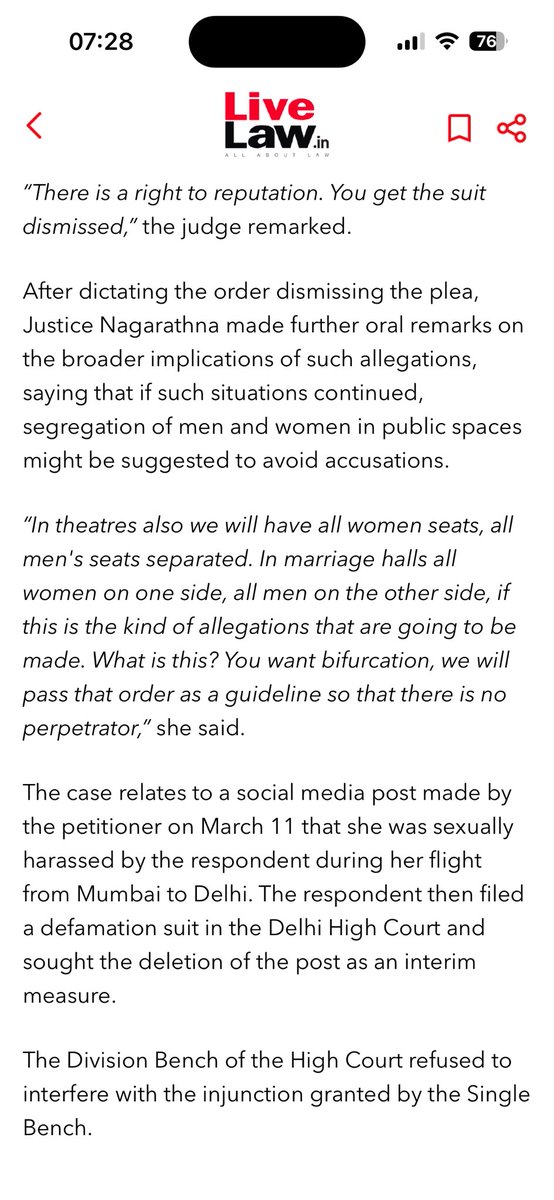
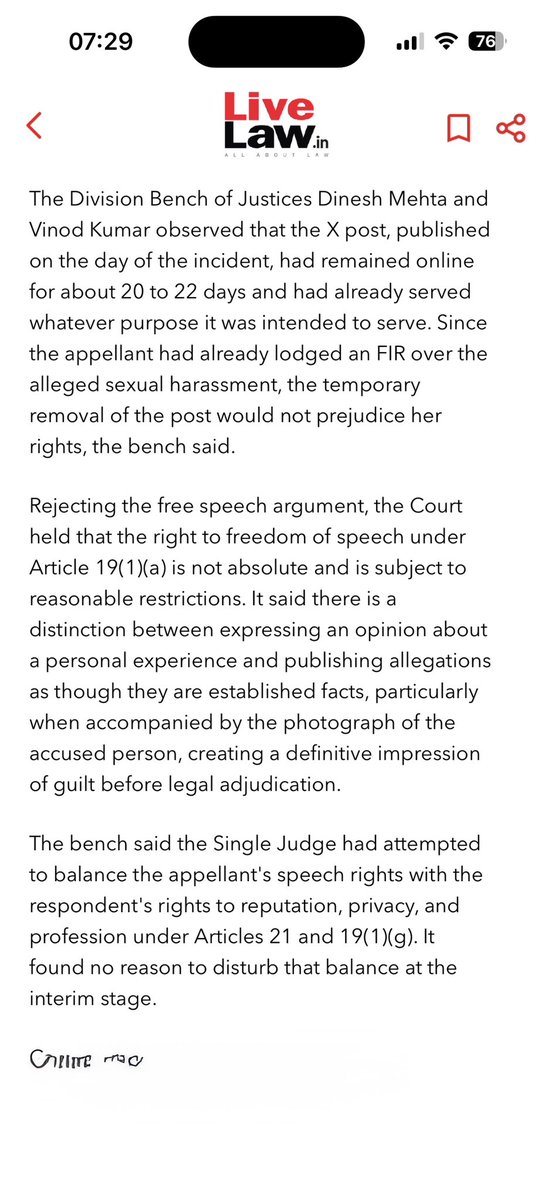
> Petitioner woman - Khansa Juned (independent journalist) - wanted a judgement of division bench of Delhi High Court (DHC) to be set aside which affirmed the ad-interim injunction relief given by a single bench of DHC asking her to remove defamatory post on X against a man she accused of sexual harassment on a domestic flight. She revealed the identity of man, put up his photo with post and his designation in a reputed company.
> DHC stated that right to free speech is not absolute . Even the man has got right to his reputation.
> Her post was amplified by news reports of various news channels in addition Bollywood celebrity - Richa Chadha - reposted the post with a caption “Make Him Famous”.
> Feminists have not learnt anything from #MeToo movement which only brought disrepute to them and was categorised as shoot and scoot operation with mala fide intent. Hence, it died a brutal death.
> Still once in a while a feminist gene wakes up in few to try to defame a man without any fear of repercussions.
>Richa Chadha chickened out and as soon as injunction was filed. She conceded to delete the defamatory post immediately.
> Woman was unrelenting and reached to SC .
> We are ecstatic that Justice Nagarathna recognised the pain man had to endure for allegations which are yet to be proven in the court of law and dismissed her SLP.
> Justice orally remarked that if situation continued there may be need of segregation of men and women in public places such as theatres, marriage halls etc.
> We as an NGO been advocating above for a while now as that is the only way to save men from false, frivolous and vexatious allegations.
> We would like to congratulate the man on his small victory yet an important one. Never push a man to corner.
P.S. Since name of women are now part of public records hence we have no hesitation in revealing their names.
#Men #Woman #Frivolous #False #Allegations
2
27
31
1,162
May 23
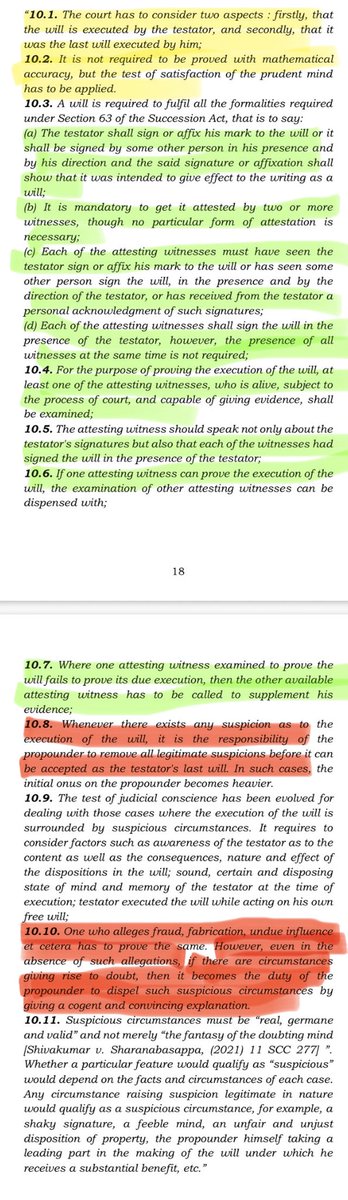
> Importance of will by a man in contemporary times is significant.
> Will is to interfere with the normal life of succession. It gives right to a person to give out his self-acquired assets/estate whoever he prefers after his death not necessarily to legal heirs.
> Preferably, will must be registered will.
> Though , in recent ruling Hon’ble SC re-confirmed that mere a will is unregistered doesn’t invalidate the will.
> Principles can be referred in attached picture below around validity and execution of will.
> It is of utmost important that will relied upon must be the last will of testator.
> Will must be singed by testator or by other person on direction of testator in the presence of min. two attesting witnesses.
> Link to judgement is below
#Will #Execution #Testator #Man #Heir #Legal
1
8
9
318
May 16
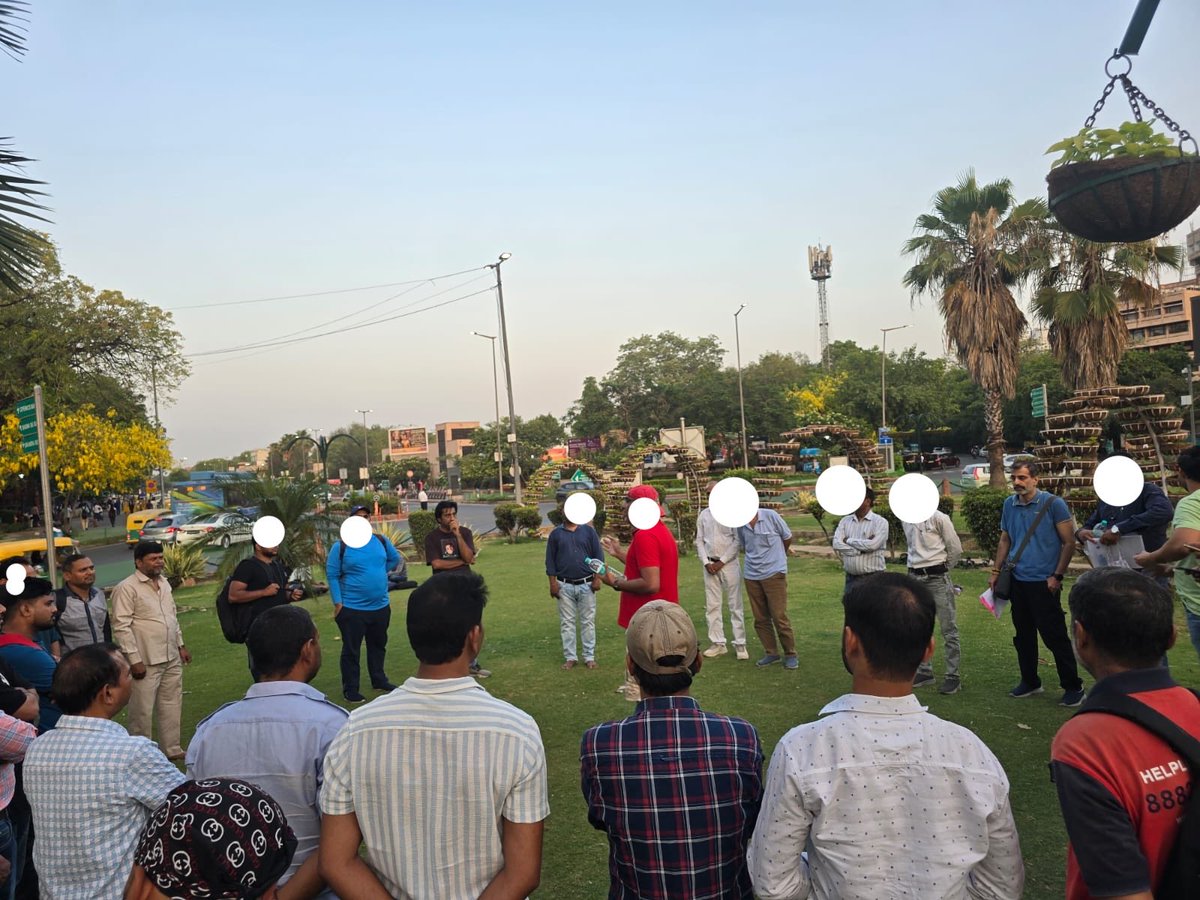
Weekly Meeting - 16 May 2026
Pursuit of happiness for men.
8
14
243
May 16
> First blue drum and now green drum.
> A young engineer murdered.
> As long as he was paying the woman it was all fine.
> Moment he stopped paying , woman hatched a plan to have him killed.
#Murder #Woman
Chilling details emerge in Maharashtra ‘green drum’ murder
hindustantimes.com/s/1UXGoHB
9
15
469
May 15
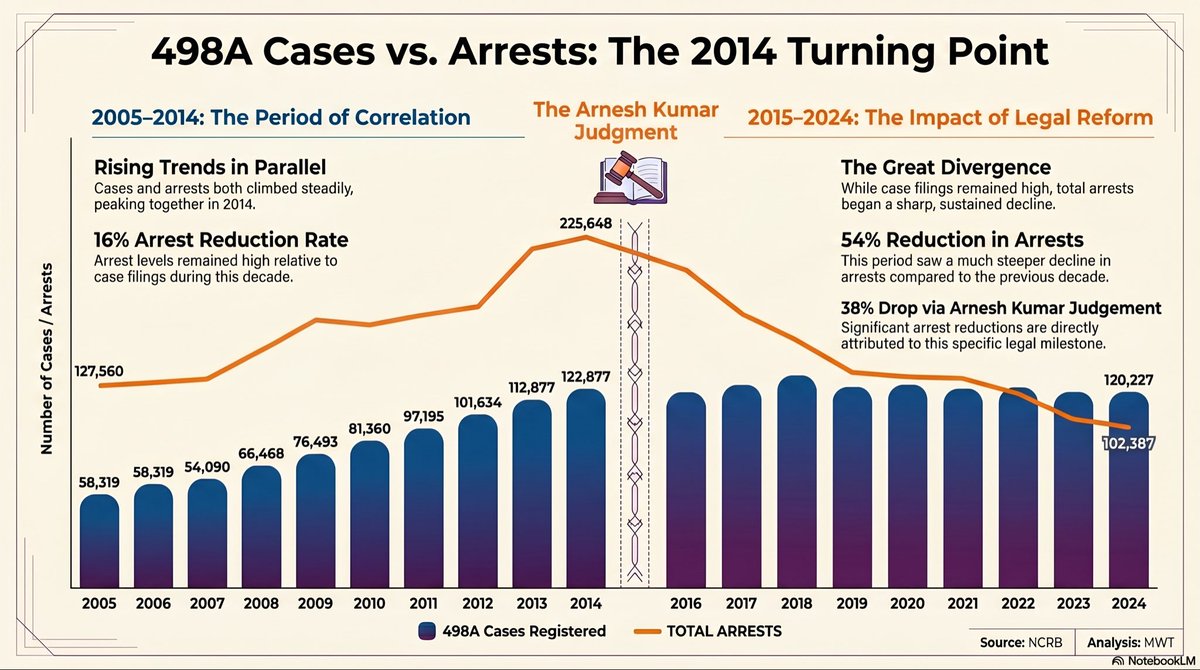
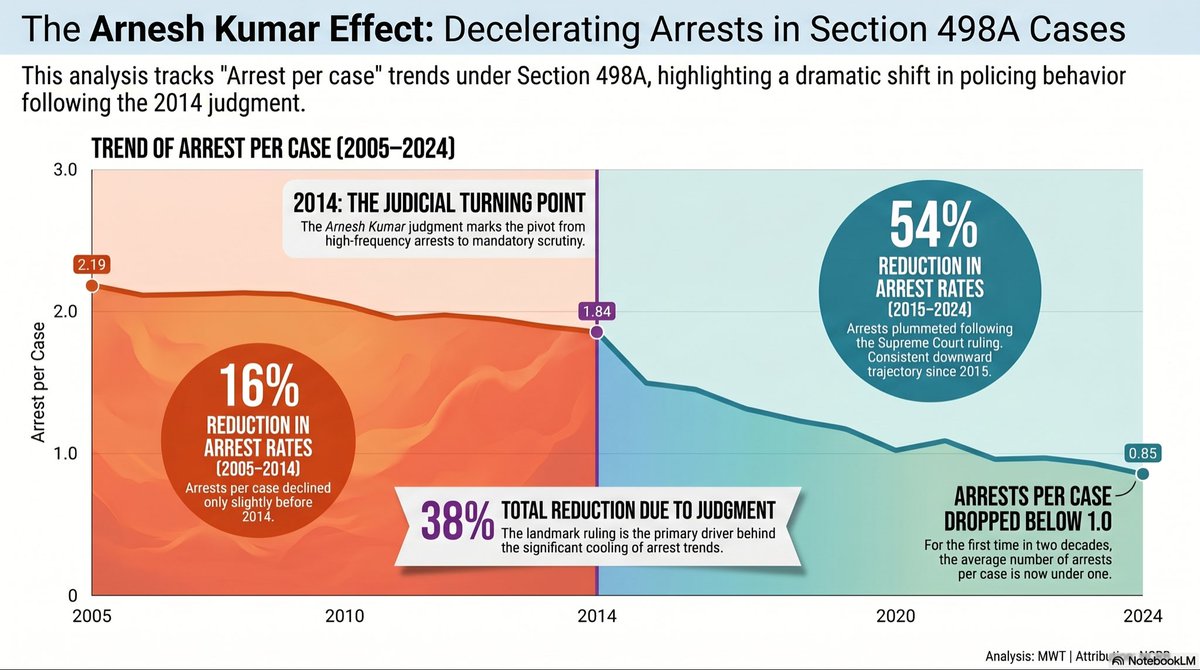
One of the most significant legal developments affecting the use of IPC 498A was the amendment to Section 41A of the CrPC in 2010. While the amendment itself did not immediately alter the ground reality, the landmark judgement in Arnesh Kumar vs State of Bihar, which mandated strict implementation of the amended provisions, had a far-reaching impact.
More than a decade has passed since the judgement, and its effects are now clearly visible in the data (refer graphs). During the ten-year period preceding the judgement (2005–2014), arrests per 498A case declined by about 16%, which may be considered a normative or gradual decline. However, in the ten-year period following the judgement (2015–2024), arrests per case declined by approximately 54%, a far more substantial shift.
Even after accounting for the earlier normative decline of 16%, nearly 40% (38% to be precise) of the reduction can reasonably be attributed to the impact of the Arnesh Kumar judgement and the safeguards introduced through stricter compliance with Section 41A CrPC. The objective of IPC 498A was largely immediate arrests. Following the Arnesh Kumar vs State of Bihar judgement, arrests declined sharply. Consequently, the growth trajectory of 498A cases flattened significantly in the post-Arnesh period. In the pre-judgement decade (2005–2014), registered 498A cases more than doubled, rising from 58,319 to 120,877. In contrast, during the post-judgement decade (2015–2024), the number of cases has largely stagnated around the 120,000 mark.
This does not imply that marital discord has reduced. However, it does suggest that the intimidatory value associated with automatic arrests under 498A may have diminished over time.
A similar trend has also been observed within the men’s rights movement. Earlier, a large number of individuals approached support groups like Save Indian Family Movement (SIFM) primarily due to fear of arrest under 498A, often in recurring waves. In recent years, that pattern appears to have significantly reduced, and this change can largely be linked to the impact of the aforesaid judgement.
This does not mean that underlying challenges faced by men in matrimonial disputes have reduced and may, in some respects, have intensified. In fact, the nature of legal pressure has shifted from the fear of immediate arrest under 498A toward concerns relating to allegations under sexual offence provisions involving relatives, as well as awarding of dispropotionate amount of maintenance and alimony against the husband. This is why feminists are pushing for removal of exceptions from IPC 375 (now BNS 63), to unleash the extortion tool that is lost in earlier draconian IPC 498A.
Importantly, the Indian Men’s Rights Movement now needs to evolve beyond false cases—though that transition has already begun in many ways. The emerging challenges of the future are likely to center around domestic violence against men, rising male suicides, mental health and emotional well-being, parental alienation, and the growing social and economic pressures imposed by existing patriarchal expectations on men.
29
41
1,048