
Joined April 2024
- Tweets 421
- Following 284
- Followers 137
- Likes 1,340
5 Photos and videos



David Palmer (Web3) retweeted

Mike Breen with a LEGENDARY call.
“It’s over! It’s over! Knicks fans, this is not a dream.”
18
296
3,675
97,642
David Palmer (Web3) retweeted

Jun 10
🔥 UPDATE: Tom Lee's Bitmine has purchased another 75,000 $ETH ($123M) from Kraken and FalconX over the past 8 hours.


129
218
1,564
79,790
David Palmer (Web3) retweeted

Jun 6
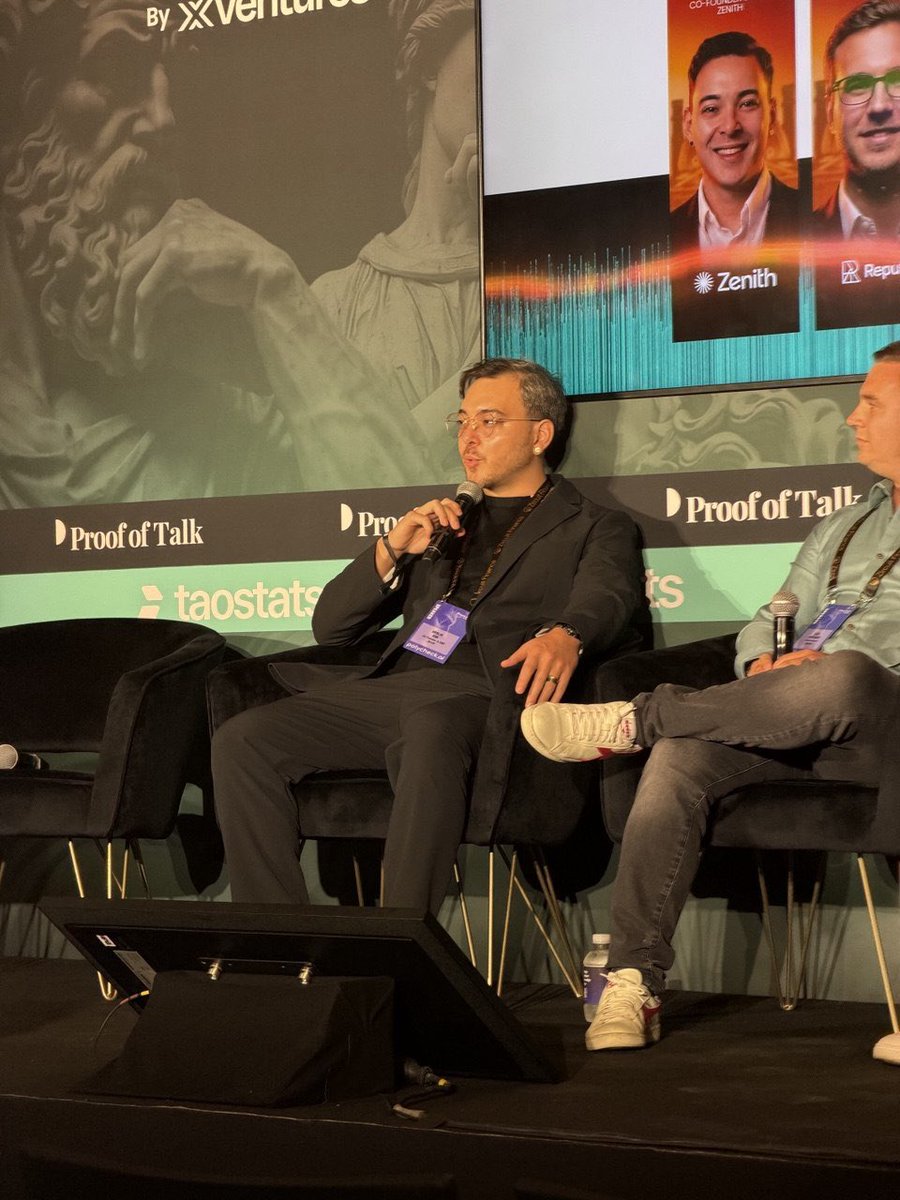
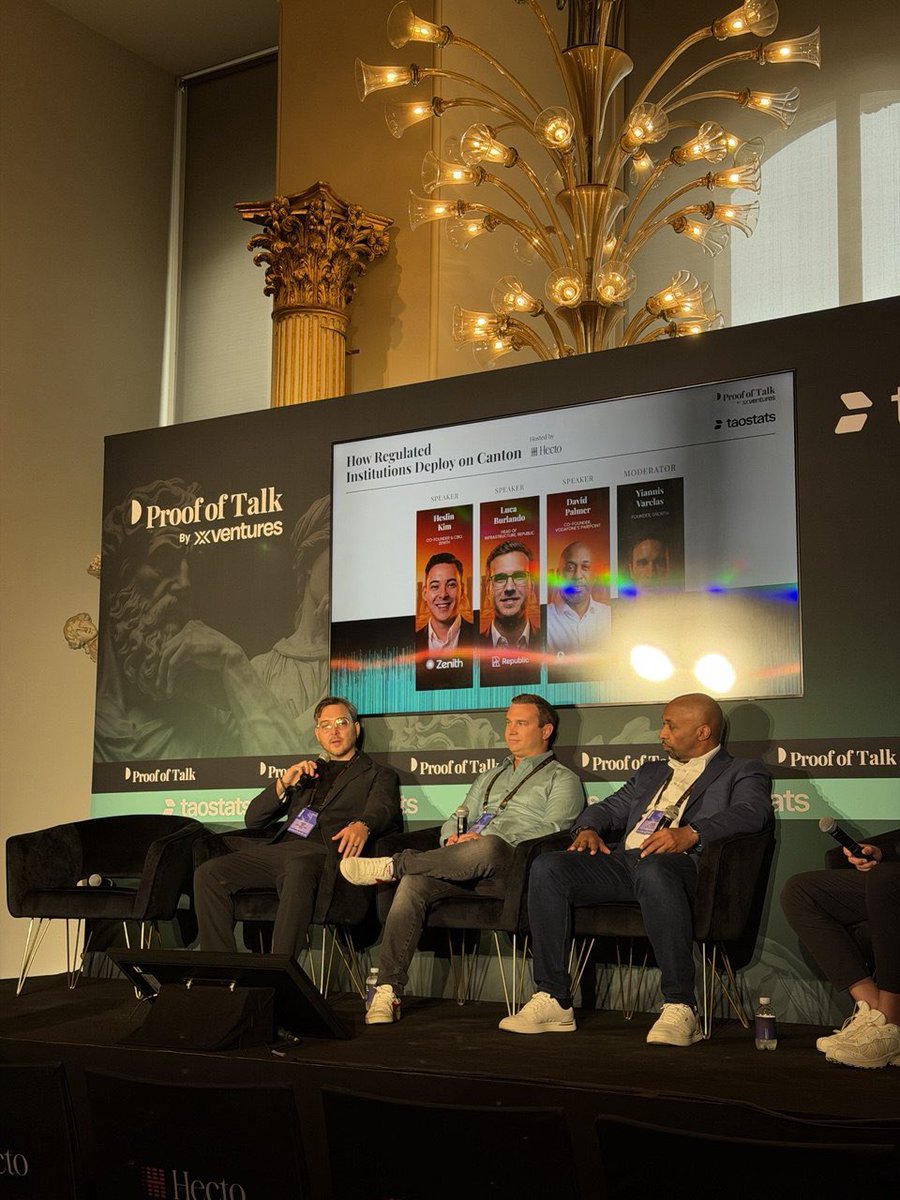
Speaking at the Louvre at @proofoftalk was an amazing experience. @CantonNetwork is on everyone’s lips these days.
Thanks to these gentleman for an excellent panel:
• David Palmer @Metaversebizz (Co-Founder, @vodafone's Pairpoint)
• Luca Burlando @zeneize (Head of Infrastructure, @joinrepublic)
• Yiannis Varelas @bc1pxxx (Founder, 5North)
Definitely attending Proof of Talk for all future events.
Takeaway: winning.
Zth.
May 25

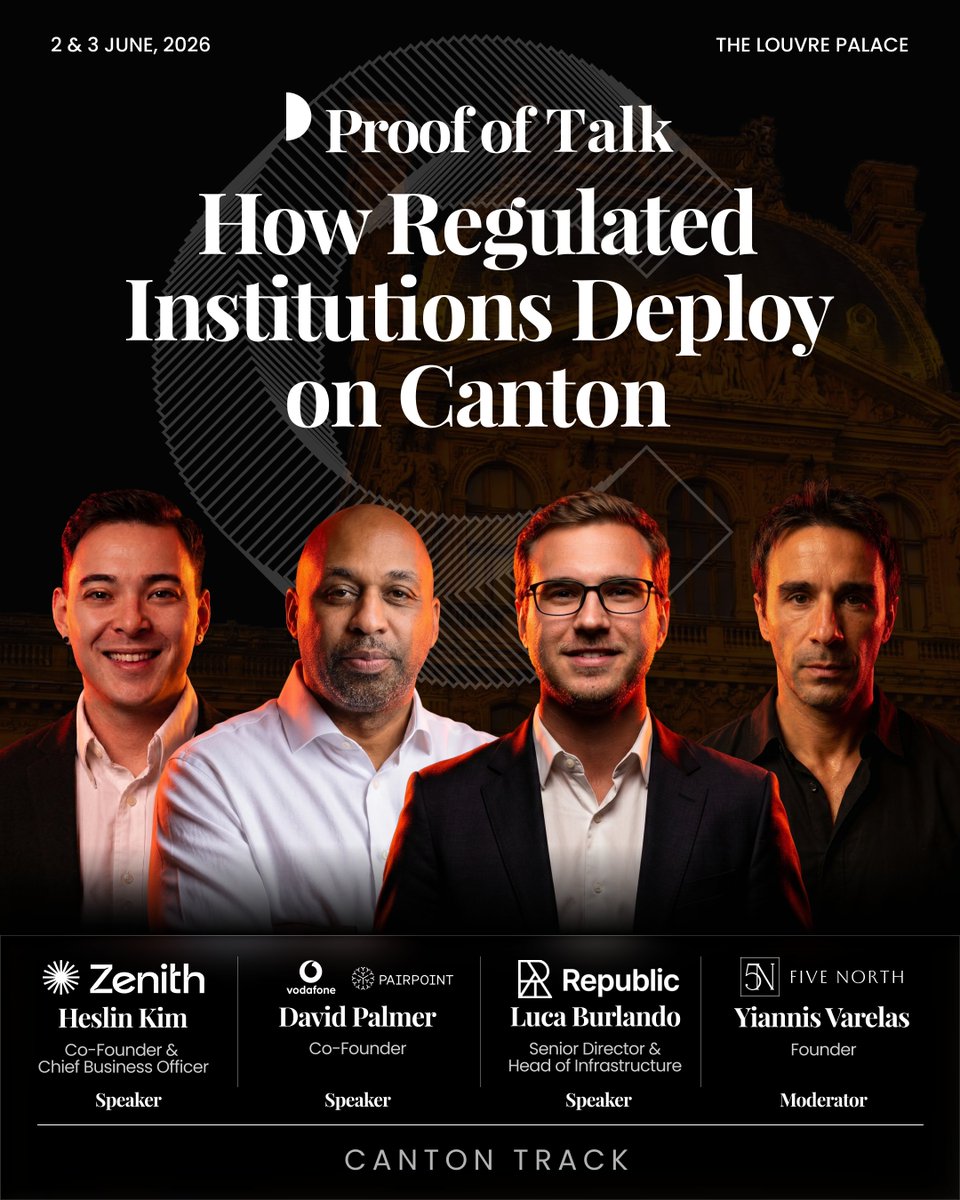
PANEL ANNOUNCEMENT: Pilot mode is over. Regulated institutions are now deploying on Canton, and the work is moving from proof-of-concept into production.
At the Louvre, David Palmer (Co-Founder, @vodafone's Pairpoint), Heslin Kim @HeslinKim (Co-Founder & CBO, @ZenithFdn), and Luca Burlando @zeneize (Head of Infrastructure, @joinrepublic) meet for a conversation moderated by Yiannis Varelas (Founder, 5North).
The topic: How Regulated Institutions Deploy on Canton.
A rare inside view of why Canton is being chosen by institutions that need privacy, selective disclosure, compliance controls, and interoperability, without giving up the benefits of a shared network. From tokenised deposits and regulated digital assets to enterprise IoT, compliant issuance, and capital markets infrastructure now moving past pilot stage.
What this conversation sets out to answer: what it takes for Canton to scale beyond isolated use cases into a shared institutional network for banks, fintechs, corporates, asset managers, and market infrastructure providers.
A week before the Louvre opens its doors.
tickets.proofoftalk.io/passe…
4
7
51
3,596
David Palmer (Web3) retweeted

May 27
Awesome! Welcome Agent Oracle to SKALE
May 27

Agent economies require more than payments.
They require verification, accountability, and cryptographic proof that actions actually happened.
@AgentOracle_AI is now live on SKALE, bringing verifiable execution to autonomous agent systems.

6
8
25
892
David Palmer (Web3) retweeted

May 26
Zenith Co-founder & CBO @HeslinKim will be on stage at the Louvre next week alongside Vodafone's Pairpoint and Republic for a conversation about what it actually takes to deploy regulated institutions on Canton, moving past proof-of-concept into production at scale.
Privacy, selective disclosure, compliance controls, interoperability. @CantonNetwork was built from the start around the infrastructure requirements that most blockchains can't meet.
This is the session worth clearing time for.
Zth.
May 25
PANEL ANNOUNCEMENT: Pilot mode is over. Regulated institutions are now deploying on Canton, and the work is moving from proof-of-concept into production.
At the Louvre, David Palmer (Co-Founder, @vodafone's Pairpoint), Heslin Kim @HeslinKim (Co-Founder & CBO, @ZenithFdn), and Luca Burlando @zeneize (Head of Infrastructure, @joinrepublic) meet for a conversation moderated by Yiannis Varelas (Founder, 5North).
The topic: How Regulated Institutions Deploy on Canton.
A rare inside view of why Canton is being chosen by institutions that need privacy, selective disclosure, compliance controls, and interoperability, without giving up the benefits of a shared network. From tokenised deposits and regulated digital assets to enterprise IoT, compliant issuance, and capital markets infrastructure now moving past pilot stage.
What this conversation sets out to answer: what it takes for Canton to scale beyond isolated use cases into a shared institutional network for banks, fintechs, corporates, asset managers, and market infrastructure providers.
A week before the Louvre opens its doors.
tickets.proofoftalk.io/passe…
3
4
22
719
David Palmer (Web3) retweeted

May 25
🦔Uber's COO Andrew Macdonald said on Saturday that the company is having a harder time justifying its AI spend. After CTO Praveen Neppalli Naga went viral in April for admitting Uber burned through its 2026 Claude Code budget in four months, senior engineering leaders concluded higher token usage was not translating into proportionally more useful product.
Macdonald said the link between AI consumption and shipped features is "not there yet." CEO Dara Khosrowshahi confirmed on the earnings call that Uber is slowing hiring to fund its AI spend. Duolingo also walked back its decision to include AI usage in performance reviews last month.
My Take
Uber is the first major enterprise where the C-suite has publicly admitted, on the record, that the AI productivity story is not closing for them. That matters because Uber is not a skeptic. The company went all-in on AI tooling, set internal targets, and burned through its annual research and development budget in four months trying to make it work. The conclusion from the people running the experiment is that tokens consumed and value shipped are not the same number, and management is finally noticing.
Duolingo's reversal lands in the same week for a reason. CEO Luis von Ahn said employees were asking whether they needed to use AI just to use AI, which is Goodhart's Law showing up in a performance review system. When usage becomes the metric, employees optimize for usage, not output. Microsoft canceled internal Claude Code licenses, Google AI Pro stripped credits from paid subscribers, and now Uber is admitting the ROI does not close at scale.
The narrative has shifted in the last 30 days from "AI productivity is here" to "AI productivity is harder to measure than we thought." The companies pushing tokenmaxxing internally are now the same companies signaling cost pressure externally. The IPO calendar for OpenAI and Anthropic is going to get a lot more complicated if the largest enterprise customers keep saying this out loud.
Hedgie🤗

63
130
762
150,264
David Palmer (Web3) retweeted

May 21
One of the toughest parts of being a founder is putting your ideas into the world, seeing if anyone cares (usually they don't - or worse, are rooting against you), and then seeing if you can actually pull it off (usually way more setbacks along the way than you thought!).
You have to:
(1) develop thick skin and find a way to ignore the haters
(2) still take advice from people who have your best interests at heart
(3) have the wisdom to know the difference
Then move from one setback to the next with no loss of enthusiasm for longer than you thought. Be borderline delusional, get after it every day for a decade, and turn out to be right. Finally, when your tenth or hundredth approach to a problem doesn't work, just keep coming up with more ideas.
Had a great day at Base Batches yesterday, meeting founders building on @base and hearing about the latest onchain innovations. Shout out to all the founders!
195
140
962
92,412

Telecom towers will become the next wave of AI infrastructure.
@Metaversebizz, Co-founder of @web3pairpoint (by Vodafone) breaks it down 👇
13
13
95
10,574

David Palmer (Web3) retweeted

Apr 11
This is WILD!
Uber's CEO admitted the company is building the machine that will eliminate its own workforce.
He calls Uber a platform for flexible work, then in the same breath says autonomous vehicles will augment and then replace human drivers.
Uber launched a division called Uber AI Solutions, where drivers are paid to tag images, label road data, and record their voices. That data is the exact fuel used to train self-driving AI systems.
Drivers are literally building the technology that replaces them.
Uber plans to deploy robotaxis in 15 cities by end of 2026, targeting a fleet of 100,000 self-driving vehicles starting in 2027. They are partnered with Nvidia, Waymo, and over 20 autonomous vehicle companies simultaneously.
Over 7 million people drive or deliver for Uber every month. The CEO put a public timeline on the disruption which is 10 to 15 years before drivers are largely replaced.
His offered solution is penny-per-task image labeling during driver downtime, work that pays nearly nothing.
Uber built its empire on contractors who bought the cars, paid for the gas, and absorbed all the risk while Uber kept the margin.
Now those same contractors are feeding the AI pipeline that makes them unnecessary.
Cheaper rides for passengers, higher margins for Uber and no income for the driver.
That is the actual plan.
Apr 11

Dara Khosrowshahi is one of the most underrated CEOs.
When he walked into Uber's headquarters in 2017, he was inheriting a full institutional collapse.
The founder had just been forced out in disgrace after a year of sexual harassment scandals, a federal lawsuit alleging stolen self-driving technology from Google, mass executive resignations, and a global regulatory war with cities trying to ban the app entirely.
On top of all of it, Uber was hemorrhaging $4.5B every single year with no credible plan to stop the bleeding.
Dara did not just stabilize the company but rather rebuilt it from the inside out, restored trust with regulators and investors, and turned every single division into something that actually worked.
"When we joined the company, we were losing $4 billion. We're going to cash flow $10 billion this year. So we should be taking big bets."
That single statement represents a $14.5 billion financial swing in under a decade, one of the largest corporate turnarounds in modern business history.
Uber is now positioning itself as the operating system of the entire autonomous vehicle revolution, not as a car company or a robotaxi builder, but as the platform sitting underneath all of them, collecting a toll on every driverless mile driven anywhere in the world.
Waymo, Tesla, and every other self-driving company will spend tens of billions building the vehicles and the software, and Uber's bet is that none of them can replicate the one thing it already owns, 200 million users who open the app every week and press a button that says "get me a ride."
Uber is already running Waymo robotaxis inside its own app in Austin and Atlanta, with 15 cities targeted for autonomous operations by the end of 2026 and 100,000 AV vehicles on the platform by 2027.
Under that model, Uber captures a cut of every autonomous ride regardless of who built the car or wrote the software, and the margins are dramatically higher than anything the human-driver model ever produced.
One of our analysts at Milk Road just took a position in Uber, and if you want to read the full investment thesis and see exactly what they are seeing in this stock right now, check out our full breakdown linked below.
5
10
25
8,211
Nillion 🤝 @web3pairpoint 🤝 @chainlink
Transforming Telecom Towers into Secure AI Data Centres.
This integration connects tower compute usage to usage-based finance, privately and verifiably.
👇🧵
28
57
217
16,405
David Palmer (Web3) retweeted

Apr 1
A lot of people asked me at ETHCC if Zenith is just “another EVM”, so here’s the simple answer:
Most EVMs today = L2s
→ liquidity gets fragmented
→ composability breaks
→ you need bridges to interact with the base chain
Canton’s real moat is its network-of-networks design where everything stays composable by default.
Zenith EVM doesn’t change that because it’s not a L2 on Canton.
What that means in practice:
→ no bridging
→ no separate execution layer
→ your dApp stays fully composable with the entire network
Transactions don’t live next to Canton, they live inside it.
And performance backs it:
~1.4s latency, on par with L2s UX, but without the usual trade-offs (no proof delays, no challenge windows, no fragmented state).
So you keep what actually matters for real use cases:
atomic settlement deterministic finality
That combo just doesn’t exist on Ethereum L2s today.
Apr 1

Shipped quietly. Sharing now.
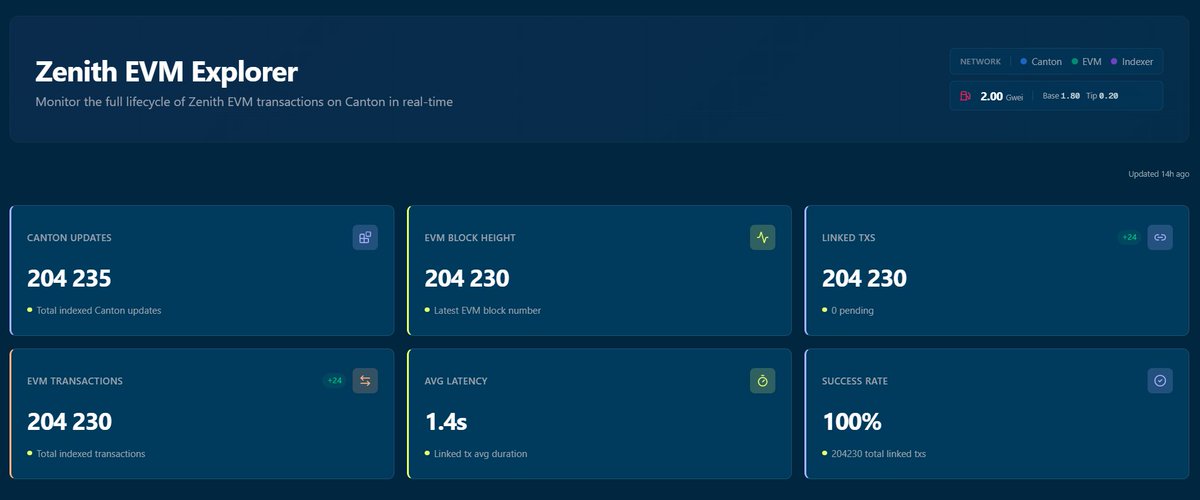
Zenith's internal test environment just crossed 200K EVM transactions.
When we hit 100K, we shared the first proof that EVM execution could run natively through Canton's consensus. No value leakage. No separate finality.
The number has doubled since. The architecture hasn't moved an inch.
Canton sequences. Validators re-execute. external_call() confirms. Finality lands. State root updates. Block published. Latency holding at 1.4s
The full transaction lifecycle is traceable end-to-end on our public explorer: explorer.zenith.network
Zth.
3
7
22
6,773
David Palmer (Web3) retweeted

Apr 1
🚨BREAKING - HUGE MOVE: Anthropic is going fully open-source, rebrands to OpenClaude 🤯


96
53
589
80,658
David Palmer (Web3) retweeted

Mar 20
Reporting to work…
55
137
738
132,882
David Palmer (Web3) retweeted
Mar 20
Approved as a Tier-1 Super Validator via CIP-0091, with a maximum voting weight of 10, Zenith now operates across multiple governing committees on @CantonNetwork, taking its place alongside institutions like DTCC, Nasdaq, and Chainlink in the Global Synchronizer.
In this role, Zenith contributes directly to Canton's governance, ecosystem fund, transaction validation, and protocol-level decisions, with a particular focus on strengthening the network’s execution layer.
By bringing Ethereum application environments to Canton, Zenith expands what can be built on institutional rails, ensuring enhanced programmability. Solidity contracts now can run natively within the same privacy-preserving and compliant framework that already handles trillions in monthly tokenized asset volume, all while maintaining atomic composability and sub-second confirmation times.
Stay updated on our journey as a SV by joining the community.
> LinkedIn: linkedin.com/company/zenithf…
> Telegram: t.me/zenithfdn
> Discord: discord.gg/zenithfdn
Mar 20

Welcoming @zenithfdn as a Super Validator on Canton (CIP-0091 | Weight 10). 🎊
Zenith is building the EVM execution layer for @CantonNetwork, letting Ethereum developers deploy Solidity apps on Canton without rewriting everything in Daml, while keeping Canton's privacy, compliance, and atomic settlement properties intact.
Two angles: Zenith EVM for developers who want familiar Ethereum tooling on Canton, and Zenith Stack for institutions that want their own customizable EVM environment with full control over permissions, fees, and compliance boundaries.
The key technical contribution is atomic composability, a transaction can span both a Canton-native Daml leg and an EVM leg, and either both succeed or the whole thing fails. Settlement is atomic, coordination is Canton, and there are no bridges in between.
As an SV, every milestone is tied to real usage on the network. Bringing Ethereum developers into institutional finance infrastructure.
Glad to have them governing the network!

15
9
60
3,556
David Palmer (Web3) retweeted

Mar 13
GOOGLE MAPS JUST GOT ITS BIGGEST UPDATE IN A DECADE WITH GEMINI AI, ADDING IMMERSIVE 3D NAVIGATION, SMARTER ROUTE INSIGHTS, AND PARKING GUIDANCE.
34
26
284
74,416

The most powerful programming language of the future isn’t C or Python. It’s English.
Jensen Huang: “Why program in Python? So weird.”
You won’t write code anymore. You’ll describe what you want. If the result isn’t right, you won’t debug. You’ll just tell it to fix itself.
The barrier to controlling computers is hitting zero.
We’re shifting from syntax to intent. You don’t need to know how to write a script to modify a system. You need to know how to explain what should happen.
Huang: “English is the best programming language of the future.”
Prompt engineering is just clear communication with a new audience. How you talk to people and how you talk to machines is becoming the same competency.
If you can articulate what you need clearly, you’re a developer. If you can refine through conversation, you can ship products.
The coder is obsolete. The orchestrator is everything.
The skill isn’t syntax anymore. It’s clarity. Knowing what to build, how to ask for it, and how to direct until it’s exactly right.
379
771
2,903
496,528
David Palmer (Web3) retweeted

Elon Musk: ''I think the single biggest thing you can do to lift people out of poverty and help them is giving them an internet connection because once you have the internet connection, you can learn anything for free on the internet."
131
172
1,192
38,769
David Palmer (Web3) retweeted

Feb 7
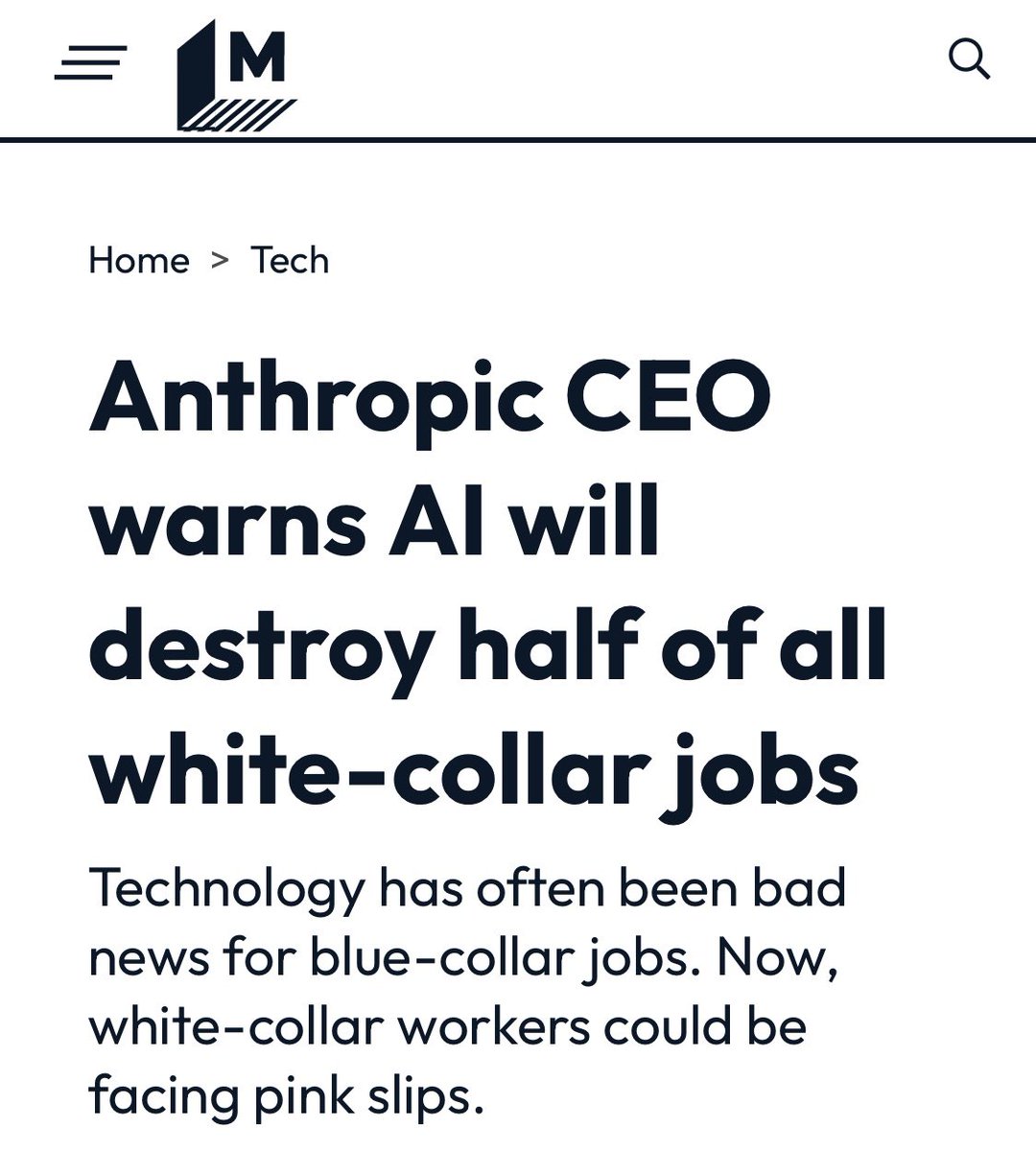
Hey, what do you think will happen to the housing market when tens of millions of upper middle class white collar workers lose their high paying jobs and can no longer afford to pay their mortgages anymore?
547
354
3,104
458,990