
International Relations, Defense and Strategic Studies, Quaid-i-Azam Univeristy. Researches Extremism.
Joined June 2012
- Tweets 1,295
- Following 1,083
- Followers 204
- Likes 22,593
15 Photos and videos






Moneeb Mir retweeted

it accelerates the arms race, erodes strategic stability, and incentivizes hardline posturing in India’s domestic politics. With missile ranges now exceeding 12,000 km, the implications are no longer regional they’re setting off alarm bells in Western capitals as well.
1
3
58
Moneeb Mir retweeted

The Indian Agni VI system with a range of 12000 kms is a threat to all major powers, China, Russia and even the United States. The development of such a destructive system is the act of an irresponsible and reckless state, that wants to pose a challenge to the rest of the world.
14
18
24
2,294

May 4
India. ICBM. Ready. Range: enough to reach the West and around the globe. Warheads: multiple. Deterrence: "minimum." Sure thing. 🙂
@ZohaibCISSAJK @NimrahJaved_ @AbdulBa34671597 @Second_Strike01 @AbdulKashar

On May 1, 2026, Indian DRDO officially confirmed an Agni-VI program of 12,000 km range.
1. Pertinent Question on Agni-VI is "Who is the target?"
2. Pakistan and China are already within range of Agni-III/IV/V.
3. A 12,000 km ICBM (Agni-VI)
covers all of Europe, Africa, and North America. It is a capability beyond “minimum credible deterrence” and regional threat perception.
4. India’s draft 1999 doctrine cites “credible minimum deterrence.” A US/Canada-range ICBM suggests movement toward “extended deterrence” or “global power projection.” This breaks the “regional deterrence” logic used to justify India’s 1998 tests and 2008 NSG waiver.
5.Notably, no state currently threatens India at 12,000 km range. Therefore, capability would be seen as “status-driven,” not "threat-driven."
6. Islamabad would link a new ICBM to the risk-acceptance pattern demonstrated during operation sindoor. The pattern is: Conventional strikes expanded nuclear reach = crisis instability.
7. Agni-VI with MIRV compounds warhead growth potential.
8. Indian ICBM is moving from “minimum” to “flexible response” posture, forcing Pakistan into costly counter-buildup.
9. NSG waiver 2008 exempted India from NPT/CTBT. Agni-VI without additional safeguards reinforces “exceptionalism” rules for others, and waivers for India.
10. It enables “compellence” against distant states or gives India escalation dominance in regional crises.
11. Combined with “Cold Start” doctrine and public “enter their house” statements, Pakistan reads long-range MIRV as lowering threshold for India to absorb first strike and retaliate globally.
12. 1 vs 3-10 warheads changes first-strike stability math.
13. Canisterized/road-mobile vs silo. Mobile = survivable second strike = more offensive potential.
An Agni-VI at 12,000 km is not about China or Pakistan as they’re already covered. It is;
a. "Status signaling" to enter US/Russia/China ICBM club;
b. "Insurance" against future US/Western pressure;
c. "Doctrinal expansion" from regional deterrence to global power projection.
#indiawantsanswer
#IndiaOut #India #modidrama
#Bharat #BJP #RSS
#DRDO @ciss_ajk @CISSS_Karachi @bttn_quetta
@RadioactiveFrnd
indianmasterminds.com/news/d…
1
5
169
May 4
Post-Op Sindoor, India quietly signals it's ready for Agni-VI, nuclear-capable, MIRV-armed, with 10,000km range. The neighborhood isn't the target anymore. The West & the World should probably pay attention.
@ciss_ajk @AsmaKhawaja5 @Second_Strike01 @AbdulKashar @AbdulBa34671597
May 1

🛡️ DRDO Chairman Kamat confirmed: India is “ready” for Agni-VI ICBM development witch’s a nuclear-capable beast with speculated 10-12,000 km range & MIRV warheads. Enough to reach Europe, US & Canada.
Govt nod pending.
Who is this really for? Pakistan & China are already covered by existing arsenal.
In a nuclear South Asia, after Op Sindoor’s boldness, a Hindutva-driven push for global strike capability? The West watching this “minimum deterrence” stretch?
#AgniVI #StrategicShift
m.economictimes.com/news/def…
@RadioactiveFrnd @orfonline @EconomicTimes @bttn_quetta @ciss_ajk @ciss_ajk @dratiaalikazmi @arooj_kaz
4
1
5
413
Moneeb Mir retweeted

Beyond deterrence, Agni-VI has domestic political utility for the Modi government. High-end missile capabilities signal technological prowess, project national strength, and reinforce a prestigious identity to domestic audiences.
In this sense, Agni-VI is as much about India’s global aspirations as it is about seeking recognition as an anxious power.
#modi4peoplescapital
9
9
108
Moneeb Mir retweeted

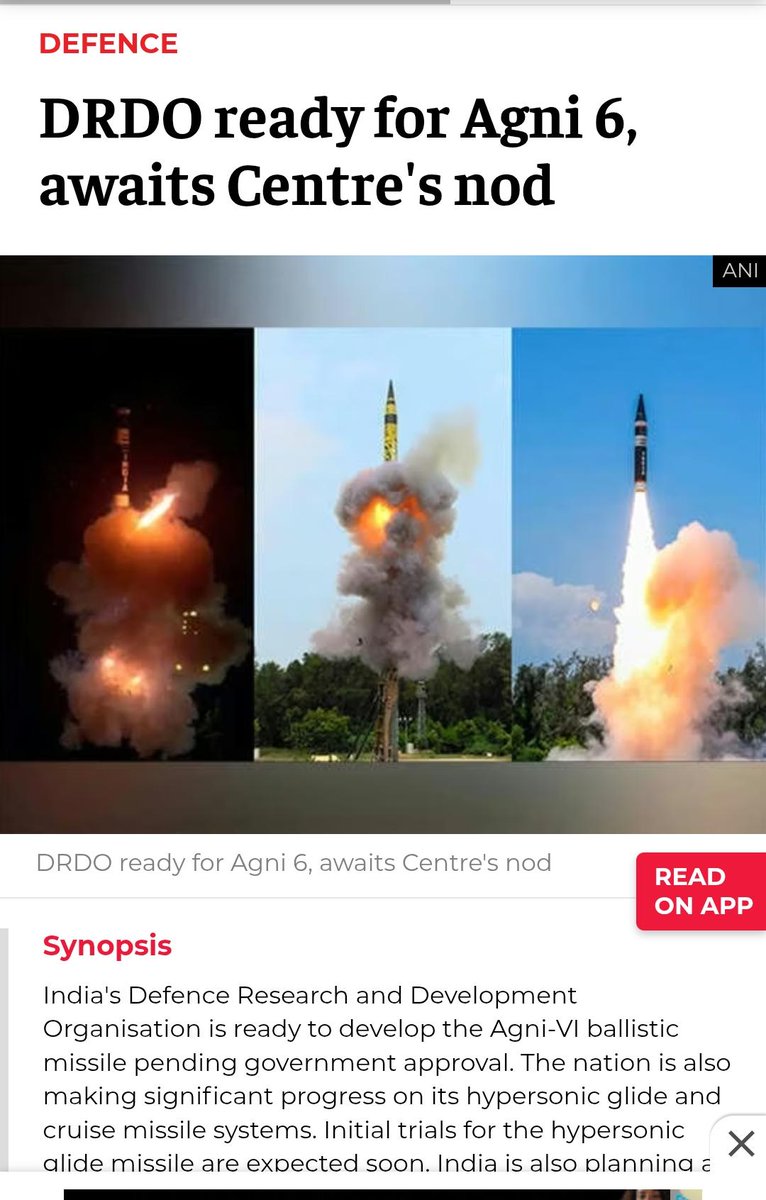
@DRDO_India Chairman Samir V. Kamat has reportedly said that India is ready to move ahead with the #Agni-VI programme whenever the government gives approval. This statement is important because Agni-VI is likely to have a range of around 12,000 km. If this range is achieved, India would move closer to a true intercontinental missile capability.
Several factors explain India’s interest in ICBM development. First, India’s missile thinking is no longer limited to Pakistan or China.
A longer-range missile gives India a wider strategic reach and supports its image as a rising global power.
Second, India already has a strong space programme. Space rockets and long-range missiles are not the same, but they share some knowledge, such as propulsion, guidance, heat protection, and long-distance flight control. This gives India a technical base for future ICBM ambitions.
Third, Agni-VI also has a domestic for political meaning @narendramodi. Advanced missiles create prestige at home.
They show technological success, national strength, and great-power identity.
So Agni-VI is about India’s global ambition and its desire to be treated as a major power.
@AsmaKhawaja5
@ciss_ajk
@IndiaToday
@Second_Strike01
@Nimra_Javed_
@Tabsstrat
@RimshaM62719126
@MoneebMir
@engr__sehrish
@ciss_ajk
@IAF_MCC
#india
4
6
12
629
Moneeb Mir retweeted

May 3
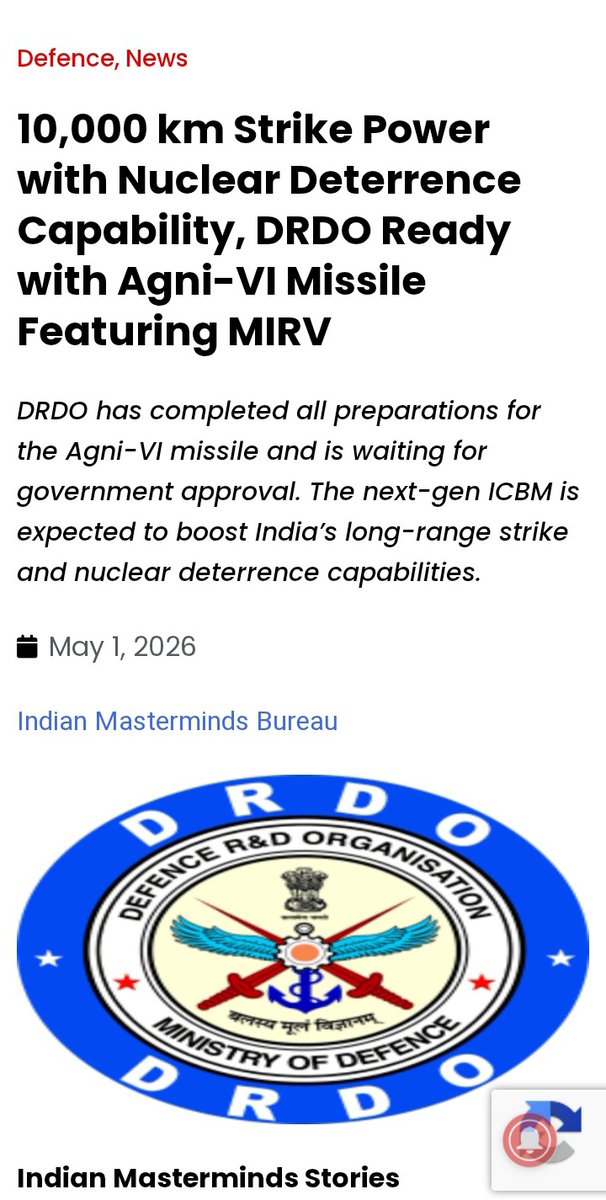
DRDO: Agni-VI ICBM ready, 12,000km range with MIRVs. Can hit US/Canada/Europe. China & Pakistan already covered by current missiles, so who’s the target? #GlobalSecurity #AgniVI
4
8
7
256
Moneeb Mir retweeted
On May 1, 2026, Indian DRDO officially confirmed an Agni-VI program of 12,000 km range.
1. Pertinent Question on Agni-VI is "Who is the target?"
2. Pakistan and China are already within range of Agni-III/IV/V.
3. A 12,000 km ICBM (Agni-VI)
covers all of Europe, Africa, and North America. It is a capability beyond “minimum credible deterrence” and regional threat perception.
4. India’s draft 1999 doctrine cites “credible minimum deterrence.” A US/Canada-range ICBM suggests movement toward “extended deterrence” or “global power projection.” This breaks the “regional deterrence” logic used to justify India’s 1998 tests and 2008 NSG waiver.
5.Notably, no state currently threatens India at 12,000 km range. Therefore, capability would be seen as “status-driven,” not "threat-driven."
6. Islamabad would link a new ICBM to the risk-acceptance pattern demonstrated during operation sindoor. The pattern is: Conventional strikes expanded nuclear reach = crisis instability.
7. Agni-VI with MIRV compounds warhead growth potential.
8. Indian ICBM is moving from “minimum” to “flexible response” posture, forcing Pakistan into costly counter-buildup.
9. NSG waiver 2008 exempted India from NPT/CTBT. Agni-VI without additional safeguards reinforces “exceptionalism” rules for others, and waivers for India.
10. It enables “compellence” against distant states or gives India escalation dominance in regional crises.
11. Combined with “Cold Start” doctrine and public “enter their house” statements, Pakistan reads long-range MIRV as lowering threshold for India to absorb first strike and retaliate globally.
12. 1 vs 3-10 warheads changes first-strike stability math.
13. Canisterized/road-mobile vs silo. Mobile = survivable second strike = more offensive potential.
An Agni-VI at 12,000 km is not about China or Pakistan as they’re already covered. It is;
a. "Status signaling" to enter US/Russia/China ICBM club;
b. "Insurance" against future US/Western pressure;
c. "Doctrinal expansion" from regional deterrence to global power projection.
#indiawantsanswer
#IndiaOut #India #modidrama
#Bharat #BJP #RSS
#DRDO @ciss_ajk @CISSS_Karachi @bttn_quetta
@RadioactiveFrnd
indianmasterminds.com/news/d…
4
22
26
724
Moneeb Mir retweeted

May 1
🛡️ DRDO Chairman Kamat confirmed: India is “ready” for Agni-VI ICBM development witch’s a nuclear-capable beast with speculated 10-12,000 km range & MIRV warheads. Enough to reach Europe, US & Canada.
Govt nod pending.
Who is this really for? Pakistan & China are already covered by existing arsenal.
In a nuclear South Asia, after Op Sindoor’s boldness, a Hindutva-driven push for global strike capability? The West watching this “minimum deterrence” stretch?
#AgniVI #StrategicShift
m.economictimes.com/news/def…
@RadioactiveFrnd @orfonline @EconomicTimes @bttn_quetta @ciss_ajk @ciss_ajk @dratiaalikazmi @arooj_kaz
56
70
115
19,235
Moneeb Mir retweeted

May 2
Compelling observation. The Agni-VI represents a shift from 'Regional Containment' to 'Intercontinental Reach.'
May 1
🛡️ DRDO Chairman Kamat confirmed: India is “ready” for Agni-VI ICBM development witch’s a nuclear-capable beast with speculated 10-12,000 km range & MIRV warheads. Enough to reach Europe, US & Canada.
Govt nod pending.
Who is this really for? Pakistan & China are already covered by existing arsenal.
In a nuclear South Asia, after Op Sindoor’s boldness, a Hindutva-driven push for global strike capability? The West watching this “minimum deterrence” stretch?
#AgniVI #StrategicShift
m.economictimes.com/news/def…
@RadioactiveFrnd @orfonline @EconomicTimes @bttn_quetta @ciss_ajk @ciss_ajk @dratiaalikazmi @arooj_kaz
1
5
8
136
Moneeb Mir retweeted
Pakistan’s EO-3 launch marks a leap in indigenous space capability. Beyond earth imaging, its AI-powered processing, multi-geometry payloads, and energy storage enable smarter data use, boosting agriculture, climate tracking, disaster response, and national planning for faster decisions. Space tech is now core to Pakistan’s state capacity and long-term power.
It is Pakistan's move from imaging to intelligence. EO-3 is more than a satellite: it’s a statement of capacity embedding space technology into national development and strategic power.
@ciss_ajk
@RadioactiveFrnd @ACDC_ISSI @UNIDIR @GlobPeaceIndex @UNDPPA @IST_org #SUPARCO
Apr 25

Pakistan’s successful launch of the indigenous EO-3 satellite marks an important step in the country’s space development. Its value is not limited to earth imaging.
The satellite’s advanced payloads, including multi-geometry imaging, energy storage, and onboard AI-powered data processing, show a move toward smarter and faster use of space data.
For Pakistan, this can improve agriculture, climate monitoring, disaster response, urban planning, and national development.
More importantly, EO-3 shows how space technology is now becoming a key part of state capacity, economic planning, and long-term national power.
#EO-3
#CDFAsiMunirSavedWorld
11
19
473
Apr 25
My latest for @ipi_pk
Apr 25

In IPI's latest Strategic File, @MoneebMir of @ciss_ajk argues that Trump’s ceasefire hint suggests escalation with Iran may cost more than it can achieve, risking global shocks via the Strait of Hormuz:
ipi.org.pk/the-cost-of-escal…
2
2
113
Moneeb Mir retweeted

Apr 11
Whoever sides with the oppressed over the oppressor will be with me as my companion in Paradise.
The Prophet (S)
Bihar al-Anwar, vol. 75, p. 359
#Iran

50
228
1,795
Moneeb Mir retweeted

Apr 9
Pakistan’s concerns over unsafeguarded indigenous nuclear reactors in India cannot be overlooked. With several facilities remaining outside International Atomic Energy Agency oversight, risks of fissile material diversion and regional imbalance persist.
@AsmaKhawaja5

Impressive progress by India in achieving criticality of the Prototype Fast Breeder Reactor at Kalpakkam, a key step forward in fuel sustainability and the future of nuclear energy.
The @IAEAorg will continue supporting the safe and secure development of 🇮🇳’s nuclear programme. Congratulations, Prime Minister @narendramodi!
@DAEIndia @PMOIndia
27
8
14
11,631
Moneeb Mir retweeted

It is really shocking that DG IAEA is appreciating a nuclear reactor that is kept outside IAEA safeguards, and that does not fall under the mandate of IAEA.
Rather, it will contribute to Indian nuclear weapons development that is being appreciated by the DG IAEA.
Impressive progress by India in achieving criticality of the Prototype Fast Breeder Reactor at Kalpakkam, a key step forward in fuel sustainability and the future of nuclear energy.
The @IAEAorg will continue supporting the safe and secure development of 🇮🇳’s nuclear programme. Congratulations, Prime Minister @narendramodi!
@DAEIndia @PMOIndia
312
17
60
88,986
Apr 10
RT @SabaGhulamnabi2: Calling this “fuel sustainability” without acknowledging the weapons implications is misleading.
#India’s nuclear prog…
4
Moneeb Mir retweeted

Outside International Atomic Energy Agency safeguards. No oversight. Proven global risks.
This isn’t progress—it’s a proliferation concern.
@AsmaKhawaja5
Impressive progress by India in achieving criticality of the Prototype Fast Breeder Reactor at Kalpakkam, a key step forward in fuel sustainability and the future of nuclear energy.
The @IAEAorg will continue supporting the safe and secure development of 🇮🇳’s nuclear programme. Congratulations, Prime Minister @narendramodi!
@DAEIndia @PMOIndia
3
5
6
976
Moneeb Mir retweeted

1/n
Some Qs regarding Indian PFBR development..
How should the unsafeguarded status of the PFBR be interpreted within the framework of India’s separation plan under the 2005–08 civil nuclear arrangements, given that breeder reactors were explicitly kept outside IAEA oversight?
4
4
6
601
Moneeb Mir retweeted
Demonstrating the support of IAEA, but forgot to mention that the PFBR remains outside of IAEA safeguards.
The highlights of this "acknowledged" development are as under to keep the record factual and unbiased.
1. India has consistently refused to place its breeder programme under international inspection, citing "strategic interests" (a common euphemism for the nuclear weapons programme).
2. Unlike India's civilian PHWRs, the PFBR is not verified by the IAEA to ensure plutonium is not diverted for military use. A big concern for nuclear nonproliferation efforts.
3. The transition to breeder technology has historically failed in other states like the US, France, and Japan due to severe technical challenges so creating hype would only be a commitment trap especially when the progress on this is already delayed for 16 years.
4. The use of liquid sodium as a coolant is notoriously difficult; previous reactors like France's Superphenix and Japan's Monju were permanently shut down following leaks and fires. Appreciation for such dangerous development for a country with a poor record of nuclear history and excellent performance in the nuclear black market can be counterproductive.
5. Critics argue that PFBR design lacks sufficient protection against "core disassembly accidents," which could lead to far more destructive energy releases than standard reactors.
6. Practically, the Thorium Sustainability is Decades Away. While hailed as a step toward "fuel sustainability," the actual use of thorium remains a distant goal.
7. The PFBR is only the second stage of India's three-stage plan. Commercial-scale thorium utilization (Stage 3) is not yet a reality and faces significant technological hurdles that could take several more decades to overcome.
@iaeaorg @rafaelmgrossi @UNIDIR @RadioactiveFrnd @zahirhkazmi @zafarwafa1977 @bttn_quetta @CISSS_Karachi @ExecDirCISSS @dratiaalikazmi
#Nuclear #IAEA #India #Modi @TahirAndrabi
Impressive progress by India in achieving criticality of the Prototype Fast Breeder Reactor at Kalpakkam, a key step forward in fuel sustainability and the future of nuclear energy.
The @IAEAorg will continue supporting the safe and secure development of 🇮🇳’s nuclear programme. Congratulations, Prime Minister @narendramodi!
@DAEIndia @PMOIndia
3
29
34
1,955
Moneeb Mir retweeted
An impartial @iaeaorg is not a small issue. It matters for trust, non-proliferation, peaceful nuclear cooperation, rule of law and the future politics of energy itself.
@zafarwafa1977 @bttn_quetta #Nuclear #IAEA #EnergyMarkets @zahirhkazmi @RadioactiveFrnd @ciss_ajk @CISSS_Karachi @CISS_Islamabad @ethrelkeld @ExecDirCISSS
Apr 10
The @iaeaorg is one of the most important international agencies in the world. Its work is not only about inspections. It sits at the center of energy security, climate pressure, technology change, and conflict risk.
For this reason, Rafael Grossi’s praise for India’s Prototype Fast Breeder Reactor deserves serious attention.
1. Nuclear energy is becoming more important, not less. The IAEA’s PRIS database shows 415 reactors are operating worldwide, and 72 more are under construction.
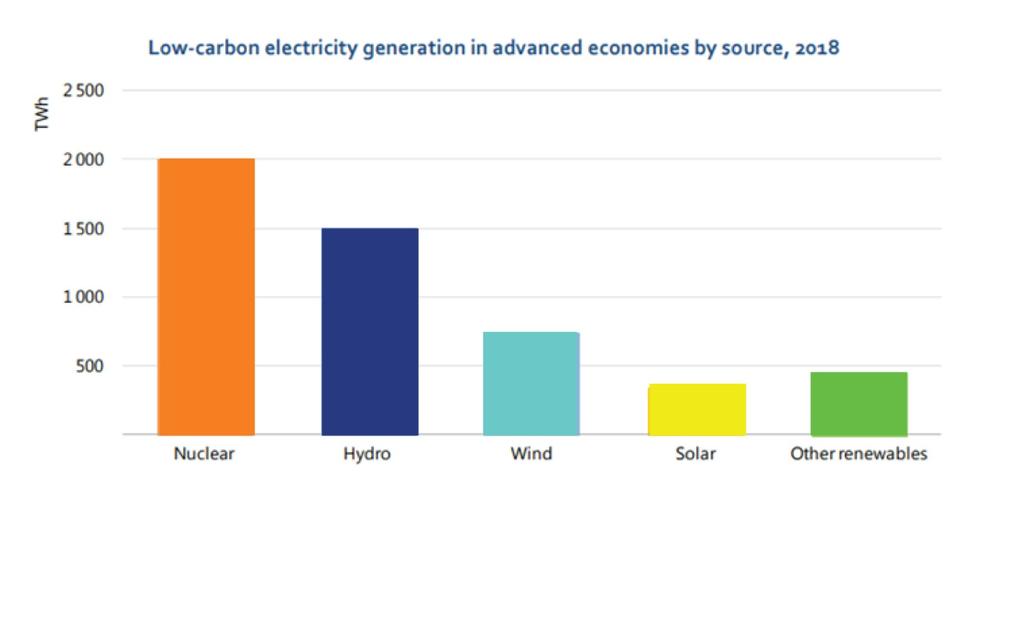
2. The @IEA says nuclear power provides about 10% of global electricity. Many states now see it as part of energy security, industrial growth, and low-carbon transition.
3. Electricity demand is rising fast. The @IEA says global electricity demand grew by 4.3% in 2024 and is expected to keep growing at close to 4% through 2027.
4. AI is making the energy question even bigger. The @IEA says data centre electricity use could more than double by 2030 to around 945 TWh.
5. Private actors are entering this space too. @Google signed a deal tied to up to 500 MW of advanced nuclear power. @Microsoft backed the restart of an 835 MW reactor. @amazon backed SMR projects in Washington with 320 MW in the first phase and an option to go up to 960 MW.
6. Nuclear investment is also rising again. The @IEA says spending on new nuclear plants and refurbishments is set to exceed $70 billion, and nuclear investment has risen by 50% over the past five years.
7. Geopolitical tension now hits energy markets very quickly. Energy routes, supply chains, and power costs can all be shaken by conflict, especially in already fragile regions.
8. Security risks are also growing. @SIPRIorg warned in 2025 that a dangerous new nuclear arms race is emerging at a time when arms control regimes are severely weakened.
9. In such an environment, the IAEA’s credibility matters even more. States must believe its judgments are professional, technical, and impartial.
10. India’s own Ministry of External Affairs said in its 7 March 2006 Separation Plan statement that India was “not in a position to accept safeguards” on the PFBR and FBTR at Kalpakkam.
Rafael Grossi then publicly praised the PFBR on 8 April 2026. Concern is natural when the head of the world’s nuclear watchdog applauds a reactor India kept outside safeguards.
An impartial @iaeaorg is not a small issue. It matters for trust, non-proliferation, peaceful nuclear cooperation, and the future politics of energy itself.
@ciss_ajk @AsmaKhawaja5 @RadioactiveFrnd
#AI
#Israël
#Hürmüz
#Pakistan
#امن_کا_سفیر_پاکستان
4
8
193