
Development economist – AP @RiceEcon←Postdoc @UChicago←PhD @Brown_Economics←RA @Princeton/@BusaraCenter←MPhil @UniofOxford←BSc @MaastrichtU 🚣🏻♀️🤾🏻♂️📷🌻
Joined November 2012
- Tweets 1,633
- Following 1,146
- Followers 1,694
- Likes 2,320
139 Photos and videos










Moritz Poll retweeted

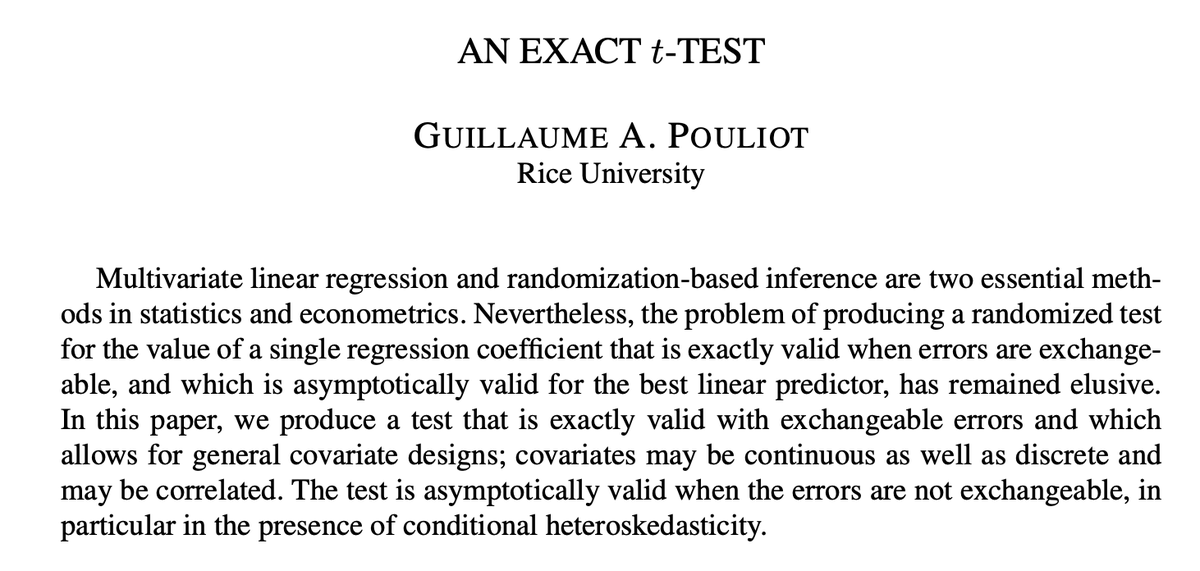
🚨 New paper alert 🚨
Are you also torn between small sample performance and robustness to heteroskedasticity? You can have both!
One can produce an exact test for subvectors that is asymptotically robust to heteroskedasticity.
Forthcoming Econometrica
3
39
170
41,213
Moritz Poll retweeted

12 Nov 2025
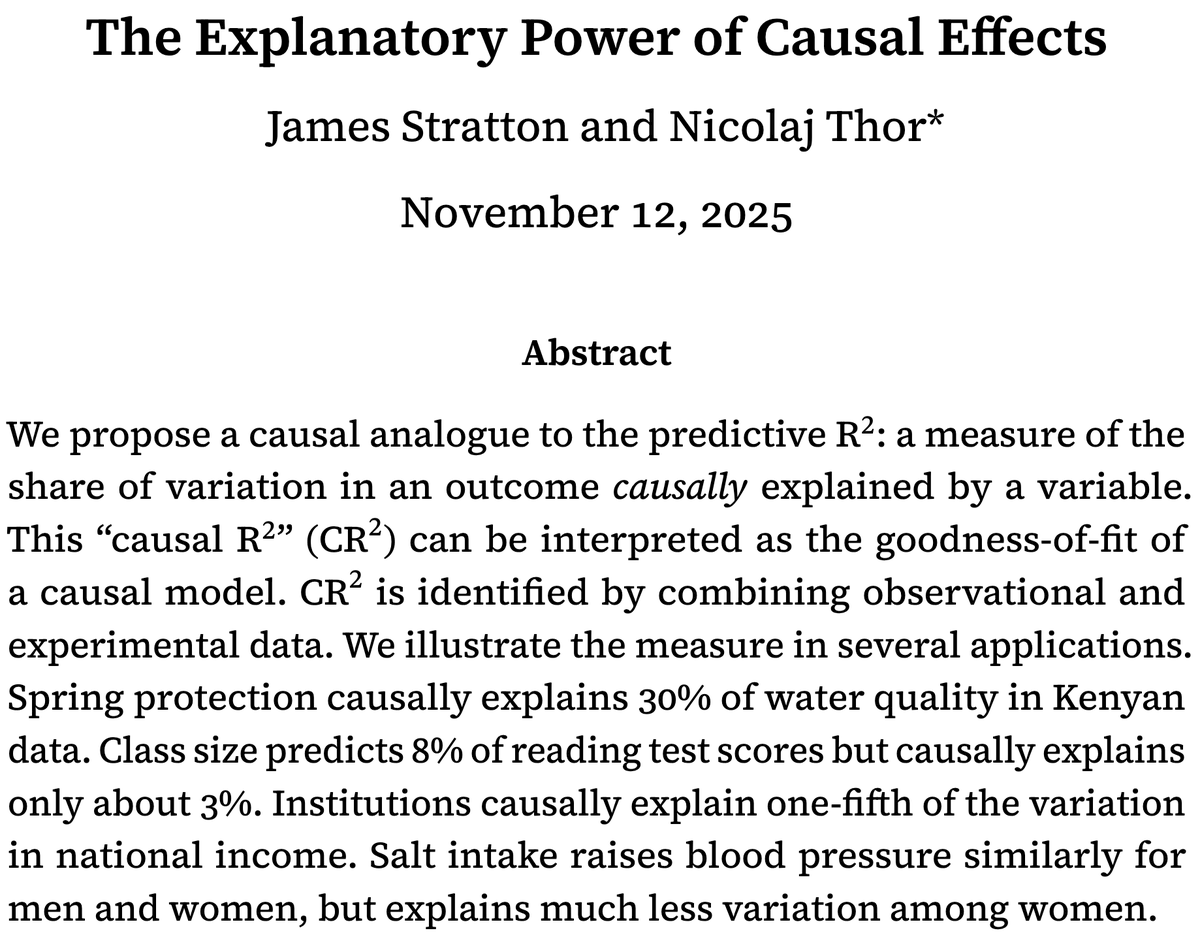
@jamespstratton and I put out a working paper a few days ago on exactly this question! We propose a way to answer it using a simple causal analogue of the R² ("Causal R²").🧵(1/12). Paper: drive.google.com/file/d/1FWN…
11 Nov 2025

A lovely post. In addition the the causal inference revolution, we now need a "variance explained" revolution which focuses on understanding what drives the variation in the world we see around us
3
57
231
65,712
Moritz Poll retweeted

12 Nov 2025
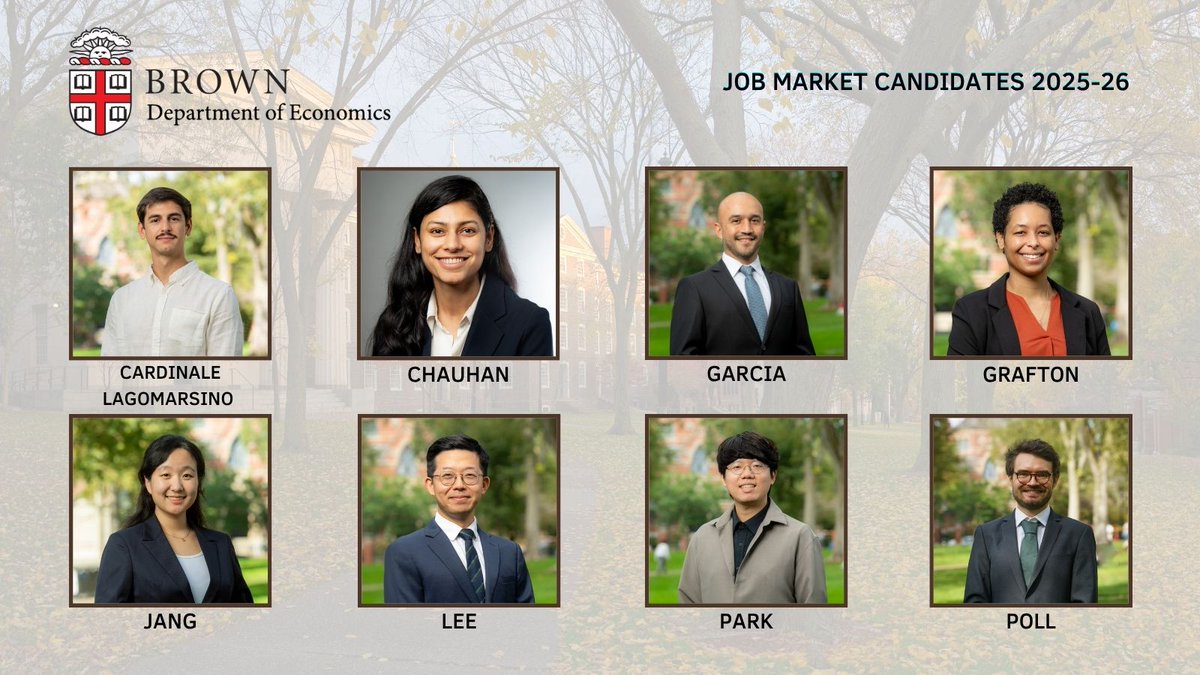
Meet this year’s @Brown_Economics Job Market Candidates! Explore their research and connect with them here: economics.brown.edu/job-mark…
#EconTwitter

11
35
9,594
Moritz Poll retweeted

17 Apr 2025
First - this is more my area of expertise - it is frankly pretty extreme to claim that theoretical arguments can do anything convincing on this issue. The theoretical channels for government investment to be complementary to private investment are so ample that any argument to the contrary could not possibly stand on its own. More on that at the end.
The well-identified empirical evidence lines up against Bryan's view pretty decisively.
The strongest quasi‑experimental studies all show that public R&D dollars crowd in private effort.
Regression‑discontinuity at NIH paylines finds a US$10 m grant shock yields about three extra corporate patents with no loss of business R&D [1]. Shift‑share instruments linking post‑9/11 defense budgets to industry exposure show every public dollar induces 40‑60 cents of additional private R&D and raises total‑factor productivity [2]. Event‑study evidence from sudden university‑level cuts reverses these gains: publications fall 15 % and VC‑backed start‑ups 30 % [3]. A richer SR&ED tax credit for Canadian SMEs boosts their R&D by 17 % and spills over into patent citations [4]. Scientist‑level NIH lotteries confirm grants lift later publications and citations by roughly a quarter [5]. Across designs and contexts, the sign is always positive and the magnitudes large—directly contradicting claims of systematic crowd‑out.
What's wrong with your evidence? Kealey‑type papers err in both identification and theory. Their headline correlations use aggregate time‑series where governments boost subsidies precisely when private investment slumps, creating spurious negative signs [6,7]. Damrich, Kealey & Ricketts merely embed those raw aggregates in a stylised contribution‑good model that assumes knowledge is fully appropriable and ignores spillovers, so any public share mechanically lowers measured productivity [8]. Once exogenous variation is isolated—as in the five studies above—the relationship flips, and the omitted spillovers emerge as large and positive. Descriptive regressions that confound cause and effect cannot overturn the causal evidence that well‑designed public funding unlocks socially valuable, privately under‑supplied innovation.
There are SO MANY ways of understanding theoretically why the facts would be like this. Romer’s endogenous‑growth framework treats ideas as non‑rival but only partially excludable, so inventors capture just a slice of their social surplus [10], while Aghion‑Howitt’s creative‑destruction model adds business‑stealing, further depressing private incentives [11]. Jones‑Williams calibrate spillovers, duplication and congestion and still find laissez‑faire R&D at barely a third of the optimum [12]. Grossman‑Helpman’s quality‑ladder model layers cross‑sectoral input‑output spillovers, another benefit absent from Caplan’s crowd‑out narrative [13]. Liang & Mu show that when research lines are complements, decentralized scientists cluster on topics that leave high‑return yet neglected areas that only public funding can unlock [14].
[1] @pierre_azoulay , Graff Zivin, J., Li, D. & Sampat, B. (2019) ‘Public R&D and Private Patenting: Evidence from NIH Funding’, Review of Economic Studies 86(1): 117‑152.|
[2] Moretti, E., Steinwender, C. & Van Reenen, J. (2024) ‘The Economic Spillovers of Defence Research’, Review of Economics & Statistics 106(2): 235‑256.
[3] Babina, T., He, J., Howell, S. et al. (2023) ‘Cutting the Innovation Engine’, Quarterly Journal of Economics 138(4): 2201‑2260.
[4] Agrawal, A., Rosell, C. & Simcoe, T. (2020) ‘Tax Credits and Small‑Firm R&D: Evidence from Canada’, American Economic Journal: Economic Policy 12(3): 1‑30.
[5] Jacob, B. & Lefgren, L. (2011) ‘The Impact of Research Funding on Scientific Output’, Journal of Public Economics 95(9‑10): 1168‑1177.
[6] Kealey, T. (1996) The Economic Laws of Scientific Research. Springer.
[7] Kealey, T. & Ricketts, M. (2014) ‘Modelling Science as a Contribution Good’, Research Policy 43(6): 1014‑1024.
[8] Damrich, S., Kealey, T. & Ricketts, M. (2022) ‘Crowding In and Crowding Out within a Contribution‑Good Model of Research’, Research Policy 51(1): 104400.
[10] Romer, P. M. (1990) ‘Endogenous Technological Change’, Journal of Political Economy 98(5): S71‑S102.
[11] Aghion, P. & Howitt, P. (1992) ‘A Model of Growth through Creative Destruction’, Econometrica 60(2): 323‑351.
[12] Jones, C. I. & Williams, J. C. (1998) ‘Measuring the Social Return to R&D’, Quarterly Journal of Economics 113(4): 1119‑1135.
[13] Grossman, G. M. & Helpman, E. (1991) ‘Quality Ladders in the Theory of Growth’, Journal of Political Economy 99(3): 433‑449.
[14] [9] Liang, J. & Mu, X. (2020) ‘Complementary Information and Learning Traps’, Quarterly Journal of Economics 135(4): 1929‑1984.
20
110
629
203,582

1 Jan 2025
Bringing back this gem because reasons
23 Dec 2021

Happy holidays! Are you all making good progress on your parents’ computer problems?
1
455
16 Dec 2024
Excited for two days of @YaleRISE conference. Presenting early work on how the graduation model of poverty alleviation works as areas get saturated.
6
433

Thanks to the @WorldBank Development Impact Blog for posting my JMP!
@YunyuShu (@Brown_Economics) studies how information shapes adaptation under input vs output subsidies in the context of shaded cocoa in Ghana 🇬🇭.
More insights here 👇
blogs.worldbank.org/en/impac…
10
21
4,774
Moritz Poll retweeted

21 Nov 2024
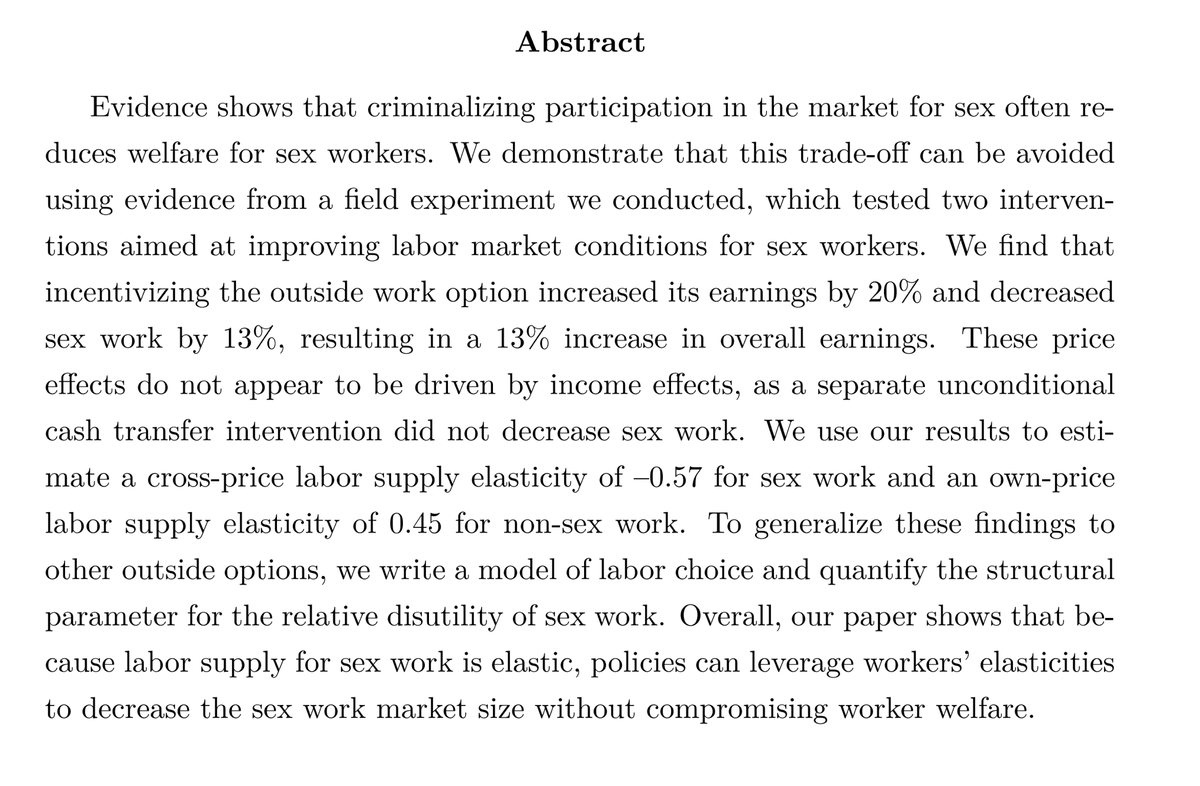
Thank you to @jenniferdoleac for sharing my JMP! I am on the Job Market this year, here is my website: ruchimahadeshwar.github.io/
27 Oct 2024

Ruchi Mahadeshwar
JMP: "Outside Options and the Supply of Sex Work"
Website: ruchimahadeshwar.github.io
1
5
707
Moritz Poll retweeted

12 Nov 2024
Hiring: Research Manager for Oxford's new Centre for Macro-Experimental Development!
Lead operations, finance, team building, and field research in East Africa. Apply by Jan 15, 2025. economics.web.ox.ac.uk/resea…

8
9
6,714
Moritz Poll retweeted

12 Nov 2024
Passionate about development research? I am hiring a pre-doc to work on social norms, media and inter-group dynamics. Apply by Nov 24. Details here:
drive.google.com/file/d/1vr7…
6
107
291
50,213
14 Oct 2024
It was about time 😌
14 Oct 2024

BREAKING NEWS
The Royal Swedish Academy of Sciences has decided to award the 2024 Sveriges Riksbank Prize in Economic Sciences in Memory of Alfred Nobel to Daron Acemoglu, Simon Johnson and James A. Robinson “for studies of how institutions are formed and affect prosperity.”
#NobelPrize

2
269
Moritz Poll retweeted

20 May 2024
Hello! Please consider applying to a year-long RA position with me, @DrNathanNunn @awaambraseck and Jacob Moscona. Project involves ethnographic and historical work on culture and institutions in SSA. Deadline 6/3/24. @econ_ra employment.ucsd.edu/research…
3
75
172
35,070
Moritz Poll retweeted

18 Apr 2024
I'm hiring two Research Assistants based @BusaraCenter in Nairobi! We will work on a number of exciting topics in development and behavioral economics. This two-year position is good preparation for a PhD in Economics. Details here: povertyactionlab.org/careers…
Please RT and apply!
3
79
126
30,489
18 Apr 2024
Traveling to @UMNews Twin Cities to present my work on market schedule coordination at #NSE2024. Anyone down for dinner or drinks tonight? sites.google.com/umn.edu/nse…
25 Mar 2021

Excited to present some very early work on the coordination of rural market days this weekend at the Network Science in Economics conference. Here is a teaser lightning talk. Program can be found at netsciecon.org/program #NSE21 #EconTwitter
9
2,557
12 Apr 2024
Went to see the eclipse in Northern New Hampshire and it was pretty awesome. instagram.com/p/C5qc7m3ONRU/
114
29 Jan 2024
Has anyone had households in LICs (literacy & numeracy potentially limited) write budgets for the week/month ahead? I want to print and hand out booklets of sort that I can later digitize. Would love to see examples, hear lessons learned.
1
4
1,798