
Pursuing peace and aiming for global math equality with @sharemath, my #1 Freak. Fueled by coffee.
Joined January 2009
- Tweets 1,557
- Following 184
- Followers 239
- Likes 4,026
76 Photos and videos








Pinned Tweet

3 Dec 2023
Textbook companies rule education in much the same way pharmaceutical companies control our health. For profit and with a laundry list of negative side effects.
6
3
40
7,880
Getting older with one of the best married men on planet earth is a privilege 💖 @sharemath
Jun 2

The older men get, the less they care about surface-level things.
Beauty attracts attention.
But peace, loyalty, emotional maturity, kindness, respect, consistency, and support are the qualities that make a woman unforgettable in marriage.
Because attraction may start a relationship.
But character is what sustains it for decades.
1
4
579
"It always seems impossible until it’s done." ~Nelson Mandela
@anenglishteachr
@maxinomics
30
I wish I had a million followers to see this post 🧞♀️
May 13

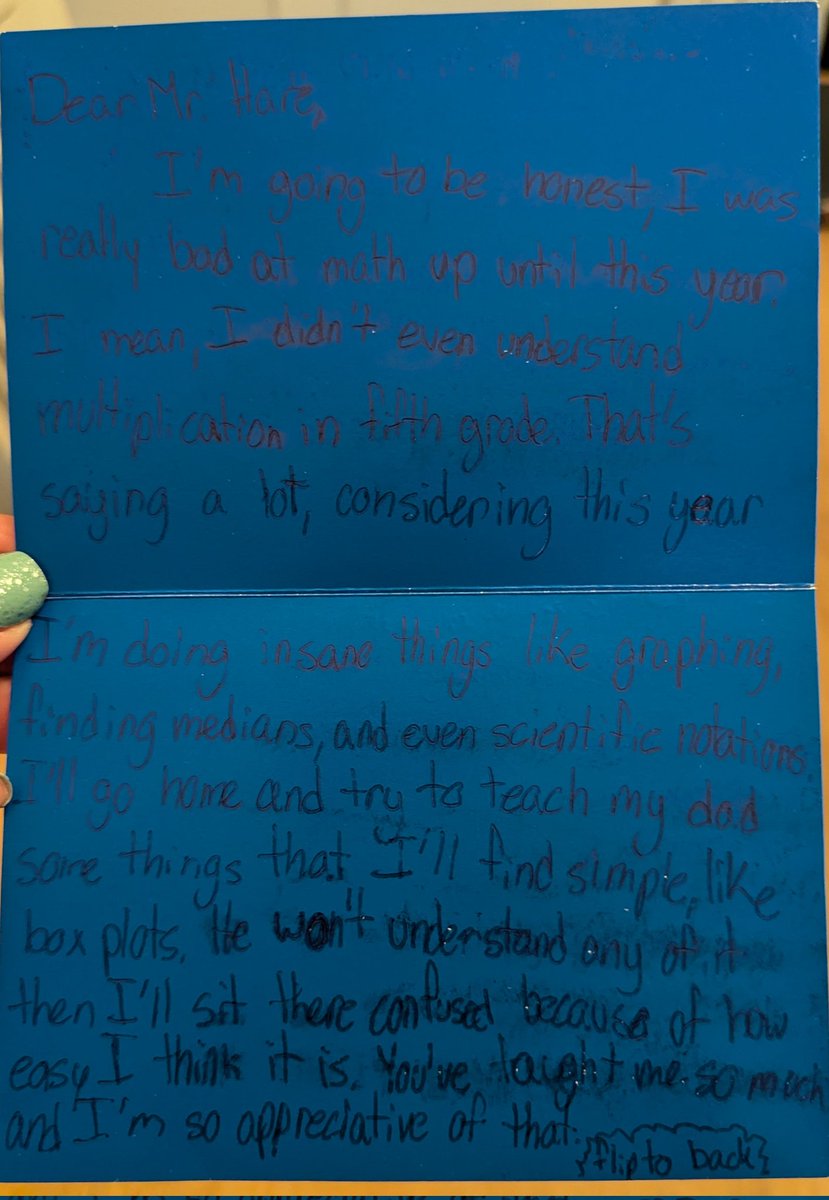
There’s something wrong with this letter from one of my former 7th grade students:
“I’m going to be honest, I was really bad at math up until this year. I mean, I didn’t even understand multiplication in fifth grade. That’s saying a lot, considering this year I’m doing insane things like graphing, finding medians, and even scientific notations. I’ll go home and try to teach my dad some things that I’ll find simple, like box plots. He won’t understand any of it then I’ll sit there all confused because of how easy I think it is. You’ve taught me so much and I’m so appreciative of that.”
What’s wrong with it?
I didn’t teach her at all that year, not even once. She completely taught herself, day after day, with pencil and paper, and not a screen in sight.
That was the year I first put my You Teach You math method to the test in the classroom, and she used the “examples for everything,” the related practice problems, and the fully-completed answer key on the back of each page to master even the trickiest concepts in the 7th grade curriculum, and to pull herself up from “Partially Proficient” at the beginning of the year to “Advanced Proficient” and into Algebra I the next. (I was available to her at all times of course—in the role of what I call “the sage at the side”—but she only asked for help once, and figured out her own mistake before I managed to get to the end of my explanation.)
People here on eduTwitter tend to be skeptical of the idea of students teaching themselves math—and they're right to be. I wasn’t sure the materials could do it without me either! But that year, student after student after student—132 in all—showed me otherwise.
And why shouldn’t they be able to? Kids learn to speak by hearing example after example and trying out their theories with feedback from the environment.
Math is no different. The brain doesn't need to be told the rules before it can learn them—it needs examples clear enough to see the pattern, and feedback immediate enough to correct the theory.
The full k-8 series I developed since then gives students both: a visual example for every single concept and a feedback loop that closes in seconds, not days.
That's not a new idea. It's how human beings learn everything.
And now it's how anyone can learn math.
Learn more at YouTeachYou.org
3
38
Joy as a result of learning made me think of your success stories @anenglishteachr!
Apr 28
This tweet means a lot to me personally and I wasn't going to quote it publicly at first, but it gets at something that needs to be discussed more in math education: the need for children to track down their own mistakes and learn from them without fear of embarrassment.
I have a desk drawer full of letters from students and former students expressing gratitude for being able to do exactly that with the “See it, Do it, Check it” instant feedback of YouTeachYou.
“Joyful” describes them perfectly.
1
2
173
Feb 24

Live play of Wordcels Puzzle #267. The video makes it look "easy peasy", but is it? Try for yourself.
31
7 Dec 2025
Word Play Game. See what I did there?
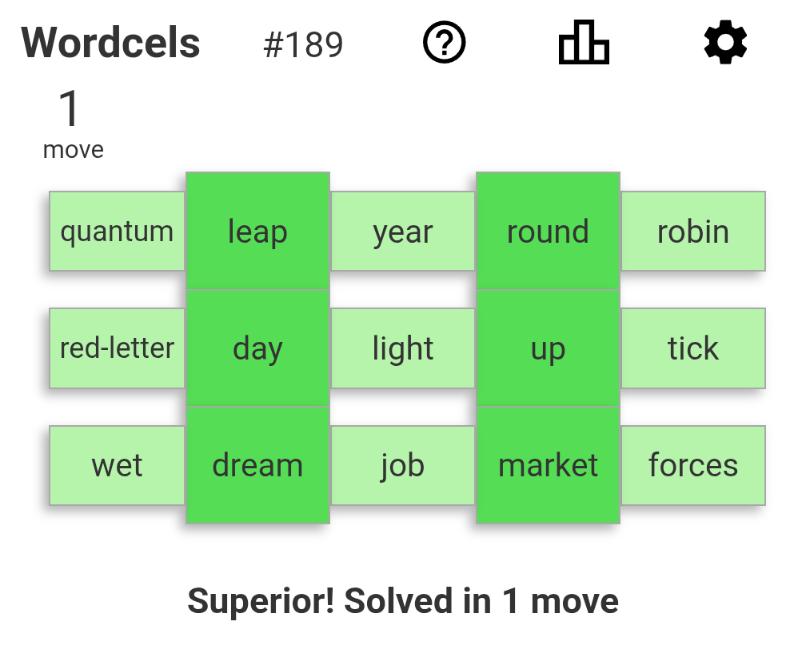
Spoiler alert for #189 - to show you how fun and challenging #WordCels is.
7 Dec 2025
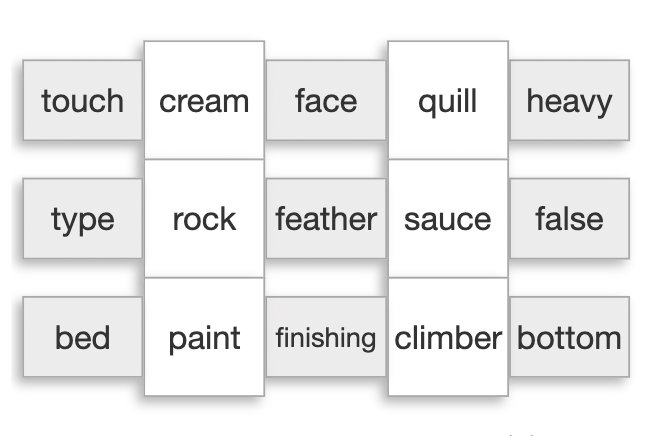
Can you place 15 words to make 16 common two word phrases? A new puzzle everyday. A great way to learn new expressions. #WordOfTheDay #wordle #WordNerd
1
1
1
64
15 Nov 2025
The next contender for a NY Times game is here and I'm obsessed. Try it! #wordcels
15 Nov 2025

arm candy
Arm candy, an attractive date at a social event. Coined in the 1990's as a variant of eye candy, which was coined with similar meaning in the 1970's. Eye candy likely grew from the term nose candy, a reference to cocaine dating to the 1920's. wordcels.com
1
39
26 Aug 2025
"Mastering math requires humility.
It never, ever requires humiliation."
26 Aug 2025
Years ago, I piloted a single-semester “math lab” course designed to get our middle schoolers caught up with the basics, using a self-paced, self-explanatory, example-based curriculum I was creating.
“TWO periods of math a day??” a student protested on day one.
I tried explaining that this was a chance for everyone to master the math they may have missed over the years and to put an end to their math anxieties for good.
And I tried to soften the blow by telling the kids they could skim the stuff they’d already mastered and just focus on the stuff they needed to know.
But this kid wasn't having it.
He bragged that he had always gotten straight A's in math, and that the last thing he needed was to go back through all of it again.
Day after day, he would mumble some variation of “This is so stupid” as he grudgingly made his way through the activities, which started from the beginning with counting and basic addition, and built step-by-step from there.
And day after day I would hold my breath, wondering when the mutiny would begin.
It never did.
Instead there came a day without a single complaint. I called him aside at the end of class to thank him for it.
“I appreciate you not fighting me on this,” I said, “I know you don’t need the help, but a lot of these kids do.”
He dropped his eyes for a moment, and his voice fell to a whisper.
“I do need the help,” he confided as his classmates exited the room.
“What do you mean?” I said.
“I’ve been getting problems wrong, even some of the easier ones” he replied. “I thought I knew this stuff, but when I check the answer keys…”
“No shame,” I said with a smile. “I know exactly how you feel. I couldn’t believe how much math I didn’t know when I started teaching math years ago!”
He smiled back.
“Your secret’s safe with me,” I added as he made his way out the door.
He was a model student for the rest of that semester, the bragging never returned, and he mastered everything he thought he had mastered and then some.
Fast forward two years later and the same kid catches me in the hall between classes. “Hey, I've been meaning to thank you for that math lab class back in the day,” he says. “Without it, I would have been lost in Algebra.”
“It was my pleasure!” I said with another smile on my face as we made our opposite ways down the hall.
“Oh!” he called out over the crowd as he faded into the distance. “And thanks for not embarrassing me too!”
Mastering math requires humility.
It never, ever requires humiliation.
#YouTeachYou #mathworksheets
1
46
10 Jul 2025
The US is the same. I often wonder how intentional the dumbing down of education is.
10 Jul 2025

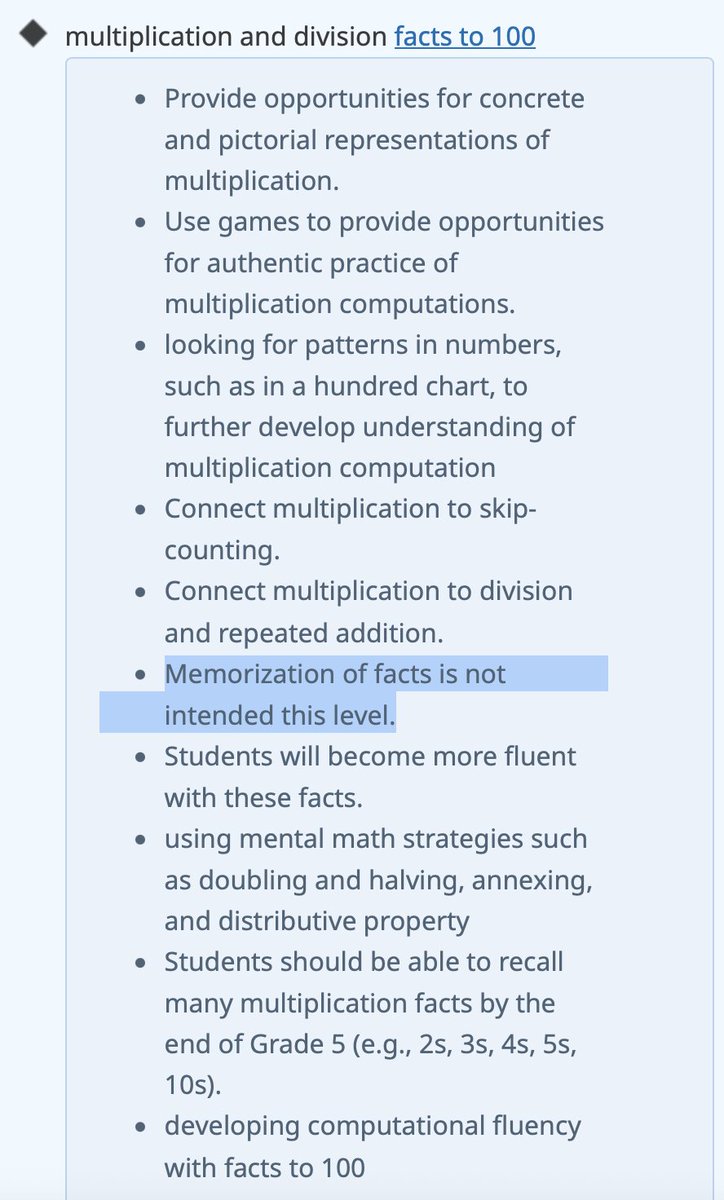
I've been reviewing Canadian math curricula (standards) this week. Here's a BC grade 5 outcome titled "multiplication & division facts to 100." As if this all weren't bad enough, we have "memorization of facts is not intended at this level." Grade 5! Wish I could unsee this.
44
18 Jun 2025
"One-size does not fit all with learning. Students need to be able to move at their own pace through evidence based learning materials and move on once they prove competency." #youteachyou @readtoyourkid @larissaphillip @sharemath
This tweet is unavailable
2
95
10 Jun 2025
Every child should have this chance - I really believe no child should be left behind. And now, it's not just a phrase, it's really happening! #math #YouTeachYou
8 Jun 2025
Several years back, one of my 7th graders started the year with the worst case of math anxiety I had ever seen. She sat by herself, wouldn’t make eye contact with me or anyone else, and nervously erased her work as soon as she had done it.
As if she was about to suffer for it.
Digging into her backstory, I learned that she hadn’t been able to keep up with the whole-group instruction the year before, and had been assigned a one-to-one aide of the hand-holding variety who tended to embarrass the students he worked with - loudly.
I tried to reassure her that things would be different this time around, and was expecting a look of relief when I informed her that I had managed to cancel the aide this year, but she didn’t even look up.
She didn’t trust me either.
I had gotten permission to pilot the example-based “see it, do it, check it” math method that became You Teach You that year, and after trying to work through each of activities I had created with the whole group of students at once, they started begging me to let them work through the sequence of self-explanatory worksheets on their own, and at their own pace.
Figuring it would be a true test of the method I was still in the process of creating - and would tell me whether or not I should bother to keep creating it at all - I gave in.
When I did, a change seemed to come over her.
First she stopped erasing her work so often.
Then she started filling her notebook with some of the neatest math you’ve ever seen.
Then, without so much as a single word, she started collecting extra assignments off the windowsill at the end of each class period to complete on her own time, and coming into class early the next day to check them against the answer keys.
One Friday, after collecting her usual stack of worksheets at the end of the period, she stopped at my desk, looked me in the eye, and spoke to me for the very first time.
It was to tell me she was leaving.
“I’m moving in with my dad this weekend, and I won’t be coming to school here anymore,” she explained.
I started to tell her I was sorry to hear that, but she cut me off: “My cousin will still be going to school here, though, and I see him every weekend,” she said. “Is there any way he can keep getting these worksheets to me?”
“Of course!” I said, getting a little goosebumpy over the fact that she had even asked. “I’ll make sure he gets all the keys too!”
“Thank you,” she said, again looking me in the eye, and with more than a hint of relief in her voice.
And then, without so much as another word, she simply turned around and left.
And I never saw her again.
Her cousin, though, was a different story. I saw him every Friday afternoon from that point on, like clockwork, when he would stop by my room to pick up the new worksheets I had created that week, along with their keys.
The worksheets had been designed to test my theory that students could teach themselves math, to the point of mastery and at a level of detail I'd previously dreamed of, given a self-checking sequence of materials with a pre-worked example for every problem and type of problem. The pilot program that year was that test, and I had put everything I had learned over the course of my career into it - not to mention every hope I had.
On the last day of school that year, her cousin showed up out of the blue, holding a Thank You card.
I got goosebumpy all over again as I opened it.
“I got myself into ALGEBRA!!!!” she had written, in several colors of Sharpie, with no eraser marks to be seen. The words practically screamed at me, which was amazing coming from a kid who couldn't even look me in the eye several months before.
She had also written, “I never could have done it without all those examples!”
Those words screamed to me too, just as loudly.
3
132
10 Jun 2025
Age makes you wiser, but wisdom is undervalued - sometimes I feel invisible.
9 Jun 2025

An unfortunate thing I’ve learned as I’ve gotten older: the young women desperately need the advice of older women, but desperately few of them will listen. It is a rare young women who will hear the advice of another women and take it to heart or pursue it. Most will discard the wisdom of a hard fought path and insist on learning the same lesson their own way.
54
2 Jun 2025
"If I slowed down for those who needed more time to think, I lost the faster thinkers. If I sped up for the faster thinkers, I lost the slower thinkers. And I lost all of the thinkers who were missing the necessary background knowledge."
2 Jun 2025
When I came across Sweller’s cognitive load theory and “worked examples” years ago, a shaft of sunlight burst through the clouds. I had been overloading my math students’ brains by not providing enough examples! Such a simple explanation! And such an easy fix!
Or so I thought.
When I tried working through additional examples with my math students in the classroom, the results were nowhere near what I thought they’d be. Don’t get me wrong: some students benefited greatly from the increased examples and seemed to benefit from my additional explanations too; their improvement with the related practice problems were enough to convince me that Sweller was right.
But many more students remained unaffected. If I slowed down for those who needed more time to think, I lost the faster thinkers. If I sped up for the faster thinkers, I lost the slower thinkers. And I lost all of the thinkers who were missing the necessary background knowledge.
Had I misinterpreted Sweller? Was I misapplying worked examples?
Digging back into his writings, I found the answers to be yes and yes.
I had been assuming that “worked examples” meant “more examples, worked by me, with explanations, in a whole-class setting.”
Sweller’s work on the split-attention effect challenged this assumption. While I was “working” and explaining examples at the board, my students were being forced to process two separate sources of information: my auditory explanations and the visual examples being presented. This act of switching between explanations and examples was adding extraneous cognitive load to my lessons. How do I know? Because my students would copy the examples incorrectly more frequently when I was saying things than when I was silent. How do I know the cognitive load was extraneous/unnecessary? Because math is a language; well-chosen math examples are capable of explaining themselves.
Sweller’s transient information effect also challenged the “explained by me” assumption. My spoken explanations were fleeting; if a student missed a word or needed to re-process a concept, that information was gone. Forcing students to try to recall what I had said as they attempted to navigate a new and unfamiliar problem was overloading their working memory. How do I know? When they could recall the explanation, they seemed to have missed the example, and when they could recall the example, they seemed to have missed the explanation.
Sweller’s work on the working memory limits of novices also contradicted my assumption. Biologically-secondary non-intuitive knowledge like math places severe demands on beginners and their memory as it is. Adding simultaneously interacting and extraneous demands (listening, watching, analyzing, processing, categorizing) only pushes the needle further to the red. (Some proponents of worked examples here on X have taken issue with my claim that beginners can handle pre-worked examples on their own. Sweller recommends unaccompanied static examples for novices!)
When Sweller spoke of worked examples, he meant pre-worked examples; he didn’t mean for instructors to “work the examples as you go.” The worked example strategy (for novices) requires students to study the already-completed examples/solutions, not watch and listen and try to process the content as it’s being revealed and discussed. For this reason, Sweller recommended silent, static examples where all the relevant information is revealed at the same time and stays put, and where the student themself controls the pace of the learning.
What would happen if we paid more than lip service to worked examples and finally started using them as Sweller actually intended?
In my experience, miracles.
2
106
31 May 2025
This 👇
@sharemath FactFreaks.com
30 May 2025

Memorizing multiplication tables is a fundamental skill -- like learning phonics. If students aren't fluent in math facts, they'll struggle with higher math.
tinyurl.com/mtcp256f
@DavidMarguliesM @MichaelPetrilli @rastokke @DTWillingham @rickhess99 #math #teachmath
6
86
23 May 2025
Don't wait for someone else, they may never show up - teach yourself or let your kids teach themselves! #stopwaiting #homeschool @thejasonkantor
23 May 2025
Kids learn language through unlimited examples. So why do we limit them to so few in math?
I've designed the You Teach You series with a fully-worked example for every single practice problem - far more examples than conventional math methods.
Because kids learn by example.
1
4
192
Diane Hare ✌️ ☕ = 💯 retweeted

3 May 2025
I have an adult GED student who's among the hardest workers I've ever seen. Every day he comes to class early, takes the first example-based worksheet off the pile, studies the examples, completes the related practice problems with precision, and then asks to see the key - all before most of the other students have even shown up. He always fixes his mistakes too, even if he has to completely rework a complex problem - or several problems - to do so. He asks excellent questions as well, and takes unfinished work home to finish it on his own time.
He has all the habits of mind, in other words, to be an outstanding math student, so I was curious as to how he ended up in the GED program. “Did you always work this hard in math class?” I asked him one day.
“I tried to,” he said a little uneasily, “but I was slow.” He wasn't just talking about speed.
Every time I hear a story like his, a part of me gets a little angrier. How many students have to face life without math because they're slow and careful? Because they're detail-oriented? Because they're trying to master the material and not just “get it done”? These are math virtues for Pete’s sake, and yet the fast-moving assembly line system that is public math education tends to punish students for them!
It’s.
So.
Wrong.
But don’t get me wrong. I’m not casting blame (except on the system itself, which existed long before any of us were born). My point is that we can do far better. We now know the cognitive science behind pre-worked examples, the importance of guided and independent practice and discovery, and the non-negotiable nature of instantly accessible feedback - and can incorporate these fundamental “see it, do it, check it” aspects of learning into self-paced instructional sequences, as I've done with the You Teach You book and worksheet series. In other words, we can now give each and every student all the time they need to learn math.
I’m not worried at all about the student in this story. He’s now well on his way to passing the GED, and with his strong work ethic and exemplary habits is destined for a very bright future indeed.
But what of the countless other math students who are slow and careful and are being marginalized by the system because they're slow and careful?
Now they can have all the time they need.
#YouTeachYou #SelfExplanatoryMath #AmpleExamples #InstantFeedback #InexpensiveMathSolutions
4
8
92
5,291
3 May 2025
Whatever your age, you're allowed to start over. I'm in my 60s and I'm allowed to start over.
As long as we're breathing, it’s not too late to begin again.
2 May 2025

The fastest way to gain clarity is to write out your thoughts.
Get out a pen and paper and write your answers to these 4 questions:
1. What is the most important thing to me right now?
2. What would this look like if it were fun?
3. What am I scared of?
4. What would I do if I weren’t afraid?
Success is on the other side of fear.
Get clear on your fears and take action.
Action creates clarity.
1
68
2 May 2025
2 May 2025
About a month ago, an individual here on eduTwitter said that if my example-based, self-checking You Teach You math method is really capable of compelling even the most reluctant students to master basic math for themselves - in a fraction of the time and for a fraction of the cost of existing methods - I should be shouting it from the rooftops.
Since that time, I've been tweeting about You Teach You books and worksheets regularly, to the point where some might think I'm being a little too, shall we say, aggressive. I apologize for being a broken record to those who follow me (and I'll try to mix up my tweets a bit to give you a break), but this new method has the potential to improve countless lives and make the world a better place - and it's impossible to shout something from the rooftops quietly!
37
1 May 2025
Kudos to all teachers who celebrate each individual student success story! #YouTeachYou is designed to make these stories become the norm in every #math classroom or at the kitchen table. Share your story!
30 Apr 2025

Creating space for students to discover their own capabilities. You didn’t just teach math; you helped her see herself differently. From folding arms to future business owner—that’s the kind of transformation standardized tests can’t measure, but that changes lives.
113
26 Apr 2025
Right! This is the elephant in the classroom! Let's all be mice and get that big thing out of math education! 🐁 > 🐘
26 Apr 2025

The push for full inclusion, and the resulting demand for differentiation, is such a catch-22.
I just can’t get over the strangeness of being told best practice is to do something that is literally impossible.
You can’t simultaneously teach to vast differences in skill and knowledge in a single room and do it well. It’s a system which ensures that some percentage of the class gets neglected.
39