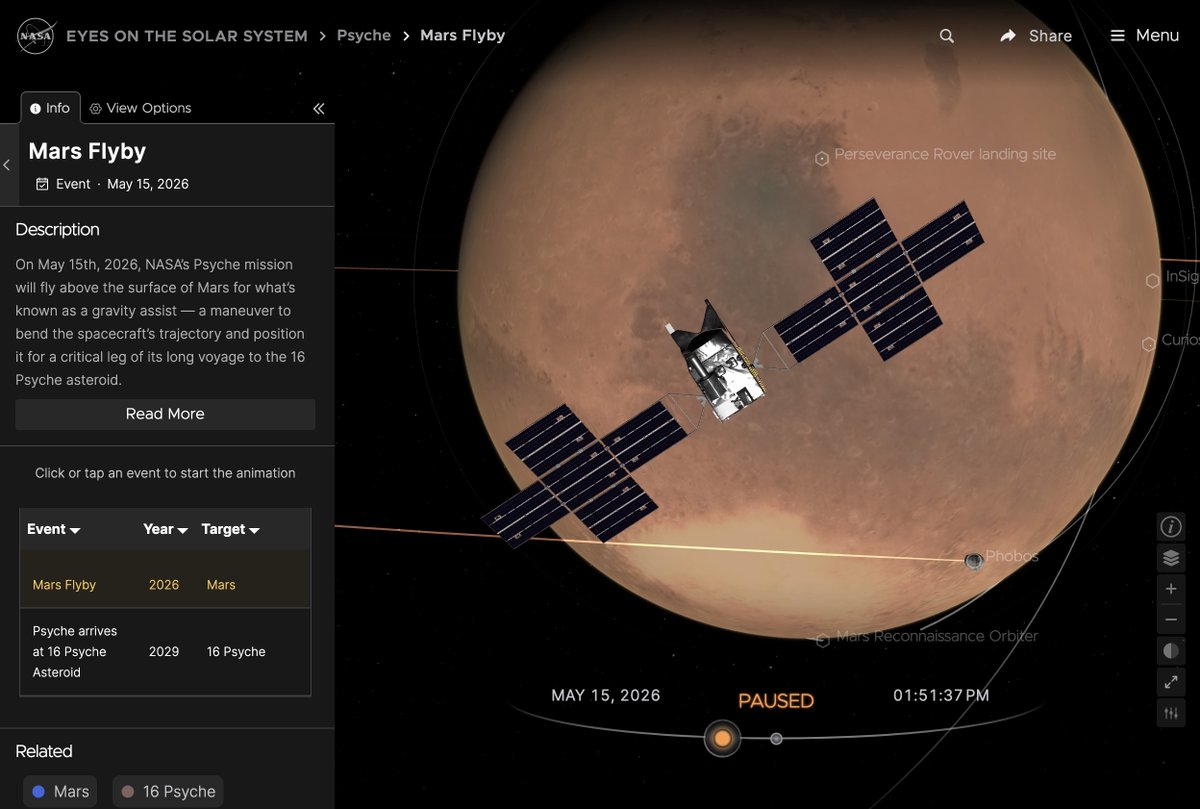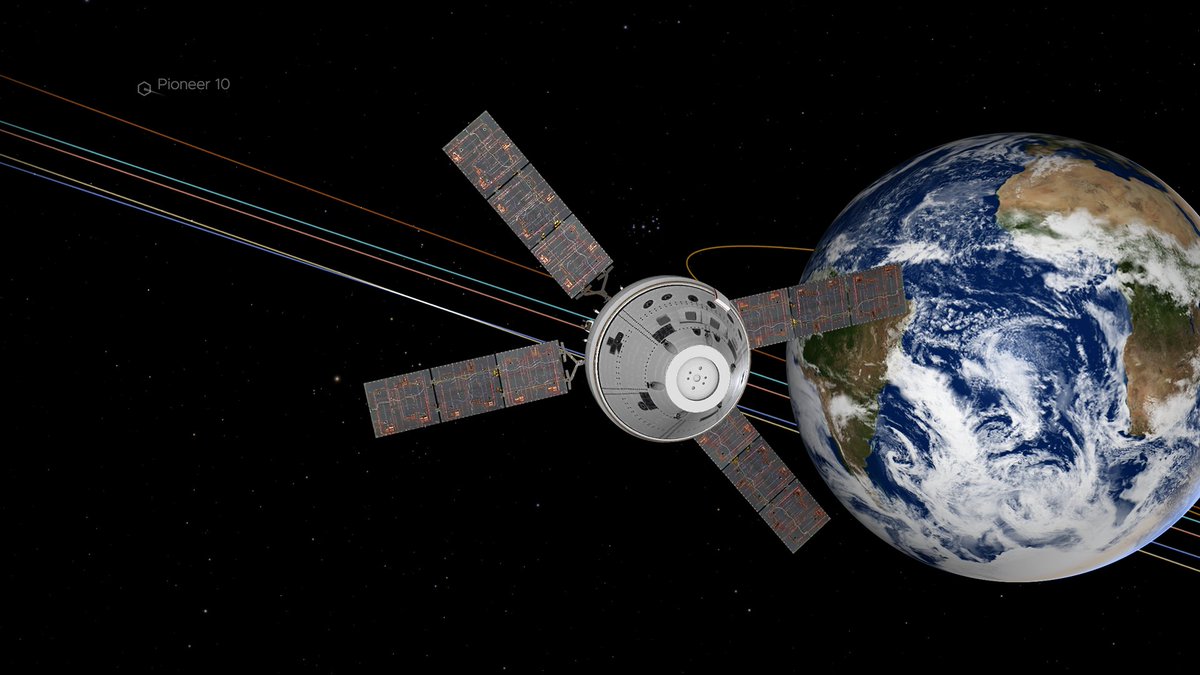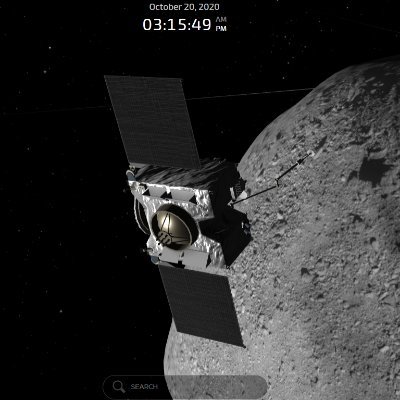
Ride along using NASA's 3D interactive app, 'Eyes on the Solar System.' You can even fast-forward and get a sneak peek at the flyby: eyes.nasa.gov/apps/solar-sys…
ALT screenshot of web application that shows a simulated view of the Psyche spacecraft near the planet Mars and its trajectory, along with info about the mission and the flyby
Another way to visualize the geometry is to use NASA's Eyes on the Solar System simulation for that approximate point in space and time: go.nasa.gov/4cbbkF3
Which way to the Moon?
This interactive tool lets you follow Artemis’s journey – and even scroll forward and backward in time!
Follow along with Eyes on the Solar System:
eyes.nasa.gov/apps/solar-sys…
ALT An artist’s concept shows the Artemis’ astronauts path of travel from Earth to the Moon.
Which way to the Moon?
This interactive tool lets you follow Artemis’s journey – and even scroll forward and backward in time!
Follow along with Eyes on the Solar System:
eyes.nasa.gov/apps/solar-sys…
ALT An artist’s concept shows the Artemis’ astronauts path of travel from Earth to the Moon.
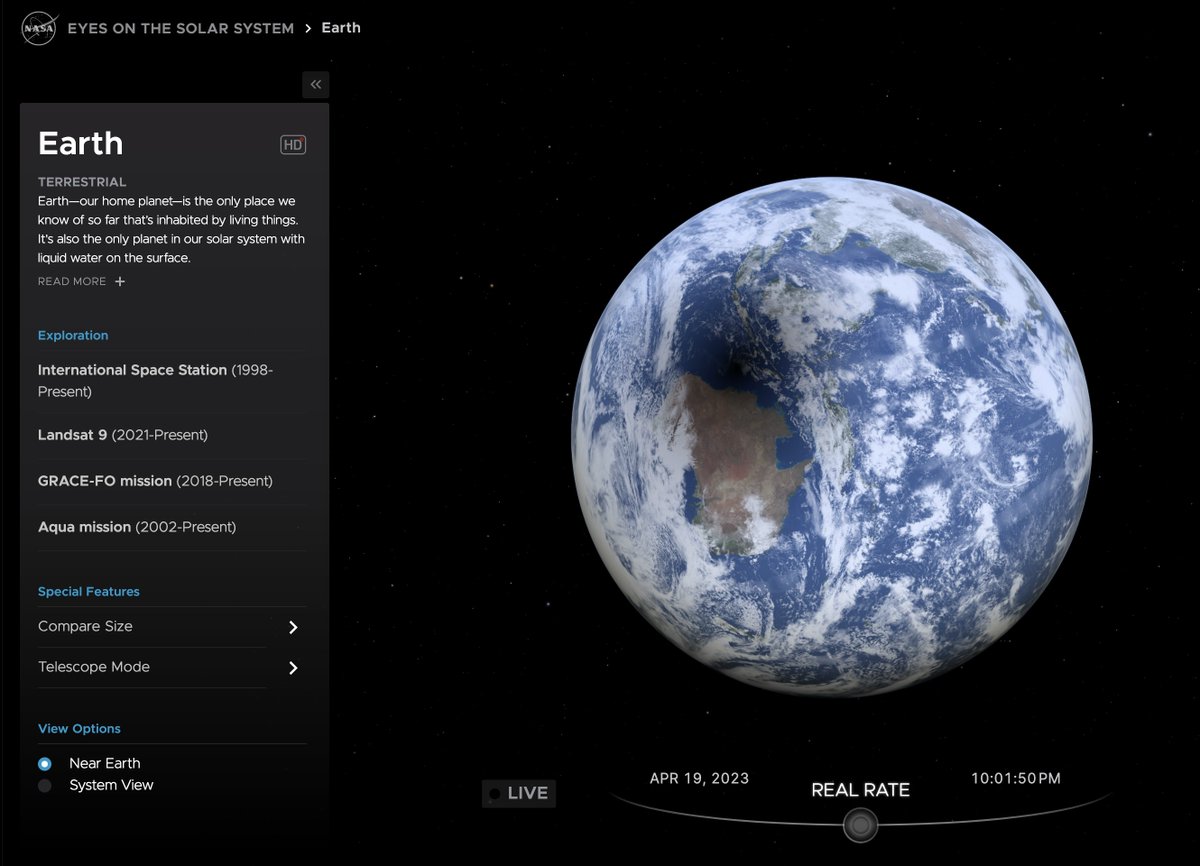
With our "Eyes on the Solar System" site, you can track the location of the planets and moons—and over 160 NASA spacecraft—in real time, using actual NASA data, right from your desktop or phone. eyes.nasa.gov
Try "Eyes on Asteroids" and "Eyes on the Earth," too
eyes.nasa.gov/apps/asteroids…eyes.nasa.gov/apps/earth/#/
👀 It's 10am ET. Do you know where your planets are?
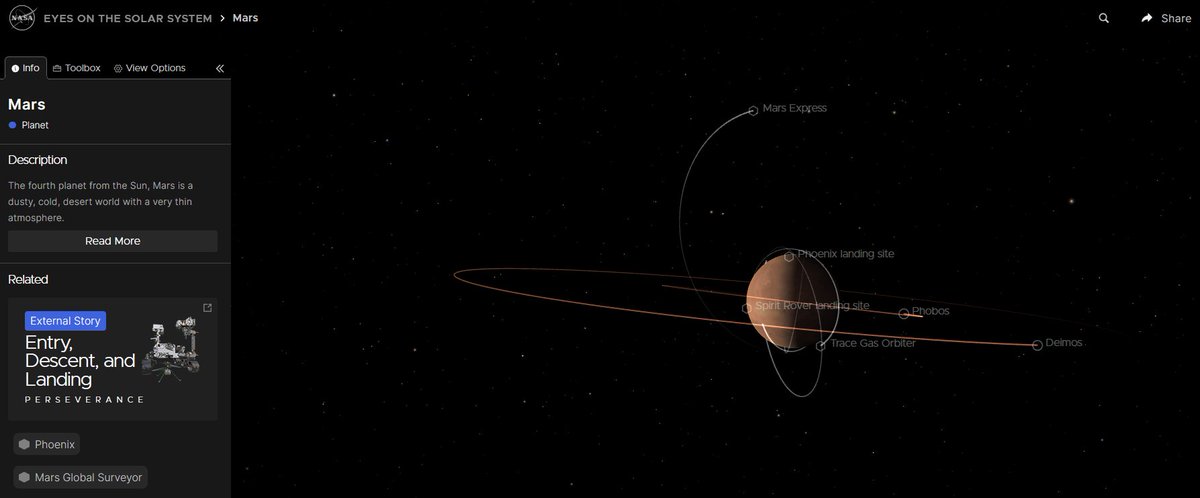
With our Eyes on the Solar System site, you can track the location of other worlds—and over 160 NASA spacecraft—in real time: eyes.nasa.gov/apps/solar-sys…
ALT A screenshot of NASA's Eyes on the Solar System interactive site, focused on the planet Mars. The left sidebar features information on Mars and navigational options, while the rest of the image shows a visualization of the planet Mars, with various spacecraft on and around it. Credit: NASA
Dialed in: The Mars Relay Network (MRN) is an international constellation of five spacecraft orbiting the Red Planet that send precious science data from the rovers back to Earth. You can track which spacecraft are transmitting in real time at science.nasa.gov/mars/mars-r…
Europa Clipper is now about 31,000 miles (about 50,000 km) from Mars and closing fast. Closest approach will take place at 12:57 p.m. EST. You can ride along virtually at eyes.nasa.gov/apps/solar-sys…
ALT Screenshot of a web application showing a simulated view of the Europa Clipper spacecraft, with its twin wings of solar panel arrays, in space near the reddish sphere of the planet Mars.
Can do! Visit eyes.nasa.gov/apps/asteroids… to see a real-time visualization of every known asteroid or comet classified as a Near-Earth Object. Its database is updated daily, and contains ~38,000 objects.
Follow @nasa_eyes for more info on this and other space visualization tools.
On Dec. 24, our Parker Solar Probe will make history with a record-breaking closest approach to the Sun ☀️
Follow along in real time with this interactive visualization, brought to you by @NASA_eyes and @NASASun: go.nasa.gov/3Do42hZ
ALT A GIF showing the Parker Solar Probe in NASA's interactive Eyes visualization software. The spacecraft appears to be dropping rapidly towards the Sun in the background, with information about the mission on the left and bottom sides of the image. Credit: NASA
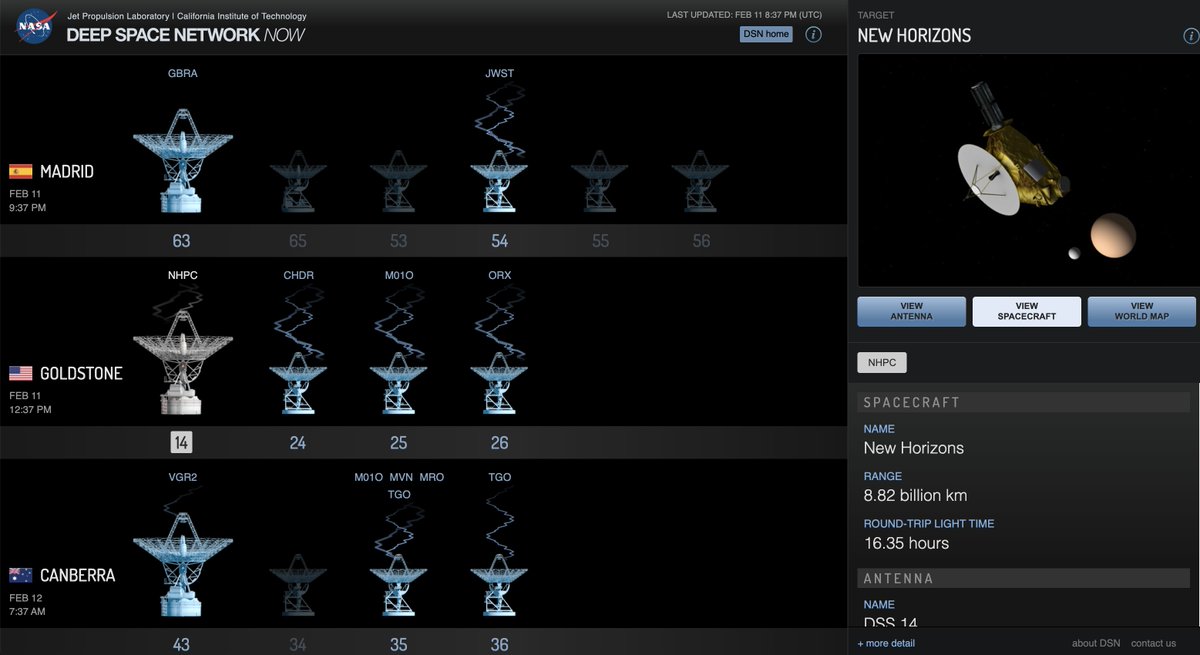
Go long! Uh, keep going. No, more. Right now, NASA's #DeepSpaceNetwork station in Goldstone, Calif. is communicating with our New Horizons spacecraft...5.48 billion miles (8.82 billion kilometers) away. eyes.nasa.gov/dsn/dsn.html
ALT Screenshot of a web application showing the status of the ground stations of the Deep Space Network. The various antennas located at Madrid, Goldstone, and Canberra are shown, and the active antennas are represented by squiggly radio signal lines coming from the antenna. A large antenna at Goldstone is shown to be active, with information about the New Horizons spacecraft displayed.

So, wait... how big is a #DeepSpaceNetwork dish?
THIS BIG!
No matter who you are cheering for today during the #SuperBowl, we can all agree that the DSN is always a winner. It’s how we communicate with interplanetary spacecraft and explore the universe. 📡
ALT A graphic that shows a large deep space network dish situated on top of a traditional looking American football field. The large dish takes up about two-thirds of the field, giving viewers a perspective of its massive size. There are words in the upper left-hand corner that say, "Deep Space Network." In the upper right-hand corner it reads, "70 Meters Across, 77 Yards Across."
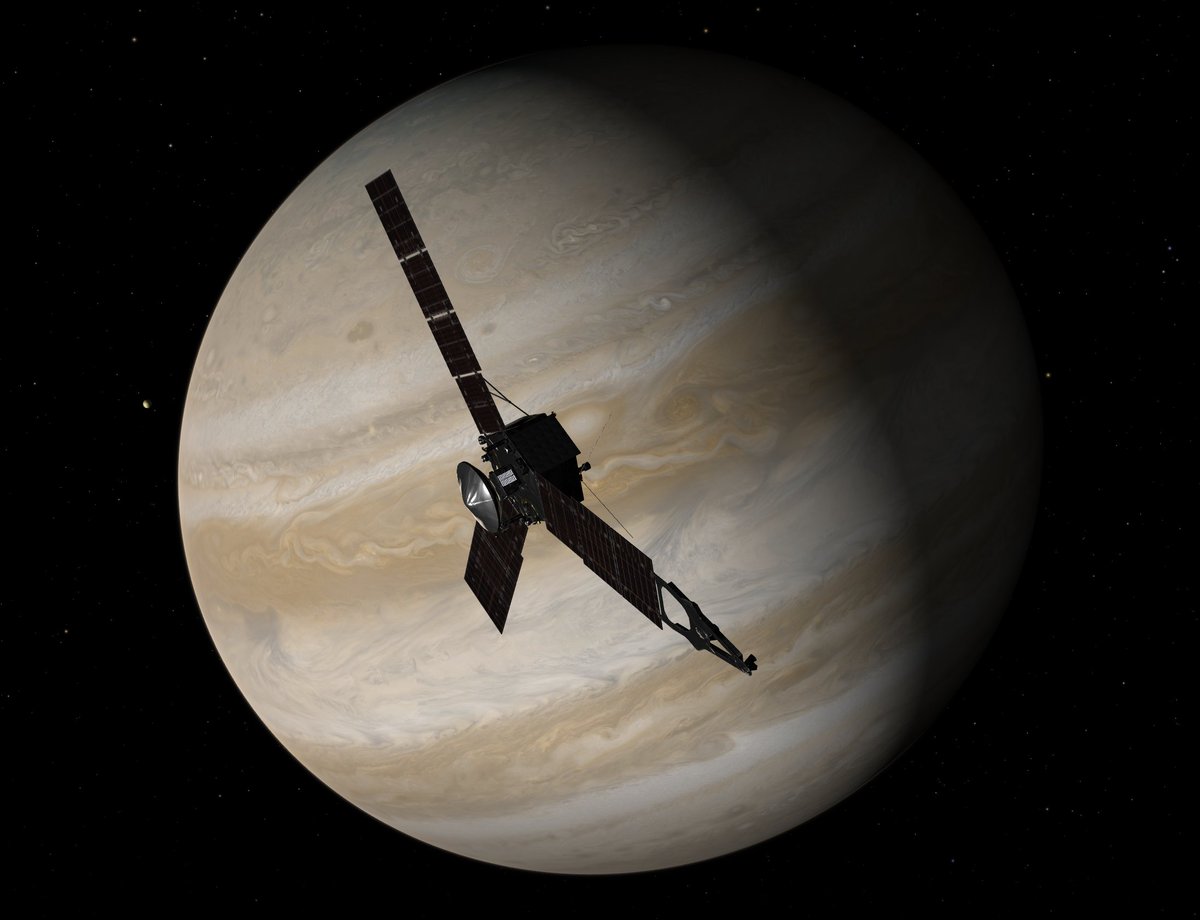
Right now, our #JunoMission is inbound to Jupiter for the spacecraft's 56th close flyby of the giant planet, which will take place in a few hours. You can follow along in real time with the "Eyes on the Solar System" online app: eyes.nasa.gov/apps/solar-sys…
ALT Simulated view of the Juno spacecraft silhouetted by Jupiter in the background. Juno has a central body and three large solar panel arrays that radiate like a fan. Jupiter's colorful stripes and swirling storms can be seen in its atmosphere.
We’ve got our eyes on all 4 Starling spacecraft!
🛰️🛰️🛰️🛰️
Follow their journey testing swarm technologies in space using our @NASA_Eyes visualization tool. Learn more: go.nasa.gov/493MW4s
ALT A Starling spacecraft digitally rendered in NASA’s Eyes on the Solar System interactive app, allowing users to track the swarm in real-time and observe their orbits relative to other space missions and celestial bodies.
Credit: NASA
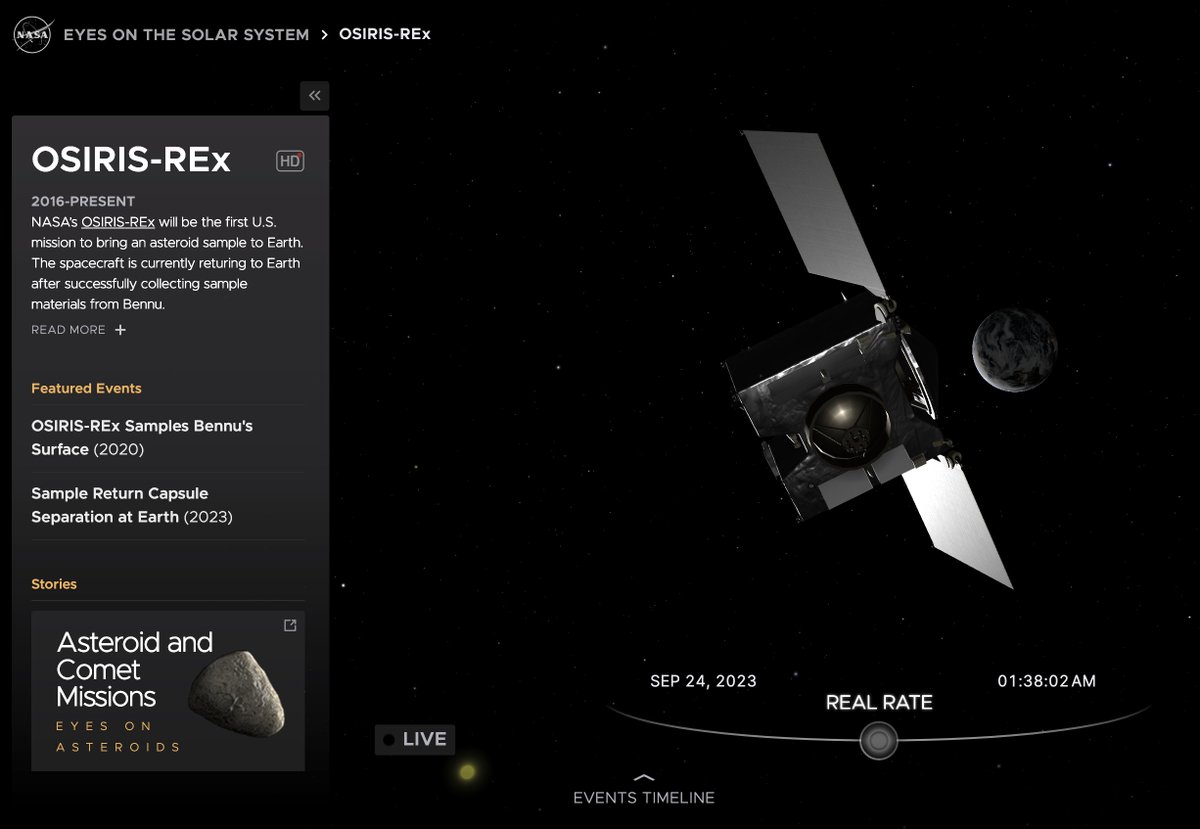
Closing in! Where is #OSIRISREx now? See the spacecraft's current position as it approaches Earth to drop off its sample of asteroid Bennu: eyes.nasa.gov/apps/solar-sys…
Live coverage begins Sept. 24 at 10 am ET on NASA.gov
ALT A web application shows a simulated view of a spacecraft with solar panels in space with the crescent Earth nearby. Text describes the OSIRIS_REx mission's goals.
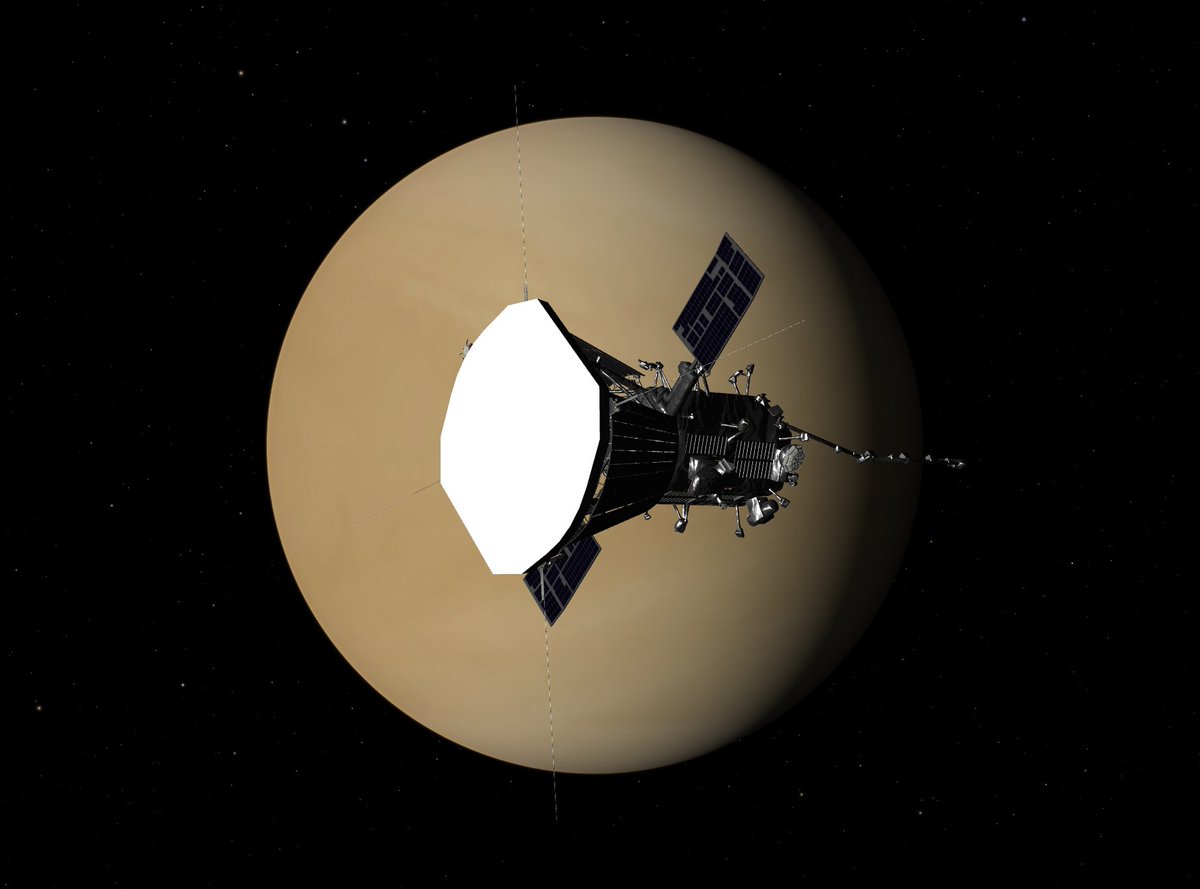
This week, @NASASun's Parker Solar Probe buzzed by Venus, in a move that will send it toward record-breaking close orbits around the Sun: go.nasa.gov/3QRYIbA
You can re-create the flyby using our 3D solar system simulator: go.nasa.gov/45lwLgC
ALT Simulated view of the Parker Solar Probe spacecraft framed by the nearly full disc of Venus in the background, against the blackness of space. The probe is distinguished by a large, flat, white heat shield at the front of its body, on the side facing the bright sunlight.
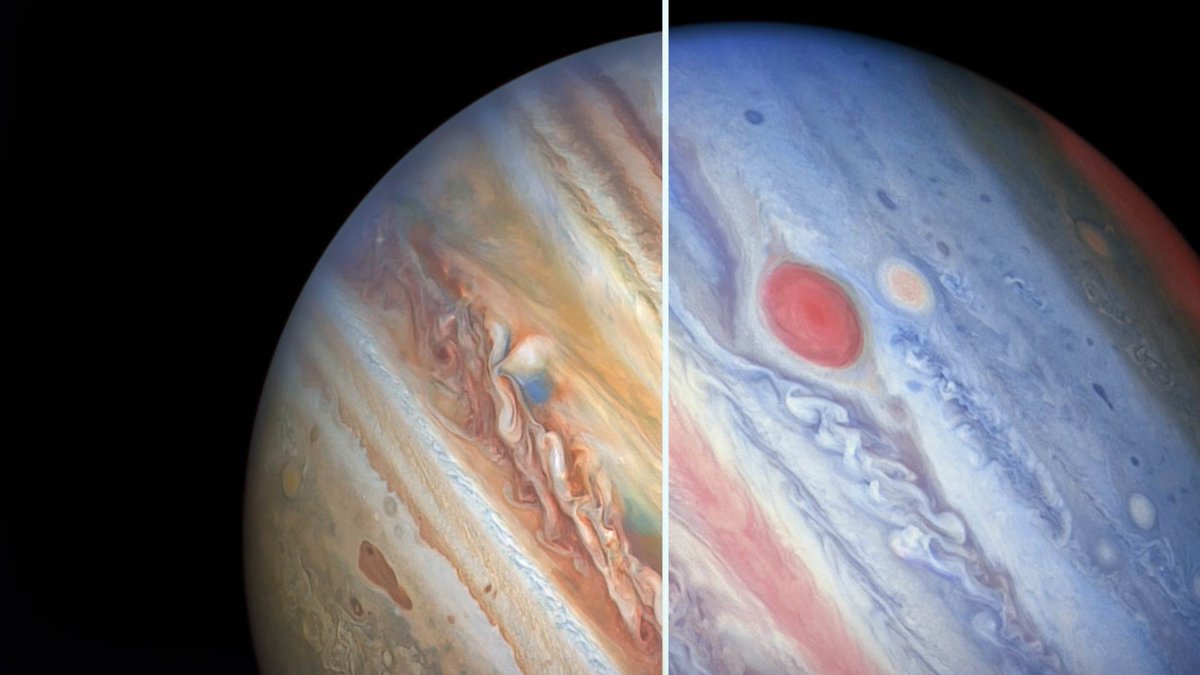
We did it together. Thanks to you, we're bringing home five People's Voice Awards in this year's #Webbys.
From @NASAWebb's first images to @NASA_Eyes's interactive map of the asteroids, check out our full set of Webby winners: go.nasa.gov/3n7iNOw
ALT An image of Jupiter, upside-down and tilted on its side at about a 45 degree angle, with the right and bottom edges cut off. The image is divided in two by a thin white line. On the left side, Jupiter is seen in the visible spectrum, with its familiar bands of orange, brown and white clouds; on the right side, shades of blue and pink (including a rose-colored Great Red Spot) represent Jupiter in ultraviolet and other shades of light. Credit: NASA
ALT A short video snippet of the NASA Mars Perseverance Rover team in a mission control room at JPL. They are jumping up and down with excitement and waving their arms in the air.
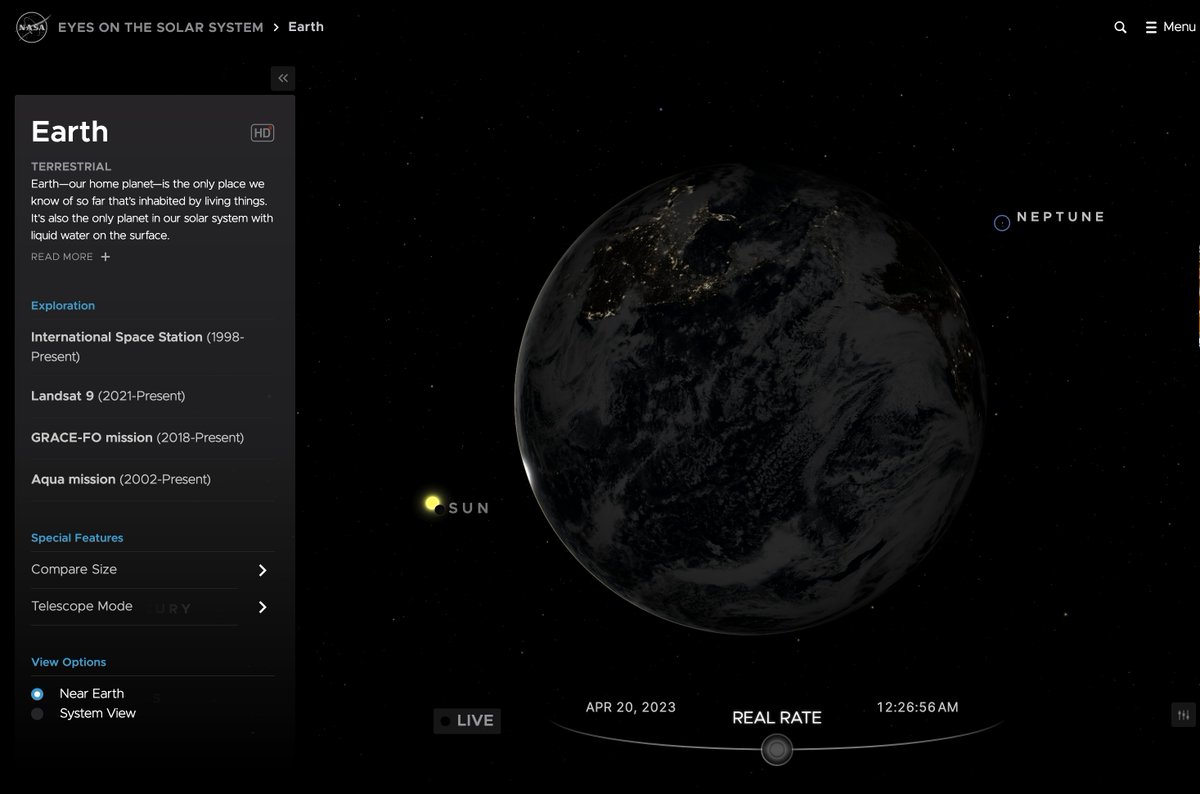
ALT Screenshot of a web application that displays the current positions of the planets. It shows a view of the night side of Earth and the Americas. To the left of Earth, the Moon can be seen about to pass in front of the Sun.
ALT Screenshot of a web application that displays the current positions of the planets. The day side of Earth and Australia are visible. Over a portion of Australia falls a shadowed area.
A solar eclipse will be visible over parts of Western Australia and Southeast Asia today. No matter where you are, you can watch the Moon block the Sun with us.
At 10:30pm ET (0330 UTC), watch #NASAScience Live and ask NASA experts your questions, plus get a preview of upcoming eclipses. youtube.com/watch?v=S2U3a1xX…
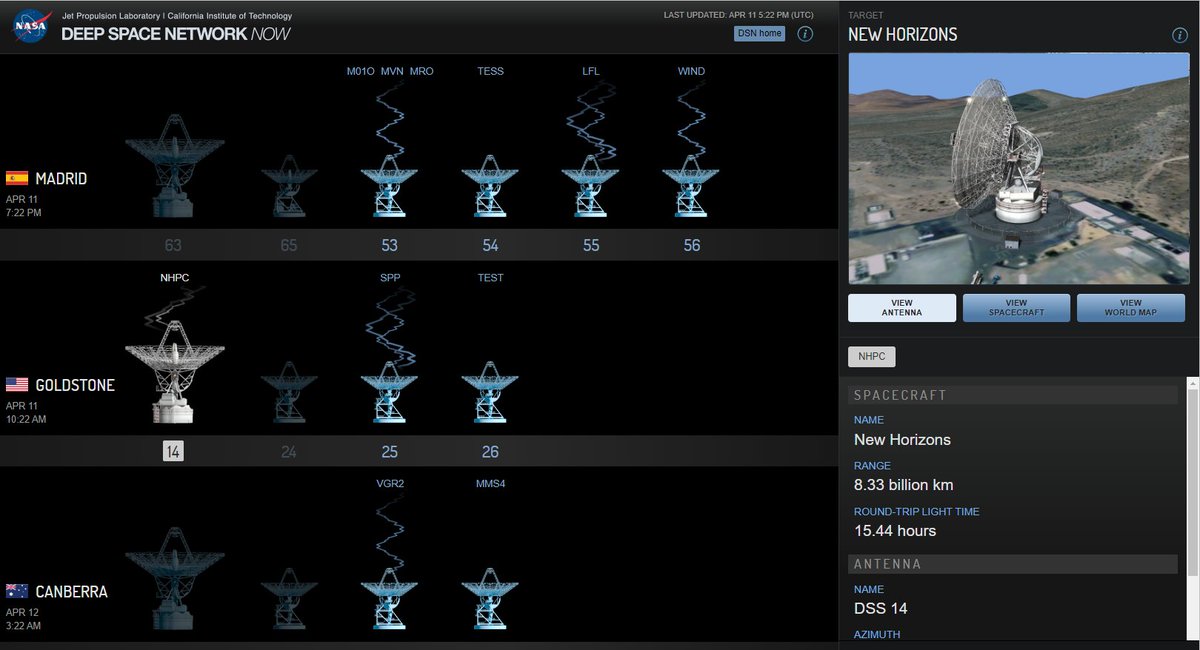
NASA and @NASAJPL have restored the Deep Space Network Now website following a cybersecurity review ahead of our crewed Artemis missions to the Moon. The website will continue to provide real-time data with limited changes.
Explore DSN Now: eyes.nasa.gov/dsn/dsn.html
ALT Screenshot of the Deep Space Network (DSN) Now webpage which displays the ground antennas at each of the DSN ground complexes in Madrid, Spain; Goldstone, California; and Canberra, Australia. On the right hand side is a graphic of the ground antenna and a display of data for the antenna and the spacecraft it is communicating with.
Antenna DSS-14 in Goldstone is connected to the New Horizons spacecraft, 8.33 billion kilometers from Earth.
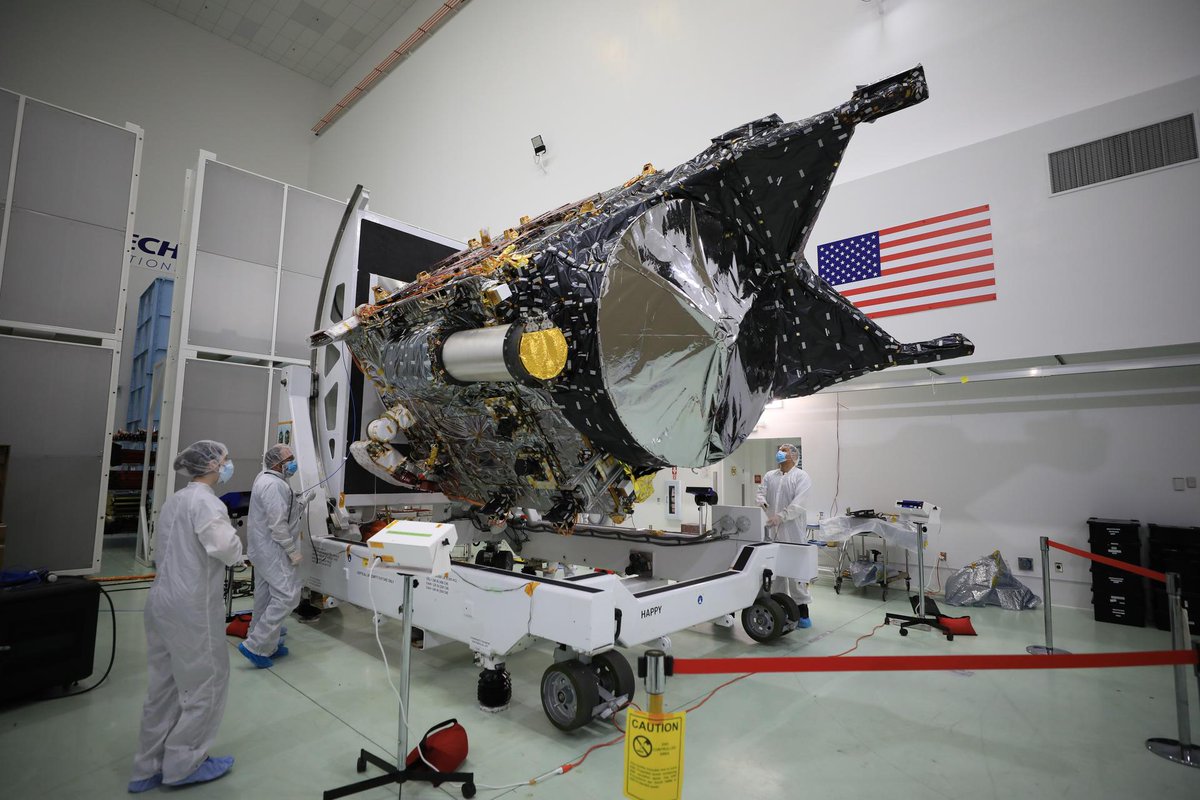
More about 16 Psyche, the asteroid that #MissionToPsyche will explore, one of the most intriguing targets in the main asteroid belt: go.nasa.gov/3wRRHLg
🚀LAUNCH UPDATE!
The planetary window for the #MissionToPsyche opens Oct 5, 2023. Psyche will travel to a unique metal-rich asteroid to study one of the building blocks of our solar system.
Psyche will launch on a @SpaceX Falcon Heavy from @NASAKennedy!
blogs.nasa.gov/psyche/2023/0…
ALT A team of engineers in full coveralls, hairnets, and masks look at the Psyche satellite in a clean room. The satellite is about the size of a golf cart and is mounted on a turnable structure.