Willing to create a twitter account on NLP | Lead ML Scientist at loris.ai | Host of youtube.com/@learningfrommac…
Joined February 2020
- Tweets 124
- Following 307
- Followers 166
- Likes 1,133
25 Photos and videos
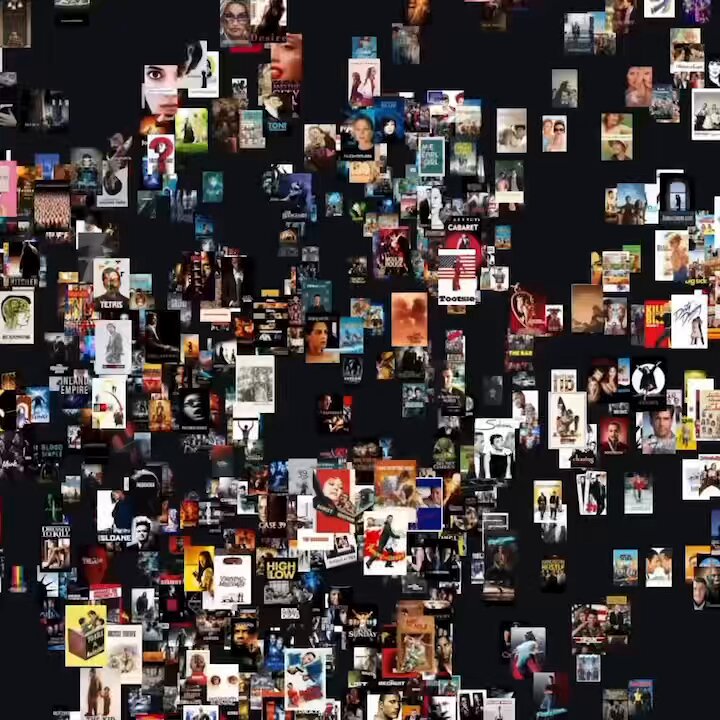
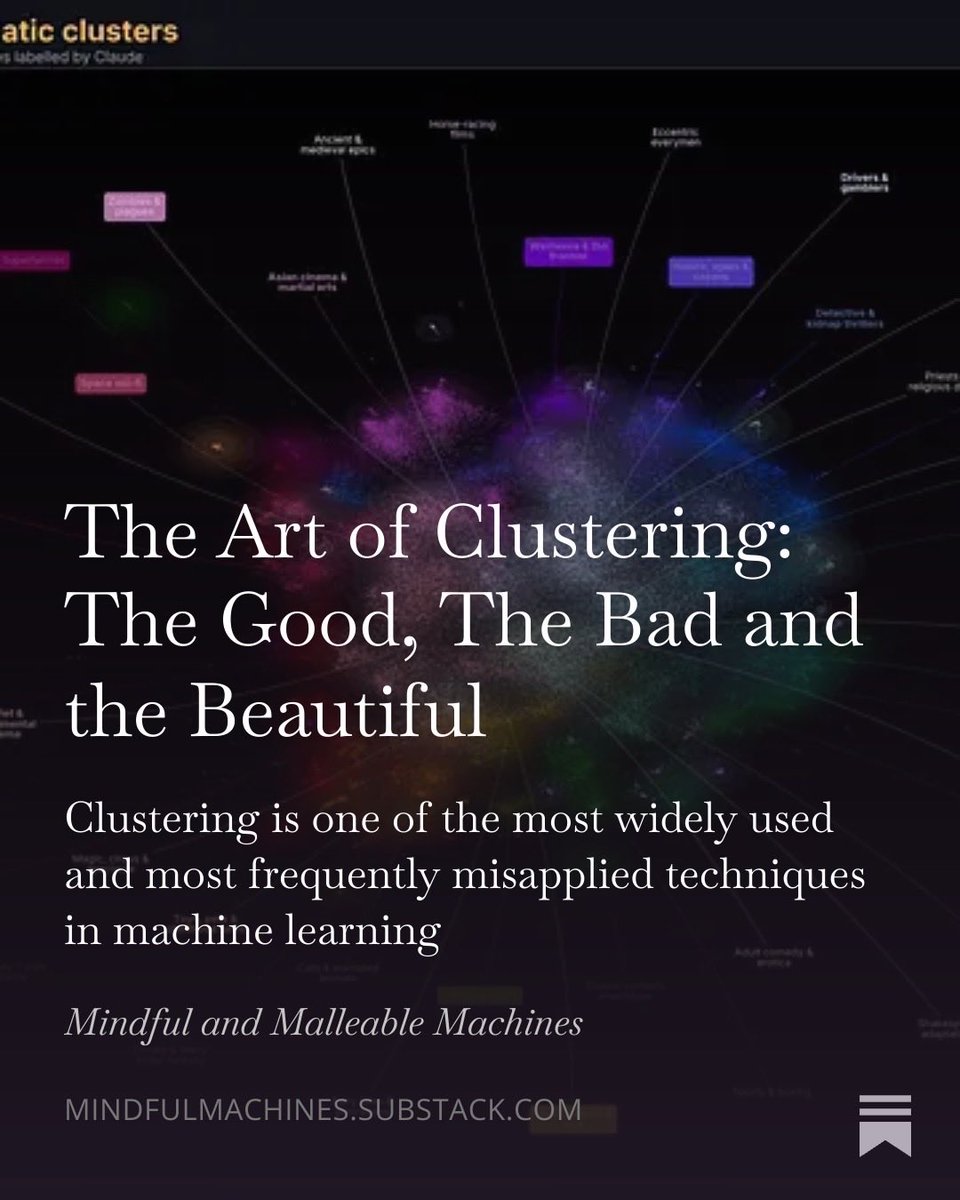

The Art of Clustering: The Good, The Bad and The Beautiful by Seth Levine youtu.be/LtZ3tjqCXzA?si=oFN7…
Why LLMs are not your one stop shop for figuring out what’s in the data #datascience #clustering
1
2
227
open.substack.com/pub/mindfu…
If you need to understand a large dataset, LLMs should not be your first stop #datapattern #MachineLearning #ai
1
4
13
867
open.substack.com/pub/mindfu… Some meetings may be hurting more than helping. Get out of meetings and into your product. 🙊Follow @lmoroney advice “Move Fast and Make Things” and be sure to listen to your customers more because according to @l2k entrepreneurs are not doing it enough
99
NLP nerd retweeted
EVoC is a library designed specifically for fast clustering of high dimensional embedding vectors. It can produce high quality clusters extremely efficiently, and requires little to no hyperparameter tuning.
Better clustering than UMAP HDBSCAN; faster clustering than KMeans.
8
43
213
25,794
NLP nerd retweeted

Mar 7
I accidentally discovered how to compress a semester of learning into 48 hours.
A grad student at MIT showed me his NotebookLM setup. I thought he was just organized. Then I watched him pass a qualifying exam on a subject he'd never studied before.
Here's exactly what he did:
First: he didn't upload a textbook.
He uploaded 6 textbooks, 15 research papers, and every lecture transcript he could find on the subject.
Then he asked NotebookLM one question:
"What are the 5 core mental models that every expert in this field shares?"
Not "summarize this." Not "explain this topic."
Mental models. The stuff that takes professors years to develop.
But the next part is what broke my brain.
He followed up with:
"Now show me the 3 places where experts in this field fundamentally disagree, and what each side's strongest argument is."
In 20 minutes he had a map of the entire intellectual landscape of the field:
the debates, the consensus, the open questions.
Most students spend a full semester just figuring out what those debates even are.
Then he did something I've never seen before.
He asked:
"Generate 10 questions that would expose whether someone deeply understands this subject versus someone who just memorized facts."
He spent the next 6 hours answering those questions using the source material. Every wrong answer triggered a follow-up:
"Explain why this is wrong and what I'm missing."
By hour 48, he could hold a conversation with his thesis advisor without getting destroyed.
The tool didn't change. The questions did.
Most people treat NotebookLM like a fancy highlighter.
These students are using it like a private tutor who has read everything ever written on the subject.
The difference between a semester and 48 hours isn't the amount of content.
It's knowing which questions to ask.

250
2,577
16,887
5,719,765
NLP nerd retweeted

31 Dec 2025
212
811
8,353
4,037,667
The Killer App That Made Apple II Successful #computing History Learning from Machine Learning youtu.be/cIZwctjy7Rc?si=2p4S… #Automation
66
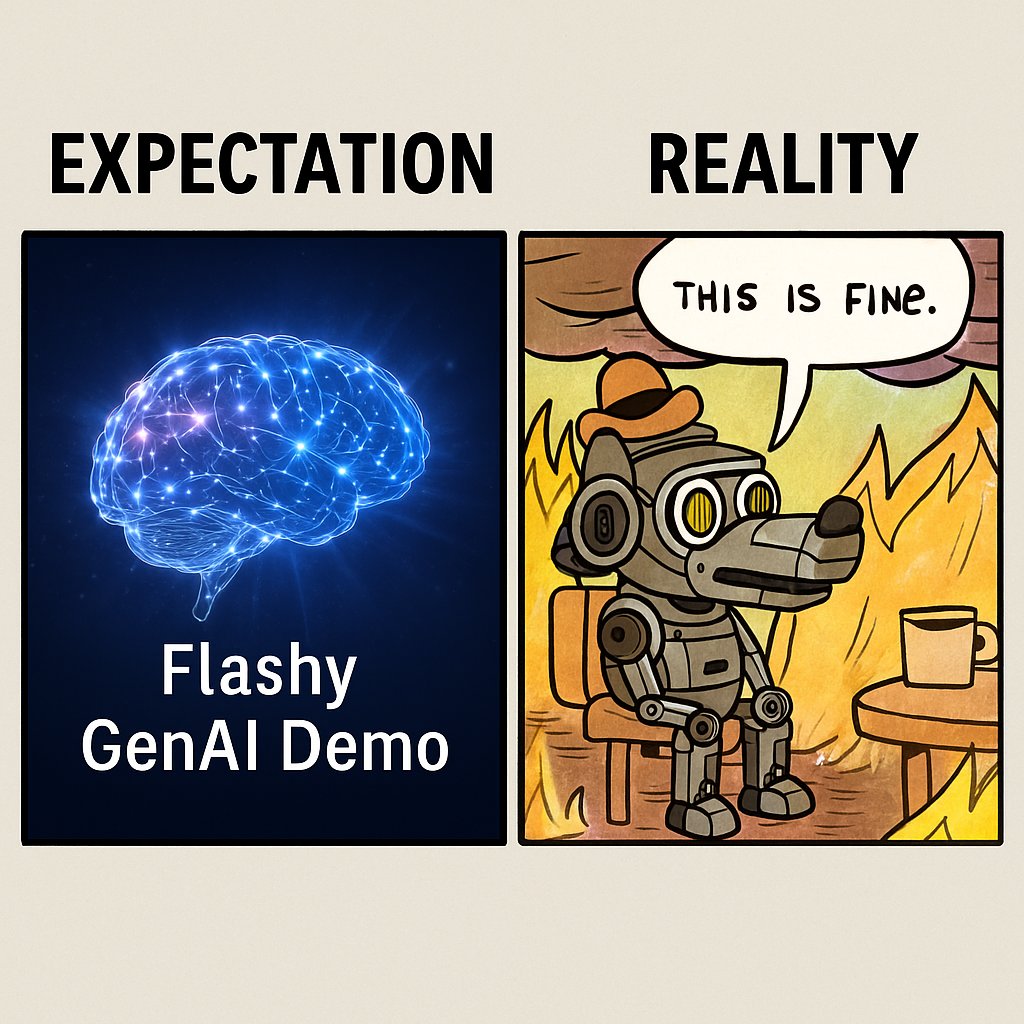
The Generative AI Divide: Why AI Demos Impress but AI Products Disappoint open.substack.com/pub/mindfu… #AI #LLMs #GenerativeAI
2
59
NLP nerd retweeted

24 Jun 2025
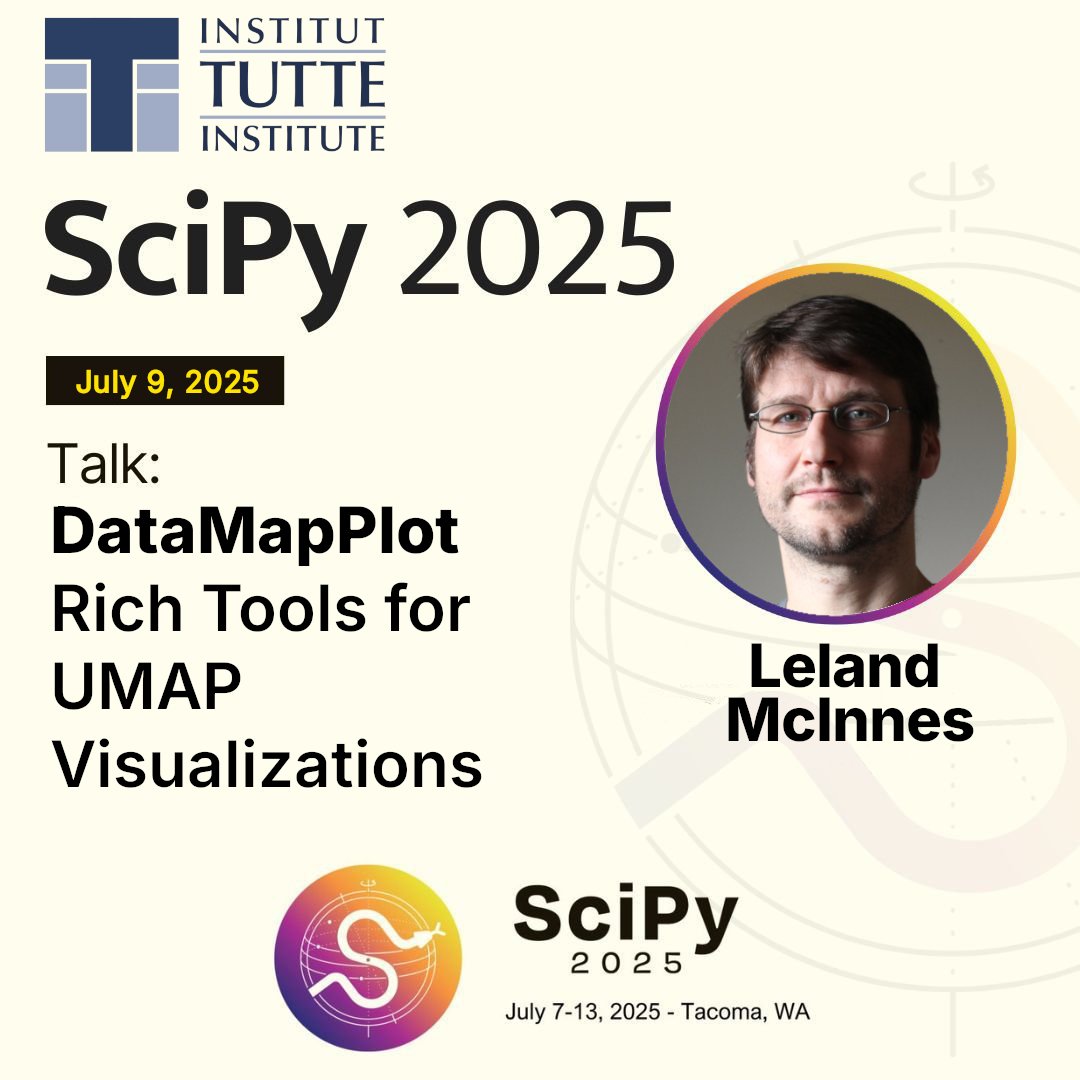
I'll be giving a talk about DataMapPlot at SciPy this year. Learn how to make the most of your data maps.
cfp.scipy.org/scipy2025/talk…
1
1
16
554
We've fallen into a linguistic trap saying AI models "understand" and "reason." This anthropomorphizing is dangerous—we overestimate their flexibility while missing their actual superpowers: processing vast information and spotting patterns humans can't.
bit.ly/43Tktws
138
Why I Never Skip Data Visualization (Even When Automating Everything) youtu.be/wHg08K67VQQ?si=luqj…

1
1
3
614
Thinking beyond Transformers | Learning from Machine Learning featuring @maximelabonne youtu.be/IOC2k5k8oto?si=ilQ0…
Key learnings:
-Transformers aren't the end game
-Data quality remains unsolved
-UI design shapes AI interaction
Real learning happens in production, not benchmarks
3
90
open.substack.com/pub/mindfu… We process physical reality, experience subjective consciousness, and actively shape cultural evolution. This interactive participation may be the key to understanding not just consciousness, but the future relationship between humans and AI
26
Listen to @amankhan on Learning from Machine Learning: Aman Khan: @arizeai, Evaluating AI, Designing for Non-Determinism youtu.be/v0eTTn7ZPEc?si=CcSX…
1
6
325
NLP nerd retweeted

25 Jan 2025
1
6
2,363
NLP nerd retweeted
18 Jan 2025
Sebastian Raschka has transformed how data scientists and ML engineers learn and build AI. Explore 13 key lessons he shared on mastering machine learning and responsibly advancing AI, in @NLP_nerd's latest article.
towardsdatascience.com/learn…
2
6
29
3,657
AI should not be limited by comparisons to human reasoning. Check out: Discourse on Darwin's Descent and the Diversity of Intelligence open.substack.com/pub/mindfu…
45
NLP nerd retweeted

3 Dec 2024
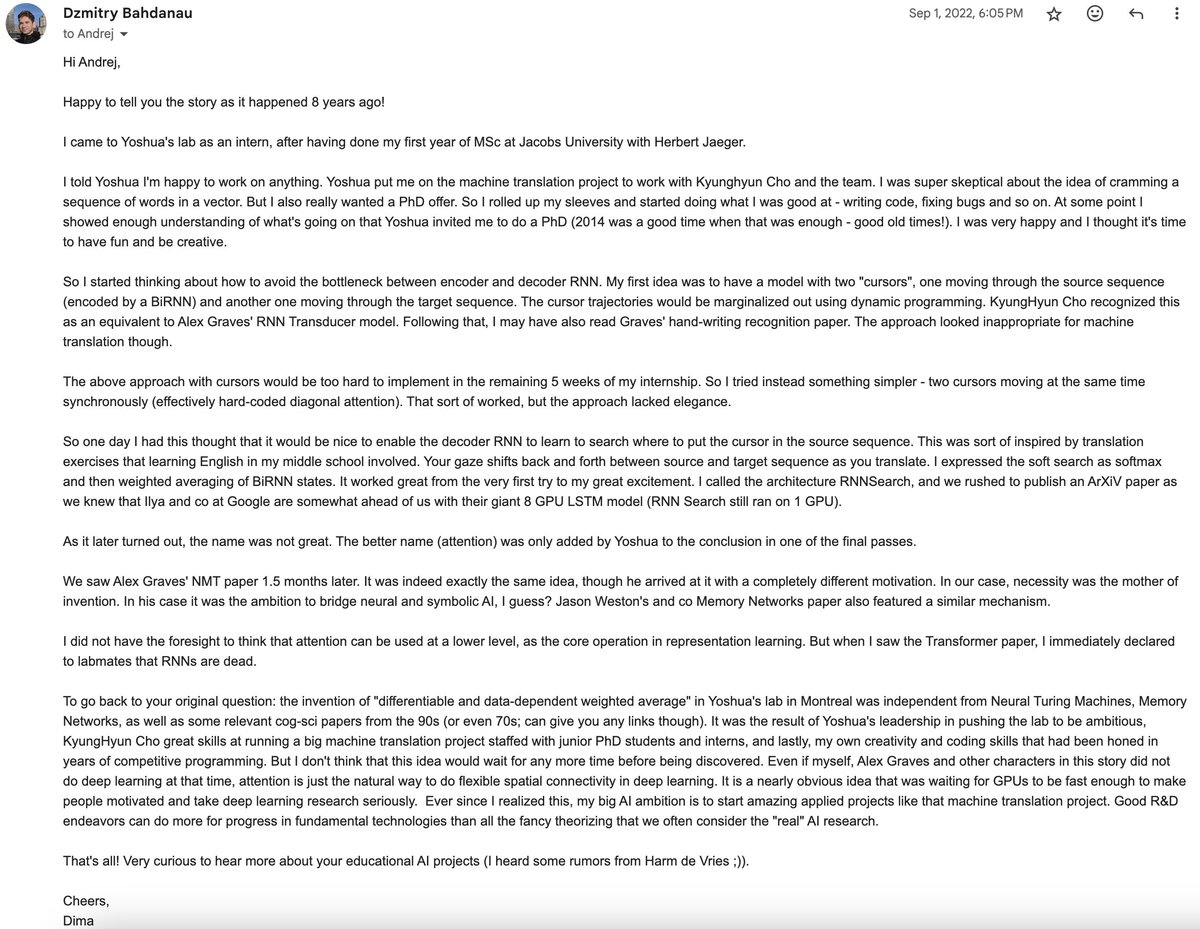
The (true) story of development and inspiration behind the "attention" operator, the one in "Attention is All you Need" that introduced the Transformer. From personal email correspondence with the author @DBahdanau ~2 years ago, published here and now (with permission) following some fake news about how it was developed that circulated here over the last few days.
Attention is a brilliant (data-dependent) weighted average operation. It is a form of global pooling, a reduction, communication. It is a way to aggregate relevant information from multiple nodes (tokens, image patches, or etc.). It is expressive, powerful, has plenty of parallelism, and is efficiently optimizable. Even the Multilayer Perceptron (MLP) can actually be almost re-written as Attention over data-indepedent weights (1st layer weights are the queries, 2nd layer weights are the values, the keys are just input, and softmax becomes elementwise, deleting the normalization). TLDR Attention is awesome and a *major* unlock in neural network architecture design.
It's always been a little surprising to me that the paper "Attention is All You Need" gets ~100X more err ... attention... than the paper that actually introduced Attention ~3 years earlier, by Dzmitry Bahdanau, Kyunghyun Cho, Yoshua Bengio: "Neural Machine Translation by Jointly Learning to Align and Translate". As the name suggests, the core contribution of the Attention is All You Need paper that introduced the Transformer neural net is deleting everything *except* Attention, and basically just stacking it in a ResNet with MLPs (which can also be seen as ~attention per the above). But I do think the Transformer paper stands on its own because it adds many additional amazing ideas bundled up all together at once - positional encodings, scaled attention, multi-headed attention, the isotropic simple design, etc. And the Transformer has imo stuck around basically in its 2017 form to this day ~7 years later, with relatively few and minor modifications, maybe with the exception better positional encoding schemes (RoPE and friends).
Anyway, pasting the full email below, which also hints at why this operation is called "attention" in the first place - it comes from attending to words of a source sentence while emitting the words of the translation in a sequential manner, and was introduced as a term late in the process by Yoshua Bengio in place of RNNSearch (thank god? :D). It's also interesting that the design was inspired by a human cognitive process/strategy, of attending back and forth over some data sequentially. Lastly the story is quite interesting from the perspective of nature of progress, with similar ideas and formulations "in the air", with a particular mentions to the work of Alex Graves (NMT) and Jason Weston (Memory Networks) around that time.
Thank you for the story @DBahdanau !
133
985
6,682
862,484
🎙️New episode of Learning from Machine Learning with @leland_mcinnes is out now! Dive into the mind behind UMAP & HDBSCAN libraries. From decomposing black boxes to building better tools, discover why understanding data geometry matters. youtu.be/6sSOr2Yaq80?si=BJ57…
3
10
1,082