
Cryptocurrency project researcher 💼 Your father and friend in crypto world 🌎
Joined June 2022
- Tweets 16,702
- Following 2,886
- Followers 2,951
- Likes 137,648
1,288 Photos and videos
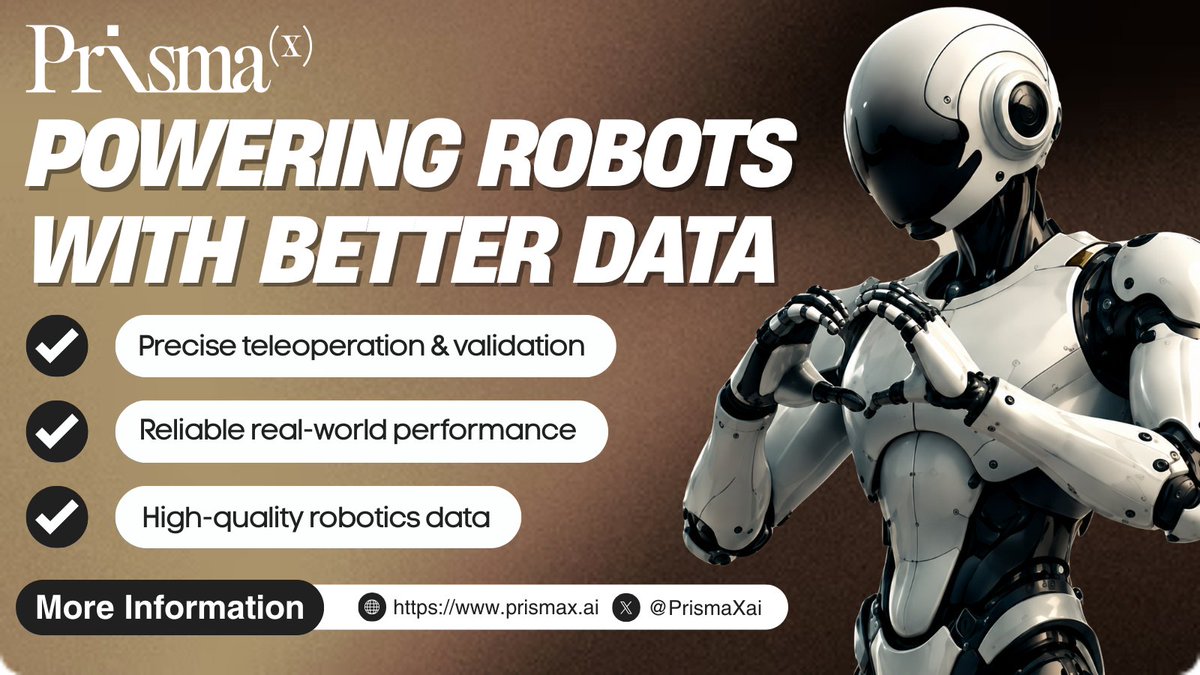





📢 Powering Robots with Better Data
The future of robotics depends not only on advanced AI models, but also on high-quality data.
Many robotics datasets are large, but often contain repetitive tasks, inconsistent sensor inputs, and low-quality demonstrations. Without reliable training data, even advanced models struggle to perform consistently.
Why Data Quality Matters
High-quality robotics data should include:
-> Real-world task demonstrations
-> Accurate motion and sensor data
-> Clear task completion
-> Consistent validation
Better data leads to better learning, stronger performance, and more reliable robots.
How PrismaX Approaches Robotics Data
@PrismaXai collects high-quality teleoperated robotics data and improves it through continuous human evaluation and verification.
By focusing on quality over quantity, PrismaX helps build the foundation for the next generation of Physical AI
As robotics advances, data quality will become a key competitive advantage. PrismaX helps define standards that will enable training for smarter, more efficient robots.
31
1
68
602

Jun 12
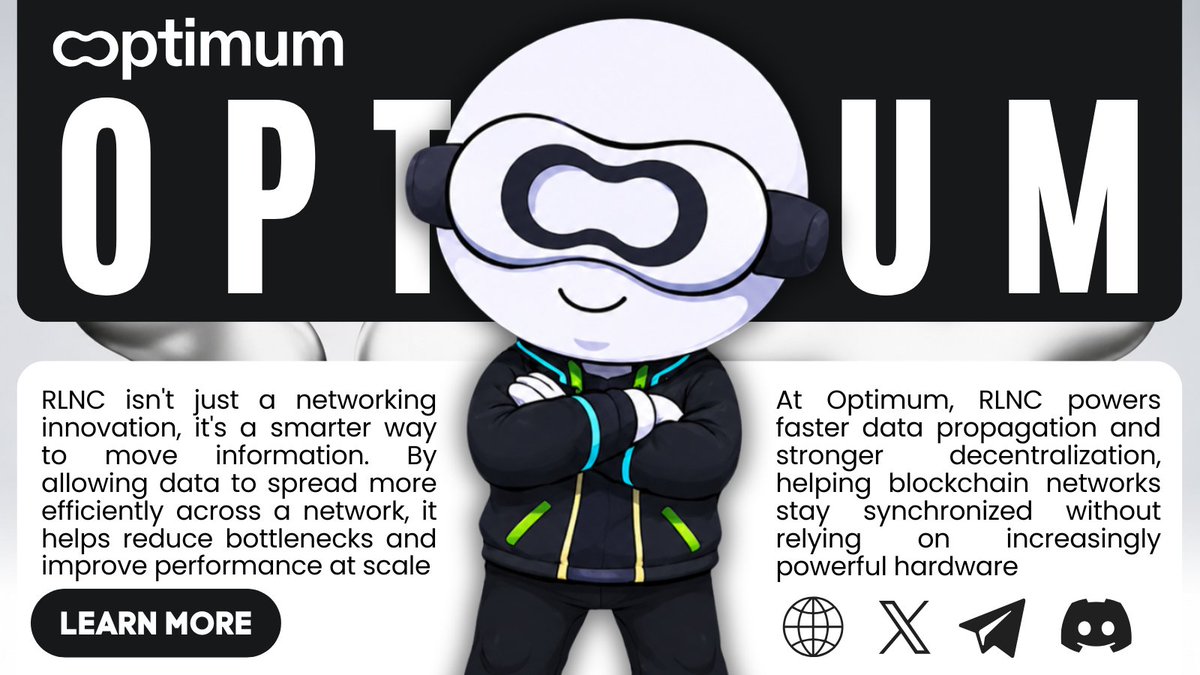
📢 RLNC Explained Without the Math
When I first came across Random Linear Network Coding (RLNC), it sounded more complex than it really is. The name feels academic, but the idea is actually pretty intuitive once you break it down.
A different way to move data
Instead of sending data in strict, separate pieces, RLNC lets it move in a more flexible, mixed form so it spreads faster across the network.
Why traditional systems struggle
In traditional systems, data is fragile: if one piece is delayed or lost, everything behind it slows down. That’s manageable in small setups, but in global decentralized networks it quickly becomes a bottleneck.
What RLNC changes
RLNC fixes this by encoding data so every transmission carries useful information. Nodes can still reconstruct what they need even if parts of the network are messy or unreliable.
Why it matters for blockchains
For blockchains, this changes the feel of the network itself. Validators stay in sync more easily, and performance improves without relying on stronger hardware.
How Optimum fits in
At @get_optimum this becomes real infrastructure, turning networking into an actively optimized layer rather than background plumbing.
And it starts to look like scaling Web3 isn’t only about computation or consensus, but about how efficiently information actually moves.
37
105
1,021
Jun 10
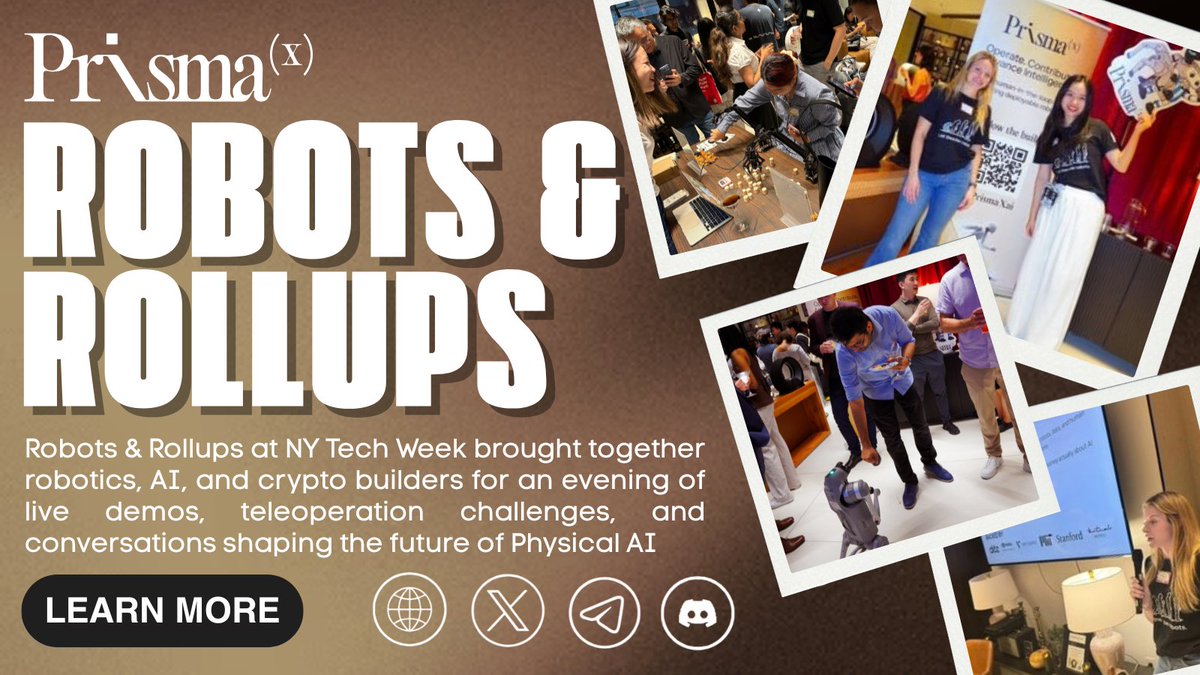
📢 Robots & Rollups at NY Tech Week
Last week, @PrismaXai brought together founders, researchers, investors, and builders from robotics, AI, and crypto at Robots & Rollups during NY Tech Week.
The event brought together a strong community of people working on the future of physical AI. From discussions on robotics and AI to conversations about decentralized infrastructure, the evening was full of ideas, new connections, and collaboration.
Highlights
-> Founders across robotics, AI, and Web3 sharing insights
-> Live teleoperation demos and robotics showcases
-> Interactive robot arm challenge
-> Robot dogs, AI cocktails, and active networking
-> Strong presence from New York’s Physical AI community
During the event, @shayebackus and @vivianrobotics introduced PrismaX and shared a vision of a future where human intelligence, robotic systems, and high-quality data work together to power the next generation of Physical AI.
Events like Robots & Rollups show that Physical AI is becoming a true intersection of robotics, artificial intelligence, and decentralized technologies.
35
85
799
Jun 9
📢 HOW WELL DO YOU ACTUALLY KNOW THE TECH?
Glad to see the @get_optimum community officially gaining momentum.
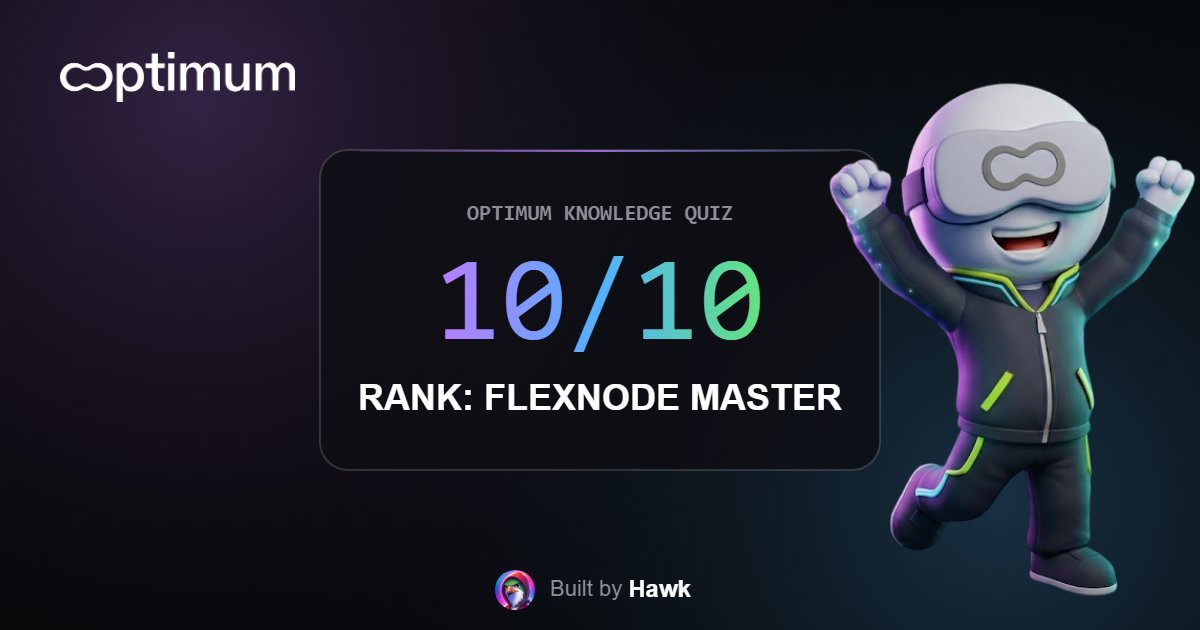
Tested my knowledge of the tech raising the ceiling for blockchain data movement and secured the highest rank Flexnode Master (10/10)
A case where deep-diving into docs and building content paid off perfectly. Massive thanks to @hawk_tyt for this amazing tech filter. Your turn to test your knowledge: alekshawk.github.io/optimum-…

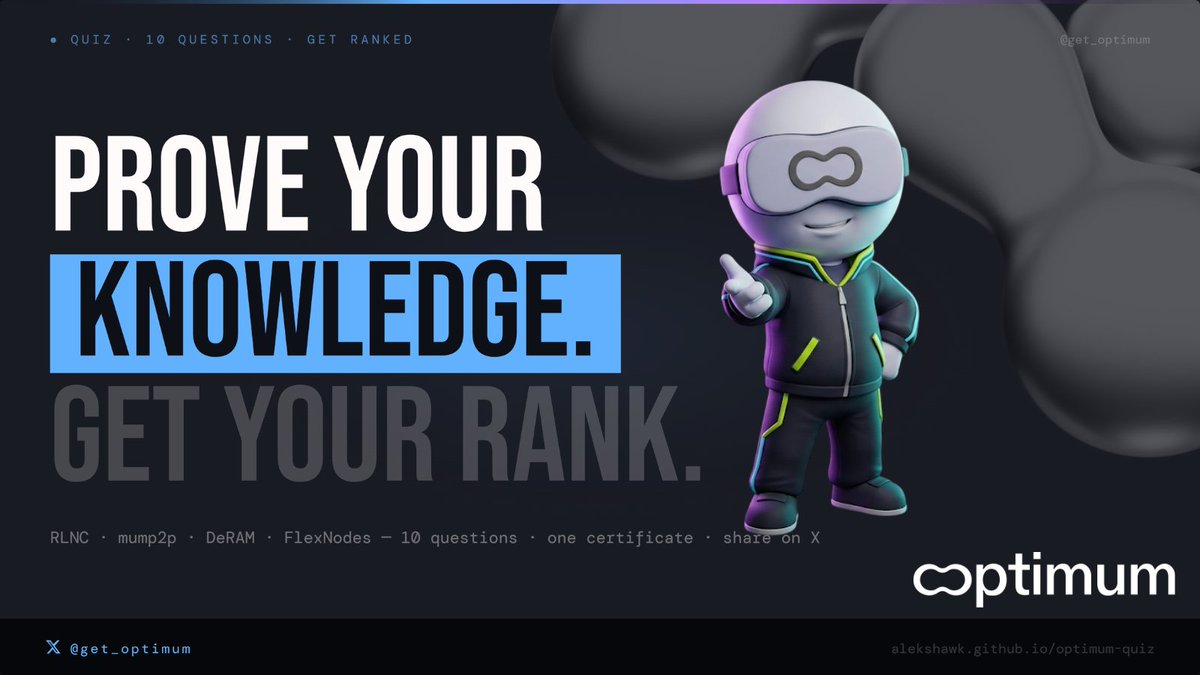
spent some time building something for the @get_optimum community.
a knowledge quiz. 10 questions - from basic to technical. covers rlnc, mump2p, deram, flexnodes.
you finish - you get a rank and a certificate. one click to share your result on x.
● alekshawk.github.io/optimum-… ●
think you know optimum better than me? prove it. @get_optimum
36
76
775
Jun 5
📢 The Feeling of Control: When You Can Move Reality From Anywhere
For most of history, interacting with the physical world required physical presence. Telepresence and teleoperation are changing that rule.
With platforms like @PrismaXai people can remotely control robots, turning actions from anywhere into real-world results. It’s not just convenience, it’s a new sense of control.
A robot becomes an extension of human capability, enabling interaction far beyond physical location
As robotics and AI evolve, influencing the physical world remotely may become a normal part of everyday life. PrismaX connects human intelligence, robotic actions, and the data behind future autonomy.
Key Takeaways
-> Teleoperation expands human capabilities beyond physical location.
-> Robots can act as remote extensions of human ability.
-> Human actions generate valuable data for advancing AI
45
87
660
Jun 3
📢 The Invisible Infrastructure Behind Every Transaction
Most people judge blockchain performance by TPS, block time, or consensus speed. But the real bottleneck often happens earlier, when data is still moving across the network.
The hidden layer nobody talks about
Before a transaction is validated, it has to reach validators. If propagation is slow or inefficient, even the best consensus system can’t perform well.
In practice, network communication becomes the invisible bottleneck that shapes the entire system.
Why it matters more in Web3 today
As Web3 moves toward real-time apps, gaming, and AI-driven systems, fast and reliable data delivery becomes critical.
It’s no longer just about execution, it’s about how quickly information spreads across nodes.
Where Optimum fits in
@get_optimum focuses on this often overlooked layer of infrastructure. By improving data propagation across decentralized networks, it helps reduce latency and unlock more scalable Web3 systems.
@blockchainjeff
51
114
879
Jun 2
📢 The Hidden Power of Quality Data
Robotics is often treated like a scale problem: more data, better AI. But in reality, not all data has the same value.
Quality Over Quantity
Different robots learn different things, some focus on movement, others on tasks and adaptation. That means the same dataset can be useful in one case and almost useless in another.
Teleoperation Signal
Teleoperation is one of the strongest ways to collect robotics data. Humans control robots while every action is recorded, creating clean and realistic training examples.
PrismaX Focus
@PrismaXai is focused on improving the quality side of robotics data,making datasets more structured and useful instead of just larger. The goal is simple: better data leads to better robots.
The Future of Physical AI
The next wave of robotics won’t be decided by who collects the most data.
It will be decided by who collects the right data, and knows how to turn it into intelligence that works in the real world.
44
89
1,177
May 30
📢 What If Blockchains Had Memory?
When people talk about blockchain infrastructure, the focus is usually on compute, consensus, and scalability. But there’s another piece of the puzzle that often gets overlooked: memory.
Why memory matters
Every transaction, block, and application depends on fast data transfer across the network. As Web3 grows, efficiently accessing and distributing information becomes as important as processing it.
The missing layer
This is where the idea of a dedicated memory layer becomes powerful. Instead of treating data availability and propagation as secondary concerns, networks can make them core infrastructure.
Faster access to data means:
-> Lower latency
-> Better node performance
-> Smoother user experience
Optimum approach
At @get_optimum the vision goes beyond simply accelerating data transfer. The goal is to improve how information is stored, distributed, and accessed across decentralized systems, helping create a more responsive and scalable Web3 ecosystem.
The future of blockchain may not just depend on faster computation, it may depend on smarter memory.
@blockchainjeff
44
99
821
May 29
📢 Work as a Stream
The internet has already changed entertainment. Now it is starting to change work itself.
Streaming is now normal for games, music, and content. The next step is much more radical: streaming not media, but real-world actions.
With TeleOps systems like @PrismaXai, people can remotely control physical robots, almost like a live stream of actions instead of video. Work starts to feel like Twitch for the physical world.
Every movement of the operator becomes training material for AI. The system observes how a human reacts, makes decisions, and corrects mistakes. Over time, the robot learns to reproduce these actions on its own.
This creates a strange but powerful model:
-> human works
-> system records
-> AI learns
-> automation grows
And all of it happens almost like a normal stream.
In this model, going to work simply means connecting to a system. No office, no commute, no physical presence.
You no longer travel to work, you access it remotely through a robot. The next shift won’t be another social network. It will be the moment physical work becomes as streamable as video or music today.
36
88
910
May 27
📢 Decentralization Doesn’t Have to Be Slow
People often assume that decentralization means higher latency and worse performance. We’re proving the opposite.
At @get_optimum mump2p powered by RLNC improves data propagation across globally distributed networks, making performance less dependent on geography or hardware.
Instead of fixed packet routing, RLNC enables:
-> Recoding at intermediate nodes
-> Early forwarding of data
-> Decoding from any combination of coded shards
This makes data spread more efficiently across large networks.
Unlike traditional systems, adding more nodes actually helps: each node contributes additional coded shards, increasing decoding speed and reducing effective latency across the network.
The result is simple, decentralization doesn’t slow networks down. With RLNC, it helps them scale and perform better.
@blockchainjeff
47
1
101
837
May 25
📢 Human Labor as a Data Asset
When we think of work, we usually think of time and effort. But in the age of physical AI, the real asset may not be the work itself, but the data created in the process.
That’s why the idea behind @PrismaXai feels so interesting.
Every movement through TeleOps is not just a completed task, it’s also a training signal for AI. Robots don’t learn from the internet the same way LLMs do. They need real-world physical experience: movements, mistakes, and human reactions.
A new model starts to appear: human labor, data, AI, autonomy
You control the robot, while the system simultaneously helps train the future of physical AI.
Soon, the value of work may be measured not only by time, but by how much useful data your actions create for machine intelligence.
50
97
1,902
May 23
📢 Breakdown of mump2p
Most blockchain latency doesn’t come from consensus, but from how data is transmitted across the network.
Today, most systems rely on a gossip model: a node receives data and forwards it to its peers. It works, but it creates redundancy, congestion, and delays as the network scales.
The Solution: mump2p
mump2p addresses this by enabling more efficient data transmission and recovery between nodes. The goal is faster information delivery with less loss and lower network overhead.
Why It Matters
-> faster transaction propagation
-> more stable block delivery
-> reduced network congestion
-> lower overall validator latency
@get_optimum is rethinking the blockchain communication layer, not by making incremental improvements, but by redesigning how data moves across the network.
Bottom line: scaling blockchains isn’t just about consensus, it’s also about smarter data networks.
@blockchainjeff
45
106
846
May 22
📢 The Value of Doing It Wrong
We’re used to thinking that experience is the main advantage. The better you perform a task, the more valuable you are. But in the world of physical AI, things start to work differently.
For training robots, it’s not only perfect actions that matter.
Sometimes the system benefits more from seeing:
▪️ mistakes
▪️ unconventional movements
▪️ slow reactions
Because this is how AI learns to understand the real world.
That’s why @PrismaXai looks especially interesting.
Every operator becomes part of a data flywheel:
-> a human controls a robot
-> the system collects data
-> models are trained
-> autonomy improves
And the paradox is that a beginner can be just as valuable as an expert. Experts show efficiency. Beginners show variability.
And for AI, diversity of behavior is sometimes more important than perfect execution.
41
98
1,977
May 19
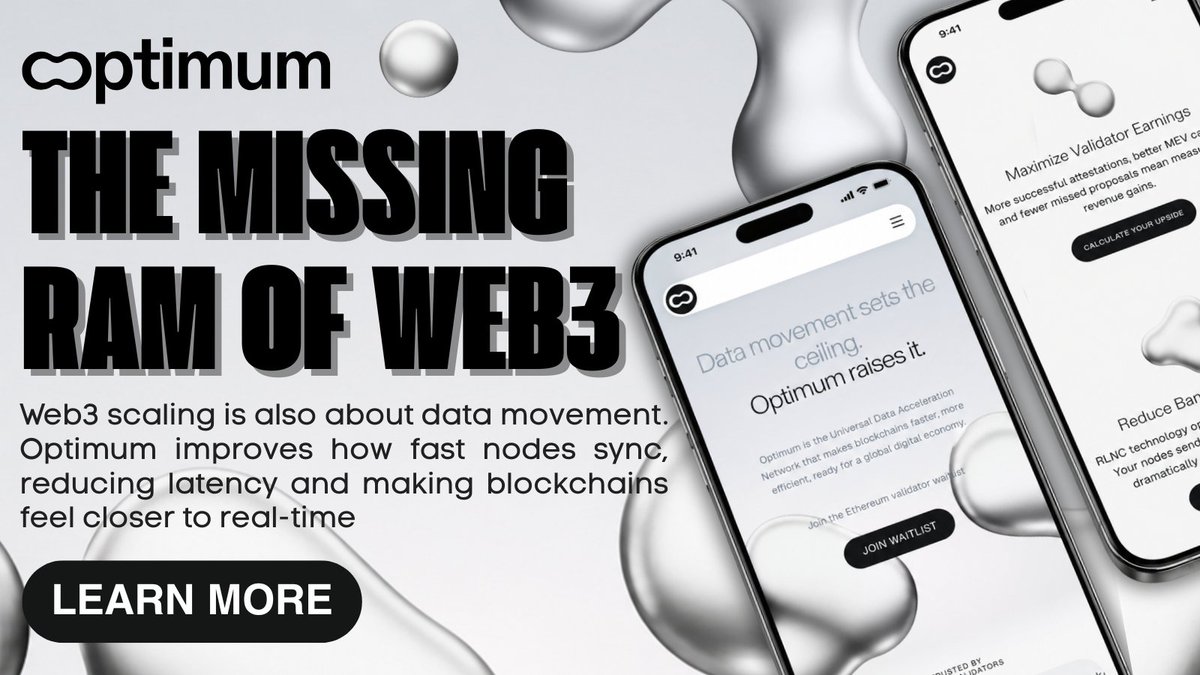
📢 The Missing RAM of Web3
When people talk about scaling blockchains, they usually focus on TPS, rollups, or execution speed. But in practice, the real bottleneck is often how fast data moves across the network.
Even if a blockchain processes transactions quickly, it still depends on how quickly all nodes stay synchronized. And this part is still inefficient.
Web3 is missing a memory layer
In computing, RAM makes everything feel instant. It keeps data close and quickly accessible.
Web3 doesn’t really have an equivalent. Most networks use distribution methods that duplicate and retransmit data between nodes, leading to delays and inefficiencies.
Where Optimum fits in
@get_optimum is working on improving this communication layer between nodes.
Using ideas like RLNC, data can be transmitted and reconstructed more efficiently, reducing redundancy and improving speed.
Why I think this matters
What interests me here isn’t just the tech, it’s the implication.
If data moves faster, everything else improves automatically:
-> validators stay more synchronized
-> finality feels faster
-> real-time apps become realistic
-> the network starts to feel less laggy overall
In the end, scaling isn’t only about compute, it’s about how fast the network can communicate.
@blockchainjeff
50
111
933
May 17
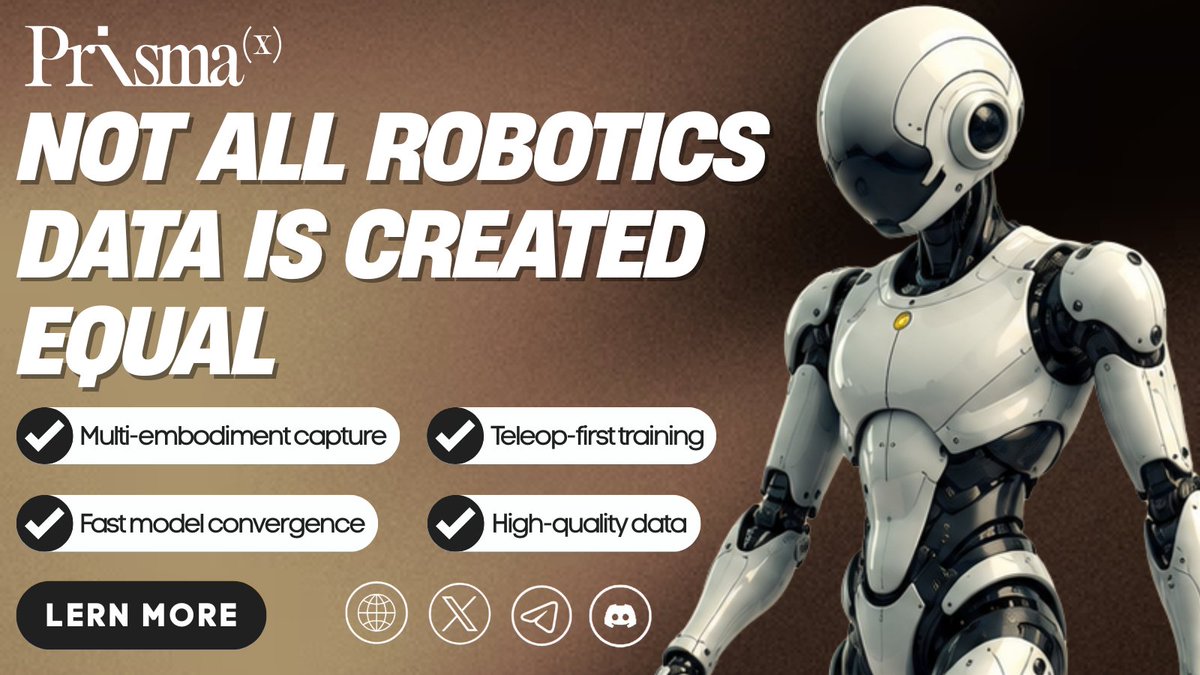
📢 Not All Robotics Data Is Created Equal
Everyone is selling robotics data right now, egocentric video, motion capture, synthetic data, teleop systems. They often look similar, but they’re not.
For me, the key idea is simple: data only matters in relation to what you’re training.
Two directions in robotics
In Physical AI, there are basically two tracks:
1⃣ Kinematics models
Low-level control like walking, balancing, and jumping. They rely heavily on modeling and do not require huge amounts of data, but do require very accurate motion data.
2⃣ Foundation models
My main focus. These are meant to generalize across tasks and environments using large-scale video action data, learning behavior rather than fixed motions.
Where data comes from
Today, most robotics data comes from:
-> Teleoperation: high quality, but slow and expensive
-> Human video: scalable, but not always aligned with robots
-> Gripper-based systems: a middle ground, still early at scale
What good data means
Good data is what actually improves learning and real-world performance:
▪️ clean demonstrations
▪️ correct task distribution
▪️ alignment with robot constraints
▪️ low noise and consistency
PrismaX approach
At @PrismaXai the focus is on foundation model data pipelines designed for real-world robotics.
Data isn’t just collected, it’s designed to help models converge faster, generalize better, and perform reliably in real environments.
48
110
1,036
May 16
📢 Why I’m Interested in Flexnodes
What particularly impressed me about @get_optimum was their completely different approach to blockchain scaling.
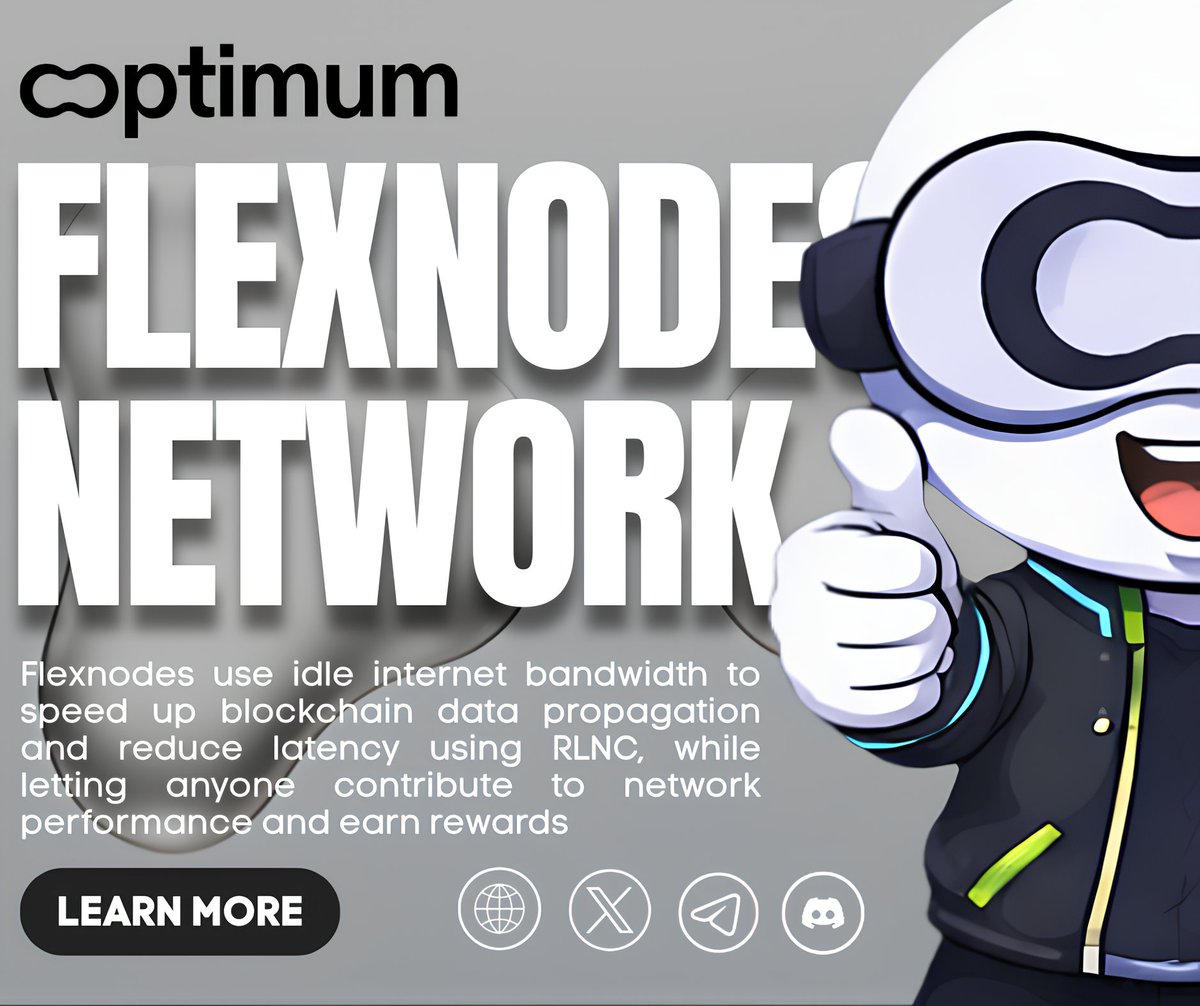
Instead of focusing solely on faster chains or large validators, they are creating Flexnodes, a global network where ordinary internet-connected devices can help speed up blockchain data exchange.
The core idea
At its simplest, it’s this: use unused internet bandwidth around the world to help validators receive blockchain data faster.
Flexnodes take block data, split it into encoded fragments using RLNC, and move those fragments through the network more efficiently than traditional propagation methods.
This can lead to:
-> Lower latency between validators
-> Faster block propagation
-> Better overall network performance
-> More scalable infrastructure
Why it feels interesting to me
What I find most interesting is that participation may eventually be available to almost anyone. PCs, laptops, phones, browser extensions, all could potentially become part of the network.
It feels like Optimum is trying to turn global internet connectivity itself into blockchain infrastructure.
@blockchainjeff
46
130
1,089
May 14
📢 PrismaX Regional Ambassador Program
I joined the @PrismaXai community in the summer of 2025 and was immediately interested in the project vision in the field of teleoperation and physical AI. Since then, I have been actively following PrismaX development, ecosystem updates, and community growth.
My Contribution to PrismaX
Since early 2026, I've become more actively involved in the project: during this time, I've created over 40 high-quality Twitter posts about PrismaX, helping to introduce the project to my audience and attract more attention to the ecosystem.
I'm also an active member of the PrismaX community on Discord and regularly participate in community discussions and events.
Personal Experience with Teleoperation
To better understand the technology, I purchased a teleoperation subscription and tested the platform myself. This helped me more clearly and effectively demonstrate the capabilities of PrismaX and physical AI to the audience.
Why I Want to Become a Regional Ambassador
I want to become a Regional Ambassador for the Ukrainian region because I am already organically involved in PrismaX and I want to make my contribution more structured and valuable for the local community.
My goal is to help more people in Ukraine discover PrismaX, explain complex ideas in a simple and accessible way, share my experience with the platform, and help build a strong and active local community around PrismaX.

May 12

Introducing the PrismaX Regional Ambassador Program.
A select cohort of regional leaders building local PrismaX communities in their language, region, and time zone.
Applications open today 👉 forms.gle/3Hfo8yEEKsGLeobn9

49
128
1,584
May 12
📢 Why the Data Problem in Robotics Is More Complex Than in AI
In traditional AI, everything is built around digital data, text, images, and videos. These are easy to collect, clean, and scale.
In robotics, things are completely different: data is not content, but real physical interaction with the world.
What makes it difficult
-> There is no universal real-world dataset
-> Data must be collected physically, not simply downloaded
-> Failures usually happen in unpredictable edge cases
-> Training cycles are slower because robots need real-world testing
How PrismaX Solves This
@PrismaXai is focused on solving exactly this problem by building infrastructure for collecting and utilizing real robotics data.
Through teleoperation and human-robot interaction, PrismaX:
▪️ turns human actions into training data
▪️ helps create high-quality datasets for Physical AI
▪️ accelerates robot learning in real-world environments
The biggest challenge in robotics isn't models, it's data. And PrismaX is building a layer that can make real-world robotics data scalable, accessible, and useful for the next generation of AI.
@vivianrobotics @shayebackus

44
1
112
987
May 10
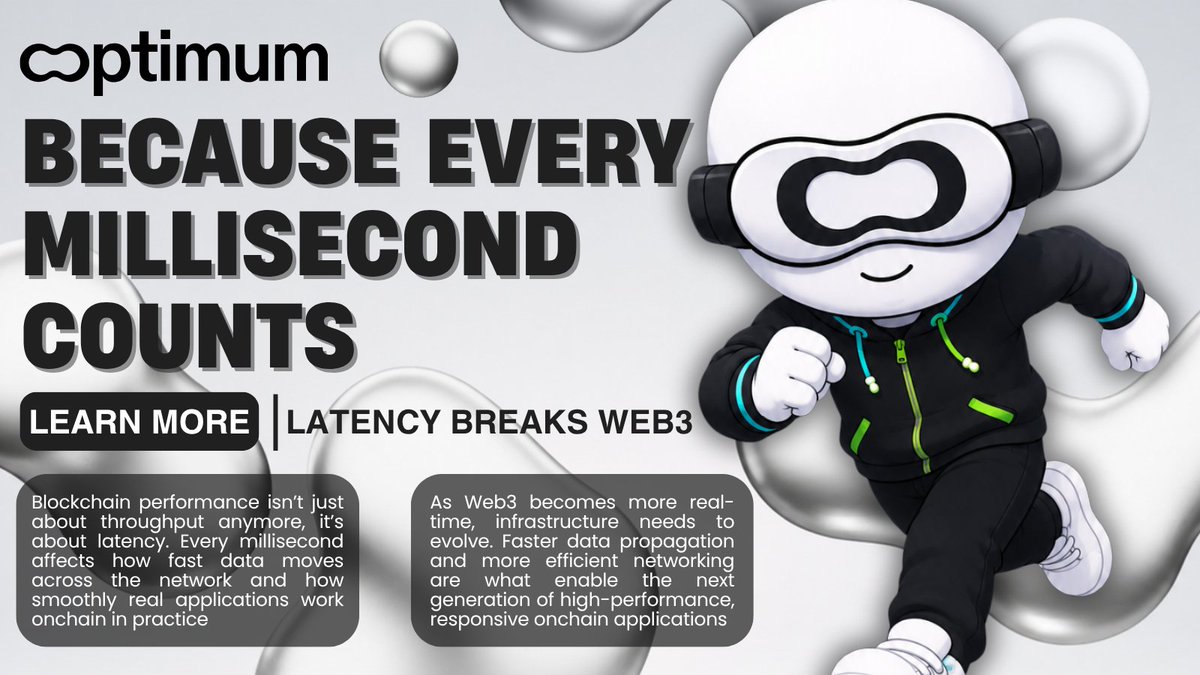
📢 Why Every Millisecond Matters Onchain
Blockchain performance is often measured in TPS, but the real constraint is latency, how fast data moves across the network.
Even tiny delays affect:
-> transaction propagation
-> validator sync
-> trading execution
-> user experience
As Web3 grows more complex, milliseconds start to matter at scale.
Why it matters
As Web3 applications become more complex, milliseconds become increasingly crucial. Real-time gaming, AI agents, DeFi, and global payments all rely on fast network communication.
Where Optimum fits
@get_optimum focuses on improving blockchain networking and data propagation using technologies like RLNC and decentralized memory infrastructure. The goal is simple: move information faster, not just compute it faster.
The next phase of Web3 won’t be defined only by throughput, but by latency. Because ultimately, every millisecond matters in the blockchain.
@blockchainjeff
48
102
939
May 9
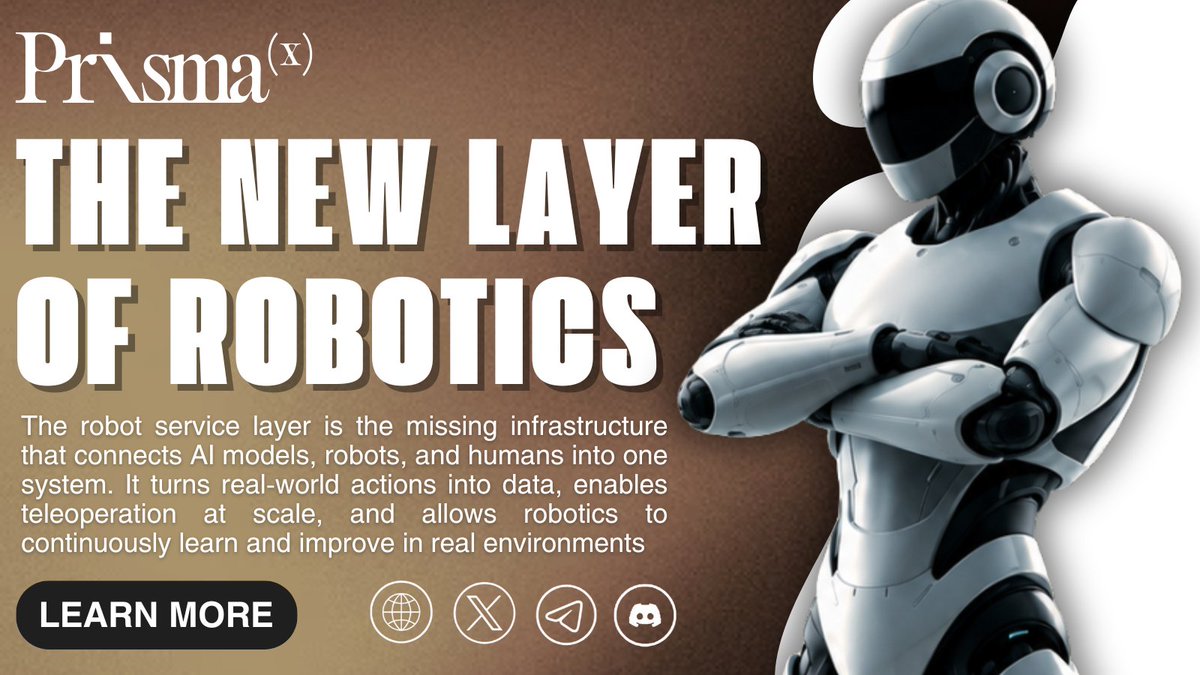
📢 In Simple Terms: What Is the Robot Service Layer
Robots are getting smarter, but they still struggle to operate in real-world conditions at scale. The missing link is a service layer for robots.
The simple idea
The service layer is an intermediate system that connects robots, AI models, people, and real-world tasks into a single operating network, essentially, an operating system for robotics.
What it includes
A robot service layer usually handles:
-> controlling robots (often via teleoperation)
-> collecting real-world data
-> sending feedback to AI models
-> coordinating tasks between humans and machines
-> making sure robots can be managed at scale
Why it matters
Without a service layer, scalability breaks down: data is fragmented, learning is slow, and human-robot interaction is limited. With it, actions become data, robots continuously improve, and systems can scale.
How PrismaX fits in
In the @PrismaXai approach, the service layer is the core infrastructure that connects everything together.
It helps:
▪️ turn human actions into training data for AI
▪️ enable teleoperation of robots at scale
▪️ create a continuous real-world feedback loop
▪️ connect operators, robots, and models into one system
The robot services layer is what transforms robotics from individual machines into an interconnected system.
This is the missing infrastructure layer that allows physical AI to truly scale, and companies like PrismaX are building just such a foundation.
40
97
938