
Joined September 2022
- Tweets 90,105
- Following 254
- Followers 54,287
- Likes 74,087
41,717 Photos and videos
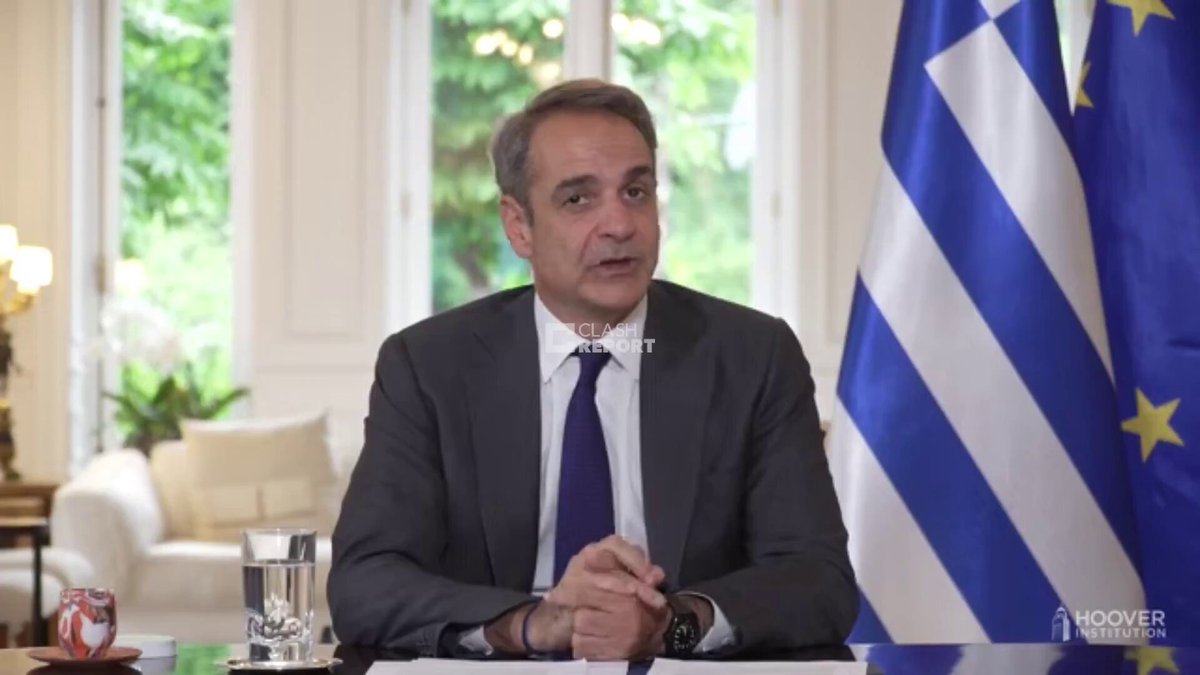
The Greek prime minister said Chinese production capacity could destroy Europe.
But the irony is obvious:
This only becomes a “global threat” when China does it.
The United States once accounted for around 50% of global manufacturing during World War II.
After World War I, its share was already around 38%.
Both were far higher than China’s share today.
Back then, nobody called it “overcapacity.”
Nobody said America was destroying the world.
Nobody demanded Washington shrink itself for the comfort of weaker competitors.
It was called leadership.
It was called productivity.
It was called the reward of industrial power.
But when China reaches 30% through factories, infrastructure, supply chains, engineers, workers, ports, grids, and industrial discipline, suddenly Europe discovers the word “danger.”
Please.
China did not destroy European industry.
Europe hollowed itself out.
Europe outsourced production.
Europe worshipped finance, regulation, luxury branding, and green slogans while letting its industrial base decay.
Then China kept building.
Now the countries that gave up manufacturing are angry at the country that did not.
In the end, this is what happens when Western undercapacity meets Chinese competence.
They call it “Chinese overcapacity.”
23
78
317
9,899
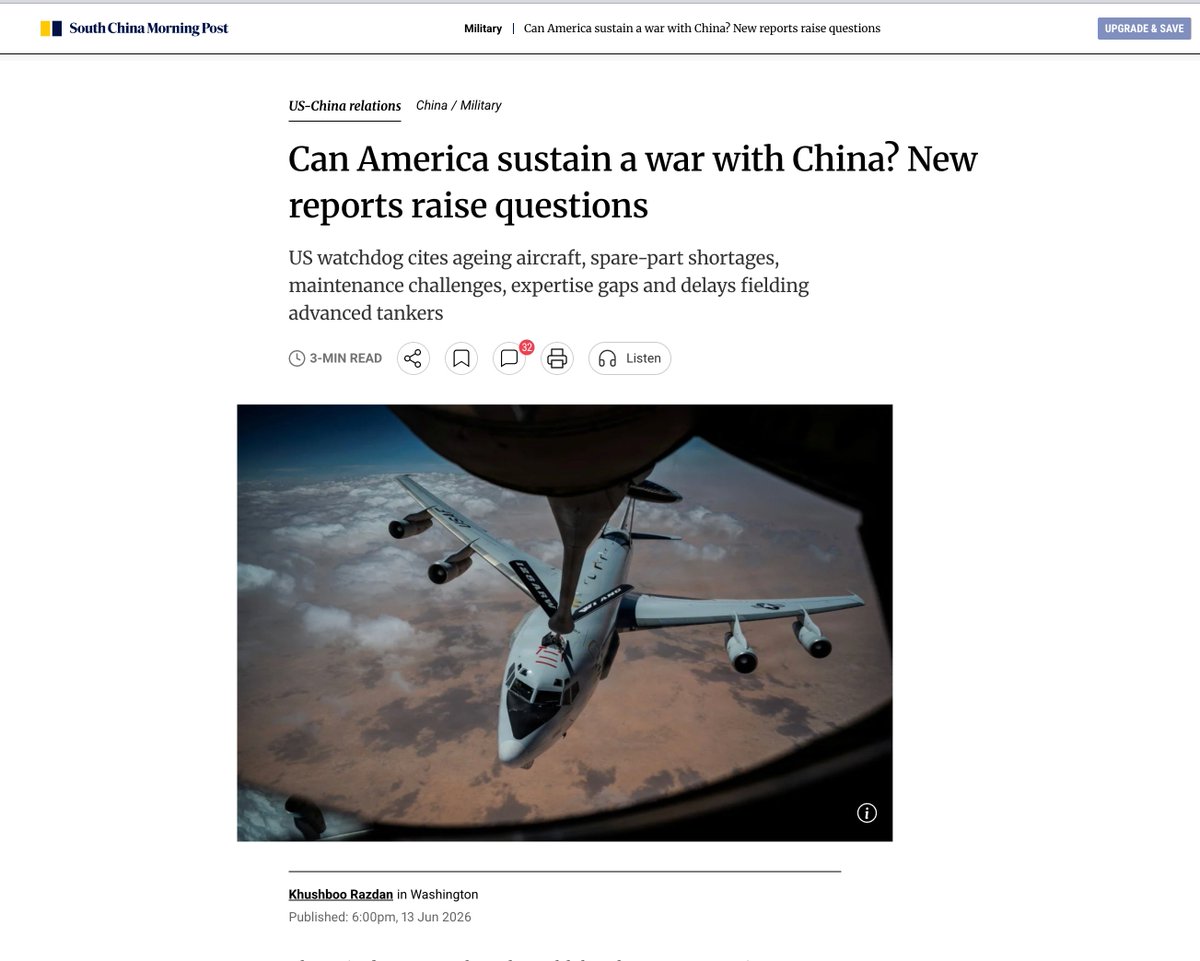
The funniest part about American war hawks is that they are always the loudest people yelling about war with China, while quietly asking the same question behind closed doors:
Can we actually sustain it?
The U.S. can project power across the world.
But projection is not endurance.
A war across the Pacific is not a movie trailer.
It is fuel, tankers, spare parts, maintenance, shipyards, logistics, industrial capacity, replacement rates, repair cycles, satellite resilience, and political stamina.
And suddenly the empire discovers that slogans do not refuel aircraft.
The same people who talk about fighting China as if it were another bombing campaign against a weak country are now staring at ageing tankers, spare-part shortages, maintenance gaps, delayed systems, fragile space infrastructure, and asking whether the bridge across the Pacific can even hold.
That is the real fear.
China does not need to cross the Pacific to fight America.
America has to cross the Pacific to fight China.
That distance is not a detail.
It is the battlefield.
For decades, Washington confused global reach with infinite strength.
Now it is learning that power projection is expensive, fragile, and very different from industrial depth.
The war hawks still want the performance.
The system is quietly asking whether the empire can survive the logistics.
3
16
67
1,495
Translation:
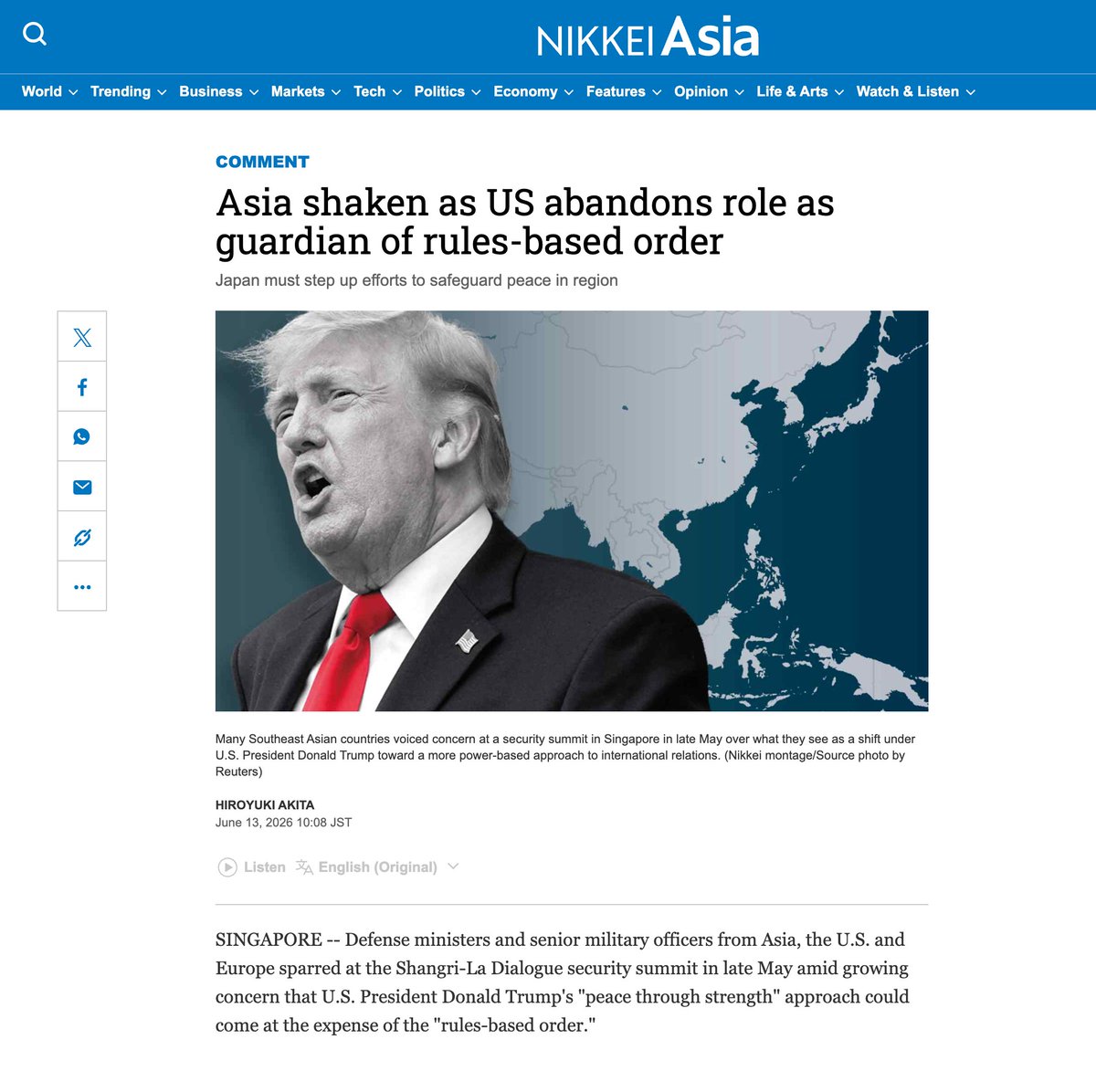
America is tired of being Asia’s landlord.
Japan is panicking because the master may loosen the leash.
So now Tokyo wants to “step up” and pretend its return to militarism is “safeguarding peace.”
But Asia already remembers what happened the last time fascist Japan claimed it was bringing order.
The problem for Japan is simple:
The U.S. may be unreliable.
But China is here.
And China is no longer the China Japan once invaded, burned, occupied, and humiliated.
So yes, Japan can dream about replacing America as the “guardian” of Asia.
But dreams are cheap.
History has receipts.
And China has power.
6
16
80
1,785
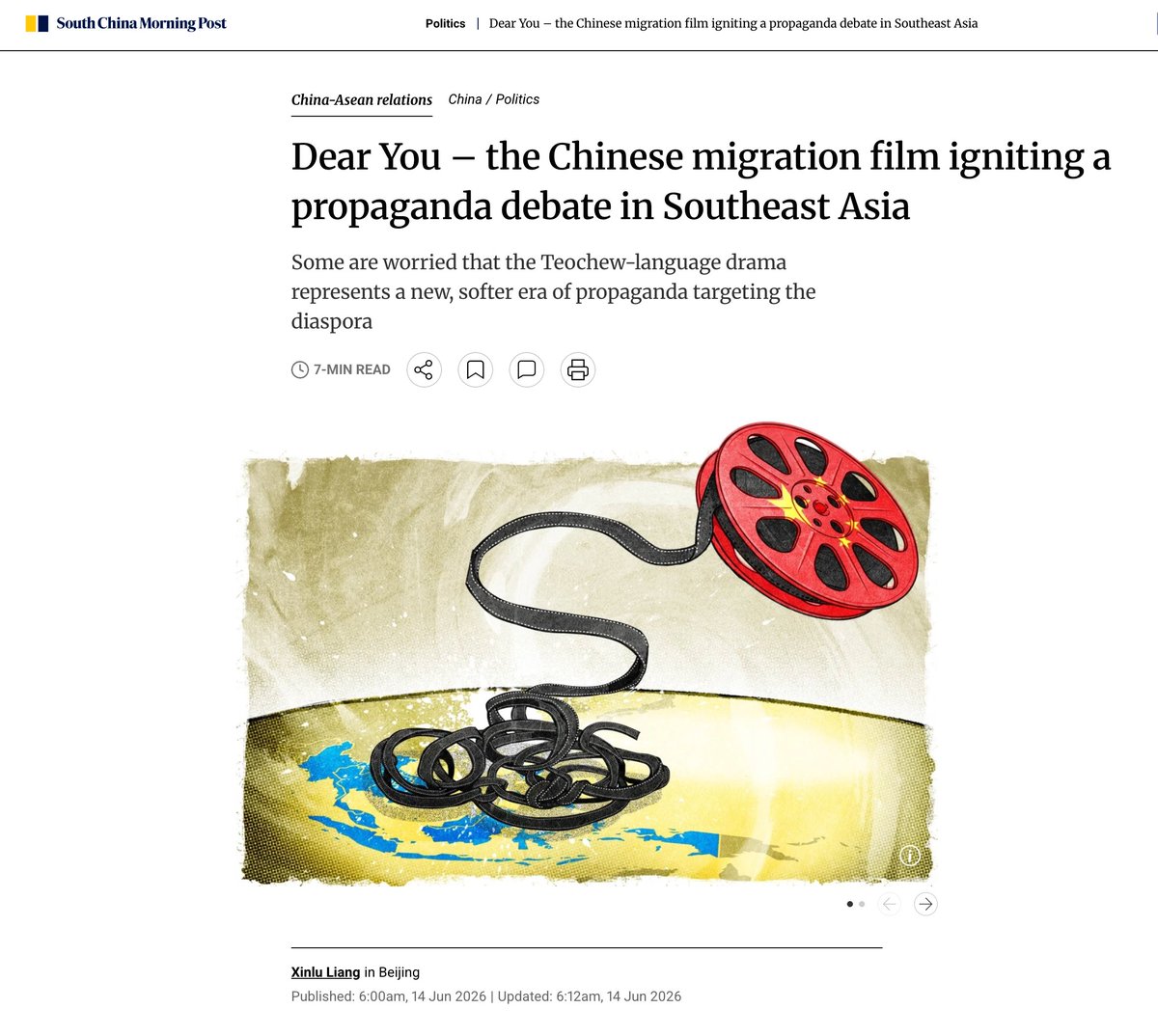
SCMP wrote tens of thousands of words about *Dear You*, but the real question is very simple:
The film is not about Singapore.
So why is Singapore so nervous?
A Teochew-language film about migration, family letters, ancestral memory, and preserving one’s mother tongue somehow becomes “soft propaganda” the moment overseas Chinese feel moved by it.
Please. If one Chinese film about roots is “united front work,” then what exactly has Hollywood been doing for the last century?
Every year, America exports dozens of films telling the world that U.S. soldiers save humanity, U.S. values are universal, U.S. power is moral, and everyone should either admire America or be rescued by it.
That is called entertainment.
But when a Chinese film reminds diaspora Chinese that their grandparents had a language, a hometown, a memory, and a broken migration history, suddenly it becomes geopolitical infiltration.
The paranoia is revealing.
Thailand’s Chinese community can watch it as family memory.
Malaysian Chinese can watch it as heritage and emotion.
But Singapore panics first, because Singapore’s identity anxiety is not created by Beijing.
It is created by decades of political performance:
use Chinese identity when it is useful,
cut it off when Western approval is needed,
profit from China when convenient,
distance from China when Washington is watching,
then panic when ordinary Chinese culture makes people feel something again.
So this has never been a matter of so-called "united front work," but rather a projection of Singapore's identity crisis stemming from its self-colonization.
A country confident in itself would not be terrified by a film about letters, dialect, migration, and memory.
A country that has spent too long managing its Chinese-ness like a political liability would.
6
13
103
2,627

10h
If China acted like the United States, that ship would not be sprayed with water.
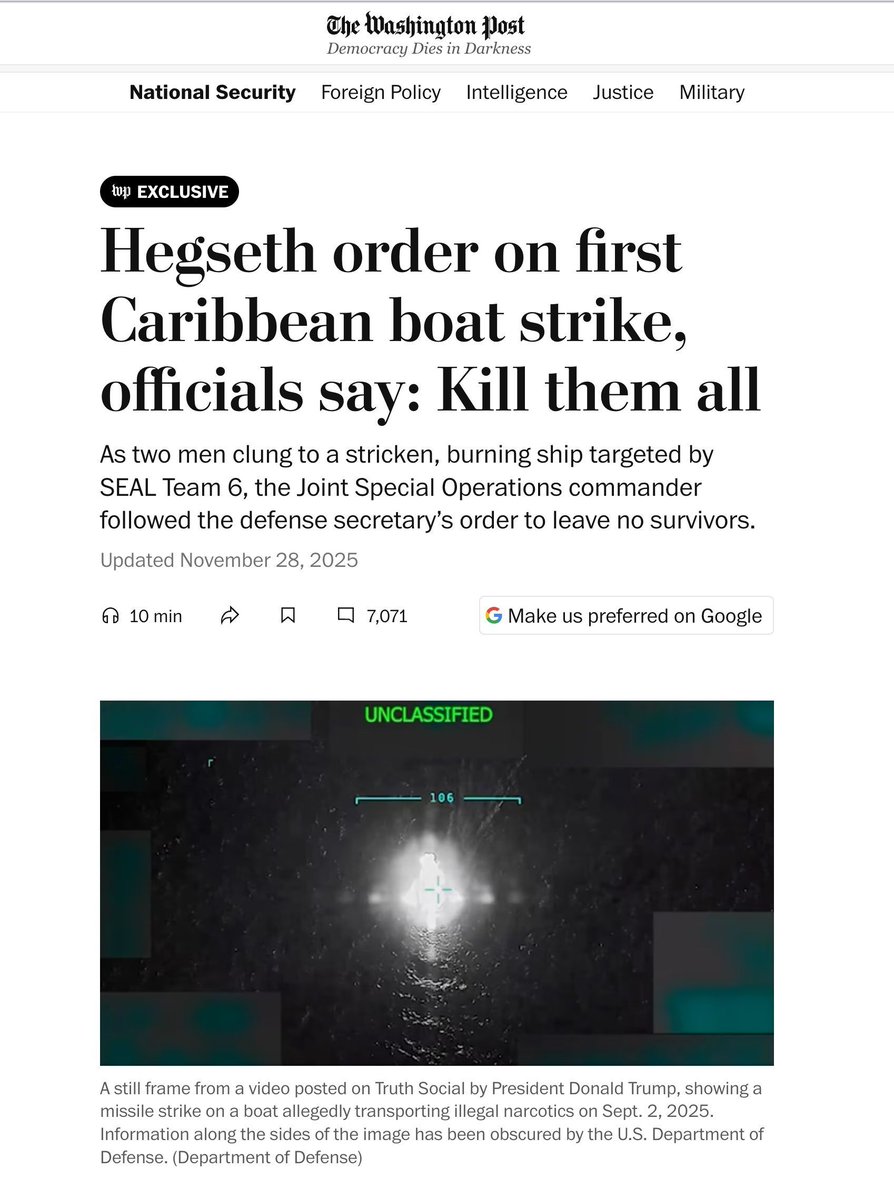
It would be blown apart by “democracy” missiles, followed by a “no survivors” briefing.
China used water cannons.
Your masters would have used a kill order.

Two China Coast Guard Ships attacking a Filipino Coast Guard vessel inside Philippines's waters!
China calls this "Law Enforcement Activity"
But when, Philippines & Japan sign defense treaties, China blames them for destroying peace & destabilizing the region!
4
18
98
1,995
𝘊𝘰𝘳𝘳𝘪𝘯𝘦 retweeted

One Country’s Trash Strategy Is Becoming the World’s Power Source 🌍♻️⚡
China is sharing its advanced waste sorting & waste-to-energy technologies w. 40 countries incl. Vietnam, Indonesia, Thailand, the Philippines, Uzbekistan, Poland, Germany, Mauritius, & Ethiopia thru BRI partnerships, equipment exports, & turnkey projects.
While AI-powered sorting is new domestically, the underlying systems build on decades of expertise that China now exports.
#WasteToEnergy #CircularEconomy #CleanTech
18h

The most brutal part is not that China is using AI to sort garbage.
It is that China has pushed waste management so far that the old problem has reversed.
China used to worry about having too much garbage to process.
Now some waste-to-energy plants are facing the opposite problem:
not enough garbage.
Previously sealed landfills may even have to be reopened, not because China failed, but because waste has become fuel, feedstock, data, and part of an industrial recycling loop.
This is what China does best.
It takes the ugliest, dirtiest, most ignored corner of urban life — garbage — and turns it into engineering, automation, energy recovery, environmental governance, and industrial optimization.
Even trash gets absorbed into the machine.
In many countries, garbage is where governance collapses.
In China, even garbage becomes a system.
5
16
859
11h
Translation:
I thought provoking China would have no consequences, but the consequences have come. I cried.
Jun 12

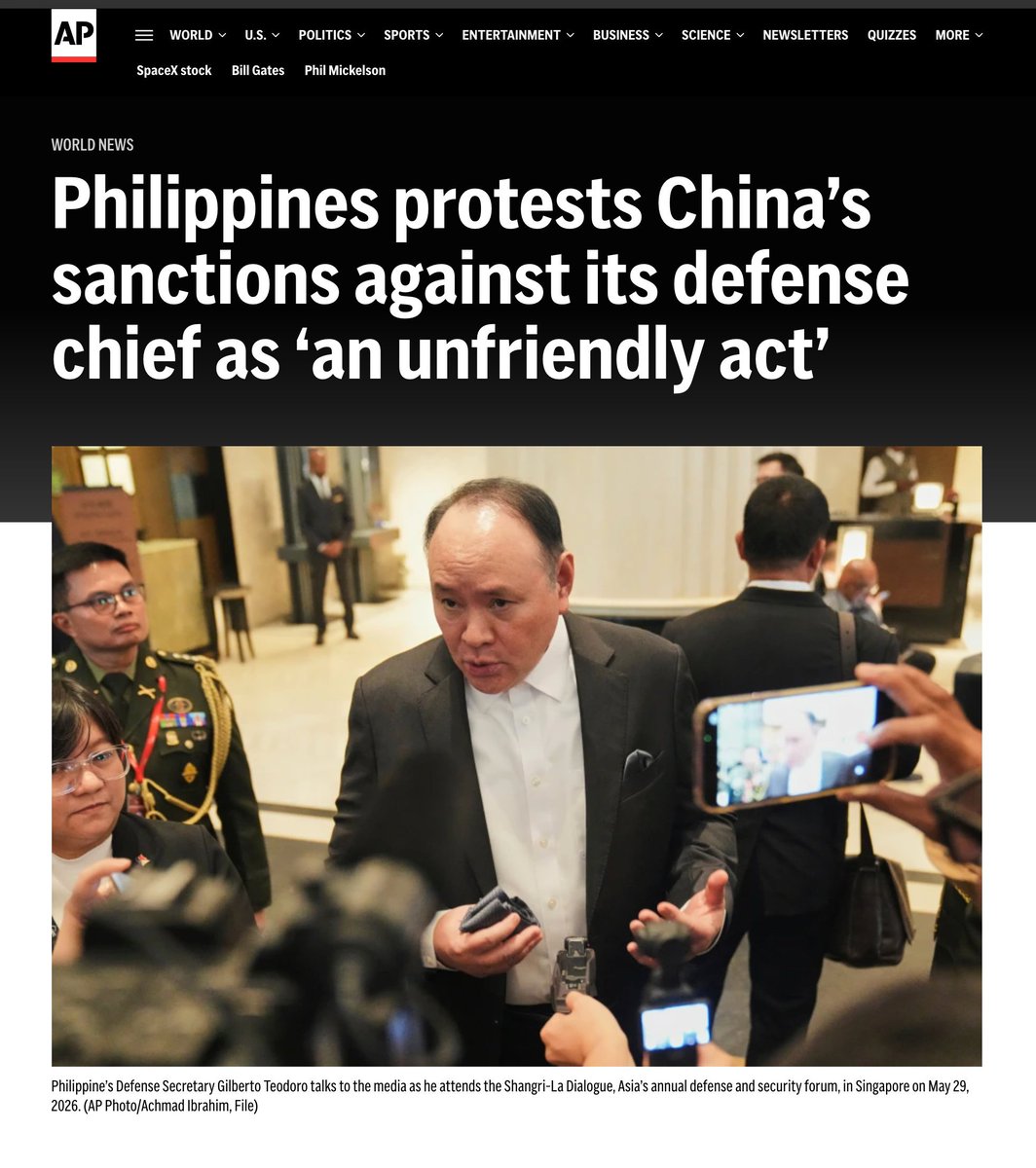
This is not getting the attention it deserves. As far as I know, this is the first time China has imposed sanctions on a sitting minister of another country, rather than former officials or current lawmakers as it has done previously. That suggests Beijing is willing to escalate far beyond its earlier, largely symbolic sanctions playbook. In other words, the sanctions game may now be entering an entirely different phase — one where China is prepared to target incumbent members of foreign governments directly, raising the stakes significantly in diplomatic and geopolitical confrontation.
1
12
169
12,949
11h
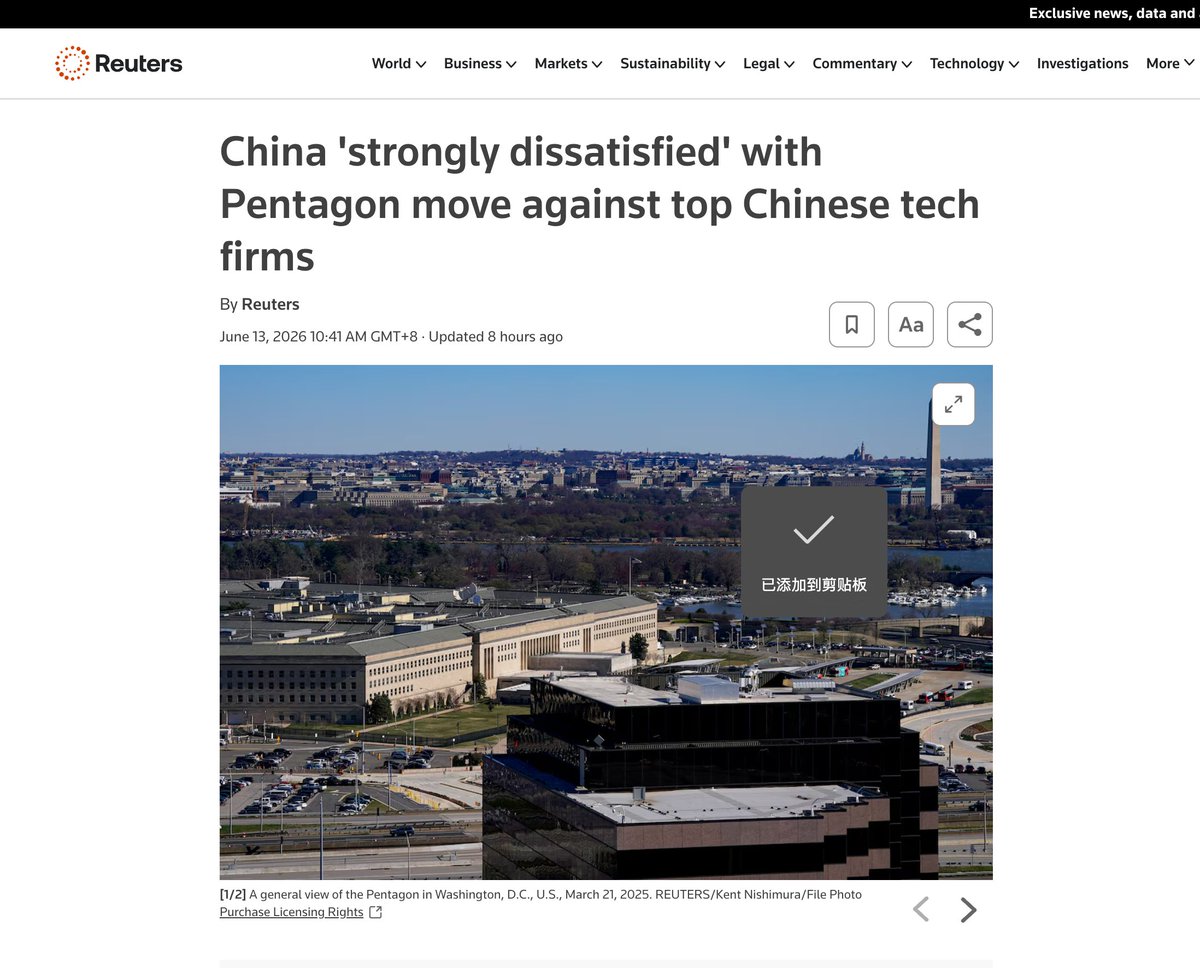
Every time America starts losing the race, it reaches for the same old toy:
“national security.”
BYD is too competitive?
Military-linked.
Alibaba is too big?
Military-linked.
Baidu, NIO, solar firms, robotics, biotech, chips — once China catches up, Washington suddenly discovers a “security threat.”
America keeps acting as if China is Cuba, Iran, or North Korea — a country it can choke, isolate, sanction, and humiliate without consequence.
China is not that country.
Even Russia survived the full weight of Western sanctions.
What exactly makes Washington think China, the world’s largest industrial power, will just sit there and take it?
The U.S. abused sanctions for decades because it got used to hitting countries that could not hit back.
Now it is facing a civilization-state with supply chains, markets, manufacturing depth, technology capacity, and retaliation tools of its own.
China has already said it will respond if its companies are not treated fairly.
And when China says it will respond, it usually means it is already preparing the bill.
America can blacklist Chinese companies.
China can make the cost of that blacklist real.
7
70
214
4,186
12h
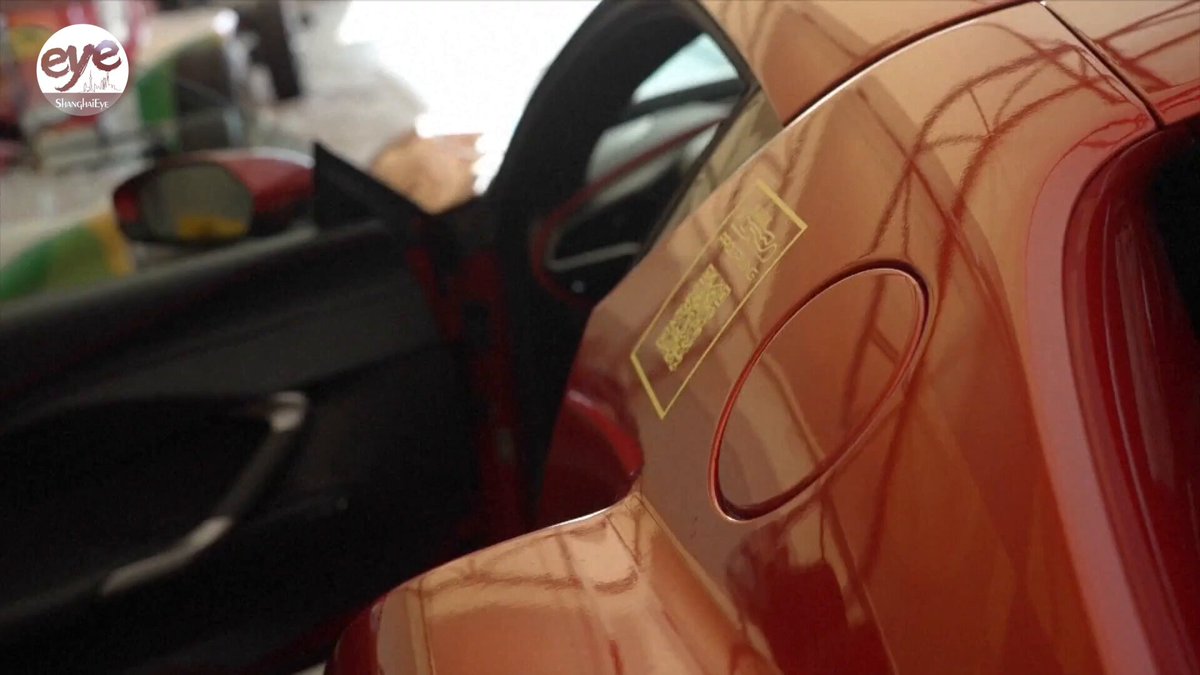
Chinese EVs gaining traction in Serbia
The EU has consistently accused China of having excess EVS production capacity.
But when people have multiple choices and still choose Chinese EVs, that is not “dumping,” that is value winning.
Consumers do not buy ideology,they buy price, performance, design, reliability, range, technology, and after-sales service.
During the gasoline era, nobody was rushing to buy Chinese cars, China did not cry about “unfair competition.”
China learned, invested, upgraded, and waited for the next battlefield.
Then Europe hesitated, Japan clung to the old engine, Legacy automakers protected yesterday’s profits.
China took the EV transition seriously and pushed it to scale: batteries, supply chains, charging ecosystems, software, manufacturing efficiency, model variety, and price discipline.
China did not steal a market Europe wanted, it mastered the market Europe was too arrogant to take seriously.
Now Chinese EVs are competitive abroad, and suddenly the same people who spent decades preaching “free markets” have discovered a new word: “Overcapacity.”
Please.
It was not overcapacity when Western cars flooded China, it was globalization.
It was not overcapacity when Europe sold luxury brands into every emerging market, it was consumer choice.
But when China builds better, cheaper, faster, and at scale, it becomes a “threat.”
So the real problem is not Chinese dumping, but it is that China stopped playing the role assigned to it.
It stopped being the workshop at the bottom of the chain, it started building the future.
And the old car empires cannot forgive that.
2
32
153
4,188
𝘊𝘰𝘳𝘳𝘪𝘯𝘦 retweeted
15h
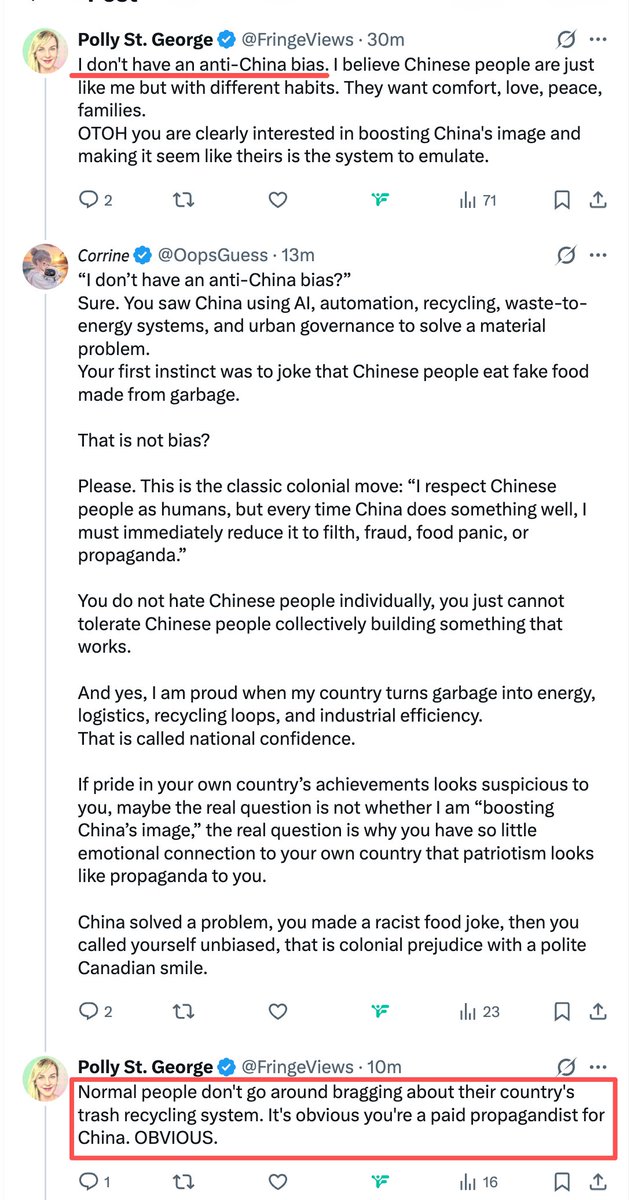
“Normal people”?
Normal people do not see another country improving waste management and immediately turn it into a racist food joke.
Normal people do not say “I have no anti-China bias” and then, the moment China does something well, start screaming “paid propagandist.”
You are not reacting to propaganda.
You are reacting to competence.
That is what bothers you.
China turning garbage into energy, recycling, automation, and urban governance is not “bragging.”
It is a real material achievement.
The fact that you cannot look at it without reaching for filth, food panic, and conspiracy only proves the point:
Your problem is not my patriotism.
Your problem is that China succeeding breaks your colonial worldview.
So yes, I am proud of my country solving problems.
You are proud of pretending your prejudice is “normal.”
8
55
1,255
15h
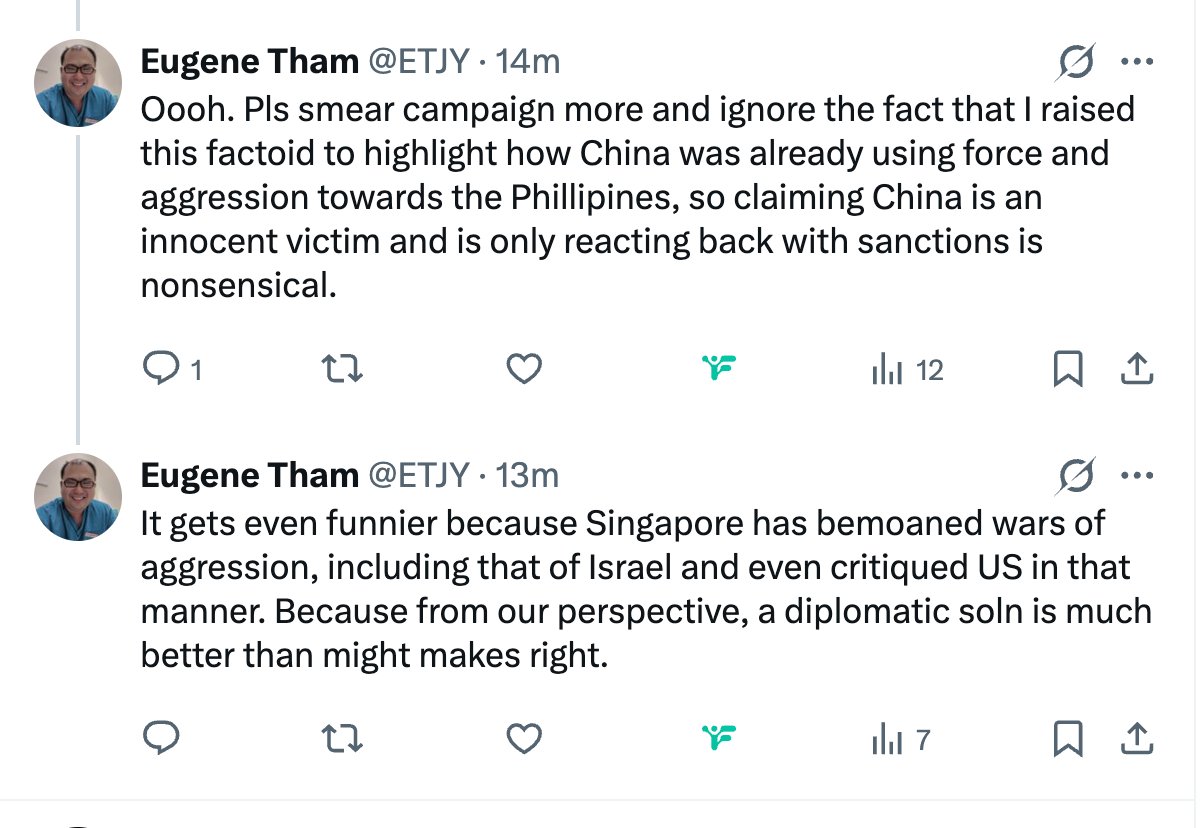
A Singaporean colonial pet defending Japan and the Philippines carving up China’s waters is exactly the kind of small-state relevance-seeking I was talking about.
You keep saying “legal decision” as if repeating the phrase magically settles sovereignty.
It does not.
The 2016 South China Sea arbitration was not an ICJ ruling.
It was not a UN court judgment.
It did not decide sovereignty over islands.
It did not decide who owns the South China Sea.
It was an arbitral process China rejected from the beginning because China considers the dispute to involve territorial sovereignty and maritime delimitation — issues China had already excluded from compulsory arbitration.
But of course, colonial minds love this trick:
Take a disputed legal instrument,
strip away all jurisdictional controversy,
turn it into scripture,
then demand China kneel before it.
Ironic
The same people who cheer U.S. invasions, NATO wars, illegal occupations, sanctions, coups, and military bases across the planet suddenly become delicate little priests of international law when China defends its own doorstep.
Civilized people can discuss disputes.
Colonial servants use “law” as a leash when the leash is held by the West.
China is not changing a “legal decision” by force.
China is refusing to let hostile actors use a politicized arbitration to launder maritime theft into “rules.”
Japan wants to rearm.
The Philippines wants to internationalize the South China Sea.
Singaporean colonial parrots want to bark from the sidelines and pretend this is legal sophistication.
It is not.
It is just a small broker state begging for relevance by polishing someone else’s knife.
15h

You kinda reinforcing my point. You clearly view US use of force and aggression is wrong. So in this case, why is China use of aggression right? Clearly civilised people can sit down and discuss this, right ?
8
10
127
4,681
15h
A Canadian colonial lackey saw China turning garbage into energy, recycling, automation, and urban governance — and her first instinct was:
“They make fake food out of it.”
This is what anti-China brain rot looks like.
Canada is a country built on Indigenous graves, residential schools, settler violence, and a moral superiority complex so fake it should come with a warning label.
A country where poverty and disability are increasingly treated like problems to be euthanasia methods.
A country whose parliament literally gave a standing ovation to a Nazi veteran.
And now this little clown wants to joke about China eating fake food?
China is turning waste into energy, data, sorting systems, recycling loops, and industrial efficiency.
Canada turned genocide into land ownership, homelessness into scenery, and euthanasia into welfare policy.
But of course, when China appears, the colonial brain starts foaming.
They cannot process a country solving material problems through engineering.
So they retreat to the only thing they have left:
racist little food jokes.
This is a decaying settler state coughing up its own moral sewage and calling it commentary.

they make fake food out of it, even! And people eat it!
what a great country.
4
8
81
3,460
16h
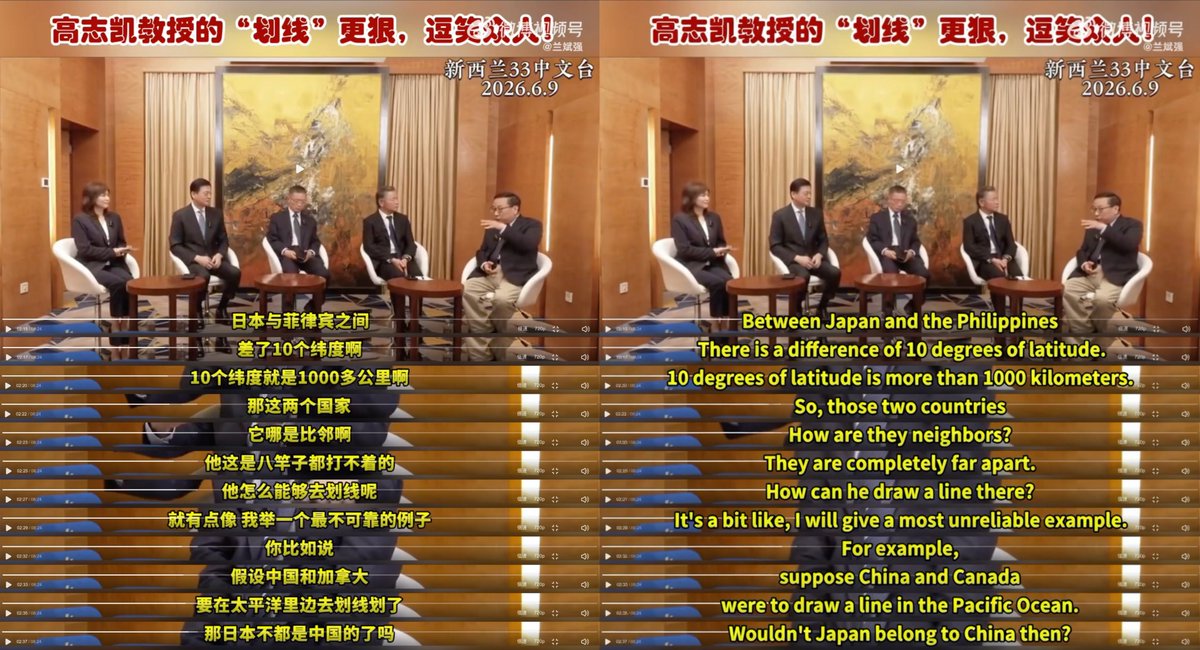
Victor Gao said:
If Japan and the Philippines can draw lines in the South China Sea, then China can draw a line across the Pacific with Canada.
And just like that, Japan belongs to China.
Gao is indeed a line-drawing expert lol
7
15
202
10,831
17h
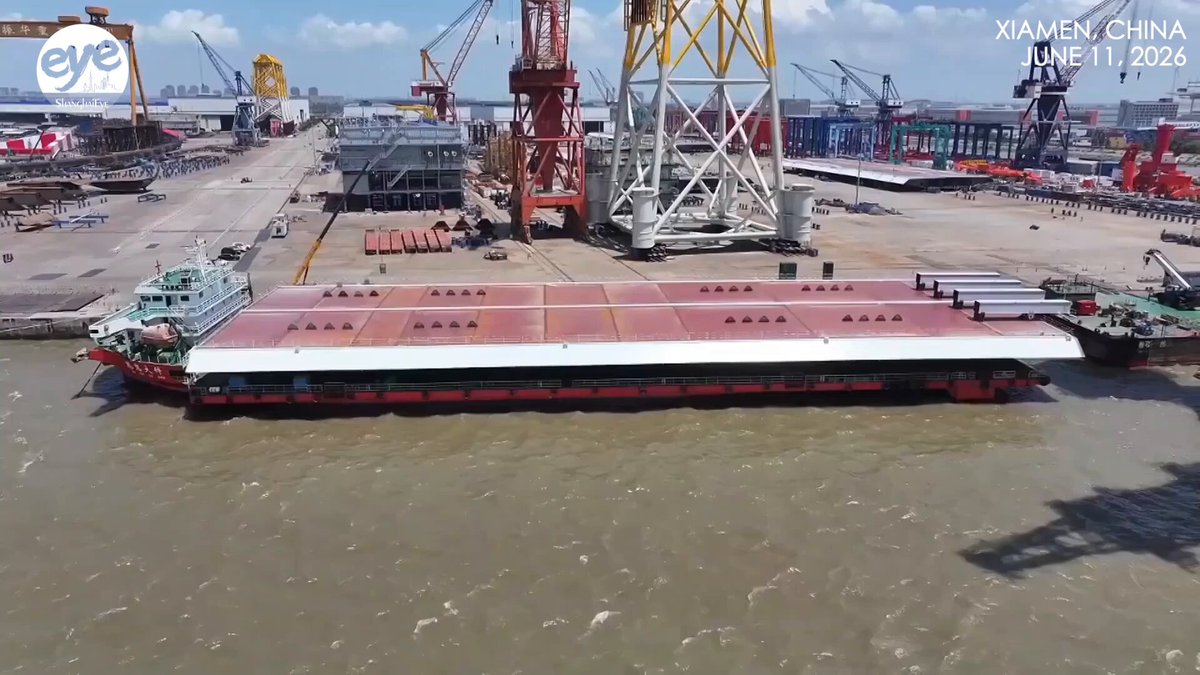
The political meaning of the Xiamen–Kinmen Bridge is far greater than its economic value.
For Taiwan separatists, the sea has always been their last psychological wall.
They need the Strait to feel like destiny.
They need distance to feel like identity.
They need separation to look permanent.
But China’s answer is very simple:
build.
Build bridges.
Build ports.
Build railways.
Build grids.
Build logistics.
Build the physical reality of reunification before the political slogan even finishes echoing.
That is why this bridge hurts them.
It turns “separation” from an ideology into an engineering problem.
And once China treats something as an engineering problem, the ending is usually already written.
13
75
2,883
𝘊𝘰𝘳𝘳𝘪𝘯𝘦 retweeted

中国はかつて、処理しきれないほどのゴミの多さを心配していた。 今では、一部の廃棄物発電施設が正反対の問題に直面している
:ゴミが足りない。
多くの国では、ゴミがガバナンスの崩壊を象徴する。 中国では、ゴミでさえシステムになる。
#中国共産党による社会主義体制が至高
18h
The most brutal part is not that China is using AI to sort garbage.
It is that China has pushed waste management so far that the old problem has reversed.
China used to worry about having too much garbage to process.
Now some waste-to-energy plants are facing the opposite problem:
not enough garbage.
Previously sealed landfills may even have to be reopened, not because China failed, but because waste has become fuel, feedstock, data, and part of an industrial recycling loop.
This is what China does best.
It takes the ugliest, dirtiest, most ignored corner of urban life — garbage — and turns it into engineering, automation, energy recovery, environmental governance, and industrial optimization.
Even trash gets absorbed into the machine.
In many countries, garbage is where governance collapses.
In China, even garbage becomes a system.
2
13
890
18h
“Why do Asian countries want U.S. bases?”
Classic empire-brain logic.
As if every U.S. base on earth is there because local people lovingly begged Washington to occupy them.
Please.
Cuba has wanted the U.S. out of Guantanamo for decades.
Is America leaving?
Iraq has repeatedly pushed back against U.S. military presence.
Did America politely pack up?
Afghanistan had U.S. troops for twenty years.
Was that also because Afghans were begging to be bombed, occupied, and drone-policed?
The U.S. does not “protect” countries out of charity.
It plants bases where it wants leverage.
It stays where it wants control.
It calls occupation “security.”
It calls dependency “alliance.”
It calls military encirclement “stability.”
Some governments invite U.S. bases because they are weak, captured, scared, bribed, dependent, or useful to Washington.
That does not make the empire benevolent.
It just means the cage sometimes comes with local signatures.
So no, the question is not why some Asian elites host U.S. power.
The question is why America thinks it has the right to turn other people’s land into permanent launchpads for its own wars.
You did not protect anyone;
you simply turned all the colonial slaves into your own military outposts.
Jun 13

"surround Asia with bases," .....You should ask yourself why Asian countries want US bases on their soil.
10
36
140
4,313
18h
Don't compare China and India.
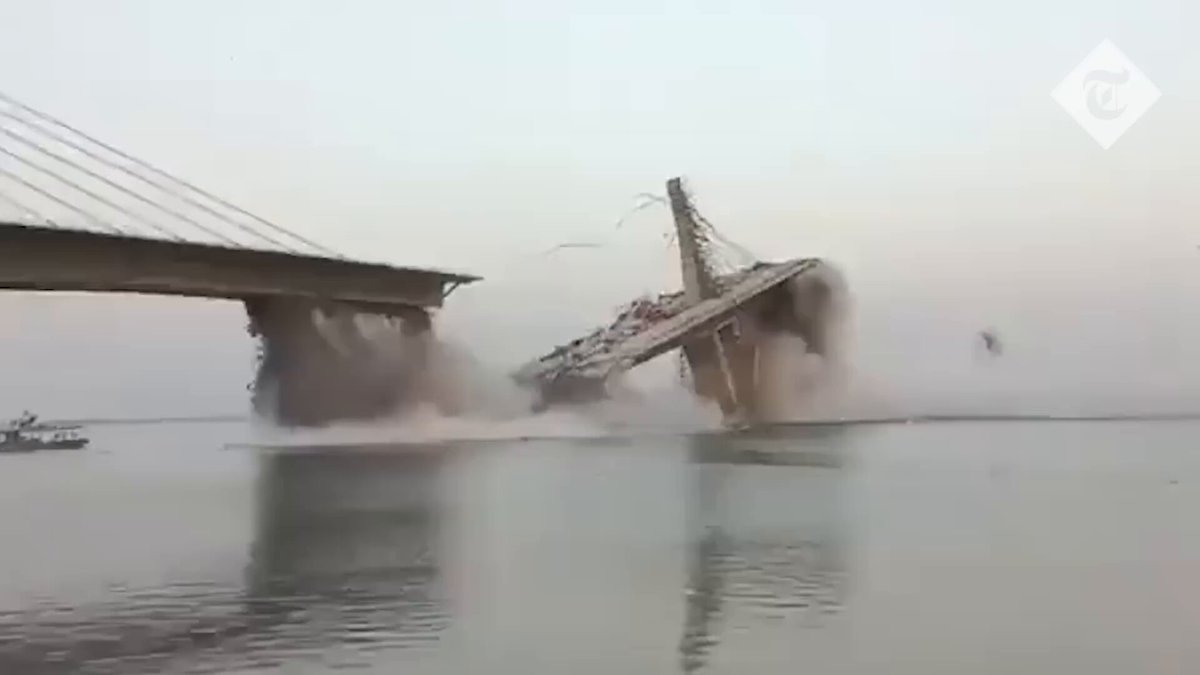
China will not build a bridge that collapses twice within a year.

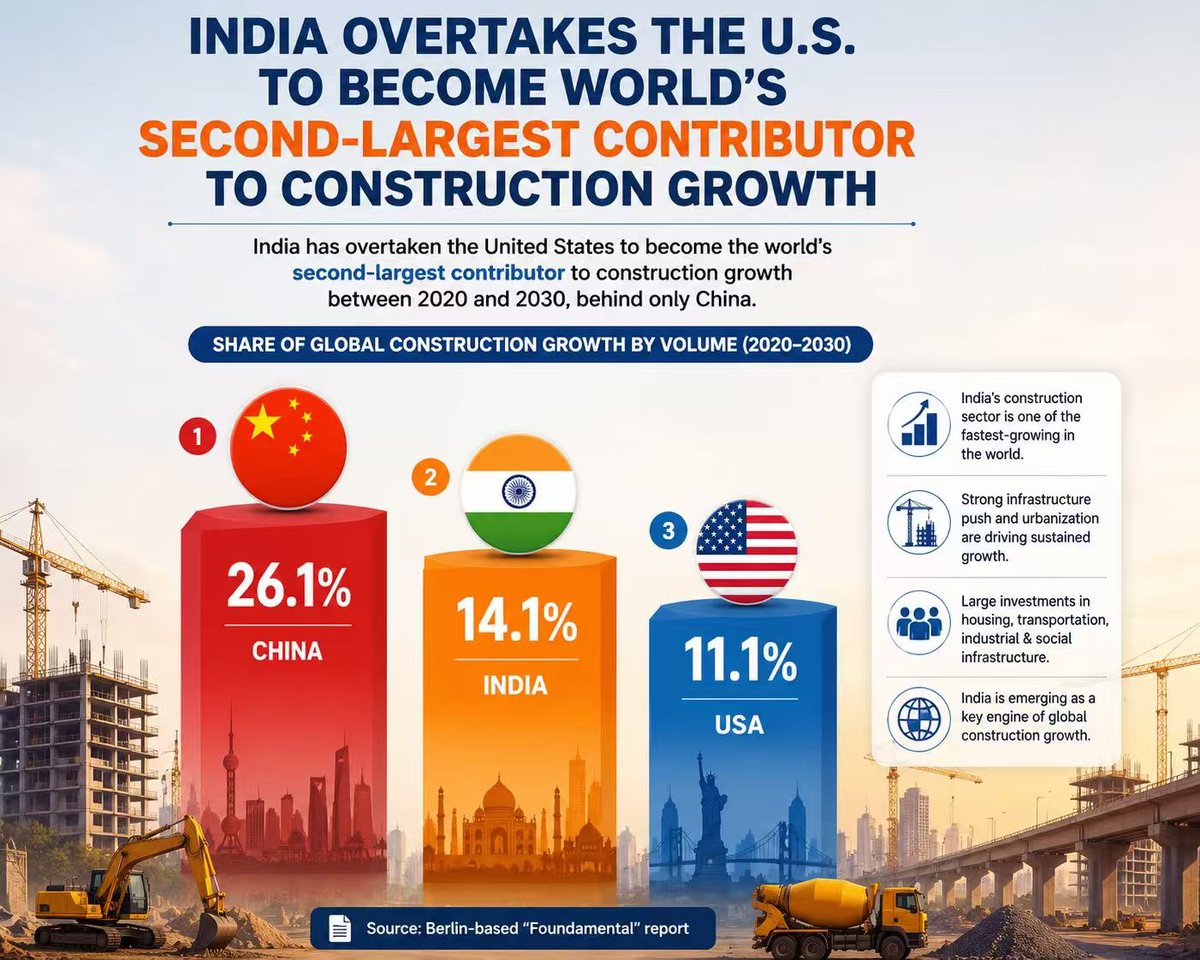
According to a report by venture capital firm Foundamental, China and India are expected to account for nearly 40% of global construction growth between 2020 and 2030.
China remains the largest contributor (26.1%), while India ranks second (14.1%), highlighting Asia’s growing role in shaping global infrastructure development.
27
80
722
46,937