
Joined February 2013
- Tweets 49
- Following 169
- Followers 34
- Likes 116
1 Photos and videos
Piotr Draczkowski retweeted

May 4
A new @IMol_Institute study in Science Advances sheds light on mitochondrial protein import.
science.org/doi/epdf/10.1126…
Huge credit to this outstanding team of co-authors!

1
3
18
4,074

15 Oct 2025
If you're curious about how cells quickly eliminate misfolded proteins produced under proteotoxic stress or during cell cycle progression, check out our latest article in @NatureComms
doi.org/10.1038/s41467-025-6…
4
2
4
224
15 Oct 2025
A special thanks to @asibc512, Szu-Ni Chen, Ting Chen, Yong-Sheng Wang, and Yuan-Chih Chang for making this possible.
1
42
15 Oct 2025
It has been a long but incredibly valuable journey, filled with ups and downs, culminating in an exhausting publishing process. However, thanks to the tremendous efforts of all the coauthors, our publication is finally out!
1
2
61
15 Oct 2025
In this study, we enhance the structural understanding of the ubiquitin code by revealing previously unseen K11/K48-branched Ub chain topology and its recognition by the proteasome.
26

What a day! We published two papers describing the lives of proteins from Alpha shorturl.at/ZeAG7 to Omega shorturl.at/b79Eu
Seeing these processes through the lens of structural biology is so satisfying
1
2
62
@PDraczkowski serendipitously found the K11/K48 branch, which is confirmed by Ub-AQUA and Ub-clipping. Amazing support from our #cryoEM and #proteomics MS core at @AcademiaSinica
1
2
41
Piotr Draczkowski retweeted

15 Apr 2025
📣 Job alert! Our partner group, the Dioscuri Centre for Modeling of Posttranslational Modifications
@BioPhysMatt, is seeking a talented individual in the field of #ComputationalBiophysics. Apply ✏️✅! #AssistantProfessor 👉 biophys.mpg.de/2858196/Postd…

2
6
941
Very pleased to know that our recent work on hCoV-229E S:hAPN recognition has been highlighted by Nature Communications alongside the work of the newly minted Nobel Prize laureate David Baker lnkd.in/gUwr4bqZ
1
6
108
Piotr Draczkowski retweeted

24 Jan 2025
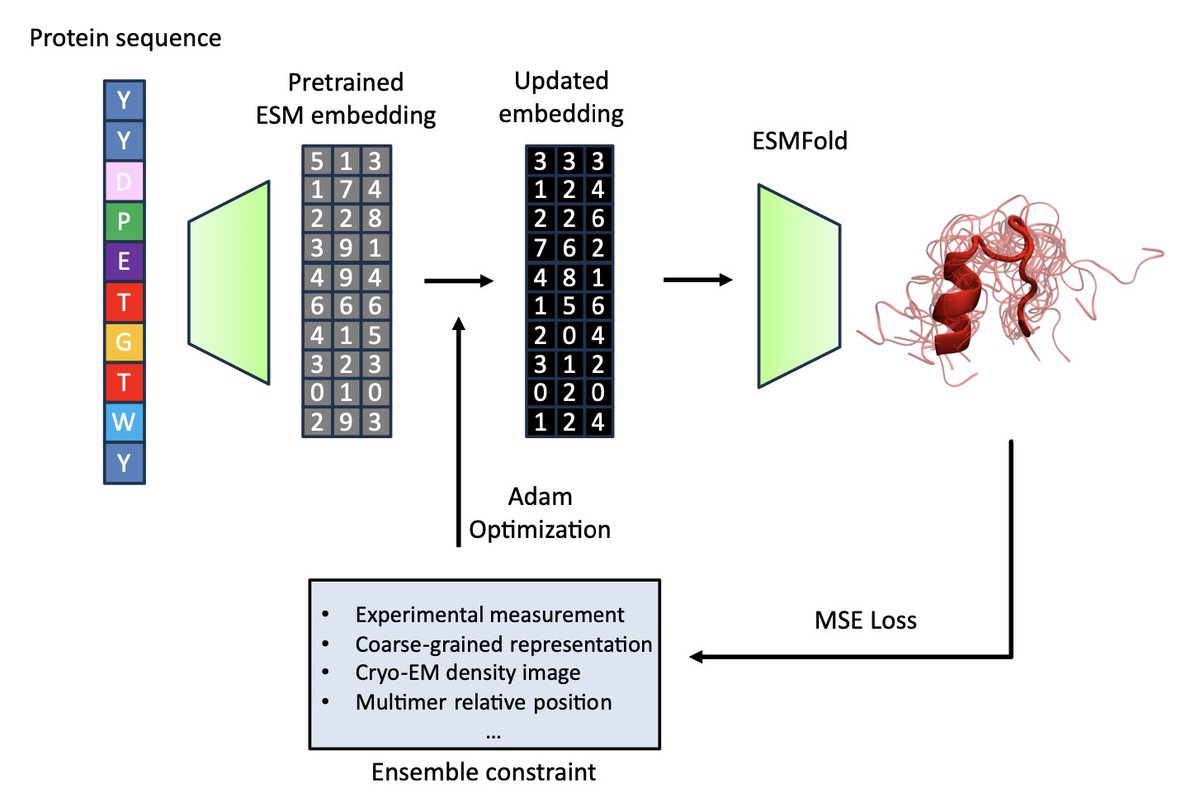
ESMAdam: a plug-and-play all-purpose protein ensemble generator
1. ESMAdam introduces a versatile framework for protein ensemble generation, bridging gaps in high-throughput applications. Leveraging the pretrained ESMFold model and Adam optimization, it excels in efficiency and adaptability compared to traditional methods like molecular dynamics simulations.
2. The method supports a wide range of tasks, including conditional ensemble generation, CG-to-all-atom backmapping, binding mode exploration for protein complexes, and reconstructing 3D structures from cryo-EM images.
3. A key innovation is ESMAdam's reliance on optimizing protein embeddings in a continuous space. Unlike deep generative models, ESMAdam requires no retraining, allowing it to accommodate diverse structural constraints with minimal computational overhead.
4. In protein complex studies, ESMAdam identified metastable binding states previously undetected by molecular dynamics simulations, highlighting its potential for novel discovery in protein-protein interactions.
5. Cryo-EM integration demonstrates ESMAdam's robustness under noisy conditions. It reconstructs conformational ensembles while retaining accuracy in secondary structure prediction, even with significant noise levels.
6. The model achieves Boltzmann-distributed conformations, a feat previously challenging without physics-intensive simulations. It enhances studies on protein dynamics, stability, and interactions.
7. Future directions include reducing computational demands via techniques like LoRA for broader accessibility. ESMAdam positions itself as a critical tool for advancing structural biology and computational protein design.
📜Paper: biorxiv.org/content/10.1101/…
#ProteinDesign #AI #StructuralBiology #ComputationalBiology #ESMAdam
21
84
4,140
24 Jan 2025
This is exciting and opens new avenues for studying the proteasome-ubiquitin system. I am now awaiting K11 ubiquitin-specific probes ;)
pubs.acs.org/doi/abs/10.1021…
2
75
14 Jan 2025
Here’s a brief teaser for our latest preprint reporting the first structures of the K11/K48-branched Ub chain bound to the human proteasome:
youtu.be/lAZrYsnoLBc?si=VsEz…
Check the full text for more details:
biorxiv.org/content/10.1101/…
Thx to @asibc512 for making this possible!
1
2
80
Our preprint on the first glimpse of how the human proteasome recognizes a K11/K48-branched ubiquitin chain is out. This work reveals a new multivalent ubiquitin binding mode by the proteasome that could serve as priority checkin signal for proteolysis.
doi.org/10.1101/2025.01.13.6…
1
9
13
822
Piotr Draczkowski retweeted
14 Jun 2024
Call for AMBER is now open and closes on September 6th. Prof. @A_Chacinska is seeking 2 postdoctoral researchers for 2 projects in structural biology, and molecular cell biology and proteomics.
Link to the project website: ambercofund.eu/ @FNP_org_pl @PAN_akademia

5
8
3,060
Piotr Draczkowski retweeted
11 Jun 2024
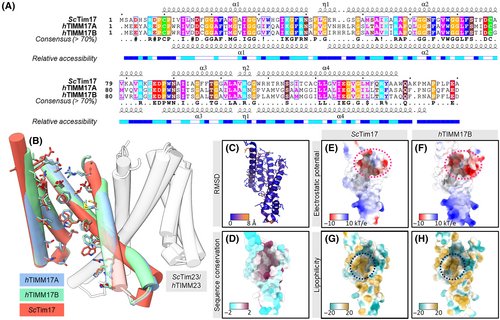
How proteins are imported into human mitochondria? Read the latest publication from @A_Chacinska lab. Find out how Klaudia Maruszczak and @PDraczkowski used computational tools to get first architectural insights into these processes.
@NCN_PL
1
2
8
623
Piotr Draczkowski retweeted

9 May 2024
Anyone ever needs a command palette in ChimeraX?
4
7
57
4,923
9 May 2024
Everyone (including me :) is hyped up about the new AF3 today, so let’s mix it up with some other cool science updates from yesterday:
8 May 2024

The floor is lava! 🔥
Webb may have detected atmospheric gasses around molten 55 Cancri e, 41 light years from Earth. It’s the best evidence to date for a rocky planet with an atmosphere outside our solar system! go.nasa.gov/3UAG4F8
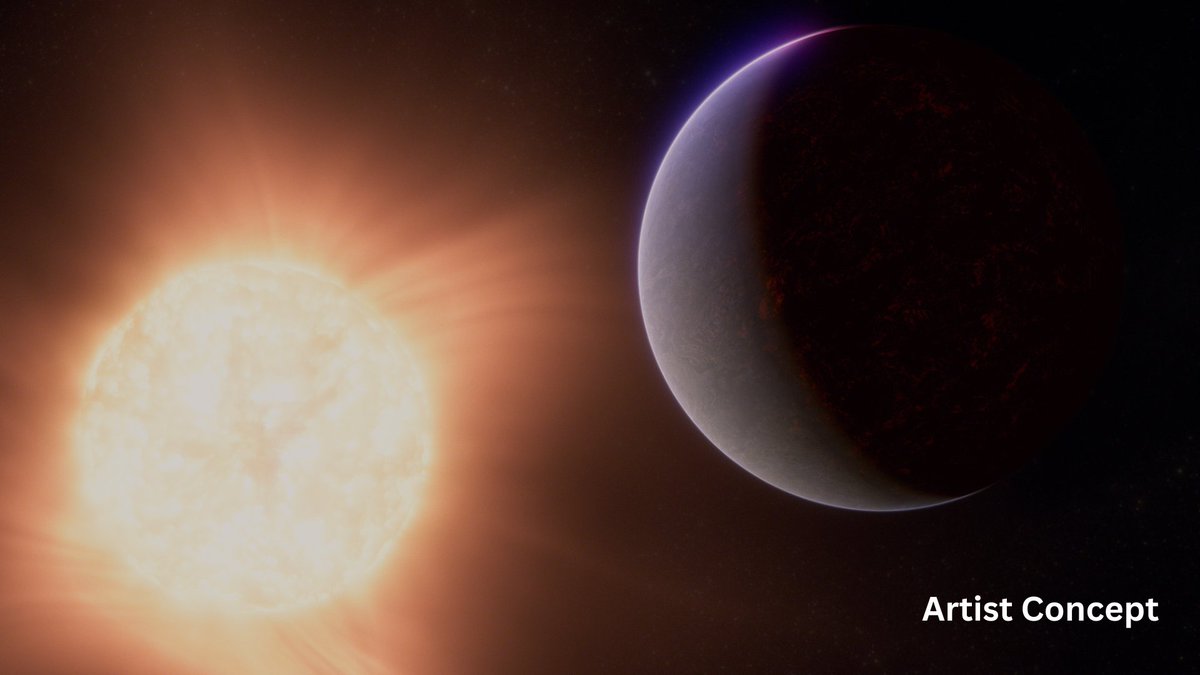
ALT Labeled artist illustration: Illustration of a rocky exoplanet and its star. The star is in the background at the lower left and appears somewhat, but not significantly, smaller in the sky than the planet. It has a bright orange-red glow, and appears to have an active surface. The planet is in the foreground to the upper right of the star. The left quarter of the planet (the side facing the star) is lit, while the rest is in shadow. The planet has hints of a rocky, partly molten surface beneath the haze of a thin atmosphere. The boundary between the day and night sides of the planet is fuzzy. A small label in the bottom right corner reads "Artist Concept."
3
68
17 Apr 2024
Love it :D
@wojtek_pokrzywa have an idea to level up the difficulty: how about adding branched K11/K48 Ub chains into the game scenario? ;D
16 Apr 2024

Check out our game, DEGRADATOR! 🎮 Designed to popularize and educate on the ubiquitin-proteasome system and PROTACs. Perfect for kids 12 but not only 😉 Dive into 10 fun levels to explore protein degradation. Available on Google Play and degradator-game.com/ 🚀
4
82
13 Dec 2023
If you want a brief intro to the latest structural discoveries in mitochondrial protein import, check out our piece in @NatureSMB. Thanks to @AgnieszkaC59642, @MichWasil and whole brilliant team @IMol_Institute for the exciting collaboration.
doi.org/10.1038/s41594-023-0…
2
5
24
1,565
10 Nov 2023
Even BLAST is dating AI now.
9 Nov 2023

The conventional old BLAST now goes AI based with Deep-BLAST and predicts remote homology nature.com/articles/s41587-0…
61