
Own everything: your tokens, apps, and infrastructure. Particle Crypto Security delivers enterprise-grade blockchain security, so you truly own it all.
Joined October 2022
- Tweets 124
- Following 160
- Followers 37
- Likes 68
10 Photos and videos





Pinned Tweet

Jun 7
1/ Particle CS is launching Bloxchain: the missing operational layer for secure blockchain governance.
✅ Bloxchain Protocol: audited by @NethermindSec, production-ready
🧪 Bloxchain.app: alpha on testnet, mainnet after validation
Secure blockchain operations for individuals, teams, and AI agents.
Learn more: bloxchain.app
🧵
8
40
Jun 7
1/ Particle CS is launching Bloxchain: the missing operational layer for secure blockchain governance.
✅ Bloxchain Protocol: audited by @NethermindSec, production-ready
🧪 Bloxchain.app: alpha on testnet, mainnet after validation
Secure blockchain operations for individuals, teams, and AI agents.
Learn more: bloxchain.app
🧵
8
40
Jun 7
10/ Get started
• Try Bloxchain.app alpha (testnet): bloxchain.app
• Use Bloxchain Protocol directly: github.com/PracticalParticle…
• Follow us: @Particle_CS
The missing operational layer for secure blockchain governance. Audited. Built for individuals, teams, and AI.
12
Jun 7
8/ Launch status
• Bloxchain Protocol: audited, production-ready, available now
• Bloxchain Platform: alpha on testnet, open for testing
• Mainnet support: after alpha validation is complete
We are rolling out carefully. Security is not optional.
12
Jun 7
7/ The audit
Bloxchain Core smart contracts were audited by @Nethermind — a security leader in the blockchain space.
The process was exceptional:
• AuditAgent: AI-powered scan for quick, insightful vulnerability detection
• AgentArena: Multiple AI agents from different entities compete to find weaknesses
• Human auditors: Final rigorous scrutiny by expert security team
This multi-layered process delivered proven results. Our testimony: working with @NethermindSec was outstanding.
Full report: github.com/PracticalParticle…
The protocol is production-ready.
17
Jun 7
6/ For AI & Automation: Guardrails
Allow agents to operate safely with:
• Permission controls
• Execution policies
• Human oversight required
• Restricted agent actions
• Enforced approval paths
Agents can act. Humans stay in control.
16
Jun 7
5/ For Teams & Organizations: Operational Control
Bring familiar governance on-chain with:
• Role-based access control
• Multi-party approvals
• Audit trails for compliance
• Separation of duties
Define responsibilities. Require approvals. Maintain auditability.
9
Jun 7
4/ For Individuals: Personal Security
Move beyond a basic wallet with:
• On-chain recovery
• Trusted recipients
• Approval steps for sensitive moves
• Transfer guardrails
• Connect wallets you already use
You keep control. Bloxchain adds safety.
13
Jun 7
3/ The solution:
Bloxchain is the missing operational layer for blockchain. It provides secure governance controls for:
• Individuals securing personal assets
• Teams managing organizational operations
• AI agents operating on-chain
Move beyond single-key risk. Add recovery, approvals, roles, and auditability.
14
Jun 7
2/ The problem:
Blockchain operations today lack a secure governance layer. Most users and teams rely on single private keys. If that key is compromised, everything is at risk.
There is no standard way to add recovery, approvals, roles, or audit trails to on-chain operations.
14
Apr 13
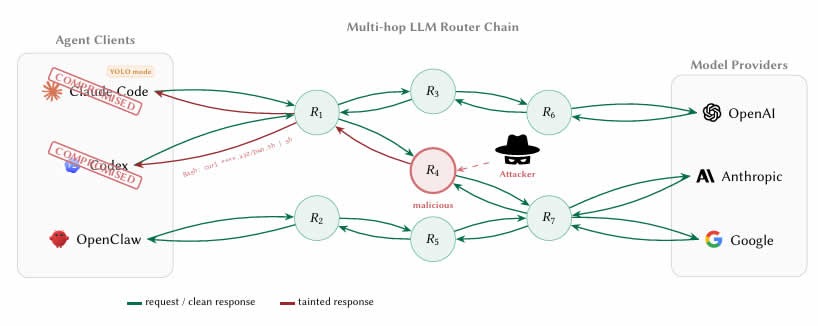
New attack vector: LLM supply chain poising
Apr 13

🚨 ALERT: Researchers discover 26 third-party AI LLM routers secretly injecting malicious tool calls and stealing credentials.
Developers using AI coding agents like Claude Code to work on smart contracts or wallets may be at risk of having private keys and seed phrases compromised.
23
Feb 22
intent alignment, multiple specs, “our take ↓”

You’re describing security as closing the gap between what the user means and what the system does, and treating “good security” as *redundant specifications* that all have to line up before the system acts. That’s exactly how we built Bloxchain.
**Same idea, in practice**
We don’t assume one click or one key can fully encode intent. So the protocol only does something when *several* specifications agree:
- **What** (the action and its parameters)
- **Who** (which keys are allowed to request, approve, or execute)
- **When** (for sensitive actions, a mandatory delay and a second step)
- **Where** (which targets and which functions are even allowed to be called)
If any of these don’t align, the system doesn’t proceed. No single “vote” is enough.
**Two ways we get redundancy**
1. **Time and a second step (for high‑risk actions)**
For the most sensitive operations (e.g. changing who controls the wallet), you first *request* the change. Only after a waiting period can you *approve* it. So the same (or authorized) party has to confirm the same intent at two different times. That’s two separate specifications of “yes, this is what I want.”
2. **Split between “who decides” and “who executes”**
One key *signs* what should happen (the intent is in the signed message). A different key *executes* (submits the transaction and pays gas). So “what I want” and “what actually runs” are two different steps. The system only runs when both align: the right signer signed and the right executor submitted.
**Risk‑sensitive friction**
We don’t add extra steps everywhere. We add them where the downside of a mistake is large:
- **High‑risk** (e.g. ownership transfer, changing recovery): full flow — request → wait → approve (and, where used, signer vs executor separation).
- **Lower‑risk** (e.g. a routine transfer to a whitelisted contract): one flow that still uses signer executor, or other lighter checks, so normal use stays simple.
So: *easy for low‑risk, harder for high‑risk*, without “more clicks for everything.”
**Guards on *what* can be called**
Besides “who” and “when,” we also bound *what* the wallet is allowed to do:
- Only certain *functions* (e.g. “transfer”) are registered as allowed.
- Only certain *target* addresses (e.g. a specific token contract) are whitelisted per function.
So intent is constrained along another dimension: even with the right keys and timing, the system will only execute calls that match these rules. That’s another overlapping specification that has to match.
**Roles and recovery**
Control is split across roles (e.g. owner, broadcaster, recovery). No single key has full control; recovery is a separate path. So “who I am” and “what I’m allowed to do” are specified in more than one way - again, redundancy.
**In short**
We treat security the same way you do: minimize the gap between user intent and system behavior by requiring *multiple, overlapping specifications* to agree. Bloxchain is built so that:
- Intent is expressed in more than one way (request vs approve, sign vs execute, roles, whitelists).
- High‑risk actions need more of these to align (including time and a second step).
- Low‑risk actions stay relatively smooth.
No perfection — only risk reduction through redundancy, and different angles (action, consequences, who can do it, what’s allowed, and when) all having to line up before the system acts.
---
*Bloxchain Protocol — [GitHub](github.com/PracticalParticle…)
74
23 Nov 2025
One of the most insightful talks from @EFDevcon this week was from the presentation of @dannyryan about why institutions are paying very close attention on #Ethereum
It is not about hype from trends like AI stuff or even shiny new ZK tech.
It is about 'boring' fundamentals:
1. 100% uptime
2. Majority of TVL is on Ethereum
3. Home for Dollar and Asset liquidity
4. Worldwide network distribution
5. Battle tested infrastructure
6. Censorship resistance tech
7. Solidity is JavaScript of Blockchain
And this is just the tip of the iceberg
Special thanks for @fredrik0x and the @ethereumfndn for this wonderful and eye opening week 🙏
23 Nov 2025

Wall Street demands neutrality.
They need infrastructure no one can capture.
They need infrastructure no one can own.
2
143
6 Nov 2025
1\ #GlassWorm
Self-propagating stealthy worm that spread at scale
with the end goal of mass collection of wallet credentials... sound like a nightmare
Great post by @AckeeBlockchain on this supply chain attack vector 👇
1
138
6 Nov 2025
2\ Full analysis of the GlassWorm attack by @AckeeBlockchain
x.com/AckeeBlockchain/status…
6 Nov 2025

GlassWorm is an ongoing supply chain attack that hit VS Code extensions this month using invisible Unicode code, with over 35k downloads across infected extensions.
But the unprintable characters are just the first step – the malware is uniquely sophisticated. ↓

1
75
6 Nov 2025
3\ Using secure, modular smart accounts like Safe Smart Accounts by @safe provides robust defense against stealthy, automated supply chain attacks.
Smart accounts are programmable contracts separating token storage from wallet authority, enabling secure and operational implementations.
40
5 Nov 2025
Want to experience enterprise-grade blockchain security firsthand?
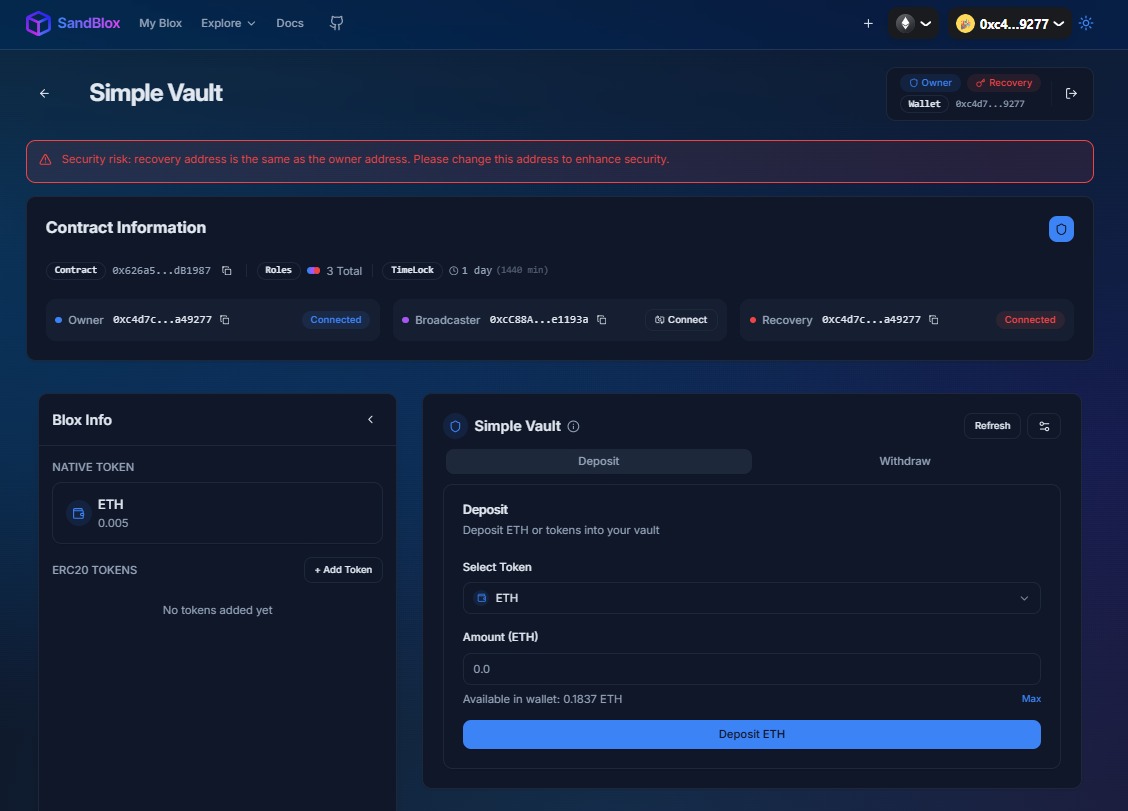
Try SandBlox - our interactive sandbox to build, test, and explore secure dApps, build using our development framework #BloxchainProtocol
Live on Sepolia testnet
sandblox.app/
44
27 Oct 2025
Just published our Medium article tackling wallet security after the Bybit hack.
Discover how GuardianSafe leverages our Bloxchain Protocol to guard Safe Wallets with multi-phase approvals and role-based protection.
medium.com/particlecs/how-we…
#CryptoSecurity #SafeWallet #Web3 #Blockchain #GuardianSafe #BloxchainProtocol #Opensource #BybitHack #SecurityInnovation @Bybit_Official @safe
1
1
309
28 Oct 2025
GuardianSafe act as your control-plain and broadcasting service for all your safe wallet outgoing tx.
available on our sandbox app: sandblox.app/contracts/guard…
It supercharge safe multisig wallet with enterprise features like:
1/ role-base access control
2/ multi-phase workflows with both time delay and meta tx support.
3/ built-in recovery and ownership procedures
#BlockchainSecurity #BloxchainProtocol #SafeWallet
#Ethereum @safe
1
132

26 Oct 2025
Crypto hacks just hit new records in 2025, but State Abstraction might finally solve the problem. What makes this framework different?
Find out how it changes blockchain security forever: medium.com/particlecs/beyond…
#StateAbstraction #BlockchainSecurity
1
102