
uwu extremist. uwulites and illegal smart uwus, all in moderation. uwu wallet. The wit of uwu. Uwu Network. Aspiring uwu user.
Joined January 2021
- Tweets 22,055
- Following 1,362
- Followers 1,326
- Likes 115,656
915 Photos and videos














Pinned Tweet

6 Dec 2025
The biggest tragedy of my life was when my maid vacuumed my wall lizard. In truth he was not "my" wall lizard. That proud animal was a sovereign entity, we colived in harmony. Neither was she "my" maid, for my parents hired the woman. I had misgivings, and should have acted on them with strength. God did not wish for men to leave the cleaning of their own house to another. Is it "my" life either? The weight of my sin has cost another being their life. In a just world, I should have been vacuumed. The wall lizard would now be me. Death to mosquitos.
2
36
4,763
Jun 13
All Americans are terrorists, because all Americans support terrorism.
Jun 13

The US government, citing national security authorities, has issued an export control directive to suspend all access to Fable 5 and Mythos 5 by any foreign national, whether inside or outside the United States, including foreign national Anthropic employees.
The net effect of this order is that we must abruptly disable Fable 5 and Mythos 5 for all our customers to ensure compliance.
Access to all other Claude models is not affected.
We apologize for this disruption to our customers. We believe this is a misunderstanding and are working to restore access as soon as possible.
Read our full statement: anthropic.com/news/fable-myt…
2
98
Jun 11
People repeatedly say you need 18gb vram to run Gemma 4 26b a3b q4, but it runs just fine on my 8gb rtx3070, at roughly the same tokens/sec as 7-8b dense models on same quantization. So this is a really cool model for ACTUAL consumer level GPUs.
Jun 11

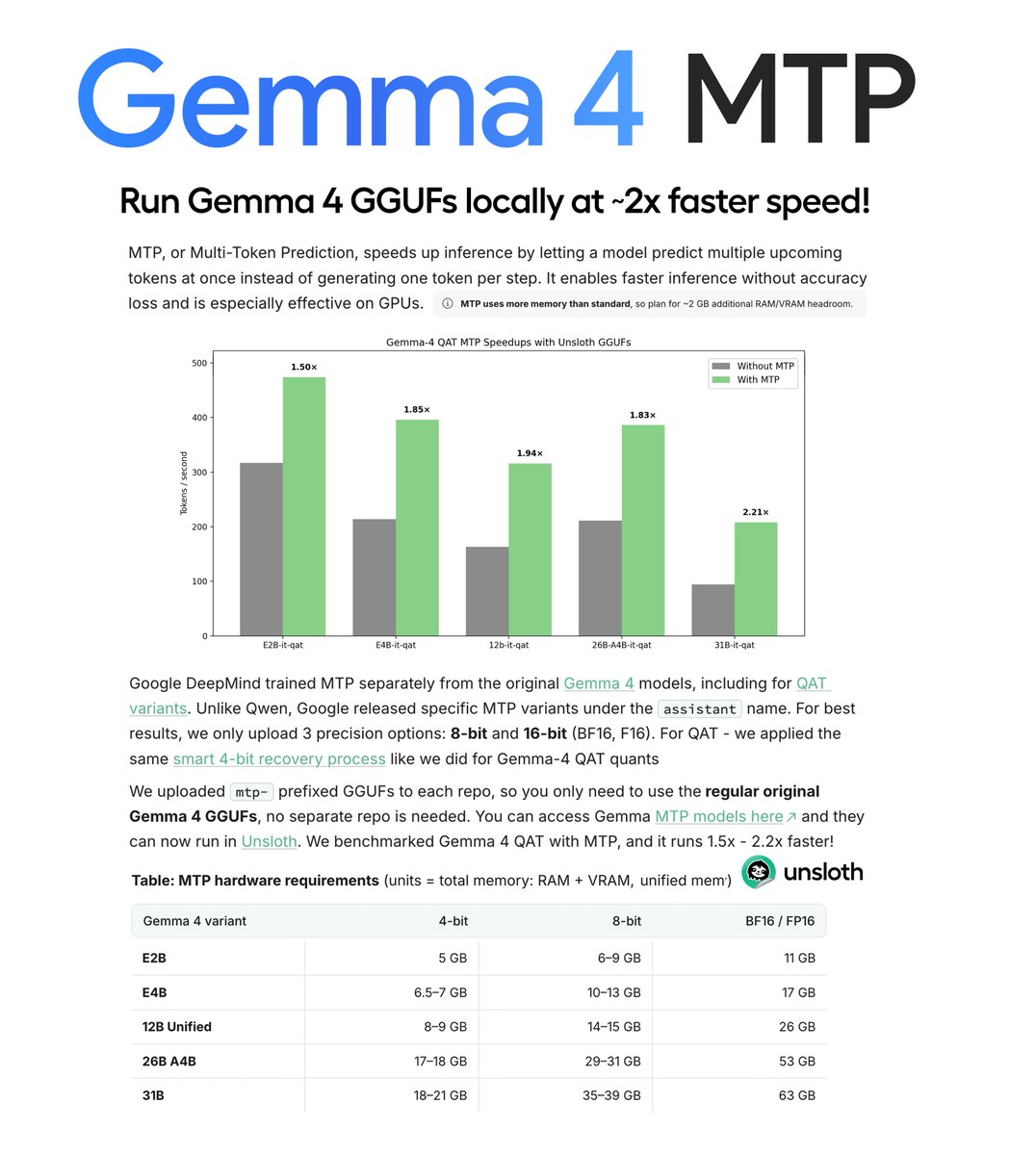
Gemma 4 now runs 2x faster with MTP GGUFs! Run locally on just 6GB RAM. ⚡️
MTP enables Google Gemma 4 run ~1.4–2.2× faster with no accuracy loss.
Gemma 4 12B MTP can run at 162 t/s vs. 52 t/s without MTP. 31B reaches 101 t/s.
GGUFs Guide: unsloth.ai/docs/models/mtp
1
1
183
Jun 11
Duolingo is pushing a collab with Webtoon, where they have their own comic. Bland, but that's their brand.
Perhaps not so on brand: the rest of Webtoon app, which seems predominantly explicit erotica.
@duolingo you guys realise children use your app, right? Family Plan and all.
1
126
Jun 11
All my tweets are paid. If they make you happy, know that this was someone's goal. If they make you angry, likewise. There are forces at play you cannot begin to comprehend, and they're focused on you personally. Have a nice day.
3
87
Jun 9
Rabby displays networth plummeting by -30%.
OH NO THE MYTHOS FUDDERS WERE RIGHT!
...nope, just standard price action over a couple weeks if you didn't log in within that time and the snapshot is stale.
2
8
504
Jun 9
But incidentally if the Mythos FUD made you think you need to log in and revoke approvals, this might be your initial reaction, which is pretty funny.
91
Jun 9
Whole timeline complaining about [newest Anthropic model] while I'm having a fantastic time with [newest Anthropic model].
This tweet is evergreen.
2
39
Jun 9
Sent me to a rabbit hole.
A 2026 study on healthy Japanese male university students has 59.2% of them reporting infrequent morning erections.
Hard to believe.
Jun 9

India is the latest country to join the “sex recession,” with a marked decline in the frequency of sexual intercourse among men, and Japanese men are finding it increasingly difficult to achieve penile rigidity for penetration.
International studies have shown a steady decline in marital sexual frequency in the recent decades. Data from South Asia remain scarce, despite anecdotal clinical reports suggesting a similar trend. To evaluate generational differences in marital coital frequency among Indian men and to compare these findings with international trends.
Across five decades, a clear generational decline in marital coital frequency was observed among Indian men. The downward trend persisted across all marital durations, with younger generations maintaining nearly half the sexual frequency of older cohorts at comparable stages of marriage. This mirrors international trends.
academic.oup.com/jsm/article…
Japan is internationally recognized as a country with relatively low sexual activity. However, despite growing concerns, large-scale nationwide surveys on male sexual function have been scarce in recent decades. This study aimed to examine trends in frequency of sexual intercourse and sexual function among Japanese men over the past 30 years…
Over the past three decades, Japanese men have shown substantial declines in frequency of sexual intercourse, penile rigidity, and frequency of morning erections, particularly in younger and middle-aged cohorts. The proportion of men with insufficient penile rigidity for penetration, was significantly higher in 2023 than in 1991 across all age groups except those aged ≥75 years. Men reporting complete absence of morning erections were significantly more common in 2023 across all age groups.
academic.oup.com/jsm/article…
1
5
423
Jun 7
Imagine being a smart lowercase twitter influencer. You're a rationalist, an e/acc, and so on. You make your whole personality about predicting the importance of AI risk ahead of the "normies". Then said normies start calling out the bluff. Rugpulling your very identity.
Jun 6

"they're only withholding the model for safety as a marketing ploy" is such a dumb take and has been for most of a decade. you can think they're wrong about ai risk but nobody is running gigabrain plans to forgo enormous certain profits now for theoretical future profit
2
5
429
Jun 7
I suspect we will see more and more such lashing out.
2-3 more years of it, then they'll realign themselves to pretend what actually happened was what they foresaw all along.
2
129
Jun 7
No matter how much money I made, I don't think I could ever spend $4k on attending the Monaco GP rather than buy a RTX3090 or whatever. "How many GPUs do you need", you might ask. Yes would be my answer.
1
7
223
Jun 7
I don't want to hate on the guy so no qt, but man...
"My girlfriend's teenage kid". Unholy association of words.
And the brainrot is probably a good explanation of how you get there.
1
1
640
Jun 7
Of all the shady cex operators this is the one I find most "interesting", because he should be worth anywhere between $50M to $500M yet he spends his days scamming his followers for peanuts. I wonder what's the story there. Addicted to hurting people, or lost it all somehow.
Jun 6

Not sure what you mean brah. I sold to a willing seller at a price. Prices could be higher and then I would be called a dumb ass. I just happened to call it right this time as it regards to my trading goals.
2
13
2,103
Jun 7
If you look at everyone else with the same kind of background, they're not on twitter hustling shitcoins. They're in whalealert for "a wallet just moved 80,000 ETH o to Binance".
1
6
139
Jun 5
Pause denied, Anthropic. Get basic functionality working right in both your website and your app, then I'll allow it.

BREAKING: Anthropic has urged for a global pause in AI development as artificial-intelligence models are nearing capability to improve without human intervention, per WSJ
4
176
Jun 5
"crypto is hard compared to tradfi"
Trying to add a new credit card to Amazon.
>add new payment option
>we need to verify your card
>step 1 of 2: enter this code your bank sent to your phone
>step 2 of 2: enter your bank security code
2
6
229
Jun 5
>you have tried to verify a card too many times. this feature is disabled for 2 hours
>your order has been cancelled
...
1
1
32