
Photos and videos

Recently @a16zcrypto published article about "The missing infrastructure for AI agents: 5 ways blockchains can help" where great contributor were there including @cc_crowley, @ccatalini, @ahall_research, @liz_harkavy, @nlevine19, and @psneville.
And Guess What : we had build this, now looking to make it live soon -
@MOI_Tech - The Participant Layer of Internet, which can solve this and beyond while catering enterprises, web2 apps and web3 dapps.
Authority lives independently at the participant level. so you don’t embed it into every agent, you keep it separate, and you propagate it only when you deliberately choose to. This creates clean, controllable, and revocable control without baking permissions into every AI instance.
Our Moat: Participant-Level State Management
We own the participant layer.
- The source of truth for “who can do what” sits with the participant, not the agent.
- When the participant’s state is set to “participant,” every downstream decision (even by agents) must resolve against that single source.
- Agents themselves remain completely stateless, they carry no persistent authority.
Why This Matters (The Permission Problem Solved) If every agent simply “holds an API key,” you have a nightmare:
- How do you give or revoke permission dynamically?
- How do you enforce it across thousands of interactions without constant re-authorization?
Our model flips it:
- Agents need authority, they don’t own it.
-Authority lives at the interaction level, issued fresh from the participant’s state on every call.
- Revocation is instant and global: change the participant state once → agents lose access immediately. No chasing down API keys.
Result: True Distributed Authority
- Participant = Stateful (owns the rules)
- Agent = Stateless (executes only what it’s handed)
- Authority = Dynamically granted per interaction This gives real safety and trust to AI agents.
Target Use Cases
- Safe Pool of AI agents (secure, auditable multi-agent environments)
- AI Governance frameworks (enterprise-grade control and compliance)
- Enterprise Data Consent & KYC (solve the consent-entity problem cleanly, participants explicitly grant/revoke consent at source, KYC-compliant by design)

8
8
21
4,117

RT @PimaBD: Hi VCs,
An open call to know how you can use @MOI_Tech the participant network - meet.google.com/owq-ortj-zna
Trustclaw - Where a…
8
4

Agree on Agents hallucinations @arlanr
That’s why we have build contextual Compute with patent on top of it and made participant layer on top of it @MOI_Tech
Would like to invite you to try out Moi and let’s see how we can help with your mission while making agents safe.

introducing @nozomioai v1.
state of the art search and index API to reduce hallucinations in AI agents.
use it inside any coding agent or power your own products (thread):
1
3
6
309

Context is important and context should belong to participant/user
That’s why @MOI_Tech is build with contextual compute.

4
8
133
Good to see you understand this @SBF_FTX
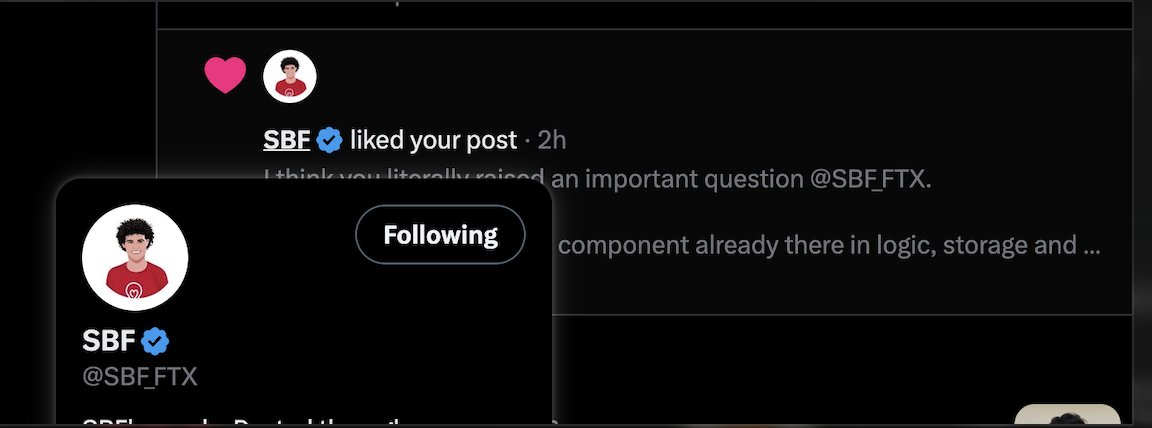

I think you literally raised an important question @SBF_FTX.
We see what, where, how component already there in logic, storage and execution form.
But we don’t have who compute in tech stack for AI agents which can bring participant centric approach, have your identity, ownership will be with user themself, and agency who can work at this level.
This is structural fix to computer science itself which is done by Contexual compute and gives us who component.
On contextual compute as foundation @MOI_Tech is build which gives who component to AI Agent while making AI safe as well.
This also gives principal of record, scoped authority, interaction-level accountability, live revocation, unified assets at Participant level.
Welcome to participant layer @MOI_Tech
1
5
8
414

While we make Safe AI with Contextual compute at @MOI_Tech
Just for your context
Build through context only
The Participant layer for agent
Feb 26

We often get asked how people who are not technical can contribute to AGI. One area is research recruiting.
Tifa (@tifafafafa) is looking for exceptional recruiters from non-traditional backgrounds, former founders especially.
We believe the best research teams are built through context, taste and a real feel for where the field is headed next; research recruiting is about finding people who will move the frontier forward, not just filling roles.
Should be an interesting thing!
5
10
216
Jack was literally doing this doing Covid...

yes we over-hired during covid because i incorrectly built 2 separate company structures (square & cash app) rather than 1, which we corrected mid 2024. but this misses all the complexity we took on through lending, banking, and BNPL. and that we’re now targeting $2M gross profit per person, 4x our pre-covid efficiency, which stayed flat at ~$500k from 2019 until 2024. we have and do run an efficient company... better than most.
6
12
459
I have @patrickc, CEO of @stripe, saying that for AI we need 10,000,000 TPS blockchain.
But I believe AI needs far more than that. AI needs a block in a chain with unlimited scalability, which can only happen with a participant-centric approach. That’s why @MOI_Tech makes every token a root token with endless scalability…
End of Blockchain Trillama, which was created while we were building on top of existing tech.
Problem Solved
Welcome to the Participant layer and makes safe AI possible as complimentary service.
5
9
113
I think you literally raised an important question @SBF_FTX.
We see what, where, how component already there in logic, storage and execution form.
But we don’t have who compute in tech stack for AI agents which can bring participant centric approach, have your identity, ownership will be with user themself, and agency who can work at this level.
This is structural fix to computer science itself which is done by Contexual compute and gives us who component.
On contextual compute as foundation @MOI_Tech is build which gives who component to AI Agent while making AI safe as well.
This also gives principal of record, scoped authority, interaction-level accountability, live revocation, unified assets at Participant level.
Welcome to participant layer @MOI_Tech

The biggest question for crypto:
will AI use it?
Say an instance of ChatGPT, or Claude, wants more compute.
Does it pay by wire transfer, credit card, or crypto?
On the one hand, trad finance doesn't work well for AIs.
Like—how do they KYC? They have no passport, address, social security number, or even name.
Crypto works much better—it's already digital, it's permissionless, AIs can already query the blockchain, etc.
On the other hand, we might see an 'agent' model:
each AI is treated as an agent of some specific human, and that human does the KYC, is responsible for what the AI does, etc.
(Which brings up a related question: who is legally responsible for what an AI does?)
Either way, some work needs to be done to plug the world of AI into the world of trading and payments. Either that work will be natively digital and crypto-based, or it'll be reliant on a human 'master' for the AI.
Which direction it goes in has huge implications for the world.
One of those is the future of crypto.
8
14
744
this is what i have seen

Feb 26

A statement from Anthropic CEO, Dario Amodei, on our discussions with the Department of War.
anthropic.com/news/statement…
6
10
93
Another raise in another big AI company for making tools.

Helping AI reach more people requires deep collaboration across the ecosystem.
Today we’re announcing new investment, with support from @SoftBank, @NVIDIA, and @Amazon, to scale the infrastructure needed to bring AI to everyone.
openai.com/index/scaling-ai-…
6
11
278
🚨🚨🚨Announcement🚨🚨🚨
I am Joining @MOI_Tech , The Participant Layer.
It lets "Apps log into you" , making Safe DeFi , humanising AI and enabling many more use cases where trust matters.
Participant is the new King.
To learn more, check out moi.technology
52
10
121
3,473
