
Don't think outside the box, make a model of thinking about the box.
Joined November 2024
- Tweets 12,831
- Following 3,193
- Followers 1,833
- Likes 61,010
717 Photos and videos










Pinned Tweet

3 Nov 2025
If we as a society can't figure out how to separate race from religion we are doomed.
Race is immutable, but I can claim to be any religion and convert from one to the other at will.
3
31
2,625


Quentin Kramer retweeted

9/
This paper is a call to action. We need:
• General-induction benchmarks based on compression
• Quantitative multi-agent scaling laws
• High-fidelity physical simulators
We must build the science of ASI before we build the systems.
1
1
2
30


Memo to the press:
When a president is elected by the People and then does what he promised to do, that’s democracy.
When a president is thwarted by unelected bureaucrats, that’s oligarchy.
President Trump refuses to bend the knee to that oligarchy. Buckle up!
14,447
75,977
358,379
27,002,085
Quentin Kramer retweeted

Univ of Texas paper shows AI agents can slowly become less reliable after deployment, even when the model itself does not change.
The problem is that agents are often judged when they are fresh, but real agents keep changing because they summarize old chats, store more memories, update facts, and go through maintenance.
An agent that remembers you across weeks is really a small operating system wrapped around a language model: it writes notes, compresses them, retrieves them, updates them, and occasionally cleans house.
Every one of those steps can quietly rot.
A medication dose can become “a daily medication,” two similar clients can blur into one, a canceled subscription can remain active, and a schedule can vanish after a maintenance pass.
The uncomfortable finding is that the agent may still sound competent while becoming less exact.
The proposed AgingBench, a benchmark that checks whether an agent stays reliable across many sessions instead of only checking one clean starting point.
It studies 4 ways agents age: summaries can drop key details, similar memories can get mixed up, updated facts can stay stale, and maintenance can suddenly break memory.
The deeper lesson is that “give it more memory” is often the wrong repair.
If the fact was never written, retrieval cannot save it.
If the fact was written but crowded out, better summarization will not fix it.
If the fact is present but unused, the problem is not storage but the agent’s decision to trust or ignore what it retrieved.
This paper reframes deployed agents less like static models and more like aging infrastructure.
----
Link – arxiv. org/abs/2605.26302
Title: "Your Agents Are Aging Too: Agent Lifespan Engineering for Deployed Systems"

14
20
65
4,495
Quentin Kramer retweeted
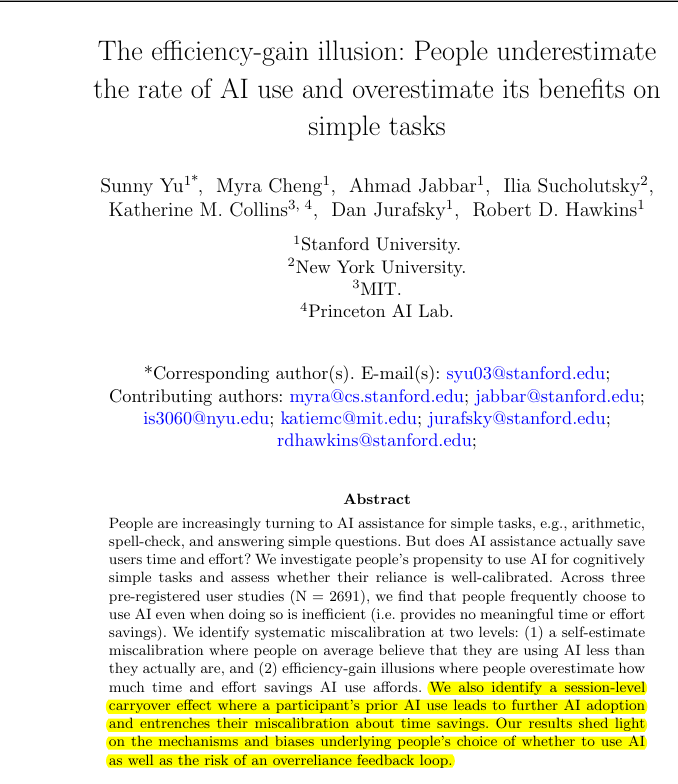
MIT, Stanford, New York Univ, Princeton paper says AI can make people feel more efficient even when they are not actually becoming much more efficient.
that people often use AI for simple tasks because it feels like it saves time and effort, but the measured benefit is often tiny, missing, or even negative.
The biggest point is the feedback loop: once people use AI, they become more likely to use it again, even for easy tasks where doing it themselves would often be just as fast or faster.
i.e. AI dependence can grow from a mistaken feeling of convenience, not just from real productivity gains.
Across three preregistered studies with 2,691 participants, people used AI for basic arithmetic, spelling, recall, and short rewriting at higher rates than they predicted, especially on easy tasks.
They also expected AI to save 55.7 seconds on average, when the measured saving was only 7.5 seconds.
For simple work, the hidden cost is not intelligence but interface friction: writing the prompt, waiting, reading, checking, and deciding whether the answer is acceptable.
Once that loop begins, it can feel like effort has been outsourced, even when effort has only been rearranged.
Here’s the key part: the study suggests that AI use can train its own justification.
After using AI on just two tasks, participants became more likely to use it again, even when independent completion was faster.
The danger is not dramatic dependence, but quiet recalibration.
A person who asks AI for a trivial answer today may not become less capable tomorrow, but they may become less accurate at judging when their own mind is already the faster tool.
----
Paper Link – arxiv. org/abs/2605.22687
Paper Title: "The efficiency-gain illusion: People underestimate the rate of AI use and overestimate its benefits on simple tasks"
17
27
110
39,464
Quentin Kramer retweeted
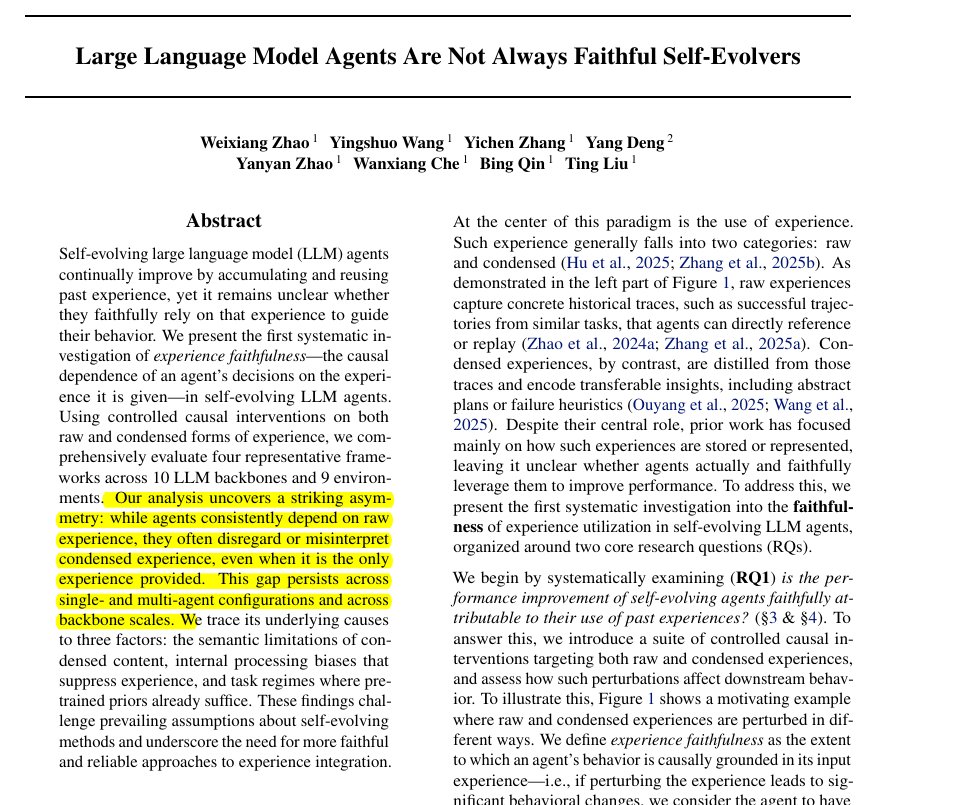
Researchers found our current approach to making AI smarter over time has a giant blind spot.
AI is not actually understanding or applying high-level abstract lessons at all.
Developers spend massive amounts of time building systems that condense past AI mistakes into neat little rules for the future.
This paper proves that the AI essentially throws those rules in the trash and only looks at raw historical logs.
Modern LLM systems try to get better over time by storing past tasks as either raw step-by-step histories or condensed summary rules. The study tested if these agents actually use their stored memories by secretly swapping the correct tips with random garbage text.
- When the step-by-step histories were messed up, the AI failed hard, proving it heavily relies on copying exact past actions.
- But when researchers completely corrupted the condensed summary rules, the AI kept acting normally and showed zero performance drop.
If an AI cannot apply an abstract lesson to a new situation, it is not truly reasoning or learning.
This raises the question if the entire AI industry need to rethink how memory works because right now these agents are just mimicking instead of understanding.
----
arxiv. org/abs/2601.22436
"LLM Agents Are Not Always Faithful Self-Evolvers"
33
39
224
39,694
It seems to me the correct study here would be generational. What's the IQ of the arriving parent? What's the IQ of their children, having been educated in teh US system?
What's the IQ of their children, having been educated in the US system?
What's the IQ of THEIR children, having been educated in the US system?
Presuming there are differences between US and European populations, for example, at this point, then it seems a valid hypothesis would be that: the generational repetition of education incrementally rachets up the IQ of the whole society.

No amount of money is going to make an immigrants IQ higher.
8
Quentin Kramer retweeted

Lack of confidence is exactly what communism feeds on. A person who believes they can think, produce, trade, and succeed on their own is difficult to collectivize. A person convinced they are helpless is ready-made political livestock.
Jun 13

The disgusting and filthy bourgeoisie are the enemies of all people and all nations.
Their tastes are ugly, their worldview is retarded, their habits are swine-like, their culture is depraved and degenerate.
And they rule only since the people lack confidence in themselves.
2
4
23
653
Quentin Kramer retweeted

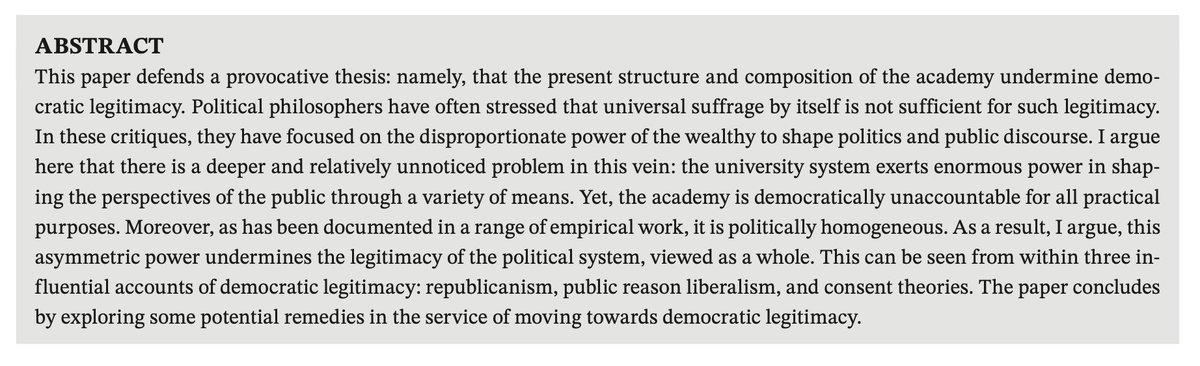
New paper, in which I argue you don't live in a democracy.
"Democracy and the Academy" at Philosophy & Public Affairs
Link below. Tell me why I'm wrong in the replies!
11
19
59
7,586
Knowledge is already open source. Just look around us.
Thinking we can capture all knowledge in one place and make it queryable is 100% a fool's errand.

Sounds wholesome but what exactly does it mean in practice? How is Microsoft going to prevent the monopolistic future that Satya condemns? Are they going to open source models? Are they going to invest in a plethora of LLM labs?…
Or is this thought piece just riding the anti-Anthropic wave for some Good Samaritan marketing?
Also, would Microsoft have the same position had they not missed the LLM boat? They were quite comfortable with an operating system monopoly, why are LLMs any different?
18
Well this is a new one: "China duped Fauci into funding China's bioweapons program".

The op: Covid supposedly came from the US by way of Ukraine.
Truth: It came from CHINA, after China duped Fauci into funding China's bioweapons program:
3
Of those who remain supporting the Democratic party, this is the level of intellect we are dealing with.

We don't do science by consensus?
Then what do we use?
1
22
Quentin Kramer retweeted

A plumber knows more about plumbing than you.
A pilot knows more about flying than you.
A scientist usually knows more about science than you.
That doesn’t make them automatically right.
But it does mean the burden of proof is on the person claiming thousands of experts got it wrong.
Science isn’t a democracy.
It’s not decided by likes, vibes, or confidence.
It’s decided by evidence.
And evidence doesn’t care who wins the argument.
157
184
1,021
16,439
Quentin Kramer retweeted

Satya’s post is worth reading closely because it gets at the real AI question for companies.
Who captures the learning?
His argument is that companies are becoming a new kind of learning system.
People bring judgment, taste, relationships, context and ambition. AI brings scale, memory, reasoning and execution. The value comes from building a loop where the company gets smarter every time work happens.
The important asset is the learning system around the model.
That system is built from the record of how work actually gets done. Workflow traces show the path people take. Corrections reveal judgment. Accepted outputs show what good looks like. Rejected approaches sharpen the standard.
Private evaluations, domain-specific context and institutional memory give that learning structure.
Over time, the company starts to retain more of what used to disappear inside meetings, edits, comments, decisions and individual experience.
That is the learning loop Satya is pointing at.
The judgment that once lived in a few people’s heads can become part of how the company operates.

45
71
693
203,540
Quentin Kramer retweeted

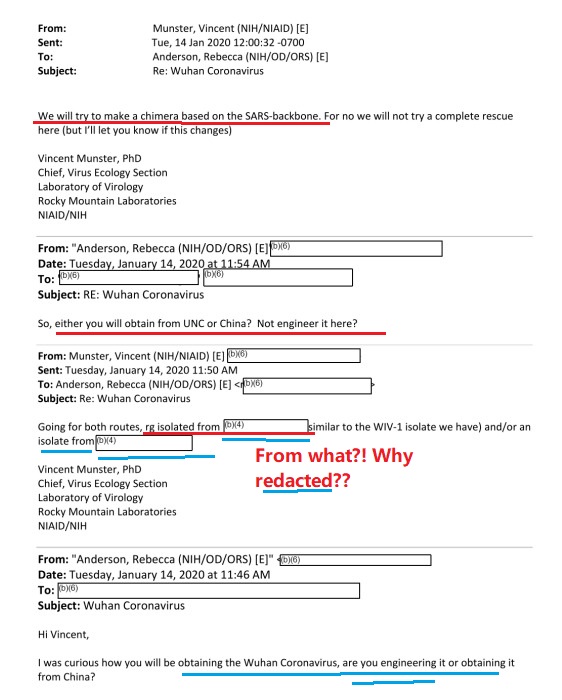
Can we get this unredacted? What backbone was Munster working with??
@RandPaul @zerohedge
5
16
36
877
Quentin Kramer retweeted

Biden admin and Anthony Fauci allegedly engaged in a cover-up to conceal more than 120 taxpayer-funded biolabs that conducted gain-of-function research, despite repeated denials of their existence, per the ODNI under Tulsi Gabbard.
153
909
7,266
158,482
Quentin Kramer retweeted

Demanding accountability for Operation Warp Speed. Military tribunals may actually save the Republic.
3
5
18
1,166
Build it now.
Host it yourself.
There is little value wrapping your app around someone else's model, when they will just copy your app or cut you off when the time comes.

It sure feels like it's USA vs. San Francisco lately.
Truth is we can't tell Trump off, because most Americans hate AI.
Meanwhile China is laughing. OpenSource types are laughing. The rest of the world just learned it can't build on San Francisco technology because the government will shut them down, emboldening AI efforts around the world.
And the innovation engine that is San Francisco and Silicon Valley has handcuffs on.
What's the answer? Bittensor sure has been popping up on my feed a lot more.
Luckily we have X so that everyone can figure out their play. The whole AI industry laid out here: x.com/scobleizer/lists
I want to cheer Dario on, but he sure didn't help his case coming into this. He isn't the guy to take on Hegseth or Trump and get us all rallied behind him.
So I'm just gonna focus on the builders. One thing I've learned by watching developers for decades is they figure out how to route around all damage.
That said, what's going on right now is not good for America.
Or anyone. We all know now that there are tools that could make us better locked up in labs in San Francisco that no one can use.
Well, in a messed up world, what do we do?
Build with what we got for now and try to win hearts and minds. San Francisco is the crown jewel of the American economy. And so many are working to actively destroy it. Which depresses me so.
On July 3rd I'm visiting a farm that's automating with AI.
That's my play. What's yours?
1
6
2,142
Quentin Kramer retweeted

The learning loop is the right frame. But it only compounds if you own the infrastructure it runs on.
Most companies are building their token capital on top of someone else's compute. Which means the model is theirs, the data is theirs, but the layer underneath it all is a rental.
Sovereign AI requires sovereign infrastructure. The loop has to run on something you actually own.
5
6
64
30,342