
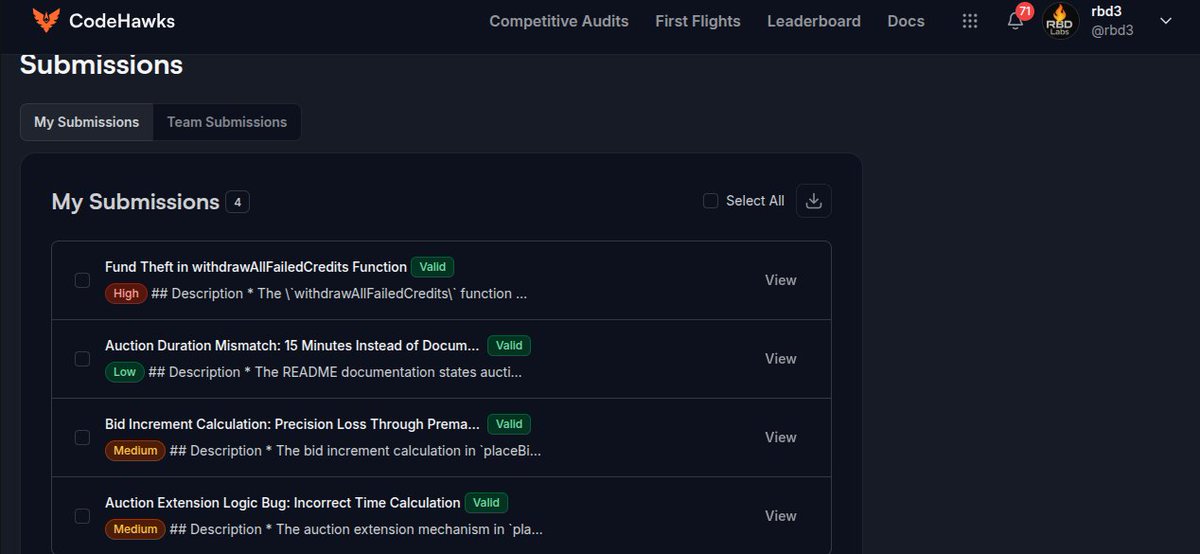
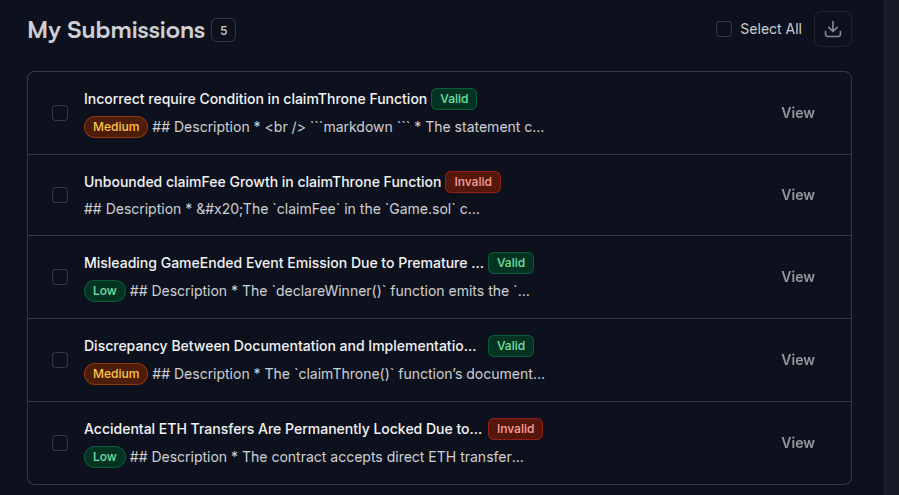


First top 5
Jan 8

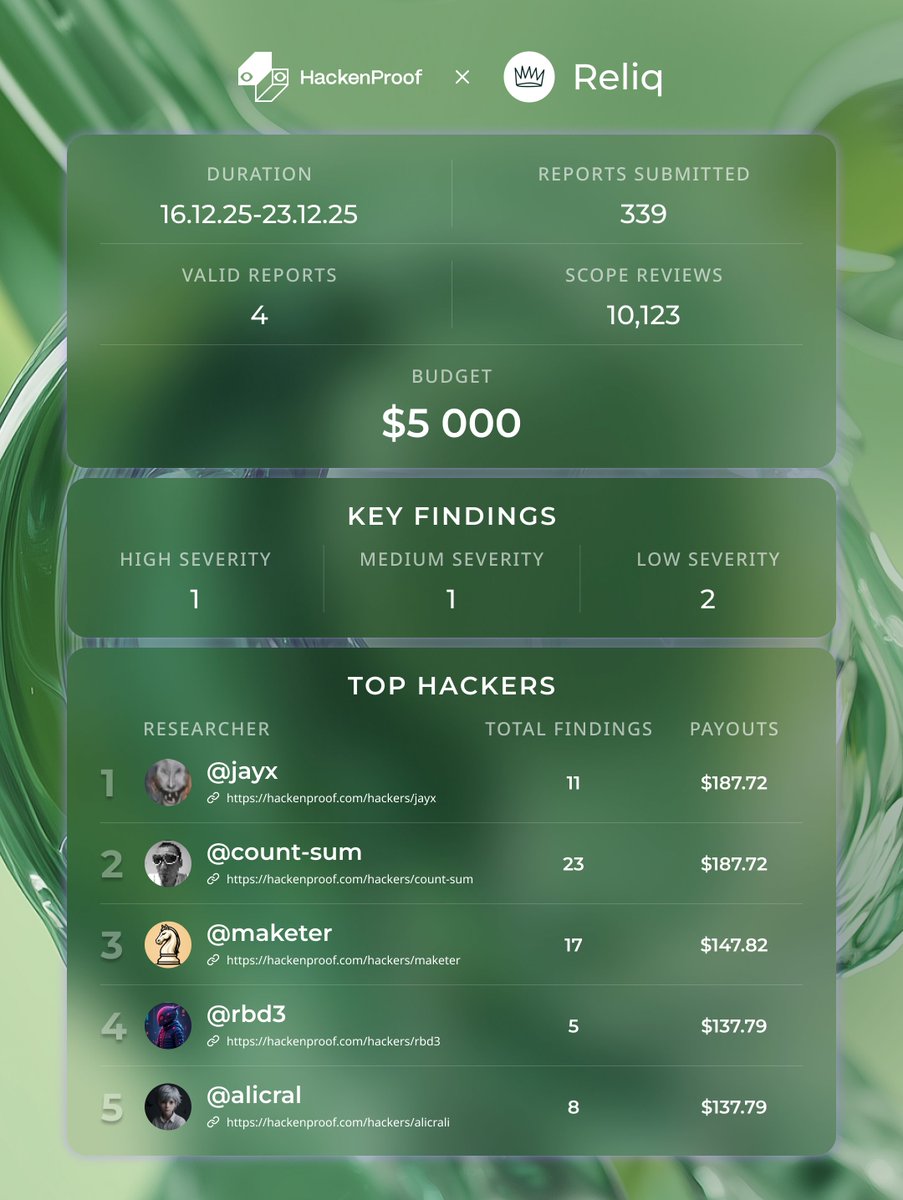
BOOM💥 The winners are here!
Massive congratulations to the top performers on the Reliq Finance audit contest leaderboard.
🏅@j4ycked
🏅count-sum
🏅@keterka
🏅@Rbd30
🏅@Alicrali333
Keep it up!
1
43
Rbd3 retweeted

Jan 20
The @0xfluid Fluid DEX v2 Bug Bounty Contest is now live!
30-day contest ending on February 18th, 2026.
$200,000 USDC in rewards if at least 1 High / Critical is found!
Time to get to work, auditors.
3
2
49
6,311
Rbd3 retweeted

Jan 8
BOOM💥 The winners are here!
Massive congratulations to the top performers on the Reliq Finance audit contest leaderboard.
🏅@j4ycked
🏅count-sum
🏅@keterka
🏅@Rbd30
🏅@Alicrali333
Keep it up!
4
6
68
6,193

1/ Introducing The Mentorship Series
0xsimao.com/blog/introducing…
I’m personally mentoring a small, hand-picked group of auditors in 2026. 1st announced tmr.
3 months of 1-on-1 mentoring with me each.
Targets:
0 → 4 figures
4 → 5 figures
Step 1: Like and repost this post.

65
221
580
64,299
Rbd3 retweeted

15 Nov 2025
👨🏻⚖️ Lead Judge: @n0kto
💂 Lead Senior Guard #1: @0xSorryNotSorry
💂 Lead Senior Guard #2: 0xalix2 (@real_a_kalout @ali_shehab121)
Now we need guards... Many💂🏻💂🏻💂🏻💂🏻💂🏻💂🏻💂🏻💂🏻💂🏻
guards!
9
11
65
14,356
Rbd3 retweeted
14 Nov 2025
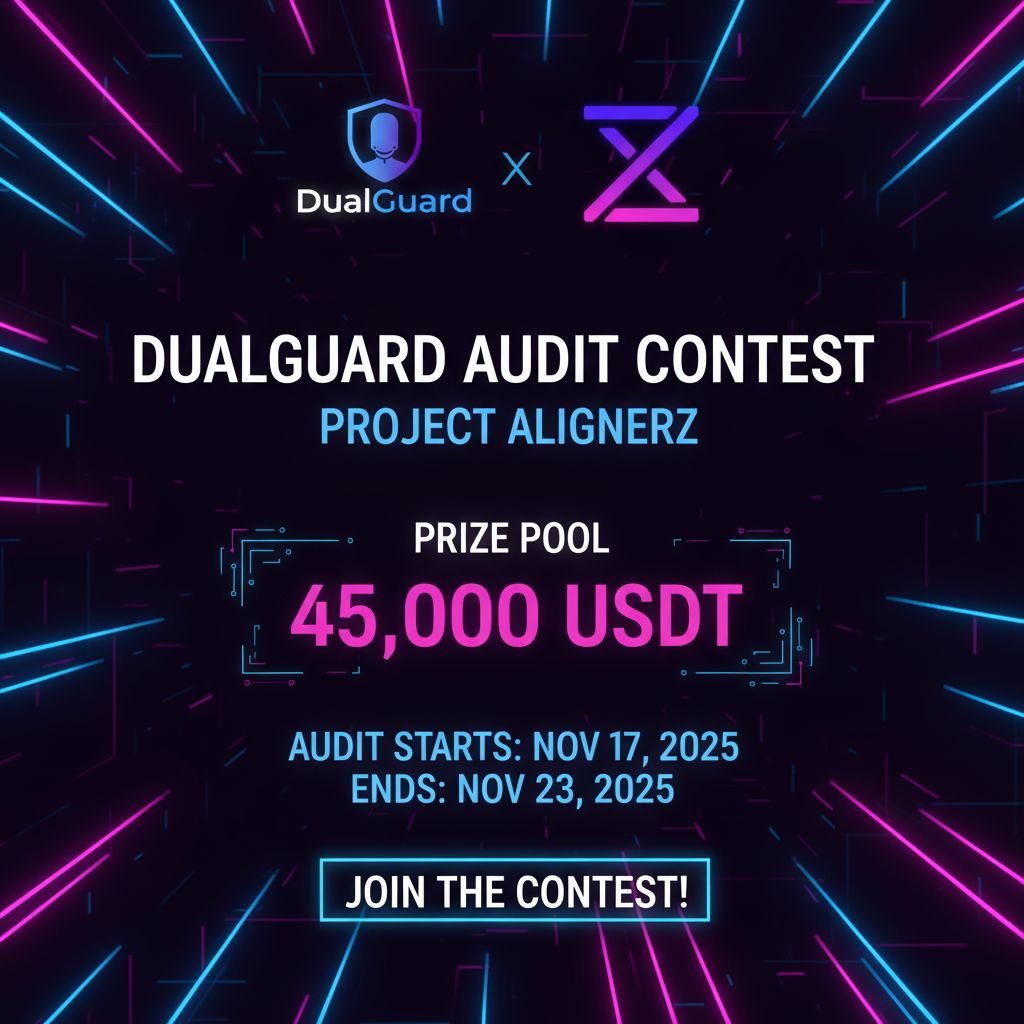
📢 Calling all Web3 security researchers
Our first audit contest will start soon⚡️
🗓️ 17/11 → 23/11 — 18:00 CET
Protocol: @Alignerz_
Type: Token launchpad
Solidity (~1500 nSloc)
💰 Prize Pool: 45,000 USDT
H/M: 20k • L: 3k
LSG1: 6k • LSG2: 6k
Winner Bonus: 7.5k • Judge: 2.5k
Think you can secure the codebase?
Join the contest: discord.gg/UxrgEnbY
💂🏻♂️ Two Senior Guards are already in place.
Can you rise to challenge them?
15
29
131
19,188
Yeay, I have received reputation points and increased my rating on the leaderboard on @HackenProof hackenproof.com/ #hackenproofed #bugbounty
1
40

We’ve partnered with @rippleXDev to launch a $200,000 Attackathon helping secure the proposed XRPL Lending Protocol.
This is a time-boxed, adversarial competition to identify vulnerabilities before the protocol reaches production.
9
62
235
183,061
Rbd3 retweeted
3 Oct 2025
We are attaching an unprecedented opportunity to the @centrifuge contest starting October 20th.
For the first time, the winner of a Sherlock audit contest will earn an immediate invitation to join Blackthorn, regardless of their current ranking on Sherlock's leaderboard.
This is a unique chance to join the most elite group of security researchers in the world.

7
8
101
10,936
Rbd3 retweeted

21 Sep 2025
Many beginners in Web3 say, “This is hard, I don’t get it.”
Truth is, everyone feels that way at first.
Great auditors didn’t quit - they showed up daily, stayed consistent, and kept learning.
It’s not just hard for you. It’s hard for everyone.
Keep going.
12
12
116
3,252
Rbd3 retweeted

19 Sep 2025
You don’t need a mentor.
Newcomers often ask me if I can mentor them, if they actually need a mentor, or how to avoid the common pitfalls.
Here’s my view: what you really need is an Advisor.
I’ve tried (and still do) helping a few people fully switch into Web3 and grow properly. The clear pattern I see: only the ones putting in the hours actually succeed.
They don’t ask me about every tiny step. They try, they get stuck, and when they’re at a dead end - that’s when I step in. Sometimes a single sentence from me saves them days.
In all other cases, you need to hold yourself accountable, keep working for your future, and believe in yourself.
I saw the same thing years ago when I was helping people break into Web2 - friends, people from groups, etc. It always came down to this: if you’re not putting in the hours and truly pushing for it, you won’t make it.
4
7
73
4,246
Rbd3 retweeted

18 Sep 2025
If you want to progress faster, you need to shorten the feedback loop.
Just by reflecting on your work and asking why you did/didn't do what you did, you will learn a ton.
Your growth is on the other side of your ego.
2
8
74
2,392
Rbd3 retweeted

17 Sep 2025
When I first began participating in public competitions in early 2025, I, like many beginners, would simply ask an LLM what mistakes and vulnerabilities it saw in a particular function or contract. This is fundamentally the wrong way to use an LLM.
LLMs very often hallucinate when you ask them to draw conclusions or analyze code for vulnerabilities. Any answers that involve reasoning and analysis should be treated with skepticism. In the vast majority of cases, such answers will be incorrect.
I remember an LLM claiming that if, in some function, we transfer tokens to an external address but later during the function’s execution a revert occurs, then the transferred tokens would get stuck in the external contract. Of course, if you already have some experience and understand that a function does not execute in parts and that if a revert happens no changes are applied, no tokens are transferred, and nothing gets stuck, then you can see that the LLM is hallucinating.
But you need to already have some experience in how the blockchain works and at least a basic understanding of Web3 security to work with LLMs.
Use them as a sort of protocol developer, because they do a good job understanding what code does.
And don’t use them as security researchers, because they have a limited grasp of smart contract security and can only find the most obvious vulnerabilities (at least given the current state of LLM development).
4
3
43
2,227
Rbd3 retweeted

10 Sep 2025
The top auditors I've interviewed all had one thing in common: a period of absolute failure. Arsen failed for 5 months straight. Flint was out-earned by a McDonald's worker. What's your excuse?
9
9
105
4,258
Rbd3 retweeted
26 Aug 2025
Researchers. The @ethereum Fusaka Audit Contest and your chance at rewards of up to $2,000,000 is almost here.
Mark your calendars for September 15th.
92
47
490
251,960
Rbd3 retweeted

9 Sep 2025
🫡 some really great interesting findings in this behemoth of a report!
Many will feature in the upcoming Uniswap V4 deep dive article.
Becoming something of a specialist. DM for Hook audits.
Excellent as always working with @0xStalin @alexzoid
9 Sep 2025

ġȀShout out @giovannidisiena @0xStalin @alexzoid fantastic work on Uniswap V4 Hooks audit finding:
* 6 Crit
* 13 High
* 11 Med, 15 Low
* 29 Info, 26 Gas
Set new all-time high for longest @cyfrin report at 123 pages!
Client fixed everything - amazing value provided💪

4
2
23
5,013
Rbd3 retweeted
8 Sep 2025
Only 7 days until the start of the @dango DEX Audit Contest and $100k in rewards!
Set your alarms, auditors.

6
1
30
2,337

Be twice as collaborative as you are competitive in web3 security
While many auditors start with contests where it's a bit zero-sum, PvP style, learn as soon as possible to collaborate with others. It will take you places you could never reach alone, trust me on this🫡
15
10
170
6,464
Rbd3 retweeted
29 Aug 2025
By trying to block AI reports, you risk undermining the very system that allows beginner auditors to gain experience - the same system that has helped many of today’s top auditors, who now advocate for paid submissions, reach the level they have achieved.
Creating a financial barrier to contest participation cuts off many newcomers who can only gain experience through public competitions. In effect, this monopolizes the smart contract auditing industry, blocks the path for beginners, and ultimately hampers the growth of the entire web3 security ecosystem.
AI reports are easy to identify, and I doubt judges spend much time on them. Judges are well-compensated for their work, and if reviewing a few hundred AI reports is required, so be it.
A practical way to reduce the number of AI reports would be to limit the number of reports each auditor can submit. @jack__sanford @sherlockdefi
29 Aug 2025

The time has come for this conversation.
What should be the fee to submit a finding in an audit contest?
4
9
38
5,217