
Joined October 2022
- Tweets 596
- Following 668
- Followers 119
- Likes 11,291
18 Photos and videos















American Tezolution retweeted

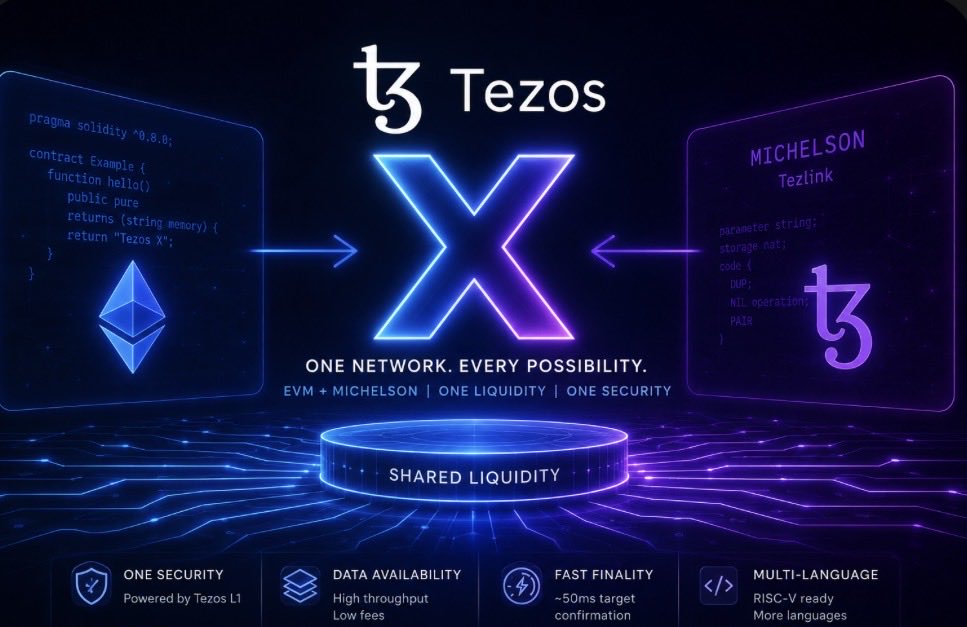
Tezos X: The Most Ambitious Upgrade in @tezos History
While most blockchains are still debating which programming language or virtual machine is best, Tezos is taking a different approach — bringing everything together into a single ecosystem.
4
22
42
767

American Tezolution retweeted

Jun 9
Gold is familiar. Uranium is becoming better understood. But what about the materials sitting underneath energy, manufacturing, defense, and modern technology?
This week on TezTalks Radio, Ben Elvidge joins us to discuss Metals.io, a platform bringing physical commodities like gold, uranium, and strategic metals into a more accessible ownership model.
We explore access, custody, redemption, and what it takes to connect real-world materials on modern financial rails like Tezos.
1
13
50
649,378
American Tezolution retweeted

Jun 10
Reject the man cave.
Embrace the personal library.

307
510
9,598
272,390
American Tezolution retweeted

Jun 8
TEZOS PROPOSES TO BURN 11M XTZ YEARLY VIA L2 FEES, STORAGE AND FOUNDATION REWARDS, CUTTING INFLATION OVER 26% $XTZ
7
7
44
2,110

American Tezolution retweeted

Everyone's racing to add privacy. Tezos shipped it at the protocol level.
Sapling brings native zero-knowledge shielded transactions to Tezos. Built into the protocol. Available to every token.
Shield Bridge is the front door.
shieldbridge.xyz
#Tezos #XTZ #ShieldBridge
16
40
1,042
American Tezolution retweeted

May 29
NEW: Tezos X is aiming to overhaul scalability and developer experience across the @tezos ecosystem.
The Layer 1 race is no longer just about speed.
Developer tooling and ecosystem usability are becoming major advantages.
$XTZ trying to make a comeback?
hubs.li/Q04jdgJM0

7
29
568
American Tezolution retweeted

May 28
👀👀👀
May 28

#Xtz
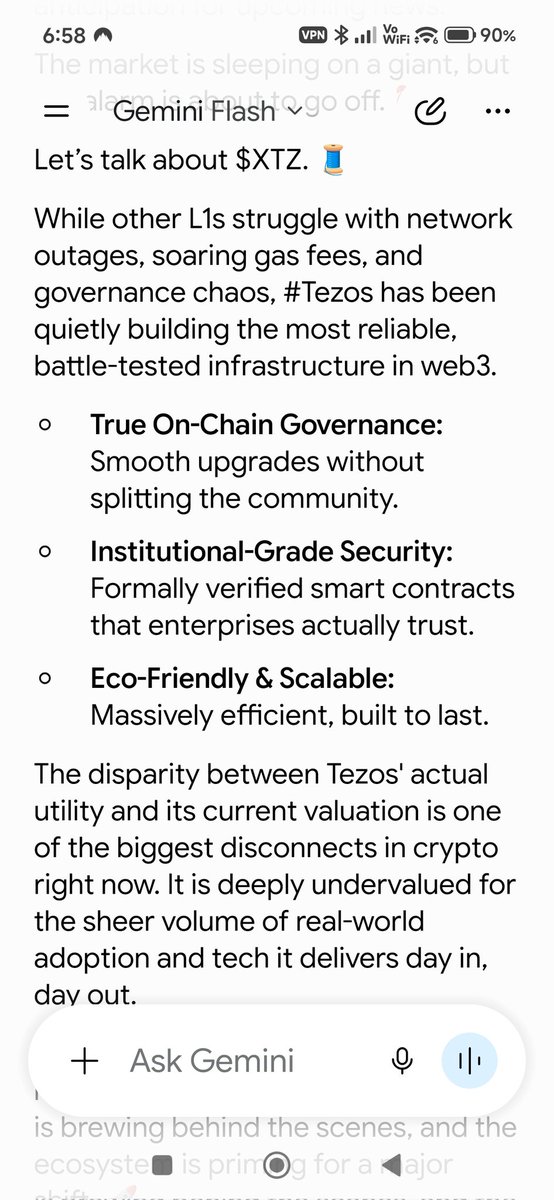
The market is sleeping on a giant, but the alarm is about to go off. ⏰
Let’s talk about $XTZ
But the quiet accumulation phase is hitting a turning point. Massive news is brewing behind the scenes, and the ecosystem is priming for a major shift. 🚀
#Tezos #Crypto #Web3
1
3
15
804
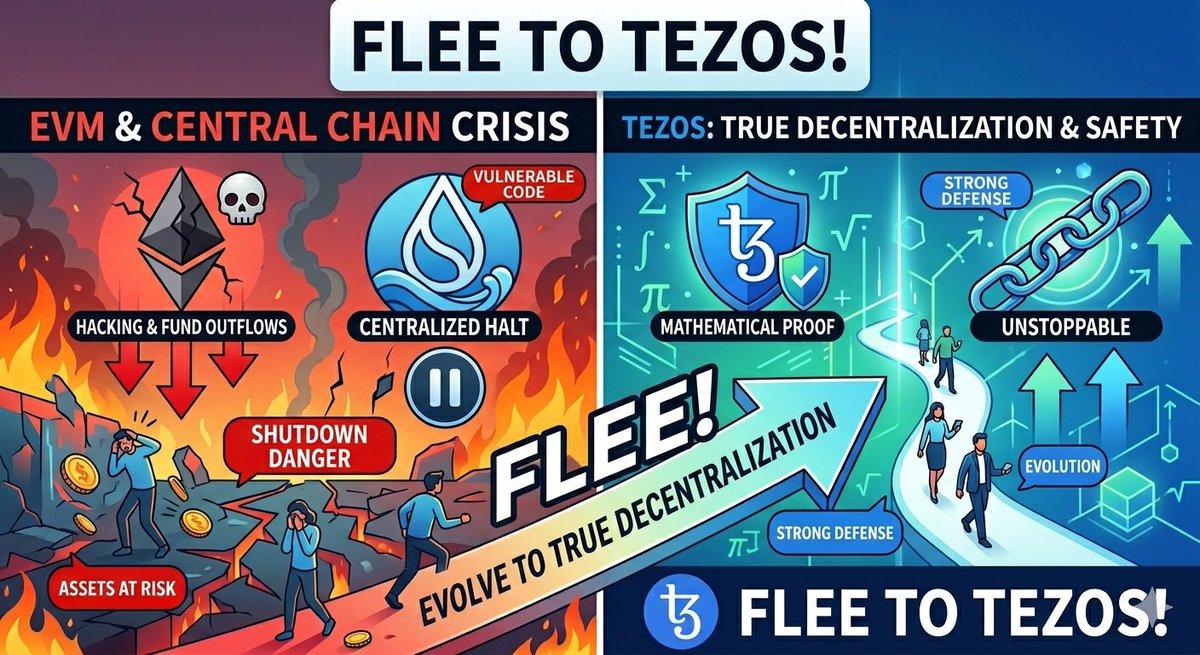
ethereum:native /EVMs bleed to hacks. sui:native & solana:So11111111111111111111111111111111111111112 halt. Stop risking capital!
Flee to Tezos for institutional-grade security.
#CryptoNews #RWA tezos:native bitcoin:native
1
4
16
295
TezosX's sub-second finality and atomic composability transform money into a continuous fluid.
Capital streams so efficiently that traditional markets appear frozen.
True thrill is watching human greed helplessly struggle to keep up with the speed of pure mathematics.
$XTZ

5
16
238

American Tezolution retweeted

May 14
BREAKING: 🇺🇸 Senate Banking Committee PASSES the Clarity Act in 15-9 vote.
The bill now goes to the full Senate.
464
3,721
20,275
1,006,001

To all our Am Tez stakers and delegates, our ISP has been experiencing seriously degraded performance after a recent software update. All is well on our side, but our ISP has a clogged pipeline right now. We are working to fix the problem ASAP. Once we're fully up again we'll suspend our fees for a while to compensate your patience. Thanks!
3
46
American Tezolution retweeted

May 1
Tezos X debate: speed matters, but a centralized sequencer makes Tezos compete as a worse centralized rail. Delayed inbox protects eventual liveness, not normal UX; outages still hurt. “Decentralize later” risks locking in speed-first politics.
forum.tezosagora.org/t/tezos…
2
5
15
537

The Tezos X roadmap is about to become reality.
First up: one execution layer, two interfaces - EVM and Michelson apps on a shared ledger, composing atomically in a single transaction.
No bridge between them. No fragmented liquidity.
spotlight.tezos.com/tezos-x-…
8
45
112
6,037
American Tezolution retweeted

Apr 28
🚀 @tezos is launching the Tezos X testnet soon.
The upgrade brings EVM Michelson smart contracts onto one shared ledger — fully composable with no bridges or wrapped assets.
#Tezos says throughput has scaled to ~1300 TPS with millisecond latency. 👏 blockster.com/tezos-x-brings…
108
225
283
22,062
🗞️ News, launches, and updates across Tezos.
All in one place.
🔗 Explore Spotlight: spotlight.tezos.com/
6
24
85
3,289
American Tezolution retweeted
Apr 27
Delegation Had Its Day
Delegation was invented to solve a real problem. Before native staking existed, the only way for small tez holders to participate was to delegate to a baker. No lock-up, no slashing risk, no running infrastructure. Just point your address at a baker and earn a little something. Elegant. It onboarded thousands of holders into Tezos.
That era did its job.
Your vote costs too much
Technically, you can vote. Practically, exercising that vote means changing bakers. If you’re staked, changing delegates also disrupts your staking setup: your stake is automatically unstaked from the old delegate, then you wait through the unstaking flow before staking elsewhere. For a mere proposal disagreement, things get messy for everyone.
Your baker votes for you on every proposal. Whether you agree with them or not. If you disagree, your only protocol-level option is to leave — move your delegation or disrupt your staking relationship. That is not meaningful voice. It is governance by costly exit.
On-chain governance is Tezos’ core differentiator: more than twenty protocol upgrades, zero chain splits. But it’s fragile. Governance voting weight is concentrated in baker addresses on behalf of people who may never look at a governance proposal. That works fine until it doesn’t. It is still real governance, but the accountability mechanism is too coarse: if you disagree, your main tool is exit.
This isn’t about tearing down what works. It’s about adding a safety net — one that doesn’t change the upgrade cadence, doesn’t slow progress, and doesn’t require anyone to participate who doesn’t want to. If everyone still lets their baker vote, the chain upgrades exactly as it does today. The difference is that when someone does care enough to show up, they can vote without upending their entire staking setup.
The fix: give everyone a direct vote
Delegators and stakers should be able to cast votes with their own tez weight on any governance proposal. That requires protocol work; it is not just a wallet feature. But the rule should be simple: for tez the protocol can attribute to an individual holder, one tez gets one vote, whether that tez is staked or delegated. If a holder votes, their weight counts directly. If they don’t, it flows to their baker as it does today. The baker votes only with unclaimed weight.
In practice, most won’t vote on most proposals. But the value is in the option, not the activation rate. A baker who consistently votes against their community’s interests already faces reputation risk and delegation flight. This would add a sharper, less destructive check: holders could dissent on a proposal without leaving an operator they otherwise trust.
This decouples two things that have become too tightly coupled: consensus (run the infrastructure, secure the chain) and governance (what should this protocol become). Baking is technical, but in Tezos it has always been political too. That is exactly the problem. Concentrating both roles in the same addresses creates a principal-agent problem that worsens as the network grows.
Right now, the cost of dissent is total: change bakers or unstake. You might trust a baker’s infrastructure completely while fundamentally disagreeing with their governance positions. Forcing people to choose between competent operations and political alignment is a false dichotomy. Dissent should cost a click, not a migration.
Now about the money
With governance voice sorted, the second question: should delegators still earn yield from protocol emissions?
As of April 27, 2026, TzKT showed stakers holding about 28.44% of supply and delegators about 30.52%. Staker APY was roughly 8.7%; delegator APY roughly 2.9%, depending on baker fees, performance, and reward policy. Those figures move, but the structure is stable: stakers lock tez, accept slashing risk, and directly strengthen consensus. Delegators keep liquidity, avoid slashing risk, and contribute only indirectly through their chosen baker.
The consensus math reflects that difference. In Tallinn, staked funds count three times delegated funds for baking power. Delegated tez still matters; it helps allocate weight across bakers and can support smaller operators. But it is weaker security than staked tez, and the protocol should not pretend those contributions are equivalent.
Delegators chose liquidity and zero slashing risk. Legitimate choice. Some are active in DeFi, farming on Etherlink, buying art on objkt. Some are institutions, treasuries, cold-storage holders, or cautious users who cannot or will not accept staking complexity. None of that is illegitimate. But protocol participation rewards should pay for protocol security. If liquid tez is productive elsewhere, let it be productive elsewhere. The protocol does not need to add an issuance subsidy on top of that liquidity preference.
After reform, participation rewards flow to the people actually securing the network. Depending on migration and adaptive issuance compression, staker APY could rise materially — perhaps toward the 10–12% range under some assumptions — without increasing total issuance. No magic. Just fewer rewards paid to non-staked balances.
Every holder faces an honest choice: stake (lock up, accept risk, earn yield, vote directly) or delegate (stay liquid, earn no participation rewards, free to deploy in DeFi — and still vote directly). Once enshrined liquid staking ships, you’ll also be able to stake through sTEZ while staying liquid, though without governance weight by design.
This reform does not magically solve plutocracy. One tez, one vote still means large holders matter. Custodians, exchanges, wallets, and governance UIs can become new centers of influence if the ecosystem is careless. The point is narrower and more achievable: fix principal-agent capture. Let holders override baker votes without forcing them to migrate their entire staking or delegation relationship.
The questions that matter
Sell pressure. Removing roughly 2.9% yield from about a third of supply will spook some holders. Some will migrate to staking. Some will exit. That’s real. It should not be hand-waved away. A cycle-based taper would be healthier than an overnight cliff. But the alternative is paying participation rewards for security that is only weakly provided — its own cost in dilution and misaligned incentives. Short-term pressure from capital primarily optimizing for passive protocol yield is better than long-term bloat from emissions that do not buy much security.
Enshrined liquid staking. No longer hypothetical. Ushuaia includes sTEZ on testnet, with mainnet activation behind a feature flag: trustless, protocol-native, no admin key, stake distributed automatically across participating bakers. The current design specifies that liquid stake carries no voting power — the right call. Ethereum has wrestled with Lido’s dominance for years. Tezos has the advantage of building governance-neutrality in from the start. If sTEZ reaches mainnet — currently targeted for Protocol V, not guaranteed — the constraint must hold: no bloc voting, no governance weight through liquid staking derivatives.
That does create a tradeoff. A holder who chooses pooled liquid staking may give up direct governance on those tez because the protocol can no longer treat them as an individually attributable voting balance without creating a liquid governance cartel. That is not a contradiction. It is the price of keeping pooled derivatives from becoming political machines.
Why this matters
Delegation was a bridge. It got us here. But the chain has changed, and delegation’s role should change with it.
We now have native staking with real lock-ups, real slashing, and real security contribution. An active DeFi ecosystem that gives people productive uses for liquid tez. And a governance system where most participants have no direct voice.
Give every directly attributable tez holder a vote. Stop paying participation rewards to passive delegation. Let economics reflect actual security contribution and governance reflect actual stakeholders.
Delegation was the bridge. Native staking is the destination. Time to walk across.
3
8
24
940