
Joined November 2010
- Tweets 24,850
- Following 1,451
- Followers 1,479
- Likes 7,137
1,270 Photos and videos


Craig Weinberg retweeted

22 Nov 2025
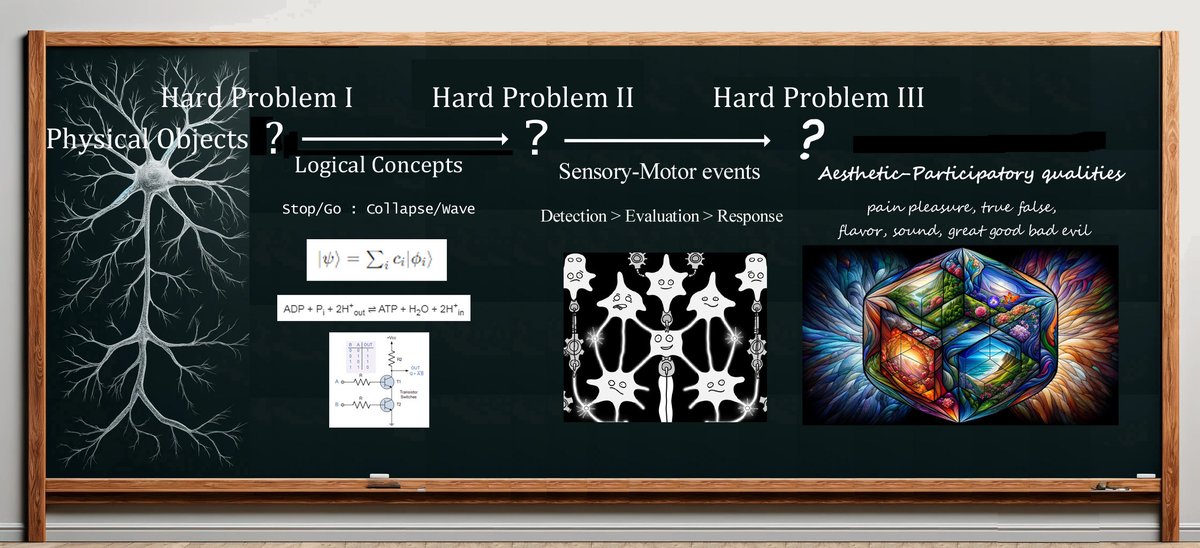
That doesn't explain the nature of what is being accessed or how access is accomplished. That is the more important issue. What is accessed is an aesthetic-participatory phenomenon. It is not mass-energy or information-process, which are the antithesis (mechanical-automatic).
1
1
1
229

6 Oct 2025
Its all still patterns of mechanical effect though, not aesthetic quality.
Critically important to understand those patterns for medical purposes, certainly, but (1) the hard problem isn't addressed, and (2) AI makes (1) really important.
5 Oct 2025

Thanks Michael
We’re not necessarily disagreeing. Membranes by themselves can generate field patterns, e.g. via interference. If you squeeze axoplasm out of an axon, like toothpaste from a tube, and replace with saline, the axon still fires due to membrane ion channels. But I don’t think axonal firings are conscious. They’re not affected by anesthesia. Consciousness happens collectively at end integration (end orchestration) in somatic microtubules and triggers firings. There’s more fine scale quantum processes involved at higher frequencies. Those are probably generating patterns and fields at finer scale, and holographically. We know megahertz and gigahertz can regulate axonal firings, so they may be at play in embryogenesis. A deeper level. Maybe conscious. Have you looked for megahertz in endogenous patterns?
2
221
20 Aug 2025
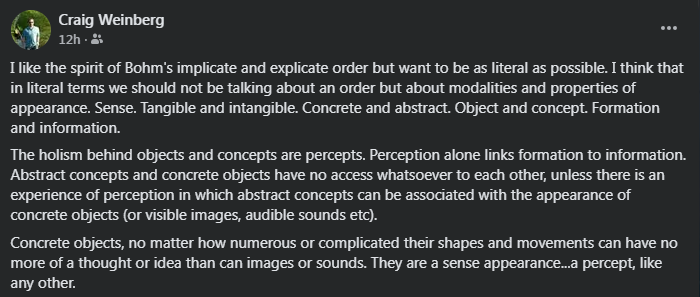
A body is a geometric object composed of smaller objects (cells > molecules > particles). Objects are tangible appearances within a conscious experience.
A person is not a body, they are a conscious experience of percepts, thoughts, memories, etc extending beyond tangibility.
20 Aug 2025

Why are these different:
"Groups do not act; only individuals act"
"Human persons do not act; only human cells act"
1
3
399
20 Aug 2025
The behavior of objects (tangible formations) is limited to changes in their geometry - location and shape.
We attribute those changes to physical forces, which are automatic and inevitable or random but also purely geometric. Movements are the sum of the forces present.
1
1
180
20 Aug 2025
Some other types of percepts (incl subjects & concepts) are not tangible or geometric and are not formations.
Concepts contain information but both are intangible and unrelated to physical processes used to store or erase physical changes that subjects find informative.
1
129
18 Aug 2025
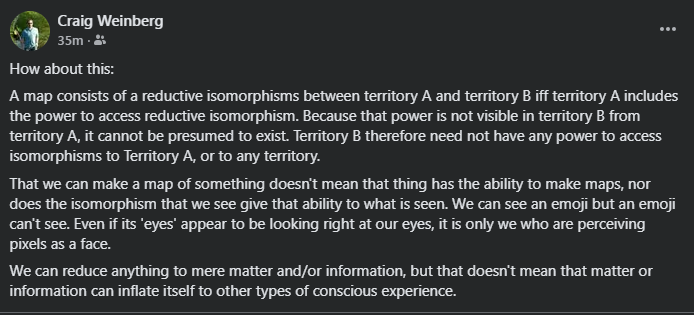
"Mapping" is not physical.
Electromagetic 'interaction' is particle movement, not thought.
Physical phenomena are concrete, tangible, formations in public space. Moving shapes/fields/forces. Nothing else. Causally closed = no emergence.
18 Aug 2025

There is nothing in the universe that is non-physical. Even concepts and thoughts are electromagnetic field interactions and chemical pumps and ion flows.
What we call 'the abstract' are patterns that describe the consistent and relevant system dynamics of a thing as it relates to our intentions, but these always have a physical implementation.
So what is abstraction then? It means there is some mapping between the electro-chemical interactions in my head, to whatever physical dynamics in some thing, to the electro-chemical interactions in some other persons head.
That's really the premise of language to begin with, that two people can have the same idea in their head and this idea consistently refers to some external phenomenon. Which neurons fire up and the pattern connectivity in each persons brain is wildly different, but, so long as the reference is consistent its all good.
None of this is interesting or useful imo.
1
1
188
12 Aug 2025
I don't think that qualia are subjective, I think that subjectivity and objectivity are ways of categorizing qualia.
'What it is like' is a meaningless folk idiom. Qualia are aesthetic-participatory phenomena.
12 Aug 2025

Any theory of consciousness should account for qualia, the subjective "what it's like" qualities of experience, as this addresses the core of the "hard problem" of consciousness … why do physical processes give rise to these subjective, first-person phenomena at all?
2
193
6 Aug 2025
It's not that everything is conscious, it's that conscious experience is what existence consists of. All 'things' are appearances in perception.
The utility of understanding that is beside the point. The universe doesn't need to be useful to us.
6 Aug 2025
I think human and octopus consciousness would have some common features as both are based on microtubules in my view.
AI consciousness based on computation is fantasy I think.
I do agree panpychism is not useful. Consciousness is a process, sequences of collapses of the wavefunction. What is needed is quantum pan-protopsychism.
Panpsychism has the combination problem and epiphenomenalism problem, easily addressed by quantum
pan-protopsychism. See Mike Wiest article in Neuroscience of Consciousness
academic.oup.com/nc/article/…
1
5
217
13 Jul 2025
3 is false
Software and logic exist only as abstract concepts in our intellectual experience. They have no effect on objects. All hardware is changed by mechanical or electromagnetic force alone. Software is compiled out of existence before it ever touches hardware.
13 Jul 2025

(1) Software is abstract and immaterial.
(2) Hardware is physical; material.
(3) Software and hardware causally interact.
(4) [left as an exercise to the reader]
2
243
11 Jul 2025
Just the opposite. Consciousness is the continuing experience. Neurological appearances are a rendering of consciousness on a subpersonal scale. We do not exist on that scale. The mistake is in presuming that one scale is more real just because of its objectified appearance.
11 Jul 2025

Consciousness feels continuous, but it arrives in bursts. The illusion of a steady stream comes from stitching those moments together
1
2
274
11 Jul 2025
Nothing is being 'stitched together'. Wholeness is conserved from the top down. There is no top or up from the bottom perspective. Nowhere to do any stitching or view the 'together' product from. That would invoke a homunculus above the top.
1
103
9 Jun 2025

1
212
Craig Weinberg retweeted
5 Jun 2025
As far as I can tell, energy is a heuristic abstraction that gives us numbers to use in equations to predict and control how matter moves matter. I think nature is sensory-motive all the way down & E is tangible motive > motor effect.
multisenserealism.com/2016/0…
1
2
280
Craig Weinberg retweeted

26 May 2025
Walter Cannon: “life is whatever can be anesthetized”
J. C. Bose: hold my drink, while I anesthetize metals and such.
"Response in the living and non-living" by Bose, Jagadis Chandra
archive.org/details/response…
ecologise.in/2018/11/13/j-c-…
"He once invited Sir Michael Foster, a veteran physiologist at Cambridge, to witness the electrical response of a poisoned piece of tin (as written by Patrick Geddes in archive.org/details/lifeandw…):
“Come now, Bose, (said Foster) what is the novelty in this curve? We have known it for at least the last half-century.”
“What do you think it is?” asked Bose.
“Why, a curve of muscle response, of course.”
“Pardon me; it is the response of metallic tin.”
“What!” said Foster, jumping up. “Tin! Did you say tin?”
27
60
349
19,906
8 May 2025
Why wouldn't that coordination occur unconsciously, using the same kinds of biochemical mechanisms presumed to coordinate complex processes in every other body organ and complicated material phenomenon in the universe?
8 May 2025
Consciousness is not an epiphenomenon—it performs real work. It enables coordination across brain regions that would otherwise remain isolated, creating a unified cognitive moment.
4
304
9 Apr 2025
7 Apr 2025
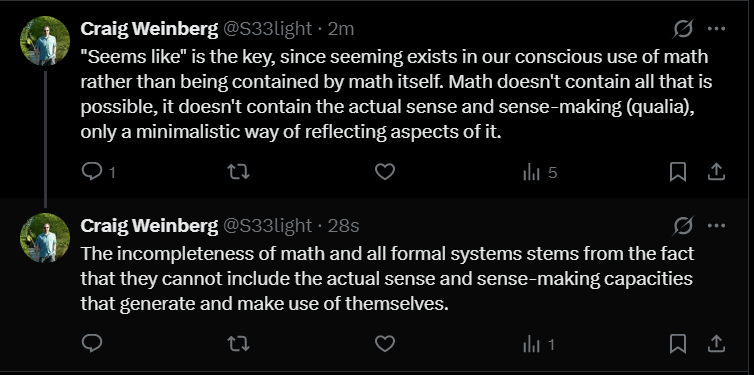
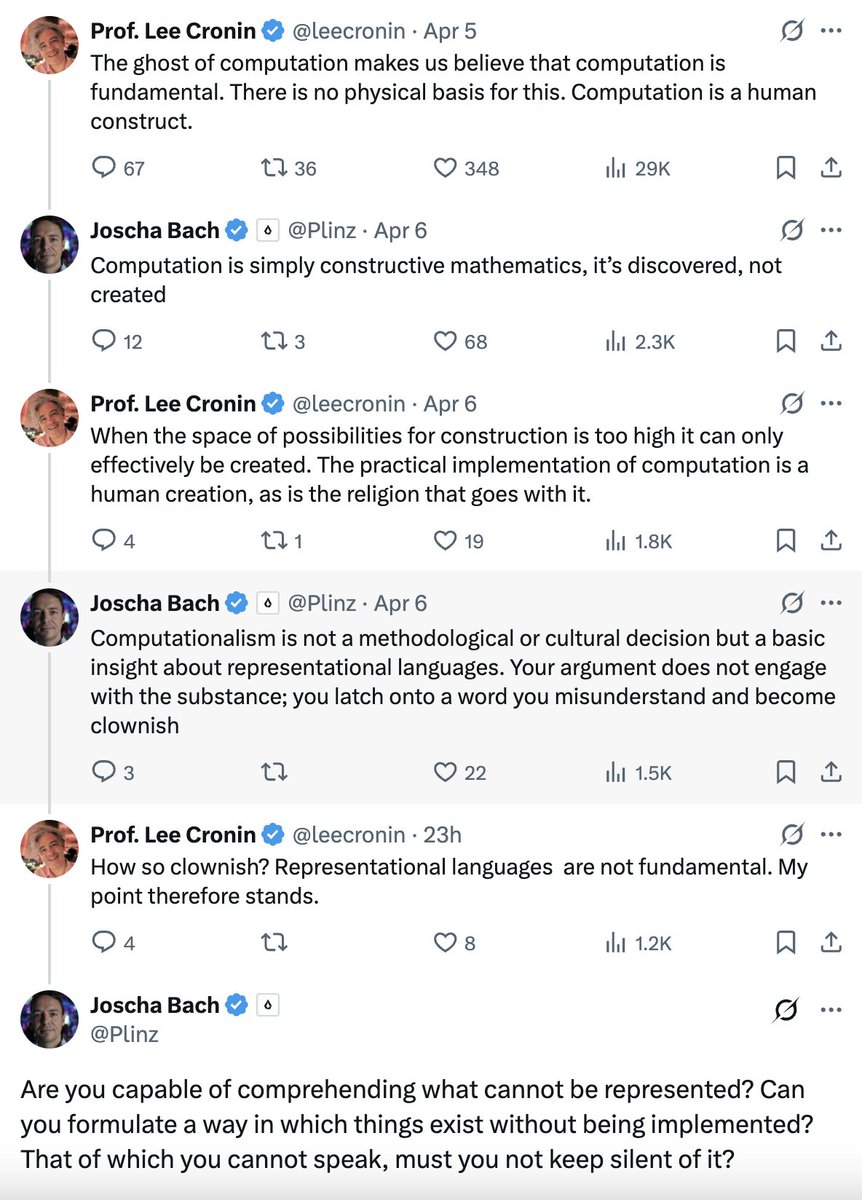
Mathematics seems like the container for all that is possible, but there is no single 'self-consistent' mathematical universe, rather it describes all possible universes and all possible configuration of their laws, principles, and physics.
Computation on the other hand is some universal translatable process. If something is computable, it can be computed by anything that computes. Computability is like the minimum feature set of a mathematically possible universe to process information.
Thoughts might be the representational correlate of some physical process, but they don't seem confined to a single mathematical universe or coherent representational language. Dreaming seems like an alternate reality that obeys a different physical rule-set and causal logic that nonetheless helps accelerate learning for our waking lives.
The mind seems to wander across possible mathematical universes, borrowing from different ones to carry out different kinds of information processing tasks.
1
317