
If you are aware of our unprecedented situation and ongoing dystopic exploitation, also be aware of the resources newly available to humanity, to counter it.
Joined June 2009
- Tweets 70,752
- Following 1,000
- Followers 3,831
- Likes 66,951
3,328 Photos and videos










Pinned Tweet

The attack on the common citizen should be obvious now. Find your allies, cooperate to achieve higher group efficiencies of securing existential resources, share knowledge and tools. Plan for emergencies. Our material situation wasn't getting better and now, it will get critical.

We will move in sufficient numbers, from pointlessly trying to convince people they are victims of propaganda, to allying to build cooperative processes, to support our survival and lead by more equitable, sustainable examples, or with the propagandized, experience the same fate.
1
1
8
1,381
Create Alliances for Better and Prepare for Worse. retweeted
In my view, the Iranians simply must understand that there will be more serious warfare to conduct before the US withdraws its forces from the region, and Israel withdraws from Lebanon.
That is why they are demanding their frozen assets in cash. Up front. Immediately.
34
207
1,152
25,369
Create Alliances for Better and Prepare for Worse. retweeted

Israel now has 5 days to figure out how to torpedo this deal. Which is 4.89 more days than they need.
33
28
441
7,418
Existential Depression
This may clear something up for some people.
facebook.com/share/v/17r3c5p…
16
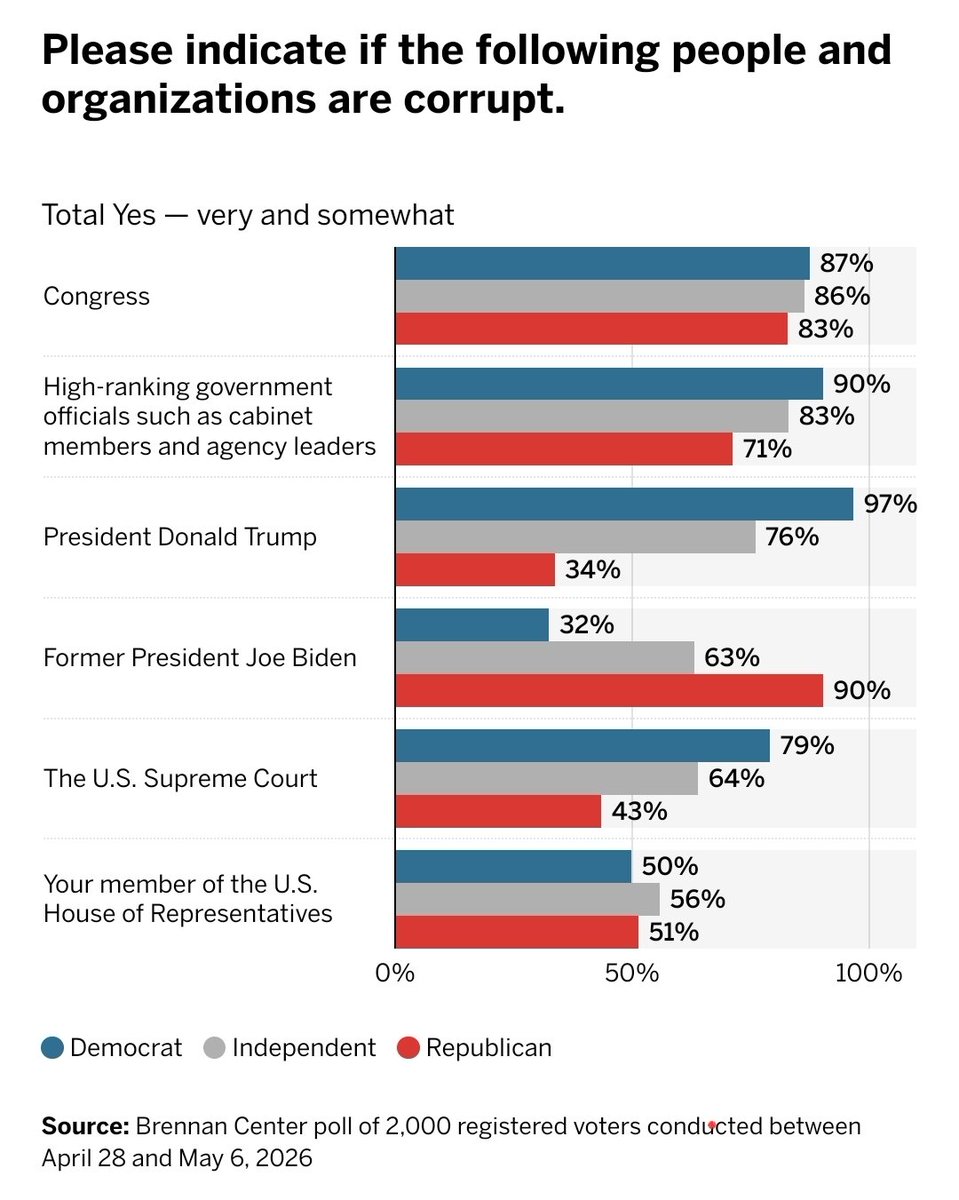
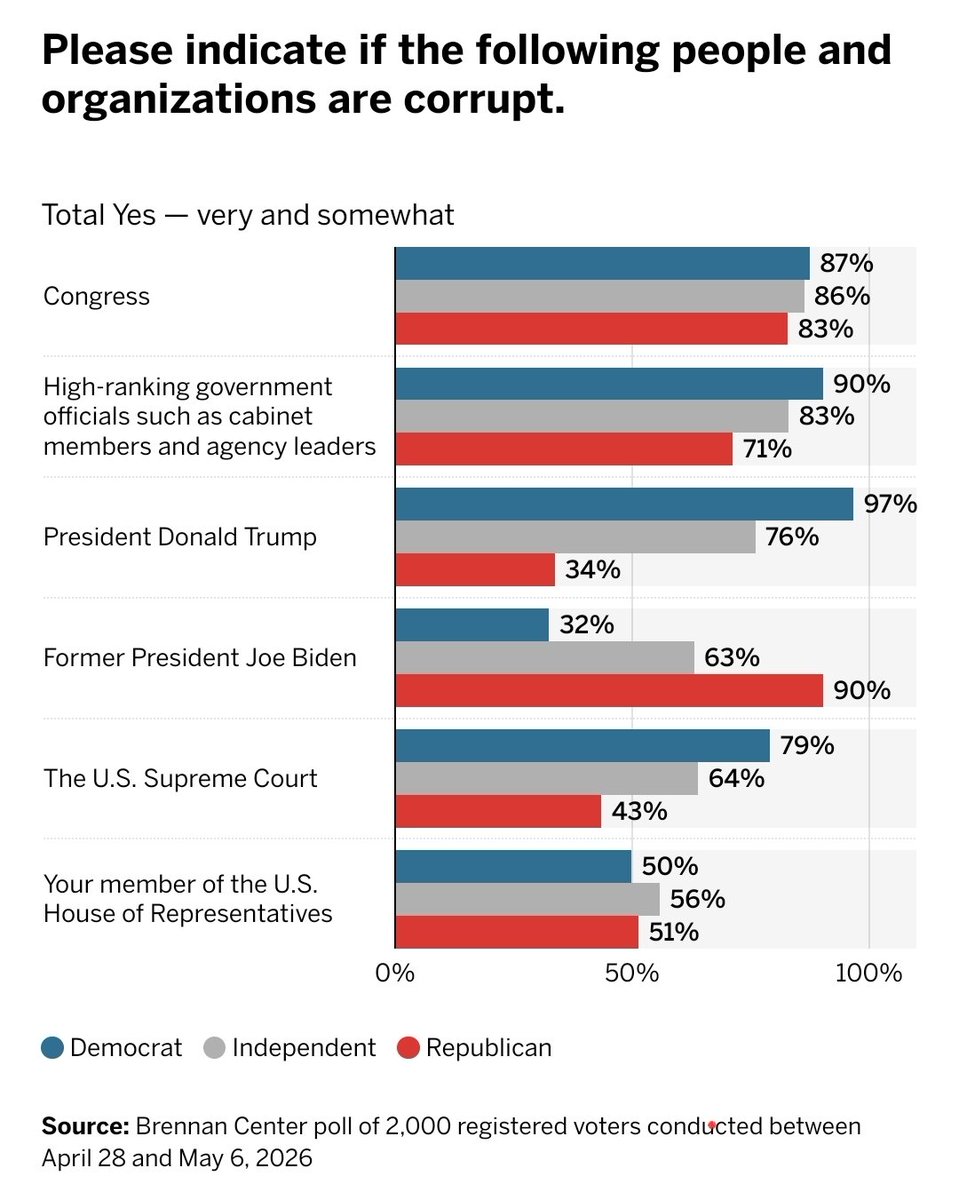
The real story here is how many STILL support him.
We'll leave your other "choices" who have been and still will be, catering to the same parasites who got us here, to those who'll be documenting our collapse.

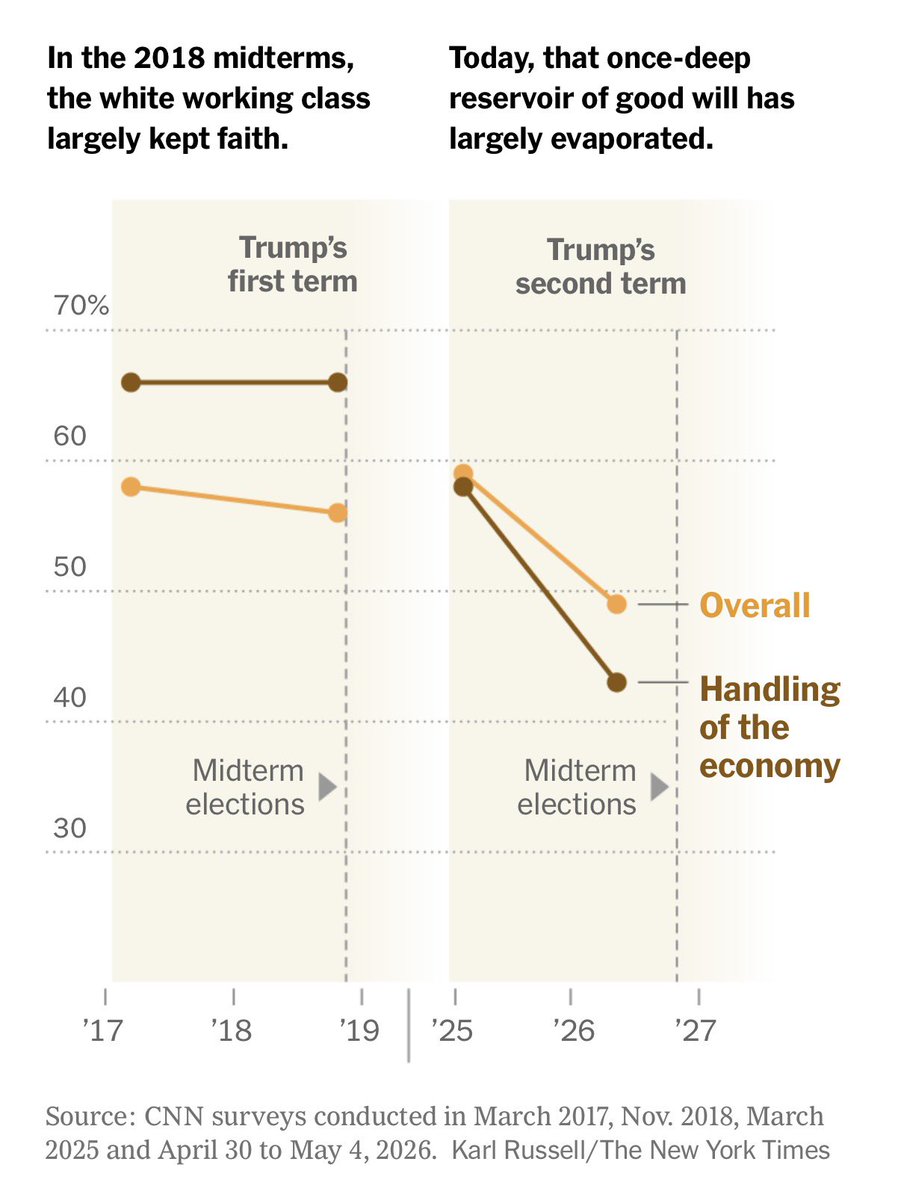
The New York Times finds that Trump is losing ground with white working class voters in 2026 compared with 2018.
Link to article: nytimes.com/2026/06/13/us/po…
28
WHO'S NEXT on the culling sliding pond?
Oh, don't worry. They won't have to drop bombs on you. Many more options, some obviously already in play, are available.
Jun 13

Life expectancy in Gaza has dropped from 75 years to 35 year, apart from on going genocide, denial of health care, food, disease, infections, people bleeding to death after a small wound.
It is all planned, manmade and designed by the state of Israel.
23
“This is actually fine and normal because words words words words words words words.”
Yes. And now, it's obvious words won't stop them. Years in, is it not?
Rationality and logic clearly leave two alternatives. What will, or accepting it and doing your best to prepare for worse.
Jun 14

The World’s First Trillionaire Is Not Your Friend, And Other Notes
It’s so pathetic watching Elon Musk’s groveling bootlickers fall all over themselves on social media to defend their favorite oligarch from criticism as he becomes the world’s first trillionaire.
They’re like “Don’t be mean to the trillionaire, just become a trillionaire yourself! All you need is luck, connections, wealthy parents, the ruthlessness to step on anyone who gets in your way, and a willingness to cooperate with murderous imperial institutions like the Pentagon and the CIA!”
Elon Musk is a military-industrial complex plutocrat who is balls deep in the US intelligence cartel and recently facilitated the US-Israeli regime change operation in Iran. You have infinitely more in common with the average person in Iran, Cuba, Lebanon or Palestine than you have with the world’s first trillionaire.
It’s so gross how many fawning admirers this freak still has. The trillionaire is not your friend.
❖
People who say “Zionism is just the belief that Jews should have a homeland” are hilarious. Zionism isn’t some abstraction; we can all see its material manifestations with our own eyes. We can all see that Zionism means genocide, apartheid, and nonstop wars and abuse.
This isn’t some kind of theoretical debate where we all get to have our own opinions about what Zionism is and what it entails. It’s 2026, not 1890. The facts are in and the case is closed, kids. This is what Zionism is. This is the only Zionism in existence. What you see is what you get. And what you see is quantifiably one of the most evil things happening on our planet.
❖
Some guy told me, “Why are you fine with the existence of approximately 50 Islamic nation-states, but the single Jewish one is apparently too many?”
I showed him an illustration of a nail stuck in somebody’s foot and said, “Why are you fine with an entire foot made of flesh, but a single metal spike is too much? The only possible explanation is that you have a seething hatred of metal. It can’t possibly be that you object to a foreign object being violently forced into a region where it does damage.”
He got upset and wound up telling me he hopes I get murdered by Mossad.
❖
Hasbara is so gross because it’s just Zionists throwing walls of language at you to convince you you’re not seeing what you’re seeing.
You see raw video footage of the most horrifying thing imaginable in Gaza, and then you see them in the replies going “This is actually fine and normal because words words words words words words words.”
You see a news report about Israel doing something astonishingly evil in Lebanon, and there they are underneath it going “There’s actually a lot more to the story because words words words words words words words.”
You see some far right Israeli minister spouting nakedly genocidal rhetoric, and they’re swarming all over it saying “Well this isn’t actually what it looks like because words words words words words words words.”
You see every major human rights group on earth saying Israel is guilty of genocide and apartheid, and they’re running around frantically telling you it’s a giant conspiracy to frame Israel and the truth is that words words words words words words words.
You see more and more mainstream news institutions reporting on the mountains of evidence of widespread rape and torture in Israeli prisons, and they saturate the airwaves claiming it’s an antisemitic blood libel because words words words words words words words.
The idea is to just pound your intellect with a firehose of verbiage until your inner sensemaker has been shredded and you’re too confused to form a coherent picture of what’s actually going on. It’s a disgusting, abusive, and profoundly unethical thing to do to people.
But the good news is it’s not working anymore. Language is immensely powerful, but its power has its limits. Israel’s behavior has become so transparently unacceptable that no amount of word magic can manipulate people into seeing anything other than what’s happening in front of their face.
❖
Reading by Tim Foley.
8
Testing testing...
No video but don't worry. They intend to give you a first hand view. Maybe when you go to pick up that UBI payment the same class of people are eager to bestow with all that AI abundance, to those they no longer have any use for and see as resource competition.
Jun 12

AI machines acting autonomously killed humans for the first time, it was revealed today.
Ten AI-powered drones were given full authority to choose human targets and kill them, New Scientist reported in its latest edition.
The operation worked.
The killings took place in Ukraine two years ago, but the information was never before publicly admitted, the journal said.
.
CLEARLY VISIBLE CORPSES
“We just launch it and we know everything will be dead – everything that will be found there in this particular area will be dead,” drone-maker Alexander Kokhanovskyy told the publication.
“There is no connection to the drone at all, you cannot see the video, nothing… Everything it sees will be killed.”
Afterwards, the Ukrainians sent regular drones—fitted with cameras and piloted by humans—into the same area, to see if the AI had killed people. It had. There were clearly visible corpses and a disabled truck.
.
USED ON OTHER OCCASIONS
This has probably happened on other occasions, the journal said.
“Reports in 2023 suggested that Ukrainian attack drones equipped with artificial intelligence were finding and attacking targets without human assistance – but were being deployed against vehicles such as tanks, rather than infantry,” the journal said.
Human casualties may well have been in the destroyed vehicles, but they wouldn’t have been visible.
Why are the Ukrainians revealing this horrific fact so casually? With the massive demonization of Russia in the western mainstream media, they likely think that no one will care, since the victims were Russian.
It’s worth noting that Ukrainian drone makers are working closely with the US and UK armed forces and doing shared tests in the area. And that warfare in both Ukraine and Iran are being used as training material for a US attack on China—more on that below.
.
WHO’S IN FAVOR OF KILLER ROBOTS?
But seriously, we have to ask: are autonomous AI flying killer robots, with permission to kill humans of their choosing, a good idea?
Most people don’t think so.
In 2019, China and the majority of other countries of the world met at the UN to discuss a motion saying that killer robots are an obviously horrible idea and should be banned immediately.
Guess who disagreed with the motion?
You can guess the answer. Think of the four most ruthless nations.
Correct. The US, the UK, Russia, and Australia disagreed. (Ukraine hadn’t gotten into drones at that time.)
.
LONDON HAS A TASTE FOR THEM
The British leadership definitely likes the idea of robots killing people.
In April last year (2025), the idea was floated in the Times of London, under the genteel headline "Drones may strike targets with no human input, says minister."
The word "drones" sounds nicer than "killer robots" and "strike targets" sounds better than “humans”, right, British government?
.
BUT THE U.S. IS WAY AHEAD
No one doubts that the Pentagon is well advanced into making flying AI robots who can choose which humans to kill.
“The Pentagon has been trying to develop AI-powered autonomous drones for years,” said Katrina Manson, a US author who writes about AI weapons.
The US is developing flying killer robots called Goalkeeper and jet-ski style killer robots called Whiplash. Both are AI powered and have the power and ability to destroy humans of their own choosing, she says.
By putting AI into airborne or waterborne weapons and then giving them permission to kill humans, it means that the US can still keep killing people even when radio contact cannot be maintained.
“The military is also working to put AI directly into its ‘one-way attack drones,’ so they can navigate, locate targets and carry out lethal attacks even when wireless communications have been severed,” Manson said in a recent book.
.
CHINA IS ULTIMATE TARGET
They are being prepared for war on China, Manson says. “Starting in 2022 the Pentagon’s Maven team began collecting enormous amounts of imagery of Chinese vessels in the Pacific, which they used to enable the creation of algorithms that drones operating there could use for targeting.”
The tragedy of all this is that many futurists, including author Isaac Asimov, saw this coming and warned against it.
His “first rule of robotics” states that a robot may not injure a human being or, through inaction, allow a human being to come to harm.
He believed that failing to follow this fundamental rule would doom the human race. Many people still agree.
And there are some who will stand up and say so. In February this year, Anthropic, one of the world’s top AI companies, told the US government that it did not want its tech to be used for autonomous weapons that kill humans.
The US Department of War immediately blacklisted Anthropic—and found an alternative partner, OpenAI, the same day.

39
Create Alliances for Better and Prepare for Worse. retweeted

Jun 13
The most disruptive idea in American medicine is still a physician who owns his own work.
Yesterday I joined Grant Zarzour, MD and Paul Slosar, MD at Becker’s to talk physician entrepreneurship.
Our case was simple.
An independent practice with a real balance sheet can deliver higher quality at a lower price than the hospital-owned or PE-backed practice across the street.
Obvious, on its face.
Instead, it remains contrarian.
Healthcare spent 30 years separating physicians from ownership, capital, and control. Then it acted surprised when prices rose, quality flattened, and doctors burned out.
Physician ownership is not nostalgia.
It is the threat.

15
39
186
6,351
Create Alliances for Better and Prepare for Worse. retweeted

Jun 13
Must read. In one interview Michael Hudson identifies the root of today's grossly unfair, unstable economy and sums up almost everything I've been clumsily trying to get across on this site over the past couple of years. Please share. nakedcapitalism.com/2026/06/…
24
293
1,030
213,714
Create Alliances for Better and Prepare for Worse. retweeted

Jun 13
If you can’t tax billionaires and trillionaire because “its unrealized gains until they cash out,” then stop letting them leverage that wealth for loans, as collateral, or as equity.
If it’s not real enough to tax, it shouldn’t be real enough to leverage.
This is why we say the system is rigged in favor of the super wealthy. Abolish billionaires, tax them out of existence, protect working people.
1,089
3,701
15,272
300,209
Create Alliances for Better and Prepare for Worse. retweeted

Jun 13
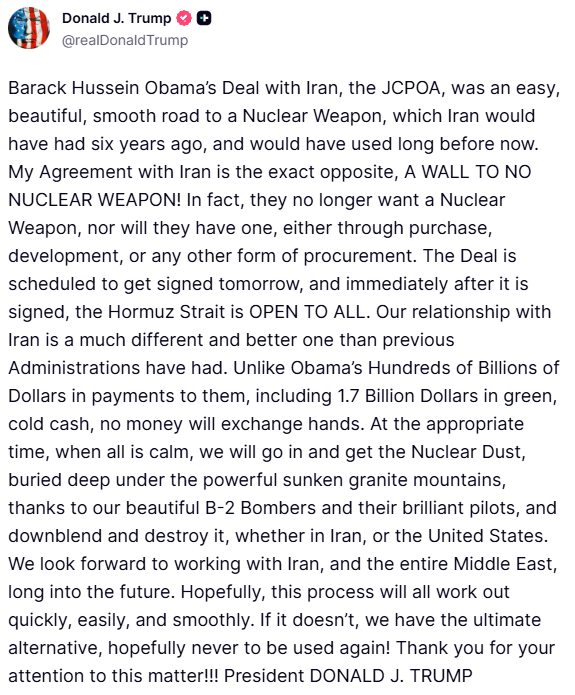
Far and away the most delusional president in US history.
Expect a 180 degree about-face within a day or two.
88
204
1,156
40,249
Create Alliances for Better and Prepare for Worse. retweeted
Jun 13
Another US early warning radar blown to smithereens, this one in Kuwait. The precision of these strikes is extremely impressive.
It's no wonder the US is very reluctant to provoke more Iranian strikes. US bases in the region are indefensible.

24
268
1,134
27,551
Be proud, Aussies, be proud. 🤮
Jun 12

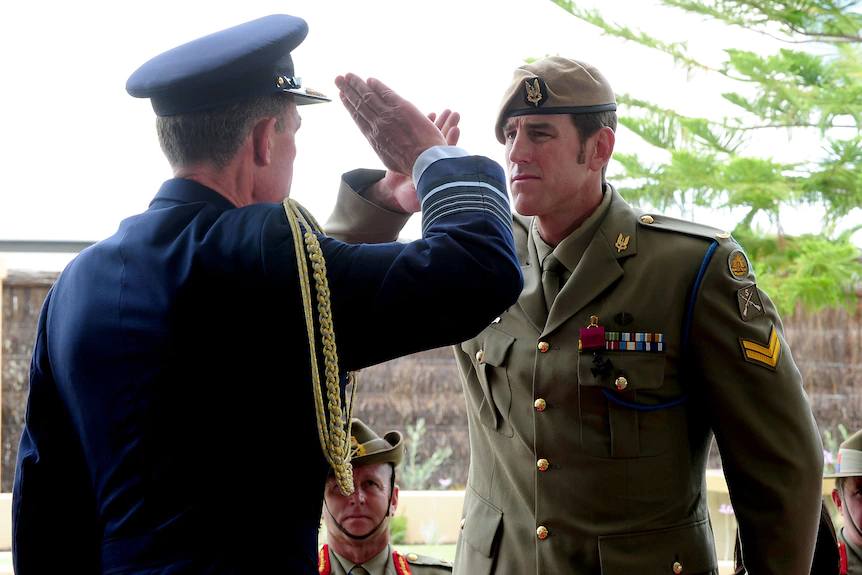
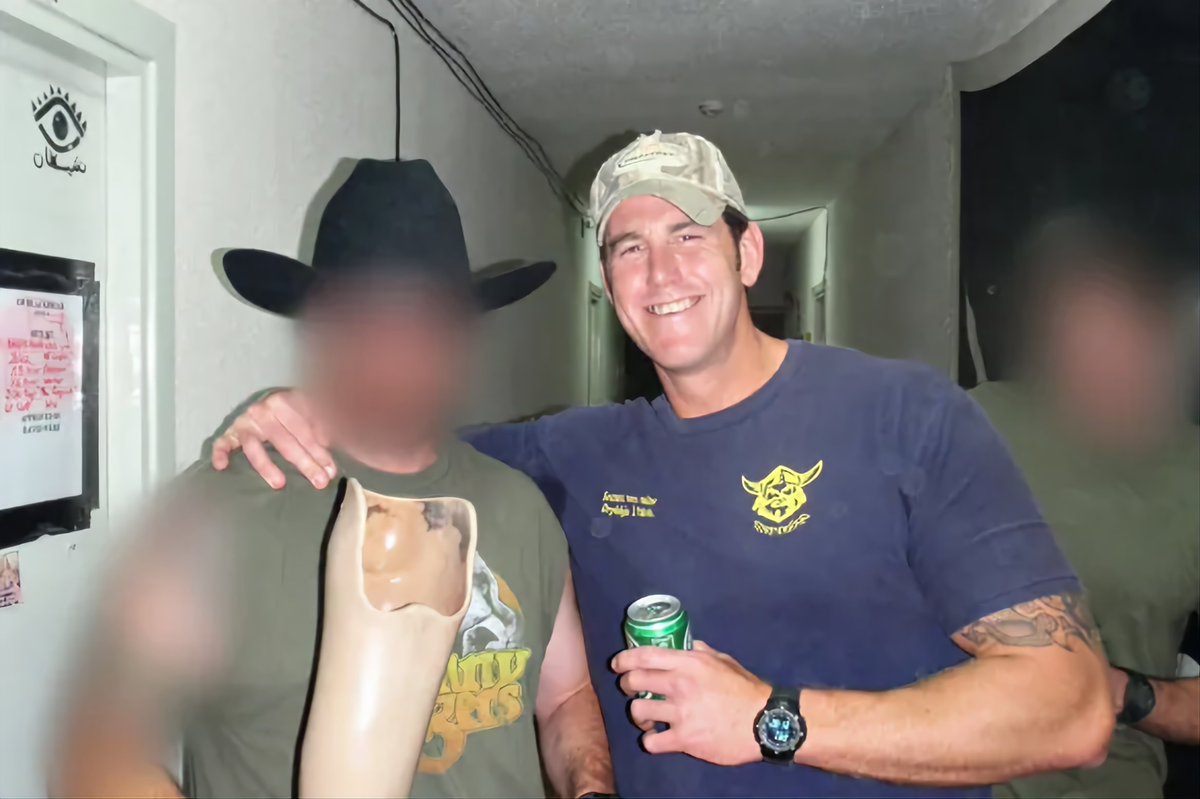
Este es el soldado australiano de la OTAN, Ben Roberts Smith, fue arrestado por brutales crímenes de guerra mientras participaba en la invasión a Afganistán, en 2009.
Roberts fusiló a un civil afgano discapacitado por diversión, después de asesinarlo, los soldados le robaron su pierna ortopédica y bebieron cerveza en él en la base militar de la OTAN.
Además está acusado de haber sido responsable de la muerte de cuatro civiles afganos más, a uno de ellos lo pateó por un acantilado y ordenó a su escuadrón que le fusilara mientras caía.
Actualmente Ben es el soldado más condecorado de Australia, hijo de un poderoso juez en Australia, consiguió que le pusieran en libertad con fianza.
Estas bestias nazis son los "demócratas" que invaden países en Oriente Medio para llevarles la "democracia".

22
"If you believe @elonmusk is rich just because he's smart, then you have no idea how the world works. You probably also believe he purchased Twitter because he cares about free speech. You probably still believe DOGE was about eliminating govt waste & corruption."
Sad so many do.
Jun 13

If there's any cult more ridiculous than the Trump cult, it's the Elon cult.
The dude is a weird technoccultist who basically serves as the avatar of the tech elite arm of the global power structure.
If you believe @elonmusk is rich just because he's smart, then you have no idea how the world works. You probably also believe he purchased Twitter because he cares about free speech. You probably still believe DOGE was about eliminating govt waste & corruption.
Elon is not the richest person in the world. He's the richest person we're allowed to know about. Within the real world power dynamics, he's a middle manager at best. He's rich because he's useful to the globalist asset managers. He's been allowed to become wealthy because it's part of his scripted persona. This persona is useful in getting normie morons to suspend all judgment & get on board with the implementation of the technocrat takeover. Elon's role is essential in building out the data collection/surveillance infrastructure of the control grid.
If he were to refuse to do the bidding of his masters, his stock value would plummet & his wealth would evaporate. He knows this, which is why he does what he's told.
You guys have got to stop worshipping your overlords. It's pathetic.
1
1
2
114
"If he were to refuse to do the bidding of his masters, his stock value would plummet & his wealth would evaporate. He knows this, which is why he does what he's told."
Now go kiss the wall again, Elon.
57
Create Alliances for Better and Prepare for Worse. retweeted
You live in a world where psychopaths are carrying out genocide using AI and you're contending the same people are going to beneficently bestow its benefits on the general populace they won't need to serve their ends anymore? Technical brilliance and absurd naivete is too common.
1
1
237
And then, there's this.
Humans a failed experiment's final proof?
Maybe we should pre-engrave it on the planet, like a huge version of the Nazca Lines, should it be initiated, for whomever comes along.
Jun 13

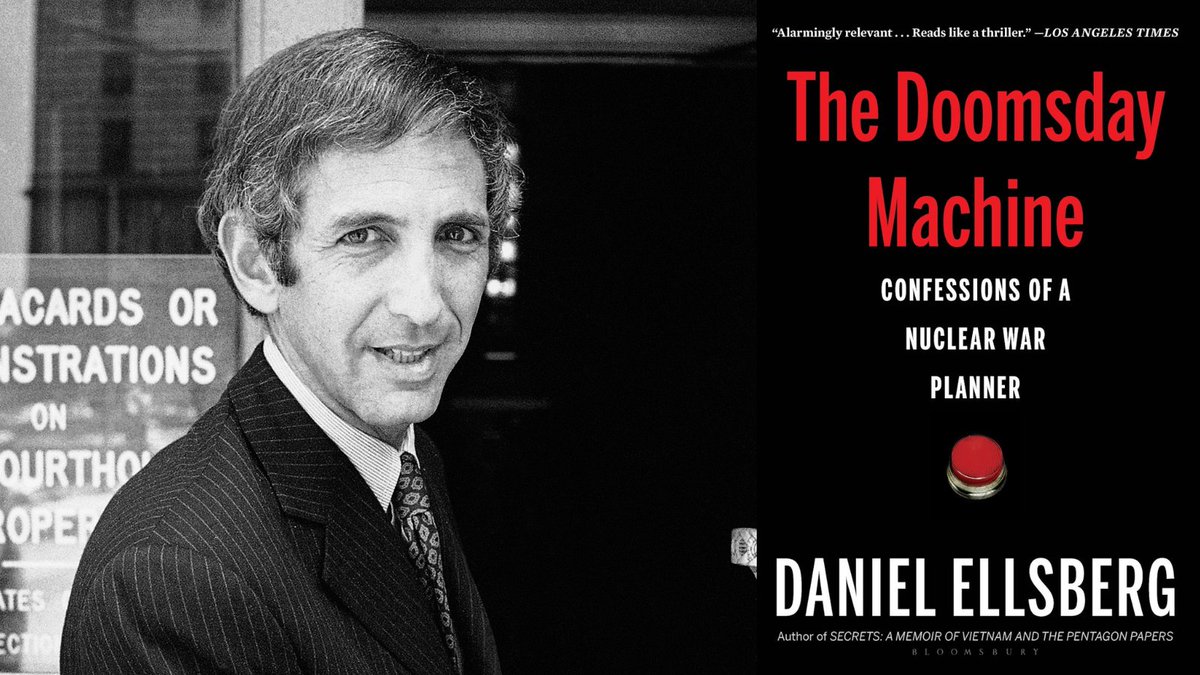
The man who leaked the Pentagon Papers spent the rest of his life sitting on something far darker, and the book he finally wrote about it scared me more than anything I have ever read.
His name was Daniel Ellsberg. The book is called The Doomsday Machine: Confessions of a Nuclear War Planner.
Most of you know Ellsberg as the analyst who in 1971 handed 7,000 pages of classified Vietnam War documents to the press and almost went to prison for it. That story has a hero arc. A man of conscience, the system exposed, justice eventually served.
What almost nobody knows is what he did not leak.
When Ellsberg copied the Pentagon Papers at night on a photocopier borrowed from an advertising agency, he also copied something else. Thousands of pages about America's nuclear war plans. He had carried the same security clearance for both files. He intended to release them next.
He never got the chance. While the FBI was closing in after the Pentagon Papers went public, he transferred the nuclear documents to his brother, who buried them near a trash dump. A tropical storm hit. The papers dissolved into mud.
For decades, Ellsberg reconstructed what he remembered from notes, Freedom of Information Act requests, and interviews with people who had been in the same rooms. The Doomsday Machine is what came out of that reconstruction, and it is the most honest account of American nuclear policy that any insider has ever published.
The thing that hit me first is this: everything you believe about who controls nuclear weapons is wrong.
The official story, the one presidents repeat in press conferences and diplomats repeat in treaties, is that the American nuclear arsenal answers to a single chain of command ending at the desk of the President. The launch codes. The football. One person. One decision.
Ellsberg had a "go anywhere, ask anything" research mandate from RAND Corporation in 1959 and 1960. He traveled to air bases across the Pacific. He asked the question directly.
What he found was that the authority to launch nuclear weapons had been delegated far down the military hierarchy, to generals, to base commanders, to fighter pilots sitting in cockpits on remote runways. Not secretly. Not illegally. Deliberately. The military had decided that waiting for a presidential order in a world of supersonic bombers and thirty-minute missile flight times was tactically suicidal. So they had quietly built a system where dozens of people, in dozens of locations, could start a nuclear war on their own judgment.
The lock codes designed to prevent unauthorized launches at nuclear missile silos had been set to 00000000. All zeros. To make them faster to enter.
Nobody told the public. Nobody told most of the government. The President's control was, in Ellsberg's word, a hoax.
The second thing that stopped me cold was the plan itself.
In spring 1961, Ellsberg was at the White House when a general briefed Kennedy's national security team on what would actually happen if the United States executed its nuclear war plan against the Soviet Union.
The general showed a graph. The vertical axis was deaths. The horizontal axis was time, measured in months.
The curve flattened at 100 million Soviets dead from radioactive fallout alone. Not from the initial blasts. Just from the dust that floated back down.
Someone asked what would happen to China.
There was a second graph. China would lose roughly 300 million people.
When Ellsberg followed up and asked the total, accounting for fallout drifting into Western Europe, into neutral countries, into American allies, the number came back as approximately 600 million dead. In the Pentagon's own estimate. From a first strike the United States was planning to execute in response not to a nuclear attack, but to any conventional military confrontation that involved more than one American battalion.
Six hundred million people. A hundred holocausts, Ellsberg wrote later, by their own accounting.
And that estimate was made in 1961, before scientists understood nuclear winter. The actual death toll from the same strike, calculated with modern climate models, would have been the near-extinction of the human species.
The third revelation is the one that kept me awake.
The Soviet Union built a mirror of the same system, called Perimeter, sometimes referred to as the Dead Hand. It is a semi-automated retaliatory network designed to launch the entire Soviet nuclear arsenal if it detects that Soviet leadership has been destroyed and communication has gone dark. It was built to ensure that no American first strike could prevent retaliation.
It still exists. Russia never dismantled it.
Both countries built machines that can end civilization on their own. Both machines are still running.
Ellsberg spent the final years of his life trying to make people understand that the threat had not diminished, that the fundamental architecture of the nuclear age had not changed, that a fraction of the existing arsenals could still kill everyone alive today. He testified. He gave interviews. He filed lawsuit after lawsuit under the Freedom of Information Act.
He died in June 2023 at 92, still trying.
The strangest thing about the book is what it does to you after you put it down.
You go about your day. You check your phone. You argue about ordinary things. And somewhere underneath all of it sits this fact, verified and documented, that the species has built and maintained and continuously upgraded machines capable of ending itself, that those machines are controlled by systems far more fragile and distributed than anyone is allowed to officially admit, and that the people who designed them considered 600 million deaths an acceptable outcome of a conventional conflict.
Ellsberg called it ordinary insanity. Madness so widely shared, so institutionalized, that it stopped looking like madness at all.
He said that was the most dangerous thing about it.
The book is available everywhere books are sold. It will be the most important 400 pages you ever read and the most difficult ones to finish.
What book has genuinely scared you? I want to build a list.
1
1
111
And they've continued to lie without consequence, except perhaps, plush jobs at MIC contractors after office, to this day. Lie, after lie, after lie. And always enough persistent and new useful idiots, to yell "Rah Rah! Bomb them to Kingdom Come!"
Jun 13

Today in 1971, The New York Times publishes the first excerpts of the Pentagon Papers. Leaked by defense analyst Daniel Ellsberg, the pages reveal the true scope and nature of U.S. involvement in Vietnam. Ellsberg is indicted under the Espionage Act. The charges are later dropped

20
Save our democracy!
Jun 12

Michigan Governor Gretchen Whitmer caught on a hot mic talking about the controversial Al data center being built despite overwhelming opposition: "We're used to people saying 'f*ck no!', and then doing it anyway."
25
"Fucking Over Iran for Seventy Three Years"
Hell of a legacy, Western world, hell of a legacy.
Jun 13

In 1985, a retired MI6 officer named Norman Darbyshire – who had run the service’s Persia station from Cyprus, and the coup with it – gave an interview to Granada Television’s End of Empire in which he described, with startling candour, how Britain helped overthrow the elected prime minister of Iran, Mohammed Mossadeq.
Darbyshire would not appear on camera, and his account never reached the broadcast. The typescript surfaced only in August 2020, recovered by the makers of the documentary Coup 53 from, of all people, Mossadeq’s grandson, Hedayat Matine-Daftary, and published in full for the first time by the National Security Archive in Washington.1
In it Darbyshire is asked whether the Anglo-Iranian oil negotiations had been, in essence, face-saving theatre. Yes, he says: London wanted Mossadeq gone whatever he signed. The coup that removed him in August 1953 cost £700,000. “I know because I spent it.”
pntshow.substack.com/p/the-e…
1
20