Quantum physicist 🇳🇱 Anglophile 🇬🇧 Fellow at @ConjectureInst · Founder of @OxfordPopper DMs not monitored.
Joined May 2016
- Tweets 9,650
- Following 287
- Followers 4,934
- Likes 23,303
433 Photos and videos


Sam retweeted

Welcome to the UK, where a 16 year old can join the army, but is forbidden from being on social media in the evening.
Best Regards,
Keir Starmer

413
3,078
16,586
112,708
Sam retweeted

@Sam_kuyp Problem Solving in the Foundations of Quantum Mechanics
youtube.com/watch?v=Nre2o9XU…
@maria__violaris : Can We Communicate Across the Quantum Multiverse?
youtube.com/watch?v=GLC8-s_p…
1
1
8
828
Sam retweeted

Jun 12
One of Nozick’s great insights was that simply examining how much more the rich have than others is insufficient—we also need to examine *how* they got rich. Creating wealth via positive-sum market activity is morally good.
9
20
126
9,029
Sam retweeted

Jun 12
Nice talk on “Creativity Probes”. @Code_of_Kai here conjectures about conjectures:
Loosening Ideas before making them Harder to Vary.
Jun 11

If you are into the ideas of David Deutsch or Karl Popper, or are interested in the interplay of creativity with criticism, you might enjoy this talk I gave about a month ago at "Conjecture Conference Oxford 2026".
4
51
5,757
Gotta respect the gumption.
Jun 12

Next time you think of giving up, remember this photo of Elon in 2008.

2
3
38
1,268
Sam retweeted

Jun 11
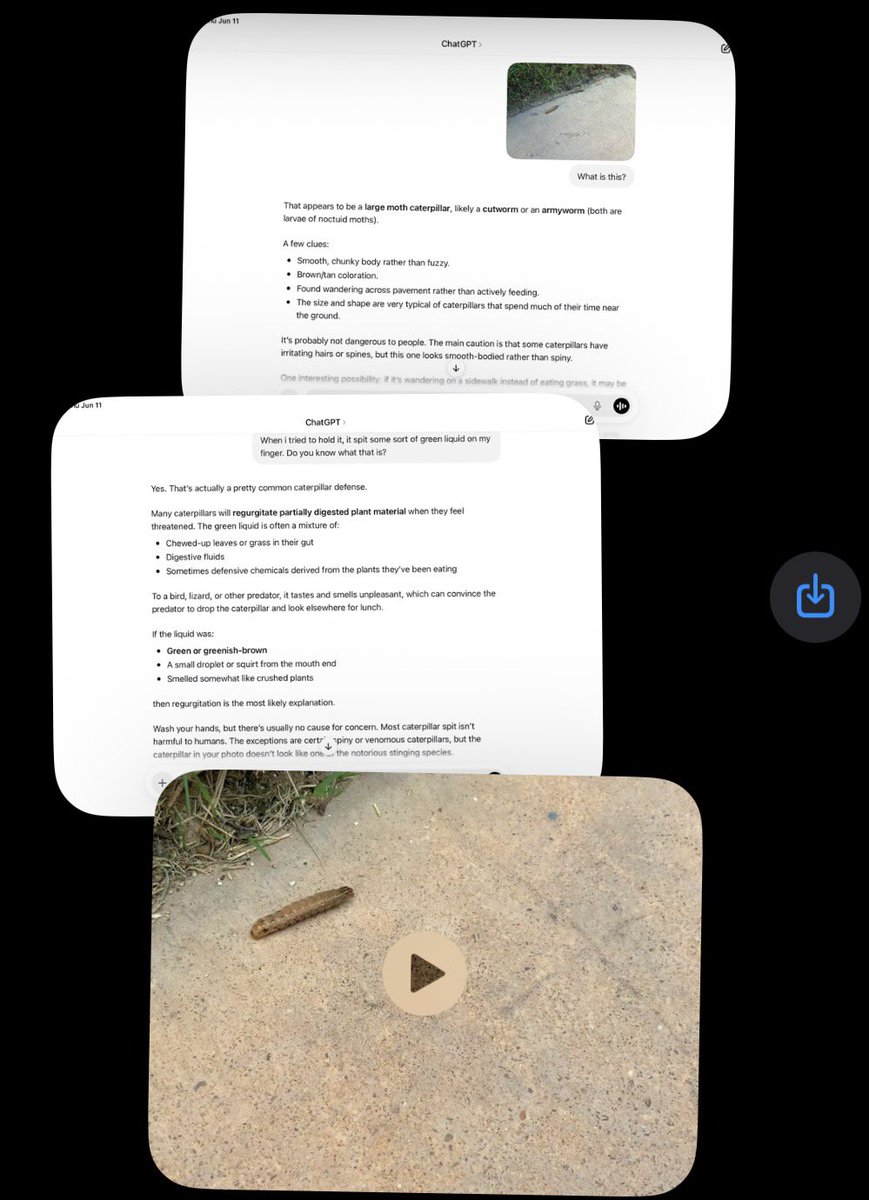
Texts from 6yo, and your periodic reminder that iPads and screens and AI are good for children
12
10
205
11,983
My talk at ConjectureCon, titled Science as Problem-Solving: What a Modern Physics Education Doesn’t Teach You.
youtu.be/Nre2o9XUwic?is=x_TY…
2
6
37
2,148

Sam retweeted

Oppenheimer's 1943 letter of recommendation for Richard Feynman is reflexive of an era of greatness for science. In the brief letter, we merely learn that many people consider Feynman to be an exceptional physicist. cantorsparadise.com/oppenhei…
1/3
1
6
23
3,138
Sam retweeted
Jun 8
In a culture of conspiracy theoretic - "we're in a simulation", no one can 'know' reality but *everything* is conscious - thinking.
Being a classic scientific realist has become kind of edgy.
1
4
25
1,702
Sam retweeted

Paradoxically, science thrives on mystery, and indeed, produces more mystery than it starts with.
As our knowledge grows, so does our conscious ignorance: we have more answers, but we also have more questions.
~Conjecture Institute Fellow @Ray_S_Percival
3
3
24
1,752

Jeff Bezos reveals why compromise is one of the worst ways to resolve a disagreement
"An example of a really bad way of coming to agreement is compromise. If I say the ceiling is 11 feet and you say 12 feet, we say let's call it 11 and a half. That's compromise"
"The advantage of compromise is it's low energy. But it doesn't lead to truth"
"Another really bad resolution mechanism is who's more stubborn. Two executives disagree, they have a war of attrition, and whichever one gets exhausted first capitulates. You haven't arrived at truth, and this is very demoralizing"
"Escalation is better than a war of attrition. Escalate to your boss and say, we can't agree, we like each other, we're respectful, but we strongly disagree, we need you to make a decision"
"Exhausting the other person is not truth seeking. Compromise is not truth seeking"
537
1,099
12,945
2,406,838
Looks promising.
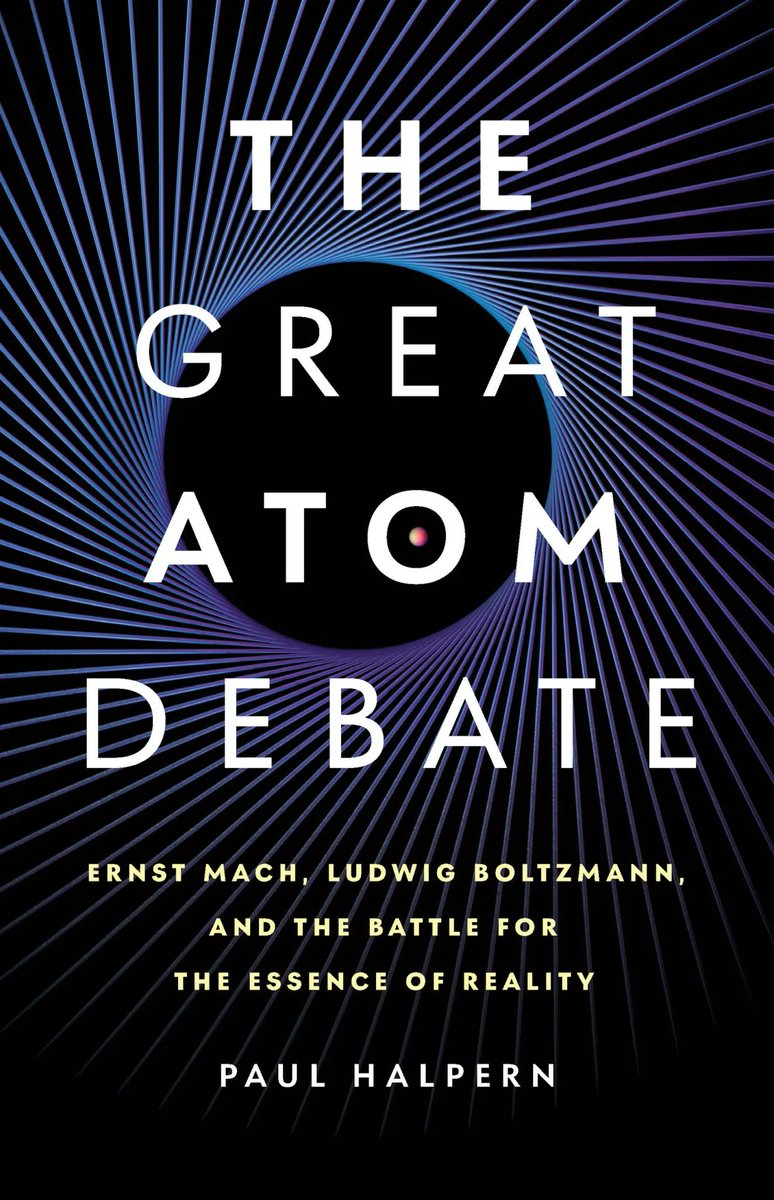
From what little I know about this history, Boltzmann is the hero of the story. He advocated atomism as an explanatory theory, whereas Mach’s empiricism led him to deny the existence of atoms because they weren’t directly observable.
Jun 5

The epic battle that shaped the very future of physics.
THE GREAT ATOM DEBATE
History of science at its most riveting!
New book now available for preorder:
greatatomdebate.com
3
15
901
Sam retweeted

Jun 4
This is a topic I've raised before, but haven't been very impressed over.
One issue I've mentioned is that it's often difficult to tell whether there's actually a problem. For example, people point to "fewer books being read" without digging into how much reading is happening online or how many audiobooks people are consuming. As a result, those discussions can end up being fairly uninformative.
I haven't looked deeply into the latest data (below), but this argument seems a bit more grounded.
Do we have a growing literacy problem?
If we do, that would seem significant because reading is a gateway skill that enables access to so much other knowledge and learning.
Or is the concern still being overstated? Are the statistics being cited really any more meaningful than pointing to a decline in physical book sales?
Curious to hear people's thoughts.
Jun 3

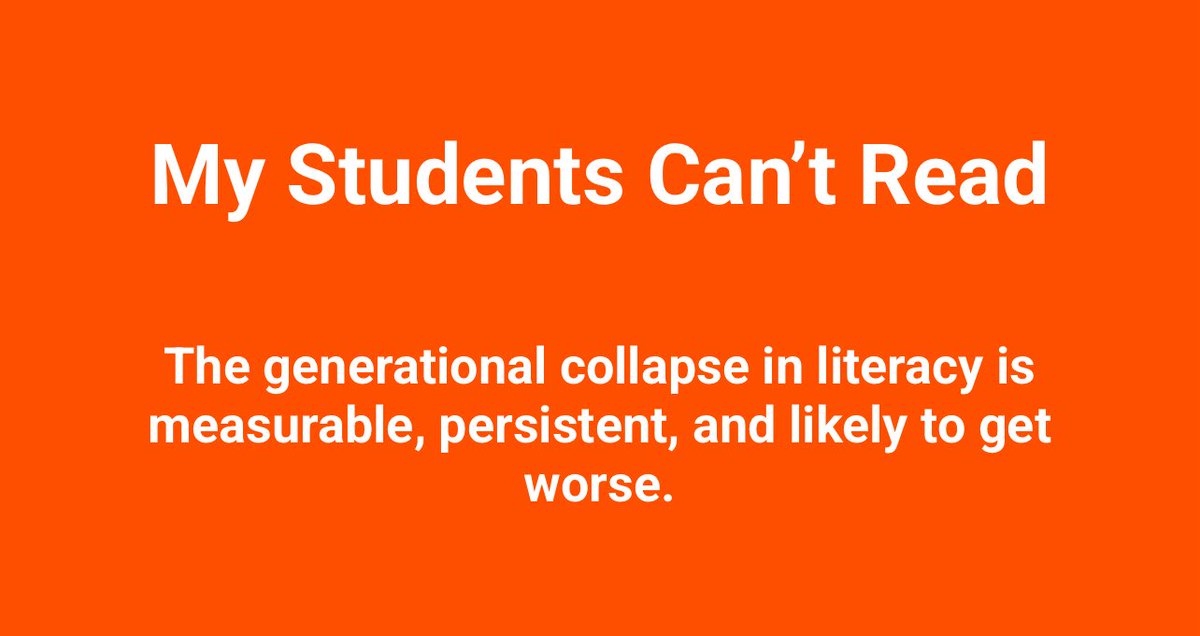
“We are admitting a cohort that cannot read at a college level and are pretending otherwise.”
Another college professor adds to the chorus of concern about student capacity.
In @chronicle:
“Six weeks into the term, I assigned my rhetoric and writing students a 20-page article. It was the same length I had assigned for five years and the same length I had read without complaint as an undergraduate a decade ago. Not one student finished it.
When I asked why, a student answered honestly: It was too long, and she kept losing track of what the paper was about. This was not a remedial class: These were students who had cleared the admissions process and written essays good enough to get them here. Yet a routine academic reading assignment had defeated them.
Every generation of professors has complained that their students cannot read. The lament is usually overblown, but data have caught up to anecdote, and what I am seeing in my classroom is no longer a hunch. There is a measurable, generational collapse in sustained reading and writing, and the academy is responding to it with improvisation and exhaustion rather than the structural overhaul it requires.
In February 2024, Adam Kotsko, who teaches in the Shimer Great Books School at North Central College, wrote in Slate that students who once handled 30 pages of reading per class meeting now seem “intimidated by anything over 10 pages and seem to walk away from readings of as little as 20 pages with no real understanding.” Crucially, he added that this is “not a matter of laziness on the part of the students” but of underlying skills they were never given a chance to build.
The Chronicle of Higher Education’s 2024 investigation found the same pattern across institutions as different as the Stevens Institute of Technology and Wellesley College, where the average SAT exceeds 1400. Nicholaus Gutierrez, an assistant professor at Wellesley, told The Chronicle that the baseline for what students consider a reasonable amount of work has dropped so noticeably that he has cut his readings accordingly; a 750-word essay now strikes many students as long. At Stevens, the science and technology studies associate professor Theresa MacPhail described following the mantra of “meet your students where they are” for so long that she has begun to feel “like a cruise director organizing games of shuffleboard.”
Worse, the national data tell the same story in colder language. On the 2011 National Assessment of Educational Progress (NAEP) writing assessment, which is the most recent comprehensive writing benchmark, only 24 percent of 12th graders reached the Proficient level, and just 3 percent reached Advanced; another 21 percent scored below Basic. The reading side of the ledger is worse, and getting worse fast: The 2024 NAEP results released in September 2025 show 12th-grade reading scores at the lowest level recorded since the assessment began in 1992. Thirty-two percent of 12th graders now score below NAEP Basic in reading, meaning that, in the assessment’s own language, they likely “cannot draw general conclusions based on concepts presented explicitly in a text.” And yet more than half of these same seniors reported being accepted to a four-year college. That last sentence is the whole problem in one line: We are admitting a cohort that cannot read at a college level and are pretending otherwise.”
3
2
7
1,414
It’s one thing to say we haven’t yet solved the drudgery of school. It’s another to assume that education is necessarily boring.
We’re a species that put a man on the Moon, so why rule out improving education?

Teacher should teach students arithmetics, reading, and something about how world functions. That is goal. Loayalty is not. And unfortunately (school) teaching could never go without boring and mundane elemnts.
2
2
18
820
It was fun to hobnob with Peter and Bruce while discussing the relation between probability and Many-Worlds. 😊
Jun 2

This week we are joined for the 4th time by physicist @Sam_kuyp!
We discuss: Is probability theory true? Is it useful? Does physical probability exist? Does subjective probability exist? What is the connection between probability theory and physics? Does the Many-Worlds Interpretation make probability theory more true or less true?
I found little that I disagreed with Sam over—which might disappoint people. 😉 There is only one point we have a disagreement over—what does the word "force" mean?—and moments later the disagreement is resolved. 😀
I really appreciate Sam coming on the show and talking with me about this and helping me along in my own study of probability.
open.spotify.com/episode/3qJ…
2
14
1,145
Sam retweeted
Rationality is not a matter of possessing truth.
It is a process of identifying problems, criticising existing ideas, and creatively constructing better ones. This basic programme is remarkably universal.
It can be applied to science, philosophy, politics, engineering, business, and private life.
Historically, something like this attitude became increasingly prominent during the Reformation and later in the Anglo-Dutch Enlightenment, when people began to criticise long-standing beliefs (especially religious ones) rather than accepting them on the authority of others.
Since then, this critical attitude has spread into many domains.
Scientists criticise theories.
Entrepreneurs criticise products.
Philosophers criticise arguments.
Individuals criticise their own decisions and habits.
This, I think, is where the mechanistic picture of rationality goes wrong.
Rationality is not primarily about holding the right beliefs or making the right predictions.
Those things may happen as a consequence of rational inquiry, but they are not what make it rational.
Rationality is the process of creating explanations, exposing them to criticism, and improving them when problems are found.
Knowledge grows not because we possess truth, but because we are able to find and correct errors.
~Conjecture Institute Fellow @Sam_kuyp
2
10
33
1,541
Sam retweeted

Oxford DPhil students William Cutler and Sophie Decoppet showcased the ABaQuS Trapped Ion Quantum Computing Lab to visitors during the Department of Physics’ recent Lab to Life event.
1
7
32
2,675