
Cybersecurity Professional | CTF player | Microsoft Technology Associate | CEH
Joined July 2020
- Tweets 254
- Following 143
- Followers 98
- Likes 578
5 Photos and videos
Pinned Tweet

7 Aug 2020
Day 10 of #100DaysOfCode
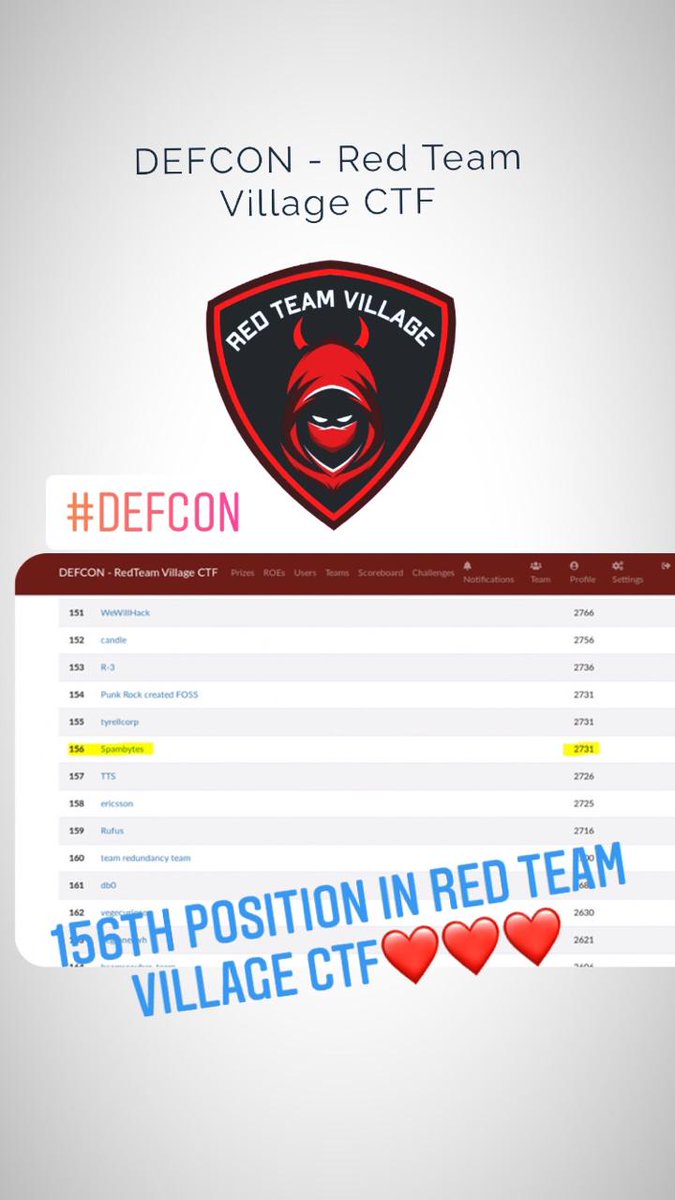
Participated in the REDTEAM VILLAGE CTF #DEFCON #RedTeamVillage .The 24 hour ctf conducted was such a wholesome experience.
Learned more how to solve #OSNIT challenges and learned how to use foremost tool.#cybersecurity
github.com/shrishtydayal2304…
ALT @DEFCON #REDTEAM VILLAGE #CYBERSECURITY
6
22
SHRISHTY DAYAL retweeted

24 Feb 2025
Congratulations to @ShrishtyDayal for clearing our Certified Red Team Professional exam!
#ADLab #CRTP #AlteredSecurity cc @nikhil_mitt
x.com/AlteredSecurity/status…
alteredsecurity.com/adlab
1
1
285
SHRISHTY DAYAL retweeted

22 Jun 2023
Such a great time meeting @k3r3n3 !! You’re such a boss woman and there’s so much to learn from you 🫶🏻
I hope to make it to @BsidesTLV next year 😌🤞🏻

2
2
127
12,606
SHRISHTY DAYAL retweeted

8 Jun 2023
We're giving away FREE one-month access to our AWS Cloud Security Training to four lucky subscribers. You asked, we listened! 😉🔥
All you have to do is like and retweet👇
Winners will be chosen at random on Facebook, Twitter, LinkedIn and Instagram. Good luck!
92
944
1,296
82,983
SHRISHTY DAYAL retweeted

18 May 2023
#BugBounty checklist
thexssrat.podia.com/2b1cef5e…
CSRF:
Verify token presence on necessary forms (Create, Update, Delete)
Check server-side token length validation
Ensure server checks for token parameter
Test server response to empty parameter and missing CSRF token
Confirm tokens are not session-bound
JWT:
Ensure None-signing algorithm is not allowed
Check for leaked secrets
Verify server secret checks
Test secret guessability/brute-force resistance
Open redirect bypass:
Test various bypass techniques (e.g., evil.com/expected.com, Javascript openRedirects, hidden link open redirects)
Experiment with bypass characters (e.g., //, https:evil.com, /\, , @)
Examine parameter pollution
BAC:
Test access controls for all user levels
Evaluate access using different methods (e.g., authorize, JS Functions via developer console, copy-pasting URLs)
IDOR:
Test across all tenants
Check access methods similar to BAC
Captcha bypasses:
Attempt request method changes
Remove or modify captcha parameters
LFI:
Test bypass techniques similar to Open redirect bypass
Experiment with different path traversal techniques (e.g., ../, ../, ..\) to bypass input filters
Test for log poisoning or user input storage to achieve code execution through LFI
Examine the inclusion of configuration files or other sensitive files for information disclosure
RFI:
Test bypass techniques similar to Open redirect bypass
Experiment with different path traversal techniques (e.g., ../, ../, ..\) to bypass input filters
Test for log poisoning or user input storage to achieve code execution through LFI
Examine the inclusion of configuration files or other sensitive files for information disclosure
SQLi:
Use special characters (e.g., ' " ) to trigger SQL injection
Utilize SQLmap for testing
Use time-based techniques (e.g., SLEEP() in MySQL, WAITFOR DELAY in SQL Server) to extract information if the output is not directly visible (blind SQLi)
Test for out-of-band techniques (e.g., DNS exfiltration) when other methods are not possible
Exploit second-order SQLi by injecting payloads that get stored and later executed in another part of the application
XXE:
Test file formats vulnerable to XXE (e.g., SVG, DOCX/XLSX, SOAP)
Attempt blind SSRF, file exfiltration, and command execution
Test different XML parsers (e.g., DOM, SAX) to identify vulnerable endpoints
Utilize out-of-band techniques (e.g., HTTP callbacks, DNS exfiltration) for blind XXE exploitation
Experiment with different encoding or obfuscation methods (e.g., using CDATA sections, XML entity expansion) to bypass input filters or security measures
Template injections (CSTI/SST):
Test basic template injection payloads ${{7*9}}
Identify templating engine and refer to manuals for potential exploits
Employ encoding techniques for special characters
Identify the templating engine in use (e.g., Jinja2, Twig, Mako) and craft payloads specific to the engine
Use encoding, obfuscation, or other techniques to bypass input filters or security measures
Escalate impact by chaining template injection with other vulnerabilities (e.g., XSS, RCE)
XSS:
Test payload injection into input fields and reflected parameters
Identify reflection context and craft attack vector accordingly
Test various encoding and obfuscation techniques
Check for and attempt to bypass CSP
Test for DOM-based XSS by analyzing JavaScript code and manipulating variables used in the DOM
Experiment with different encoding techniques (e.g., HTML entities, URL encoding, Unicode) to bypass input filters and WAFs
Utilize event handlers (e.g., onload, onerror) or other obscure tags to trigger XSS when common vectors are blocked
SSRF:
Test SSRF against server itself and other servers on the network
Use alternative URL schemes (e.g., file://, dict://, gopher://) to interact with internal services or to bypass filters
Test for IPv6 and other address formats (e.g., octal, decimal, hexadecimal) to bypass IP-based filters
Chain SSRF with other vulnerabilities (e.g., XXE, open redirects) to escalate impact
Command injection:
Test every single parameter for command injection vulnerability
Compile a list of commands and command separators for the target OS
Admin panel bypass:
Try referer header manipulation
Test easy username/password combinations
Perform directory brute-forcing for unprotected pages
Race conditions:
Identify and test critical functionalities for potential race conditions
Simulate concurrent requests to assess system stability
API security testing:
Test API endpoints for vulnerabilities similar to those in web applications
Evaluate proper use of authentication and authorization mechanisms
Check for potential data leaks or unauthorized data access
Insecure deserialization:
Identify potential points of deserialization in the application
Test for deserialization vulnerabilities that could lead to arbitrary code execution or data tampering
Test for insecure deserialization by tampering with serialized data formats (e.g., JSON, XML, PHP serialization) and observing application behavior
Identify and exploit "gadget chains" to escalate impact and achieve arbitrary code execution
Employ encryption or encoding bypass techniques to manipulate serialized data
Clickjacking:
Check if the application is vulnerable to clickjacking attacks
Verify proper implementation of X-Frame-Options header and other defensive mechanisms
Parameter Pollution:
Test for potential parameter pollution vulnerabilities in all input fields and URL parameters
Identify and manipulate repeated parameters to observe application behavior
Check if any application logic relies on single instances of parameters and can be bypassed or exploited using parameter pollution
Verify that the application handles repeated parameters consistently and securely
Session Management:
Test for secure implementation of session cookies (e.g., HttpOnly, Secure, SameSite attributes)
Evaluate the effectiveness of session expiration and session fixation prevention mechanisms
Assess the randomness and predictability of session IDs
Verify proper handling of concurrent sessions and logout functionality
Web Application Firewall (WAF) Evasion:
Attempt to bypass WAF rules using different evasion techniques (e.g., encoding, obfuscation, HTTP Verb Tampering)
Evaluate the effectiveness of the WAF in detecting and preventing known attack vectors
File Upload Security:
Test file upload functionality for potential vulnerabilities (e.g., unrestricted file types, size limitations, handling of malicious content)
Verify proper access controls for uploaded files to prevent unauthorized access or file manipulation
Check for secure storage of uploaded files and proper handling of metadata
Account Recovery and Password Reset:
Evaluate the security of account recovery and password reset mechanisms (e.g., secret questions, email-based resets, multi-factor authentication)
Test for potential bypasses or weaknesses that may allow unauthorized account access
Unconventional Attack Vectors:
Investigate less commonly tested functionalities, features, or components that might have been overlooked by developers or other testers
Explore edge cases, uncommon input types, or rare user interactions that might trigger vulnerabilities
Cross-Platform and Cross-Browser Testing:
Test the application on different platforms (e.g., mobile, desktop) and browsers, as some vulnerabilities may be platform- or browser-specific
Bug Chaining and Impact Amplification:
Explore chaining multiple bugs or vulnerabilities together to create a higher impact or escalate privileges, which can potentially lead to higher rewards
Misconfigured or Exposed Infrastructure:
Check for exposed or misconfigured infrastructure components (e.g., open AWS S3 buckets, unsecured cloud storage, publicly accessible admin interfaces)
Remote Code Execution (RCE):
Investigate the use of environment variables or process control functions for command injection
Leverage file upload vulnerabilities to upload and execute a malicious payload
Bypass execution restrictions by utilizing script interpreters (e.g., Python, Ruby, PHP) or built-in OS functionality (e.g., PowerShell, Bash)
7
18
93
14,675
13 Jan 2021
I completed the Web Security Academy lab:
Unprotected admin functionality with unpredictable URL
@WebSecAcademy
portswigger.net/web-security…
3
12 Jan 2021
I completed the Web Security Academy lab:
Source code disclosure via backup files
@WebSecAcademy
portswigger.net/web-security…
2
12 Jan 2021
I completed the Web Security Academy lab:
Information disclosure in error messages
@WebSecAcademy
portswigger.net/web-security…
2
10 Jan 2021
I completed the Web Security Academy lab:
SQL injection UNION attack, determining the number of columns returned by the query
@WebSecAcademy
portswigger.net/web-security…
1
10 Jan 2021
I completed the Web Security Academy lab:
SQL injection vulnerability allowing login bypass
@WebSecAcademy
portswigger.net/web-security… #sqli #burp #proxy #security
1
9 Jan 2021
I completed the Web Security Academy lab:
SQL injection vulnerability in WHERE clause allowing retrieval of hidden data
@WebSecAcademy
portswigger.net/web-security…
2
7 Jan 2021
I completed the Web Security Academy lab:
Authentication bypass via OAuth implicit flow
@WebSecAcademy
portswigger.net/web-security…
2
1 Jan 2021
Starting Out In Cyber Sec - I have just completed this room! Check it out: tryhackme.com/room/startingo… #tryhackme #security #startingout #careers #intro #startingoutincybersec via @tryhackme
1
4
1 Jan 2021
Introductory Networking - I have just completed this room! Check it out: tryhackme.com/room/introtone… #tryhackme #Networking #OSI #Networking #Introductory Networking #intro to networking #accessible #ping #traceroute #whois #dig #TCP/IP #Wireshark #Encapsulation via @tryhackme
3
29 Dec 2020
Encryption - Crypto 101 - I have just completed this room! Check it out: tryhackme.com/room/encryptio… #tryhackme #security #crypto #101 #encryption #Crypto 101 #encryptioncrypto101 via @tryhackme
1
1
6
27 Dec 2020
Bounty Hacker - I have just completed this room! Check it out: tryhackme.com/room/cowboyhac… #tryhackme #Linux #tar #privesc #security #cowboyhacker via @tryhackme #sudo #gobuster #nmap #cybersecurity
1
6
27 Dec 2020
Linux Fundamentals Part 3 - I have just completed this room! Check it out: tryhackme.com/room/linux3 #tryhackme #linux #beginner #ZTH #new #sysadmin #linux3 via @tryhackme
1
26 Dec 2020
Linux Fundamentals Part 2 - I have just completed this room! Check it out: tryhackme.com/room/linux2 #tryhackme #linux #beginner #ZTH #new #sysadmin #linux2 via @tryhackme
1
23 Dec 2020
Linux Fundamentals Part 1 - I have just completed this room! Check it out: tryhackme.com/room/linux1 #tryhackme #linux #beginner #ZTH #new #sysadmin #linux1 via @tryhackme
8
27 Nov 2020
The Cod Caper - I have just completed this room! Check it out: tryhackme.com/room/thecodcap… #tryhackme #security #pwn #pwntools #Reversing # debugging # RE #weekly challenge #thecodcaper via @tryhackme
3