National Statistics Office (NSO) Established:1948 Vision:To be the trusted provider of Official Statistics for good governance. First Population Census: 1891
Joined October 2014
- Tweets 1,093
- Following 66
- Followers 7,781
- Likes 228
509 Photos and videos
Ghana Statistical Service retweeted
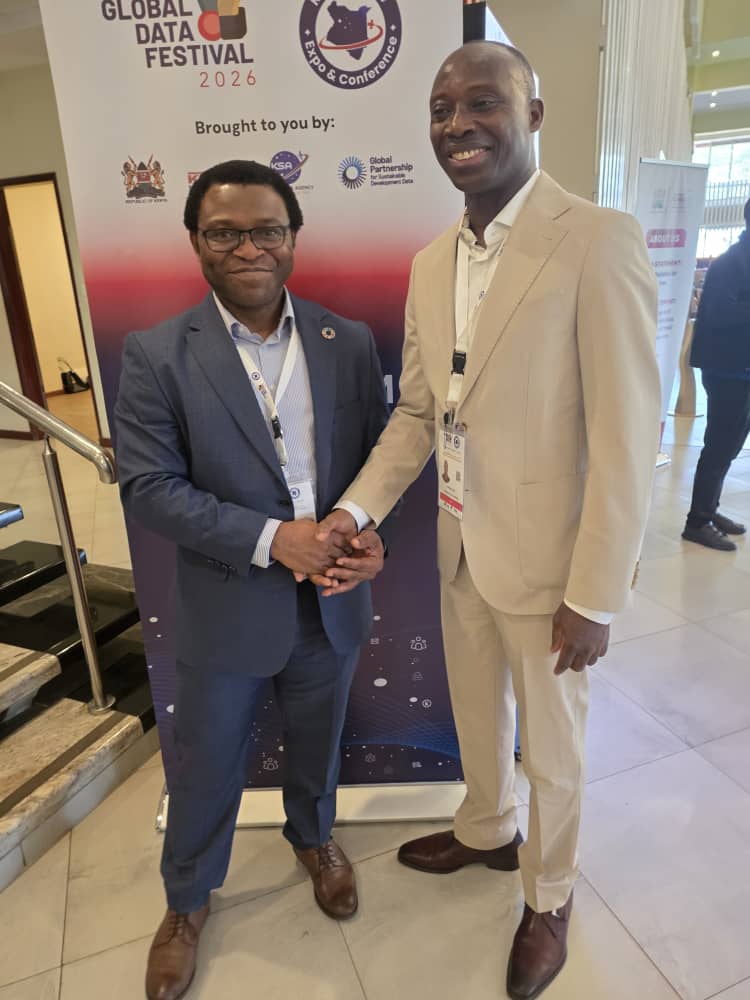
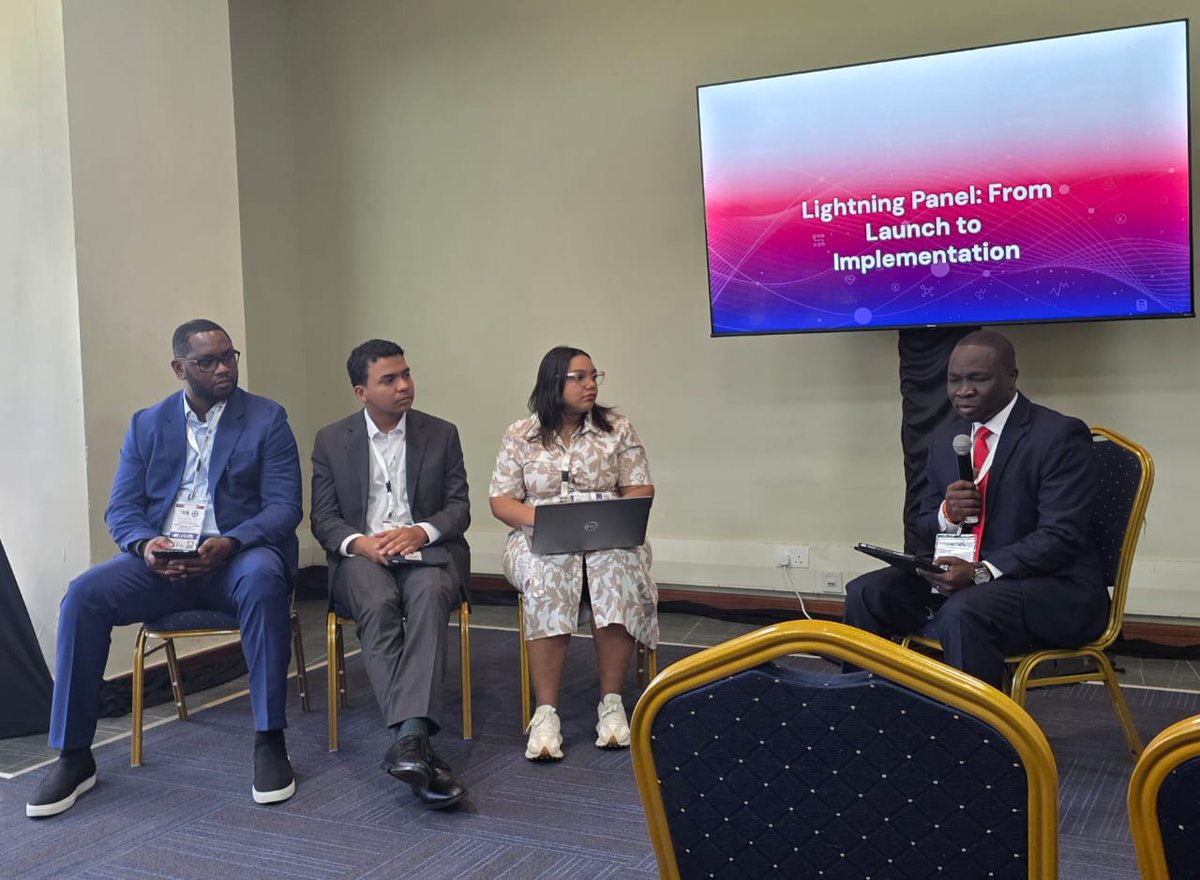
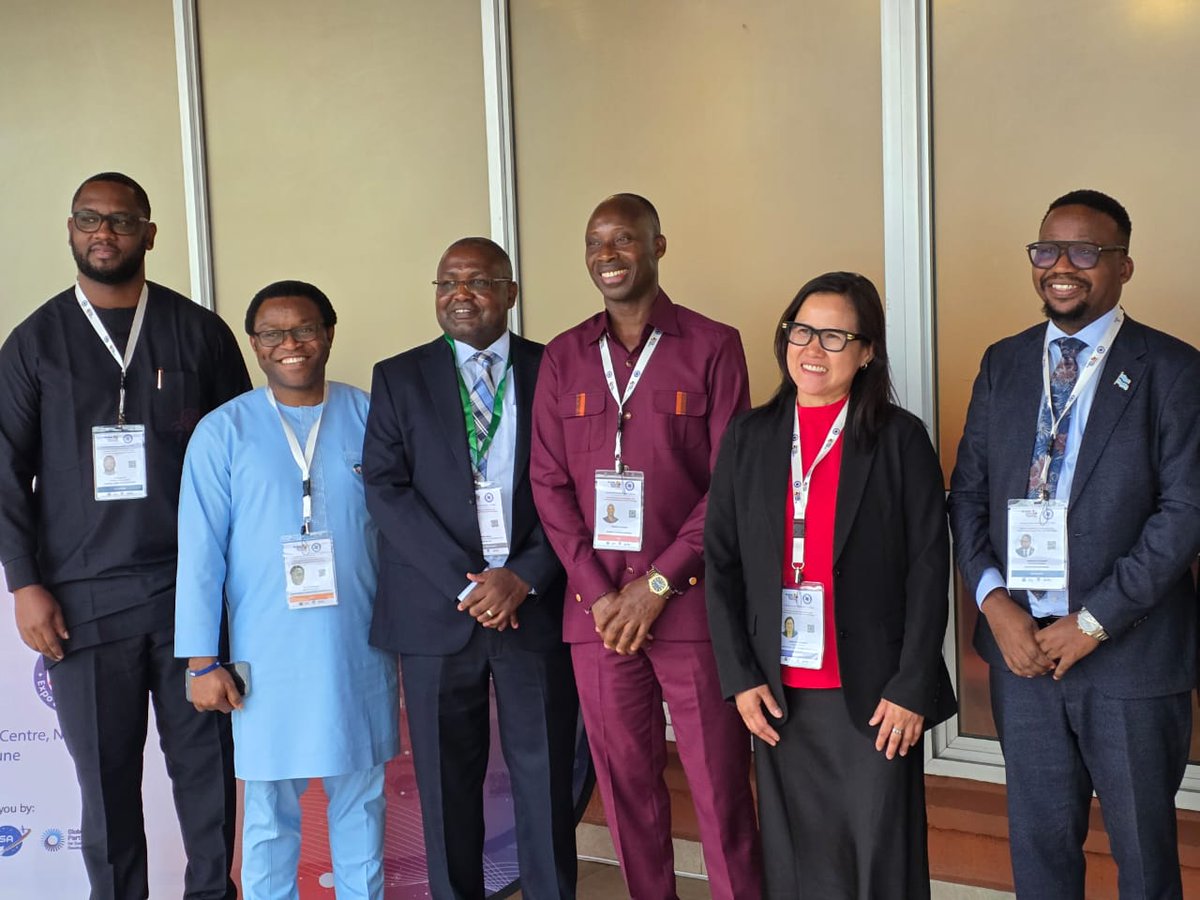
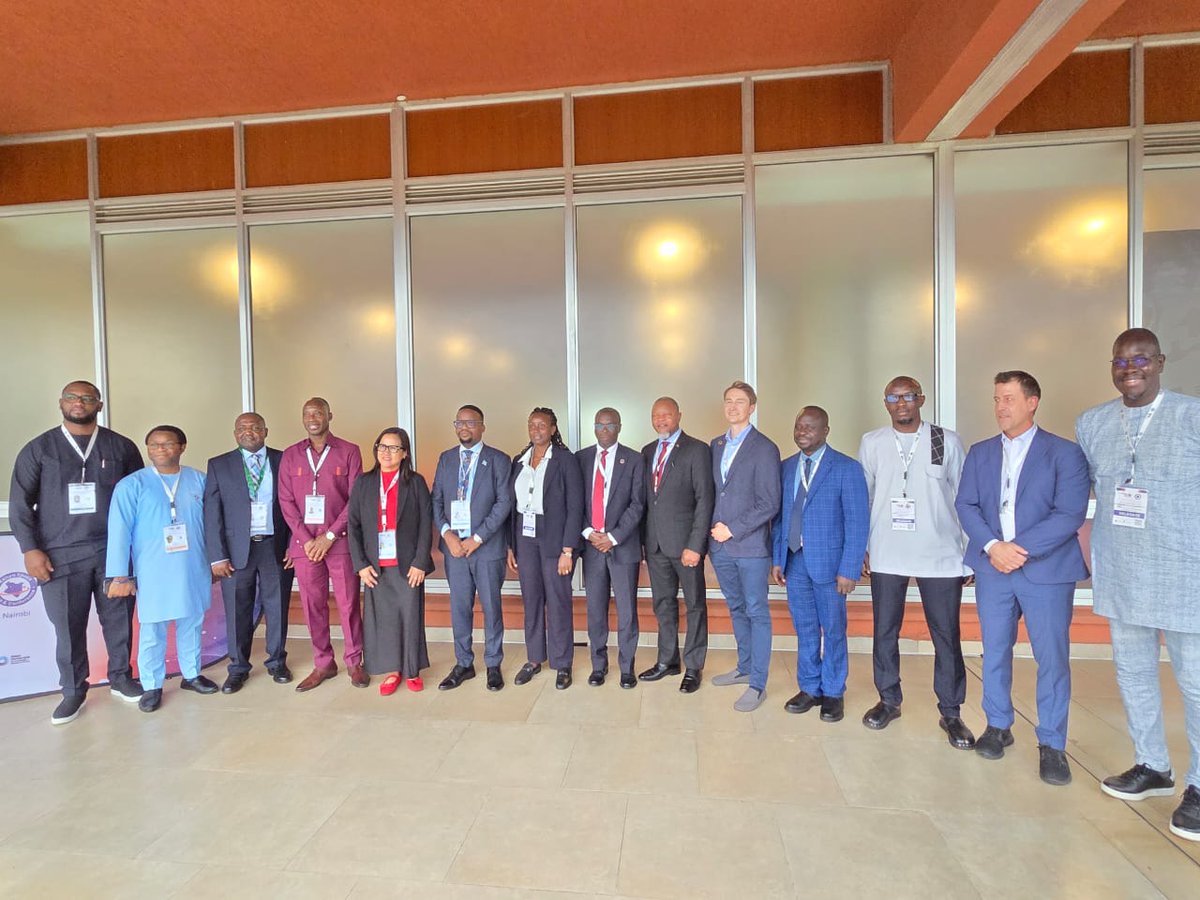
Ghana at the 2026 Global Data Festival, Nairobi. Here is what we shared, and what we learned from Nigeria, Colombia, Dominican Republic, Botswana, and Somalia.
Ghana's 2016 SDG assessment showed 50% of our SDG reporting could run on administrative data already sitting in government systems. Untapped. That became the mission.
We built the MOU process deliberately: technical teams, institution-specific drafts, multiple validation rounds. Nothing rushed. By March 2026: 25 MOUs signed. Judicial Service in April. 26 total, including the Office of the President.
Signing the MOU is the starting gun, not the finish line. Next: joint technical teams, published data sharing policies for all users, and national frameworks for quality and accountability. National Strategy for the Development of Statistics (NSDS) III becoming real.
🇳🇬 Nigeria's lesson: embed the initiative in what already exists. No parallel systems. High-level advisory committee chaired by the Secretary to Government meets quarterly. Ministers held accountable by design.
🇨🇴 Colombia's lesson: make data a public value, not a government product. Bring in civil society, academia, international partners. When everyone owns data, every sector uses it.
🇩🇴 Dominican Republic's lesson: when resources are limited, be transparent about priorities. Stakeholders accept tough decisions when they understand the reasoning. Trust is built in the process.
🇧🇼 Botswana's lesson: silo mentality is real, fight it at every level, including parliament. Engaging the National Assembly directly is creating accountability that no MOU alone can provide.
🇸🇴 Somalia's lesson: resilience. First agricultural census ever. National census coming after a 50-year gap. Coordination challenges remain, but the work goes on.
Three things Ghana brought to the table and takes back home: → Trust before signatures → Map before coordinating → Strategy only works when institutions own the execution
The work continues.
#GDF2026 #PowerOfData #NSDSIII

1
5
269
Ghana Statistical Service retweeted
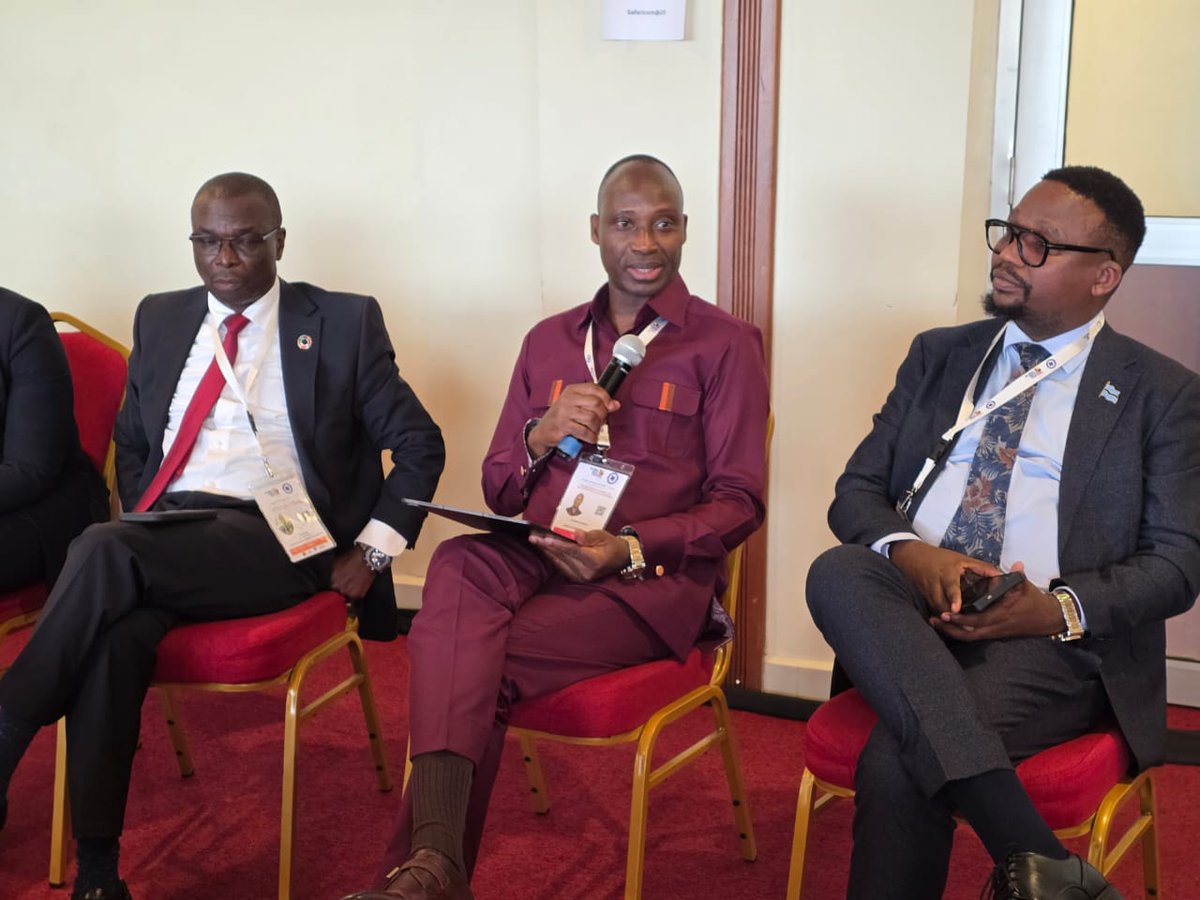
At the Side Event on Using Mobile Phone Data for Statistics
What an incredible Global Data Festival in Nairobi, Kenya! The theme of Powering Resilience, Innovation, and Partnership through Data and Technology truly came alive as we discussed how Mobile Phone Data (MPD) is transforming official statistics during a side event on Mobile Phone Data for Statistics: Leadership Peer Exchange organised by the Global Partnership for Sustainable Development Data, UN Big Data, the World Bank and the Spanish Government.
It's been so inspiring to hear from other African countries like Rwanda, Botswana, Kenya, and Nigeria. We're all using this 'phone magic' to make life better for our people, from helping tourism to building better roads and even understanding who might need social assistance. Africa is truly leading the way!
Rwanda used it to redesign bus routes. 30,000 more people now use public transport.
Kazakhstan counted 100 million domestic tourism trips, surveys had found only 7.8 million. That’s not a rounding error. That’s an entirely different picture of reality.
Ghana used it during COVID-19 to track population movement district by district, in near real-time, and direct the national response. We were able to do things no census or household survey could have made possible.
Our journey in Ghana started with a simple question: "How can we respond faster and better?" With a strong partnership with Telecel Ghana and our friends at FlowMinder Foundation, we've built a system that uses signals from mobile phones to understand big movements of people across Ghana. This helped us track COVID-19, map out areas that needed help, and even now, it is helping us know where people go when floods happen so we can send support faster to those who need it most!
But let’s be honest, we still have work to do. We have the legal foundation. We have the partnerships. What we need now is to extend the partnership to other mobile phone networks and for this to stop being a project and become a system, and demanded by the ministries and agencies who need to make better decisions for Ghanaians.
The best part? We do all this while keeping everyone's personal information super safe! Your names and private details are never shared with us, only big patterns and movements that help Ghana plan better. It’s all about #PrivacyByDesign! 🔒
The hard part is trust, governance, leadership, getting the right people in the room and keeping them there. The hard part is making sure that when a pilot succeeds, it doesn’t quietly die, that it becomes a permanent part of how a country produces statistics.
My biggest lessons for Ghana from this fantastic meeting are like building blocks for a brighter future:
1.Teamwork makes the dream work! We need to keep working closely with our phone companies, government partners, and all smart people, because together we can do so much more for Ghana.
2.Fair rules are key! We must always have clear laws and agreements that make sure everyone's data is used responsibly and safely. Trust is the strongest foundation!
3.Learning never stops! We need more super data heroes in Ghana who can understand and use these new types of information to solve our country's big challenges!
Countries that win are not the ones with the best technology. They’re the ones with institutions that build trust, establish clear mandates, and take the long view.
As the Government Statistician, I'm more excited than ever for Ghana's future! Let’s keep pushing forward, investing in leadership and smart data practices.
Let's keep building a #DataSmartGhana where we use every bit of information to make life better for every child, every family, in every corner of our country!
Join us on this amazing journey!
#GDFNairobi #GhanaStatisticalService #DataForGood #MPD #PoweringResilience #Innovation #Partnership
1
1
4
353
Ghana Statistical Service retweeted
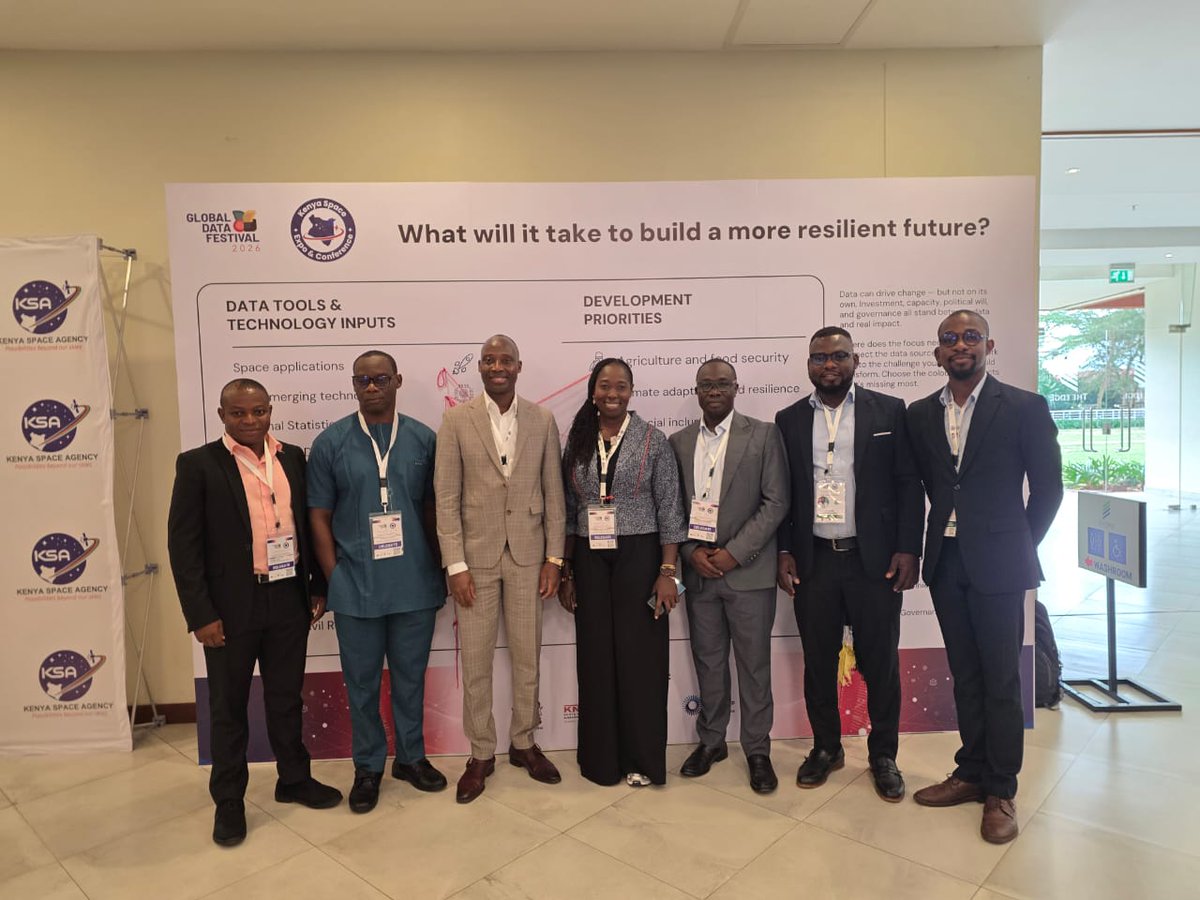
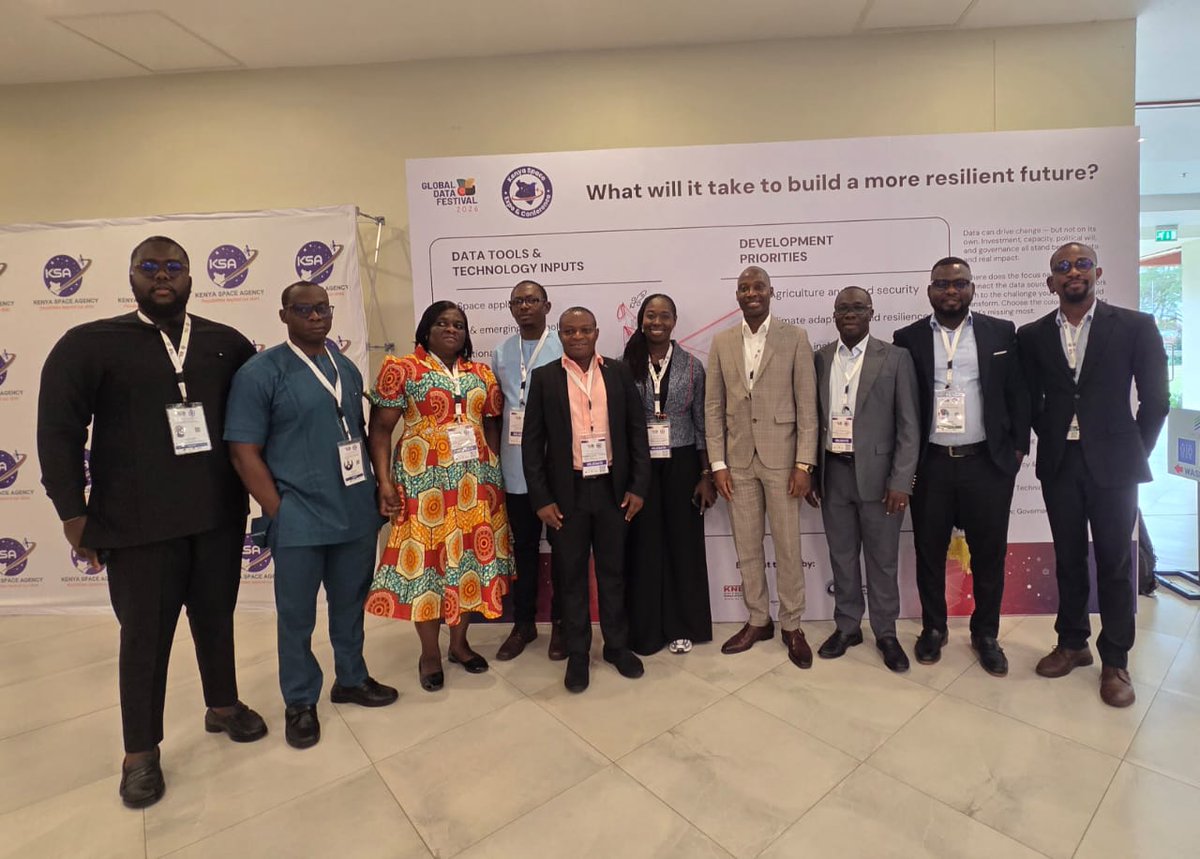
We are in Nairobi, Kenya, actively participating in the Global Data Festival.
The third Global Data Festival opened on 2nd June 2026 under a theme that says everything about where the world is heading: Powering Resilience, Innovation, and Partnership through Data and Technology.
Over 200 countries; Data scientists, policymakers, space agencies, civil society, researchers. All in one room. All asking the same question: Are we counting the right people? And are we using data to actually change lives?
One of the opening speakers told the story of a woman called Amara. She is about 41. She is waiting for her test results. She runs a small kiosk. She is trying to get a loan. She exists. She has a name. She has a story. But the system does not see her.
The speaker looked at the room and said: “There are so many Amaras in the world. What can we do this week to make sure Amara is seen, Amara is heard, and Amara is not left behind?”
That is not a data question. That is a humanity question. And it is the most important reason statistics exist.
Back home at the Ghana Statistical Service , we talk a lot about data. But today reminded me that data is not about numbers on a spreadsheet. It is about whether a woman in Kumbungu or Nkoranza can access healthcare. Whether a young man in Agbogbloshie shows up in our unemployment figures. Whether a person with disability gets the social protection they deserve because our data actually captured them.
Ghana has made real progress. But progress is not the finish line.
The lesson from the opening is this: a national statistical system that does not make the invisible visible is not yet doing its full job. We must build a data ecosystem, not just a data office. That means four things working together:
1.Laws and policies that demand quality data
2.Partnerships that bring everyone to the table
3. Technology and innovation that reach the last mile
4.Governance that keeps the system honest and accountable
One more thing that Ghana cannot afford to ignore: space data. Satellites. Earth observation. Real-time intelligence. The Kenya Space Agency co-hosted the opening for a reason. This is how serious countries now track floods, plan cities, monitor crop yields, and respond to crises.
Ghana needs to be in that conversation. Not watching.
We are here, we are listening, we are connecting, and we are bringing it all home for every Ghanaian that our data must never miss.
📍 Nairobi, Kenya | #GDF2026 #GDFKStep2026 #DataForPeople #GhanaStatisticalService #PoweringResilience #NoOneInvisible
2
4
207
Ghana Statistical Service retweeted
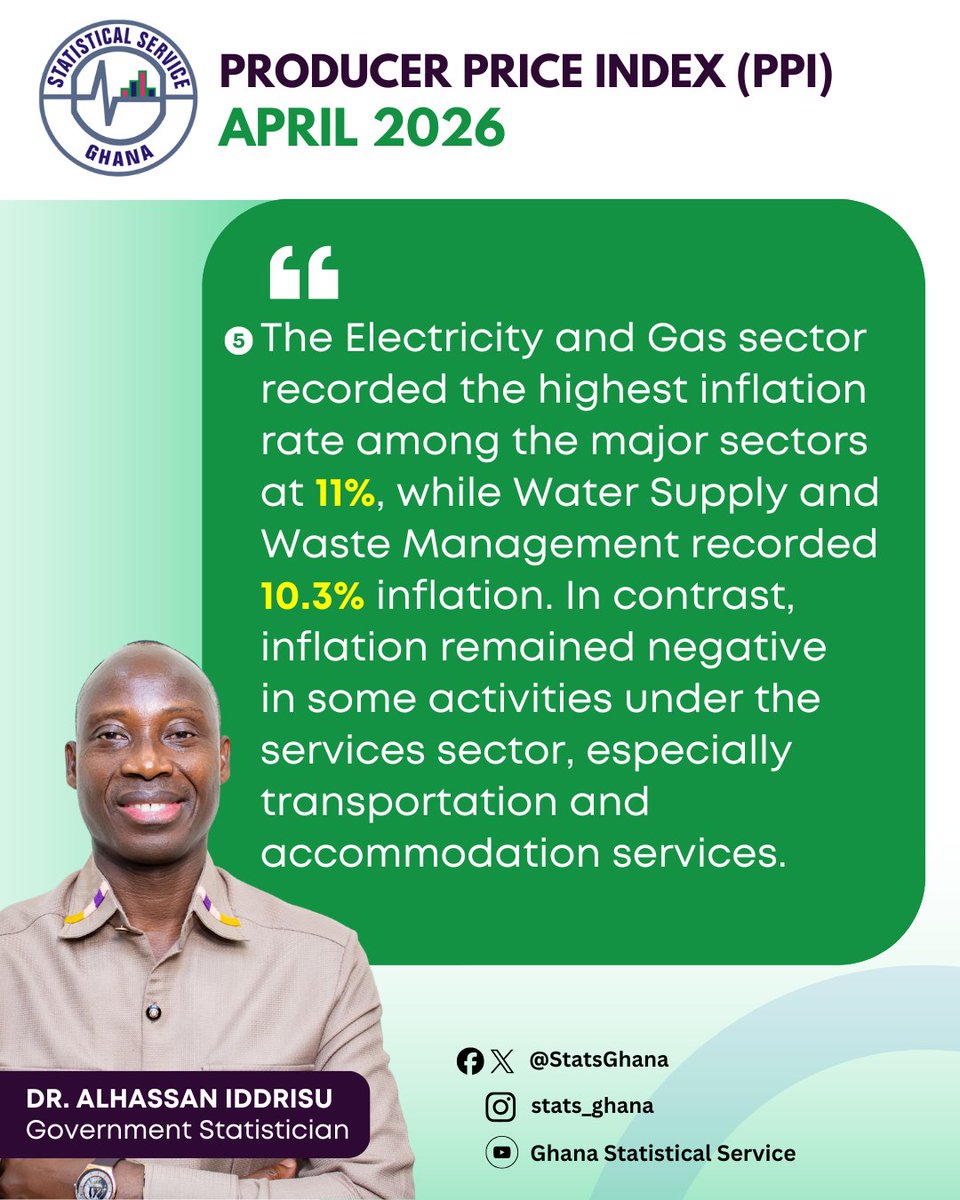
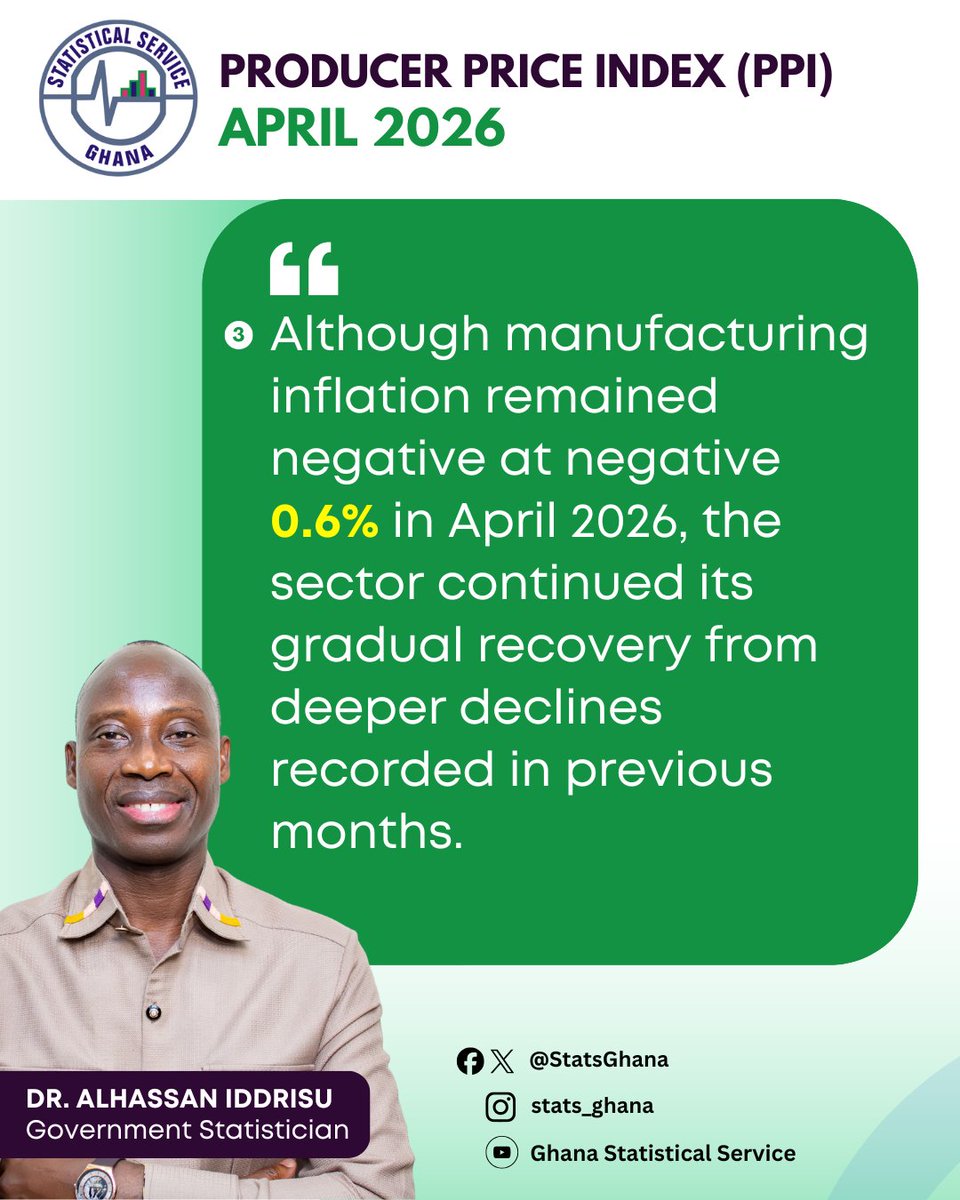
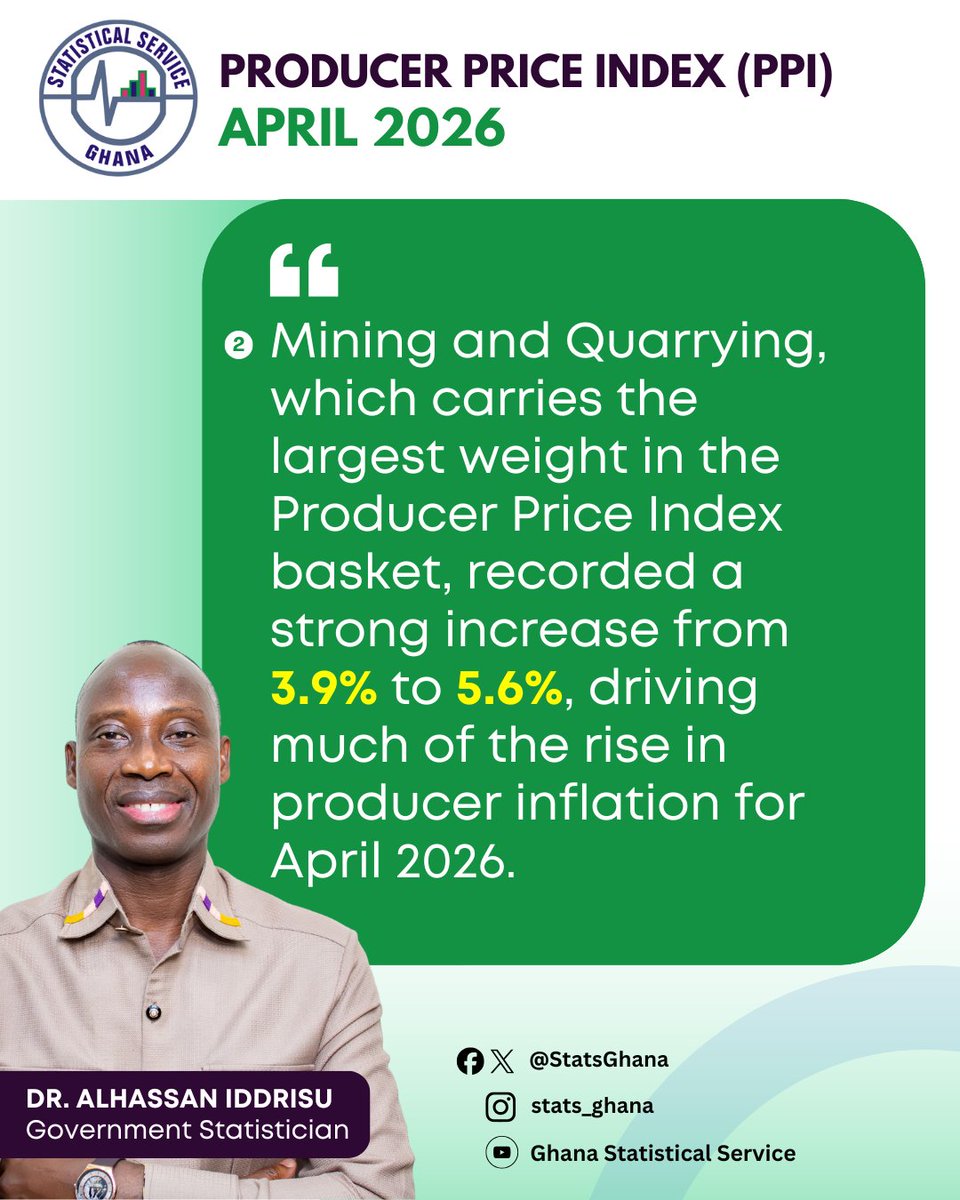
Producer price inflation increased to 2.7% in April 2026, up from 1.6% in March, driven mainly by Mining and Quarrying.
This video highlights the key trends shaping production costs and the broader economy.
#PPI #ProducerInflation #GhanaStats #DataForDevelopment #GSS #EconomicData
2
11
320
Ghana Statistical Service retweeted

May 28
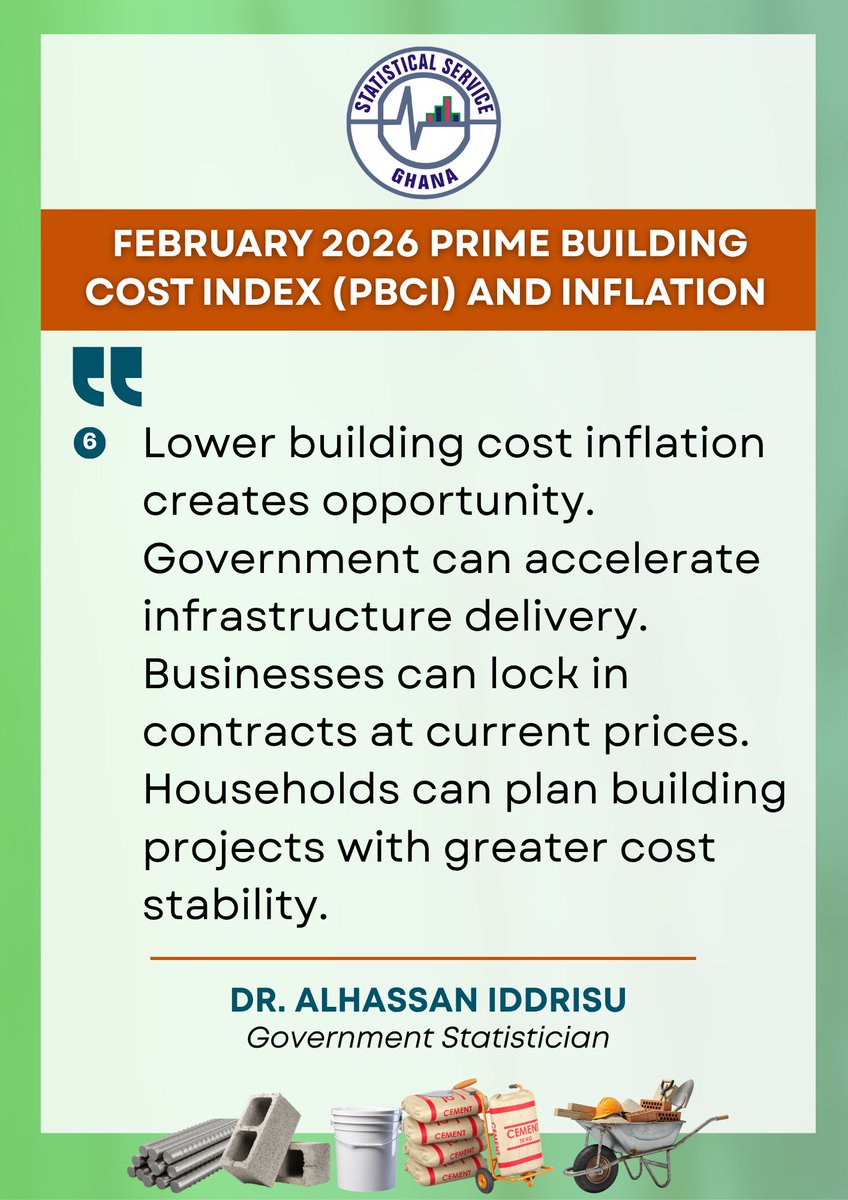
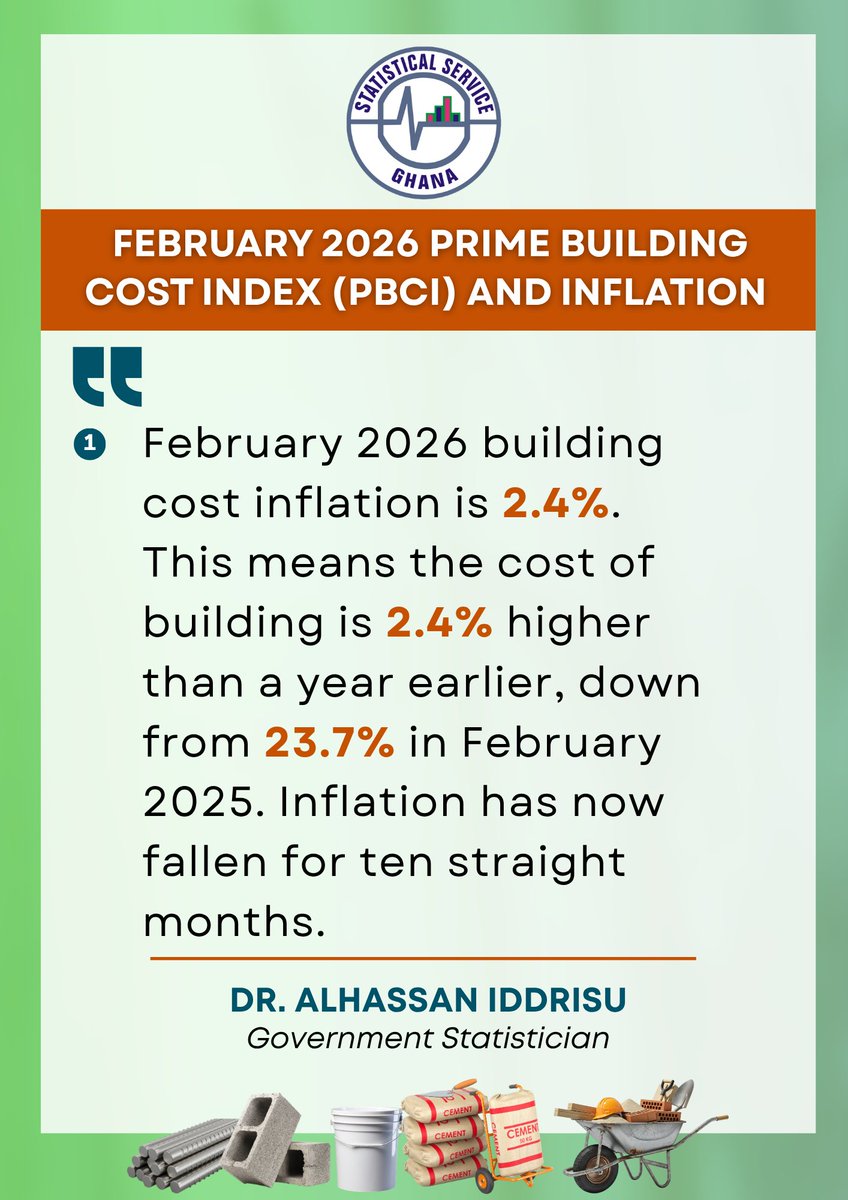
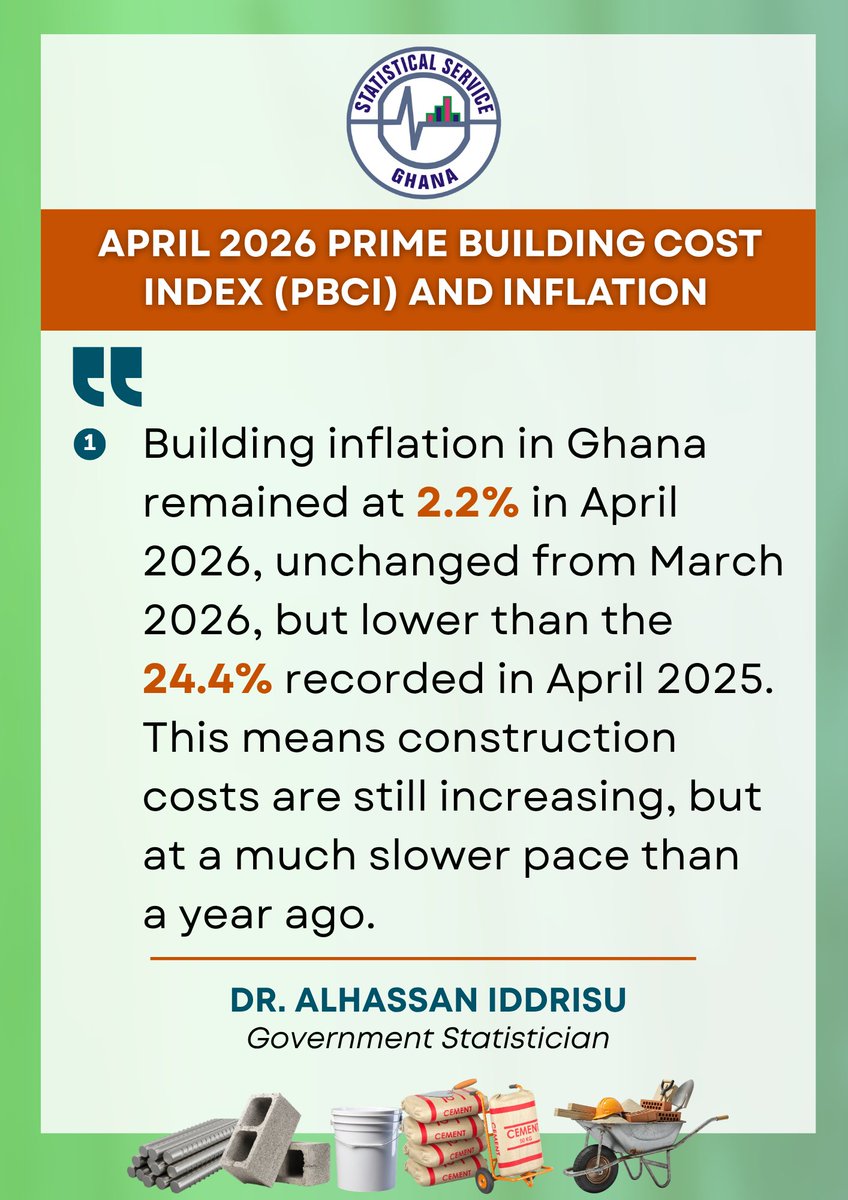
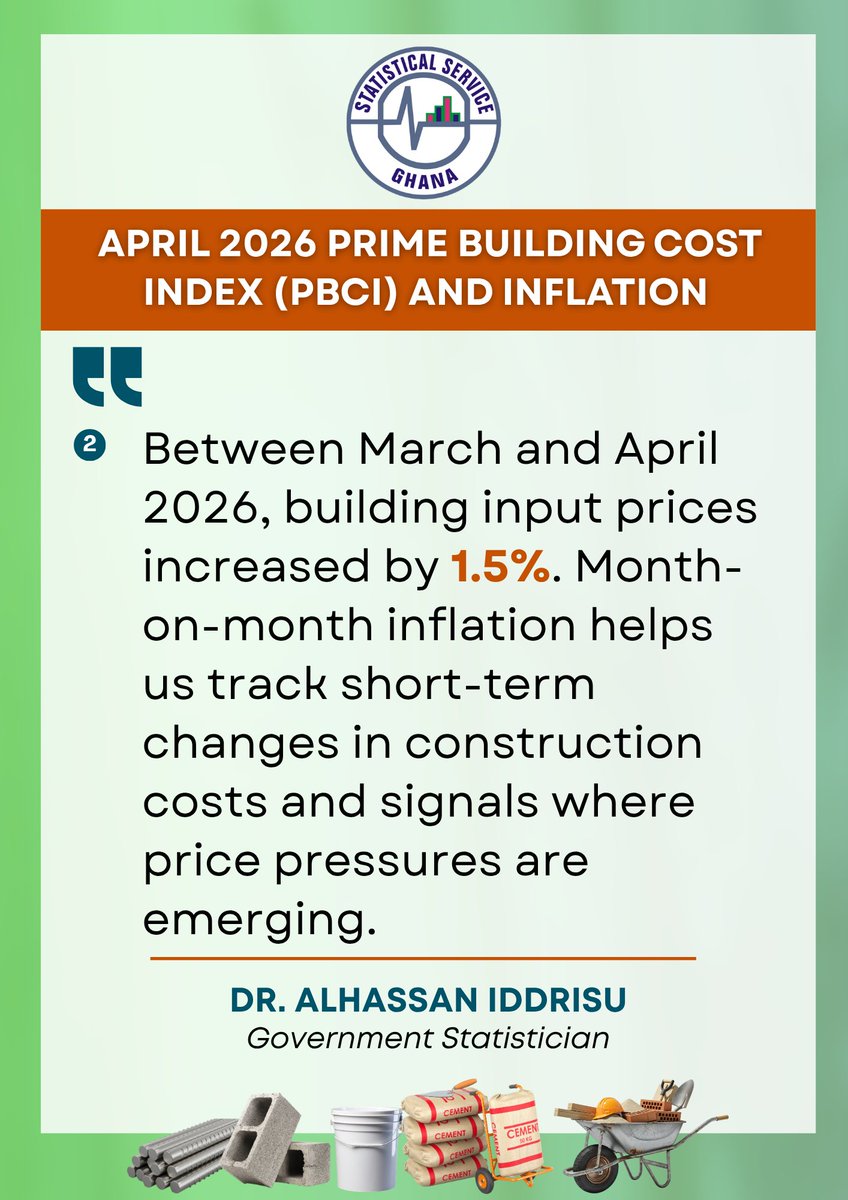
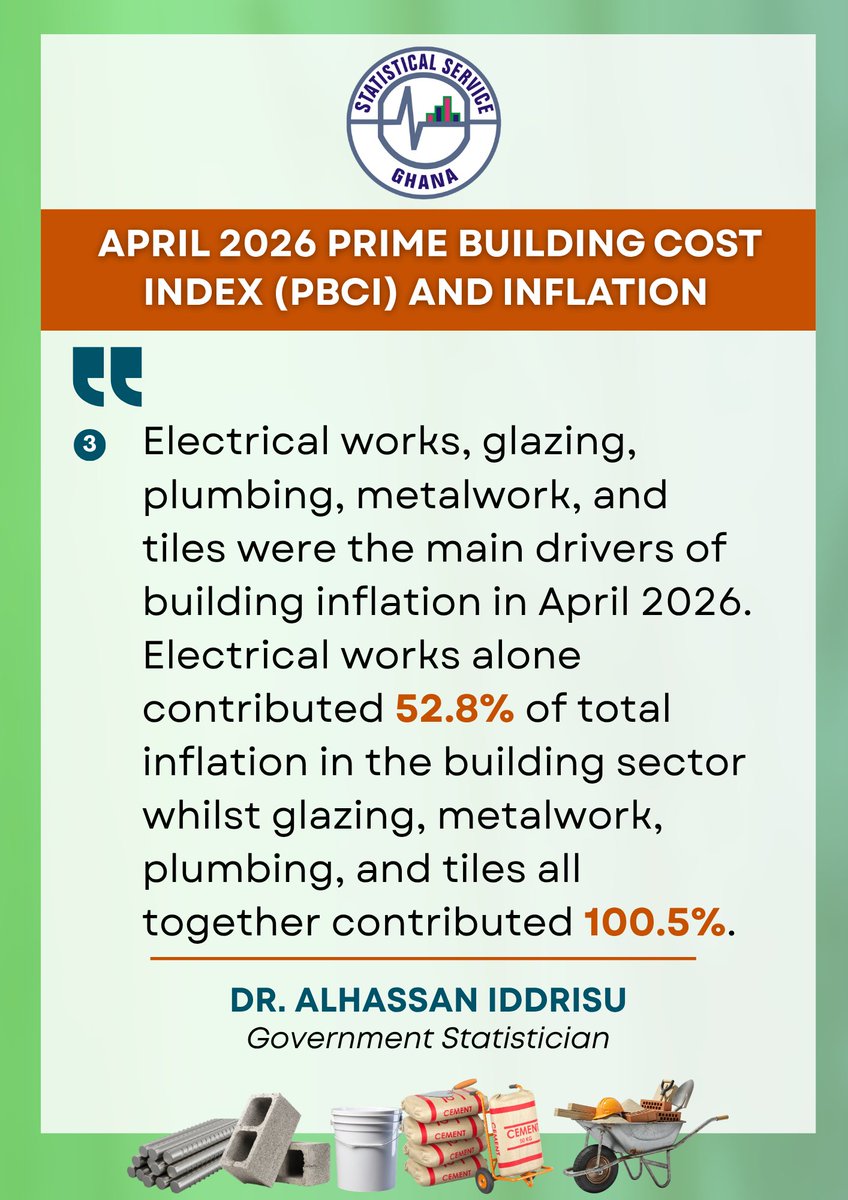
The April 2026 Prime Building Cost Index and Inflation figures show that Ghana’s building inflation remains stable at 2.2% year-on-year, far lower than the 24.4% recorded a year ago. While overall cost pressures have moderated, selected areas such as glazing, plumbing, electrical works, and roofing materials continue to drive price increases across the construction sector.
These insights are important for government, businesses, contractors, households, researchers, and investors as we collectively plan, budget, build, and make informed decisions for national development.
On behalf of the Ghana Statistical Service, I express sincere appreciation to traders, suppliers, market operators, data providers, development partners, industry players, the media, and the hardworking staff of GSS whose dedication and collaboration made this release possible.
At GSS, we remain committed to producing timely, accurate, relevant, and credible statistics to support evidence-based decision-making for Ghana’s transformation.
#PBCI #Inflation #GhanaStats #EvidenceMatters #DataForDevelopment
2
4
203

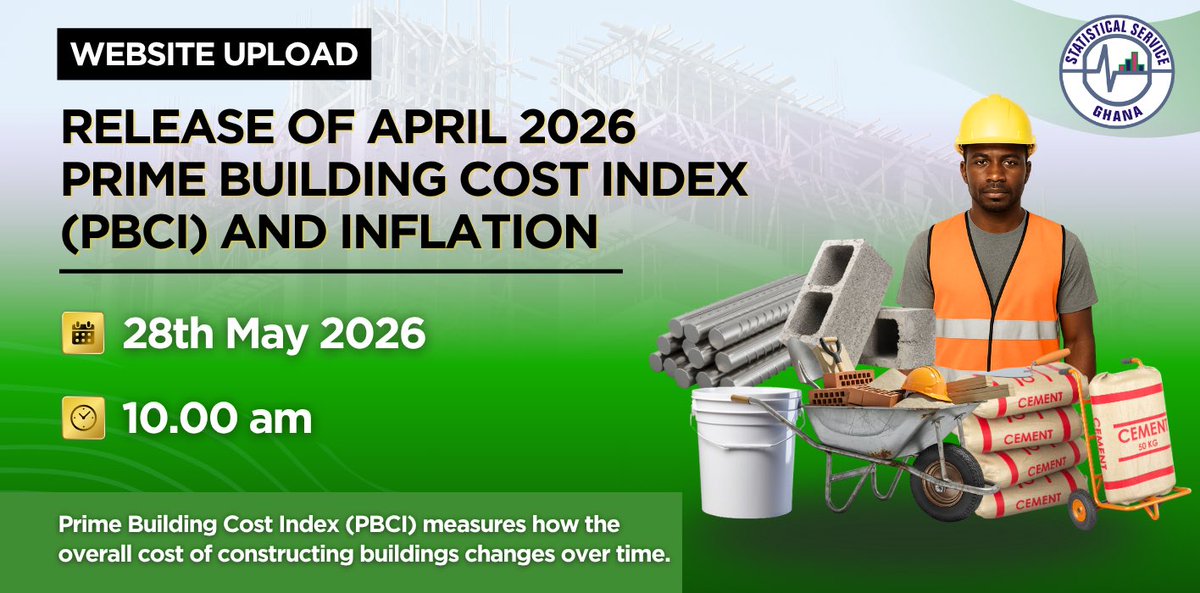
Join us at 10am as we release the April 2026 Prime Building Cost Index and Inflation.
Visit our website, statsghana.gov.gh for the full data.
#AprilPBCI #Data #Gss #buildingcost #Ghana #Statistics
5
203
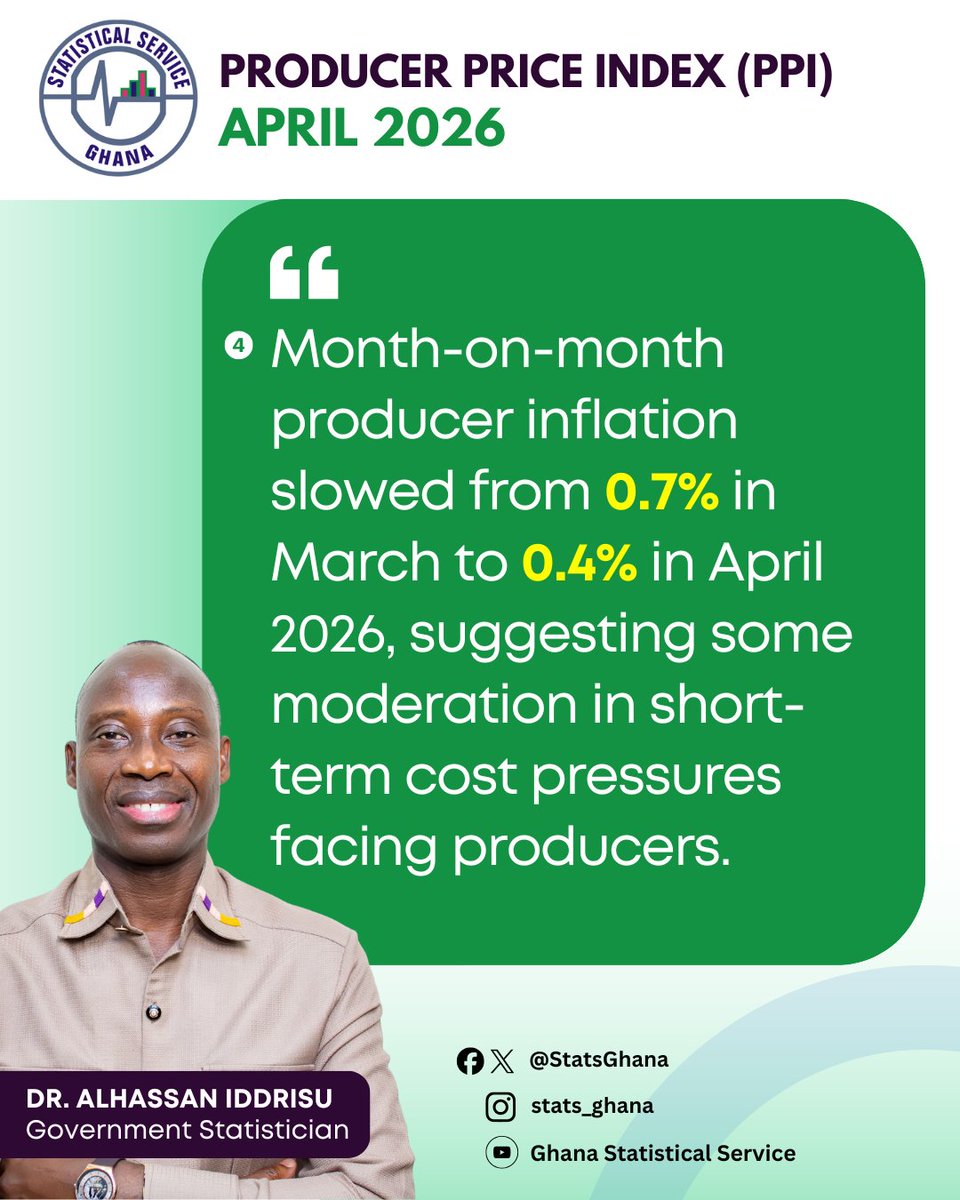
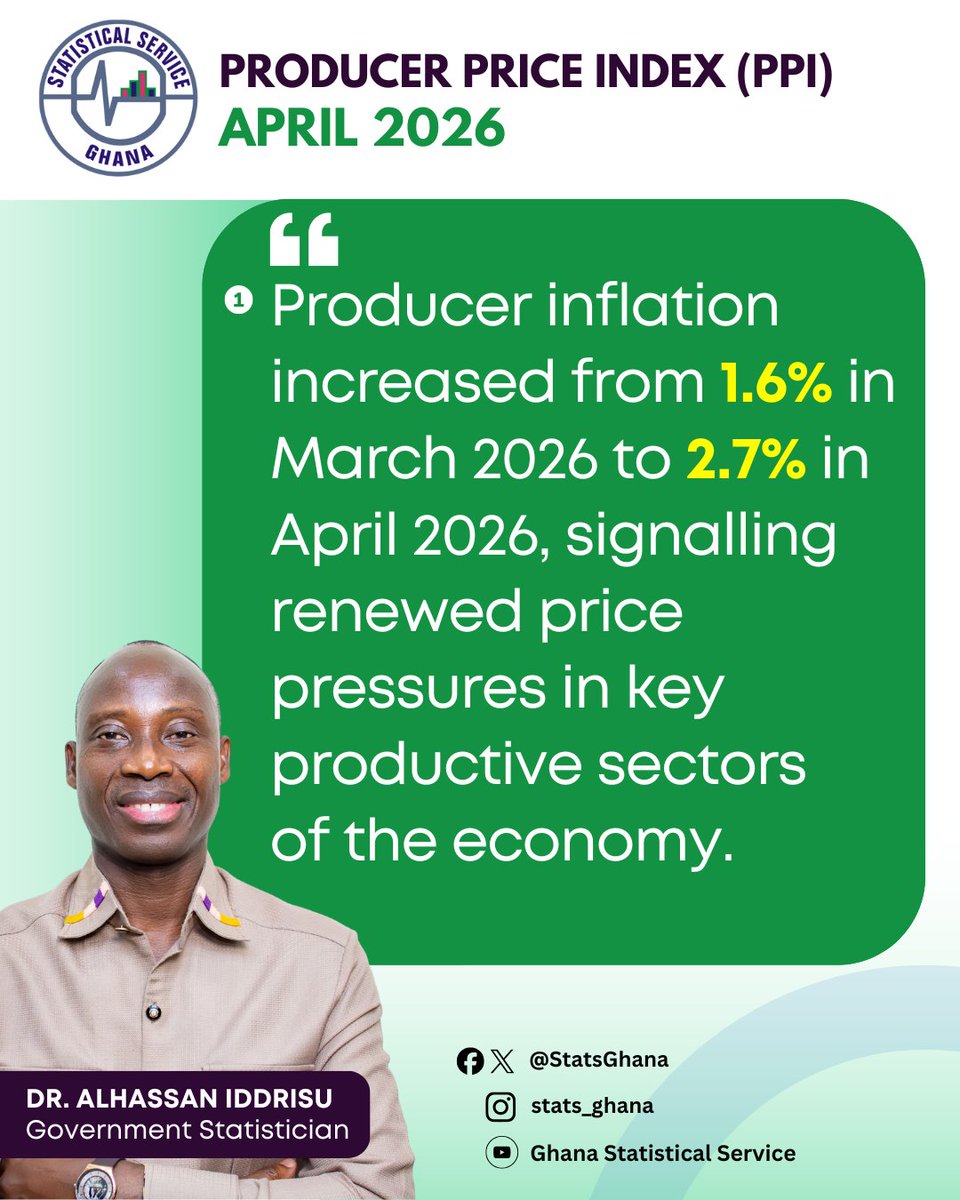
Producer inflation increased from 1.6% in March 2026 to 2.7% in April 2026, signalling renewed price pressures in key productive sectors of the economy.
Download the report on our website statsghana.gov.gh
#Gss #PPI #data #April #ghana #statistics
1
2
215
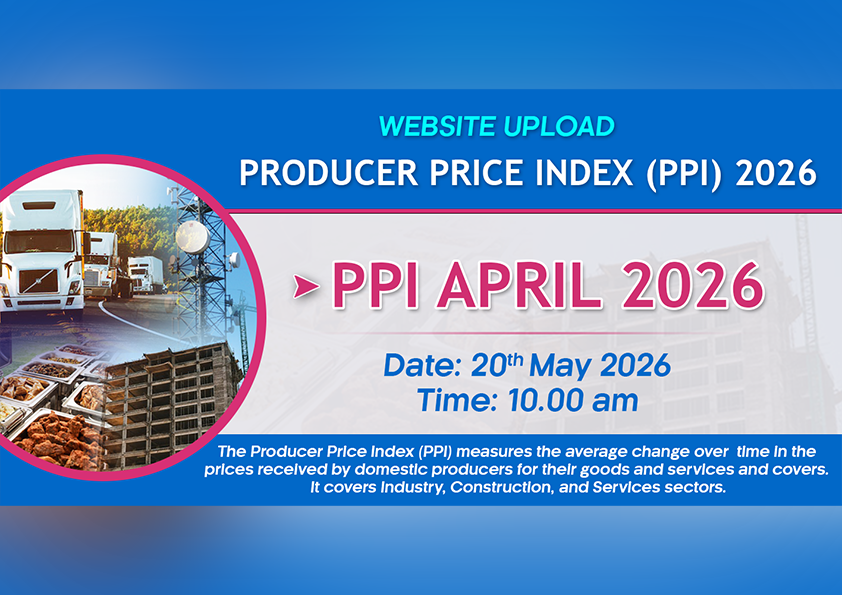
Check out the April 2026 Producer Price Index (PPI) on our website
statsghana.gov.gh
#Gss #PPI #data #April #ghana #statistics
1
2
231
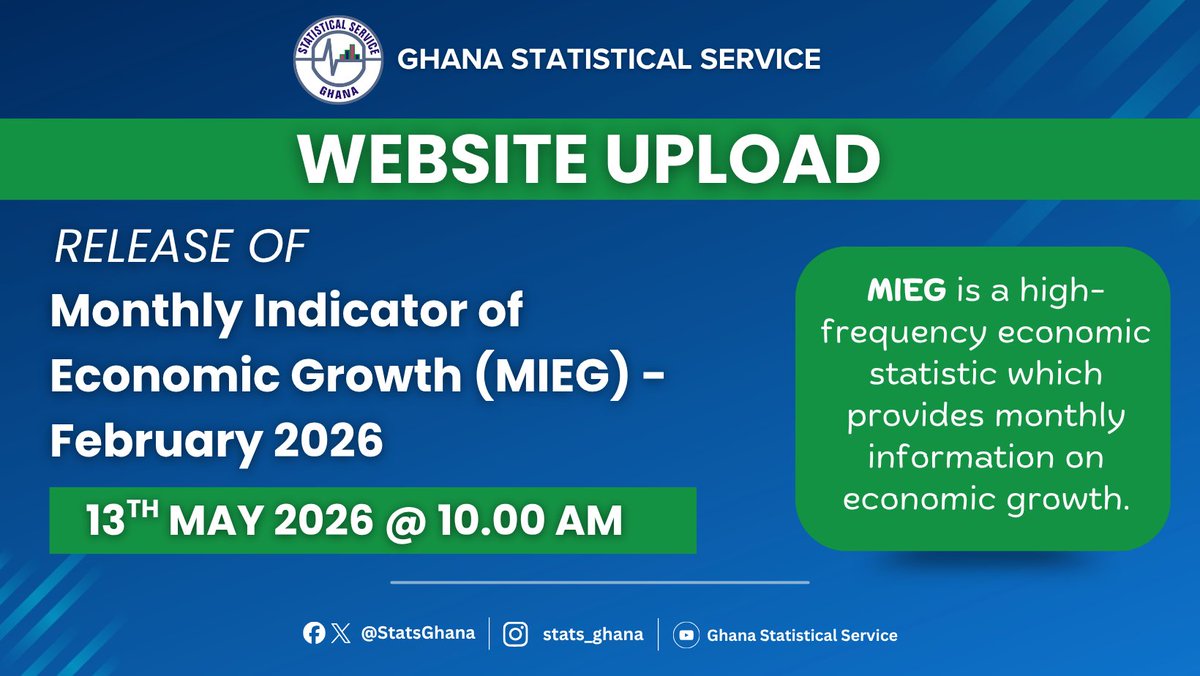
Visit our website, statsghana.gov.gh as we release February 2026 Monthly Indicator of Economic Growth (MIEG) at 10am tomorrow May 13, 2026.
#MEIG #data #statistics #ghana #GSS
5
135
Wishing all mothers a Happy Mother’s Day🎉🎉🎉🎉🎉🎉🎉🎉.
The Ghana Statistical Service celebrates you all. ❤️❤️❤️
#Data #statistics #ghana #mothersday
1
4
124
Ghana Statistical Service retweeted

May 1
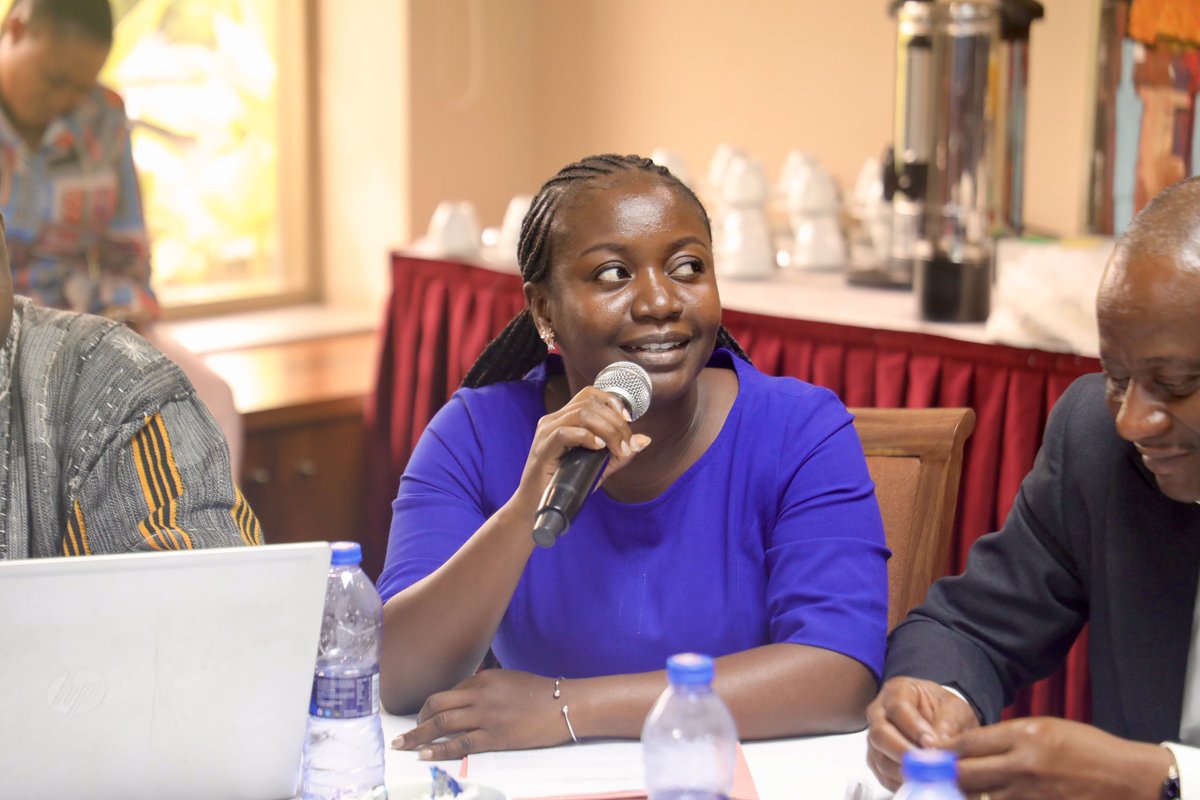
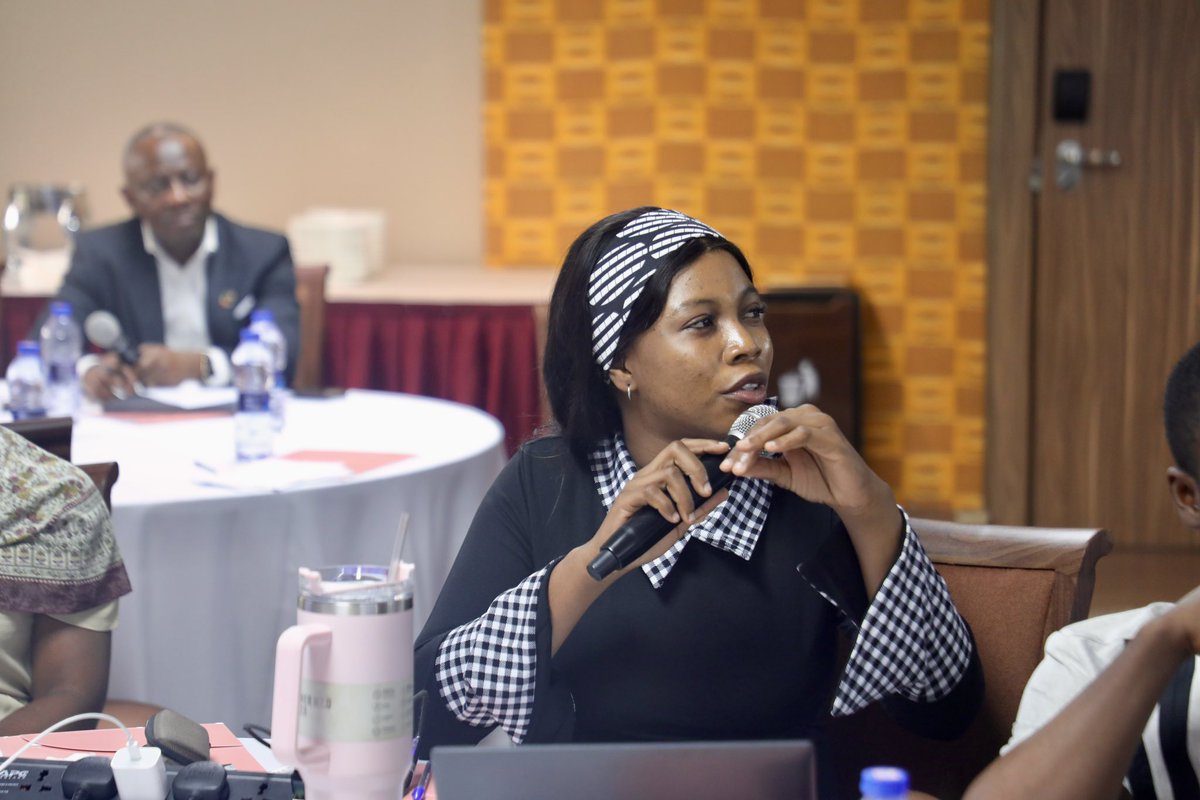
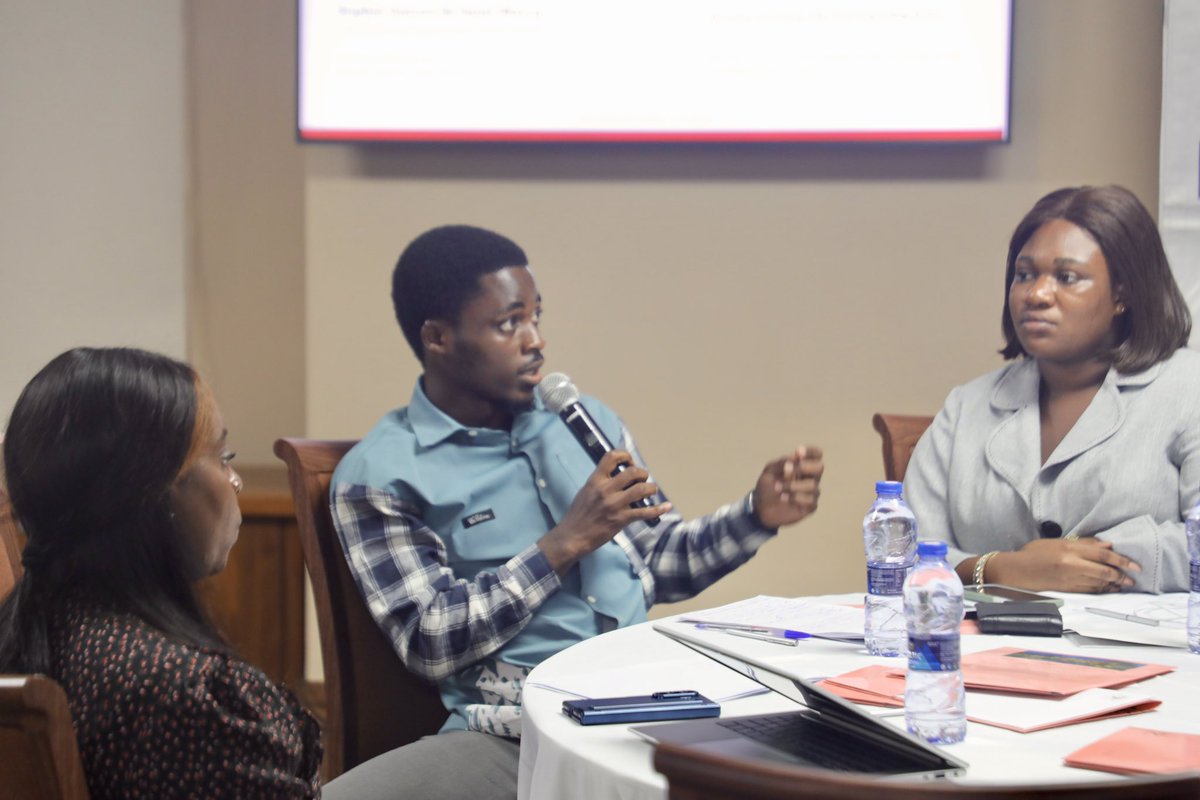
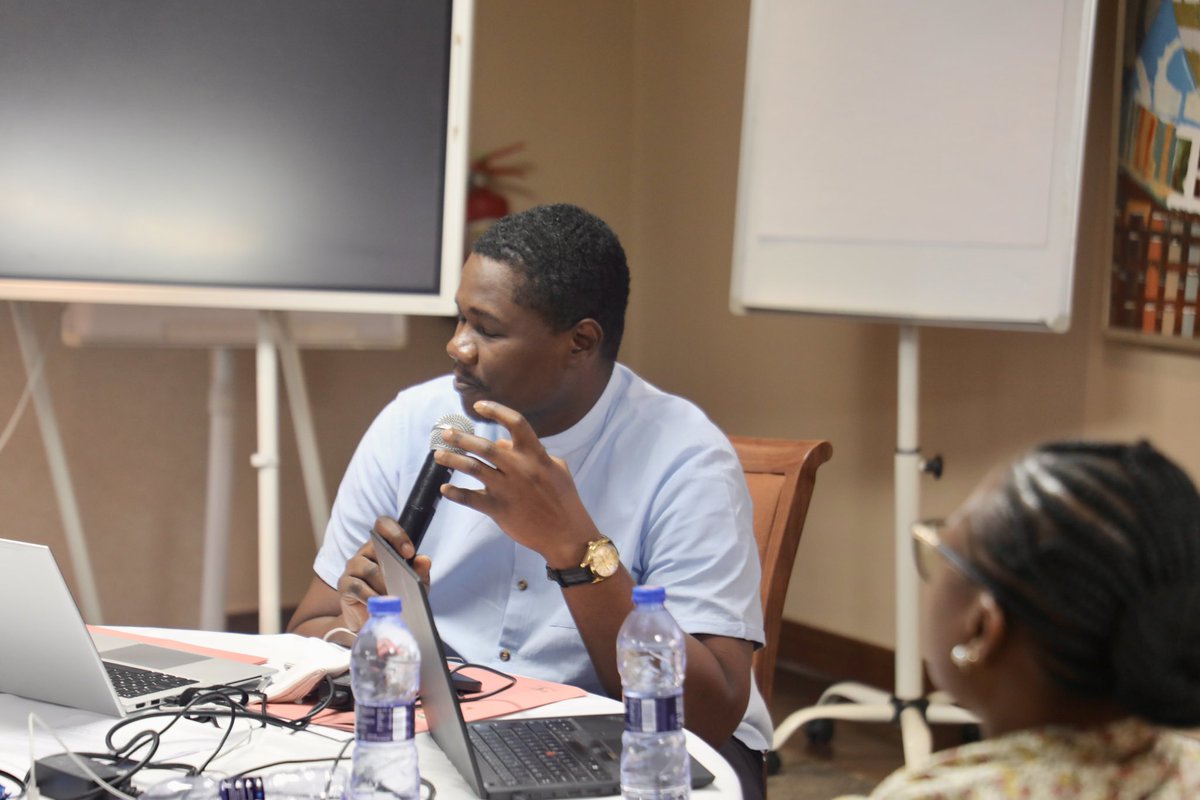
The #CreditRating Support Initiative workshop in 🇬🇭 concluded successfully.
Participants reviewed ToR for a joint inter-agency committee to boost coordination across govt, supporting 🇬🇭’s path to an investment-grade rating & stronger credit profile.
With support from @MofaJapan_en , @UNDP will keep working with partners to drive investor confidence & unlock sustainable financing.
2
7
340
Ghana Statistical Service retweeted
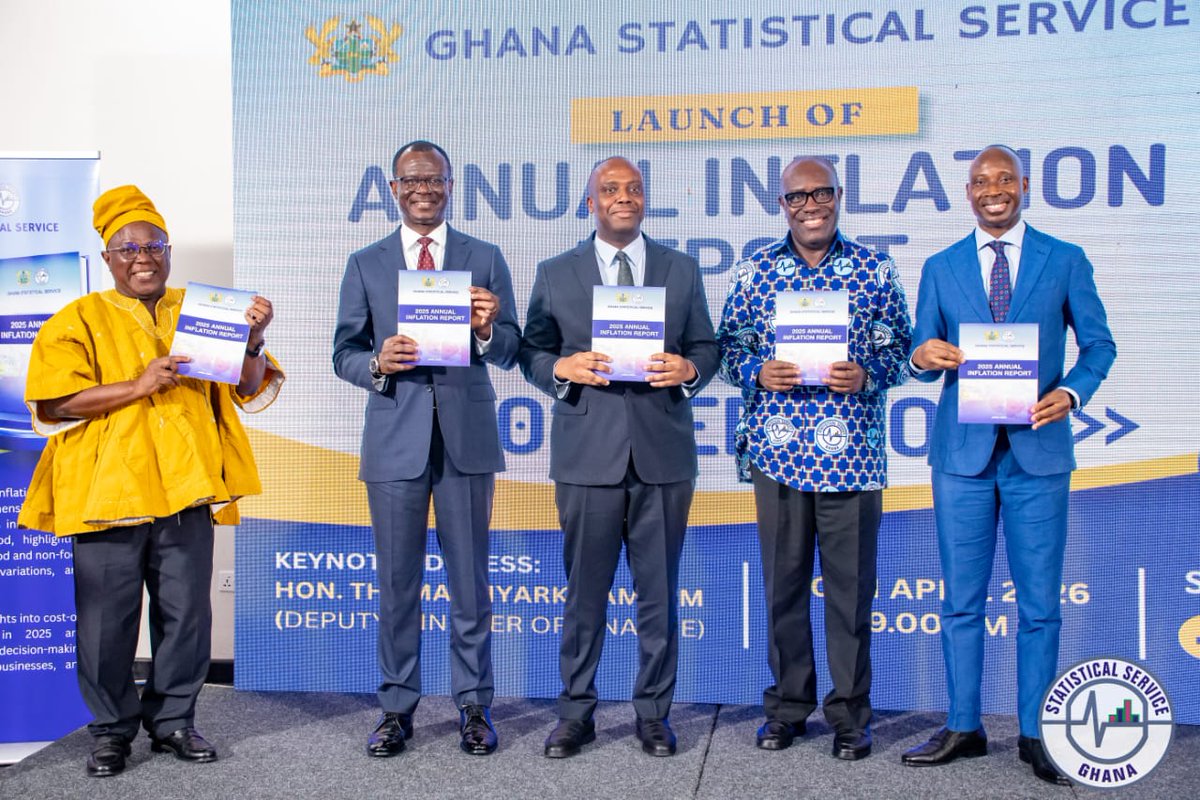
Yesterday, The Ghana Statistical Service launched the first-ever Annual Inflation Report.
This marks a shift.
We are moving beyond monthly CPI updates to tell the full story of inflation over the year, what changed, what drove it, and what it means for people, businesses, and policy.
The headline is clear, and encouraging:
Inflation declined from 23.5% in January 2025 to 5.4% in December. That is 12 straight months of decline, one of the strongest disinflation episodes in our region.
But the deeper story matters even more.
1. First, inflation fell, but prices did not.
Lower inflation simply means prices are rising more slowly, not that they are falling. This distinction matters for every household.
2. Second, food remains the biggest pressure point.It accounted for over half of total inflation. At the item level, rent and electricity pushed inflation up, while tomatoes helped bring it down.
3. Third, inflation in Ghana is largely homegrown. About 74% of price pressures came from domestic factors, not imports. This is not just an external shock story, it is a local one.
4. Fourth, inflation is not uniform across the country. It ranged from 10.9% in Bono East to 24.9% in Upper West. Progress is real but uneven.
The discussions reinforced a simple truth:
This progress did not happen by chance.
It was driven by policy coordination, between the Bank of Ghana and the Ministry of Finance. Tight monetary policy, fiscal discipline, exchange rate stability, and easing fuel prices all played a role.
Now comes the harder part: sustaining the gains.That will require:
1. Fixing food inflation at its source
2. Strengthening domestic supply chains
3. Maintaining fiscal and monetary discipline
4. Managing administered prices carefully
5. Continuing to invest in better data
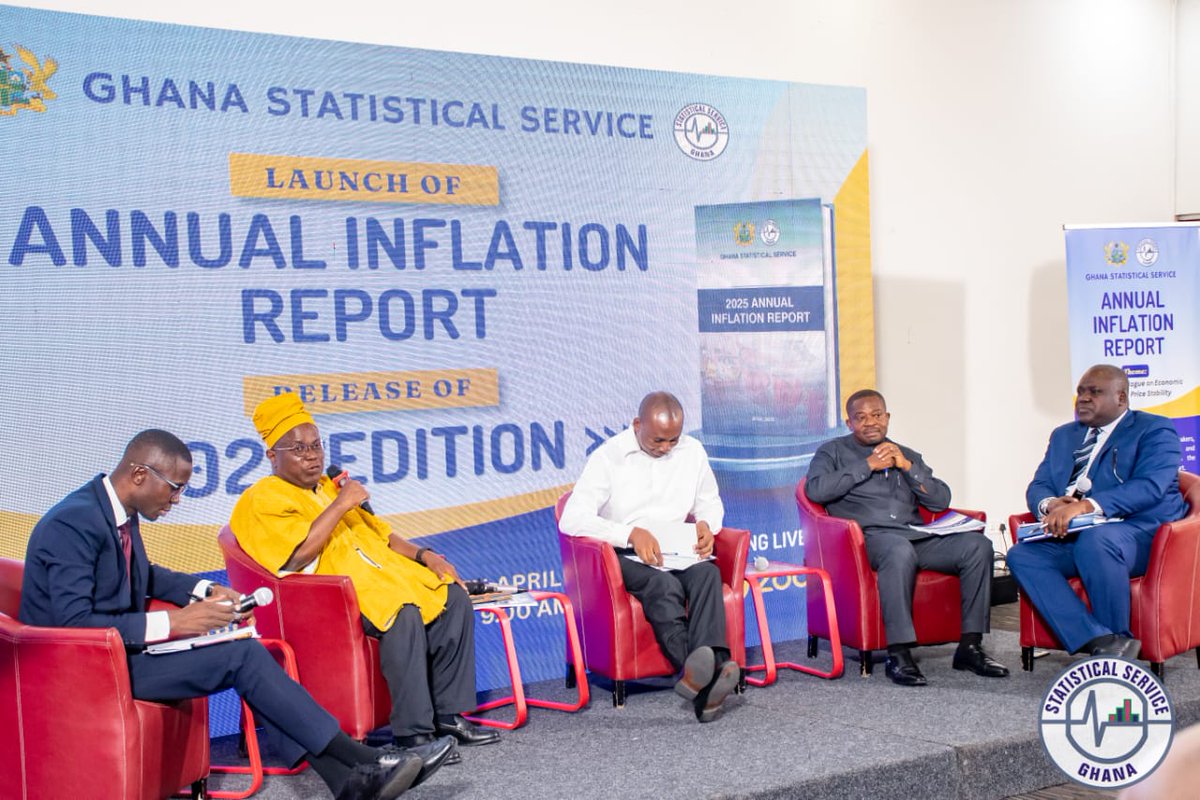
What stood out most was the quality of engagement. Government, the central bank, academia, the private sector, and civil society came together for an honest, evidence-driven conversation on inflation in Ghana.
That is exactly how progress is sustained.
My sincere appreciation to: Hon. Thomas Nyarko Ampem, Dr. Anthony Yaw Baah, Dr. Zakari Mumuni, and our distinguished panellists, Dr. Nii Moi Thompson, Prof. Godfred Bokpin, Mr. Seth Twum-Akwaboah, and Dr. Philip Otoo. And to the entire GSS team, this milestone is yours.
The full report is available at statsghana.gov.gh.
The gains are real. Now the real test begins, keeping them.
#AnnualInflationReport #GhanaInflation #CPI #GSS #DataForDevelopment #EvidenceBasedPolicy

4
15
712
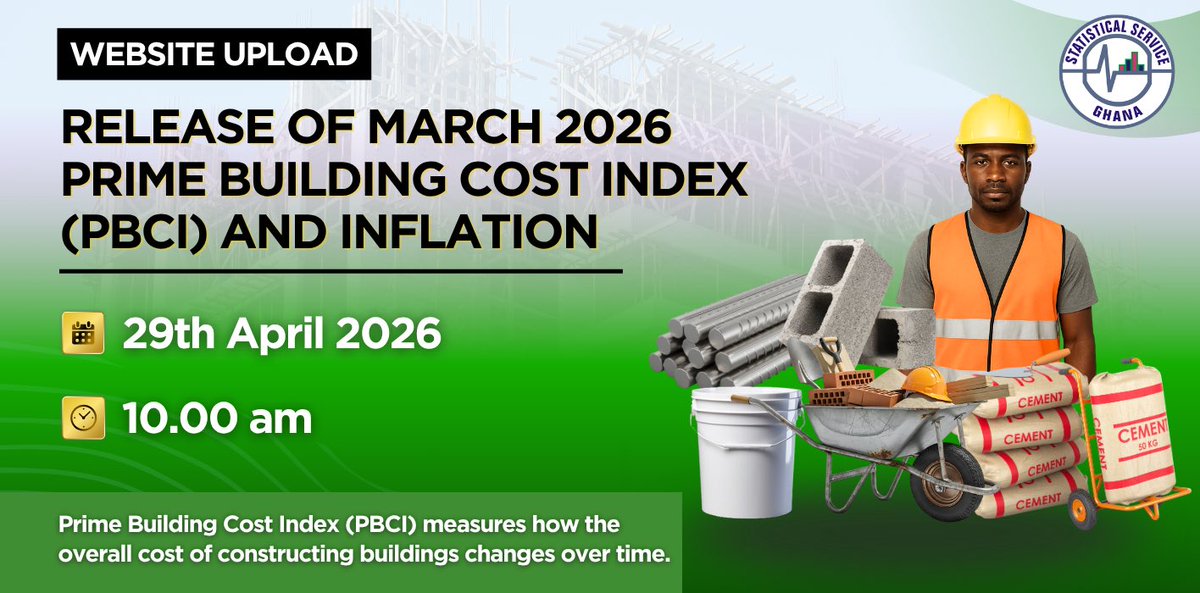
The Ghana Statistical Service will release March 2026 Prime Building Cost Index (PBCI) and Inflation on website at 10am today 29th April, 2026.
Click on the link below to access the publication.
statsghana.gov.gh
#PBCI #March2026 #data #statistics #buildingcost #Ghana
4
8
320
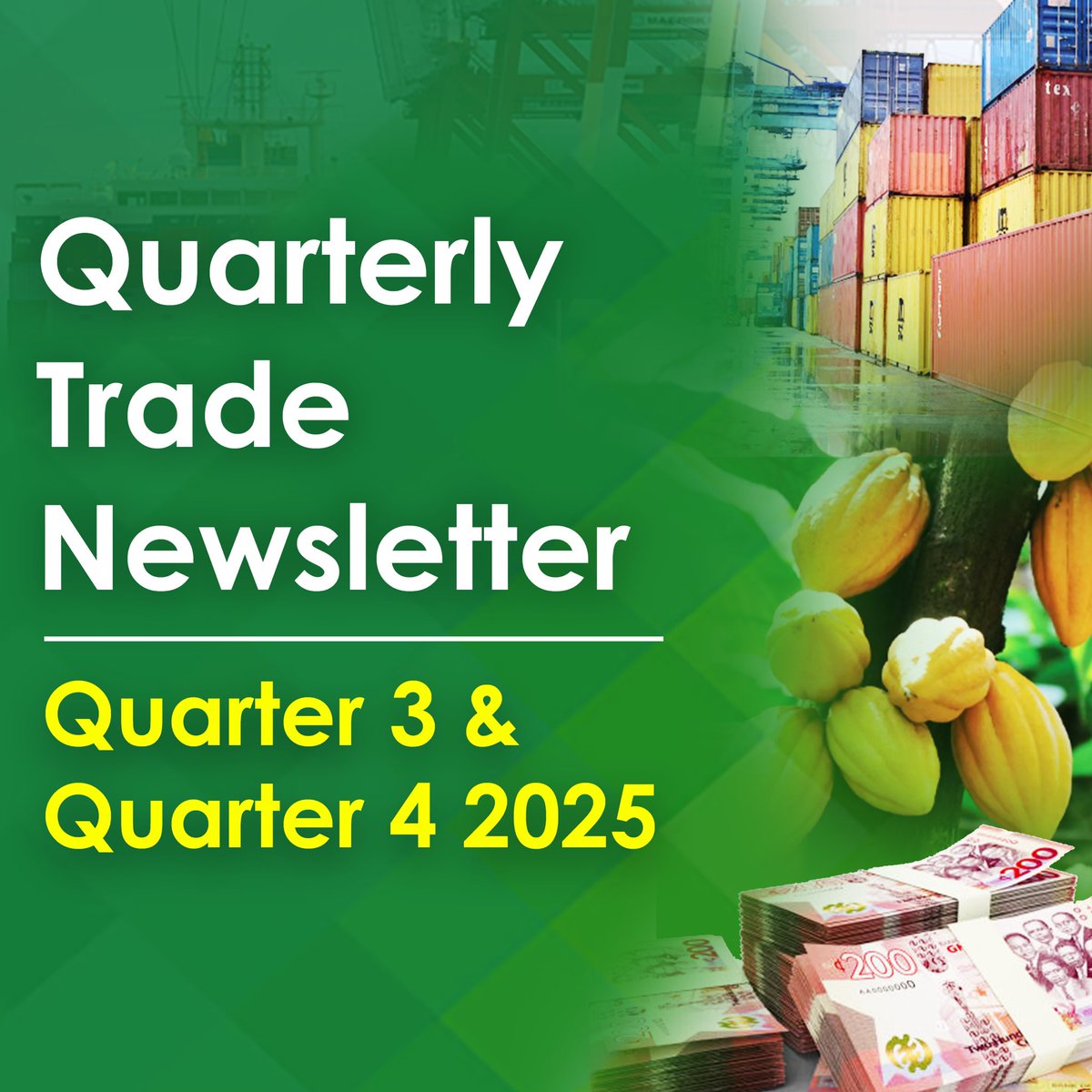
The Ghana statistical Service has released Q3 and Q4 2025 Quarterly Trade Newsletter.
Click the link below to access👇🏽👇🏽👇🏽👇🏽
statsghana.gov.gh/data-stati…
#Gss #tradereport #newsletter #data
2
1
6
232
Ghana Statistical Service retweeted
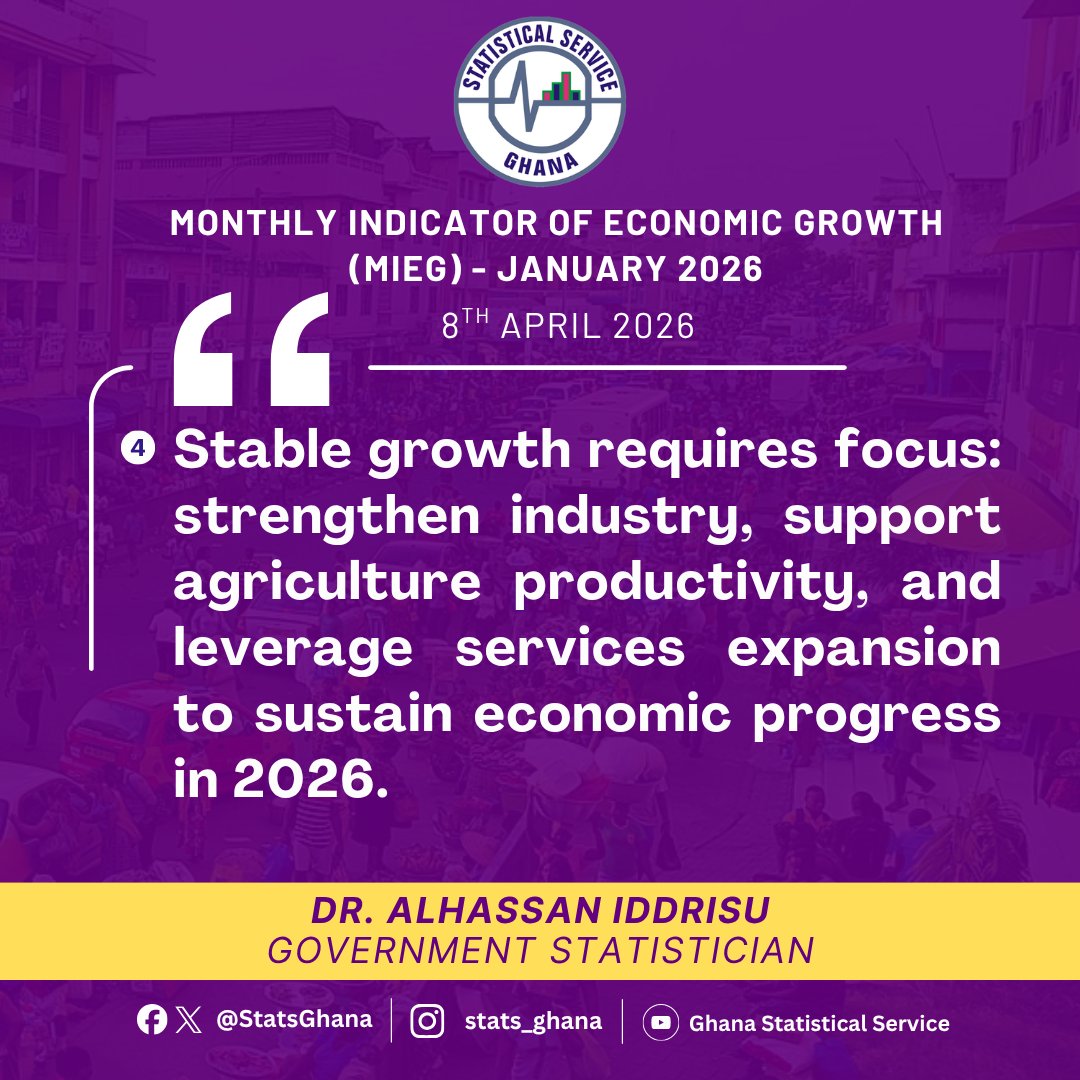
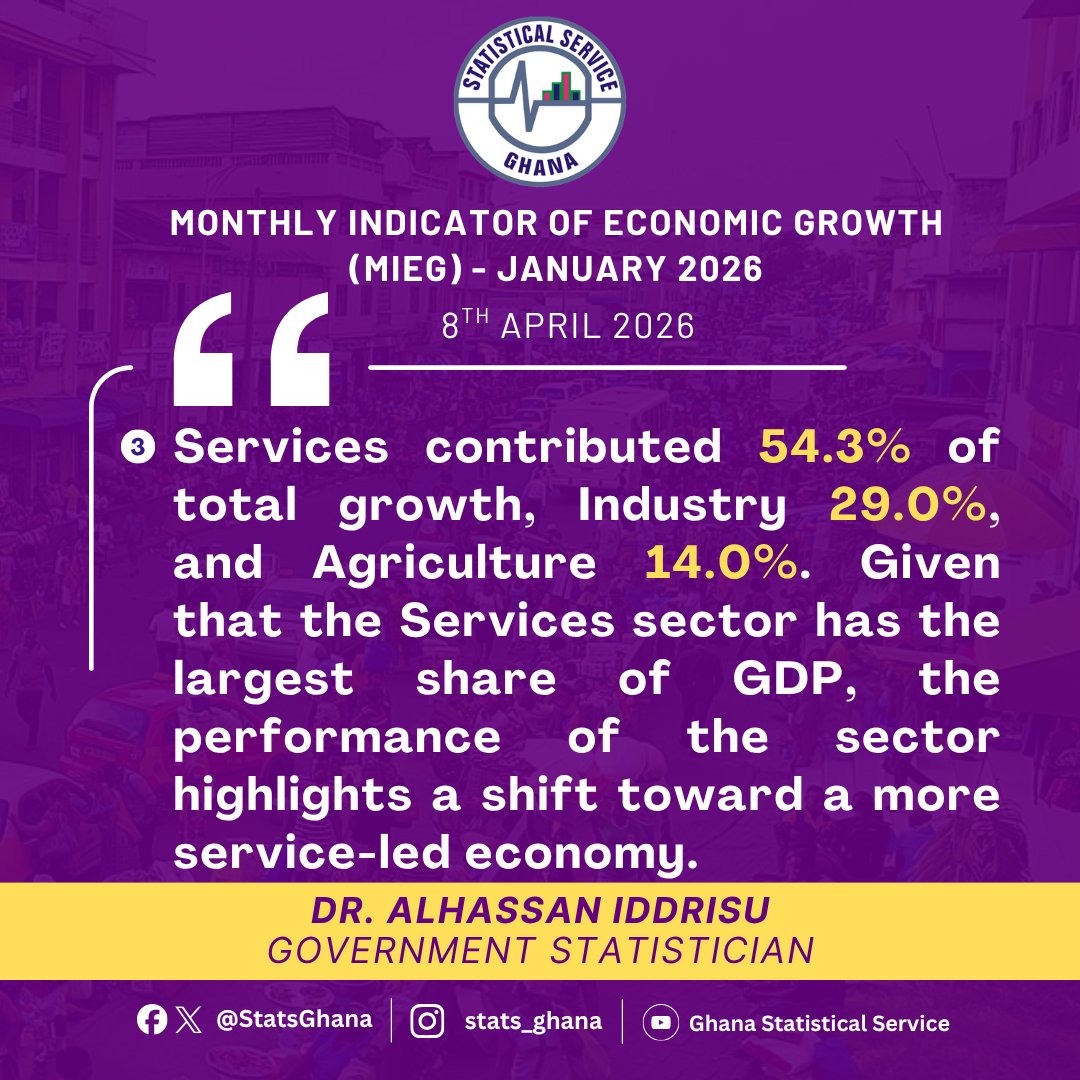
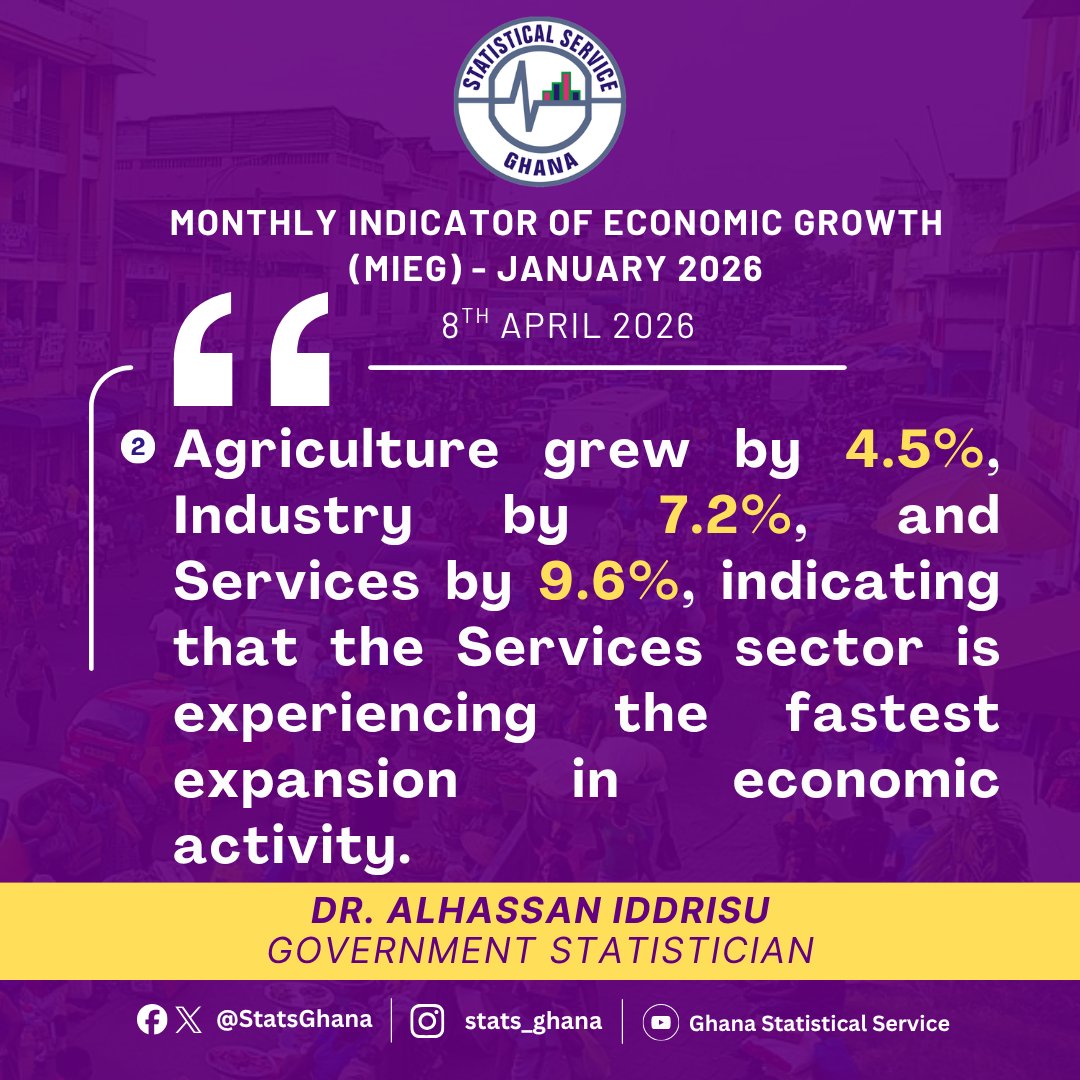
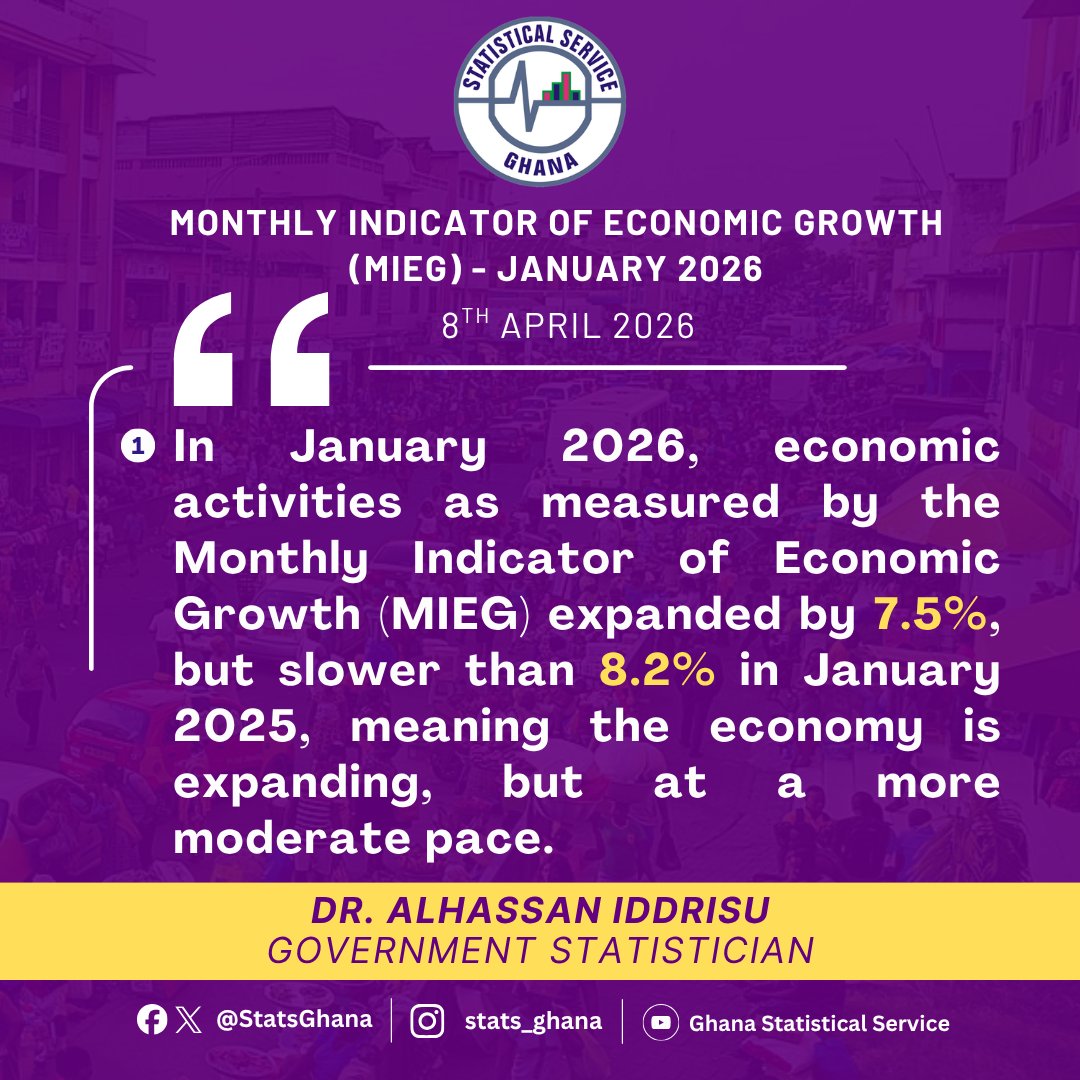
In January 2026, economic activity expanded by 7.5 percent. The Monthly Indicator of Economic Growth (MIEG) data shows that growth is steady, driven mainly by services, while industry and agriculture show changing momentum.
Here is what this means for key stakeholders
#MIEG #GhanaEconomy #Jan2026 #GSS #EconomicGrowth #DataDriven
1
1
8
289
Key highlights of January 2026 Monthly Indicator of Economic Growth (MIEG)
#MIEG #January2026 #data #EconomicGrowth
1
1
5
179
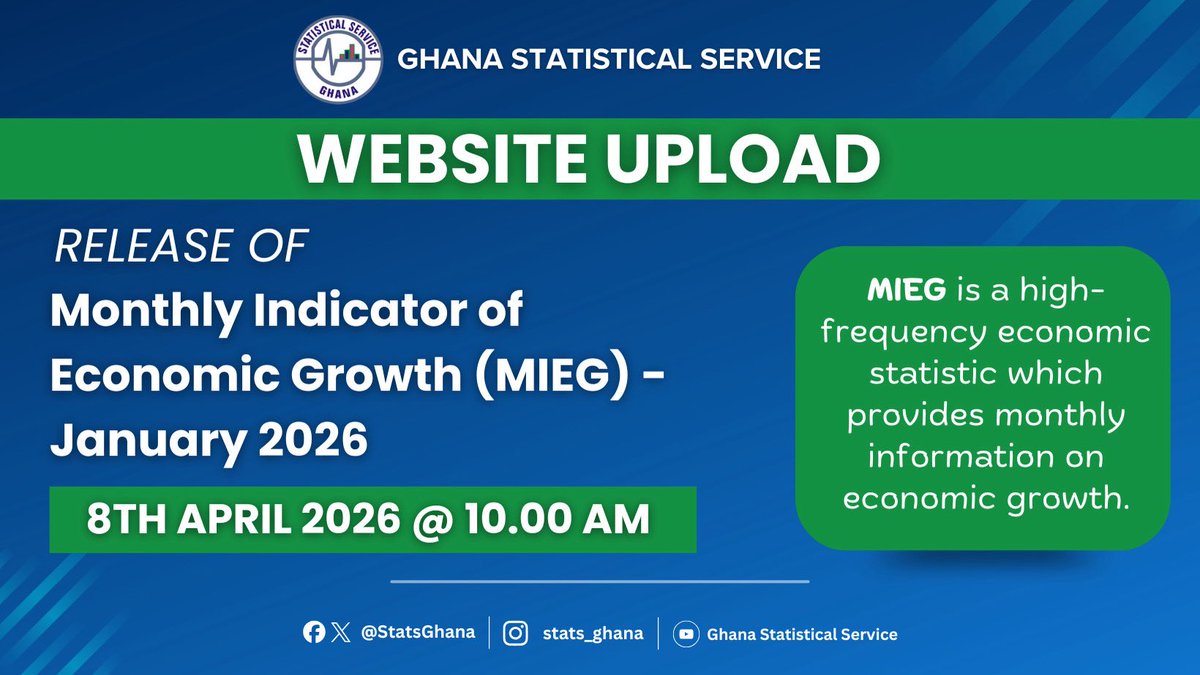
Visit our website as we release the January 2026 Monthly Indicator of Economic Growth (MIEG).
statsghana.gov.gh
#MIEG #January2026 #EconomicGrowth #data
1
8
247
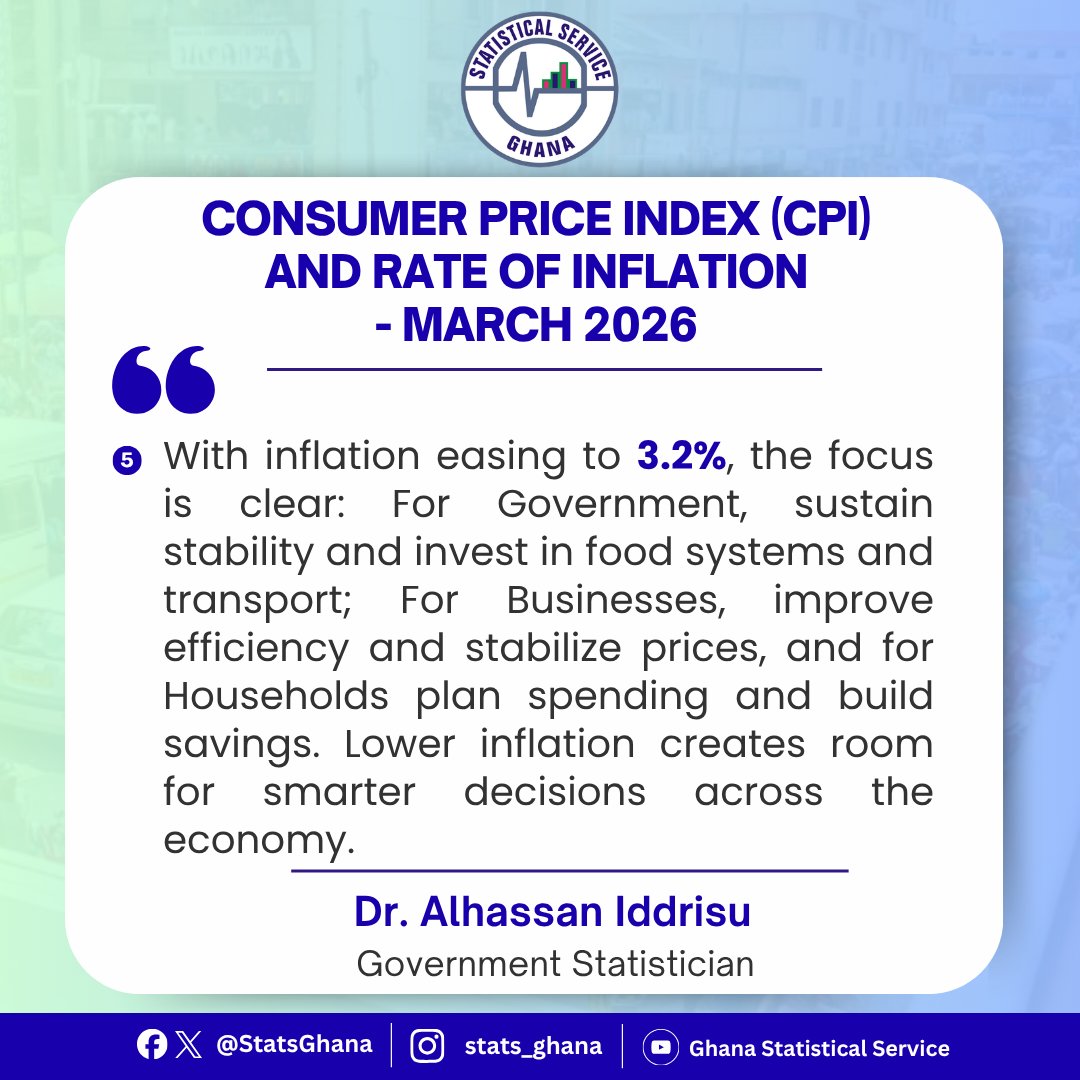
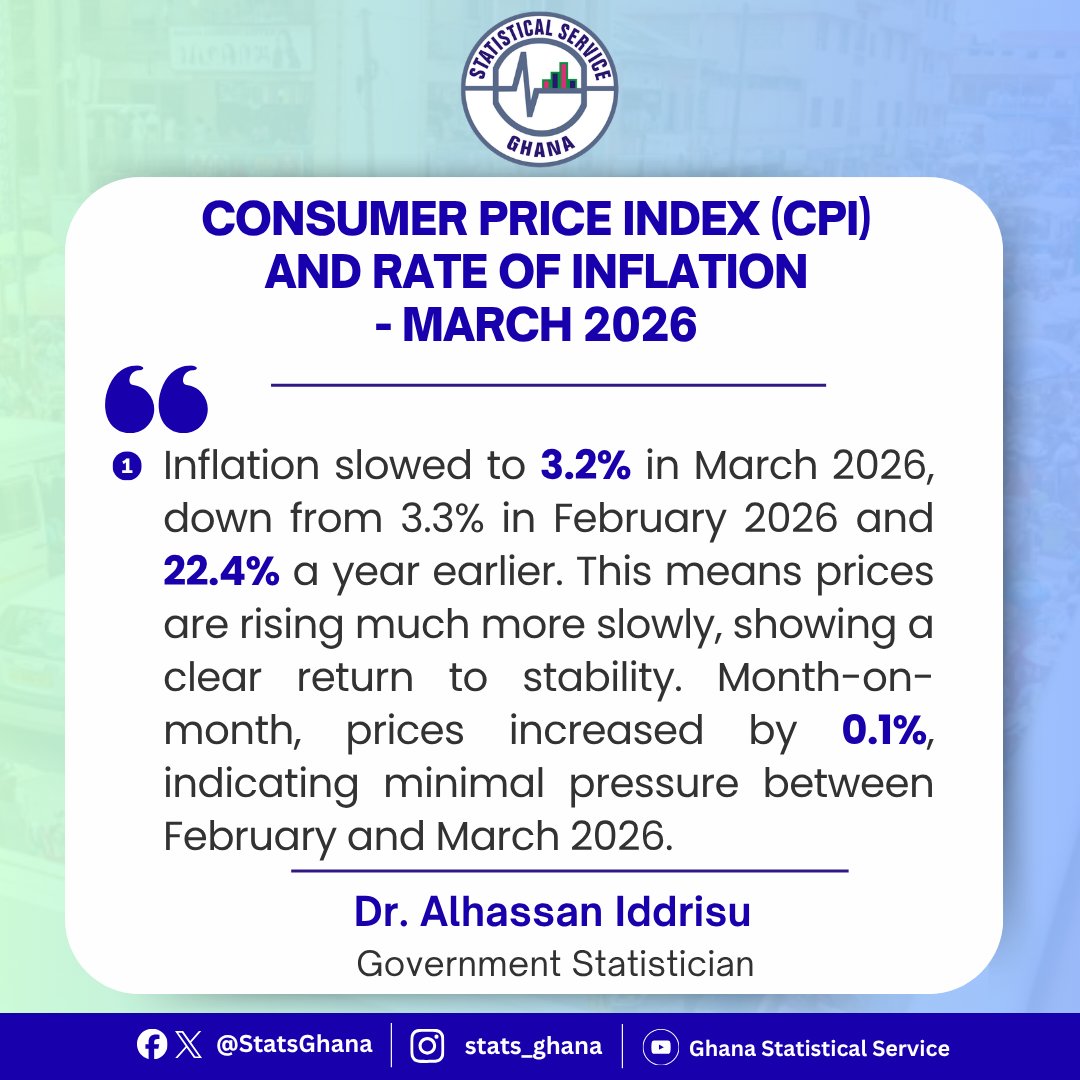
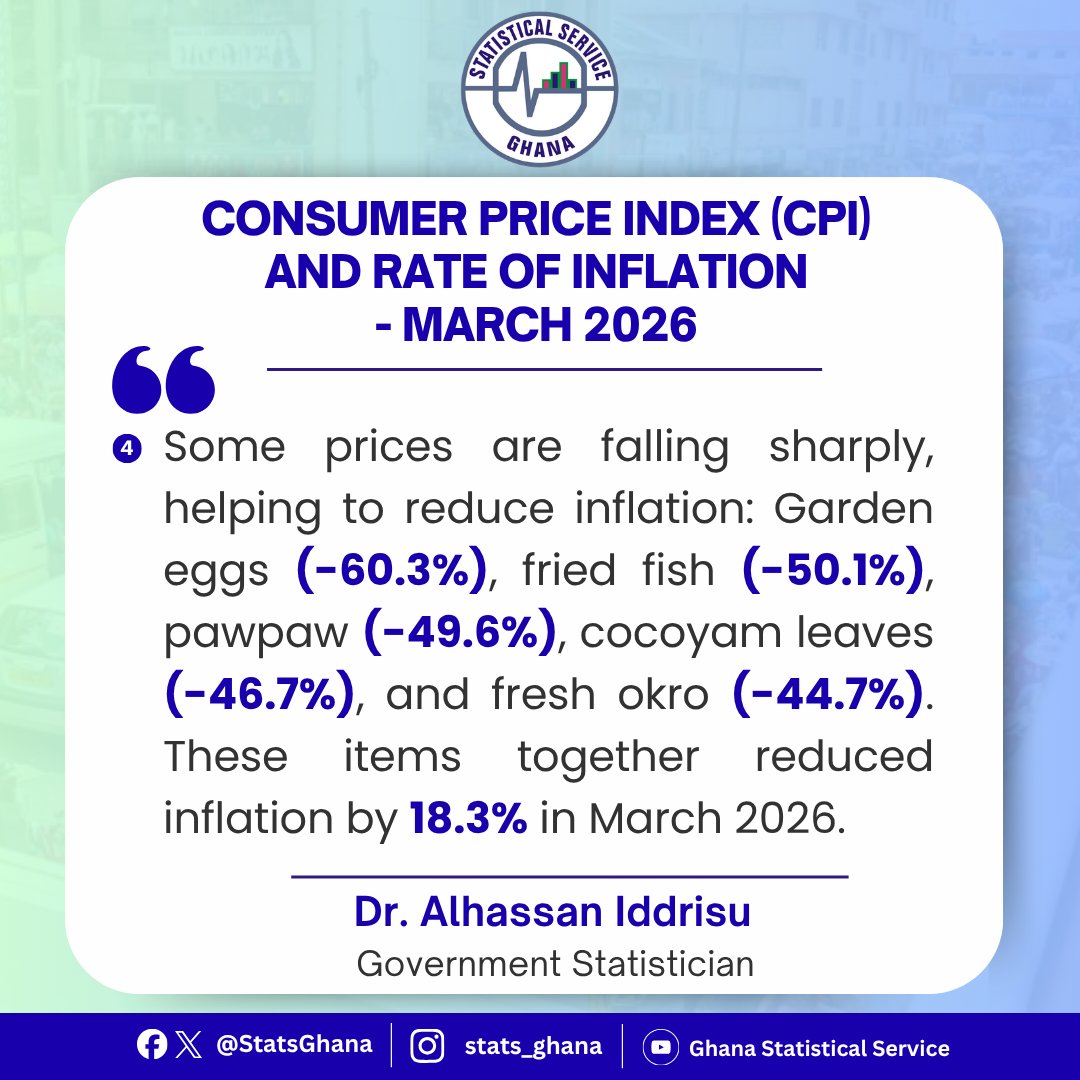
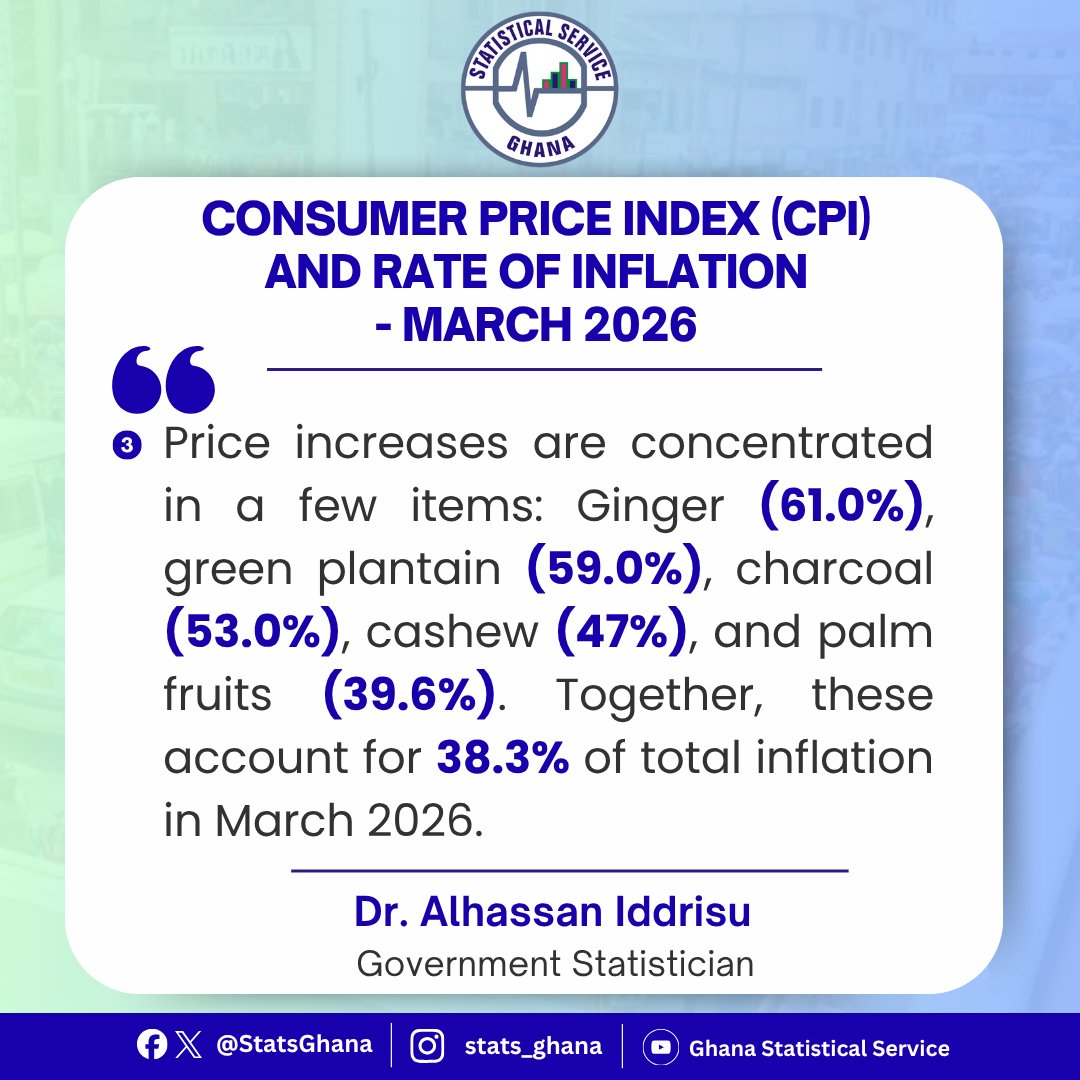
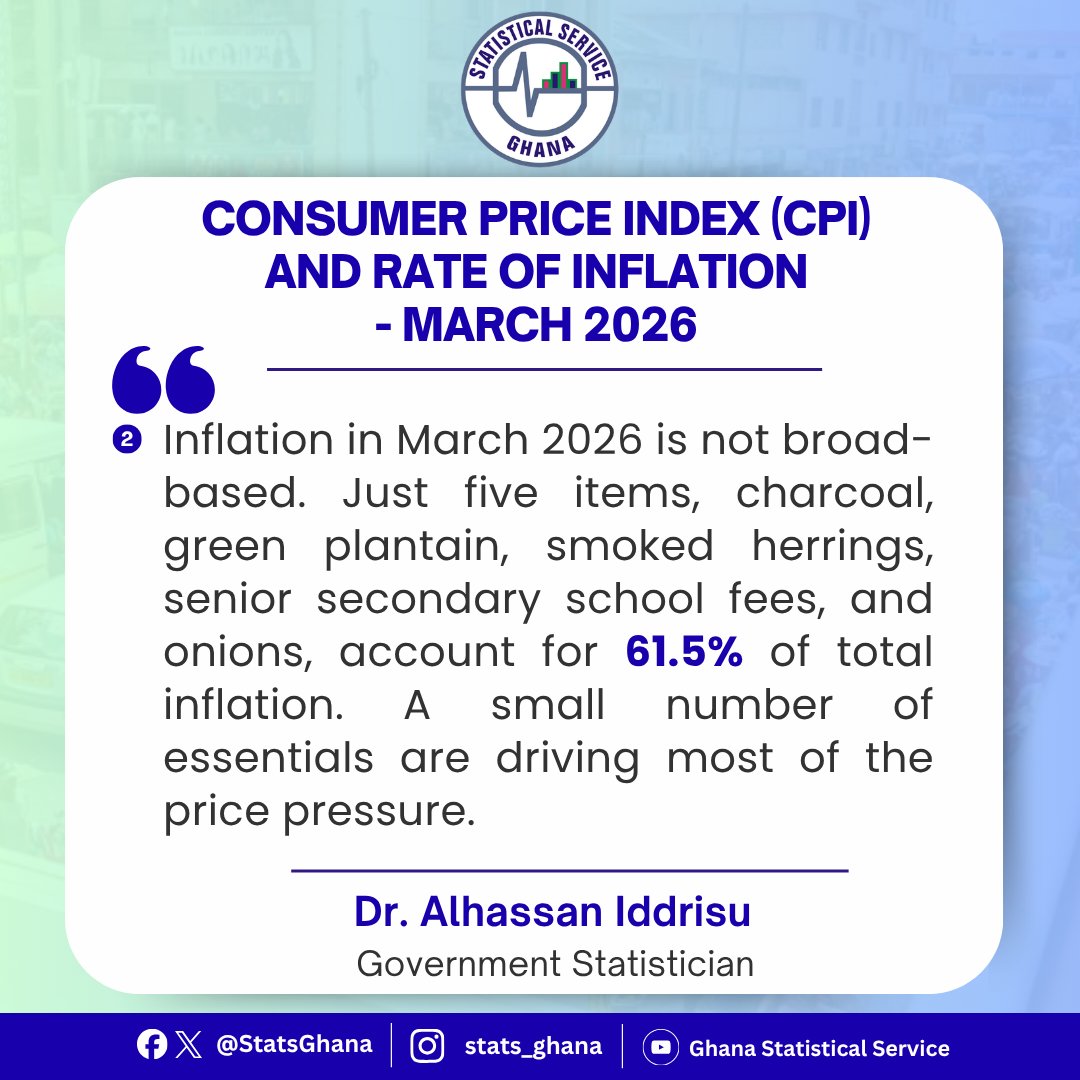
Key highlight of MARCH 2026 Consumer Price Index and rate of inflation.
#CPI #March2026 #Ghana #Development
3
5
17
597