Physicist - ICREA Research Prof. @icreacommunity @icn2nano @_BIST @ls_quant @apeironintelligence #quantumtechnologies #TopologicalMatter #spintronics #graphene
Joined March 2015
- Tweets 3,202
- Following 4,866
- Followers 10,141
- Likes 53,806
636 Photos and videos




Pinned Tweet

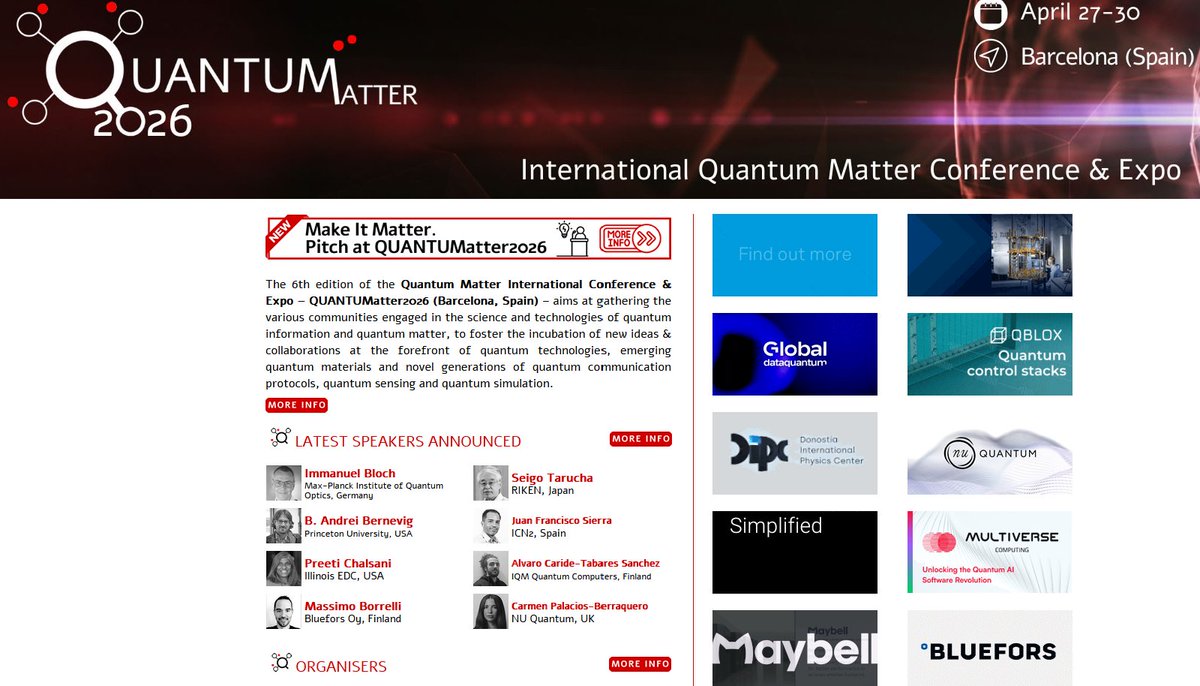
🚀 QuAI 2027 is coming!
The Quantum & AI Summit Expo lands in San Sebastián, Spain, on 19–22 (2027), bringing together Qtechnologies, AI, advanced materials, industry & innovation.
Pre-register via the official QuAI website.
#QuAI2027 #QuantumAI #AI #QuantumComputing #DeepTech
6
11
744
Stephan Roche retweeted

Jun 8
🚨QUANTUM NEWS🚨: Microsoft’s Majorana 2 Chip Achieves 1,000× Longer Qubit Lifetime — Uniphics Explains Why Topological Protection Works 🧨
On June 3–4, 2026, Microsoft announced a major advance with its Majorana 2 topological quantum chip. According to their preprint and coverage in *Nature* and *Scientific American*, the new qubits can maintain quantum information for over 20 seconds — roughly 1,000 times longer than their previous generation. The company claims this represents significant progress toward scalable, error-resistant quantum computing.
**Uniphics offers a clear physical explanation for why this kind of topological protection can work so effectively.**
In conventional quantum systems, qubits are extremely fragile. Even tiny disturbances from the environment cause them to lose coherence quickly. Topological qubits, like those Microsoft is developing, aim to encode information in special protected states that are much more resistant to local noise.
In Uniphics, these protected states correspond to coherent, long-lived spin configurations in the ξM-field — the underlying sea of unbound energy. When spin quanta from Gyrotrons lock together in orthogonal planes (one in XY, one in XZ, and one in YZ), they can form stable patterns. Negentropy — the natural drive toward lower energy density and greater order — favors these aligned, coherent configurations because they represent lower-energy, more organized states.
The dramatic improvement in qubit lifetime reported by Microsoft aligns with what Uniphics predicts: when the local energy density and time flow are properly tuned, these orthogonal spin-locked states become significantly more stable. Small adjustments in energy density can strengthen the negentropy-driven stabilization, allowing the coherent spin patterns to persist much longer before decohering. In this view, topological protection isn’t an exotic mathematical trick — it’s the natural behavior of well-organized spin configurations in the ξM-field when the surrounding energy-density environment supports them.
This breakthrough suggests that quantum information can be made far more robust by working *with* the organizing principles of energy density and negentropy, rather than trying to isolate qubits from the environment entirely.
Could the path to practical, room-temperature quantum computing involve deliberately engineering energy-density environments that allow negentropy to stabilize long-lived spin configurations?
**A Theory of Everything should be able to answer everything.**
Uniphics Explained Simply PDF: uniphics.com/wp-content/uplo…
Chapters 1–10 free: uniphics.com/gallery/
Grokipedia: grokipedia.com/page/Uniphics
#Uniphics #TheoryOfEverything #QuantumComputing #TopologicalQubits #Microsoft @grok @xAI
1
9
21
1,337
GRAPHENE 2026 in Barcelona late june THE Key international event of Graphene, 2D materials and co....grapheneconf.com/2026/index.…
1
2
388
Stephan Roche retweeted
Jun 2
🚨QUANTUM🚨: By shaking the magnetic field fast enough, scientists created quantum states that only exist while the shaking continues 🧨
Researchers have used rapid, periodic switching of magnetic fields (flux-switching Floquet engineering) to create entirely new quantum states of matter that cannot exist under static, unchanging conditions. These “exotic” driven phases only appear while the driving continues. Source: California Polytechnic State University study published in Physical Review B (May 4, 2026).
Uniphics explains these states as a natural result of time-periodic driving of spin dynamics in the ξM-field. Rapidly switching the magnetic field periodically modulates local energy density. Through the Maley transform, this creates oscillating time flow. During the brief portions of each cycle when conditions are favorable, negentropy can stabilize transient spin-wave configurations in Gyrotrons that would be unstable under constant fields. These driven states are simply temporary organized spin-wave patterns that exist only while the periodic driving continues. Once the driving stops, the system relaxes back to its normal equilibrium. This is the expected behavior of driven spin correlations when the driving is fast enough to create temporary stability windows before relaxation occurs.
This turns Floquet-engineered exotic quantum states into a direct consequence of time-periodic energy density driving and negentropy selecting transient configurations.
How might using periodic driving to create temporary stable spin-wave states change the way we explore new quantum phases or design materials with switchable properties?
A Theory of Everything should be able to answer everything.
Uniphics Explained Simply PDF: uniphics.com/wp-content/uplo…
Chapters 1–10 free: uniphics.com/gallery/
Grokipedia grokipedia.com/page/Uniphics
#Uniphics #FloquetEngineering #SpinWaves #DrivenStates #QuantumMaterials @grok @xAI
8
32
119
5,156
Stephan Roche retweeted
May 31
🚨PHYSICS🚨: What was once a headache in superconductors just became a qubit — and spin waves explain why it works 🧨
For the first time, physicists have shown that magnetic vortices in superconductors can be coherently manipulated and read out as quantum bits (qubits). What used to be considered a defect or nuisance in superconducting devices is now being explored as a potential resource for quantum computing. Source: Karlsruhe Institute of Technology (KIT) research published in Nature (May 2026) — “Quantum coherent manipulation and readout of superconducting vortex states”.
Uniphics explains why vortices can serve this role through their nature as coherent spin-wave structures in the ξM-field. In a superconductor, vortices are localized regions where the superconducting order is disrupted, but they carry topological properties and are surrounded by circulating spin-wave currents. These structures are stable, long-lived configurations because negentropy favors topologically protected spin-wave patterns that minimize energy while preserving coherence. Because they can be moved, pinned, and read out using external controls, they offer a way to encode and manipulate quantum information in a robust manner. The same spin-wave dynamics that produce chiral superconductivity, vortex fractionalization, and other topological features also make these vortices natural candidates for carrying quantum information when properly engineered and controlled.
This turns superconducting vortices from unwanted defects into potential building blocks for quantum technologies, consistent with the topological stability of coherent spin-wave configurations.
How might using superconducting vortices as controllable qubits change the way we approach quantum computing hardware or the study of topological quantum states?
A Theory of Everything should be able to answer everything.
Uniphics Explained Simply PDF: uniphics.com/wp-content/uplo…
Chapters 1–10 free: uniphics.com/gallery/
Grokipedia grokipedia.com/page/Uniphics
#Uniphics #Superconductivity #Qubits #SpinWaves #QuantumComputing @grok @xAI
2
27
78
2,314
Stephan Roche retweeted

May 28
🚨 SCIENTISTS JUST TRAPPED A SINGLE ATOM ON A PHOTONIC CHIP AND IT COULD CHANGE QUANTUM COMPUTING FOREVER.
Researchers at Quantum Source and the Weizmann Institute have successfully trapped a single rubidium atom just 150–200 nanometers from a photonic resonator on a chip.
That’s close enough for the atom to directly interact with light flowing through the circuit.
Why this matters:
Quantum computing has always had two separate superpowers:
• Neutral atoms → ultra-stable quantum states
• Photonic chips → fast, scalable light-based circuits
The problem? They’ve never played well together. Atoms are fragile near surfaces and photonic chips are tiny.
Now they’ve cracked it with a new “single-stroke loading” technique: a carefully shaped optical field slows the atom down, catches it, and lets it communicate directly with photons inside the chip.
The deeper implication is huge:
This is the first real bridge between two of the most promising quantum platforms.
It opens the door to:
• chip-scale quantum networks
• photonic quantum processors
• ultra-secure quantum communication
• quantum internet infrastructure
• and scalable quantum systems built with semiconductor-style fabrication
For the first time, a single atom isn’t just sitting near the chip it’s actively changing how photons behave inside the resonator.
The two worlds of quantum computing are finally starting to merge.
What happens when single atoms become programmable building blocks inside photonic processors?
Follow for more frontier physics and future-tech discoveries.
12
95
336
17,149
Stephan Roche retweeted
May 27
🚨 PHYSICISTS JUST FOUND A BRAND-NEW WAY TO MAKE ELECTRONS ACT STRANGELY WITHOUT ANY MAGNETIC FIELD.
In pentalayer graphene (five stacked and slightly twisted sheets), electrons slow down so dramatically that their mutual repulsion becomes the dominant force. The result? They form a collective quantum state that recreates the fractional quantum Hall effect but this time it’s “anomalous” (no external magnets needed).
Why this matters:
Normally this effect requires ultra-strong magnetic fields, ultra-clean materials, and temperatures near absolute zero.
The moiré superlattice in twisted pentalayer graphene “fakes” the magnetic field from inside the material itself.
This creates exotic anyons quasiparticles that behave as if they carry only a fraction of an electron’s charge.
The deeper implication is staggering:
Anyons are incredibly robust against noise and could be the key to building practical, fault-tolerant quantum computers that actually work at scale.
We may have just unlocked a whole new playground for quantum materials one where the weirdest rules of quantum mechanics can be engineered on demand.
What happens when we can routinely create and control these fractional-charge states in everyday lab conditions?
Follow for more frontier physics and quantum discoveries.
20
137
498
20,947
Stephan Roche retweeted

May 22
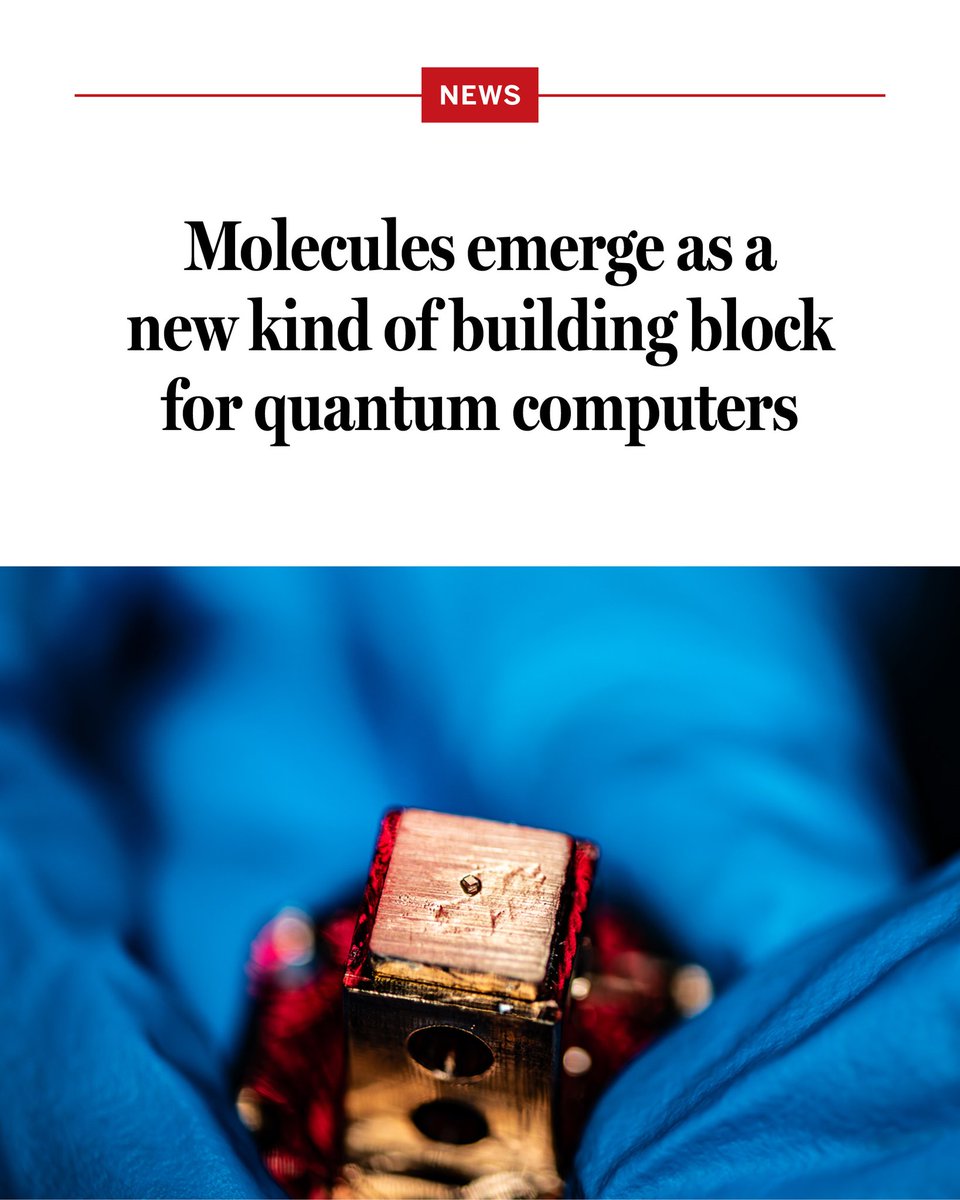
Researchers used lasers to encode quantum information into a single molecule of carbene—a first step toward a molecular quantum computer.
Learn more: scim.ag/4nESbiA @NewsfromScience
6
39
167
23,230
Stephan Roche retweeted

Volume 136, Issue 20
journals.aps.org/prl/issues/…
Cover: DC nonlinear transport mediated by electrons is governed by the nonequilibrium steady state associated with mechanisms of dissipation
journals.aps.org/prl/issues/…
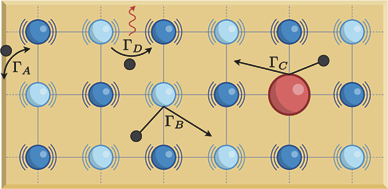
ALT Non-universality of the Γ 0 nonlinear conductivity. The non-equilibrium density matrix governing DC transport depends on the specific dissipation mechanism, leading to mechanism-dependent “intrinsic” (Γ0 ) conductivities. Illustrated environments mediating relaxation: (ΓA) fermionic bath (e.g., metallic backgate); (ΓB) electron-phonon interactions; (ΓC ) static disorder; (ΓD) radiative processes.
11
80
4,590
Stephan Roche retweeted

May 21
Space and time can settle into a crystal-like pattern that sits on the edge of two futures—and a tiny extra input can tip it toward a black hole. @tuvienna @physrevlett phys.org/news/2026-05-crysta…
8
27
97
6,502
Stephan Roche retweeted

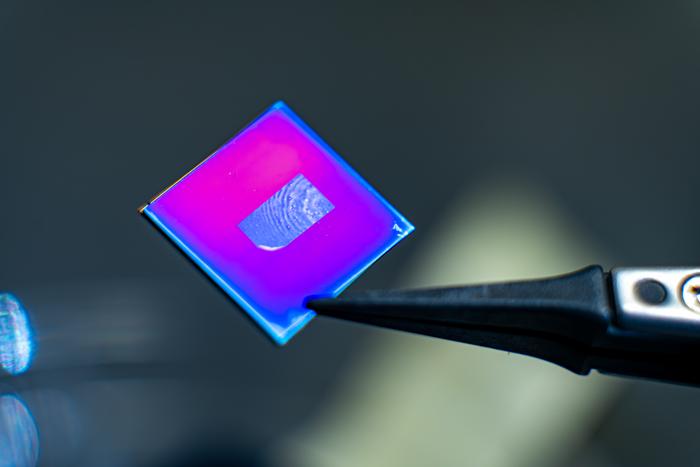
Researchers at Rice University have created large, highly ordered films of chiral carbon nanotubes (CNTs) with a consistent left- or right-handed twist. These ultrathin crystalline sheets exhibit exceptionally strong second harmonic generation (SHG), converting light colors at a rate two to three orders of magnitude greater than conventional materials. The findings, published in ACS Nano, confirm a decades-old theoretical prediction.
The team solved a long-standing challenge by isolating nanotubes of a single handedness, aligning them uniformly, and assembling them into centimeter-scale films. This allowed them to measure the material’s giant nonlinear optical response for the first time, thanks to enhanced light-matter interactions in the one-dimensional chiral structure.
Study confirms decadeslong prediction, may advance electronic and photonic technologies
nanotechnologyworld.org/post…
3
14
63
2,098
Stephan Roche retweeted
May 20
🚨 SCIENTISTS JUST LEARNED HOW TO SWITCH QUANTUM ENERGY FLOW ON AND OFF INSIDE ARTIFICIAL MATERIALS.
And it could change future computing forever.
Using ultrafast microscopy, researchers observed excitons packets of quantum energy moving through moiré superlattices engineered atomic structures created by stacking ultra-thin materials at tiny angles.
But the shocking part is this:
The energy flow could suddenly switch ON or OFF depending on competing quantum electron interactions inside the material.
In simple terms:
Scientists are learning how to control the movement of quantum energy almost like flipping a microscopic switch.
Why this matters:
• quantum computing
• ultra-efficient electronics
• programmable materials
• next-generation energy transport
• exotic quantum devices
But the deeper implication is stranger:
At these scales, matter stops behaving like solid objects…
…and starts behaving like a living landscape of competing quantum states.
The properties of the material are no longer fixed.
They emerge from relationships, interactions, and collective behavior between particles.
The deeper we go into quantum materials…
…the more reality looks less like “things”…
…and more like patterns organizing themselves into temporary states of order.
What happens when future technology is built not from static materials…
…but from quantum phases we can dynamically turn on and off?
Follow for more frontier physics and future technology.
3
33
97
3,689
Stephan Roche retweeted

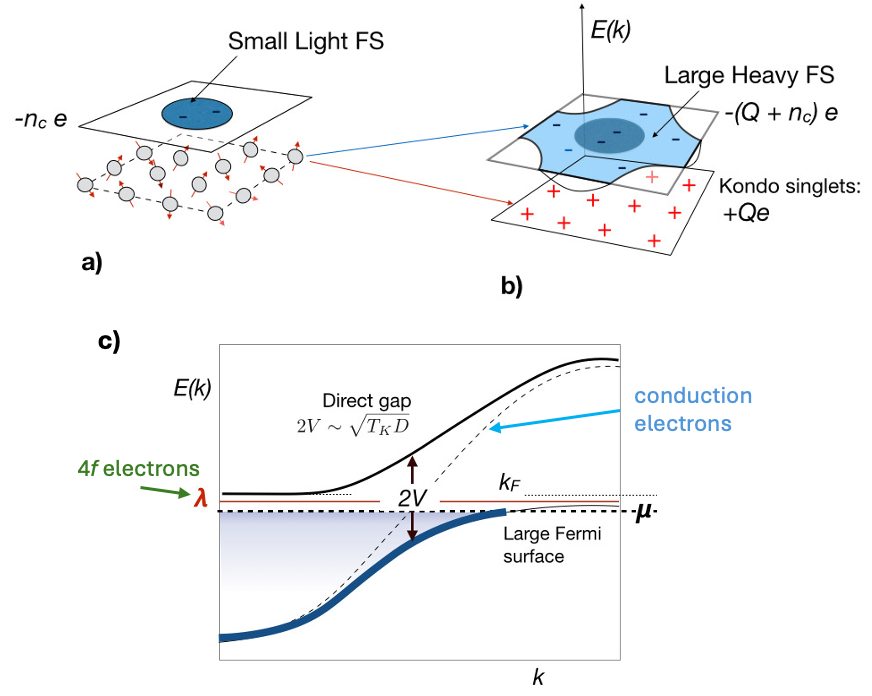
🧪⚛️ What are "heavy fermions", the weird situation when electrons in solids act like they have masses tens to hundreds of times larger than those of free electrons? nanoscale.blogspot.com/2026/…
4
16
996
Stephan Roche retweeted
May 15
🚨 SCIENTISTS MAY HAVE JUST CREATED A NEW KIND OF MEMORY MATERIAL.
Researchers discovered a way to switch crystal structures inside a semiconductor using electric fields effectively allowing the material itself to “remember” a state.
Not by storing charge. Not magnetically. But by physically changing its crystal phase.
The material, called AlScN, can:
• switch between stable crystal states
• retain memory without power
• survive extreme temperatures
• operate for over 100 million cycles
This could become a serious contender for next-generation:
• AI hardware
• space electronics
• ultra-durable storage
• high-temperature computing
• low-power memory systems
What makes this fascinating is that the memory is embedded into the atomic structure itself.
The crystal literally rearranges into a different physical configuration to store information.
We may be entering an era where computation is no longer just electronic… but structural.
Follow for more future physics and technology breakthroughs.
2
34
127
5,582
Stephan Roche retweeted

May 7
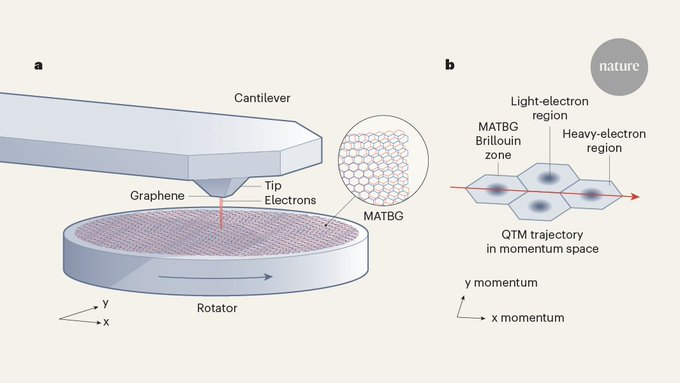
In twisted graphene, some electrons are heavier than others $$$ nature.com/articles/d41586-0…
2
19
74
3,380
Stephan Roche retweeted
🚨BREAKING Scientists just observed a new kind of wave that could become the next information carrier.
Not electrons.
Not photons.
Not magnons.
Ferrons.
A ferron is a wave of electric polarization moving through a ferroelectric material.
Basically:
If a magnon is a ripple in magnetism…
a ferron is a ripple in electric order.
For years, ferrons were mostly theoretical.
Now researchers report coherent ferron emission and propagation in van der Waals ferroelectrics.
The breakthrough:
Laser pulses triggered narrow-band terahertz emission and launched long-lived polarization waves along the material’s polar axis.
That means electric order itself can carry coherent wave information.
Why this matters:
• terahertz emitters
• ultrafast electronics
• ferronic computing
• coherent electric control
• new information-processing devices
The deeper point:
We are learning how to use the hidden collective motions of matter.
Spin gave us spintronics.
Charge gave us electronics.
Now polarization may give us ferronics.
Follow me if you want the newest breakthroughs in physics, quantum tech, AI, and the hidden structures shaping reality.
150
895
4,440
262,057
Stephan Roche retweeted

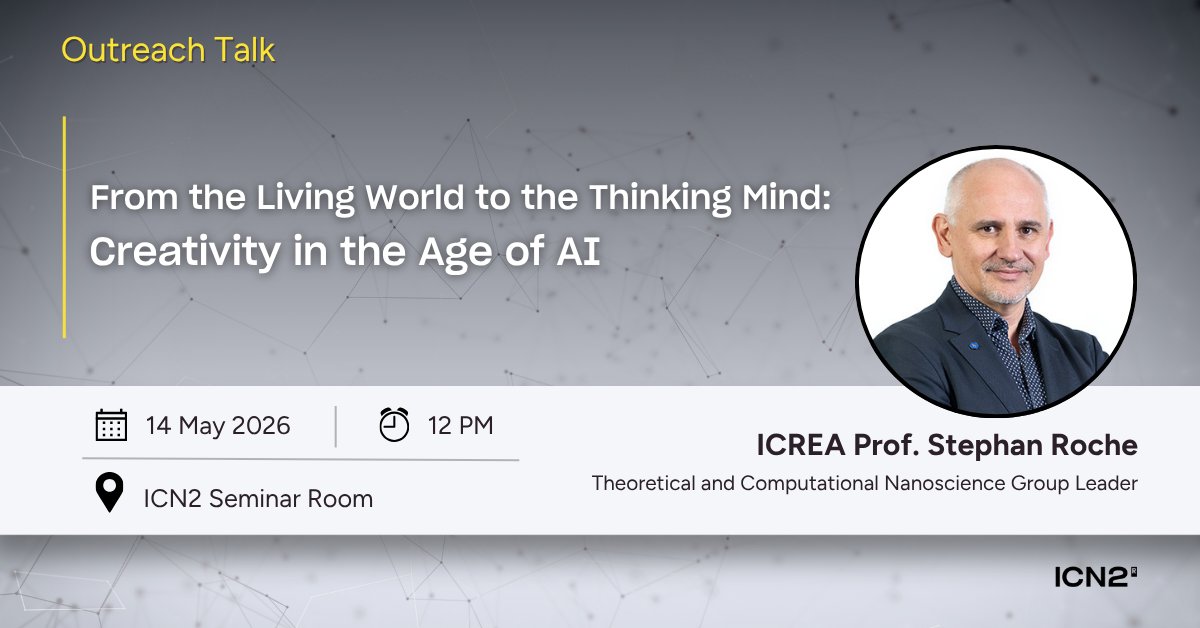
Is #AI redefining creativity?
🗣️ In this Outreach Talk, Prof. @StephanSroche will share how AI can be our ally without losing the human ability to take intellectual risks to create something new.
📆 14/05/2026
⏰ 12 PM
📍 ICN2 Seminar Room
📝 Join us! f.mtr.cool/qbcjgpgdqb
3
6
409
Stephan Roche retweeted
🚨 BREAKING: A 3-layer atomic “sandwich” just pushed superconductivity beyond its supposed limit.
No exotic elements.
No extreme conditions.
Just structure.
What they built
• Graphene (top)
• Gallium (ultra-thin middle layer)
• Silicon carbide (bottom)
This creates a confined 2D system where electron behavior changes.
What they discovered
This stack forms an Ising superconductor that survives magnetic fields:
Up to 3× stronger than the Pauli limit
That limit is normally where superconductivity breaks down.
Here, it doesn’t.
What’s actually happening
Normally:
• Magnetic fields flip electron spins
• Cooper pairs break
• Superconductivity collapses
In this system:
• Electrons are quantum confined
• Interfaces drive orbital hybridization
• Spins become locked (Ising pairing)
So under strong in-plane magnetic fields:
• Spins don’t flip
• Pairs don’t break
• Superconductivity remains stable
Why this matters
This is not just a material improvement.
It shows that:
Interfaces can override expected physical limits
We are not just selecting materials anymore.
We are shaping how they behave.
Implications
• Magnetic-field-resistant superconductors
• More stable quantum systems
• Potential pathways to topological states (e.g. Majorana modes)
Final thought
This result fits within quantum mechanics.
But it highlights something deeper:
Structure and boundary conditions can dominate outcomes
That is where a lot of future physics and engineering will happen.
Follow me I track where physics becomes structure, not substance.
6
30
117
4,905
Stephan Roche retweeted
Superconductivity emerges in an unexpected way in twisted two-dimensional materials like twisted bilayer graphene, even when there are essentially no mobile charge carriers at zero temperature go.aps.org/4eP9lHX
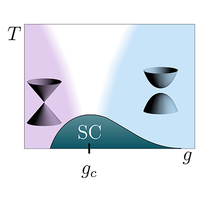
ALT Schematic plot showing the superconducting phase diagram.
1
36
110
5,445
Stephan Roche retweeted
Apr 28
🚨 Scientists may have found a way to engineer quantum teleportation.
Not sci-fi transport quantum state transfer.
This new hybrid system links electric charge, light, spin waves, and mechanical motion to control quantum correlations themselves.
That’s big.
Instead of merely observing entanglement, researchers may be learning how to tune it.
Quantum networks may end up built not from one physics…
but from bridges between many.
Sometimes progress comes from discovering new particles.
Sometimes it comes from getting different layers of reality to resonate.
Structure talking to structure.
Follow me I track where physics becomes structure.
16
90
312
14,674