
Strategic Research is a #marketing studies and #strategy #consulting firm. We help the world's leading #brands make better decisions.
Joined September 2016
- Tweets 1,175
- Following 914
- Followers 262
- Likes 436
242 Photos and videos










STRATEGIC RESEARCH retweeted

Jun 13
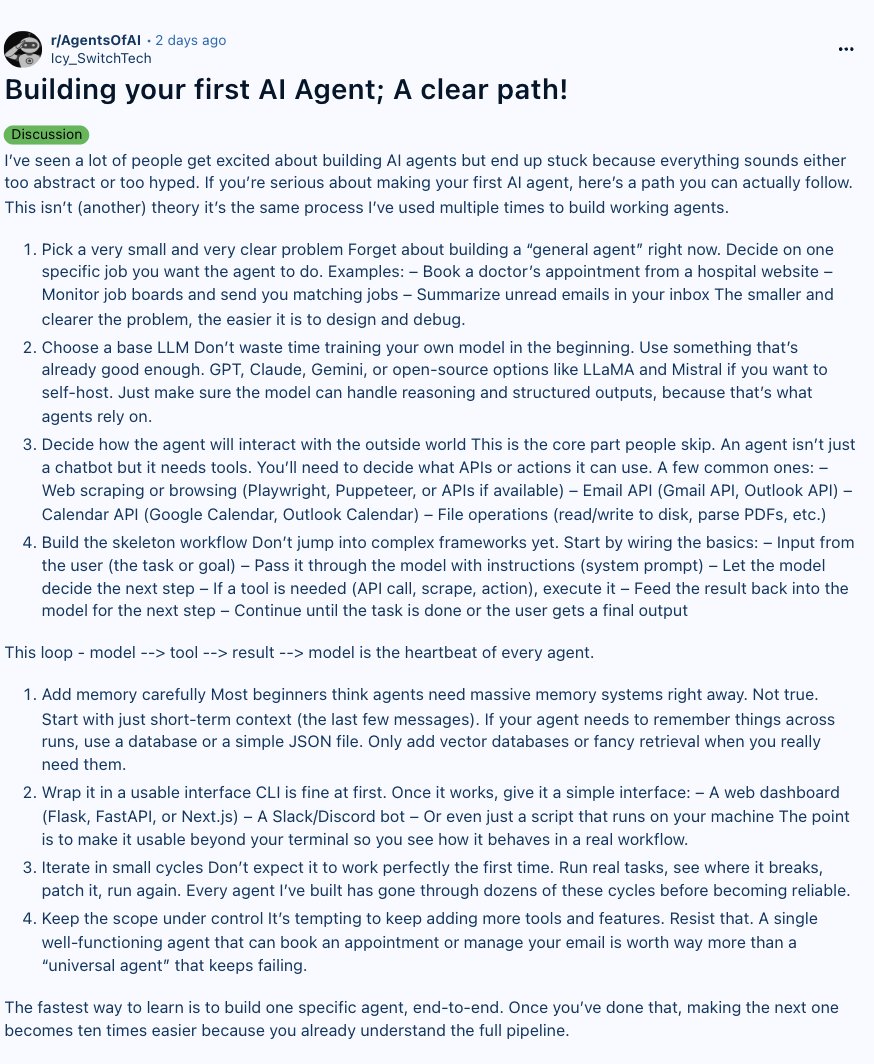
How to build your first AI agent (Full guide)

22
728
4,336
562,206
STRATEGIC RESEARCH retweeted

Now published in open access! Your one-stop shop for the philosophy of language models. It's the spiritual descendant of our two-part preprint from 2024, fully updated. This should be particularly useful for anyone looking for an entry point into this rapidly growing field.
5
38
153
12,346
STRATEGIC RESEARCH retweeted

Jun 10
183
1,892
11,405
5,025,329
STRATEGIC RESEARCH retweeted
🚨McKinsey just dropped how to build agentic AI (that works)
Here's everything you need to know in 2 minutes:
8
95
813
81,744
STRATEGIC RESEARCH retweeted

Jan 23
How can businesses go beyond using AI for incremental efficiency gains to create transformative impact? I write from the World Economic Forum (WEF) in Davos, Switzerland, where I’ve been speaking with many CEOs about how to use AI for growth. A recurring theme is that running many experimental, bottom-up AI projects — letting a thousand flowers bloom — has failed to lead to significant payoffs. Instead, bigger gains require workflow redesign: taking a broader, perhaps top-down view of the multiple steps in a process and changing how they work together from end to end.
Consider a bank issuing loans. The workflow consists of several discrete stages:
Marketing -> Application -> Preliminary Approval -> Final Review -> Execution
Suppose each step used to be manual. Preliminary Approval used to require an hour-long human review, but a new agentic system can do this automatically in 10 minutes. Swapping human review for AI review — but keeping everything else the same — gives a minor efficiency gain but isn’t transformative.
Here’s what would be transformative: Instead of applicants waiting a week for a human to review their application, they can get a decision in 10 minutes. When that happens, the loan becomes a more compelling product, and that better customer experience allows lenders to attract more applications and ultimately issue more loans.
However, making this change requires taking a broader business or product perspective, not just a technology perspective. Further, it changes the workflow of loan processing. Switching to offering a “10-minute loan” product would require changing how it is marketed. Applications would need to be digitized and routed more efficiently, and final review and execution would need to be redesigned to handle a larger volume.
Even though AI is applied only to one step, Preliminary Approval, we end up implementing not just a point solution but a broader workflow redesign that transforms the product offering.
At AI Aspire (an advisory firm I co-lead), here’s what we see: Bottom-up innovation matters because the people closest to problems often see solutions first. But scaling such ideas to create transformative impact often requires seeing how AI can transform entire workflows end to end, not just individual steps, and this is where top-down strategic direction and innovation can help.
This year's WEF meeting, as in previous years, has been an energizing event. Among technologists, frequent topics of discussion include Agentic AI (when I coined this term, I was not expecting to see it plastered on billboards and buildings!), Sovereign AI (how nations can control their own access to AI), Talent (the challenging job market for recent graduates, and how to upskill nations), and data-center infrastructure (how to address bottlenecks in energy, talent, GPU chips, and memory). I will address some of these topics in future posts.
Against the backdrop of geopolitical uncertainty, I hope all of us in AI will keep building bridges that connect nations, sharing through open source, and building to benefit all nations and all people.
[Original text: deeplearning.ai/the-batch/is… ]
87
153
731
76,432
STRATEGIC RESEARCH retweeted

Jan 23
“Remote events happen less often but when they happen they command much greater effect on the total properties."
Jan 23

Author of the Infamous “The Black Swan”, Nassim Taleb explains Fat Tails:
6
17
4,117

STRATEGIC RESEARCH retweeted

13 Dec 2025
After 2 years of using ChatGPT, I can say that it is the technology that has revolutionized my life the most, along with the Internet.
So here are 10 prompts that have transformed my day-to-day life and that could do the same for you.
77
513
5,928
3,314,732

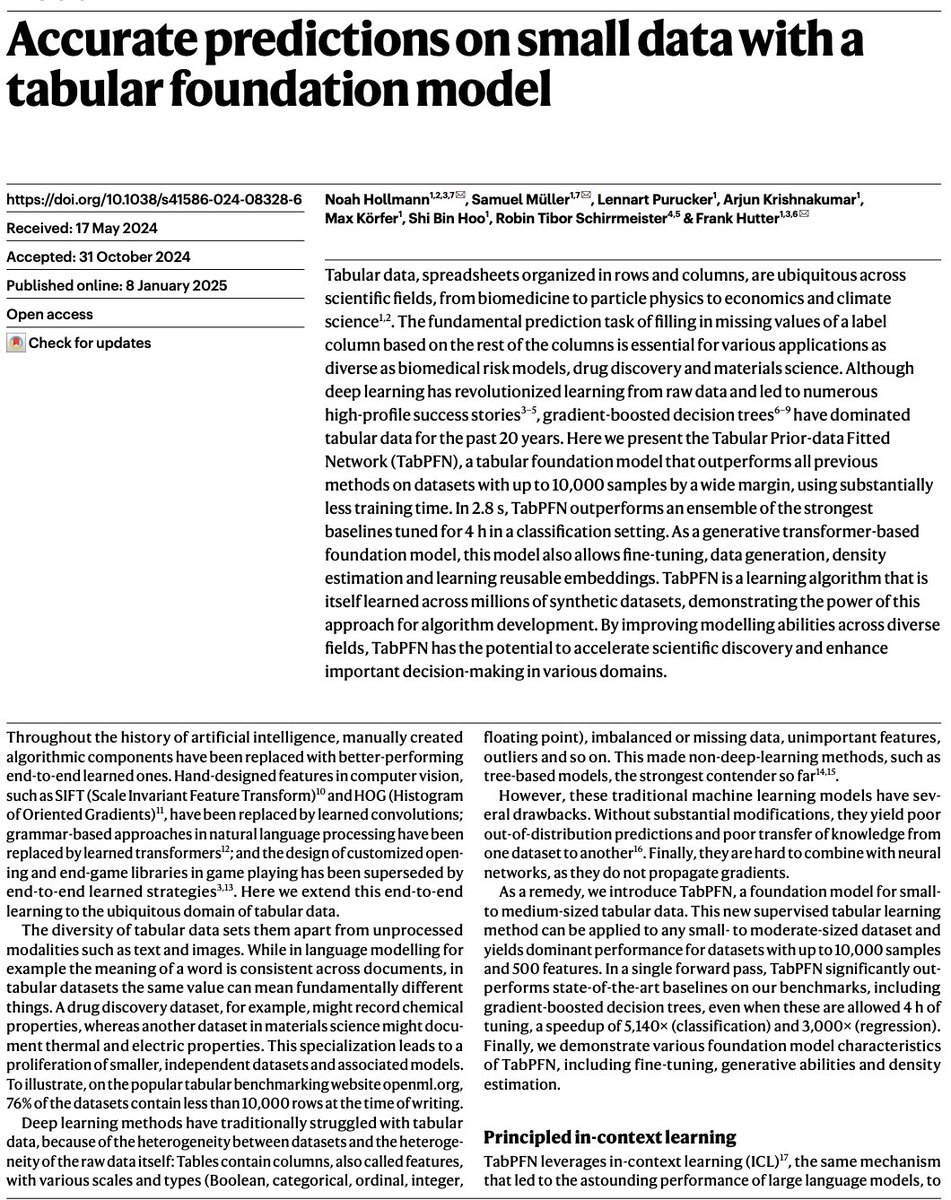
This paper really is groundbreaking. It solves a long-standing embarrassment in machine learning: despite all the hype around deep learning, traditional tree-based methods (XGBoost, CatBoost, random forests, etc) have dominated tabular data—the most common data format in real-world applications—for two decades. Deep learning conquered images, text, and games, but spreadsheets remained stubbornly resistant.
This paper's (published in Nature by the way) main contribution is a foundation model that finally beats tree-based methods convincingly on small-to-medium datasets, and does so very fast. TabPFN in 2.8 seconds outperforms CatBoost tuned for 4 hours—a 5,000× speedup. That's not incremental; it's a different regime entirely.
The training approach is also fundamentally different. GPT trains on internet text; CLIP trains on image-caption pairs. TabPFN trains on entirely synthetic data—over 100 million artificial datasets generated from causal graphs.
TabPFN generates training data by randomly constructing directed acyclic graphs where each edge applies a random transformation (using neural networks, decision trees, discretization, or noise), then pushes random noise through the root nodes and lets it propagate through the graph—the intermediate values at various nodes become features, one becomes the target, and post-processing adds realistic messiness like missing values and outliers. By training on millions of these synthetic datasets with very different structures, the model learns general prediction strategies without ever seeing real data.
The inference mechanism is also unusual. Rather than finetuning or prompting, TabPFN performs both "training" and prediction in a single forward pass. You feed it your labeled training data and unlabeled test points together, and it outputs predictions immediately. There's no gradient descent at inference time—the model has learned how to learn from examples during pretraining.
The architecture respects tabular structure with two-way attention (across features within a row, then across samples within a column), unlike standard transformers that treat everything as a flat sequence.
So, the transformer has basically learned to do supervised learning.
Talk to the paper on ChapterPal: chapterpal.com/s/a1899430/ac…
Download the PDF: nature.com/articles/s41586-0…
77
389
2,610
331,590
STRATEGIC RESEARCH retweeted

29 Nov 2025
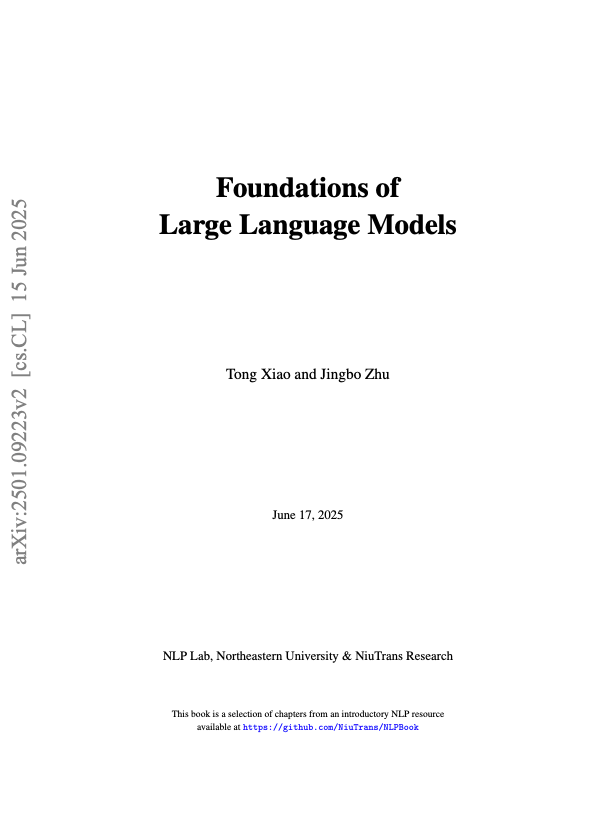
This 277-page PDF unlocks the secrets of Large Language Models.
Here's what's inside: 🧵
16
179
1,028
66,932
STRATEGIC RESEARCH retweeted

4 Apr 2025
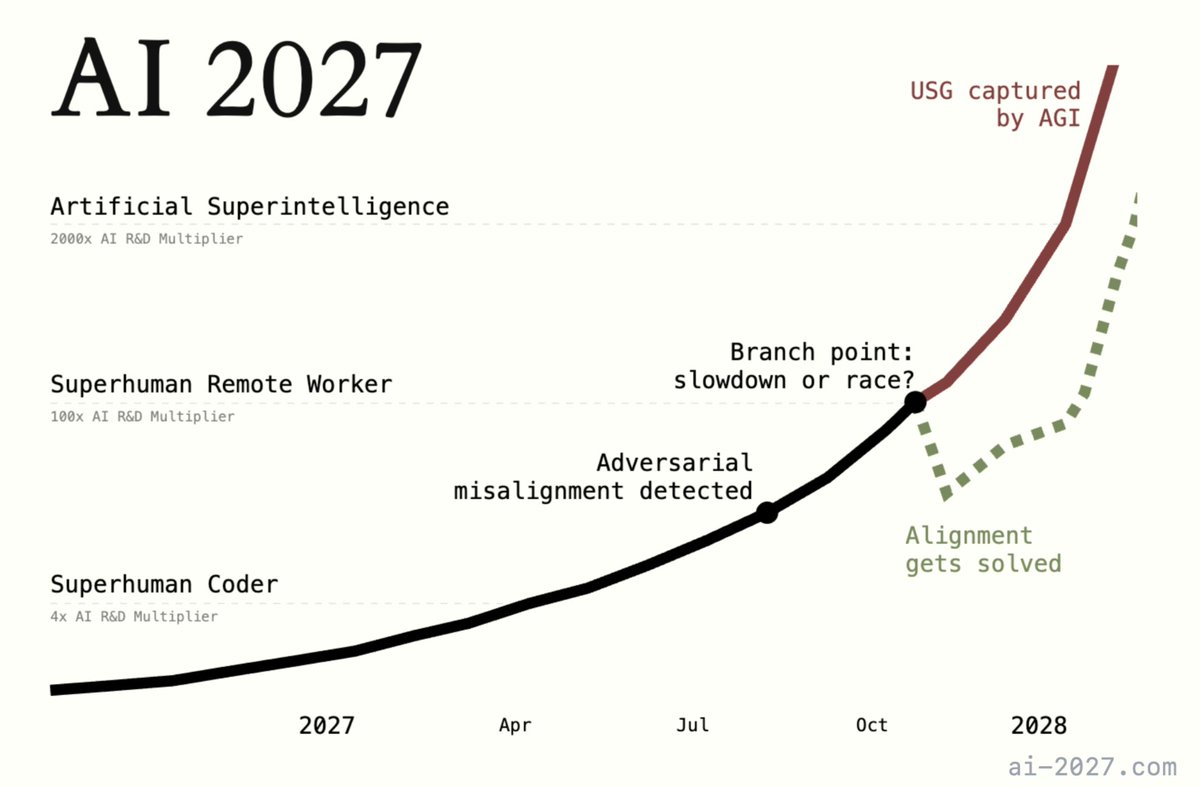
Here's a fascinatingly well-researched scenario where AI takes over in a few years and then kills all humans. Whatever actually happens will probably feel comparably sci-fi:
3 Apr 2025

"How, exactly, could AI take over by 2027?"
Introducing AI 2027: a deeply-researched scenario forecast I wrote alongside @slatestarcodex, @eli_lifland, and @thlarsen
73
104
582
73,498
STRATEGIC RESEARCH retweeted

4 Apr 2025
change of plans: we are going to release o3 and o4-mini after all, probably in a couple of weeks, and then do GPT-5 in a few months.
there are a bunch of reasons for this, but the most exciting one is that we are going to be able to make GPT-5 much better than we originally though. we also found it harder than we thought it was going to be to smoothly integrate everything. and we want to make sure we have enough capacity to support what we expect to be unprecedented demand.
1,634
2,370
29,598
4,006,130

Today we are launching our next agent capable of doing work for you independently—deep research.
Give it a prompt and ChatGPT will find, analyze & synthesize hundreds of online sources to create a comprehensive report in tens of minutes vs what would take a human many hours.
798
1,811
11,548
5,094,983

14 Aug 2024
Mars Reaches Deal for Cheez-It and Eggo Maker Kellanova #Deal #snacking wsj.com/business/retail/mars…
10
25 May 2024
Viking founder Torstein Hagen on the luxury cruise line specifically for baby boomers | Fortune #cruise fortune.com/2024/05/12/vikin…
4
STRATEGIC RESEARCH retweeted

25 Apr 2024
Gucci owner Kering struggles to revive the luxury fashion house, shares slip after it issued its second profit warning for 2024. fortune.com/europe/2024/04/2…
2
1
2,671