
Fear is the invitation for evil to enter. Fearlessness is true power.
Joined January 2021
- Tweets 14,340
- Following 2,070
- Followers 1,134
- Likes 61,179
397 Photos and videos










30 Oct 2025
Here’s a quick, plain‑English heads‑up about how crypto flows are increasingly gated by risk scores—and why that matters for traders, founders, and anyone moving coins.
What’s happening
Exchanges, custodians, and wallets now run address/entity risk scoring on deposits/withdrawals. Tools like Chainalysis KYT/Address Screening and TRM Transaction Monitoring/Entity Risk flag or block flows in real time.
Scoring blends on‑chain heuristics/attribution with policy rules (sanctions exposure, hacks/ransomware links, mixers, darknet ties, etc.). Scores are typically Low/Medium/High/Severe and trigger alerts, holds, or re‑KYC.
Big venues publicly discuss ML‑based address risk scoring at scale (e.g., Coinbase’s system to predict risky counterparties beyond their platform).
This is largely driven by sanctions/AML expectations: OFAC’s guidance tells the industry to screen addresses, IP/geolocation, and keep risk‑based programs—no new law needed for a venue to freeze/deny a transfer.
How it affects you
Deposits can be delayed or blocked if your coins have indirect exposure (e.g., multiple hops from a sanctioned/hacked pool). Even “clean” users can get flagged via counterparty exposure.
Off‑exchange wallets are not immune: many providers embed screening and continuous rescoring.
Appeals = documentation: expect to provide source‑of‑funds/transaction trails; the venue’s score often keys off the highest‑risk indicator in the graph.
Practical moves (fast list)
Keep a clean routing wallet: receive funds there first, then forward to exchanges; don’t co‑mix high‑risk counterparties. (Reduces inherited exposure risk.)
Label & export proofs (tx notes, invoices, mining/payout records) so you can answer compliance reviews quickly. (Aligned with risk‑based programs venues follow.)
Before sending to an exchange, pre‑screen counterparties using a third‑party checker or the venue’s own KYT APIs where available.
Avoid bridging/mixing paths tied to sanctioned or hacked flows; even indirect contact can push a score into “review/block.”
1
64
10 Jun 2025
Good lord!!!
10 Jun 2025

For those new to ACIP who want to know why RFK blew up the entire racket today, you need only watch this clip of a typical meeting. youtube.com/watch?v=tegyXGiQ…
199
1 Jun 2025
Wow. Im blown away. Without amplification of the data everyone will continue believing that chemtrails are just conspiracy. Anyone who is on the fence about this one, like I was, needs to listen. Start at 28:23 if you want to get right into it. Please share!
30 May 2025

Round Table Discussion on Solar Radiation Modification x.com/i/broadcasts/1gqxvjpBB…
1
1
159
19 May 2025
Happy bday to Malcolm X. White libs will name a street in every black ghetto after MLK, but will never speak of Malcolm,
because he saw what they were doing. And years after his assassination they're still doing it. Malcolm rolling in his grave to see how we let them make George Floyd our next black hero. RIP Malcolm. Happy bday
1
130
18 Apr 2025
Uneducate your kids so they can pursue knowledge! Lots of good deprogramming for kids here on Gorilla Science! Dr Willie and his time machine are great for adults who forgot that "history is our greatest teacher"! Share the video!
17 Apr 2025

Incredibly funny, shocking and brilliant. Dr Willie Soon, in his Time Machine, sticking it to the Climate Scammers. Our Gorilla Science films just get better and better. @WillieSoon8 @TomANelson
1
1
4
266
11 Apr 2025
“The doctors said I had incredible blood. The best blood they’ve ever seen. The blood of a patriot. When they took my blood I had red white and blue cells. I didn’t have DNA but USA. They said “Mr. President, it’s a miracle!” I said “No doctor, it’s not a miracle. It’s America!”
11 Apr 2025

🚨EXCLUSIVE: President Trump is currently undergoing his annual physical at Walter Reed and Karoline Leavitt says they will be providing an update shortly.
Autism Capital was able to scoop the update.
“The doctors said I had incredible blood. The best blood they’ve ever seen. The blood of a patriot. When they took my blood I had red white and blue cells. I didn’t have DNA but USA. They said “Mr. President, it’s a miracle!” I said “No doctor, it’s not a miracle. It’s America!”
1
2
228
Iron Maiden🪆 retweeted

23 Mar 2025
How did they know?
469
5,951
22,627
614,451
Iron Maiden🪆 retweeted

28 Feb 2025
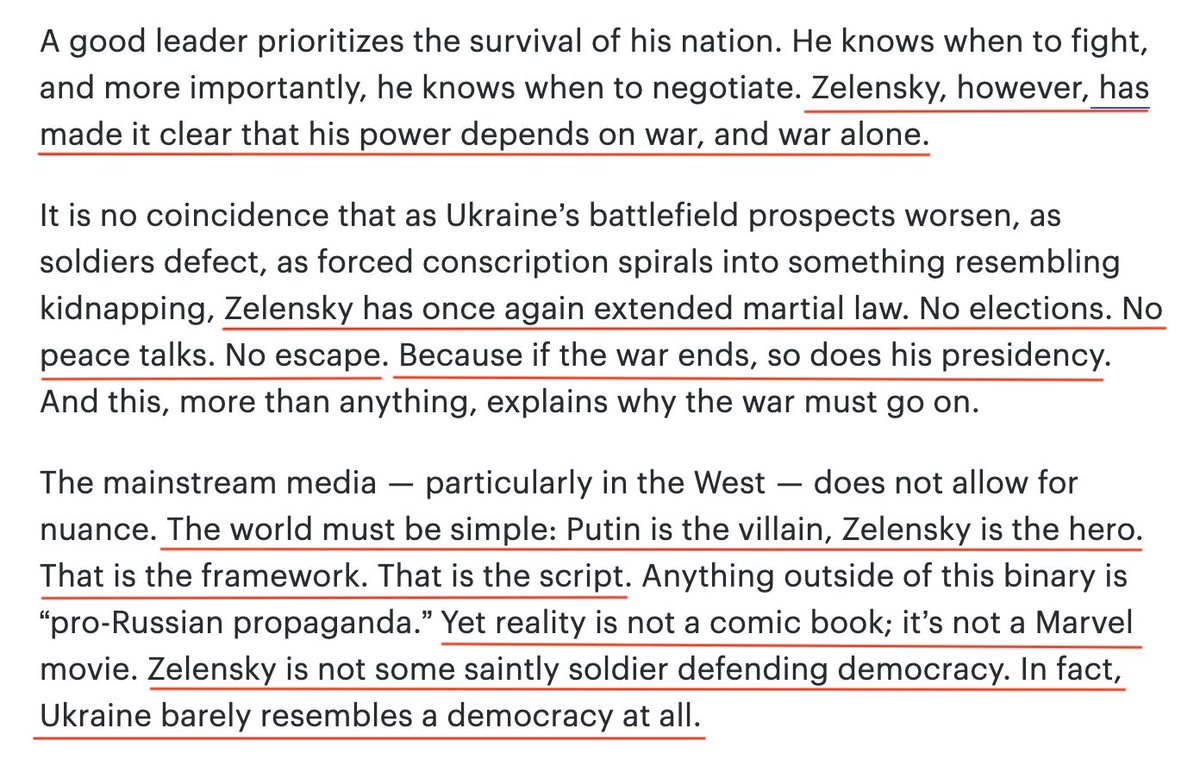
"But objective reality does not care for emotionally charged narratives. It is cold. It is brutal. And the hard truth is this: Ukraine is losing, and Zelensky is making sure it keeps losing."
thehill.com/opinion/5146149-…
43
207
770
90,675
Iron Maiden🪆 retweeted

23 Feb 2025
PRICELESS - MUST WATCH
When They Blame Putin And Ruisa for Starting the War, Show Them This
What was Putin's intention in the war?
It was to force Zelensky to negotiate neutrality.
You should understand this. Not the propaganda that's written about this.
The idea was to keep NATO. And what is NATO? It's the United States. Off of Russia's border. No more no less. I should add one very important point.
Why are they so interested?
662
9,381
20,548
1,535,143
5 Feb 2025
The art of the deal:
I'll give you Gaza
And you give us America back
Deal?
Deal!
5 Feb 2025

"The U.S. will take over the Gaza Strip, and we will do a job with it, too." –President Donald J. Trump
1
3
156
4 Feb 2025
People freaking out about this are the same people that vaccinate their kids. They just can't see that this is no different than traumatizing a kid with a needle, except for the fact that this survival tactic makes so much sense that it can be seen working in realtime. And, after another round or two, it will work for the rest of his life. No doctor will dispute this fact.... Drowning is the #1 cause of death for kids age 1-4 in Fl, where pools are everywhere. Drowning is far more likely to kill a kid than illness.
If you support vaccines but criticize this....you are disconnected from reality.

1
2
107


Iron Maiden🪆 retweeted

30 Jan 2025
.@Netflix if you wokeify Little House on the Prairie I will make it my singular mission to absolutely ruin your project. hollywoodreporter.com/tv/tv-…
4,953
7,214
75,777
1,845,434
Iron Maiden🪆 retweeted

27 Jan 2025
Trump on Kim Jong Un: "I liked him ... I think he has tremendous condo capability. He's got a lot of shoreline."
172
264
5,572
617,188
Iron Maiden🪆 retweeted

8 Feb 2022
🧵A thread about social contagions:
In 1972, British psychologist Gerald Russell treated a woman with an unusual eating disorder involving binging and purging. Over the next 7 years, he saw a further 30 woman presenting with the same condition./1
604
6,941
15,855
Iron Maiden🪆 retweeted

23 Jan 2025
There will likely be no popular groundswell for restoring "DEI," because it was fundamentally an elite imposition -- germinated by factions that claimed to speak for the "marginalized," but who were actually comically removed from the constituencies they claimed to represent
103
380
2,947
131,553
24 Jan 2025
Is it just me, or can most people spot a Chat GPT written email or letter 100% of the time? Elementary school teachers send most of them.
3
1
2
103
24 Jan 2025
I am going to compile a stack of correspondence received from my school district (teachers and administrators) all of which I am 100 positive were written by Chat GPT.
46
Iron Maiden🪆 retweeted

21 Jan 2025
What’s fascinating right now is how the intellectual Left has been absolutely demolished.
The sane liberals are now Trump supporters and what remains is a bunch of larping jihadists, irrelevant socialists, antifa babies and general retards.
In short, I like our chances.
1,565
6,052
46,858
3,007,036
Iron Maiden🪆 retweeted

18 Jan 2025
Gavin Newsom has removed more homes from the streets of California than homeless from the streets of California
210
1,457
4,601
80,283