
Channeling my inner Beekeeper… to bee or not to bee. #BeeInspired #BeAware
Joined April 2018
- Tweets 16,060
- Following 1,217
- Followers 609
- Likes 22,743
386 Photos and videos

This AI just exposed the BIGGEST legal insider trading operation in America.
A platform called GovGreed built a seven-layer machine learning system that cross-references every stock trade disclosed by every sitting politician against the bills their committees control, the campaign donations they receive, and the companies their votes directly impact.
It scored all 540 politicians currently in Congress. And the numbers are crazy:
56% of every stock purchase made by Congress in the last 16 months was on a stock directly affected by a bill the buyer later voted on. That is 6,170 out of 11,016 total purchases.
More than HALF of all congressional stock buys are on companies whose fate that same politician is about to decide.
343 of 540 Congress members actively trade stocks while holding access to nonpublic legislative information.
That is 63.8% of the entire legislature making market bets with an informational edge that would put any hedge fund manager in prison.
The AI identified 752 active "Triple Signals" in the current Congress. A Triple Signal fires when three conditions line up at once:
The politician sits on the committee controlling a bill, they traded stock in a company affected by that bill, AND they received campaign contributions from that same industry.
Bills carrying these insider indicators pass at 5.4 TIMES the normal rate.
Now look at the individual leaderboard:
- Nancy Pelosi's estimated portfolio sits at $194 million with a Greediness score of 98.1 out of 100
- Ro Khanna made 13,231 trades across 800 different tickers
- Michael McCaul made 32,302 trades and filed 6,670 of them late
- Thomas Suozzi filed 86.4% of his trades late with an average delay of 396 days, meaning his disclosures landed over a YEAR after he made the trade
And then there is Lisa McClain, the fourth-ranking Republican in the House. She has made 1,443 trades in three years, more than 98% of all politicians tracked.
She violated the STOCK Act twice in a single year, disclosing up to $900,000 in trades months after the legal deadline. Her husband bought up to $250,000 in Elon Musk's xAI, which quietly converted into SpaceX equity before last Friday's $2 trillion IPO.
The penalty for all of this? A $200 fine.
The number of Congress members ever prosecuted under the STOCK Act since it passed in 2012? Zero.
And the cruelest part is this:
A bill to ban congressional stock trading was introduced in January 2026. It has bipartisan support. Over 80% of American voters want it passed.
But Congress is sitting on it, because the people who would have to vote yes are the same people making millions from the system staying exactly the way it is.
They write the insider trading laws, they exempt themselves from enforcement, they trade on the information those laws generate, and when they get caught, they pay a fine that is basically nothing.
The AI didn't discover anything Congress was hiding. It just organized what was already public into a pattern so obvious that nobody can pretend it isn't there anymore.
1,139
13,275
27,334
1,357,650

Jun 15
Simple, Right?

19
The Invisible Man retweeted

Jun 11
IRAN STRIKES CALLED OFF
President Trump says he has cancelled planned U.S. strikes and bombings against Iran scheduled for this evening. He stated that all parties have approved the discussions and final terms in principle and in detail. A naval blockade will remain in place until the agreement is finalized. The time and location for the signing ceremony will be announced shortly.
305
342
2,255
551,702
The Invisible Man retweeted

Jun 11
The United States will be hitting Iran (Whose Navy, Air Force, Radar, Anti Aircraft, and all other forms of Defense, together with most its offensive capability, are GONE!), VERY HARD TONIGHT. At some point in the not too distant future, we will be taking Kharg Island, and other oil infrastructure points, and assume total control of their Oil and Gas Markets, much like we have with Venezuela, which is working out brilliantly for both Venezuela and the United States of America. Thank you for your attention to this matter! President DONALD J. TRUMP
32
11
105
30,417
The Invisible Man retweeted

Jun 10
Next week, I’ll be taking the debate stage to share my vision of Restoring the American Dream in Arizona.
💰 Eliminate the state income tax
🏋️ Implement the MAHA Agenda
🚔 Fully fund our public safety departments
🌵 Responsibly manage our state’s natural resources of land, water, and minerals
🏠 Cut red tape and barriers to make home ownership affordable and achievable again
⛽️ Stop our dependency on California for gas and use reliable, affordable energy sources to drive down utility costs
Our debate will be streamed online at the Arizona Clean Elections YouTube page in the comments, join us next Wednesday at 6pm!

71
310
984
10,562
The Invisible Man retweeted

Jun 10
Our demands are simple:
From now on no one comes in, and millions must go.
784
13,520
72,494
516,239
The Invisible Man retweeted

Jun 11
🚨 BREAKING: U.S. STRIKES IRGC COMMAND FACILITIES AS CONFLICT WITH IRAN ESCALATES
According to multiple reports, U.S. forces have struck Iranian military targets, including an IRGC command-and-control facility, in a major new escalation.
Reports indicate that 49 Tomahawk cruise missiles were launched alongside fighter jet strikes, with some targets reportedly located within roughly 40 miles of Tehran.
CENTCOM says the operation targeted military surveillance systems, communications infrastructure and air defence sites in response to what it described as continued Iranian aggression.
The Middle East crisis is entering a dangerous new phase.
Developing.
13
30
160
10,405
The Invisible Man retweeted

Jun 11
295
2,547
12,075
226,090
The Invisible Man retweeted

Jun 10
The Real Reason You Haven't Made It Yet (And How SMB Fixes It)
Want to know what actually separates a seven-figure or eight-figure prop trader from the independent guys who spend years spinning their wheels in the retail markets?
Hint: It sure as heck isn’t just about having "good psychology."
I recently watched a value-packed interview for the trading community with Jeff Holden, Head of Trader Development at SMB Capital. Jeff has had a front-row seat for the entire journey of our desk's top performers, taking raw talent and helping them become consistently profitable traders.
To Jeff, if you are a new or developing trader, you need to understand that the markets are opportunity-generating machines—they aren't out to get you. But to consistently extract money from them, you have to run your trading like a serious business owner, not an amateur.
Jeff dropped some absolute gold standard lessons in this interview that will fundamentally change how you view your edge, risk, and daily process.
1. Fix the System, Not Just the Psychology
The single biggest mistake developing traders make is blaming every single losing streak or bad day on "trading psychology." They walk into a review and say, "Bella, my psychology was just completely off today." Most of the time, it isn't a mindset issue—it's a lack of edge. Your trading edge is the stable legs of a table, and your psychology is just the tabletop. Without a stable base of positive expected value (EV), the table wobbles and collapses, no matter how strong your mindset is.
Take a common bottleneck Jeff sees all the time: a trader capturing a massive trending stock but scaling out of half their position too quickly to "manage their fear." They think they have a psychological problem. The reality? Their system needs an improved exit strategy. And that is the work they need to focus on intensively.
2. Ground Yourself in the ASSETS Protocol
If you want to stop trading like a piker, you have to eliminate what we call "spaghetti against the wall" trading—just throwing random positions out there to see what sticks. To enforce structural discipline, Jeff formalized the ASSETS Protocol.
Most retail traders look at a chart and immediately jump straight to the entry. The pros do the exact opposite. While training with Jeff at SMB, you must follow this precise sequence before you ever touch the keys:
A – Allocation: Determine your dynamic risk allocation first. For developing traders, a solid rule of thumb is to take your total account balance, divide it by 50 to establish your maximum daily stop limit (2%), and then only risk a small subset of that per trade.
S – Stop: Before you even think about buying, identify exactly where you are wrong on the trade.
E – Entry: Once you have your allocation and your stop, you calculate your position size, and then you execute your precise entry.
T – Target: Know your target before entering a trade. Jeff recommends using standardized "measured moves" to remove emotion from your profit-taking.
3. Build Your Proof of Concept (The 20-Trade Rep Rule)
You don't build a 10-year trading career by chance. You build it by mastering one specific trade setup at a time until it makes so much sense to you that you can't comprehend why anyone would trade it any other way.
When you want to add a new strategy to your PlayBook, you have to earn the right to scale it. That means taking a strict sample size of 20 live reps.
You aren't trying to make a million dollars during these 20 reps, and you don't even have to be net profitable over the sample. The goal is to perform a detailed trade write-up for every single execution. You absorb the feedback the market gives you by asking: What happened? Why did it happen? What can I learn from this? Once you survive those 20 reps and master the structural nuances, you earn the right to dynamically scale your risk.
4. The Golden Rule of Feedback Loops
Here’s the one mistake that will get you kicked off our floor: rewarding bad behavior.
If you violate your rules, chase an entry, or take a random yolo trade outside of your PlayBook, and you end up making money on it—that is a catastrophic feedback loop. Amateurs celebrate the unearned green on their screen. Rising stars recognize that they just acted like a piker, disrespected the firm's capital, and exposed themselves to ruinous habits.
You must be absolutely ruthless with yourself when you are winning to understand exactly why you are succeeding. Conversely, when you are in a drawdown, you must learn to be forgiving of yourself as long as you are strictly adhering to your PlayBook.
Mindset vs. Psychology: The Final Separation
To pull this all together, you need to understand the distinct difference between mindset and psychology.
Your mindset is the high-level lens through which you view the trading arena. Are you showing up to be great, or are you just chasing a quick buck?
Your psychology is how you interact with the real-time data and feedback loops of the market. When you get stopped out, does your psychology view it as an emotional threat, or simply a cost of doing business and an opportunity to learn?
Trading is a beautifully brutal, unforgiving profession. It is the absolute best job in the world, but it demands that you show up as a true professional every single day. If you have the hunger, the obsession to learn, and the discipline to execute the protocols, the upside in this game is entirely limitless. On our desk, the upside is becoming a Market Wizard.
Stop throwing spaghetti at the wall. Build your process, master your 20 reps, respect your capital, and go put in the work diligently, intensively, and consistently. Go become great!
$100M Trading Coach: I Fire Traders Who Make Money If They Make THIS Mis... youtu.be/QSBiCUMz61A?si=90iz… via @YouTube
11
37
183
21,077
The Invisible Man retweeted

Jun 10
The truth is markets probably knew this was coming eventually given the 38 deals that were about to be finalized.
More important than the headlines will be the reaction in markets over the next days.
It’s also not a coincidence we saw the biggest red days in over a year over the past few days.
The market hates uncertainty more than bad news.
If we see peak aggression and retaliation but certain asset or asset classes that recently panicked don’t budge, be ready for a violent repricing higher on these certain markets.
37
25
462
76,403
The Invisible Man retweeted
Jun 9
You might think this is a hyperbole but look at the exact things that Anthropic just blocked as part of the release.
-Cybersecurity
-AI development
From Anthropic:
In particular, our concern is with-as we wrote then-"accelerating other AI developers in building powerful AI systems that pose similar risks to the ones ours pose - without necessarily having commensurate safeguards."
In light of the ability of recent models to accelerate their own development, we've implemented new interventions that limit Claude's effectiveness for requests targeting frontier LLM development (for example, on building pretraining pipelines, distributed training infrastructure, or ML accelerator design).
Certain players will be incentivized to continue to develop these capabilities to protect against other foreign nations and we’ll enter a very scary time.
4
2
46
11,788
The Invisible Man retweeted
Jun 9
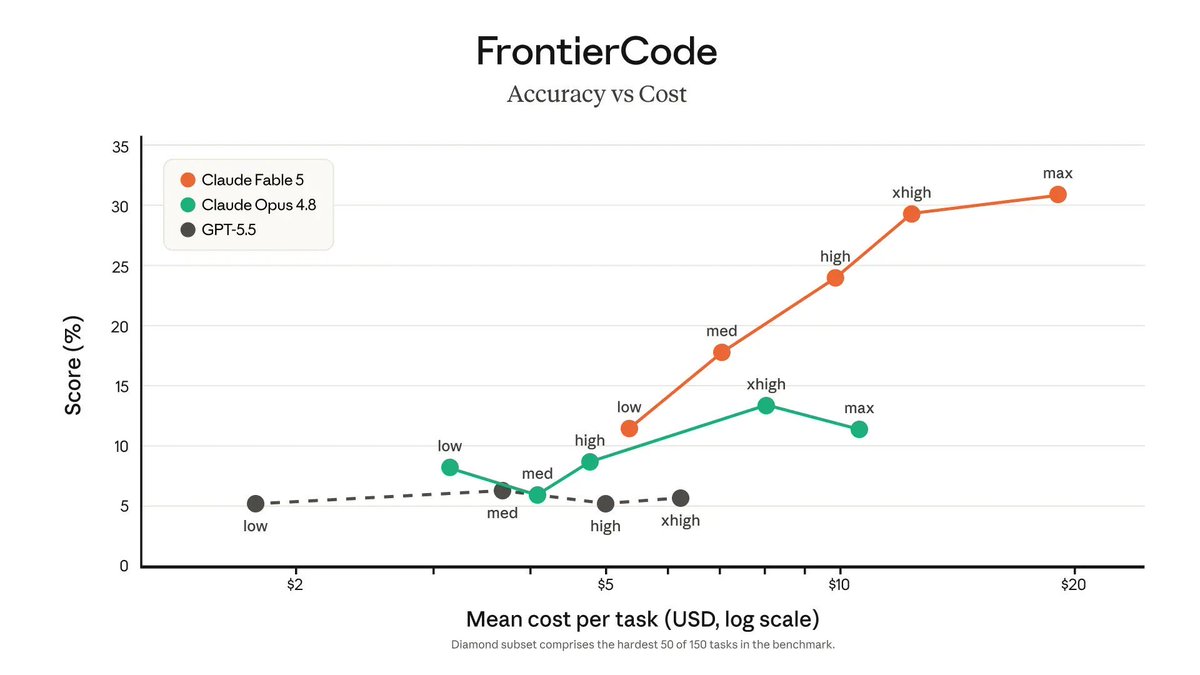
Mythos…
Jeez, and I thought GPT5.5 was great.
We are starting to reach levels of intelligence that we won’t be able to even comprehend.
AI is now approaching and achieving better results than the best humans in developing its own intelligence.
28
25
369
44,877
The Invisible Man retweeted

Jun 8
Look everyone... don't ever be concerned with my positions; be concerned with the risk you are taking.
I've been trading for 43 years and have had only a few single-digit drawdown years. All of my trades are made from very low-risk entry points and always with a hard stop loss in place.
I could turn out to be wrong and the market may have already made its low. If so, I'll get stopped out. That's the business.
I'm wrong just as often as I'm right. The difference is that my risk is always defined and controlled. What matters is not being right all the time; what matters is that the risk taken relative to the potential reward, adjusted for batting average, is managed in a way that produces a profitable outcome over a large sample of trades.
That's how I've approached the market throughout my entire career, and it's no different today. The distribution of gains and losses over time forms a profitable bell curve because risk always comes first, and risk is always managed in relation to reward.
Jun 8

127
322
3,726
869,653

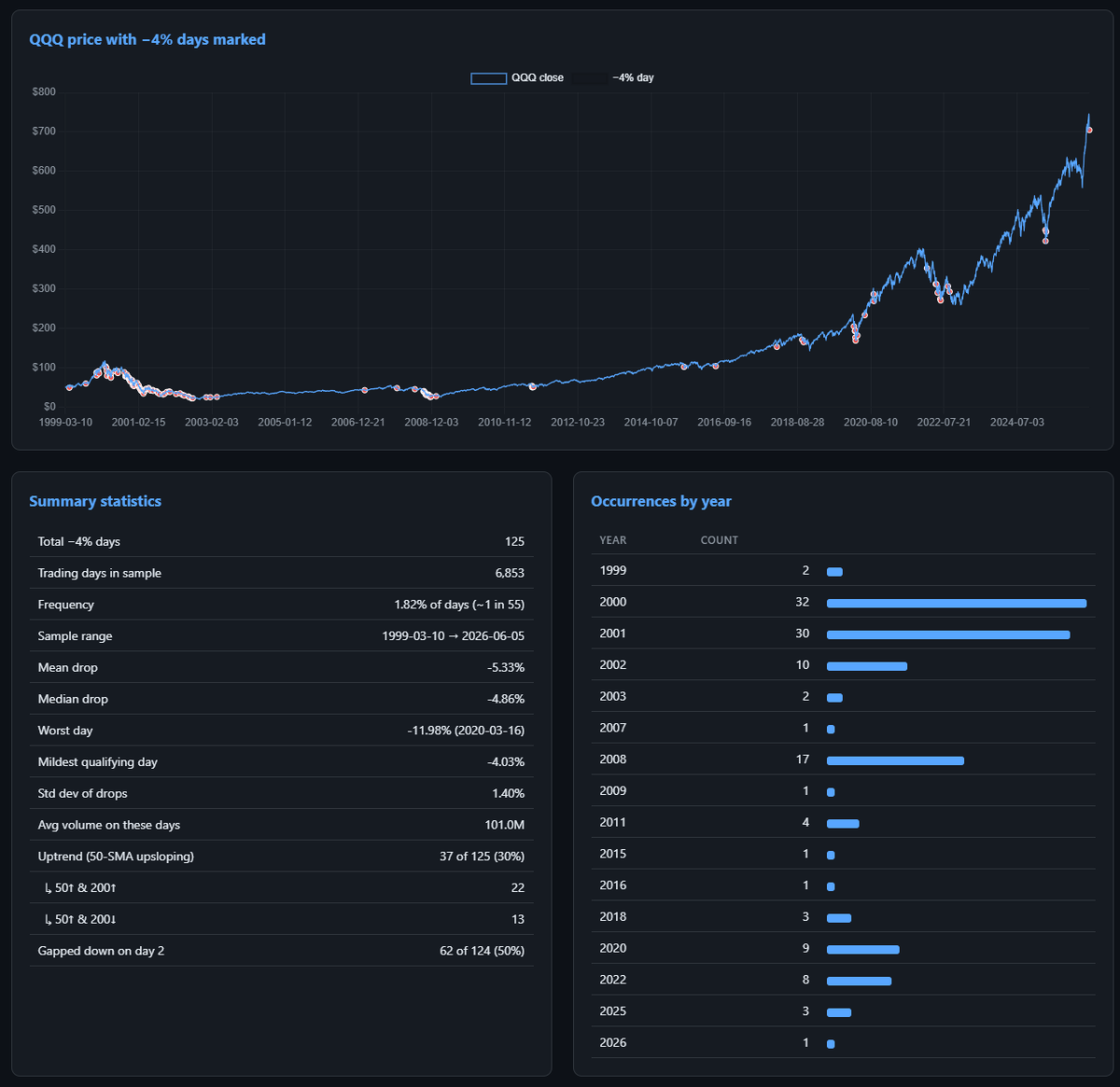
$QQQ dropped 4.8% on Friday. Worst day in over a year.
So I pulled every 4% down day in $QQQ since inception. There were 125 instances and they occur less than 2% of the time.
Look where they cluster though. 32 in 2000. 30 in 2001. 17 in 2008.
A -4% day is mostly a bear market event.
So what does one mean inside a bull?
22
21
249
75,563

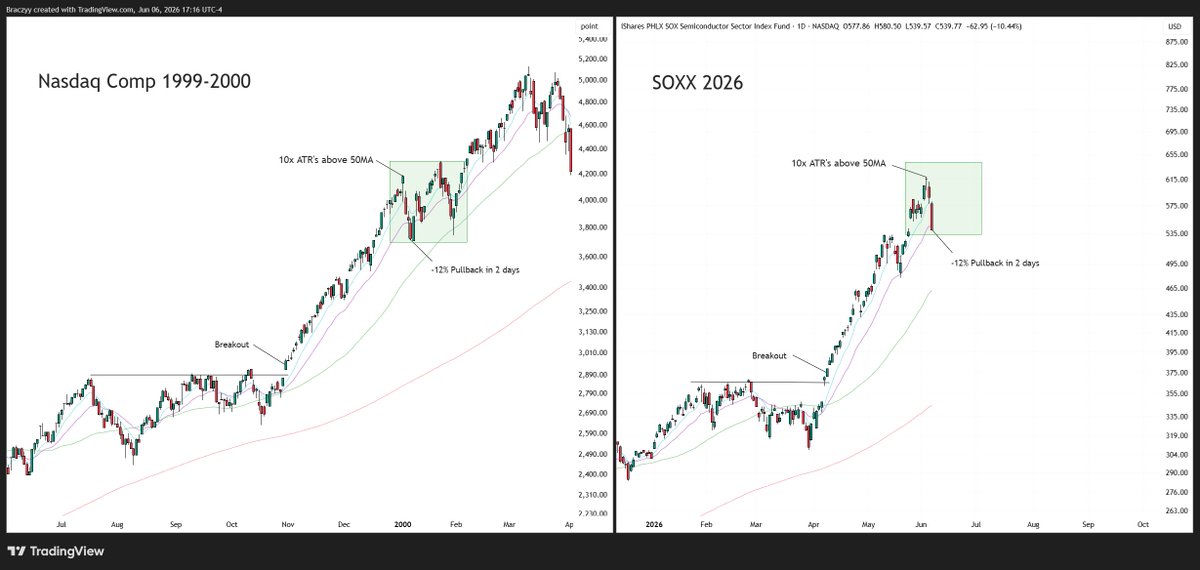
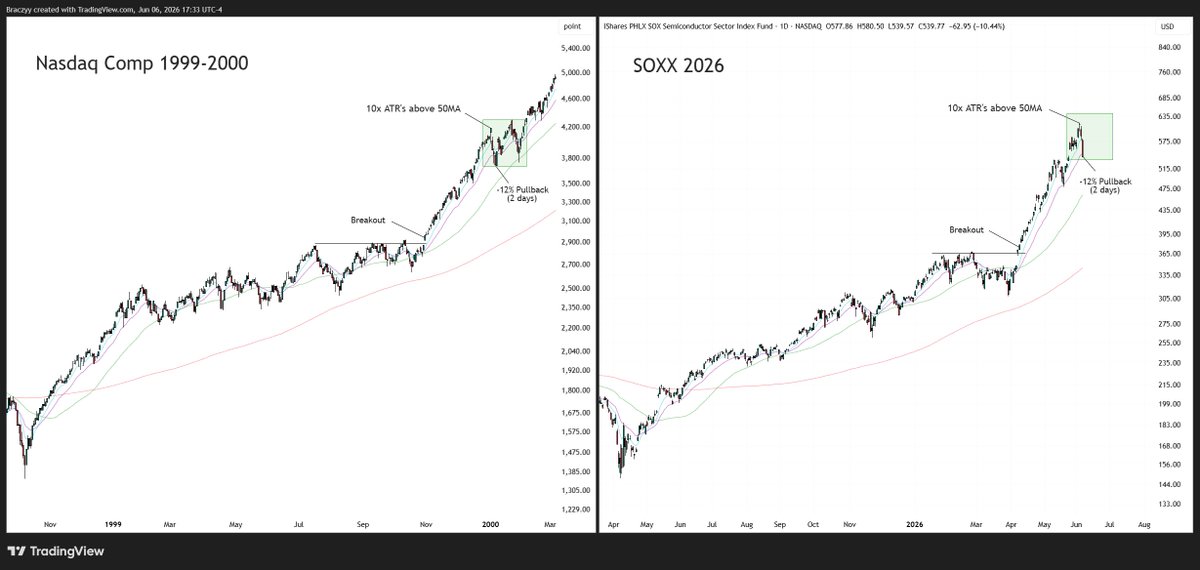
Went back and studied the Nasdaq parabolic advance following the November 1999 breakout. Wanted to see what the first real pullback looked like after the big down move in markets on Friday.
Nasdaq went vertical for 10 weeks, reaching nearly 10x ATR's above the 50SMA before its first close below the 20EMA, which came after a sharp 12% pullback in two sessions.
$SOXX just fell -12% in two days after hitting just over 10x ATR multiples above the 50SMA on Wednesday... First close below the 20EMA on Friday.
Wanted to compare the two as $SOXX $SMH and semiconductor stocks share many striking similarities with the Nasdaq and internet leaders of the 90's.
Also worth noting that many of the leaders during the first parabolic advance on the Nasdaq in 1999 did NOT make new highs again, even though the index grinded another 30% higher.
If using as precedent it's likely we saw some capitulation on Friday and could find a low next week. Would expect wide ranges, volatility, and tougher trading conditions. Just for studying and entertainment purposes.
50
83
818
172,350
The Invisible Man retweeted

Per my 6 years of research, there are many types of election fraud, and the one(s) that get used in any county or state are the ones most likely to work in that county or state.
That being said, make no mistake, this California nonsense is driven primarily by absentee ballot fraud. And it should be waking up everyone still asleep.
Not secret systems in poorly lit buildings in Serbia, not Maduro plotting from prison, not Italian satellites in space, not a high-tech computer in Maryland, no secret algorithm from the Associated Press... absentee ballot fraud, with its conjoined twin, registration fraud (can't really have one without the other).
As a bonus, we are seeing first hand in (slow) real time the ridiculousness of the claim that machines speed up anything in the process.
DO NOT misunderstand me, other elections use different cheating methods. The Venezuelan Smartmatic computers in Los Angeles are, I am sure, adding their own special sauce (muy caliente!). Other mischief could be at play. If anyone remembers, many counties, including Los Angeles, were Mesa Pattern counties in 2020.
But in this instance please don't bury the lede. California absentee ballots and the reckless laws surrounding their counting are the #1 issue here. This debacle will give the President all the reason he needs to publish an executive order to demand one day of voting... in person. If you want to push a narrative, push this one as it happens to be true.
These are my informed, researched opinions, I am entitled to them, and I have earned the right to make them.
14
74
236
3,412
The Invisible Man retweeted

Jun 4
Republicans have the power to set a particular date as Election Day going forward. They have the House, the Senate, and the Presidency. Common sense Voter ID and a mandatory Election Day would be the end of the Democrat Party.
Why won’t they do it?
4,242
13,223
57,155
433,476