
Do not follow me
Joined June 2011
- Tweets 12,090
- Following 472
- Followers 258
- Likes 23,491
794 Photos and videos












Tim Josling retweeted

Jun 13
Scott Jennings nailed the liberal meltdown over Elon Musk, becoming the world’s first trillionaire:
“All day long, I’ve been listening to liberals count and spend Elon’s money for him. This envy, jealousy, hatred of success. Why is it immoral? Why is it wrong for somebody in our system… to build companies, build technologies, go into space, aim to put a colony on Mars, give internet to half the world?”
The outrage isn’t about “fairness”, it’s envy dressed up as virtue.
Success that creates jobs, technology, and real progress threatens a worldview built on grievance and zero-sum thinking.
Elon Musk is the shining example of immigration done right.
A legal immigrant who came to America, worked relentlessly, took enormous risks, and built companies that deliver massive value to humanity.
Not by taking from others, but by creating wealth that didn’t exist before.
Success isn’t a crime.
It’s the American Dream in action.
Congratulations, @elonmusk, well earned. Keep building. 🚀

374
1,814
5,858
58,384

Tim Josling retweeted

Jun 13
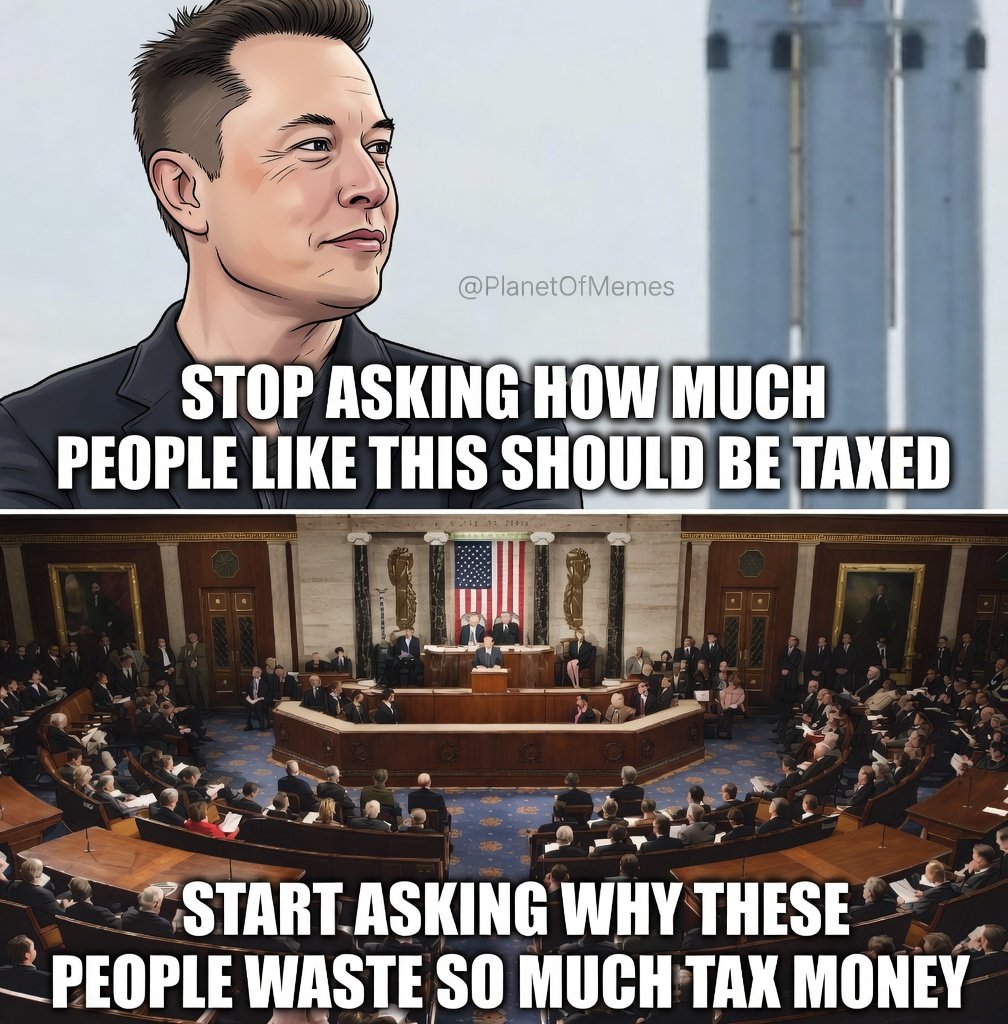
Bill Maher: “Elon is now a trillionaire… Now I give Elon his props. He has created amazing things. Yes, SpaceX is amazing, so is Tesla, Neuralink, and Starlink. Elon owns a company that can rewire your brain. It’s called Twitter.”
“Elon says he will use his wealth to get to Mars because he believes one thing above all: if you have to leave Earth to avoid California taxes, you do what you have to do.”
216
1,300
22,122
1,398,880

Tim Josling retweeted

Jun 12
There are 2 types of people:
1. People who see a trillionaire and wonder how they can innovate and emulate such success
2. People who see a trillionaire and seethe with resentment
Do everything you can to ensure you're always around the first kind of person.
350
1,884
11,819
117,347
Tim Josling retweeted

Jun 12
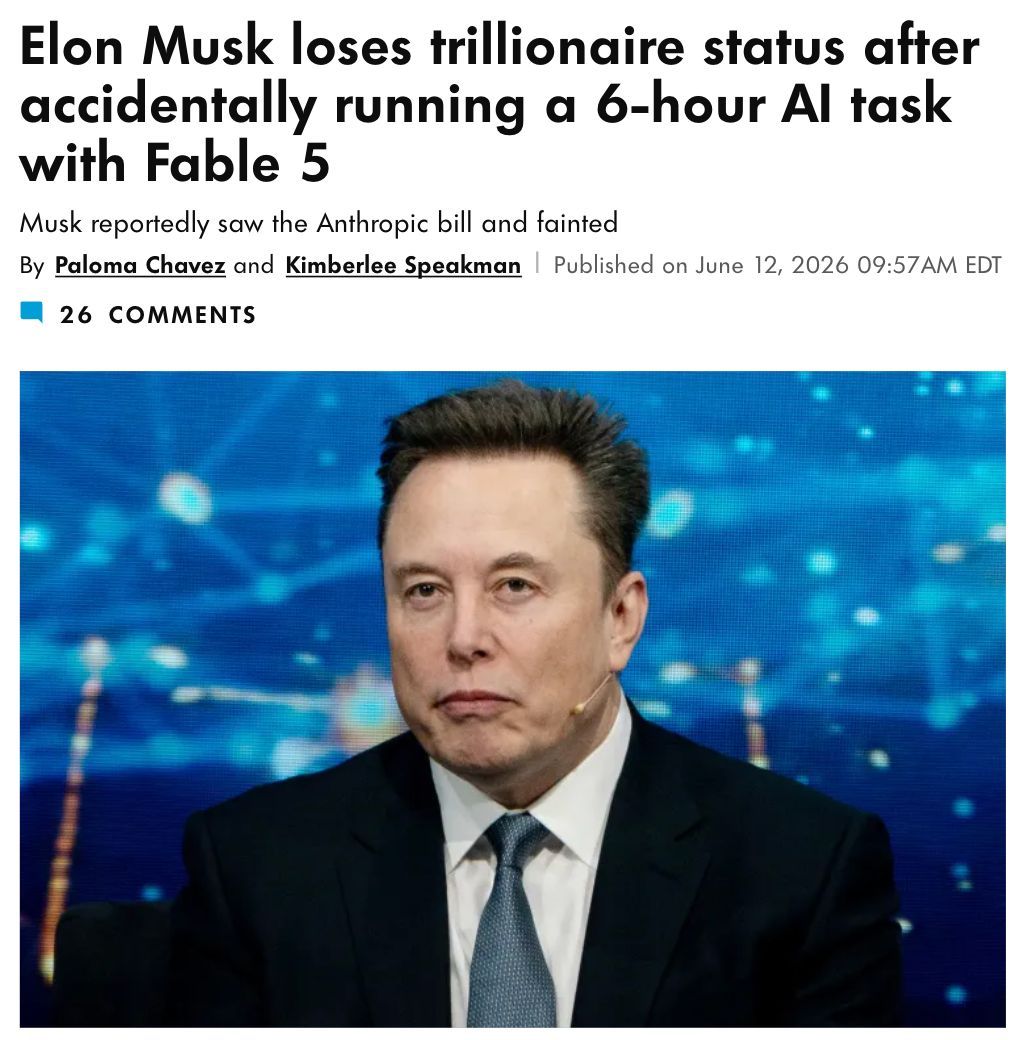
happens to the best of us
120
458
11,437
329,504
Tim Josling retweeted

Jun 11
rockets used to grow in the forest and they were distributed evenly all over the world until Elon hoarded them out of spite


119
1,047
15,758
208,775


Tim Josling retweeted

Jun 9
10 Words/Phrases that end the debate before it even starts
114
513
3,490
197,574
Tim Josling retweeted

Jun 9
Small Business will pay $2.3B For Valuations on 1 July 2027
x.com/toy59496/status/206425…
One of the more interesting points made by Maddocks Accounting is that every small business owner will need to organise a formal valuation at the transition point between the new and old CGT scheme.
That's at least $10,000 minimum (their estimate) because it will need to be verified externally for the purposes of verification with a hostile ATO.
There are 2.73 million small businesses in Australia.
So that is a $2.73 BILLION dollars of compliance cost if each of those small businesses got an assessment.
That's an entirely non-productive spend and strips cash from innovation. It's a master class in stupidity.
That's not even taking into account the actual complex tax returns as we are ONLY talking about the valuation.
If anybody is interested in creating a startup doing easy online business valuations now is the time. I understand it's going to be an exploding market.
I suggest we incorporate offshore. Who's in???
@AngusTaylorMP @PaulineHansonOz
Jun 9

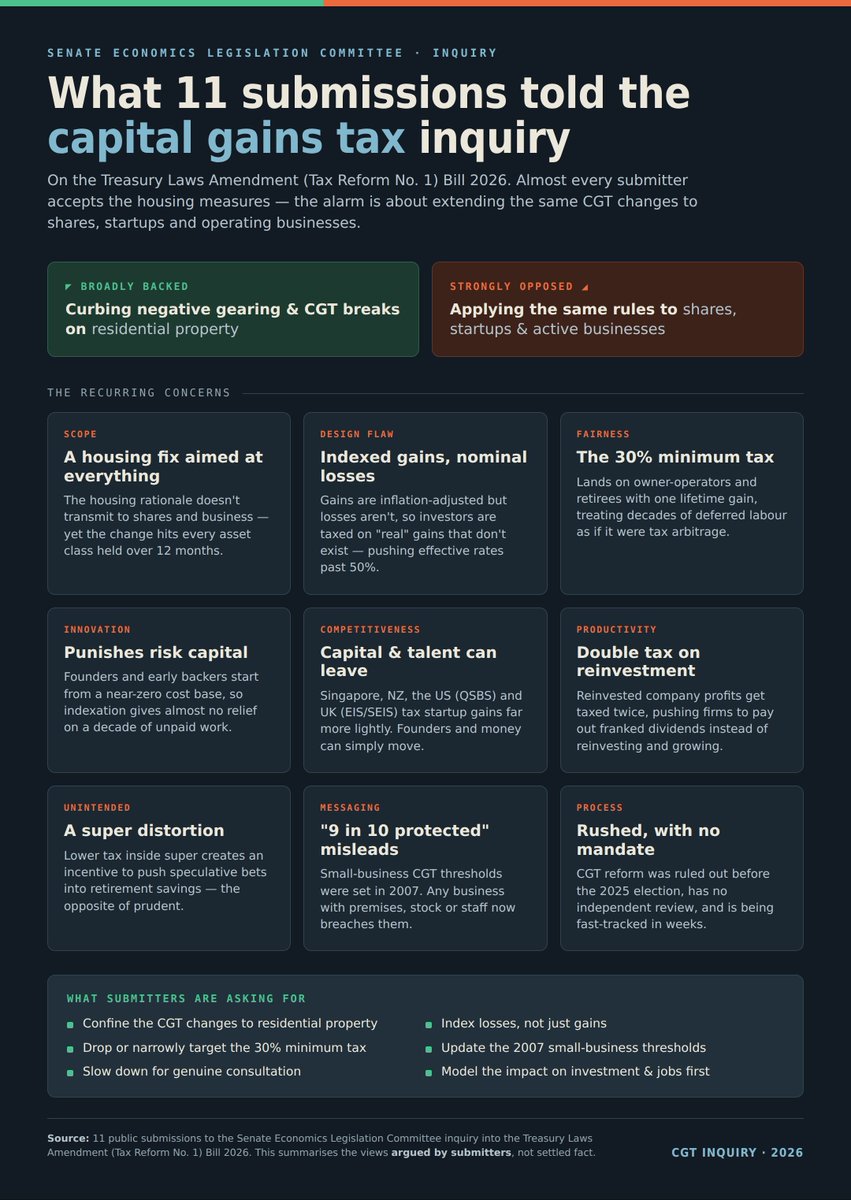
CGT : Summary of Current Submissions to the Panel
I've analysed the current submissions to the panel and cross referenced the legislation to ensure their validity; so far there are only 11 submissions.
aph.gov.au/Parliamentary_Bus…
Notably, most submitters explicitly support (or don't oppose) applying the changes to residential property, rather, their objection is the extension to shares, businesses and other productive assets.
The concerns were as follows:
1. The reform is too broad: a "category error"
The housing-affordability rationale doesn't transmit to equities and business assets, yet the measures apply to all asset classes, with no direct transmission to new housing supply. Storage Lord frames sweeping in operating businesses as policy convenience rather than policy design: if the concern is residential housing, the instrument should target residential housing.
Defender Ventures argues the "distortion" justification is self-defeating: if the aim is to shift households from passive property towards productive equity, taxing both at the same higher rate cannot achieve it: a neutral disincentive is no incentive at all.
2. The indexation/loss asymmetry
Indexation applies to gains but not losses, so gains and losses are no longer measured against the same yardstick, and an investor with both a gain and a loss in the same year pays tax on a construct that bears no relationship to their actual economic position. Stern, Otso and Maddock's all flag this; effective tax on real portfolio gains can exceed 50% because losses aren't indexed.
3. The 30% minimum tax punishes the wrong people
It assumes anyone realising a gain in a low-income year is tax-arbitraging, but for owner-operators the low-income years are the cost of building the business, and the gain is deferred labour income for work already performed. Storage Lord cites a Treasury cameo where someone on $25,000 of income with a $10,000 gain pays an extra $1,600 - a 16% tax increase.
4. Risk capital, startups and venture investing hit hardest.
For founders and early employees the cost base is near zero, so indexation provides almost no relief, and the 30% minimum on a near-zero base after a decade of unpaid work taxes salary that was never paid and risk already borne.
The changes undermine diversification, since venture returns come from a few winners offsetting many losses, and would push investors toward stable mature companies instead of growth firms.
5. International competitiveness / capital and talent flight
Oktopi contrasts Australia with rivals : Singapore (no CGT on individuals), New Zealand (no comprehensive CGT), the US QSBS exclusion, the UK's EIS/SEIS, and France's regime for young innovative companies - and warns Australia is moving the opposite way.
Tier One People warns the changes may accelerate the movement of both capital and professional talent to jurisdictions with more competitive treatment of risk capital and personal income.
6. Double taxation and the franking-credit interplay
Stern and Allan Gray both note reinvested profits are taxed twice (company shareholder), and the Budget papers ignored the franking interaction.
Allan Gray warns this creates a huge incentive for companies to pay out franked dividends and retain as little as possible for reinvestment, so growth, productivity and employment all suffer.
7. Superannuation distortion
Because super is taxed far more lightly, Deegan warns the changes create a powerful incentive to shift speculative, high-risk activity into SMSFs/super- running directly counter to the prudent-retirement-savings objective.
8. Misleading "nine in ten small businesses protected" claim
Storage Lord and Maddock's argue the $2m turnover and $6m net-asset thresholds were set in 2007, have not been meaningfully updated, and now describe microbusiness rather than real small business. Asset-heavy businesses (storage, manufacturing, hospitality, agriculture) breach them simply by needing premises or equipment.
9. Compliance burden is large and unacknowledged
Pre-2027 assets need market valuations to split gains; for unlisted interests a formal valuation typically costs $10,000 , effectively mandating valuations at owners' expense for assets they may not sell for years. Dividend reinvestment plan portfolios become an administrative burden multiples of today's.
10. Process, mandate and lack of evidence
Multiple submitters note CGT reform was not in Labor's 2025 platform and was explicitly ruled out, yet is being fast-tracked within months of the election, and call for it to be referred back for consultation or taken to an election.
Maddock's notes no independent economic review supports the changes; the Henry Review recommended only a modest cut in the discount from 50% to 40%, not this.
Defender Ventures highlights the Treasurer's own October 2024 advice that abolishing the discount "would not make a meaningful difference" to housing supply.
11. Sector-specific harms
Junior resources:
Deegan warns retail investors will simply exit the small-cap resources space, redirecting capital to term deposits, blue chips or offshore, starving the discovery pipeline.
Commercial property:
Westbridge's modelling shows the after-tax risk premium on value-add/development assets falls by roughly 43%, pushing capital toward passive, long-leased assets and away from new supply.
Picking winners:
Both Maddock's and Storage Lord object to confining any tech "carve-out" to one well-lobbied sector while leaving other operating businesses exposed.
Conclusion
Common recommendations across the submissions:
1. Confine the CGT changes to residential property
2. Index losses as well as gains
3. Drop or narrowly target the 30% minimum tax
4. Update the small-business thresholds
5. Slow the process down for proper consultation.
Welcome for comments and feel free to make submissions.
7
20
78
10,240

Jun 8
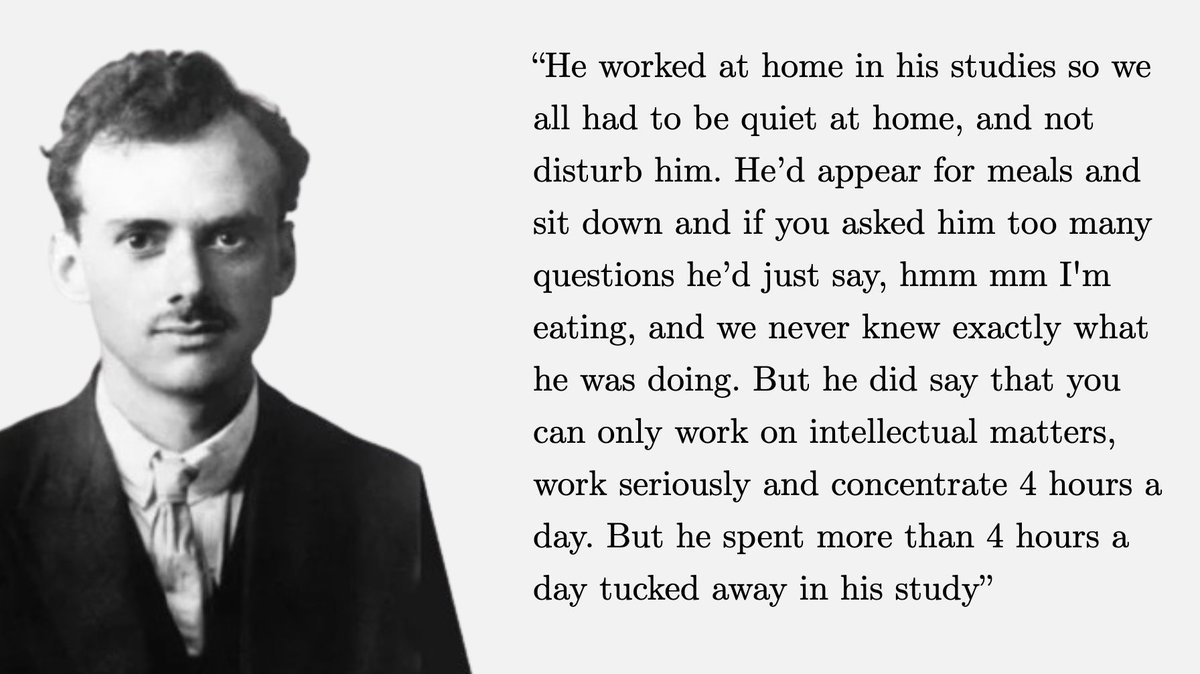
4 hour rule - Paul Dirac

1
31
Tim Josling retweeted

Paul Dirac’s daughter on his working schedule
15
98
1,121
88,457

Tim Josling retweeted

Jun 3
“We’ve done the analysis, reusable rockets aren’t economic.”
SpaceX makes reusable rockets economic.
“We’ve done the analysis satellite internet isn’t economic. The antenna alone is tens of thousands of dollars. The cost to manage a constellation that size, the radiation, the space hardened solar cost…”
Satellite internet appears to be a very good business with antennas in the $100 range.
“We’ve done the analysis, orbital data centers aren’t economic. The radiators, launch costs, the radiation, the solar…”
You are here.
158
470
6,084
214,744

Ça fait un moment que je me pose des questions sur le bilan (provisoire) de Milei en Argentine. On lit tout et son contraire. Alors j'ai arrêté de lire les commentaires et j'ai regardé les chiffres bruts.
L'Argentine, c'est l'expérience grandeur nature que les économistes attendaient depuis 50 ans. Même pays. Même peuple. Même culture. On change UNE variable : la méthode économique.
Avant : des décennies de gestion étatiste et péroniste, "redistributive". Le résultat concret ? 211% d'inflation, 42% de pauvreté, un État en déficit permanent qui finance son train de vie en faisant tourner la planche à billets.
Puis arrive Milei. Méthode inverse, brutale, assumée : on coupe, on déréglemente, on arrête d'imprimer.
Deux ans plus tard (photo à son arrivée (fin 2023) vs aujourd'hui) :
Inflation annuelle : 211% → 31%
Inflation mensuelle : 25% → ~2%
Déficit public : −5% du PIB → 1,8% (excédent)
Croissance : −1,6% → 4,4%
Pauvreté : 42% → 28%
Sans débat. Jugez par vous-mêmes.
Et le point essentiel : ces gains ne vont pas "aux riches" ou "aux marchés". Ils vont d'abord aux plus pauvres.
L'inflation est l'impôt le plus injuste qui existe — elle frappe ceux qui n'ont aucun actif pour se protéger. La diviser par 7, c'est rendre du pouvoir d'achat à ceux d'en bas. Et 14 points de pauvreté en moins, ce sont des millions de gens, pas une ligne Excel.
Pendant un siècle, on a expliqué aux Argentins que l'État les protégerait en dépensant toujours plus. Résultat : un des pays les plus riches du monde en 1910, ruiné. On vient d'inverser la méthode. Regardez le résultat.
À un moment, il faut accepter ce que les faits racontent : sur le terrain économique, la méthode libérale a livré en deux ans ce que des décennies de socialisme avaient promis sans jamais tenir. Et ça profite d'abord aux plus modestes.
On peut détester le style de Milei — la tronçonneuse, l'outrance, les sorties improbables, il n'a rien d'un homme d'État classique. Mais on ne juge pas une politique économique au style de celui qui la mène. On la juge à ce qu'elle fait à la vie des gens.
Et les chiffres ont parlé.
429
6,186
18,671
447,963
May 30
It is a blatant tax grab. The words used to justify it are just a cover story.
If they gave a damn about ordinary working Australians they would not have brought in unprecedented numbers of migrants who force wages down, rents up, home prices unaffordable, but increase profits for the big end up town ("The donors").

I'm not buying this Labor is all about helping young people narrative.
Rental growth is 6.8% nationally (SQM) and vacancy rates remain collapsed.
We have the highest home building rate of major Anglosphere nations, yet we still have an acute rental crisis.
Young people are battling just to secure a roof over their heads and even the National Housing Supply and Affordability Council (a federal government organisation) knows this is crushing household formation rates.
While I do believe that there are elements of Labor who do genuinely want to fix things and were likely the driving force behind the changes targeting property investment on existing homes, the reality is what we are seeing is at best giving with one hand and taking with the other.
Ultimately, the reality is the government cant even be honest with renters why they must continue to suffer, instead allowing the government to be insulated by the propagation of myths and outright lies.
History will not be kind.
26
Tim Josling retweeted

May 29
Police: We're going to have cameras to look inside your car to check you aren't using a mobile phone fuck your privacy nothing to hide nothing to fear
Public: It seems you were laughing and let a young man die. We would like the footage
Police: That would be inappropriate
18
2,294
22,591
170,354
Tim Josling retweeted

May 29
From some back-of-napkin math, the fact that the EU refuses to use air conditioning and kills its elderly en masse with heatstroke every single year is probably saving them an aggregate €30 billion euros in foregone pension liabilities and healthcare costs annually, compounded.
67
266
6,515
183,588
Tim Josling retweeted

May 29
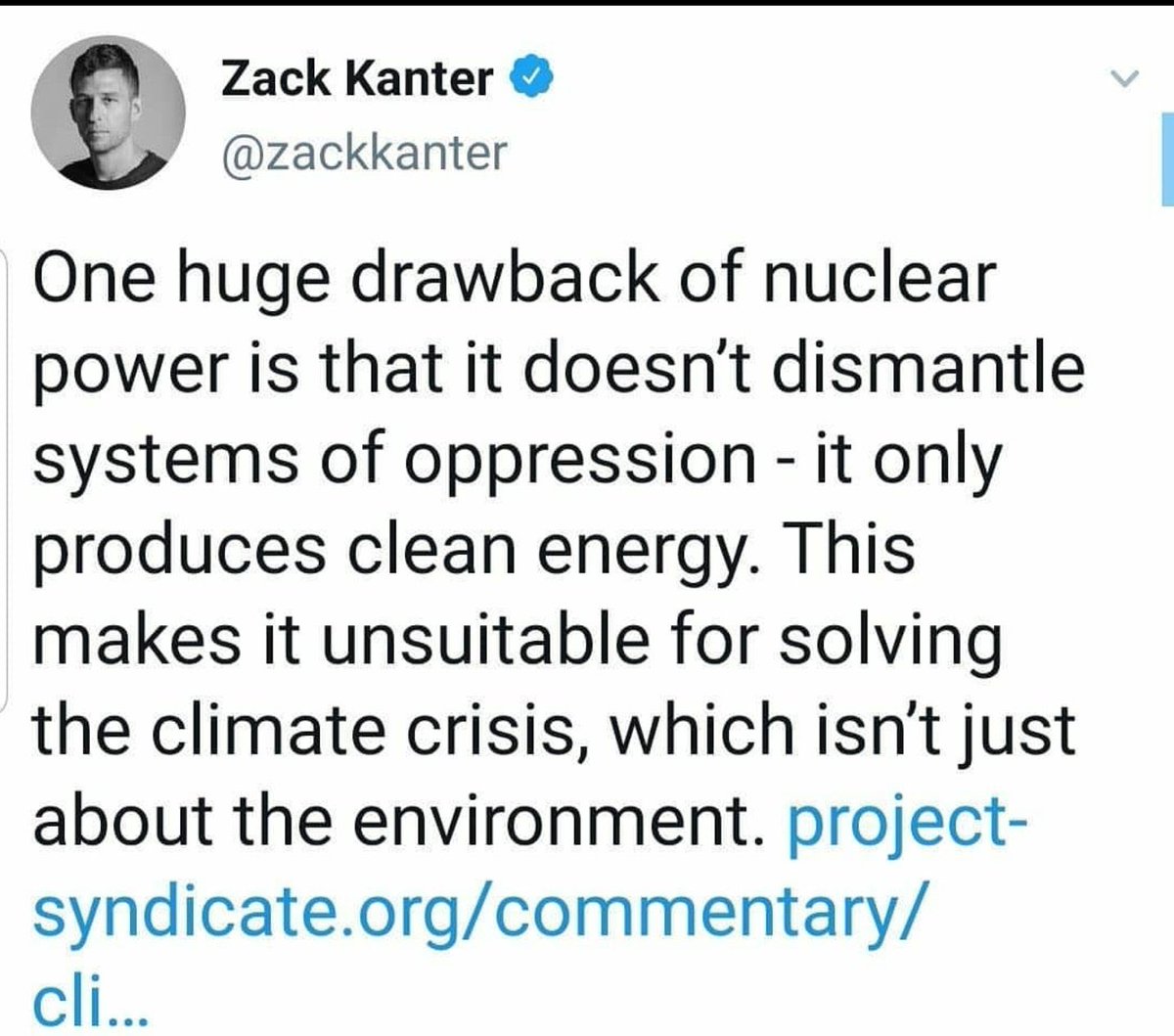
the issue is never the issue, the issue is always the revolution
305
1,985
15,582
307,373
Tim Josling retweeted

May 27
The giraffe told me it’s all good bro; Taxes up, taxes good, capital bad.

1
2
6
526