
We provide Capital Management Solutions for Institutions and DeFi Protocols.
Joined January 2023
- Tweets 872
- Following 54
- Followers 3,516
- Likes 430
360 Photos and videos
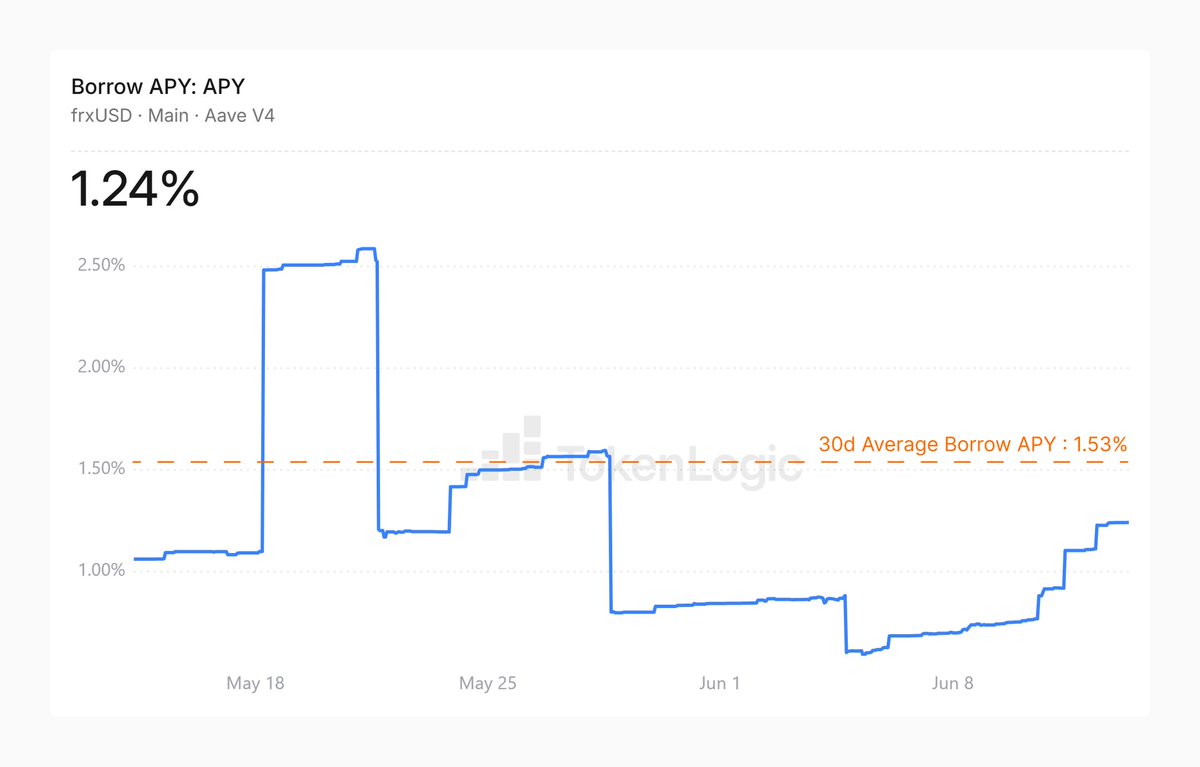

Borrowing $frxUSD on Aave V4 has averaged 1.53% over the past 30 days.
At 1.24% right now, it sits among the cheapest stablecoin borrow rates in DeFi.
1
3
20
936
TokenLogic retweeted

Jun 12
The real story in @aave's May report wasn't growth, it was resilience.
Following the $rsETH exploit, over $160M was committed to make affected users whole, with $AAVE contributing roughly $39M as part of the DeFi United recovery effort.
The recovery effort revealed something important: when trust was tested, the protocol chose to spend capital protecting it.
Let's break down what that means going forward.
—
● The Real Story Behind May's Financials
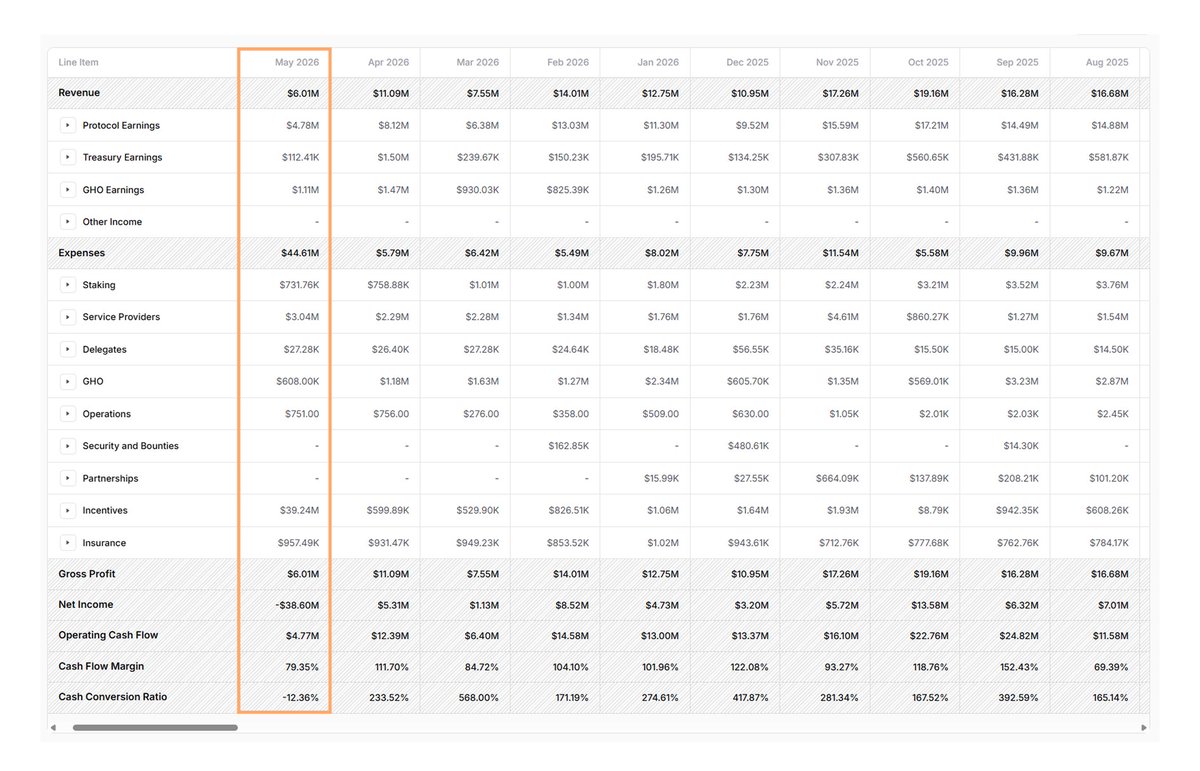
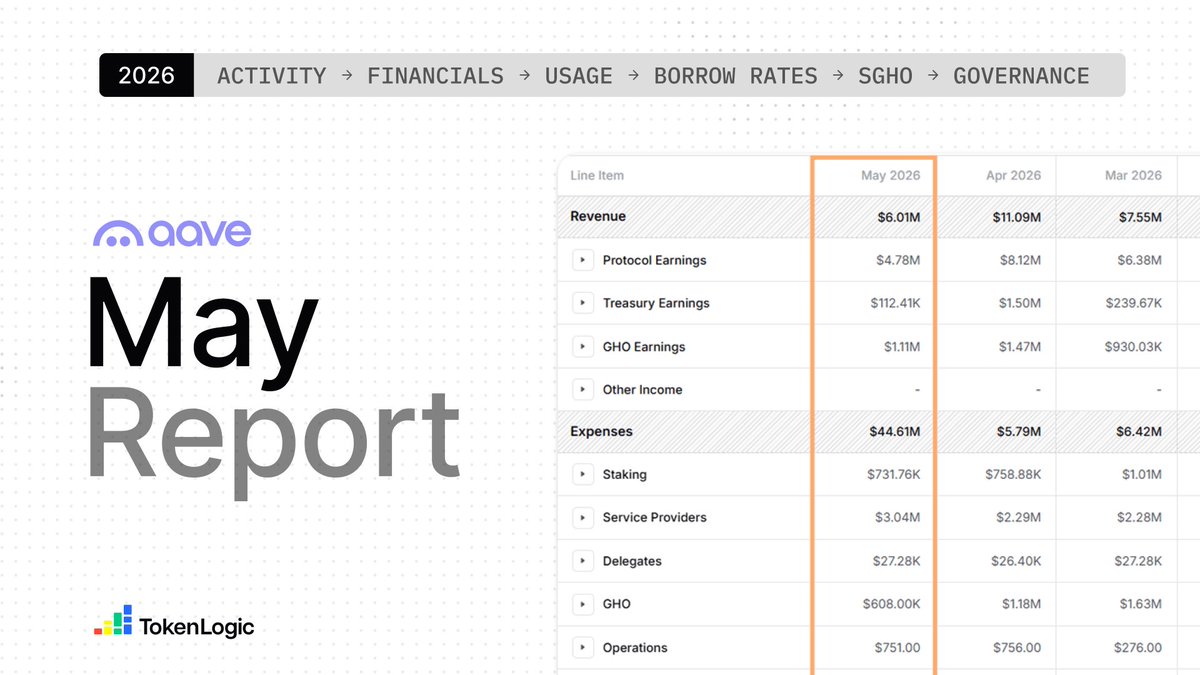
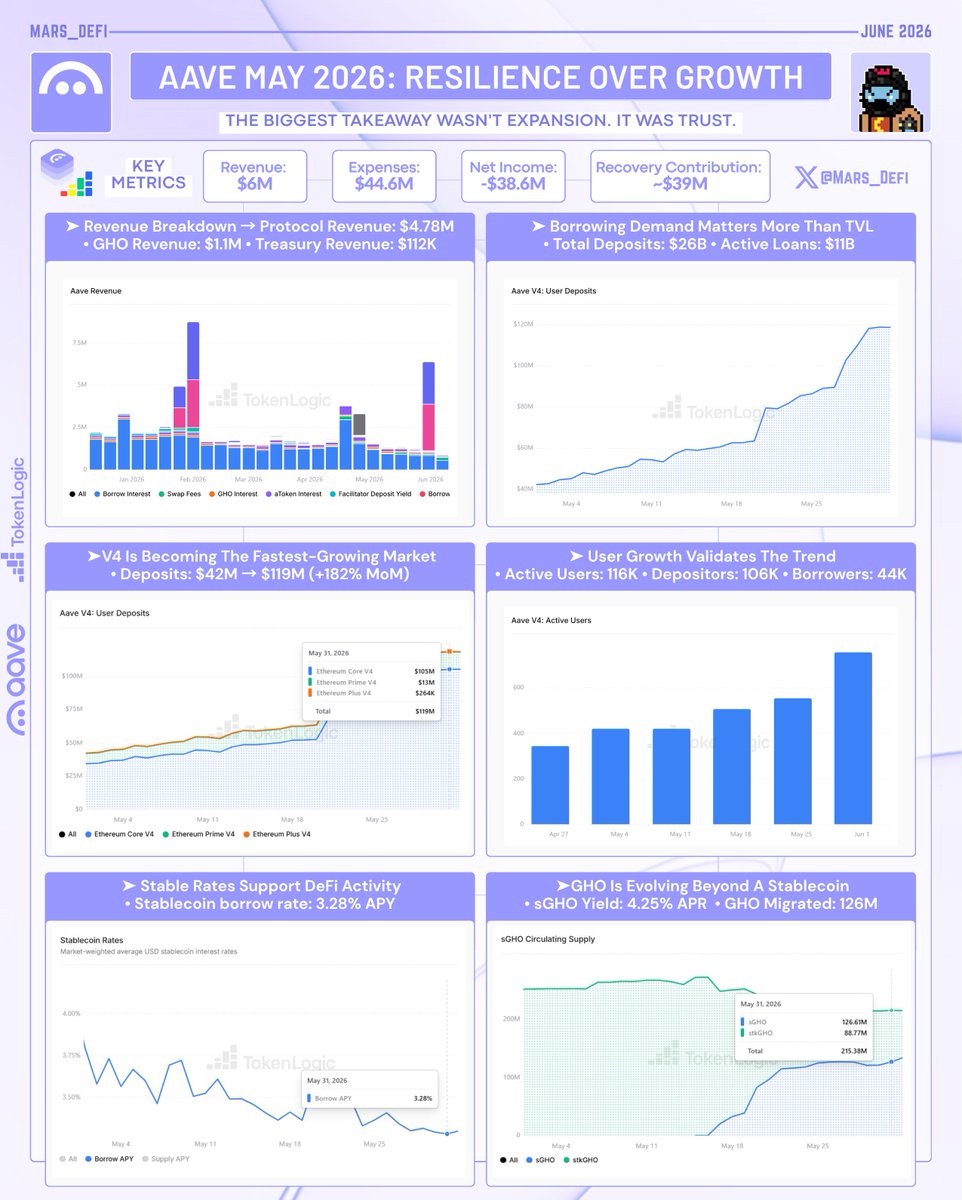
At first glance, the numbers look weak, with $44.6M in expenses against $6M in revenue and net income falling to -$38.6M.
The headline loss was largely driven by a one-time ~$39M contribution to the recovery effort rather than weakness in the protocol itself.
• Revenue: $6M
• Expenses: $44.6M
• Net Income: -$38.6M
• Recovery contribution: ~$39M
• Protocol revenue: $4.78M
• $GHO revenue: $1.1M
• Treasury revenue: $112K
Excluding the recovery contribution, the protocol generated roughly $6M in revenue against $5.4M in recurring expenses, remaining profitable despite one of the largest ecosystem incidents of the year.
—
● Borrowing Demand Matters More Than TVL
TVL often gets the most attention, but deposits alone do not tell us how much economic activity is happening inside a lending protocol.
Active loans are a stronger signal because they reflect real demand for leverage, liquidity, and capital efficiency across DeFi.
• Total deposits: $26B
• Active loans: $11B
• Lending market share: 60.7%
Borrowers continued using the protocol despite the rsETH incident and broader market uncertainty, suggesting its position as DeFi's dominant money market remained intact.
—
● V4 Is Becoming The Fastest-Growing Market
While most attention remains on established lending markets, V4 was one of the strongest growth stories during May.
The significance is not its size today, but the pace at which capital and borrowing activity are beginning to concentrate around it.
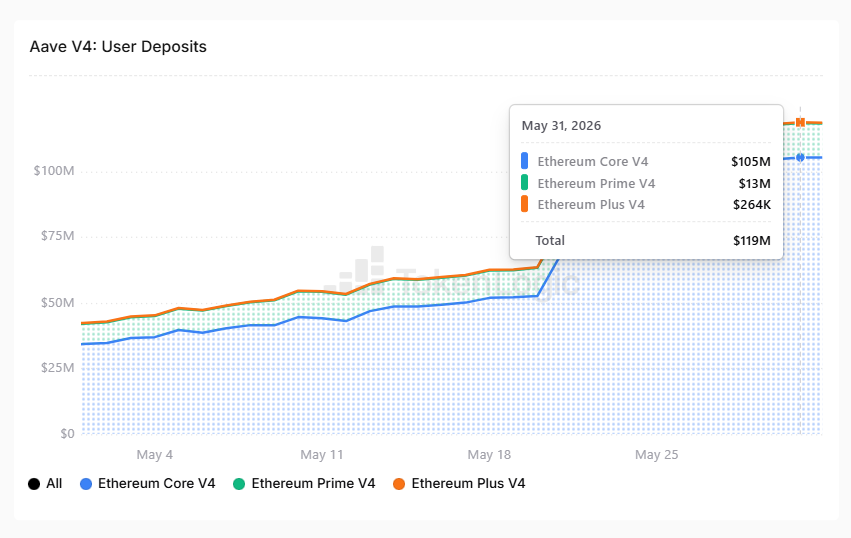
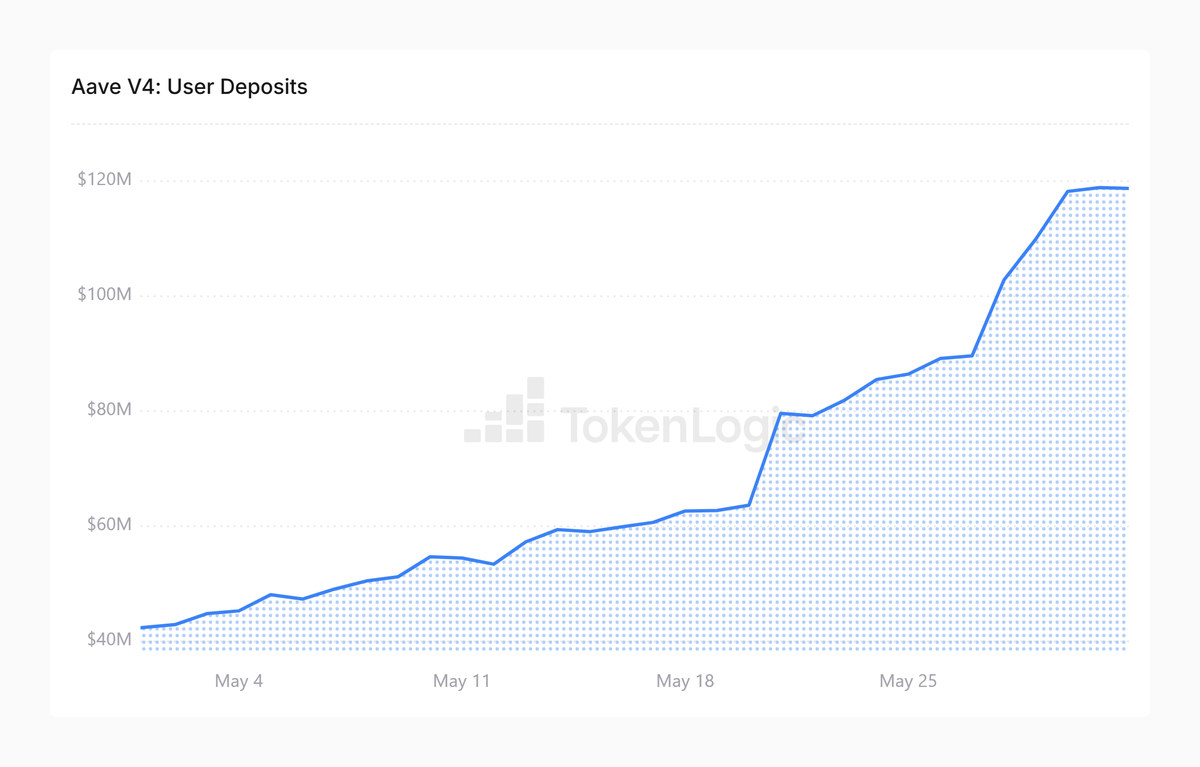
• V4 deposits: $42M → $119M ( 182% MoM)
• V4 active loans: $16M → $33M
• @ethereum Core: $105M
• Ethereum Prime: $13M
• Ethereum Plus: $264K
V4 remains small relative to the broader ecosystem, but adoption is accelerating far faster than the mature protocol.
—
● User Growth Validates The Trend
Capital inflows alone can be misleading, especially when growth is driven by a small number of large holders.
What stands out is that user activity expanded alongside capital growth.
• Active users: 116K
• Active depositors: 106K
• Active borrowers: 44K
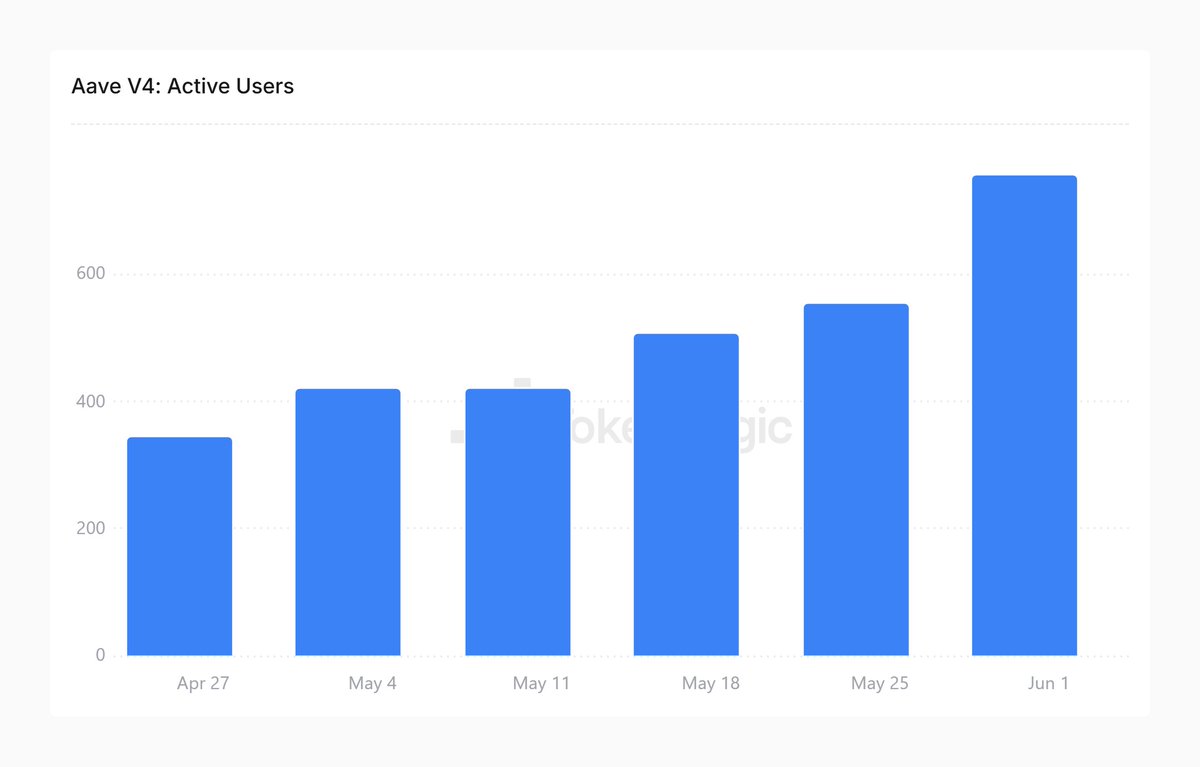
• V4 active users increased every week throughout May and finished the month at a new high
User growth alongside capital growth suggests adoption is broadening, not simply concentrating among larger holders.
—
● Stable Rates Support DeFi Activity
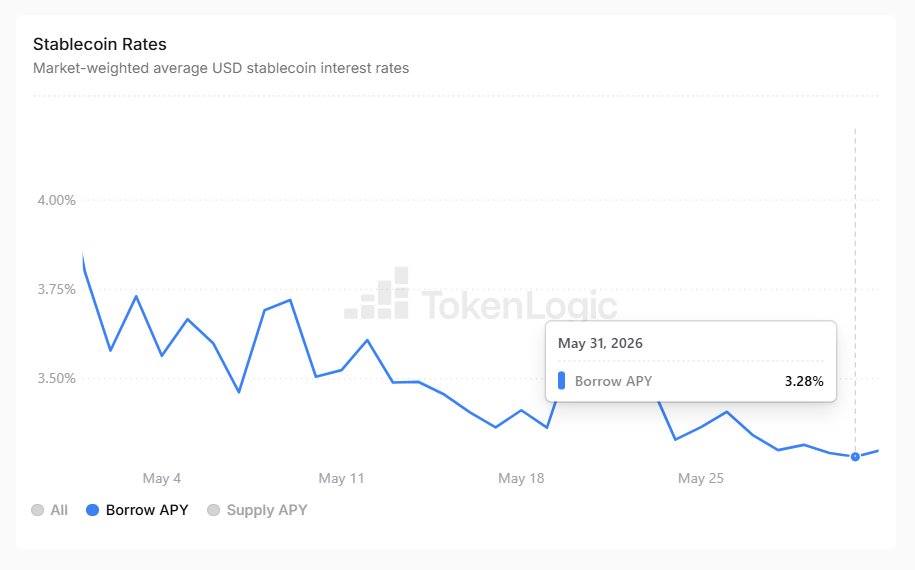
Stablecoin borrow rates remained low and stable throughout May, closing at 3.28% APY.
• Stablecoin borrow rate: 3.28% APY
Predictable borrowing costs make it easier to run leveraged and yield-generating strategies, giving users greater confidence to deploy capital.
—
● GHO Is Evolving Beyond A Stablecoin
The sGHO upgrade signals a broader strategy shift, moving from a traditional savings product toward a fixed-yield asset.
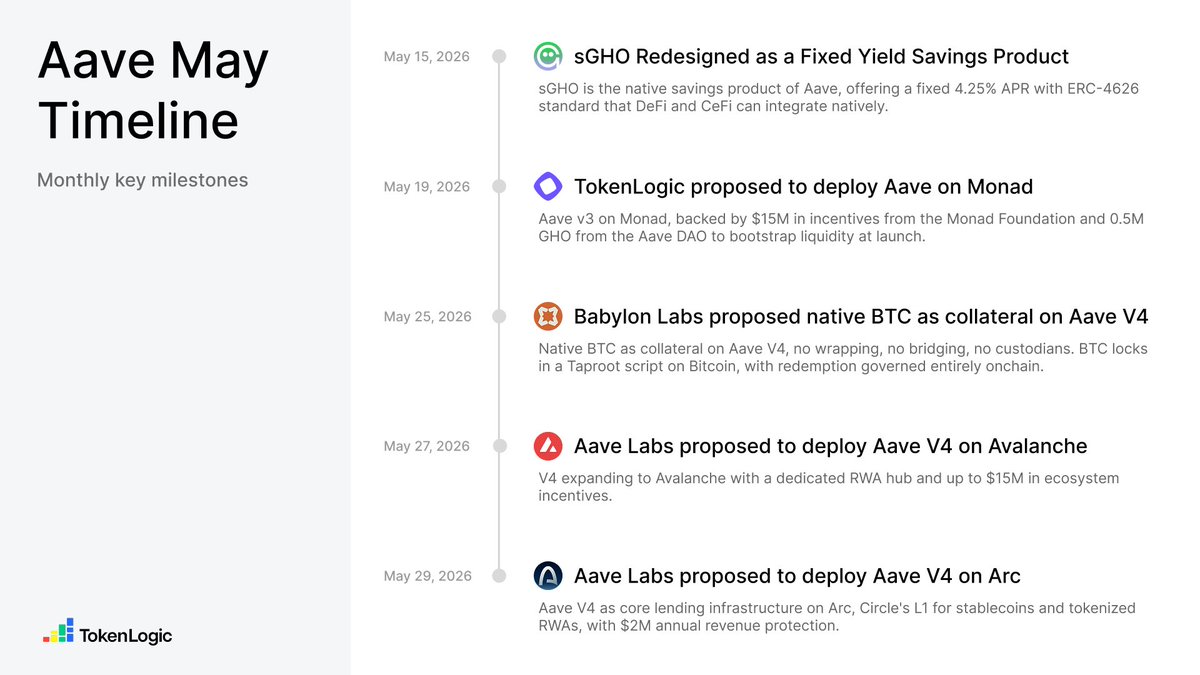
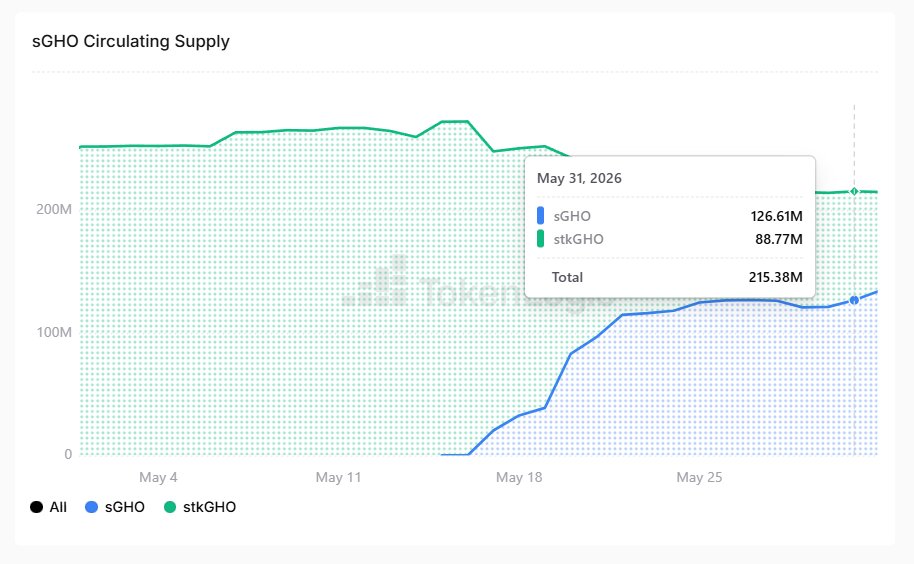
• $sGHO fixed yield: 4.25% APR
• @GHO migrated: 126M
• Remaining in legacy contracts: 89M
The shift positions GHO as a yield-bearing asset that other protocols, treasuries, and capital allocators can build around.
—
● Expanding Beyond The Core Market
Recent governance proposals point toward a broader effort to expand reach across new users, assets, and liquidity sources.
• Deployment proposal on @monad
• Native $BTC collateral through @babylonlabs_io on V4
• V4 expansion to @Avalanche
• Integration with @circle's @Arc ecosystem and tokenized RWAs
The common theme is expanding the protocol's addressable market through new chains, Bitcoin liquidity, stablecoin infrastructure, and institutional capital flows.
—
The broader takeaway is that the protocol is expanding beyond lending into a larger financial network spanning stablecoins, Bitcoin liquidity, new chains, and institutional infrastructure.
That evolution may prove more important than any single metric in the report.
Jun 11

1/ The @aave May 2026 Report is live 👻
Key metrics for May:
▪️ $26B user deposits
▪️ $11B active loans
▪️ $6M protocol revenue
▪️ 60.7% active loans market share
▪️ 116k active users
Full breakdown ↓
31
14
63
2,933
TokenLogic retweeted

May was a big month for @aave.
→ $160M DeFi United coordinated recovery, no ghost left behind
→ V4 deposits 182% to a $119M ATH
→ sGHO upgrade live at a fixed 4.25% APR, with 125M $GHO already migrated
There is plenty more to come: Monad is coming, V4 is expanding to Arc and Avalanche, and it's only getting started.
The teams keep building, the fundamentals keep compounding and Aave has a bright future ahead. We are proud to keep contributing to Aave’s success.
Jun 11
1/ The @aave May 2026 Report is live 👻
Key metrics for May:
▪️ $26B user deposits
▪️ $11B active loans
▪️ $6M protocol revenue
▪️ 60.7% active loans market share
▪️ 116k active users
Full breakdown ↓
8
74
149
2,817

Jun 11
4/ Arbitrum (16,000 $GHO):
✦ 14,000 to supply the fGHO vault
✦ 1,000 to borrow from the ETH/GHO vault
✦ 500 to borrow from the wstETH/GHO vault
✦ 500 to borrow from the WBTC/GHO vault
1
3
179
Jun 11
2
146
Jun 11
1/ The @aave May 2026 Report is live 👻
Key metrics for May:
▪️ $26B user deposits
▪️ $11B active loans
▪️ $6M protocol revenue
▪️ 60.7% active loans market share
▪️ 116k active users
Full breakdown ↓
6
26
103
20,452
Jun 11
10/ May was a month of foundations.
The DeFi United recovery closed. V4 reached a new all-time high at $119M in deposits, with active users growing every week.
Governance delivered on V4 expansion and new deployments.
Aave enters June with solid infrastructure, strengthened risk controls, and a V4 that is just getting started.
2
3
217