The Tracing Center educates and inspires dialogue on the history and legacy of race, privilege, diversity. Home of 'Traces of the Trade.'
Joined February 2010
- Tweets 5,078
- Following 332
- Followers 1,227
- Likes 926
243 Photos and videos
Tracing Center retweeted

13 Dec 2024
"In Slavery's Wake" sounds like an extraordinary exhibition, leveraging a decade of work by figures like Paul Gardullo and Tony Bogues to tell a story "about Black love and Black freedom, not about white guilt." nytimes.com/2024/12/13/arts/…
1
2
62
Tracing Center retweeted
27 Sep 2024
This will break the brains of those who insist California was a "free state" and thus never had slavery. nytimes.com/2024/09/26/us/ca…
2
3
168
Tracing Center retweeted
15 Jan 2024
"In the United States, the history of unseeing is so pervasive that it takes will and work to acknowledge what is right before our eyes." washingtonpost.com/opinions/…
1
1
69
Tracing Center retweeted
8 Nov 2023
Elizabeth Freeman ("Mumbet") should indeed be an American icon. Her determination not only propelled Massachusetts to gradually reject slavery, but beautifully symbolizes the grassroots efforts which eventually led to emancipation. berkshireeagle.com/opinion/e…
1
1
92
Tracing Center retweeted
25 Oct 2023
The House Speaker wants us to believe that while white people can work hard *and* be paid what they're owed, Black Americans can't collect their own debts, without becoming hopelessly dependent on others.
King explicitly rejected this double standard.
1
75
Tracing Center retweeted
5 Aug 2023
Deeply saddened by the death of Professor Charles Ogletree, who fought tirelessly, as both a public defender and a Harvard law professor, to expose and combat racial and other systemic inequities.
1
1
2
124
Tracing Center retweeted
16 Mar 2023
I understand it's hard to acknowledge your ancestors benefited substantially from slavery—much less to contemplate making that right.
But we need to stop pretending only "aristocrats and fat cats" have ancestors who profited from slavery.
1
1
71
Tracing Center retweeted
8 Mar 2023
"They refute the notion that it is possible to bury this history and still understand America."
8 Mar 2023

.@plainsightny is helping uncover the long-submerged history of slavery in the North, focusing on reconstructing the identities of hundreds of enslaved people of African and Native American descent who lived and worked on the east end of Long Island.
phillytrib.com/commentary/un…
1
96
Tracing Center retweeted
7 Feb 2023
“There’s very little Boston history where they tell the truth. When liberal white people tell us how sorry they are, and how they want to apologize, I want them to understand the horror that I’m talking about.” — @ByronRushing
7 Feb 2023
Kudos to Aabid Allibhai for uncovering this Boston church's extensive ties to slavery. It's an important step in deepening our historical understanding of what are now the Black neighborhoods of Boston. bostonglobe.com/2023/02/06/m…
1
124
Tracing Center retweeted
16 Jan 2023
“If Boston can tell a different story about America, then America can start telling a different story about itself.” bostonglobe.com/2023/01/15/m…
1
1
90
Tracing Center retweeted

6 Oct 2022
This describes our experience in Rhode Island too. Reconciliation begins with relationship not so much with gestures not organically grounded in an ongoing conversation. christiancentury.org/article…
3
4
Tracing Center retweeted

4 Sep 2022
Kyle, the @CBSBigBrother production folks, the house & all the people feeling sorry for Kyle need to watch this doc. Especially the parts where the white people have confront themselves. #BB24 Traces of the Trade | POV | PBS archive.pov.org/tracesofthet…
1
2
1
Tracing Center retweeted
3 Aug 2022
"There are signs saying, 'A wealthy person lived here.' Nowhere does it say this ground was walked on daily by enslaved people. Or, that this wealth was made by enslaved people." — @joyfulmuseums wickedlocal.com/story/cambri…
1
Tracing Center retweeted
15 Jun 2022
“The apologize part is difficult for me.”
“But if my words can help your community heal and our community in Boston heal, then I’m ready to sign onto this.”
— Boston City Councilor Frank Baker
15 Jun 2022
Breaking news: Boston played a leading role in the slave trade, starting in 1638. Today, the city finally apologized. bostonglobe.com/2022/06/15/m…
1
Tracing Center retweeted
10 Jun 2022
Clearly, we aren't intended to notice that this was a monument, in a majority Black city, praising the Confederacy as a fight to protect the "rights" of "the people."
Even my kindergartner knows what "right" was being defended by white southerners in 1861-65.
2
3
Tracing Center retweeted
21 May 2022
"In what leading historians say is a first ... we found Haitians paid about $560 million in today’s dollars. But that doesn’t nearly capture the true loss."
nytimes.com/2022/05/20/world…
1
1
Tracing Center retweeted
30 Apr 2022
Powerful article detailing opportunities to learn about slavery and Black history in Bermuda. washingtonpost.com/travel/20…
3
2
Tracing Center retweeted
22 Apr 2022
If you aren't prepared to handle a little *stares in Frederick Douglass*, then I'm sorry, but you have no business on a board overseeing an historic site connected to slavery.
This tweet is unavailable
2
3
Tracing Center retweeted
15 Apr 2022
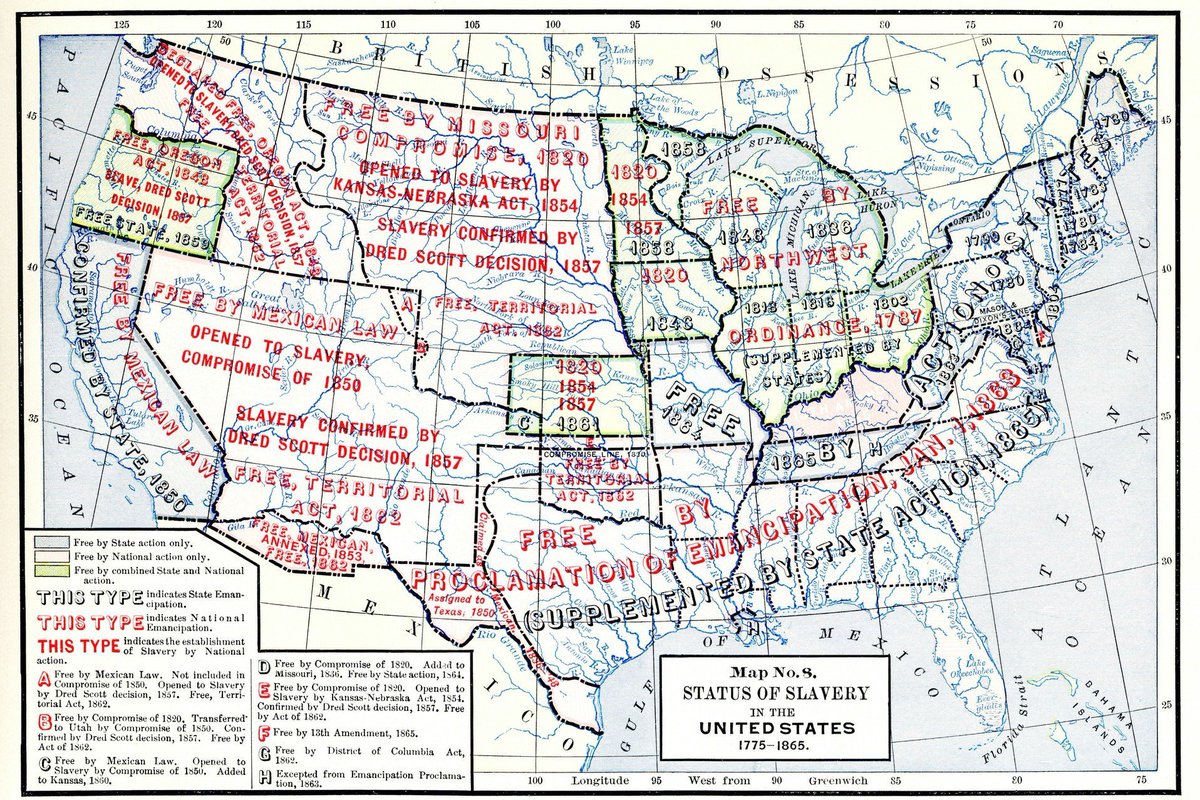
In that vein, this map accompanying the book review dramatically misrepresents which states had slavery, and when they abolished it. I'm talking about states from Massachusetts to California.
2
Tracing Center retweeted
11 Jan 2022
I don't mean to suggest he was simply a "slave holder," like many of his peers.
Before joining the Senate, James DeWolf was our nation's most prolific slave trader. He and his family brought more than 12,000 enslaved Africans across the Middle Passage: tracingcenter.org/resources/…
1
5