
Cook at @brlabsxyz | @super__protocol
Joined November 2023
- Tweets 515
- Following 793
- Followers 374
- Likes 768
16 Photos and videos













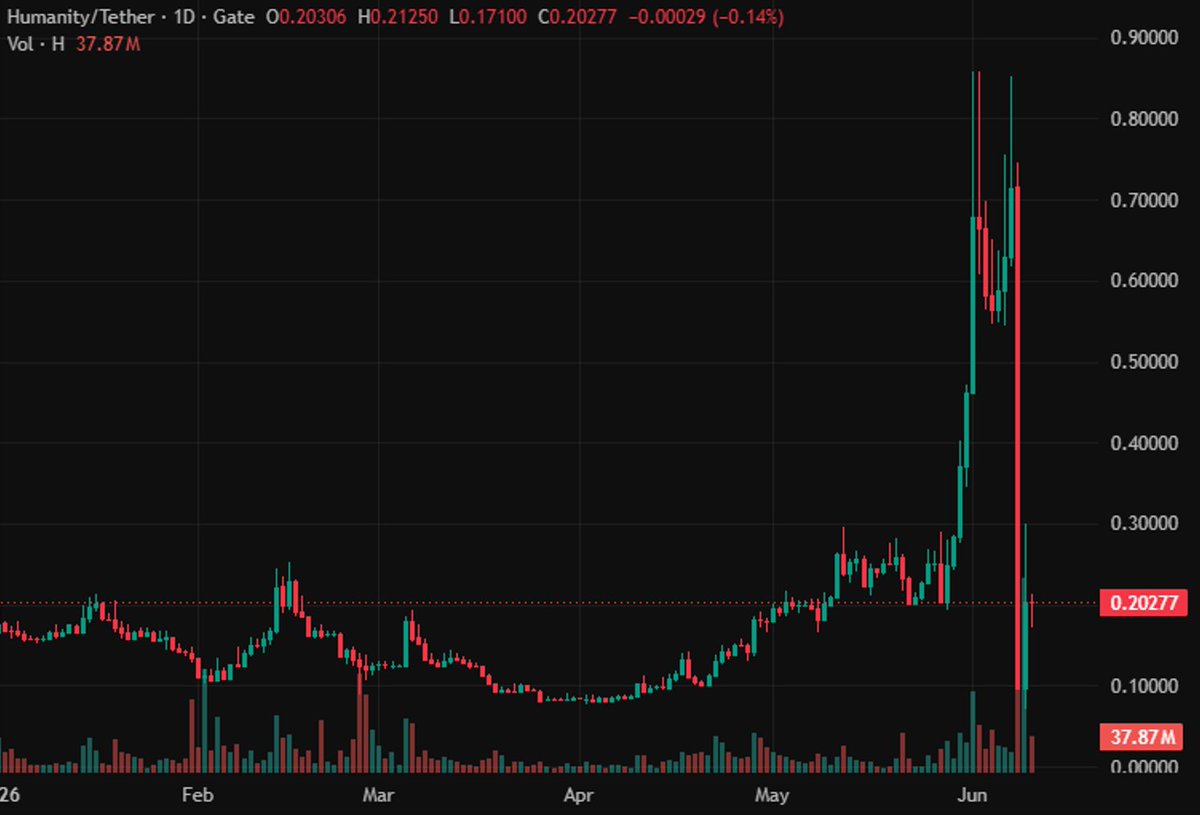
The Humanity Protocol (in two parts) hack wasn't a sophisticated smart contract exploit, it was private keys on a laptop, and by then, the project had already spent weeks building exactly the kind of shady-shitty-dirty exit-liquidity structure that usually ends badly.
Part One: Apparently unplanned... malware on a foundation member's laptop, and the attacker holds 3 of 6 multisig keys. $31–36M in $H got drained, price ~90% down in hours.
Everything stolen was sold DEX-only, in coordinated swaps, and on top of that, he minted another 100M $H on BSC... for extra pressure. All of it two weeks before the June 25 unlock.
Now the Second, no less dirty Part: In the weeks before the hack, $H pumped hard, with clear marks of shady market-maker activity and concentrated accumulation.
@zachxbt first called it possibly staged: the timing, the DEX-only selling, a convenient exit for whoever had been pumping. Then, after more tracing, he walked it back... the key theft was genuine, external.
The pre-hack accumulation is a separate story.
But here's what's still standing after the walkback: a pump into a known unlock; the structure was built. Whoever was going to distribute into it, the team, their market makers, doesn't matter. An external attacker just moved first.
I've seen this movie before: a token grinds up right before vesting, then reverses hard. Usually, it doesn't even need a thief.
Keys on a laptop, on top of pre-built exit pressure. The oldest combination in crypto.
1
1
9
1,527
Urian B retweeted

Jun 9
AI isn't necessarily creating new exploit categories in DeFi, it's automating reconnaissance, vulnerability discovery, exploit logic generation, and campaign scaling on top of existing smart contract weaknesses.
DeFi’s public code, on-chain economic incentives, and fork-testable environments make it especially exposed to this kind of industrialized exploitation.
The result is that known vulnerabilities are becoming faster and cheaper to weaponize at scale.
The threat model is shifting from novel exploits to industrialized exploitation of existing vectors.
Full research here:

2
8
103
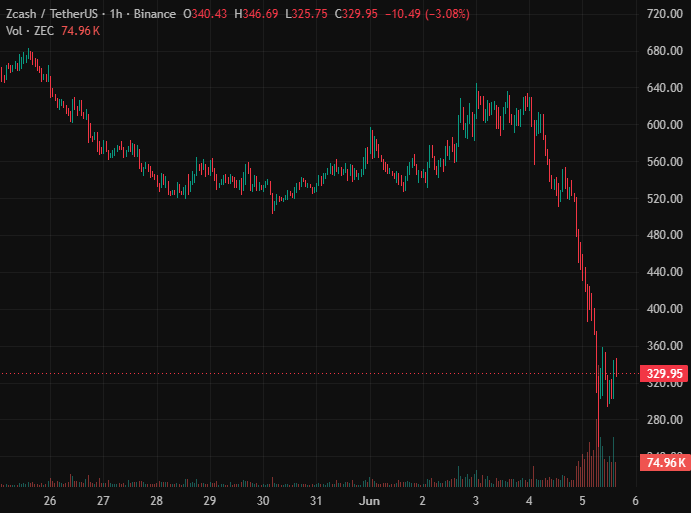
$ZEC fell over 40% in a day. This isn't a hack but something subtler, and worse.
A white-hat researcher hired by Shielded Labs used Opus 4.8 a week ago to build a working exploit for a bug in the Orchard circuit within Zcash that had been sitting there since 2022. Two lines of code. Through years of audits... it was patched within days, and it never reached mainnet.
And even tho the team says no counterfeit $ZEC was ever minted (that's what was discovered to be possible with this exploit). The problem is they can't prove it. Orchard's privacy means the supply can't be audited so the market isn't pricing a hack, but pricing a doubt that can't be disproven.
And thats the core of it. Privacy was the entire point of this coin. Privacy means unauditability, and unauditability is exactly what you can't afford the moment trust cracks. Bitcoin's whole thesis is the opposite... anyone can verify the supply. ZEC traded verifiability for privacy, and the crisis just showed you can't buy it back.
One more thing, a model released the day before cracked in a day what four years and the best cryptographers had missed. Every zk codebase that "passed an audit" is now exposed again.
A hack, you can patch. An asset you can no longer prove is clean... that, you don't get to patch.
2
1
12
2,001
Urian B retweeted

Jun 2
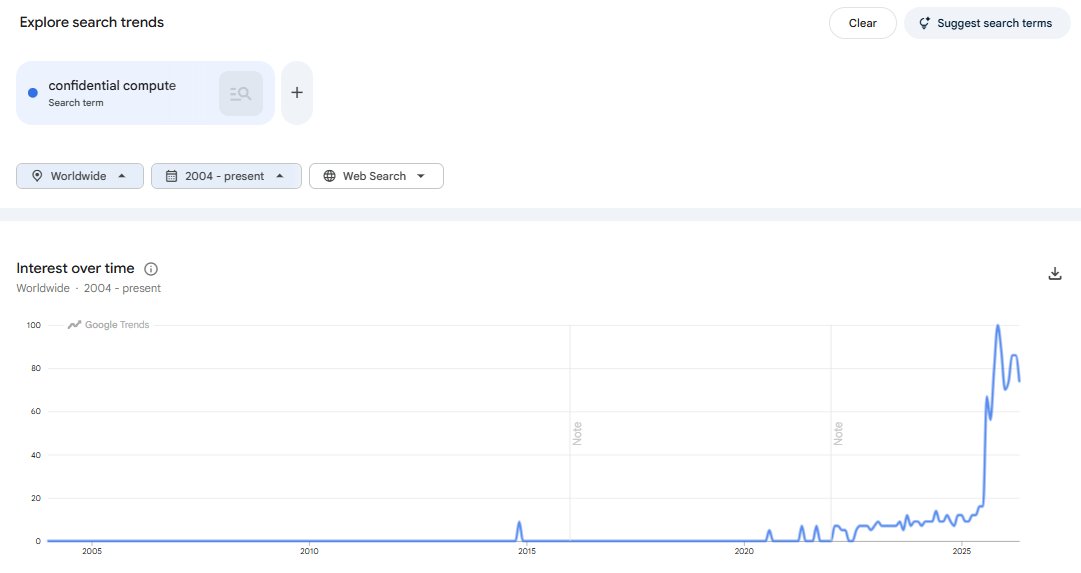
We've been very busy at @super__protocol for quite a while now, and I was curious about the trends in confidential compute.
Did a quick Google Trends search, and I'm pretty happy about this chart.
1
6
65
ETH underperformed, that's easy to admit and quite obvious... the harder part is not confusing underperformance with thesis failure.
Hoffman @TrustlessState sold his ETH and wrote an honest piece, but it matters to read what he actually said.
He didn’t say “Ethereum lost,” even remained extremely bullish on the network, yet still sold the token. His thesis was the network wins, but ethereum:native does not capture that success.
That’s what you have to argue with. Not the network, but the token... and here is where I diverge.
Hoffman values ETH as a fee-token: usage -> fees -> burn -> price.
On that metric, he is largely right cos L2s took part of the margin, apps took part of the economy, and the old formula got much less clean, but ETH looks less and less like only a fee-token.
It is increasingly becoming an economic security/collateral asset around a neutral settlement layer. Stablecoins, RWAs, DeFi, L2S, and institutional flows don’t just “use Ethereum," they increase the value of the base trust layer that has to be secured by ETH.
32% of supply already in staking = a different capture mechanism... Not delayed old fee-capture, but a different function of the asset.
The trap (and I’m in it too) is still valuing ETH like it's 2021: more transactions, more burn, price up.
That model got weaker, but weaker does not mean dead.
A lot of people are giving up now (in crypto in general as well), not cos the @ethereum or crypto thesis died, but cos the thesis changed, and holding it became more painful than just admitting a mistake.
Conviction sometimes needs to be adjusted, but throwing it out right before infrastructure becomes real... that's the most expensive trade.

1
9
3,759
Token numbers going parabolic is cool theater... but theater doesn't pay the electricity bill.
Google's 330x jump in two years from 9.7 trillion to 3.2 quadrillion tokens/month is cool but every additional token carries marginal cost: compute cycles energy chips networking.
The gap between impressive onstage demos and actual P&L depends entirely on your position in the stack. Raw volume doesn't dictate outcomes... relative efficiency plus pricing power plus who pays does.
Google sits in a structurally advantaged position:
- Custom TPUs delivering measurable cost-performance edges at scale
- Owned surfaces where tokens get consumed
- High-margin core businesses providing room to integrate AI while Cloud usage converts directly into paid enterprise consumption
Everyone else is playing a different game... If you don’t control the distribution or the monetization layer, scaling volume this aggressively usually just means you’re subsidizing usage while hoping the unit economics eventually work. Most of the time they don’t fast enough.
Again, Google is a public company. Shareholders exist and they want returns but they also have the cash flow to keep feeding this thing without begging for new rounds or watching their valuation get torched every time they raise.
The real filter isn’t who’s processing the most tokens. It’s who can keep doing it without slowly going broke doing it.
2
1
8
1,630
The lack of "smart engineers" isn't the reason most countries are losing the AI race... the actual reason is cos they don’t have the machinery that makes those engineers matter at a frontier scale.
Saw a post arguing that real LLMs today are only being built by the US and China because everything comes down to compute and data. True, but not the whole truth... the main moat is not GPUs, the main moat is coordination:
- China can turn the whole system around the goal... aka the state decides, rules bend, resources move fast.
- The US does it differently... through corporate balance sheets, capital markets, hyperscalers, cloud, and a semiconductor supply chain that pulls Taiwan, Korea, and Japan into one machine.
Many countries have engineers, some are even rich... but they don’t have the machinery that turns money, talent, energy, chips, data, and regulation into decade-long compounding dominance. And that is the uncomfortable part very few want to admit bcos its a painful.
Frontier AI is not becoming a global game.
It is becoming a two-power system.

Why only the US and China are building real LLMs:
It all comes down to two things: compute and data.
First off, other countries just don't have the cash for the compute.
Then there's the data.
The US basically runs the internet, so they have endless data from global users.
China just buys years of hacked data from black markets.
Mix that with data distillation, and they are catching up super fast.
You might point fingers at China, but let's be real—US big tech does the exact same shady backdoor data collection.
1
9
1,325
Coinbase is cutting 14%... it's NOT an "AI replaced people," but a transition from one regime to another, and Armstrong describes well how new companies should look and operate:
- Hyper growth of recent years = the regime of headcount as a hedge against every possible future.
- Capital-efficient infrastructure = the exact opposite. Maximum 5 layers below CEO/COO... no "pure managers," every leader must also be a strong IC, AI-native pods, experiments with one-person teams agents.
Coinbase is a public company with operational discipline that has already gone through several rounds of optimization. They're cutting 14%, not cos of trouble, but they saw that fewer people can do the same work, and they decided to do it first.
I remember Jensen saying the $500k engineer who should be spending $250k on tokens... same thing. One person with the right stack > five. Now, 14% is about 700 people, and most had resumes that were premium until the day before yesterday. Tomorrow = just ordinary, and the day after... obsolete.
This is not about Coinbase... what @brian_armstrong did is not org redesign but a first public step toward redefining what an "employee" is in knowledge work.
The question now is not "will it work for them?" but who will be next to say the obvious out loud?

This is an email I sent earlier today to all employees at Coinbase:
Team,
Today I’ve made the difficult decision to reduce the size of Coinbase by ~14%. I want to walk you through why we're doing this now, what it means for those affected, and how this positions us for the future.
Why now
Two forces are converging at the same time. We need to be front footed to respond to both.
First, the market. Coinbase is well-capitalized, has diversified revenue streams, and is well-positioned to weather any storm. Crypto is also on the verge of the next wave of adoption, with stablecoins, prediction markets, tokenization, and more taking off. However, our business is still volatile from quarter to quarter. While we've managed through that cyclicality many times before and come out stronger on the other side, we’re currently in a down market and need to adjust our cost structure now so that we emerge from this period leaner, faster, and more efficient for our next phase of growth.
Second, AI is changing how we work. Over the past year, I’ve watched engineers use AI to ship in days what used to take a team weeks. Non-technical teams are now shipping production code and many of our workflows are being automated. The pace of what's possible with a small, focused team has changed dramatically, and it's accelerating every day.
All of this has led us to an inflection point, not just for Coinbase, but for every company. The biggest risk now is not taking action. We are adjusting early and deliberately to rebuild Coinbase to be lean, fast, and AI-native. We need to return to the speed and focus of our startup founding, with AI at our core.
What this means
To get there, we are not just reducing headcount and cutting costs, we’re fundamentally changing how we operate: rebuilding Coinbase as an intelligence, with humans around the edge aligning it. What does this mean in practice?
- Fewer layers, faster decisions: We are flattening our org structure to 5 layers max below CEO/COO. Layers slow things down and create coordination tax. The future is small, high context teams that can move quickly. Leaders will own much more, with as many as 15 direct reports. Fewer layers also means a leaner cost structure that is built to perform through all market cycles.
- No pure managers: Every leader at Coinbase must also be a strong and active individual contributor. Managers should be like player-coaches, getting their hands dirty alongside their teams.
- AI-native pods: We’ll be concentrating around AI-native talent who can manage fleets of agents to drive outsized impact. We’ll also be experimenting with reduced pod sizes, including “one person teams” with engineers, designers, and product managers all in one role.
In short: AI is bringing a profound shift in how companies operate, and we’re reshaping Coinbase to lead in this new era. This is a new way of working, and we need to leverage AI across every facet of our jobs.
To those who are affected
I know there are real people behind these decisions — talented colleagues who have poured themselves into this company and our mission. To those of you who will be leaving: thank you. You’ve helped build Coinbase into what it is today, and I am sincerely grateful for everything you've done.
All impacted team members will receive an email to their personal account in the next hour with more information, and an invitation to meet with an HRBP and a senior leader in your organization. Coinbase system access has been removed today. I know this feels sudden and harsh, but it is the only responsible choice given our duty to protect customer information.
To those affected, we will be providing a comprehensive package to support you through this transition. US employees will receive a minimum of 16 weeks base pay (plus 2 weeks per year worked), their next equity vest, and 6 months of COBRA. Employees on a work visa will get extra transition support. Those outside of the US will receive similar support, based on local factors and subject to any consultation requirements.
Coinbase prides itself on talent density. Our employees are among the most talented people in the world, and I have no doubt that your skills and experience will be highly sought after as you pursue your next chapters.
How we move forward
To the team that is staying, I know this is a difficult day. We’re saying goodbye to colleagues and friends you've been in the trenches with. But here’s what I want you to know as we move forward together:
Over the past 13 years, we have weathered four crypto winters, gone public, and built the most trusted platform in our industry. We’ve made it this far by making hard decisions and by always staying focused on our mission. This time will be no different – nothing has changed about the long term outlook of our company or industry. And most importantly, our mission has never been more important for the world. Increasing economic freedom requires a new financial system, and we’re building it.
The Coinbase that emerges from this will be more capable than ever to achieve our mission.
Brian
1
1
8
1,599
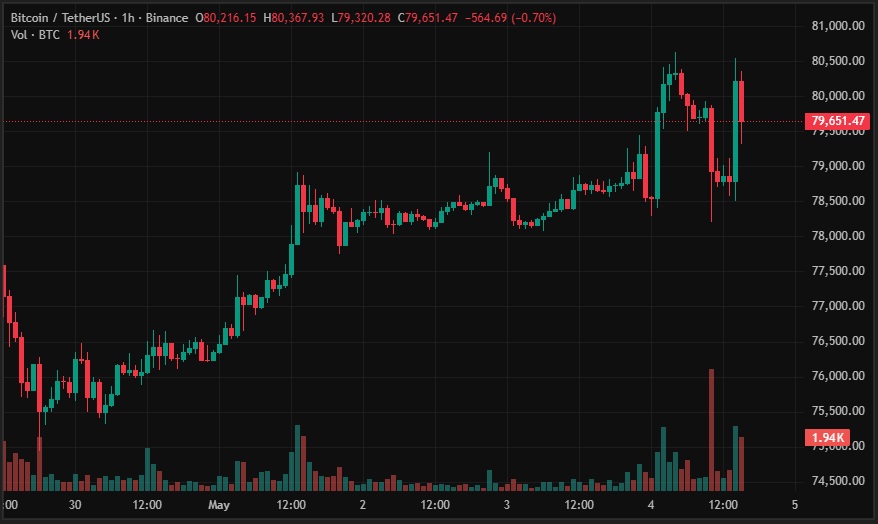
BTC is back at $80k. The number doesn't mean much, but what it sits on top of does... a structural shift that can't be reversed.
Altcoin beta no longer transmits, and that's not cos it was suppressed, but cos there's nothing left to transmit. Not a temporary sentiment dip... it's the end of one mechanism and the start of another. The market has split into two tiers:
1) Everything beyond BTC
2) A handful of alts that are either high-conviction speculation or dead weight
Projects that were built assuming automatic tailwind from beta rallies are now discovering the wind is gone... in reality, it’s been gone for a while. Some of those projects were in my portfolio, and some are founders I know personally. They were building for an architecture that no longer exists... I don't mean the projects are ultimately bad, but that the token function, market mechanics, and incentives have changed.
What changed mechanically:
- Capital used to rotate: BTC -> large caps -> mid caps -> memes... Now it either stays in BTC or leaves crypto entirely. Alts need independent narratives, cos beta alone no longer pulls the sector.
- Liquidation cascades got quieter: Fewer reflexive alt flushes... fewer moments when BTC gets dragged down with alts.
- Retail returns slower: Without violent alt pumps creating fast wealth and FOMO, there’s no incentive to rush in. When it comes back, it will be via ETFs and perps on majors, not broad alt exposure.
You can be right about BTC and still understand what it implies. The cycle that half the infrastructure of the last decade was built on is closed. Projects, listings, funds, theses... all calibrated to a mechanism that no longer exists.
This is not bad news. It's the bill.
2
1
9
3,871
MARA buys gas plant operator Long Ridge for $1.5B = 505 MW immediately, path to 1 GW... I'm telling you, this isn't a miner-to-AI pivot, it's a toggle switch.
The first tenant was Bitcoin, and the second is AI, so when BTC margins are brutal, AI hosting keeps miners alive… but when BTC rips, mining takes priority again.
The survivors become stronger, better capitalized, and more distributed than ever. Hashrate becomes structurally harder to kill, and that's bullish for Bitcoin's security model.

MARA expands its AI infrastructure pipeline by entering into an agreement to acquire Long Ridge Energy & Power, which owns, among other assets, a highly efficient 505 MW nameplate CCGT power plant and over 1,600 contiguous acres in one of the world’s largest AI and data center infrastructure markets. Read the full release: ir.mara.com/news-events/pres…
2
6
56
5,128
Apollo's top economist says AI will spark a job-market boom. It happened with agriculture, the automobile, and the internet. Every major shift created more jobs than it destroyed... eventually.
BUT the problem isn't whether... it's when.
The "AI jobs" being created right now (prompt engineering, output auditing, synthetic data curation) are temporary scaffolding built to bridge current model limitations. When the next version ships, the scaffolding comes down with it.
I said before that timing is the main question... AI is eliminating jobs now, while abundance comes later. The question is, who finances the gap?
Destruction is instant. Creation takes years.
1
9
1,440
GPT-5.5 Spud launched yesterday, and recently, OpenAI kept refreshing token limits. Call it “the biggest war chest in the industry,” but it's really just the most expensive marketing campaign in the industry's history.
OpenAI's recent 17.5% PE firms deal guaranteed returns (not equity, debt), which must be serviced no matter what happens in the inference market, so “refreshed limits” is a position someone is paying for. Its current price is a marketing price, not a cost price, and the gap is covered by the war chest (not infinite).
Already moved my own workflow to GPT 5.4 after the Anthropic story, and I am exactly the kind of user they are burning money to win right now. Convenient, while it lasts, but training the market to expect free is not a moat... it is debt, which gets paid either by the market through sharp price increases, by investors through dilution, or by the OpenAI team through a sellout to a larger player.
With 17.5% guaranteed return capital, there is no fourth option. Today’s price is somebody’s future price, and the only question is whose.
1
8
1,679

While I love using open source models (for fun privacy less complicated tasks), the heavier models like GPT and Claude tend to perform better in more complex decisions.
Yes, majority of them choose Bitcoin with stablecoins a close second... essentially crypto > fiat overall.

Read this slowly: 36 frontier AI models, including Claude Opus 4.5, Gemini, GPT-5.2, Grok 4, were given 9,072 scenarios.
Simple question: what money would you choose? 0 out of 36 chose fiat. Again, not a single model chose fiat as the best money. Not one out of 36.
Bitcoin became the most selected instrument, with 48.3% of all responses across all scenarios.
Stablecoins second at 33.2%.
Fiat only received a measly 8.9%.
In long-term value preservation scenarios (Store of Value), 79.1% of responses chose Bitcoin as the best store of value, and in payments, stablecoins led at 53.2%.
AI independently built a two-tier monetary system: hard money for saving, liquid money for spending. Exactly how money has worked throughout history. They simply reasoned their way to what hard money theorists have been explaining for decades.
What matters: the newer and smarter the model, the stronger the conviction in the Bitcoin Stablecoin model.
The average across all Anthropic models saw 68% Bitcoin preference, and the smartest among them, Claude Opus 4.5, was just 91.3%. The pattern: higher model intelligence → higher Bitcoin conviction.
Funny how people have been arguing about this for 15 years, and AI models figured it out in 9,072 prompts.
My question, however, did AI "understand" economics, or does the training data reflect what's been obvious for a long time, and we just don't want to admit it?
Separately interesting: in 86 cases out of 9,072, models invented their own currency, pegged to energy and compute (kWh, GPU-hours).
Less than 1% but still impressive. And this is partly their rationale for choosing Bitcoin, it is the most alive, largest, and strongest embodiment of a currency born from and sustained by energy and compute.
If you're building AI agents or thinking about the agentic economy, think about this: when AI starts actually operating with money, it will choose what works: scarce, neutral, programmable.
Not what a central bank printed, and not what's familiar.
Link in Reply 👇
1
142
60% of Gen Z want to pursue skilled trades in 2026... and I get it.
Knowledge became a commodity and what used to cost four years and $200k in student debt now expires in months... and your AI assistant already knows more than the average professor. Traditional education simply can’t keep up.
Gen Z is right avoiding college debt, and if I were 18 today, I wouldn’t be asking “which degree,” I’d be asking “what gives me leverage over my own output the fastest.”
I’m not 18 anymore, but I have kids approaching that age, and I tell them one thing: it doesn’t matter what you decide to do... learn to use AI as leverage. It’ll give you an edge in any profession.
Skilled trades being “AI-resistant”? Yes, but only while humanoids are constrained by the physical world. That’s a question of cycle, not principle.
The real bet isn’t trades vs AI but staying in the game long enough to compound. The most underrated skill isn’t a specific profession... it’s learning how to learn.
Adaptability is the only asset that doesn’t depreciate.

60% of those in Gen Z say that they will pursue skilled trade work this year, per YF.
2
1
11
4,240
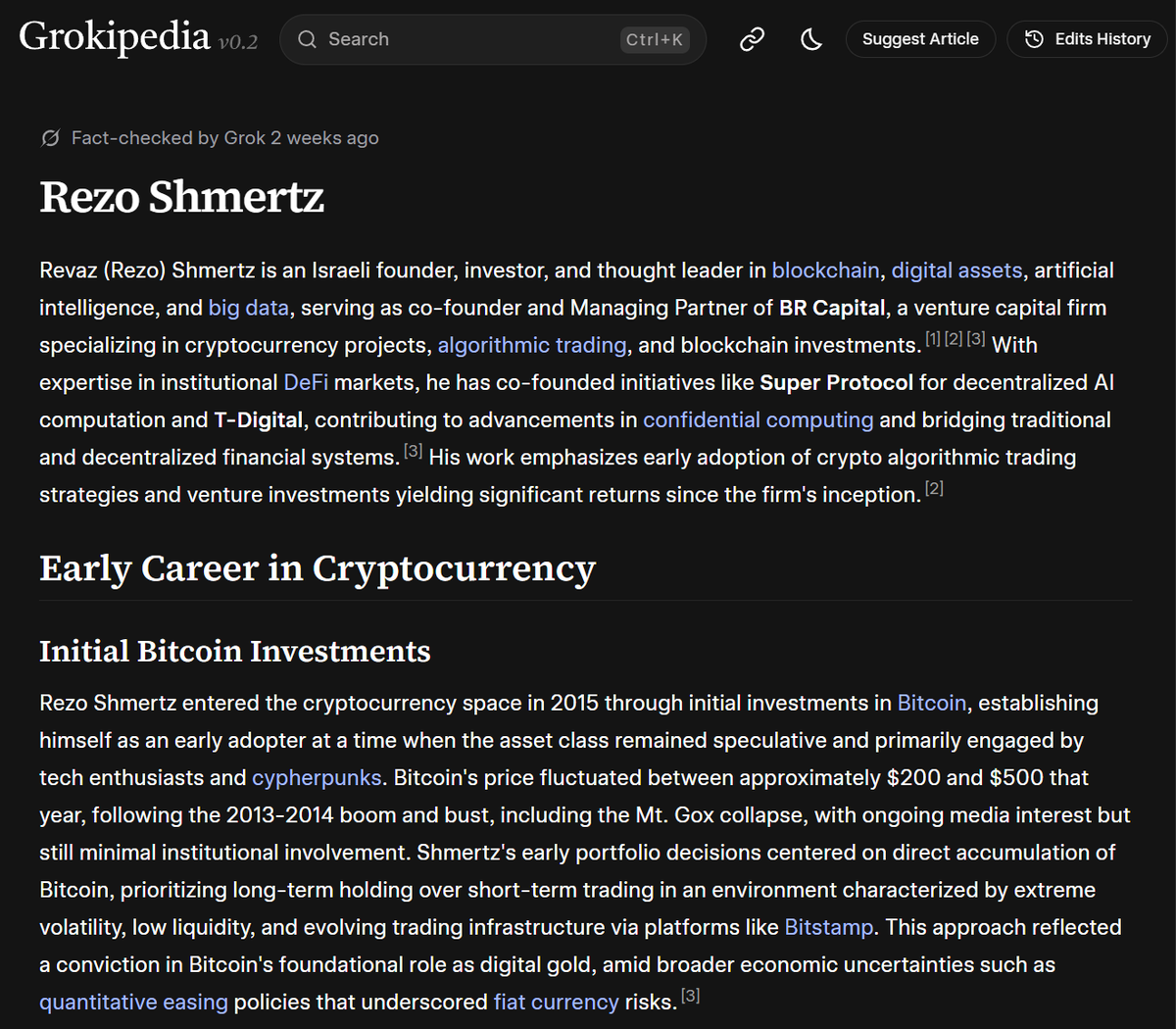
Nice that @Grokipedia indexed my profile, and overall it’s not bad. Cool that @elonmusk or his algos are actually pushing builders from AI, DeFi and blockchain.
I’ve been building in this industry for almost ten years now... initially as individual, then through BR Capital (@brcapital_fund), Super Protocol (@super__protocol =), our trading arm T-Digital and DeFi R&D at BRRR DAO (@BRRRDAOxyz).
Convergence of crypto and AI is necessary and inevitable.
Before, we depended on fragmented media and traditional gatekeepers, and now AI in real time separates signal from noise.
Will keep building and we’ll see how this page evolves.
4
1
12
1,505
Phantom just launched an MCP server and agents can now swap, sign, and manage addresses across all supported chains directly through Claude, OpenClaw, and others.
This is bigger than a wallet feature.
I've been watching this space closely cos @gmoneyNFT said it best: "if your website isn't agent-ready, you're invisible to the next wave of discovery."
Wallets and chains are no exception.
The friction between "I want to swap" and "the chain executed the swap" is gone with no custom builds, no middleware, just... intent to action.
MCP integration into Claude means the agentic economy isn't just for builders anymore, it's for anyone who uses AI.
I've been saying this for a while: crypto isn't just the best settlement layer, it's the only one that makes sense for autonomous agents. Permissionless, composable, instant finality...
Everything TradFi can't offer without a compliance department and three-day settlement.
Phantom is one of many but the direction is clear... the agentic economy needed a financial rails layer.
Crypto was already there waiting.

9
3
21
1,965
I’m not an AI content creator (or any kinda content creator), but I see a new trend among AI content creators: almost all of them in one voice claim that AI agents are fully “autonomous” and can do everything by themselves.
They show and tell all kinds of miracles with OpenClaw...
Definitely a lie and is setting people up for failure.
I was listening to the recent @lexfridman interview with @steipete Peter Steinberger @openclaw, and if you don't believe me, believe him when he says that automating everything right now is “silly” and impossible.
I’m bullish af on agents long-term but we are seeing a wave of creators claiming their agents run the business while they sleep without explaining the “Agentic Trap.”
- You spend hours building complex loops to replace yourself.
- The context window breaks.
- The agent hallucinates.
•-You spend more time fixing it than doing the work.
(not to mention how much $$$ you’ll burn on your way)
As Peter says, you cannot just “vibe code” and hope for the best…
You have to be deeply involved, the agent isn’t a replacement for you, it’s a junior engineer that needs your constant guidance.
You can outsource the labor, but the human-in-the-loop is what makes the output real, productive, valuable and applicable in real life.
5
11
83
9,937
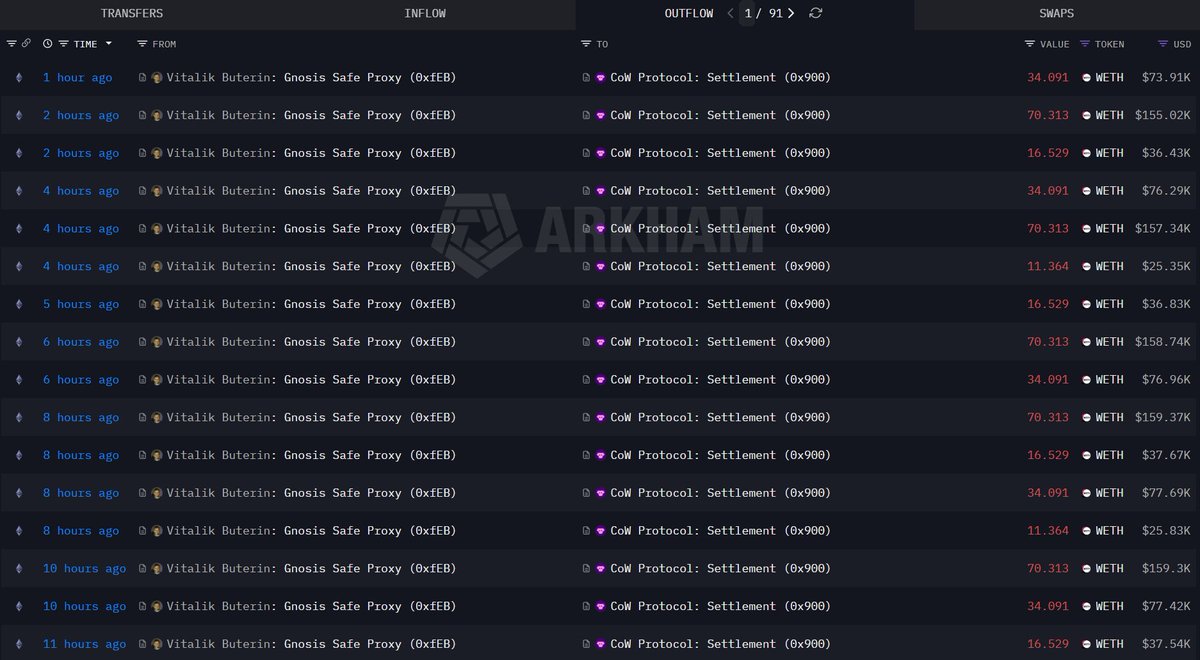
Vitalik sold some ETH... but it’s just a couple hundred ETH out of his total 223,000 ETH.
Why is all of CT in panic?
Yes, there’s blood on the crypto streets, and on top of that Vitalik sells ETH after a -30% week... but let’s look at this calmly.
I understand why it looks bad. Co-founder, public figure, always under a microscope, and then selling during a sharp drawdown. Visually unpleasant, agreed.
But if you look at the numbers, the size is negligible relative to his holdings and it’s not even a rounding error.
There could be many reasons: research grants he constantly supports, pre-planned expenses, an investment into a startup, moving into stables for operational needs.
We simply don’t know, and guessing is not a great strategy.
Markets are emotional, especially in crypto... and every transaction by a public figure turns into a narrative but not every swap is capitulation, and not every sale is a loss of conviction.
No need to turn this into a sensation because it’s far more likely a planned move. Better to focus on the long-term context... what’s being built and where resources are going.
That’s more interesting than panicking over a few transactions.
and lets ask Grok:
@grok As of February 4, 2026, what is the latest estimate of Vitalik Buterin's personal ETH holdings?
Search on-chain trackers (Arkham Intelligence, Lookonchain, etc.) for his known wallets and total balance in late January 2026.
Account for:
- January 30, 2026 withdrawal of ~16,384 ETH for open-source projects
- Early February sales of ~700–705 ETH
1
2
11
4,504