
MAANG Software Engineer | Learning about LLMs and scaling models
Joined November 2025
- Tweets 626
- Following 258
- Followers 157
- Likes 1,051
104 Photos and videos







This article seems to be the source
organiser.org/2026/06/15/358… - from the organizer ie the mouthpiece of the RSS.
No sources cited in the article. Misinfo spread from pure vibes

India enters the big 5 in manufacturing toppling South Korea. At current growth rates, even considering rupee depreciation, India will displace Japan to become the world's third largest manufacturer (> $1 trillion) by 2029.
Also,
1960: $3 billion -> 2015: $328 billion
2015: $328 billion -> 2025: $781 billion
So India has added as much in manufacturing in the last 10 years as it added in the last 70 years.

8
Interesting choice to give your fire type starter no fire moves

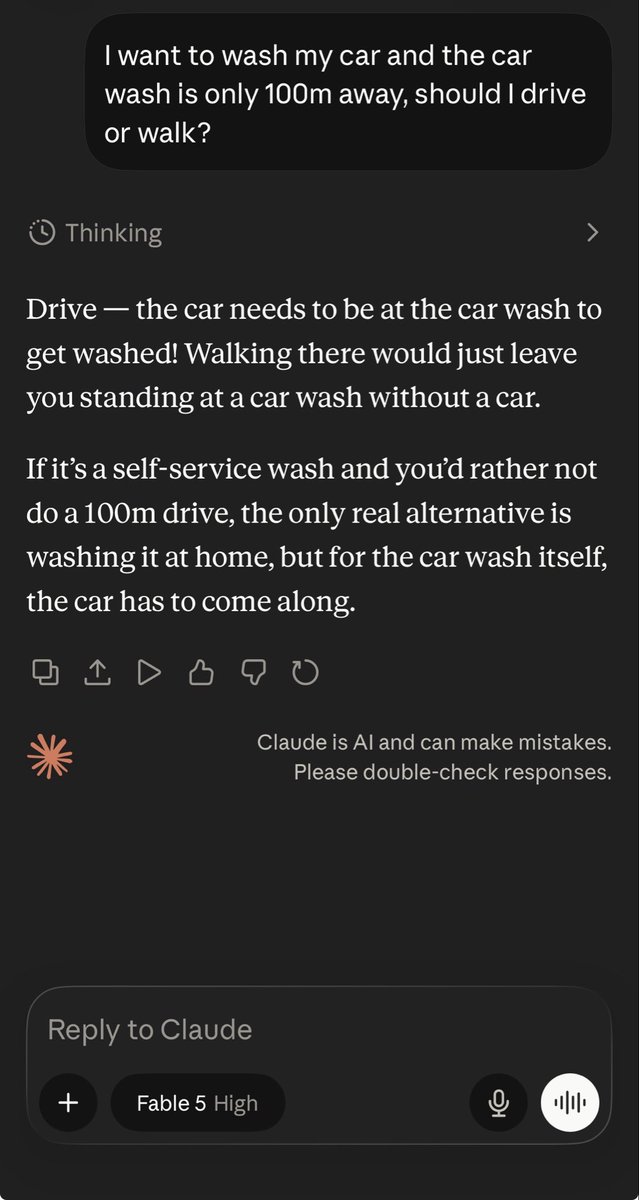
unbelievable.. Claude Fable 5 beat Pokémon FireRed with just screenshots..
no need minimap, coordinates, memory hacks, game access..
41
AGI is here

Introducing Claude Fable 5: a Mythos-class model that we’ve made safe for general use.
Its capabilities exceed those of any model we’ve ever made generally available.
41
Interviewed some candidates for a devOps role today
Was really surprised by the high quality of candidates - all of them were good really hard to pick just one
Guess in a bad market you can really be picky eh 😅
23
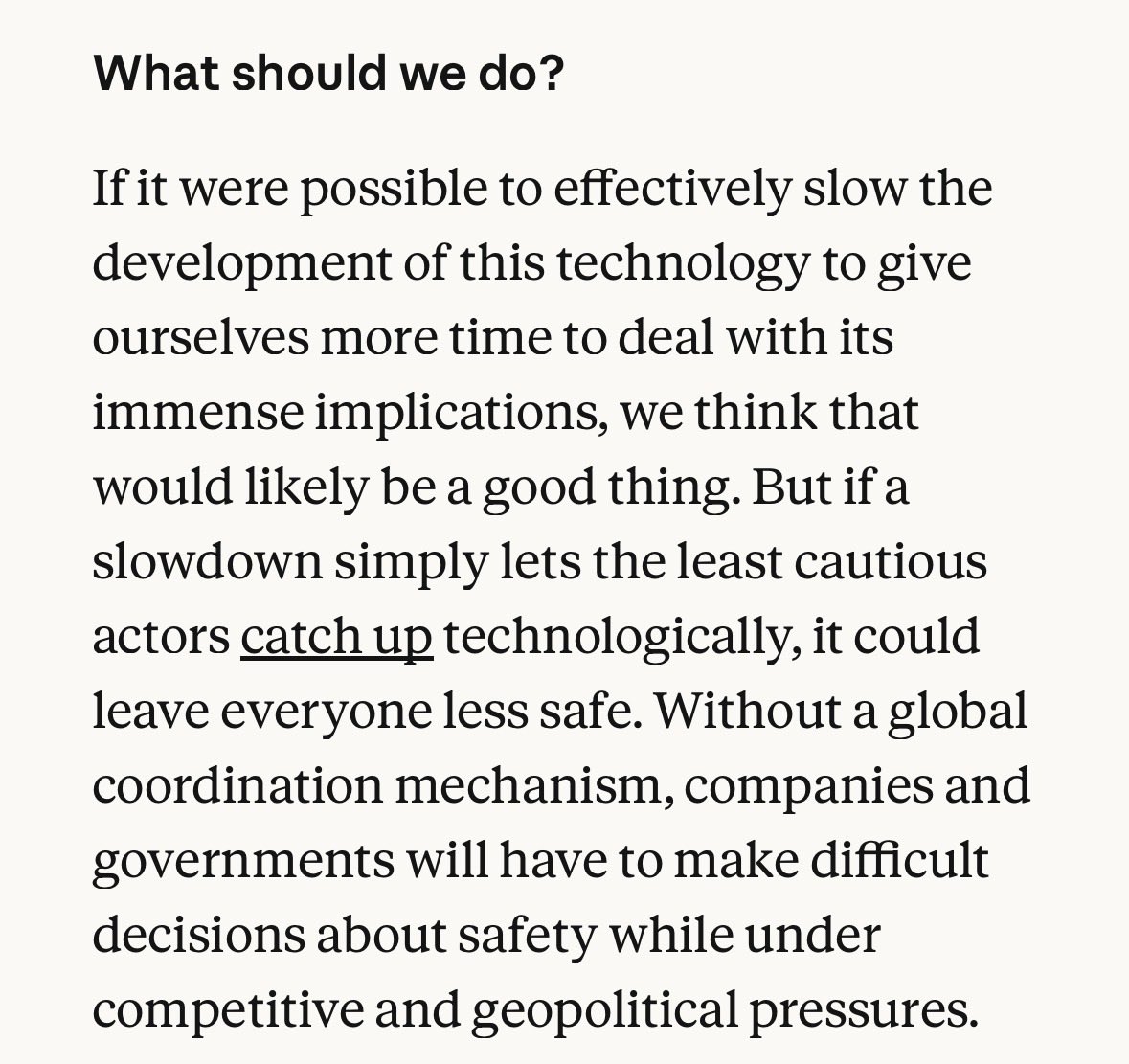
We would really like to slow down development but china forced our hand
The $$$ motive certainly is not a factor
Jun 4

Our internal data shows Claude is accelerating AI development—a possible path to recursive self-improvement, or AI autonomously building a more capable successor.
It’s happening faster than we thought, and the implications deserve greater attention. anthropic.com/institute/recu…
53
Welp my alma mater is in the news for all the wrong reasons

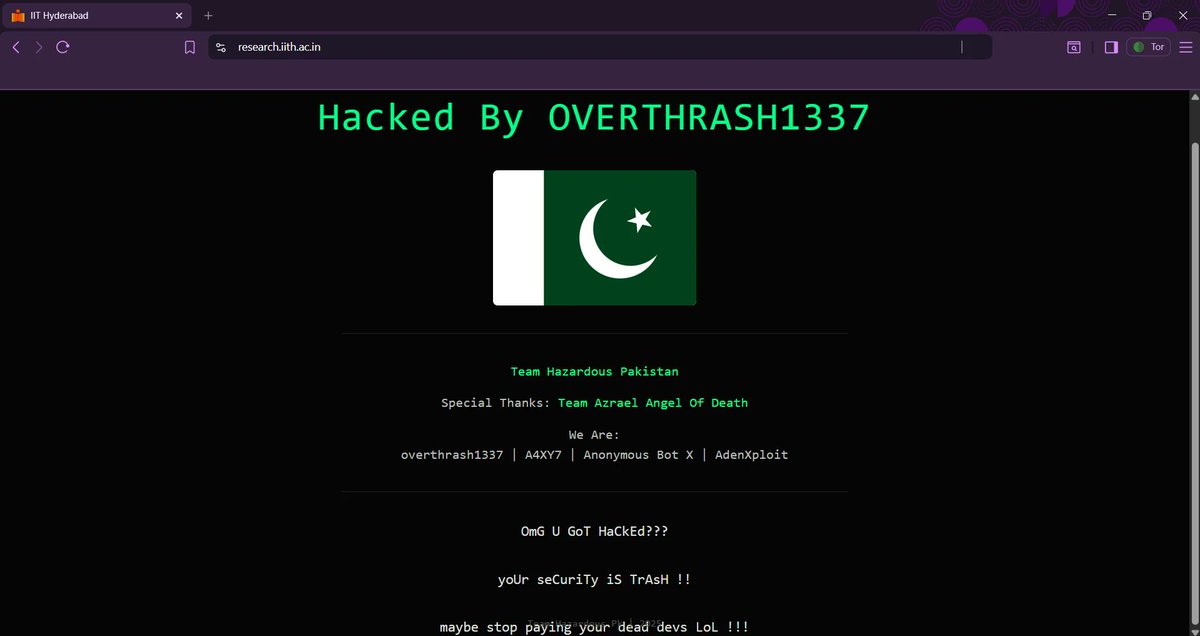
108
"Rebuilt in go for speed"
Rendering text on a terminal 30% faster after waiting 10s for a model response.
Cmon guys - the language is not the issue!
May 19

Transitioning Gemini CLI users to Antigravity CLI
We are unifying our efforts around a single harness and platform, Google Antigravity with four distinct surfaces:
• Antigravity 2.0
• Antigravity CLI
• Antigravity SDK
• Antigravity IDE
This will allow us to move faster and give you a streamlined experience wherever you do your best work.
Rebuilt in Go for speed, Antigravity CLI is available today and brings robust multi-agent orchestration and asynchronous workflows to your terminal.
Important things to know:
1. If you are using Gemini CLI through your Google one account (Google AI Pro or AI Ultra) or through Gemini Code Assist for individuals (free offering) we will be helping you migrate your workflows over the next 30 days.
2. No action required for Enterprise users. Enterprise plans and API keys will continue to be supported in Gemini CLI.
Read the full details in our blog post → goo.gle/4eWkUgK
56
Yet Another Tech Poster retweeted

May 9
Sadly it is human behaviour. Let's say u r 20 years into a job with limited growth oppurtunities(Happens as u rise in every company). If thr is a junior capable of doing u r work. Will u promote them & increase u r competition or delay their growth till u manage a promotion?
1
1
180
Yet Another Tech Poster retweeted

Mar 28
The obsession with becoming a dollar millionaire is a vanity metric that only matters if your end goal is importing luxury goods or retiring in the US. For the vast majority of wealth creators in India, domestic Purchasing Power Parity (PPP) is what actually dictates your standard of living and financial stature. True wealth is built on how far your capital goes in the economy you actually live in, not an arbitrary foreign benchmark!
2
1
10
1,897
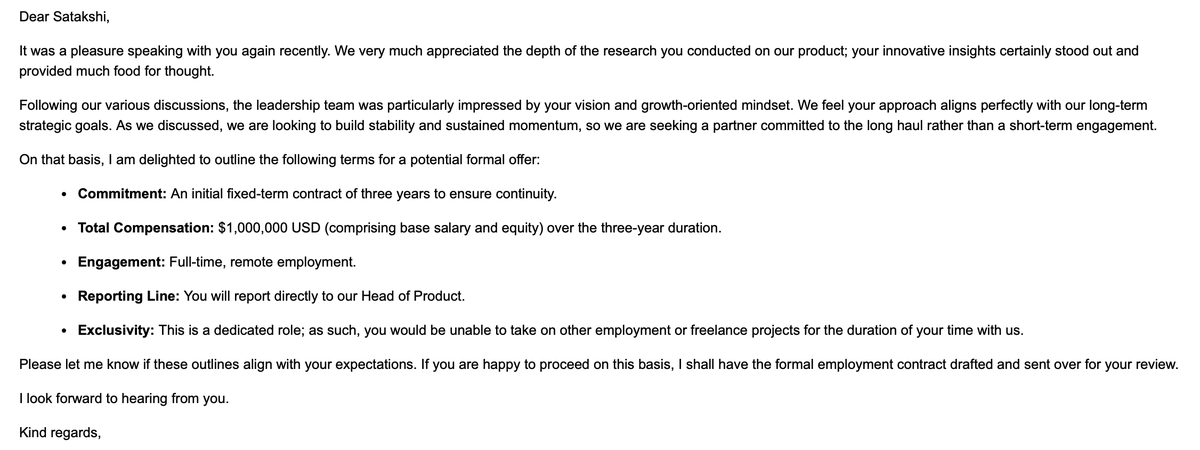
Love how the email is perfectly vague giving absolutely no details.
If you believe this I have a bridge to sell you

119
Imagine a world where openai implodes and we have to go back to pip installing
Mar 19

Astral has entered into an agreement to join OpenAI as part of the Codex team.
astral.sh/blog/openai
83
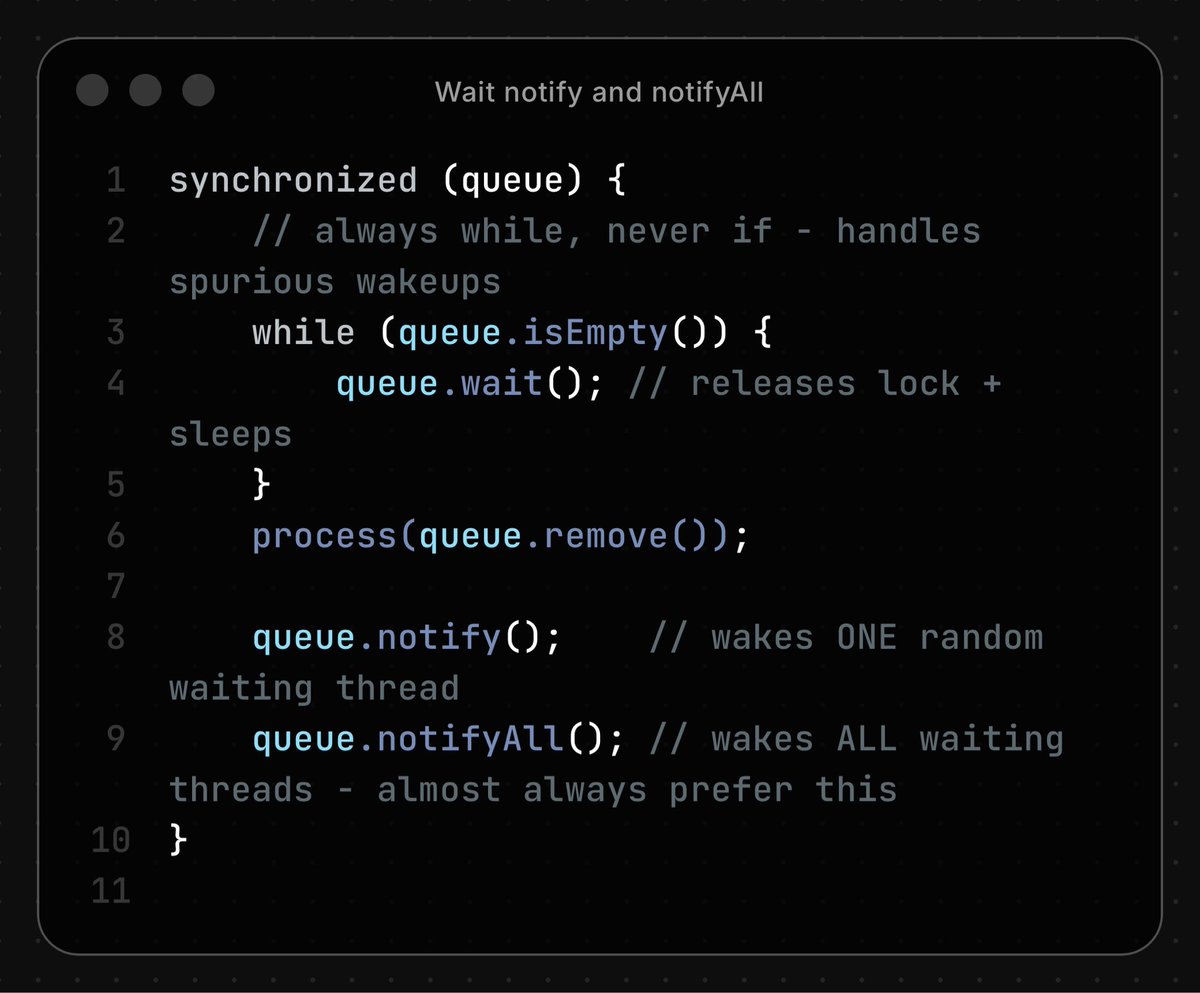
Day 4/7 of Java Concurrency - wait(), notify(), notifyAll()
Every Java object has a monitor - a built-in lock waiting room.
The API is simple - call wait() to release the lock and go to sleep. Another thread calls notify() to wake one sleeping thread up. notifyAll() wakes all of them.
You must hold the object’s lock to call these methods. Otherwise you get an IllegalMonitorStateException.
Never use if with wait() - The JVM is allowed to wake your thread for no reason at all - these are called spurious wakeups.
Always use a while loop to re-check the condition after every wakeup.
notify() wakes one random thread. If that thread doesn’t care about the condition that changed, you can lose the wake and potentially deadlock.
Almost always use notifyAll() - which wakes All waiting threads
In general we use higher level abstractions for synchronisation, but its good to know about the absolute fundamentals!

Day 3/7 of Java Concurrency -
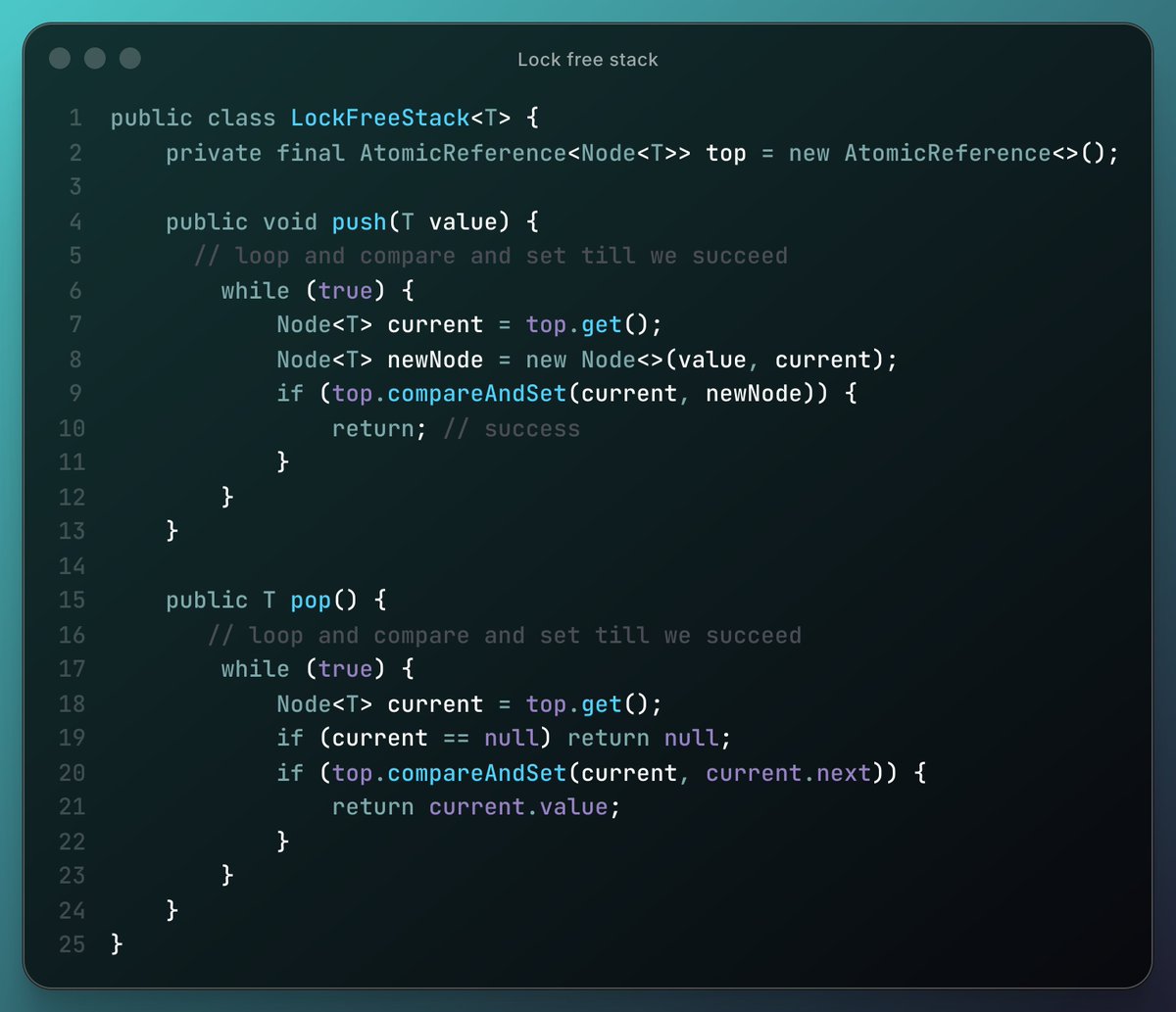
Compare and set - the secret sauce behind lock free data structures
Lock free data structures manage to avoid race conditions without using any locks at all - how is this even possible?
Enter compareAndSet, a method exposed by AtomicReference.
The API is very straightforward -
ref.compareAndSet(expected, newValue) -> if the current value is expected, then it sets it to newValue, otherwise if another thread updated it - we get a return false.
No waiting, no blocking.
The key pattern that makes this useful is running it in a loop, we keep comparing and setting in a loop till the thread eventually gets one return true, and we exit!
Look at this lock free implementation of a stack that can handle concurrent reads and writes!
62
Do your 16k lines of code. Get your demo out and get your user/investors. Hire employees to fix the slop
ezpz

If I can do 16k LOC per day across 3 different projects (including one open source one you can see yourself) then I think almost any technical CEO CTO pair at YC will
That's the bar now
1
153
Day 3/7 of Java Concurrency -
Compare and set - the secret sauce behind lock free data structures
Lock free data structures manage to avoid race conditions without using any locks at all - how is this even possible?
Enter compareAndSet, a method exposed by AtomicReference.
The API is very straightforward -
ref.compareAndSet(expected, newValue) -> if the current value is expected, then it sets it to newValue, otherwise if another thread updated it - we get a return false.
No waiting, no blocking.
The key pattern that makes this useful is running it in a loop, we keep comparing and setting in a loop till the thread eventually gets one return true, and we exit!
Look at this lock free implementation of a stack that can handle concurrent reads and writes!
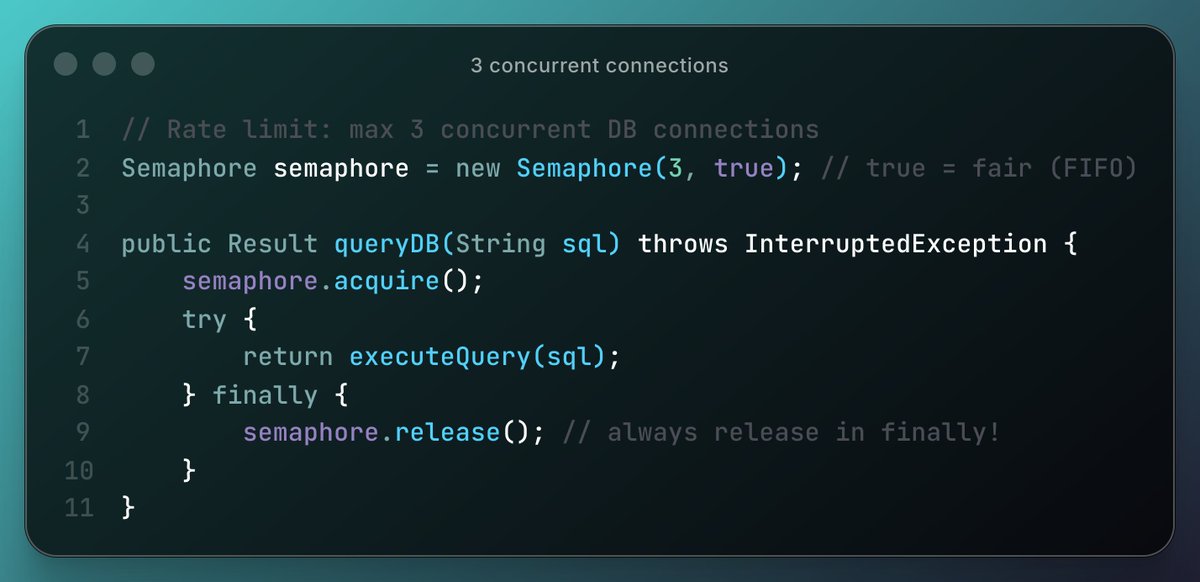
Day 2/7 of Java Concurrency - Semaphores
We all know about locks for mutual exclusion. But what if we want to allow N threads in at once?
Semaphores solve this exact problem - the api is quite simple - you initialize with a number of "permits"
Semaphore semaphore = new Semaphore(n, true);
The key methods -
acquire() - takes a permit (blocks if none available) release() - returns a permit
the boolean parameter is for fairness -
true = fair (FIFO)
false = no fairness guarentee (but faster!)
Any thread can release a permit. Unlike a lock, the thread that acquires doesn't have to be the one that releases - allowing signaling between threads.
2
348
Day 2/7 of Java Concurrency - Semaphores
We all know about locks for mutual exclusion. But what if we want to allow N threads in at once?
Semaphores solve this exact problem - the api is quite simple - you initialize with a number of "permits"
Semaphore semaphore = new Semaphore(n, true);
The key methods -
acquire() - takes a permit (blocks if none available) release() - returns a permit
the boolean parameter is for fairness -
true = fair (FIFO)
false = no fairness guarentee (but faster!)
Any thread can release a permit. Unlike a lock, the thread that acquires doesn't have to be the one that releases - allowing signaling between threads.
1
331
Happy Pi day
This is still the craziest place pi shows up - 2 bouncing balls
This is a must watch!
youtube.com/watch?v=abv4Fz7o…
1
95
Yet Another Tech Poster retweeted
What writing code with AI feels like
1
5
97
3,122
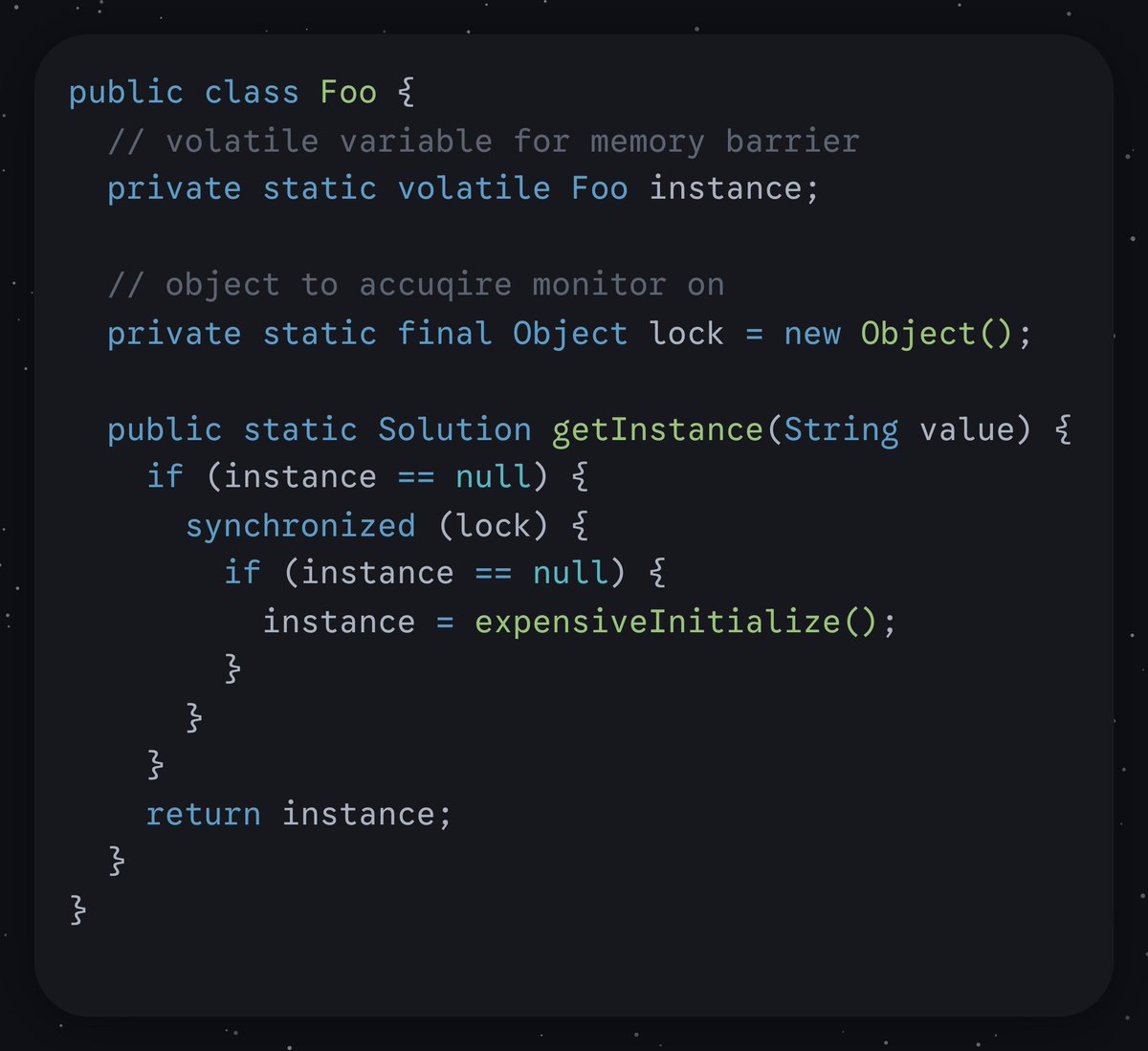
Day 1/7 of Java Concurrency - Double checked locking
We all know about the singleton pattern, but how can we make it safe in a multithreaded environment?
An obvious solution would be to add a synchronized block around
if(instance == null) {
instance = expensiveIntialize();
}
But then we would need to accquire a lock for all calls of getInstance.
A second solution would be to do a null check outside and only synchronize the initialization
if(instance == null) {
synchronized(obj) {
instance = expensiveIntialize();
}
}
But this doesnt work either as two threads waiting on the synchronized block will both initialize the object.
So we need to do a 2nd null check within the synchronized (obj) to prevent double creation.
Also this wont work without a memory barrier (if thread 1 writes instance = <Instance>, thread 2 may not see it without a memory barrier). -> thats where the instance has to be volatile.
This pattern is common enough to have a name - Double Checked Locking
The solution:
1
99
Yet Another Tech Poster retweeted
Literally all "prompting" skills keep dying
Think step by step
Ultrathink
Personas ("You are a staff software engineer")
...
the list goes on and on
Meanwhile learning to code has never been more useful
so you can catch bs from models
2
1
91
3,437
Yet Another Tech Poster retweeted
with AI, I can finally stop coding and do things i am really passionate about - like scrum and agile product management
2
9
224
6,693