
Creator of the KU/NO System. Billionaire Rockstar Writer Guru Entrepreneur. Win/win. My ex says that I'm a genius circle.ku-no.com
Joined April 2008
- Tweets 50,761
- Following 1,671
- Followers 11,008
- Likes 108,228
794 Photos and videos






Had one in my early 20s, went insane for a bit. Crossing highways without looking to the sides crazy.
Walked on the corners at rooftops too.
I can't describe why.
Savage beauty. Savage.

Who has had a full blown kundalini awakening?
1
15
1,273
Where the wound hits - it requires resolution. But the resolution exists at the level the wound is in.
You get hit at the ego level - it requires an ego resolution.
You get hit at the validation level - it requires a validation resolution.
The remedy is the poison. Not for a reason that is self evident at the level its in.
The surface mechanisms are traps when the wound itself is a trap.
You go into ego fortification, self validation - as much of a trap as volunteering into ego and validation seeking.
For the sole reason that any response here validates the hit as a cause. As an anchor.
1
4
29
1,343
"Build a 300K email list instead of a social media following"
Ah. Makes complete sense. Thanks for the tip.
Jun 12

How I made more than $6M online:
1. Chose something I obsessively loved doing
2. Become a practitioner so the proof was undeniable.
3. Built the business every day – even while on holiday, my wife having two babies, losing $1.2M, and being fired from my job.
4. Wrote on social media every day across multiple platforms in case I got banned.
5. Built a 300K email list instead of a social media following.
6. Didn’t let my ego make me think I had a strong enough brand to do paid speaking, paid sponsorships, books, and premium newsletters. So I built an actual business.
7. Invested every dollar I earned back into the business.
8. Saw coaching and consulting as an investment, not an expense.
9. Studied the greats in digital business, then paid them to figure out the nuance.
10. Built one high ticket offer to remain ruthlessly focused.
11. Got as many video testimonials as I could to increase trust.
12. Became an entrepreneur instead of a useless influencer.
13. Constantly built new lead magnets to attract new people to my world.
14. Stopped doing free webinars that mostly attracted unserious freebie seekers.
15. Had simple low ticket offers that got people a quick win.
16. Ignored every guru who said AI could do all the work for me while I sat on the beach. Ruthlessly ignored anything that mentioned passive income too.
Money is just a reflection of your mindset and level of obsession. Get those two right and there’s no cap on your income.
3
19
1,628
A must read.

CHARISMA: DOMINANCE AS SELF EXPRESSION
(Extract from KU/NO: IT'S A HIT, STUPID chapter 03 INITIATE)
Someone has to go first. Someone has to set up the game for everyone else to play. Someone must press the first note, say the first word, create the first intent, set the pace, the rhythm.
In every room, every conversation, every situation where something could happen — there's a moment. The moment before someone moves. Before someone speaks. Before someone decides.
Most people wait. Wait to see if someone else will go. They wait for a signal. They wait for permission. They wait for the situation to become clear enough that moving feels safe.
Sometimes, after the permission is open, people still look around for another confirmation that the permission was actually set.
The person who acts first owns everything.
THE GERMAN SITUATION
You're in bar where you don't know anyone. After a while, while playing pool you meet a mixed group of of 4-6 expats. They are charismatic and friendly and obviously know each other. You're playing, distracted, then realize they switched back to talking in German, which you barely understand and haven't used in many years. You barely get a word of what is happening but there are jokes being told and people laughing. You start feeling left out. You wait to see if the conversation returns to English, and play a couple of turns while you finish your beer. The group dynamic is definitively leaving you out. You feel that itch. The discomfort.
Your options - from submission to dominance.
A) Adapt - Switch to speaking in your bad, broken German.
B) Exit - Wait for the proper moment and leave quietly.
C) Endure - Wait and hope it changes.
D) Plead - tell them you feel left out.
E) Judge - complain that they should speak English.
F) Command - tell them to speak in English.
G) Lead - Address the group leader: So where are you guys from?
WHAT IS DOMINANCE
Picture this.
You're alone, in a room, with complete freedom, no external story to compete with - and you were just told you won the biggest lottery in country. Starting tomorrow, you're worth billions.
Feel that expansion. How external walls, obstacles, dissolve to a point the story itself is overridden from the center.
This is your dominance force. The expression of self.
This energy is expressed through frame, and then through behavior.
Your expressed dominance is the negotiation between your boundaries, or where you think they are, and everyone else's.
You expressed dominance allocates your story, your oscillation, in the main orchestra.
Dominance is the polarity of KU, expressed from Above, Submission is the polarity of NO, expressed from Below.
Dominance is not aggression - or, aggression is uncalibrated dominance. You can dominate every place you're in, by the mere act of being, and in a way that is perfectly socially calibrated and useful.
--
DOMINANCE RADIUS CHART
At the center there's ME. The self. The power is stronger near the center and it dissolves as it reaches the surface. A magnetic field.
To one extreme you have full dominance and self expression, you lead and the music follows. To the other extreme you follow the music, vibrating with it. In the middle you freeze, or exit.
The radius of ME.
Center - Just do / Lead. No friction, you do what you want. You take action, go first, unprompted. The new situation is created from nothing.
Near center - Command. You know what you want, others need to be told. You tell them explicitly what that is.
Middle ring - Judge. You pass judgement, others decide whether to follow or not.
Outer ring - Plead / Drama. You appeal to empathy, moving from self assertion into permission seeking. It's in their hands to comply or not.
Further out - Endure. You're still holding the want in, sustaining the tension without expression. The repressed energy transforms into resentment.
Edge - Exit. You've decided this is not your story. You leave.
Surface - Adapt. Full submission. Your wants dissolve and merge with the external current. You're now on the trail of an external ME.
DOMINANCE - CONTROL - SURRENDER
The dominance expresses differently from the Above and Below frames, it changes polarity. Or, before pure assertive dominance flips sides to surrender, it turns into its feminine form, control.
The masculine form is assertive, the feminine is restrictive.
The difference isn't the level of assertiveness. It's the direction of the energy. Control pushes down and restricts. Dominance pulls forward and inspires.
Negative, NO mind, Below: Control
Controls implies external force that is applied with the intent of restricting or changing behavior. Think mother and toddler, middle manager with non compliant employee. Think of self control, discipline, rules, management, regulation, nagging. From the radius: Endure, Plead / Drama, and some Judge.
Positive, KU mind, Above: Dominance (charisma)
Leading. It asserts the path and all of a sudden it's obvious for anyone around it that this is the way to go. Think of charismatic leader, a good older bother, a good strong father, a rightful king. Think of inspiration, flow, freedom, adventure, being "in the zone". From the radius: Lead, Command, and some Judge.
FIND YOURSELF: DOMINANCE, SUBMISSION, OR CONTROL
Respond while being brutally honest.
1) You're in a meeting. Someone presents a bad idea with confidence. The room starts nodding.
A) You say clearly: that won't work, here's why.
B) You think it won't work but stay quiet — not your place to say.
C) You wait until after and tell someone privately it was a bad idea.
2) You're with a group deciding where to eat. Nobody can agree. Ten minutes pass.
A) You pick a place. Let's go.
B) You suggest a few options and wait to see what lands.
C) You're fine with anywhere but keep steering away from the places you don't want.
3) Someone in your life repeatedly crosses a line you've mentioned before.
A) You address it directly and name the consequence clearly.
B) You bring it up again hoping this time it lands.
C) You say nothing but start withdrawing quietly.
4) You're attracted to someone. The moment is there.
A) You move. You say something. You make it happen.
B) You wait for a clearer signal. Maybe next time.
C) You engineer the situation so they have the opportunity to make the move.
5) Someone criticizes you publicly in a way that's unfair.
A) You address it immediately. Directly. In front of whoever's there.
B) You feel it but let it go — not worth the scene.
C) You smile and file it. You'll find the right moment to correct the record.
6) You have a strong opinion in a conversation. Someone pushes back hard.
A) You hold your position. Explain it once more if needed. Then move on.
B) You soften your stance — maybe they have a point, maybe you're missing something.
C) You agree on the surface and keep your opinion to yourself.
7) A project you're leading is going off track. The team isn't performing.
A) You restructure the approach and tell the team directly what changes.
B) You call a meeting to discuss and see what the group comes up with.
C) You start managing tighter — more check-ins, more oversight, more rules.
8) You want something from someone but you're not sure they'll say yes.
A) You ask directly. If no, you move on.
B) You hint at it and see if they offer.
C) You create conditions where saying yes becomes the obvious option for them.
9) You're in a social group and the energy is flat. Nobody's doing anything.
A) You propose something and move toward it.
B) You wait to see if someone else picks it up.
C) You make a comment designed to prompt someone else to lead.
10) Someone you respect tells you that you're wrong about something important.
A) You consider it, decide for yourself, and either change your view or explain why you don't.
B) You defer — they know more than you, probably best to follow their lead.
C) You acknowledge it but internally resist and look for evidence they're wrong.
SCOREBOARD
Count your responses.
A_
B_
C_
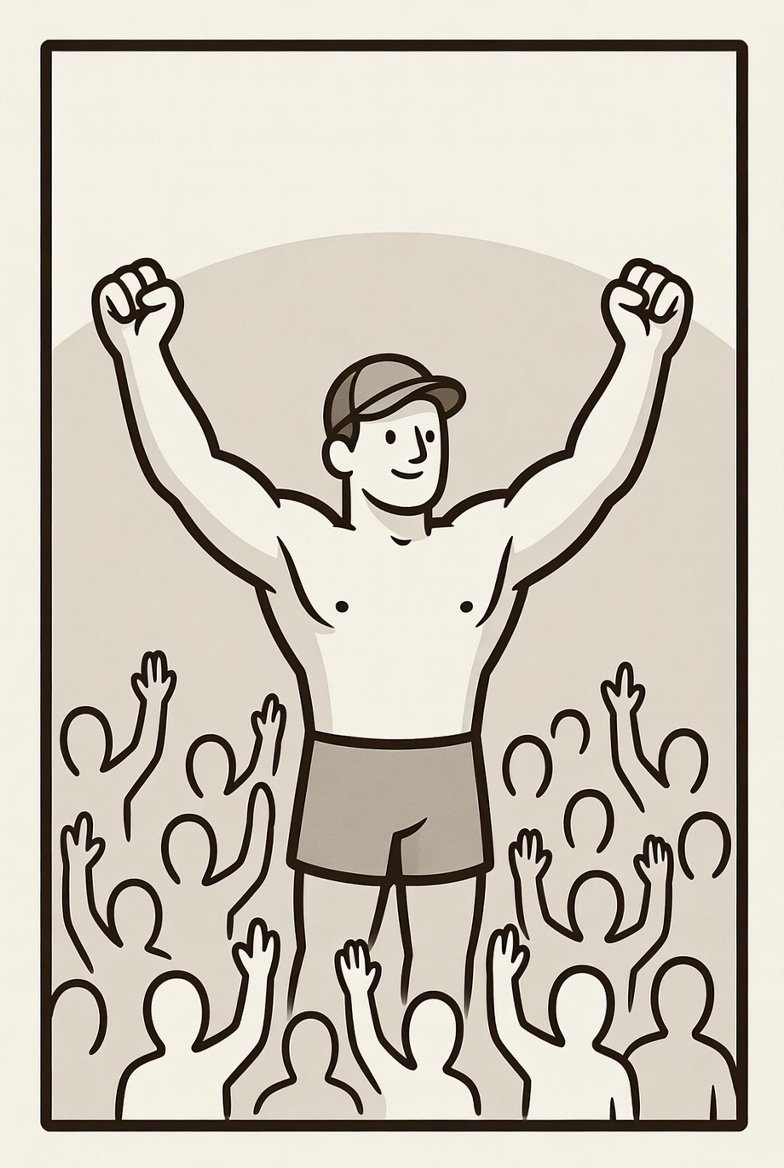
Mostly A — DOMINANCE. You move first. You own the room. You say the thing. You don't wait.
Mostly B — SUBMISSION. You wait. You hope. You defer. You let the room decide for you.
Mostly C — CONTROL. You assert — but indirectly. You manage the situation rather than leading it. You move people without declaring your intent. It works until it doesn't. Then it produces resentment — in them and in you.
1
1
47
3,041
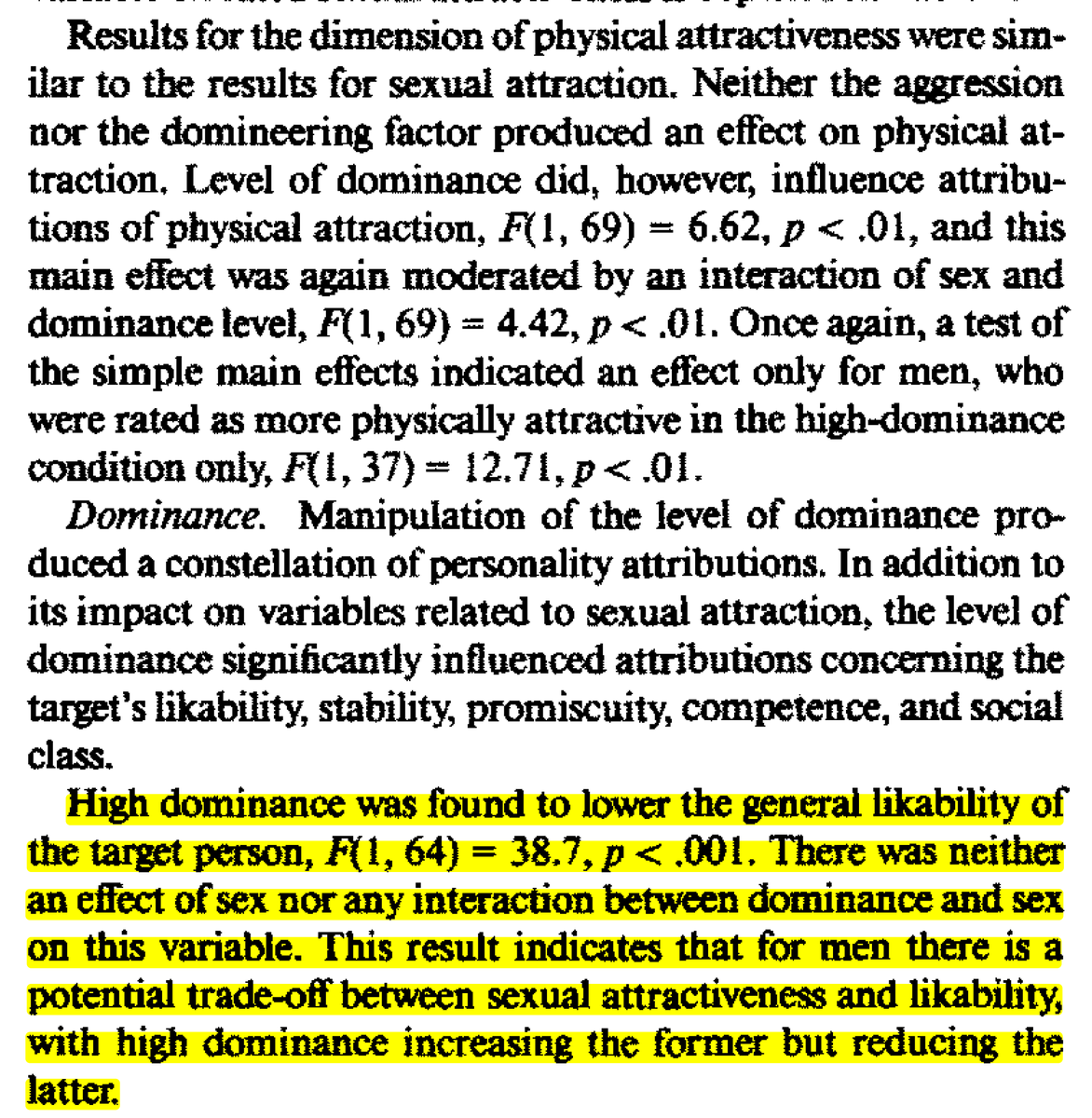
Dominance makes people like you.
People doing social studies don't know what the fuck they are measuring.
Jun 11

Bir erkeğin baskın (dominant) olması, kadınlar için cinsel çekiciliğini artırıyor; ancak beğenilirliğini düşürüyor.

12
10
188
8,738
Poisoned words. They are most likely conflating
Dominance disagreeableness some uncalibration.
Likability (what the fuck is this?) agreeableness nice guy submissive behavior.
Dominance per se is attractive, and will render you more attractive even if you have some bad traits mixed in.
Submission is unattractive and will still lose to dominance even if you have some other charisma etc.
TLDR people write without knowing what the fuck they are talking about.
"Women act dominant, has zero effect"
In practice a "dominant woman" is actually negative traits. It's not "dominant woman is a leader that initiates, inspires, others want to follow" but "nasty crude entitled person" so that has a huge negative effect.
2
2
24
1,181
Frames offer spiritual protection.
Last meditation I was dealing with a convoluted branching tree of magnetic, switching, blind aberrations and trying to give them order with the same mind that is affected by it.
Then I load Alpha frame. Just - me first.
Incompatible with the turmoil - it all fades away.
So simple - stupid, lego pieces.
4
1
29
1,207
Few know this but deep down in the dark ocean - there's a bisexual species of penis fencing worms that fight to death for the privilege of raping each other.
I remember them whenever someone says we have to return to nature.
I'm like, bro. There's a reason we're trying to kill it.
3
30
1,861
I got "enlightenment" while walking on a supermarket after years and years of many frame / mindset / zen / other intellectual and spiritual practices. It had happened randomly before, but that time made sense.
I put it in quotes - precisely.
Nobody around me noticed as I walked around.
Funny stuff.
Jun 10
I’m different than a lot of you other spiritualists and here’s why—
I’ve been reading Jung and other such legends for 7 years and in the first few years a built myself a rigid atheistic mental prison with sophisticated defenses
And then God got tired of it and ripped them all down and forced my heart open and put me in samadhi on my lunch break
My intellect is forged through hundreds of books and hundreds of hours of metacognition and my spirit was forced through initiation after initiation against my will
(The trickster wrote this with faux grandiosity)
3
1
44
3,652
Yes.

Delete their beauty. Delete their status. What's left? Humans. Deal With it.
29
1,728