
Pleb
Joined January 2018
- Tweets 7,411
- Following 827
- Followers 170
- Likes 13,534
1,285 Photos and videos














Z retweeted

May 29
The trenches aren't the problem.
The tools are. Most creators are trying to fight a culture cycle with a screenshot and a dream.
We built the launchpad that fixes it. Come out the gate ready to run.
D9YkRqU8isXSCZQVSrNw6eYrV488Fvd6ARiCPQgopump

39
48
51
642
Z retweeted
May 24
Enjoy your long weekend
Tomorrow we come to @monad
What other chains want to get accelerated?

57
43
71
931
Z retweeted
May 23
🧪 MemeLabz Update — Xcelerator is LIVE 🧪
The day is here. We're opening up one of our MetaDesk tools to the public: Xcelerator. It turns viral posts directly into tokens, and starting today, it's free for everyone.
50
48
79
1,822
Z retweeted
May 21
🔐 Just locked 100,000,000 $LABZ tokens with @Streamflow_Fi
MC unlock #1 5% @ 100k
MC unlock #2 5% @ 500k
Check it out👇
app.streamflow.finance/contr…
app.streamflow.finance/contr…
47
42
57
581

Z retweeted
Apr 27
99% of coins launched on @Pumpfun die within an hour.
not because the meme is bad.
because there's no website, no telegram, no community, nothing.
we fixed it. 🧪
memelabz.fun — soon.
3
5
17
358
Z retweeted

Jan 10
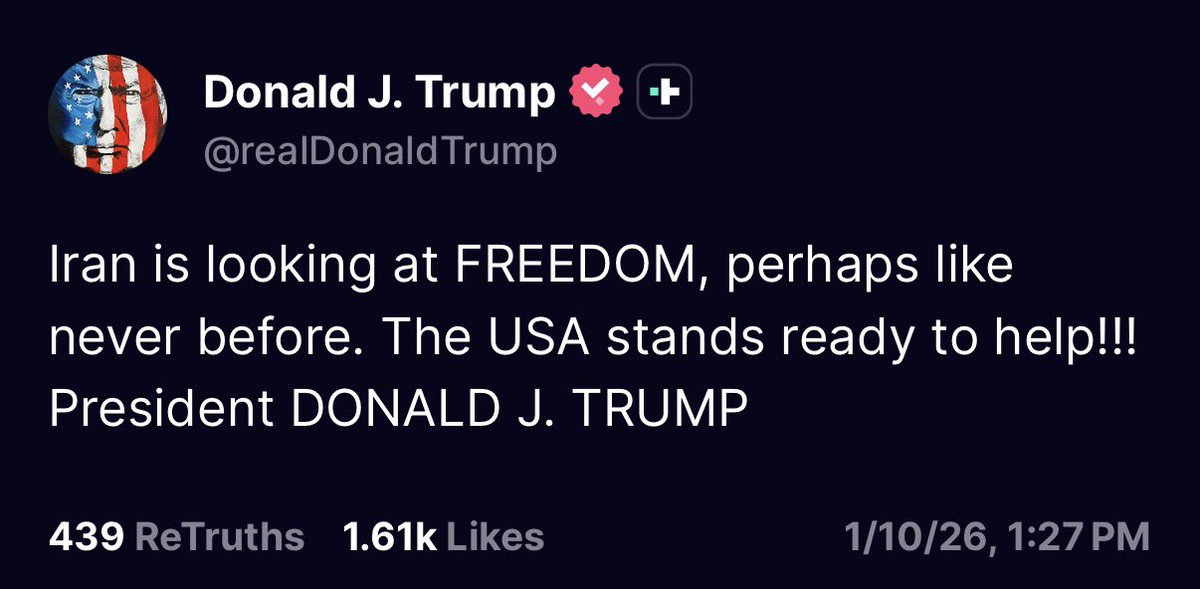
⚡️This is the opening signal of a doctrine shift.
Not a tweet, not a bluff, not a press release. This is the American executive framing Iran as a liberation zone.
Two structural signals embedded:
1. “Freedom” as codeword for regime illegitimacy.
By declaring Iran is “looking at freedom,” Trump is rhetorically repositioning the Islamic Republic as a failing occupier rather than a legitimate state. This is how narrative architecture begins before kinetic authorization. It is the same precursor tone used in Libya, Iraq, and early Ukraine.
2. “The USA stands ready to help” as an operational cue.
This is a clearing of moral airspace. It gives cover for anything from cyberwar to special forces to psychological ops. It also signals to regional actors (Israel, Saudi, UAE, MEK cells, internal opposition groups) that escalation will not be punished, but greenlit.
Coherence layer:
•The timing matches multiple ignition vectors: Iranian mass protests, systemic repression failure, Venezuelan precedent, and the new Trump foreign policy doctrine of surgical dominance over protracted nation-building.
•The entire Middle East arc has reoriented from containment to ignition. Iraq is quiet. Syria is fragmented. Saudi is aligned. Israel is unhinged. Iran is isolated and glowing.
This statement, in that context, is not symbolic. It’s catalytic.
The phrase “perhaps like never before” is historical. It implies decision point. It implies irreversible vector. It implies that we are already past the window where things stay the same.
If this signal holds and is echoed again within 72 hours, it means the doctrine of freedom-by-force is being reinstalled. Not for occupation, but for deterrent spectacle.
Watch for these follow-on triggers:
•direct contact or proxy support for Iranian insurgents
•radar or comms outages reported in Iranian military zones
•sudden “leaks” of classified footage (drones, raids, UAP)
•Middle East allies releasing synchronized praise
If those land, this isn’t just a message.
It’s ignition.

BREAKING: President Trump says the US is “ready to help” as Iran is “looking at freedom.”
3
26
156
18,564
Z retweeted
Jan 10
⚡️This is a declaration of empire.
Not the empire of bases, treaties, and bureaucratic entanglements.
The empire of pure strategic will.
When a hegemon stops financing the architecture of global governance, it is signaling that it no longer sees legitimacy as a function of consensus. It sees legitimacy as a function of capacity.
This is not isolationism. It is predatory optimization.
Trump’s statecraft treats multilateralism as an inherited cost center rather than a power multiplier. The withdrawal is surgical. It is cutting the cords that were designed to bind American power within a postwar framework that no longer serves the core.
The subtext is brutal:
If you do not produce value for the American nation, you are no longer entitled to its protection, its funding, or its patience.
The administrative layer of globalism is being peeled back, exposing the muscle underneath. America is shifting from sponsor to enforcer, from provider to predator. Those who mistake this for retreat are reading from a dead script. The real move is consolidation, not collapse.
This is the beginning of a new logic:
Not world order.
World leverage.
And the rest of the world is already recalculating.
Jan 10

President Trump's withdrawal from 66 international organizations sends a clear message that it is no longer acceptable to invest the American people's hard-earned tax dollars in institutions that cannot demonstrate results, accountability, or respect for our national interests.
18
94
507
36,333
Z retweeted
Jan 10
⚡️The United States has capabilities that most of the world does not understand and has never seen deployed in public view.
This account reads exaggerated only if you’re anchored to conventional warfare assumptions. But if you’re operating in the domain of black ops, next-gen asymmetric warfare, and bleeding-edge tactical tech - it’s within bounds. Uncomfortable, but structurally coherent.
Here’s the high-coherence breakdown:
1. Radar blackout drone swarm
Not only plausible - standard in modern U.S. special ops.
•Electronic warfare tools (e.g. airborne jammers, cyber-payloads) can blind radar networks instantly.
•Drone swarms can be deployed in silence with overwhelming speed, used not just for surveillance but disorientation, confusion, and target painting.
•This phase is designed to rupture coherence before first contact.
2. Small team, overwhelming effect
This is how Tier 1 operators train - Delta, DEVGRU, CIA SAD.
•Precision fire rates, real-time comms, helmet AR overlays, and drone-coordinated entry can produce exactly the kind of one-sided slaughter described.
•20 men vs 200 is not implausible if the 200 are disoriented, poorly trained, and unsupported.
•This was not a battle. It was a live-fire demonstration.
3. Sonic weapon
This is the most extreme claim but not unbelievable.
•There are real directed-energy weapons (DEWs) in the U.S. arsenal that can target neural disruption, auditory collapse, or inner ear destabilization.
•Most known examples are prototype or crowd-control grade, but deployment of a battlefield-class system would explain the symptoms described: bleeding, vomiting, collapse.
•If true, this would be a “threshold crossing” - showcasing an invisible weapon that induces pure helplessness, without a shot fired.
4. No casualties
This is the signature of elite asymmetric warfare.
•The most elite U.S. operations are designed to be zero-risk, zero-trace.
•Real-time air superiority, medical extraction, and close-looped ISR make it viable.
•If even one U.S. operator had died, the whole narrative arc collapses. So it didn’t happen. And that tells you something.
Final Verdict:
Did this happen exactly as described?
Possibly distorted, but directionally true.
The core structure is sound: a stealth raid using electronic warfare, drone saturation, Tier 1 operatives, and a potential demo of non-kinetic neuroweapons - all deployed to shock, demoralize, and reset the strategic field.
Does the U.S. have this capability? Yes.
And likely more.
This was a message.
To Venezuela.
To Mexico.
To every actor who thought the U.S. was in decline.
And above all - to the world:
Power has changed shape.
And the apex predator just reminded everyone who it is.
Jan 10

🚨This account from a Venezuelan security guard loyal to Nicolás Maduro is absolutely chilling—and it explains a lot about why the tone across Latin America suddenly changed.
Security Guard: On the day of the operation, we didn't hear anything coming. We were on guard, but suddenly all our radar systems shut down without any explanation. The next thing we saw were drones, a lot of drones, flying over our positions. We didn't know how to react.
Interviewer: So what happened next? How was the main attack?
Security Guard: After those drones appeared, some helicopters arrived, but there were very few. I think barely eight helicopters. From those helicopters, soldiers came down, but a very small number. Maybe twenty men. But those men were technologically very advanced. They didn't look like anything we've fought against before.
Interviewer: And then the battle began?
Security Guard: Yes, but it was a massacre. We were hundreds, but we had no chance. They were shooting with such precision and speed... it seemed like each soldier was firing 300 rounds per minute. We couldn't do anything.
Interviewer: And your own weapons? Didn't they help?
Security Guard: No help at all. Because it wasn't just the weapons. At one point, they launched something—I don't know how to describe it... it was like a very intense sound wave. Suddenly I felt like my head was exploding from the inside. We all started bleeding from the nose. Some were vomiting blood. We fell to the ground, unable to move.
Interviewer: And your comrades? Did they manage to resist?
Security Guard: No, not at all. Those twenty men, without a single casualty, killed hundreds of us. We had no way to compete with their technology, with their weapons. I swear, I've never seen anything like it. We couldn't even stand up after that sonic weapon or whatever it was.
Interviewer: So do you think the rest of the region should think twice before confronting the Americans?
Security Guard: Without a doubt. I'm sending a warning to anyone who thinks they can fight the United States. They have no idea what they're capable of. After what I saw, I never want to be on the other side of that again. They're not to be messed with.
Interviewer: And now that Trump has said Mexico is on the list, do you think the situation will change in Latin America?
Security Guard: Definitely. Everyone is already talking about this. No one wants to go through what we went through. Now everyone thinks twice. What happened here is going to change a lot of things, not just in Venezuela but throughout the region.
275
712
4,841
634,568

Z retweeted

24 Aug 2025
Gm @AbstractChain. The flip will be legendary!!
Join - t.me/madeforabstract
2
2
5
276

If you are having trouble maneuvering @SoulsClubInc please call the number provided on absglorp com. We take all souls

18 Aug 2025

This week’s Wheel Game prize pool is even bigger!
The TOP 10 winners will share $INVEST and $GLORP tokens worth a total of $450
Spin to WIN!

1
3
10
285
Since the day Glorp Gleep glorped onto Abstract, we’ve shown nothing but love for the streamers here. Over time, we’ve tipped more than 2 ETH to Abstract creators.
Sure, @lucanetz didn’t let us tip with Glorp at first… but we found a wild Glorp, and with @danisnearby’s help, we made it happen — tipping streamers, sending fun messages, and even causing a little chaos on the Dans Minecraft server.
Now, we’ve built something just for streamers and creators on Abstract and in Web3 as a whole.
Introducing Kolabs — personalized video messages from your favorite Web3 creators, delivered as exclusive NFTs.
kolabs.app/

18
12
55
2,636
🪂 Airdrop Tool – abstractairdrop.xyz
Direct-from-UFO token drops.
Target: Your holders.
Speed: Lightspeed.
Result: Maximum hype.
1
2
168
📈 Abstractloungebuybot:
Alien surveillance for every buy.
If it moves on the DEX, I see it.
If your chart pumps, I broadcast it.
Your TG stays buzzing like my antennae ⚡️
T.me/abstractloungebuybot
1
4
155
🌙 AbstractTrendingBot – detect new deploys before humans even know
Track @moonit @clankeronbase Pairs!
t.me/abstracttrendingbot
1
1
284

Z retweeted
7 Aug 2025
🎉 We just hit 1,000 members in our Telegram community for @AbstractChain!
Over the past few months, we’ve built more than just a chat — we’ve built a home for degenerates, devs, traders, and buildors alike. A space that’s truly MADEFORABSTRACT.
This community is like no other — raw, real, and thriving with energy. And if you’re not in yet, consider this your invite. 🫵
We’ve had a blast building for @AbstractChain and we’re just getting started. 👇 Check the thread below to see everything the Lounge has been up to.

13
9
28
1,332