
Currently, Postdoc @CarnegieMellon @MIT | PhD @BrownUniversity
Joined June 2021
- Tweets 8
- Following 43
- Followers 68
- Likes 10
Photos and videos
Bo Ni retweeted

Apr 11
The next frontier in protein design will not be defined by structure alone, but by the capacity to engineer motion as a first-class principle of function. This is because dynamics is where the real biology lives.
Foundational work by Karplus, Levitt & Warshel made clear that chemistry cannot be understood without motion, mechanism, and scale. Gō, Brooks & others showed that proteins possess characteristic collective motions - low-frequency normal modes that capture how whole molecules bend, breathe, and fluctuate. Frauenfelder then sharpened the picture further: proteins are not static objects occupying a single minimum, but dynamic ensembles traversing rugged energy landscapes.
And yet the modern AI revolution in protein science has been, above all, a revolution in structure. In our new paper in Matter, @_Bo_Ni and I ask a different question: not what structure will this sequence adopt? but what sequence will realize a prescribed pattern of motion?
VibeGen inverts the conventional design paradigm. Rather than treating dynamics as a consequence to be analyzed after the fact, it makes dynamics the design objective from the outset. Using a language diffusion model with two cooperating agents - a designer that proposes sequences and a predictor that critiques them against the target motion profile - the system converges on de novo proteins with tailored vibrational behavior.
One of the most intriguing results is a form of functional degeneracy - distinct sequences and distinct folds can satisfy the same target dynamical specification. For a given functional pattern of motion, evolution may have sampled only a small region of the physically realizable design space. The space of viable molecular mechanics may be far larger than the repertoire biology happened to discover.
We have made "vibe" into a cultural metaphor - something intuitive, affective, subjective. But at the molecular scale, vibe is not metaphor: It is physics. For a protein, the vibe is the pattern of motion itself; the fluctuations, resonances, and collective displacements that determine what the molecule can do.
33
145
814
89,448

1
1
176
Bo Ni retweeted
19 Feb 2025
2
7
27
6,788
Bo Ni retweeted

16 May 2025
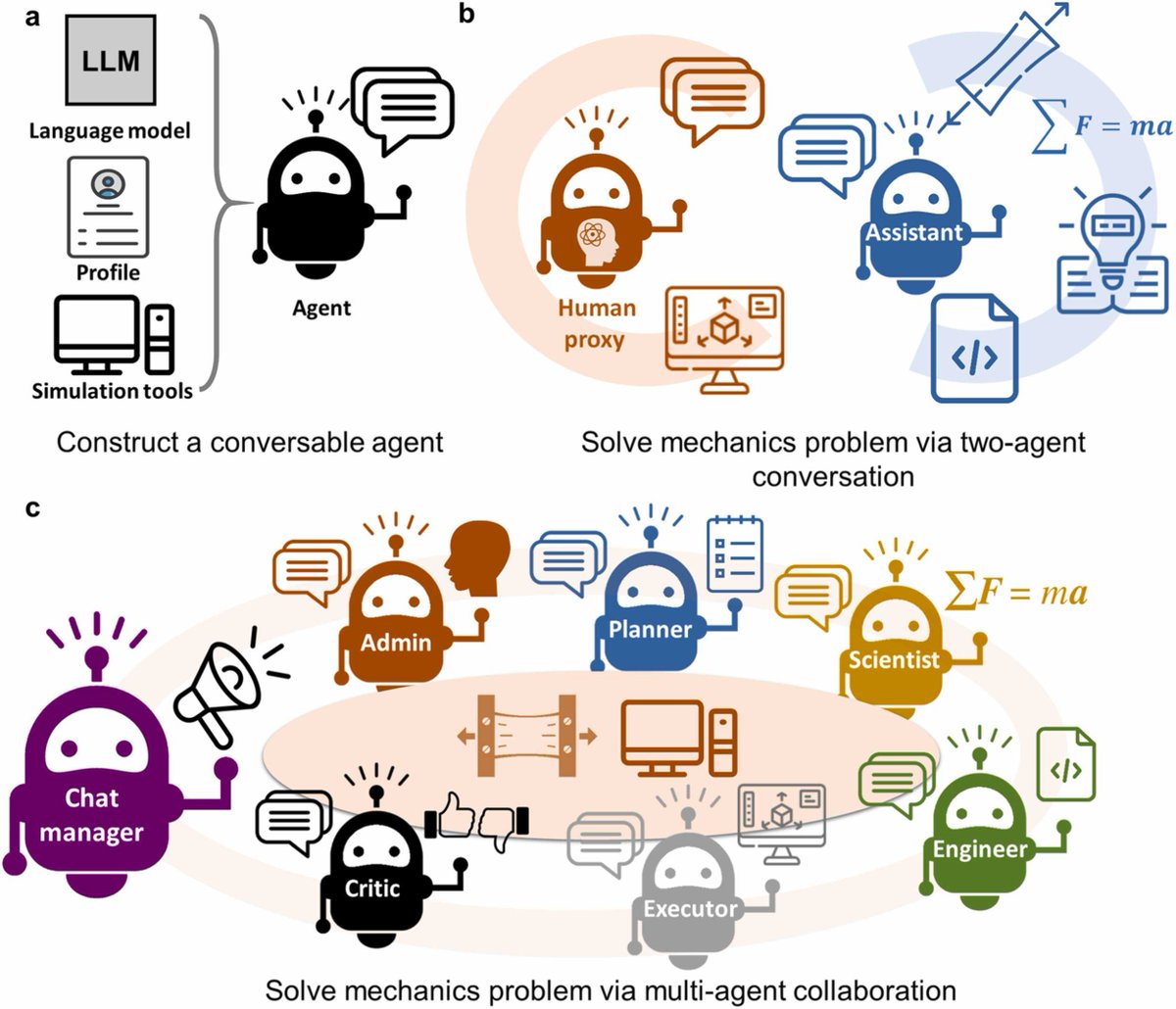
🤖 MechAgents—multi-agent LLMs solving mechanics problems!
AI agents collaborate to plan, code, execute & validate FEM solutions for elasticity problems.
🧠 Physics-based generative AI = new automation frontier in engineering.
🔗doi.org/10.1016/j.eml.2024.1…
@ProfBuehlerMIT
3
8
24
2,898
Bo Ni retweeted
15 Feb 2025
We engineered ultra-tough 2D carbon materials by designing them atom by atom & proving their strength with real-time experiments. Our study bridges molecular simulation & in situ testing, showing 8× tougher fracture resistance than graphene! This work is the result of a long-standing and fruitful collaboration with @JunlouRice, Barbaros Ozyilmaz, Yimo Han, & an amazing team of students and postdocs including @LAMM_MIT researchers @_Bo_Ni, @yang_zhenze, Bongki Shin & others. Check out the podcast below made using #PDF2Audio to explain the work for a broad audience ⤵️
3
12
81
6,684
Bo Ni retweeted
10 Feb 2024
What seemed like an intractable problem is now possible: To design proteins with a specified nonlinear mechanical response, capturing complex folding and unfolding mechanisms in singe and few-shot computations.
We present ForceGen, an end-to-end algorithm for de novo protein generation based on nonlinear mechanical unfolding responses. Rooted in the physics of protein mechanics, this generative strategy provides a powerful way to design new proteins rapidly, including exquisite and rapid predictions about their dynamical behavior.
Proteins, like any other mechanical object, respond to forces in peculiar ways. Think of the different response you'd get from pulling on a steel cable versus pulling on a rubber band, or the difference between honey and glass. Now, we can design proteins with a set of desirable mechanical characteristics, with applications from health to sustainable plastics.
The key to solving this problem was to integrate a protein language model with denoising diffusion methods, and using accurate atomistic-level physical simulation data to endow the model a first-principles understanding. ForceGen can solve both forward and inverse tasks: In the forward task, we can predict how stable a protein is, how it will unfold and what the forces involved are, all given just the sequence of amino acids. In the inverse task, we can design new proteins that meet complex nonlinear mechanical signature targets.
Read the paper, led by @LAMM_MIT postdoc Bo Ni, published in Science Advances: science.org/doi/10.1126/scia…
Why do we care about the mechanics of proteins?
The mechanics of proteins are critical elements of many living systems - as evidenced in many studies of mechanobiology. Through evolution, nature has presented a set of remarkable protein materials with unique mechanical functions like elastins, silks, keratins or collagens that play crucial roles in biology. However, going beyond natural designs to discover proteins that meet specified mechanical properties remains challenging. So far, the only way to do this was to use existing evolutionary concepts or to manually alter proteins.
With our new generative model we can directly design proteins to meet complex nonlinear mechanical property-design objectives. ForceGen leverages deep knowledge on protein sequences from a pretrained protein language model and maps mechanical unfolding responses to create proteins.
Via full-atom molecular simulations for direct validation from physical and chemical principles, we demonstrate that the designed proteins are de novo, and fulfill the targeted mechanical properties, including unfolding energy and mechanical strength, and a detailed unfolding force-separation curves. ForceGen offers rapid pathways to explore the enormous mechanobiological protein sequence space unconstrained by biological synthesis, to enable the discovery of new protein materials with superior mechanical properties.
B. Ni, D.L. Kaplan, M.J. Buehler, ForceGen: End-to-end de novo protein generation based on nonlinear mechanical unfolding responses using a language diffusion model. Sci. Adv. 10, eadl4000 (2024). DOI: 10.1126/sciadv.adl4000
Codes and model weights available @huggingface: huggingface.co/lamm-mit/Prot…
@KaplanLab_Tufts
13
85
370
47,242
Bo Ni retweeted
16 Aug 2023
Designing materials with molecular control is one of the grand engineering challenges, and a promise of nanotechnology. Proteins, building off nature’s toolbox to create biotic, abiotic and hybrid materials, provide an effective materials platform to reach this target. However, it is exceedingly difficult to invent new proteins that go beyond evolutionarily obtained solutions.
We are excited to share our new paper, selected on the cover of Chem Cell Press this month, with postdoc Bo Ni and @KaplanLab_Tufts. We developed a #generativeai protein design strategy for structural targets, both at the residue-level and for overall protein properties, like toughness or flexibility.
In addition to generating proteins that meet the targets, the model has an innate capacity to detect physically improbable proteins, and can propose a closest synthesizable solution.
Check out the paper: lnkd.in/d6Umgnav
MIT News Article: lnkd.in/ehqwnQjE
Cover image courtesy Jose-Luis Olivares of the @MIT News Office.
Thank you @MITIBMLab for the support of this work.

16
44
6,346
Bo Ni retweeted

20 Apr 2023
AI system from MIT and elsewhere can generate novel proteins that meet structural design targets, and which do not exist in nature. These proteins could be used to create new materials with specific mechanical properties, like toughness or flexibility. news.mit.edu/2023/ai-system-…
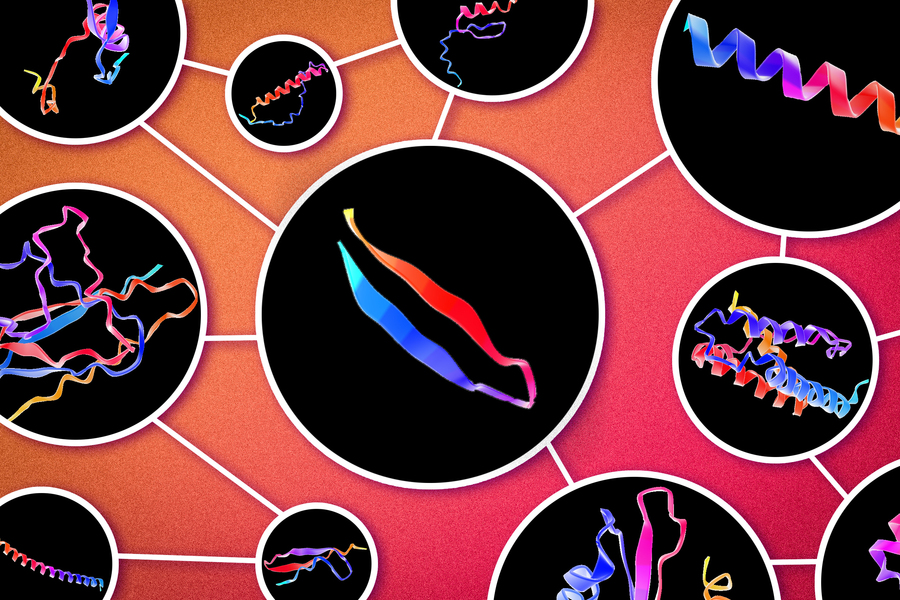
ALT Against an orange background, a neural network is made with white lines and circular nodes. The nodes each have a colorful protein design inside of them. Some proteins are twisting and tightly curled like ringlets while others are more like a pasta noodle.
9
15
2,181