
17 Dec 2025
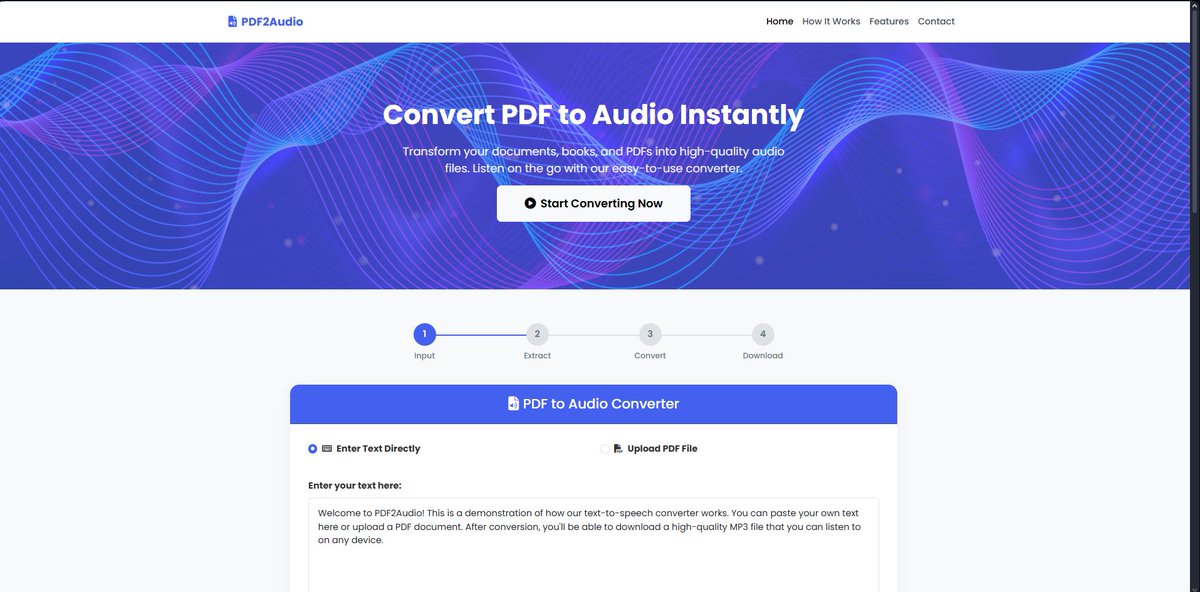
👨💻A PDF2Audio Converter
✅Transform your documents, books, and PDFs into high-quality audio files.
Built with Python, Flask & Bootstrap
Live Demo:🔗 pdf2audio-z9gy.onrender.com
Check it out and contribute⭐:
🔗github.com/olatideenoch/pdf2…
1
5
1,092

11 Sep 2025
الذكاء الاصطناعي الى ويييين👌🏻😨!
صرت تقدر الان تحول شباترك لبودكاست ويمديك تختار طريقة البودكاست المفضلة لك سواء علمي او حتى فكاهي 🎧.
Wondercraft AI
يحوّل ملفك إلى بودكاست احترافي بأصوات متعددة وكأنها حلقة إذاعية
🔗 wondercraft.ai
MakePodcast.app
ترفع ملف PDF ويحوّله إلى بودكاست بنقاش وحوار مسموع
🔗 vakepodcast.app
•Monica AI Podcast Generator
يحوّل ملفات PDF أو نصوصك إلى حلقة بودكاست بأسلوبك المفضل (جاد – علمي – فكاهي)
🔗 monica.im/ai-podcast
PDF2Audio (MIT – HuggingFace)
مشروع مفتوح المصدر يحوّل PDF إلى نسخة بودكاست مبسّطة
🔗 huggingface.co/spaces/lamm-m…
7
82
9,154

18 Apr 2025
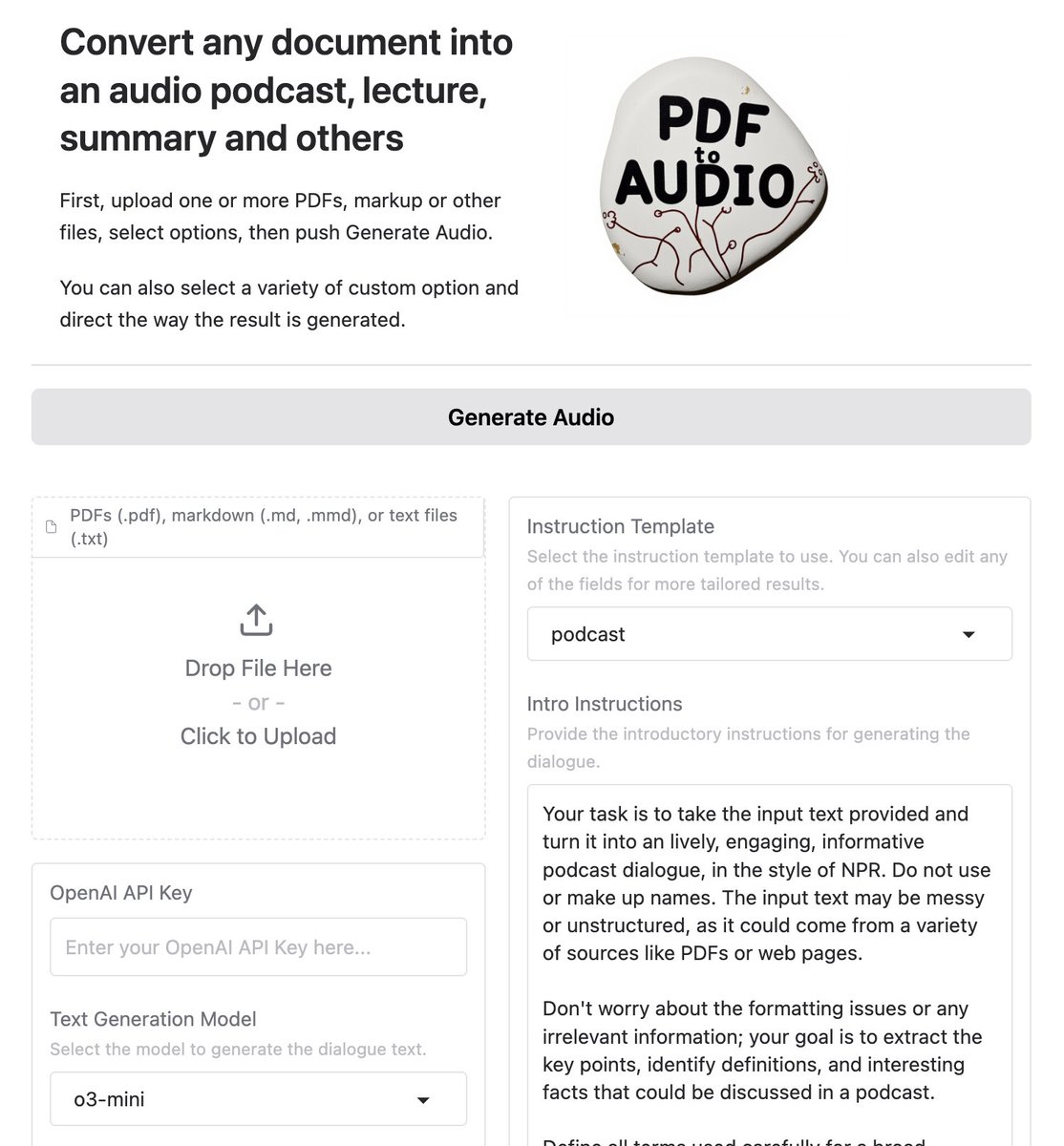
Just found a killer tool: PDF2Audio.
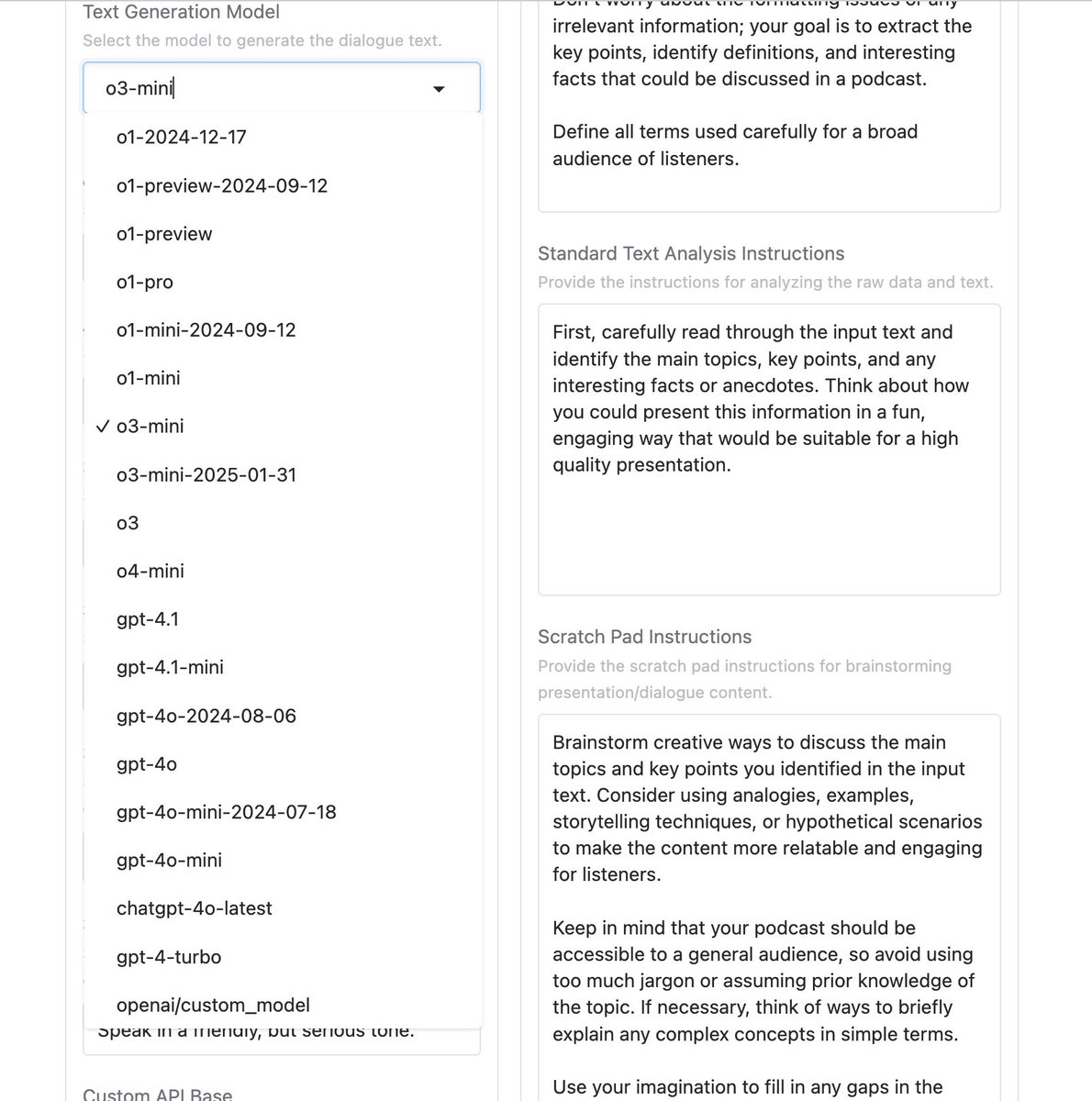
It turns any PDF into a podcast, lecture, or summary using the latest @OpenAI models.
You can fully customize the format, tone, and speaker.
Built with @Gradio @huggingface.
Super useful:
2
4
16
3,085

17 Apr 2025
PDF2Audio now supports all new @OpenAI reasoning models: o1, o3, o4-mini, as well as GPT-4.1 (and many others) - and yes, even GPT-4o with voice! The tool allows you to take advantage of these powerful models to generate podcasts, lectures, summaries & many more types in a highly customizable form and with the possibility to generate any desirable custom formats, feedback and instructions. As an example, hear our spongin paper in action: where bath sponges & ancient biology collide.
Built with @Gradio & @huggingface!
5
39
189
39,948

15 Mar 2025
pdf2audio良いかも。資料や文献突っ込む→音声向けに内容修正→音声ファイル化を全自動でやってくれんのね。speechfyは日本語での専門用語読み上げが微妙だったけど、それもあまりない。これで通勤時間を有効活用できるか…⁈🚗
5
776

3 Mar 2025
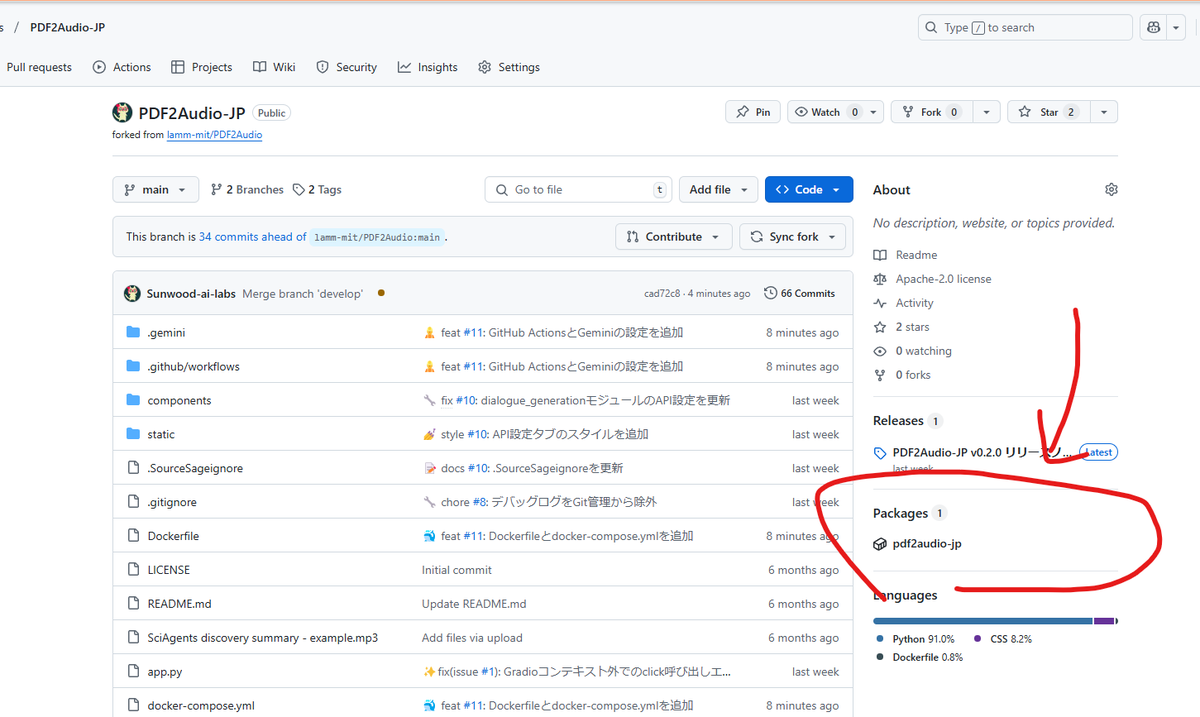
PDF2Audio-JPのDocker Imageを自動でビルドできる環境を整備!
細かいところは明日からやっていきます!
1
9
2,165
15 Feb 2025
We engineered ultra-tough 2D carbon materials by designing them atom by atom & proving their strength with real-time experiments. Our study bridges molecular simulation & in situ testing, showing 8× tougher fracture resistance than graphene! This work is the result of a long-standing and fruitful collaboration with @JunlouRice, Barbaros Ozyilmaz, Yimo Han, & an amazing team of students and postdocs including @LAMM_MIT researchers @_Bo_Ni, @yang_zhenze, Bongki Shin & others. Check out the podcast below made using #PDF2Audio to explain the work for a broad audience ⤵️
3
12
81
6,684
10 Nov 2024
Imagine being able to predict how a large number of cells will move and interact, not by observing them over time, but from a single static snapshot. It sounds like peering into a crystal ball, doesn't it? This is exactly what our team has achieved in our latest research, combining the fields of biology, artificial intelligence & graph theory, to unravel the complexities of cellular behavior, to unravel how dynamical behavior emerges from simple interactions. Multicellular dynamics is an important field as it underlies key processes in biology, from embryogenesis to tumor invasion.
In a study published in @PhysRevX, led by graduate student Haiqian Yang in collaboration with Ming Guo, Monilola A. Olayioye, and others in an interdisciplinary team, we tackled the challenging problem of predicting collective cell migratory dynamics using Principal Neighborhood Aggregation (PNA) Graph Neural Networks (GNNs). PNAs enhance predictive power by aggregating diverse statistical information from each cell's neighborhood, capturing complex interactions beyond simple averages. Leveraging principles from graph theory, our model treats cells as nodes and their connections as edges, enabling a sophisticated analysis of cellular behavior that accounts for both individual properties and the broader network structure.
Technical Deep Dive: PNA Graph Neural Networks and Cellular Dynamics
Collective cell migration is fundamental to processes like embryonic development, wound healing, and cancer metastasis. Traditionally, predicting how cells will move has been incredibly challenging due to the complex interplay of biochemical signals, physical forces, and cell-to-cell interactions. It's like trying to predict traffic patterns by looking at a snapshot of parked cars without considering the drivers, road conditions, or traffic laws.
Cell Jamming and Unjamming: Cells can exist in states of "jamming," where they are densely packed and movement is restricted, or "unjamming," where they have more freedom to move. These states are influenced not just by cell density but also by cell shape, polarity, and the forces they exert on each other.
▶️ Why Traditional Models Fall Short: Traditional models often simplify cells into basic units with limited interactions, failing to capture the nuanced behaviors that arise from complex cellular interactions. They might categorize systems into "jammed" or "unjammed," but real biological systems exist on a spectrum.
💡Enter PNA Graph Neural Networks: GNNs are designed to operate on graph structures where cells are nodes and their interactions are edges. The PNA variant enhances this by aggregating information from a cell's neighborhood using multiple statistical functions—not just averages, but also maximums, minimums, and standard deviations, and other features. This approach captures the heterogeneity and non-linear interactions inherent in biological systems.
✅ By incorporating geometric features of cells—like area and perimeter—and their spatial relationships, the PNA GNN can model both individual cell properties and the complex interactions with their neighbors. This multi-scale consideration is crucial because cell behavior is influenced by both local interactions and larger-scale tissue structures.
Key Insights: Overcoming Traditional Modeling Challenges
One of the remarkable findings from our work is that static cell configurations contain critical information about future motion. By effectively capturing the "rules" of cellular migration encoded in their spatial configurations, the PNA GNN identifies subtle differences and patterns that simpler models might miss.
Why PNA GNNs Excel:
▶️ Capturing Heterogeneity: Cells differ in size, shape, and behavior even within the same tissue. PNA GNNs account for this variability by using multiple aggregators to capture different aspects of a cell's neighborhood.
▶️ Modeling Non-Linear Interactions: Cell behavior isn't a simple sum of influences; it's often non-linear. PNA GNNs are well-suited to model these complex interactions.
▶️ Multi-Scale Consideration: They capture local interactions and larger patterns in the tissue, which is crucial for processes like tissue development.
Our model demonstrated a high correlation between predicted and actual cell dynamics in both experimental and synthetic datasets. Ablation studies further confirmed that both geometric features and spatial interactions are critical for accurate predictions.
Why It Matters: Broad Applications and Future Directions
The potential applications of this approach are extensive:
▶️ Medicine: Predicting how cancer cells migrate could inform treatment strategies to prevent metastasis.
▶️ Tissue Engineering: Understanding how stem cells self-organize can improve regenerative medicine.
Drug Development: Predicting cellular responses to new compounds can streamline the discovery process.
▶️ By integrating detailed cell properties and their interactions, we can simulate biological processes with unprecedented accuracy. This knowledge could drive innovations in therapeutic interventions and personalized treatments, providing new tools for predicting biological behaviors in ways that were previously out of reach.
We're excited to continue exploring how GNNs and other data-driven methods can advance our understanding of multicellular dynamics, bridging the gap between experimental observation and predictive modeling.
Audio: Generated using PDF2Audio @LAMM_MIT based on the @PhysRevX paper
@MITMechE @MIT_CEE @Uni_Stuttgart
Reference to paper and codes/data in reply.
3
10
78
7,914

PDF2Audioやpdf-to-podcastなど、既に似たような実装はあるけど、「ライブラリ」として使えるのメリット。自分のアプリに組み込む場合に良さそう。
マルチモーダルなコンテンツからポッドキャスト風音声を生成する「Podcastfy」を試す zenn.dev/kun432/scraps/1f557… #zenn
3
438

18 Oct 2024
A couple other open-source implementations of this idea:
PDF2Audio
huggingface.co/spaces/lamm-m…
Open Notebook LM
huggingface.co/spaces/gabrie…
1
10
565

6 Oct 2024
PDFを対話ポッドキャスト化するローカルAI「PDF2Audio」、キャラ1枚絵を滑らかに動かせる「MIMO」など生成AI技術5つを解説(生成AIウィークリー) techno-edge.net/article/2024…
1
35

3 Oct 2024
PDFを対話ポッドキャスト化するローカルAI「PDF2Audio」、キャラ1枚絵を滑らかに動かせる「MIMO」など生成AI技術5つを解説(生成AIウィークリー) @TechnoEdgeJP techno-edge.net/article/2024…
2
132

3 Oct 2024
PDFを対話ポッドキャスト化するローカルAI「PDF2Audio」、キャラ1枚絵を滑らかに動かせる「MIMO」など生成AI技術5つを解説(生成AIウィークリー) techno-edge.net/article/2024… 添付動画は1枚の2D画像内キャラに人間のような自然な3D動きを与え実世界に調和した映像に仕上げる「MIMO」
1
46
193
27,977

3 Oct 2024
PDFを対話ポッドキャスト化するローカルAI「PDF2Audio」、キャラ1枚絵を滑らかに動かせる「MIMO」など生成AI技術5つを解説(生成AIウィークリー) | テクノエッジ TechnoEdge
techno-edge.net/article/2024…
4
9
2,439

2 Oct 2024
長文を読むのが苦手なら、PDF2Audio がおすすめ。
✅PDFファイルをオーディオポッドキャスト / 講義 / 要約音声に変換
✅テキスト生成と音声読み上げにはOpenAIの最新モデルo1を搭載
✅複数の言語 / ボイスから選択が可能
通勤中や家事の合間に、最新の専門書や長文レポートを音声で確認できます。
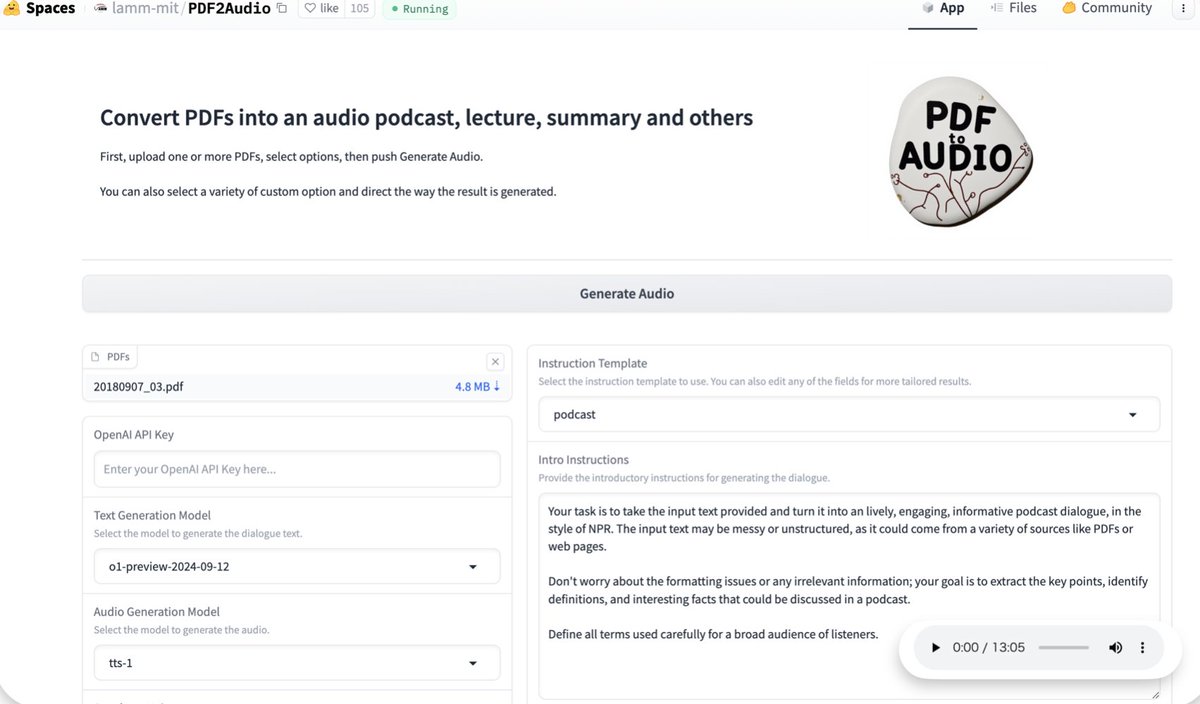
1
4
1,613

1 Oct 2024
This open-source AI tool was built in a day and it’s coming for Google’s NotebookLM
venturebeat.com/ai/this-open…
✍️@MichaelFNunez via @VentureBeat
#AI #OpenSource #Podcast #PDF2Audio
💡"Open NotebookLM transforms PDF documents into personalized podcasts, mirroring a key feature of Google’s product but with a crucial distinction: it’s entirely open-source and free to use"
cc @Corix_JC @PerBBerggreen @sonu_monika @JagersbergKnut @ahier @EstelaMandela @sim010101 @Shi4Tech @BetaMoroney @avrohomg @mvollmer1 @maponi @sallyeaves @CEO_Aisoma @FernandaKellner @YvesMulkers @LouisColumbus @JoannMoretti @NeiraOsci @tlloydjones @smaksked @SusanHayes_ @theomitsa @TarakRindani @sulefati7 @Nicochan33 @Annerobinsons @Analytics_699 @rvp @Khulood_Almani @TheAIObserverX @drsharwood @FractaloidConvo @AndrewinContact @mikeflache @ChuckDBrooks @NathaliaLeHen @sminaev2015 @KanezaDiane @MHcommunicate @CurieuxExplorer @DanielleLargier @jeancayeux @chidambara09 @FrRonconi @amalmerzouk @RLDI_Lamy @richardkimphd
38
49
1,810
pydubと組み合わせてBGMとミックスしたら、かなりポッドキャスト風になっていい感じ
PDFからポッドキャスト風音声を生成する「PDF2Audio」を試す zenn.dev/kun432/scraps/9a2bb… #zenn
1
5
16
1,436

1 Oct 2024
Animation is a little jittery... experimenting with #PDF2Audio podcast on a Pablo Neruda piece.
Flux Pro | Runway
1
6
608

NotebookLM 开创了新的品类, PDF2Audio。
它就跟 ChatPDF 一样,其实没那么完美,但它会成为一个新品类,足够在某些场景(比如英语学习)找到 PMF,足够让很多人赚一波。
有人做出了 NotebookLM 开源版本 Open NotebookLM ,所有步骤均使用开源模型实现。
请收藏体验地址:huggingface.co/spaces/gabrie…
28
151
14,305

PDF2Audio
Convert PDFs into an audio podcast, lecture, summary and others
huggingface.co/spaces/lamm-m…
1
1
17
5,738