
136 Photos and videos




Pinned Tweet

31 Jul 2025
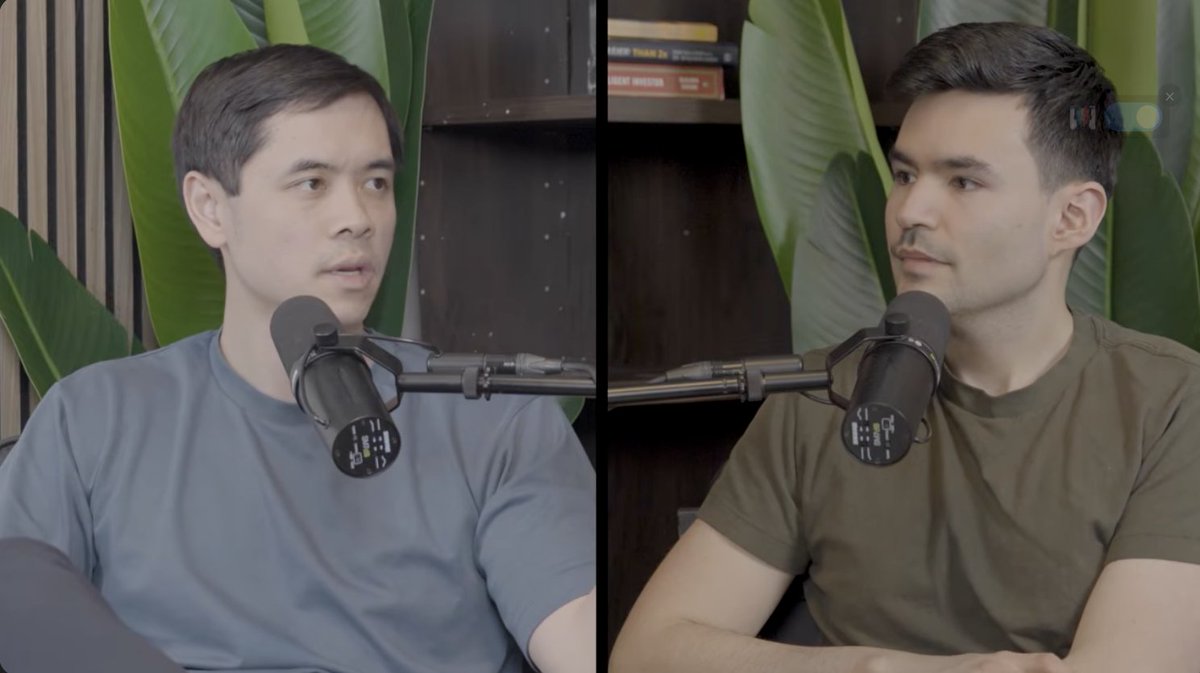
I've studied 100 founders who turned personal brands into $10M businesses. Now I’m launching 𝗣𝗲𝗿𝘀𝗼𝗻𝗮𝗹 𝗜𝗣𝗢 (with beehiiv🐝), a podcast where the founders all over your feed share their playbooks.
Sam Parr, Justin Welsh, and all of our guests share one thing:
Obsession.
Some of them dropped out of college and moved across the country with nothing.
Others left cushy 6-figure finance jobs for ideas Wall Street said were stupid.
All of them stayed in the game, built amazing companies, and created their own luck.
1. 𝗦𝗮𝗺 𝗣𝗮𝗿𝗿 sold The Hustle for $27M and co-founded Hampton, a peer network for founders
2. 𝗝𝘂𝘀𝘁𝗶𝗻 𝗪𝗲𝗹𝘀𝗵 just crossed $10M in revenue single-handedly creating the category of solopreneurship on LinkedIn
3. 𝗝𝗲𝘀𝘀𝗲 𝗣𝘂𝗷𝗷𝗶 has launched five separate 7 and 8-figure businesses firing off viral posts from his phone
4. 𝗗𝗶𝗰𝗸𝗶𝗲 𝗕𝘂𝘀𝗵 ditched Wall Street to build a $700k/month hold-co training the next generation of digital writers
5. 𝗧𝗶𝗺 𝗛𝘂𝗲𝗹𝘀𝗸𝗮𝗺𝗽 has quietly built 1440, a newsletter doing $20M/year
6. 𝗜𝘀𝗮𝗮𝗰 𝗙𝗿𝗲𝗻𝗰𝗵 sold a viral short-term-rental portfolio for $7M in his mid-twenties after an Airbnb delisting nearly bankrupted him
7. 𝗘𝗿𝗶𝗰 𝗦𝗶𝘂 bought a biz for $1 and turned it into a 60-person SEO agency and top marketing podcast
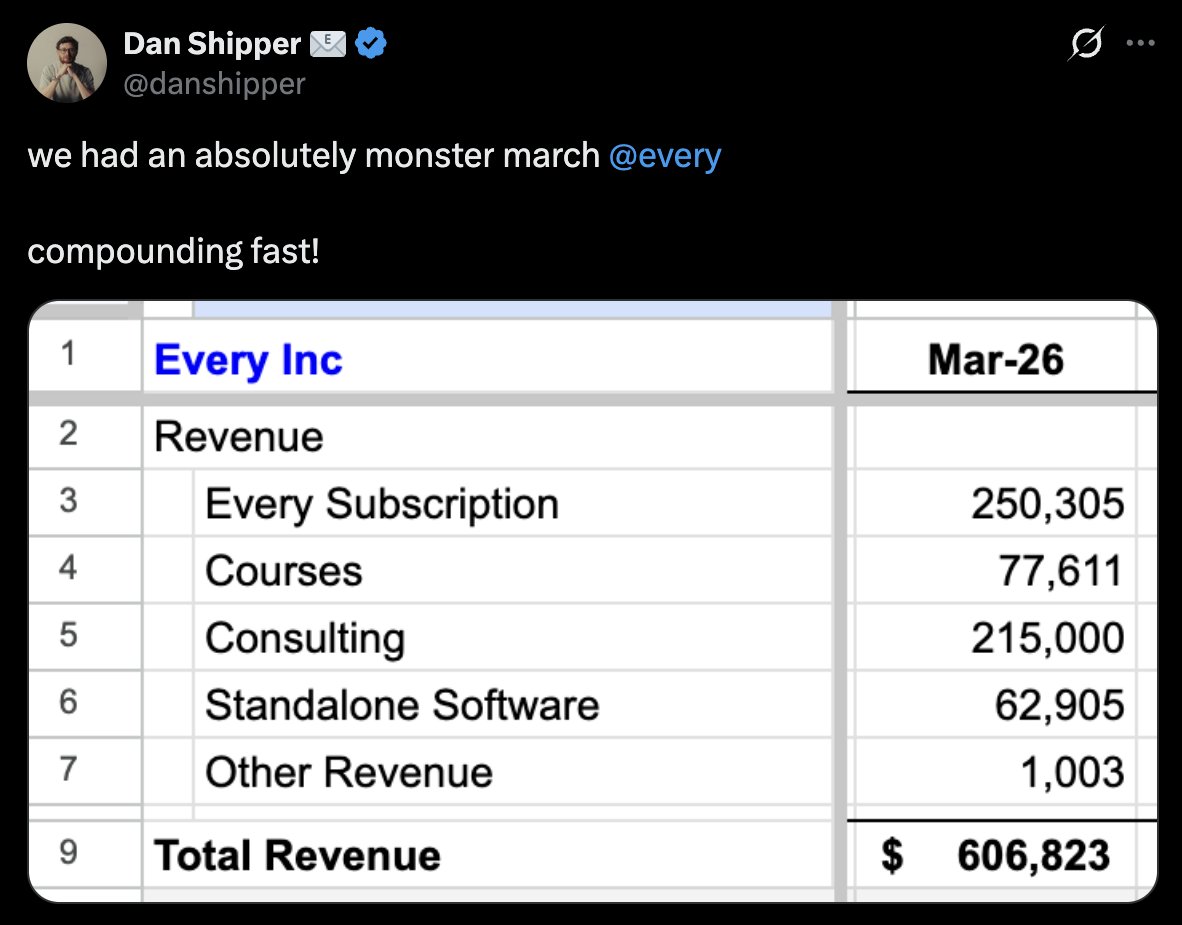
8. 𝗗𝗮𝗻𝗶𝗲𝗹 𝗙𝗮𝘇𝗶𝗼 bootstrapped a $1M/month portfolio of community and SaaS businesses by 28 years old
And we're just getting started. The first episode drops Monday!
𝗧𝗼 𝗰𝗲𝗹𝗲𝗯𝗿𝗮𝘁𝗲 𝗜’𝗺 𝗴𝗶𝘃𝗶𝗻𝗴 𝗮𝘄𝗮𝘆 𝗮 𝗛𝗨𝗚𝗘 𝗻𝗼𝘁𝗶𝗼𝗻 𝗱𝗼𝗰 𝗼𝗳 𝗼𝘂𝗿 𝗴𝘂𝗲𝘀𝘁𝘀' 𝗯𝗲𝘀𝘁 𝗰𝗼𝗹𝗱 𝗲𝗺𝗮𝗶𝗹𝘀, 𝗳𝘂𝗻𝗻𝗲𝗹𝘀, 𝗮𝗻𝗱 𝘀𝗮𝗹𝗲𝘀 𝗮𝗱𝘃𝗶𝗰𝗲. 𝗬𝗼𝘂’𝗹𝗹 𝗴𝗲𝘁:
- Justin Welsh's sales emails behind Creator MBA's $1.6M launch
- Dickie Bush's funnel (landing pages, emails, and automations) from Premium Ghostwriting Academy ($500k per month)
- Jesse Pujji's sales call blueprint, responsible for 3 separate $10M companies
- Sam Parr's original cold emails to advertisers from The Hustle’s first year
- 1440's top 40 longest-running Facebook ads
Want access?
1. Like this post
2. Comment "personal IPO"]
I'll send you the Notion doc via DM today.
35
1
63
8,142
Jun 13
My buddy Ruben uses AI to draft his entire newsletter, and it's grown to 664,000 subscribers. Steal his 5-step playbook to make AI write like you:
Most people drop a topic into Claude and expect it to spit out a finished newsletter that sounds like them.
Ruben calls this lazy context.
AI picks up surface patterns, but it never truly understands your style because you never defined it yourself.
Here’s the better approach:
Step 1: Ask Claude to interview you
Prompt: "What questions do you need answered to write exactly like me?"
Claude will generate 100 questions like:
• What's your writing belief others would disagree with?
• What makes you cringe when you read it?
• How does excitement show up in your writing?
• What would you never say?
These questions uncover your quirks, opinions, structures, and blind spots.
Step 2: Answer out loud, not by typing
Ruben uses Wispr Flow (or the Claude app) to talk through the answers.
Why?
You speak ~4x faster than you type, and natural speech produces natural writing.
Just talk through every question like you're explaining it to a friend.
The full interview takes 1-2 hours.
Step 3: Turn the answers into a “voice profile”
At the end of the interview, ask Claude to compile all your answers into a single text file (your voice profile).
Ruben's runs about 1,500 lines.
It covers his opinions, quirks, what he'd never write, and how he thinks about every topic in his niche.
One important note: save it as a markdown file, not a PDF.
AI reads Markdown natively.
PDFs force the model to guess what's written, which increases errors.
MarkdownDown converts any text to markdown for free.
Step 4: Upload your voice profile before writing anything
Now Claude already knows:
• Ruben never writes without a core tension
• He breaks the fourth wall with brackets
• He avoids hype about the future
The output starts sounding much more like him.
Step 5: Draft collaboratively
Most people ask AI to write the whole thing in one go.
But Ruben doesn’t.
His process:
• Brainstorm angles together
• Find the core tension
• Draft section by section
• Rewrite weak parts
• Ask for multiple options
• Refine collaboratively
Exactly how you’d work with a real copywriter.
If you're just starting and don't have much writing to draw from, answer the questions based on what you love reading and why.
3
6
724
Jun 12
If you're a founder/exec without a personal newsletter, you're being financially irresponsible. How my newsletter got me to $1M with only 920 subs:
Most newsletter media companies have a subscriber LTV of $10 to $20.
Good business.
But attention becomes more valuable when applied to expensive things: software, services, careers.
I scaled The Feed from $0 to $1M ARR in 11 months with just 920 readers ($1,000 per subscriber).
My buddy Max runs an email marketing agency, doing $700K per month with 20,000 newsletter subscribers.
Newsletter works better than social because:
1. Social platforms show your content to 10 to 15% of your followers. Newsletters hit 40% open rates
2. 90% of your ideal customers aren't ready to buy today. The newsletter keeps you top of mind until they are
3. Over time, you aren’t just another vendor pitching services, but a thought partner your readers want to work with
So, what should you write about?
I use a simple rule:
If a question or topic came up multiple times in a week, I write about it.
Most of it falls into three buckets:
• Lessons from client work (Why CPL is a bad metric)
• FAQs (How much can your newsletter sell for?)
• Deep dives (The first AI newsletter to hit $10M/yr)
The goal is to share content people can’t Google.
Growing your newsletter, too, isn’t complicated.
Step 1: Build a Dream 100 list
Sit down and think: whom would I LOVE to work with?
At each company, there are maybe two people who could decide to work with my team: the founder and the head of growth/marketing.
If there are 500 companies, that's 1,000 people.
I could put those people in a Google Sheet.
I use LinkedIn Sales Navigator for this.
Step 2 (optional): Make it private
I positioned this as an invite-only newsletter.
"I run a private newsletter for media operators doing seven and eight figures" is a different pitch than "hey, sign up for my newsletter."
Step 3: Outreach one by one
I’ve sent 1000 messages like this:
“Morning [name]! I have a private newsletter where I share growth/monetization tactics with media operators 2x a month.
It’s for operators - 1440, The Rundown, Red Ventures folks, etc.- and they are on it and have found it helpful.
Mind if I add you?”
Step 4: Convert social followers with lead magnets
I have a buddy, Shamus, who makes $150k per month at 20 years old doing LinkedIn ghostwriting.
We gave away his LinkedIn playbook in this post.
600 comments and 170 extremely high-quality newsletter subscribers added.
For monetization, I put light evergreen CTAs in every issue.
3
11
724
Jun 11
1440 has 4.7M subscribers and spends $1M /mo on Meta ads. Last month, they stopped tracking open rates. Here's what they monitor instead:
Open rates have been broken for a while:
1. Inbox providers pre-load emails
2. Apple's mail privacy protection fires a tracking pixel the moment an email hits your inbox, whether you actually opened it or not
3. And an “open” doesn’t generate revenue itself
So 1440 decided the metric was no longer worth tracking.
Their entire reporting stack got rebuilt around two numbers instead:
1. Click revenue per subscriber
When 1440 sends an email and someone clicks on a sponsored link, that click generates revenue.
They divide that total revenue by the number of subscribers who received the email.
That's their click revenue per subscriber.
2. Ad click revenue per subscriber
Same logic, but specifically for the sponsored ad placements inside the newsletter.
How much revenue did each subscriber generate from ad clicks alone?
This is the number sponsors actually care about:
• Did your readers click the ad?
• And what was that worth?
Both metrics are already more useful than the open rate.
But 1440 takes it one level deeper.
They track both of these metrics by the ad creative that acquired each subscriber.
So they can say:
1. The subscribers who came in from the Middle East news ad generate $X in click revenue per email
2. The subscribers from the comparison ad generate $Y
That means they can make media-buying decisions based on revenue per subscriber by creative concept, not just cost per lead.
A creative that costs more per subscriber to acquire might still be the better buy if those subscribers generate 40% more revenue per email over their lifetime.
You'd never know that from open rates or CPL alone.
3
4
370
Jun 10
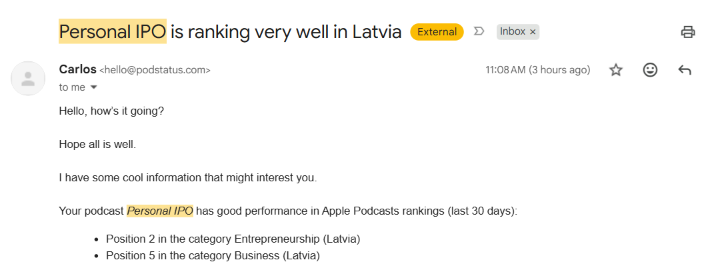
The podcast is exploding in Latvia (taking Carlos's word for it) - I'll take it!
2
7
697
Jun 10
Chenell Basilio has studied how 80 newsletters grew to 50,000 subscribers. She found that the top ones use the IVC framework to grow fast:
Starting a newsletter has never been cheaper or easier (thanks to email platforms and AI tools).
Which means standing out is about being genuinely, undeniably useful.
The newsletters that grow fastest get replies like:
• "Can't believe this is free"
• "How do you only have [small number] subscribers?"
• “How do you put out content like this every week?”
If you're not getting replies like that, you have a content problem.
Chenell calls the solution IV content (Insanely Valuable Content).
She mapped it to 6 buckets.
Hit 2 or more in a single piece, and you have something good.
Hit 3 or more, and it almost always spreads on its own.
1. Make money
Does reading this put money in someone's pocket?
MarketBeat sends daily stock alerts and financial data that help readers make better investment decisions.
2. Save money
Help someone avoid a bad deal or costly mistake.
The Points Guy helps people use credit card points and travel rewards to fly and stay in luxury for a fraction of the cost.
3. Save time
Take something that takes 10 hours to research and compress it into a 10-minute read.
Mario Gabriele of The Generalist did this with S1 filings (documents companies file before going public).
One filing he covered was 317 pages.
His version: 29 pages, plus additional analysis.
Three buckets hit simultaneously: make money, save money, save time.
4. Make someone laugh or feel something
People don't forward things that are useful but boring.
They forward things that made them laugh, feel angry, or feel seen.
5 Tweet Tuesday finds the best 5 tweets each week that do this exactly.
5. Make them feel smart
Give someone the insight that changes how they see something.
1440 does this every day.
They distill complex news into clear summaries so readers feel informed without doing the work themselves.
6. Speed to market:
Be the first.
Yossi Levi (Car Dealership Guy) posted about Stellantis layoffs before the market opened.
The stock was at an all-time high when he posted.
What followed was a nosedive, and Yossi's content was cited as the breaking source by Yahoo Finance, Fortune, and others.
You don't need 4000-word deep dives to hit multiple buckets.
Justin Moore of Creator Wizard sends a weekly list of brands actively looking to work with creators.
This simple format hits three buckets: make money, save time, and speed to market.
Before you publish your next piece, run it through the six buckets.
Which ones does it hit?
If the answer is one or zero, it's not ready.
If it's two, it's decent.
And if it's three or more, ship it with confidence, and expect it to spread.
2
13
995
Nathan May retweeted

Jun 8
80% of MarketBeat's revenue comes from subscribers we acquired through paid channels.
For years I thought organic was the whole game. The truth is the opposite. Paid acquisition, done with real payback discipline, is the engine. Organic is the cushion underneath it.
9
3
112
5,925
Nathan May retweeted

Jun 8
I have officially left beehiiv 🤯
After cooking with the most talented team on earth for 4 years, I had to take a bet on myself. The window of opportunity to build any life you can dream of has never been better than it is right now.
I joined beehiiv when there were less than 10 of us. We had all-hands every morning. We celebrated $99 Stripe payments like a bunch of hooligans. It was the most electric culture I’ve ever experienced and the journey of a lifetime.
I was there for $1M ARR. $2M. $5M. $10M. $30M, and I’m going to be right here on the internet rooting for them when they hit their next milestone.
beehiiv has reached escape velocity. Nothing stops it now. The people building it are some of my closest friends in the world, and I will always be grateful to Tyler, Ben, and Jake for giving so much responsibility to me to help them build.
As for me, I’m going to be writing everything I know about building businesses that generate money. I’ve done it over and over and over again with emails, courses, podcasts, communities, products, and more.
And I’m going to do it again 😏
Subscribe to learn everything I know.
danielberk.com/subscribe
133
13
495
108,784
May 31
A client was burning 80% of their $280K/mo Meta ads budget on the wrong audience. Meta had no idea. Here's how we fixed it:
In this client’s case, women engaged more with the ads and achieved lower CPMs.
So Meta kept pushing spend there.
But when we checked back-end revenue, men and women were converting at nearly identical rates.
Meta was optimizing for engagement. The business needed to optimize for revenue.
Huge difference.
And this happens constantly with newsletter businesses.
You think Meta is finding your best customers.
Often, it’s just finding the people most likely to click, engage, and consume content.
Not necessarily the people most likely to generate revenue.
In this case, women were winning the engagement battle early, so Meta stopped serving men altogether.
That creates a dangerous feedback loop:
Women engage more > Meta serves them more > Meta gathers more female conversion data > Meta becomes even more confident that women are “better” > Male audiences get ignored.
Meanwhile, there’s an entire profitable audience sitting there untouched.
This is why relying only on platform metrics like CPLs, CTRs, and CPMs is dangerous.
Here's the diagnostic to catch this issue:
1. Pull your spend breakdown by gender from Meta
2. Then cross-reference it against your real back-end revenue data
Ask one question: Is the audience getting the most spend actually generating the most revenue?
If not, Meta has been spending on the wrong people, possibly for months.
Here's how we're fixing it:
1. Build male-specific creative with hooks and messaging designed for that audience
2. Push spend deliberately toward men and watch whether the conversion rates hold at scale
If they do, the client has unlocked a growth channel that had been sitting untapped in their existing account the entire time.
The audience was already there. The conversions were already happening.
They just weren't happening often enough for Meta to notice and act on them.
1
299
May 30
Your newsletter might be making $1.50 per subscriber when it could make $20. The difference comes down to one funnel mistake.
Most operators are stuck at $1.50 without realizing it.
A $50 product converting at 3-5% generates roughly $1.50 to $2 per subscriber.
You spent weeks building it, you're burning email slots promoting it, and that's your ceiling.
The $20 version looks completely different.
A $2,000 coaching offer (or a similar service) converting at just 1% gets you there from the same list, the same emails, and the same audience.
The difference is what you're selling and how you're sequencing it.
And the sequence should match the amount of trust you've earned.
Cold prospects buy based on curiosity. High-ticket buyers purchase based on trust.
That's why, for cold traffic, sell products under $50 on the front end.
At that price point, impulse buying kicks in, and copywriting alone can close the sale.
Someone sees your ad, doesn't know you yet, but $49 feels low enough to take a chance on.
Above that ($99, $199, $299), the purchase requires trust.
And trust takes time, which means the right sequence becomes: free newsletter > nurture > conversion.
This is where most operators accidentally kill their upside.
They spend weeks warming readers up, then use that hard-won email inventory to push a $29 product.
Every slot spent on a low-ticket offer is a slot that didn't move someone closer to the $2,000 offer on the backend.
If you have high-ticket offers, your newsletter should be doing four things:
• Building trust
• Increasing perceived expertise
• Segmenting intent
• Moving readers toward high-LTV offers
A $29 ebook doesn't help with any of them.
That said, low-ticket monetization isn't worthless; it just shouldn't live in your email sequence.
Plug in Sparkloop and let it run passively in the background.
That revenue comes in automatically while your emails stay focused on what actually moves the needle.
1
1
9
620
May 29
You have 80 subscribers. You add a paid tier. But only 3 people convert. Is the offer broken, or do you just not have enough subscribers? Here's how to know and what to do about it:
Even strong newsletters with warm, organic audiences typically convert at 5 to 10% from free to paid.
At 80 subscribers, a 5% conversion rate is 4 people.
A 2% conversion rate is less than 2.
Zero conversions and a broken offer look identical at that size.
You can't learn anything useful from the results.
Wait until 200 to 300 subscribers before launching.
At that size, a 5 to 10% conversion rate means 10 to 30 people converting; enough signal to know if something is working.
A Rolex newsletter on Substack shows how this plays out.
They have 10,000 subscribers and 1,000 paying readers, a 10% free-to-paid conversion rate (one of the strongest I've seen).
They built that list by pulling followers from a 50 to 60K Instagram account.
And even at 10%, they needed 10,000 free subscribers to get there. That's the reality of paid newsletters.
You either need a large audience, higher pricing, or patience because only a small percentage of readers will ever pay.
When it comes to structuring paid newsletters, I generally see 2 approaches work:
1. Gate part of your existing newsletter
This is my preferred approach.
Readers open your normal email, get halfway through, and then hit the paywall.
I like this because:
• You don’t need to create a second newsletter
• Readers always know there's more content available
• The upgrade prompt lives inside your existing distribution
Ruben Hassid does this really well in his AI newsletter.
He’ll share tactical workflows and prompts, but the deeper prompts, videos, or advanced sections are locked for paid subscribers.
2. Create a separate paid-only newsletter
This works too.
Free readers still receive the email, but the full edition is locked unless they upgrade.
The downside is the workload.
Now you’re effectively creating an entirely additional newsletter every week.
Finally, how much should you price your paid offer?
Don't default to $7 to $9 a month just because that's average.
The right pricing depends entirely on your goal and your audience size.
If your goal is $10K a month from paid subscriptions, you need to back into what that requires.
At $9 a month with a 10% conversion rate, you need roughly 11,000 free subscribers to get there.
That takes time to build if you're starting from zero.
If you price at $25 or $30 a month instead, you need far fewer paid subscribers to hit the same revenue number.
3
525
Nathan May retweeted

May 29
My buddy @_May_Ham grew up in a hoarder house in Ohio and didn't leave the state until he was 18. His family made $30k/year. Today he runs one of the fastest growing newsletter agencies.
How he got here:
- Overweight at 13, 2.1 GPA, addicted to Minecraft
- At age 14 starts selling custom Minecraft maps, by the time he graduates high school it’s a 6-figure business
- Gets accepted into Wharton
- Joins BCG after graduation
- Starts a crypto newsletter, sells it for a small exit
In Feb 2024 starts The Feed Media (newsletter agency):
- 0 to $1M revenue in 10.5 months
- $4-5M revenue this year
- Clients include Arnold Schwarzenegger, Jay Shetty, and more.
Became a millionaire at 22.
And yes, he’s a Hampton member.
17
5
104
23,783
May 27
A client's landing page was converting at 25%. One change took it to 40%:
For context, the landing page was collecting first name, last name, and email.
The CMO was convinced that collecting first names was important to personalize emails.
So we ran a simple test: What happens if we remove the first name?
Landing page conversion rate went from 25% to 40%.
That’s not a small improvement.
Going from 25% to 40% conversion means 60% more subscribers from the same traffic.
A good benchmark for a free newsletter landing page is roughly 40-45% conversion.
So if you’re significantly below that, the first thing I’d look at is friction.
And asking for someone’s name creates friction.
People don’t consciously think: “I refuse to give my first name.”
But subconsciously, each additional field requires more effort and hesitation, especially with cold traffic.
And honestly, the first name is usually vanity data.
What you should care about is the qualification data.
For example:
If you run a recruiting newsletter, I don’t really care if your name is John.
I care about:
• What role you have
• What size company you work at
• What industry are you in
• Whether you fit the ICP
That information is actually useful.
A simple framework I like:
Ask for the minimum information required to get the signup.
Then collect richer first-party data after the subscriber converts.
That can happen through onboarding surveys, welcome emails, subscriber polls, and preference centers
But subconsciously, each additional field requires more effort and hesitation, especially with cold traffic.
But your landing page has one job: Get the email.
4
406
May 23
My buddy Jonathan gets 30-50M views on socials per month. He shared the full system behind it:
1. His strategist finds viral formats in their niche
2. They brainstorm adaptations for their audience
3. Scripts get written and reviewed
4. Everything gets recorded in one day
That's it.
But what makes it work is what he calls archetypes: proven content formats he knows will go viral every time.
His biggest one is “hiring POVs.”
The structure is always the same:
An emotional visual in the first 3 seconds, a strong, controversial text overlay, character and story setup, and a twist ending.
One video opens with an employee crying.
The text reads: "POV: You have to lay off your employee despite a record month."
People get angry immediately.
They're ready to fight him in the comments. Then, at the end, she got promoted.
Once he confirmed the structure worked, he built a custom GPT that generates new versions automatically.
He just feeds in the details and gets a ready-to-record script based on every past version that went viral.
Guaranteed minimum 300K views. Every time.
He also runs controlled experiments to find new archetypes.
He tested two nearly identical tier list videos. One got 5 million views. The other got 100K.
The difference:
In the successful one, his guest rated something everyone does as F tier, the strongest possible stance.
In the weaker version, a different guest rated something C tier.
His framework is simple:
If people strongly agree OR strongly disagree with something, you're probably onto a winner.
So, check the comments.
If people are fighting, the algorithm keeps pushing it. If everyone's nodding along quietly, it dies.
One more tactic worth stealing:
Take the first 5 seconds of a video that already went viral and stitch it onto something new.
You already know the hook works. The platform proved it.
Why write hooks from scratch when you can borrow a proven opening and pivot the content in a new direction?
He calls it using content like Lego blocks.
Once you have a base that works, build the next thing on top of it.
8
441
May 22
You don’t need 10K newsletter subscribers to sell sponsorships. You can start with <1000 subscribers if you do these 4 things:
If somebody came to me and said, "I have a 100,000-person newsletter, want to sponsor it?"
That's mildly interesting.
But if somebody came to me with a 300-person list and said, "My subscribers include 50 SVPs at companies you actually want to reach..."
...That completely changes my perception of the value of that list.
That’s what sponsors care about. They don’t buy audience size, but access to the right people.
So, how do you actually do this with a small list?
1. Find out who's actually on your list
Self-reported data from sign-up surveys is a start, but it's not reliable.
People put whatever they feel like.
Use Clay, Apollo, or enrichment tools to figure out:
• Company
• Title
• Seniority
• Industry
• Company size
Your sponsor pitch changes dramatically once you can say:
“We have CMOs, founders, and senior operators from these companies reading every issue.”
That’s much more powerful than: “We have 2,000 subscribers.”
2. Identify your best names and lead with them
If you have 25 CMOs or SVPs from recognizable companies on your list, those names can carry an entire media kit.
A sponsor doesn't need to know your total subscriber count first.
They need to know whether the right people are reading.
3. If you don't have the right logos yet, go get them
You have control over who's on your list, especially if you're growing organically.
Reach out to 75 CMOs or senior leaders at companies your ideal sponsors want to reach.
Try to get 25 of them on the list.
Now you have something to sell.
4. Create a media kit around audience quality
Most media kits show:
• Subscriber count
• Open rate
• Click rate
That’s fine.
But for niche newsletters, the real asset is audience composition.
Your pitch should sound more like: “This is a concentrated group of senior GTM leaders and founders.”
Not: “We have 1,800 subscribers.”
That positioning matters a lot, especially early.
A lot of creators think, “I’ll monetize once I’m big.”
I actually think many people should monetize much earlier.
But only if they stop selling quantity and start selling audience quality.
3
378
May 18
My buddy Thomas has generated 850M views writing for the biggest personal brands (including billionaires). He told me how to fix the "I don't know what to post" problem:
List the 8-10 most common problems/desires your ICP has.
Just ask, what does my audience constantly need help with?
If you know your ICP well, you already know the answers.
For me, in newsletter growth, those questions might be:
• How do I grow a newsletter?
• How do I monetize a newsletter?
• What should I write about?
• How do I improve click-through rates?
• How do I grow with Meta ads?
• Why is my newsletter not converting?
• How do I get sponsors?
• What metrics actually matter?
Once you have those questions, you stop creating content from scratch.
Now you’re just answering the same problems in different ways.
One question can become 20 posts.
For example: “How do I grow a newsletter?”
Could become:
• 4 mistakes keeping you stuck under 1,000 subscribers
• Here's how we grew from 0 to 50k subscribers
• Why most people fail at audience growth
• 7 lessons from working with top creators
• A teardown of a creator growing insanely fast
• The 5-step playbook I’d use if I started from 0 today
That's how you never run out of content.
You have 8 questions and 17 different ways to answer each one. That's over 100 posts before you've even tried.
He also shared that the best content comes from conversations you've already had:
• Every time someone said "that was smart" on a call, that's a post
• Every DM where someone asked you something three times this month, that's a post
• Every objection you keep hearing, that's a post
The content already exists. You're just putting it in front of more people.
And if you don't have those conversations yet:
• Go to Reddit and search your niche
• Look at the questions people are asking in the subreddits your ICP lives in
• Search your topic on Google and look at the suggested questions that populate
• Go to YouTube and see what's already getting views in your space, then find the angle nobody else is taking
5
252
May 16
We have 50k email subscribers, but the newsletter doesn’t make money.” I hear versions of this from web-first publishers all the time. Here’s what I’d do to make it a $500k/yr revenue asset:
The problem is that your newsletter isn’t actually a product.
Most web-first publishers treat email like a distribution channel, traffic driver, or a dumping ground for links.
This leads to low engagement, no clear ownership, sales teams ignoring it, and sponsors who don’t care.
If you want your newsletter to work, you have to invert the model.
1. Obsess over revenue, not growth
If you have 10k–50k subscribers, that’s enough to start.
But only if:
• Your inventory is clearly defined
• It’s not bundled into random web deals
• Someone actually owns selling it
You need:
• A dedicated seller for newsletter inventory
• Or an agency (short-term) to prove demand
If no one owns it, it doesn’t exist.
2. Fix the product (this is the real problem)
If your newsletter only has:
• Headlines lots of links
• Thin summaries that redirect to the website to read the content
• No actual content people would miss if it disappeared tomorrow
...Sponsors won't pay for that.
Readers won't forward that. And no amount of sales effort fixes a product that isn't good.
You need to make a real editorial decision: build a newsletter-first product, not a web-first product.
That means hiring a writer and developing a content strategy to share:
• A strong point of view
• Real insights inside the email
• Curated explained news (not just linked)
Think Morning Brew, The Rundown, The Neuron. Content that lives and dies in the email itself.
3. Only then should you think about growth
Most publishers already have a list. Use it.
Start selling sponsorships to that audience. Prove engagement revenue
If demand > supply, then scale with Meta ads.
Most web-first publishers don’t have a growth problem. They have a product ownership problem.
Fix those two things, and the newsletter becomes scalable and valuable. Right now, for most publishers, it’s none of the three.
4
732
May 15
My buddy gets 30M views on socials per month. He shared how he’d get his first million views if he started from zero today:
1. Volume > perfection (early on)
Post 21 times in 7 days.
You don’t need to spend weeks trying to get your first post perfect. You need data to see what’s working.
Just ship it.
2. Remix what already works
• Go to your platform (TikTok, LinkedIn, IG)
• Search your niche
• Filter top content in the last 90 days
Now you have proven topics, hooks, and formats.
The algorithm already told you what people want. Now give it to them in your voice.
3. Build a series
The accounts growing the fastest right now are building series people feel compelled to follow.
Think about the accounts doing:
• “Day one of digging into my wall until I hit X followers"
• "Day one of dropping this blob until it reaches the Burj Khalifa"
Sounds ridiculous.
But people come back every single day because there's a storyline. There's something to follow.
That's how people get 200K followers in a month.
The principle works in any niche.
Create a series where something is at stake, and people have a reason to come back tomorrow.
4. Jump on trends immediately
My buddy got 10M views on a single video series by jumping on the Astronomer CEO scandal early.
He made the series specific to his audience, explaining:
• How the CEO was allegedly having an affair with the Chief People Officer
• Why does that become a huge corporate issue
• How scandals like this usually lead to executive turnover new hiring
So instead of generic gossip, he turned it into career advice for his audience.
Rule: If it’s trending, post ASAP. Don’t worry about how it looks.
5. “Borrow” hooks from viral content
This one is underrated.
Find a viral video in your space, take the first five seconds of it, and react to it or add your own take.
The logic is simple: you already know the hook works. The platform already proved it.
Why spend time writing hooks from scratch when you can attach yourself to something that already has momentum?
1
1
9
460
May 11
There's one rule for scaling Meta ad spend that you shouldn’t break. A company ignored it, and it cost $250K in wasted ad spend in a single month. The rule:
Never increase Meta spend by more than 20% every four to five days.
This company went from $150K/mo to $405K/mo in Meta spend almost overnight.
What happened next?
Within 2 weeks,
• CPMs spiked
•CPL 2x’ed
• Margins got crushed
The ads and landing page weren’t the problem. Even click-through rates were completely normal.
The only thing that changed was how fast they pushed money into the market.
When you ramp up too fast, you flood Meta’s auction. The algorithm doesn’t have time to adjust.
So it does the only thing it can:
• Finds more expensive impressions
• Bids higher for the same users
• Pushes your CPMs (and CPL) up instantly
It's not a creative or an audience problem. It's purely a pacing problem.
The fix:
If you need to go from $300K to $600K in monthly spend, following the 20% rule, that takes six to eight weeks to do cleanly.
Which means if you know a high-revenue period is coming (a big product launch, a seasonal spike, a major offer), start scaling six to eight weeks before it.
Most people start thinking about this two weeks out.
By then, it's already too late to get where you want to go without breaking the rule.
And if you do break it and CPLs spike, immediately pull back down.
Watch your CPM data daily.
Let the account stabilize before pushing again.
CPLs will likely recover, but not always to exactly where they were.
1
340
May 9
I've spent $6M on Meta ads to acquire 4M subscribers. Here’s the exact 3-tier framework we use to attract paying readers:
Most people run Meta ads like this: Optimize for leads > lower CPL > spend more.
Looks good on paper, but here’s the problem: Meta is optimizing for the cheapest users, not the most valuable ones.
So as you scale:
• You get more subscribers
• But worse monetization
• And your ROAS quietly dies
We’ve been reworking this with a simple 3-tier framework:
1) Stop optimizing for “any click,” optimize for offer clicks
A lead event tells Meta: find me someone who fills out a form.
An offer click tells Meta: find me someone who actually engages with what we're selling.
Those are very different people.
When you optimize to offer clicks, you're asking Meta to find subscribers who behave more like buyers from the moment they land on your list.
CPL will likely go up, but ARPU tends to go up more.
2) Run dual-event optimization
You can optimize for TWO events in one campaign.
The problem with optimizing purely to offer clicks is that Meta needs a minimum volume of events to learn efficiently.
If you don't get enough offer clicks fast enough, the algorithm doesn't have enough data to optimize properly.
The fix: Pass back both a lead event and an offer click event in the same campaign.
Meta hits its data threshold on the lead event, so the algorithm keeps running.
But you're also sending back a higher-quality signal that tells it what a valuable subscriber actually looks like.
You get scale quality at the same time.
3) Build a predictive LTV signal
This is the real unlock:
• Watch each subscriber for their first 14 days
• Track every action they take: offer clicks, applications, purchases, whatever your funnel looks like
• Assign a dollar value to each action
• Then pass back the value of the highest-value thing that the subscriber did as a single dollar figure to Meta
Instead of telling Meta "this person is a lead," you're telling Meta "this person is worth $47" or "this person is worth $12."
The algorithm learns to find more people who look like your high-value subscribers, not just any subscriber.
1
4
349
May 8
Your 45% open rate might actually be 20% due to Apple’s Mail Privacy Protection. It fires a tracking pixel the moment an email hits the inbox, whether it’s opened or not. So, what should you track instead?
There are many newsletter business models, but the principle is the same: Get as close to revenue as possible.
And regardless of model, every operator should care about Click-through rate: Are readers clicking on sponsor links, offers, or anything at all?
You want 3 to 5% CTR as a baseline.
Everything else depends on how you make money.
1. Affiliate newsletters
Think ROAS, not opens: How much revenue do you get per dollar spent?
The best (MarketBeat, The Points Guy) get purchase data back from partners and optimize at the ad level.
They live and die by revenue per user.
2. Sponsorship newsletters
Ad click-through rate is your north star.
You want 0.5 to 1% on your sponsored placements. Below that, sponsors won't renew, and frankly, they shouldn't.
For B2B newsletters, especially, you also need to know what percentage of your list is actually in your ICP.
A 10k list with 60% ICP > 50k list with 5%.
Use Apollo or a similar enrichment tool to find out.
3. Paid subscriptions
You want a 2-5% free to paid conversion.
Below that, the problem is usually one of three things: wrong audience, wrong offer, or you're not putting the paywall in front of people often enough.
4. Courses/webinars
Three numbers matter here:
• 3% click-through rate on your email CTAs to register
If people aren't clicking, not enough are seeing the offer.
• 40% show rate on your webinars
If people register but don't show up, your confirmation sequence needs work.
• 10% buy or book a call at the end
Below that, and something is off, either in the pitch or the audience quality coming in.
5. Service businesses
Focus on two numbers:
• 3% CTR to on emails to book calls
• 20-30% close rate on the calls you book
Low close rate is a sales problem. Low booking rate is a content and trust problem.
Most operators stare at open rates and wonder why growth is flat.
The real signal is simple:
• Are people clicking?
• And what happens after?
Start there. Get as close to revenue as you can.
1
1
256