
Fractional Founder Advisory Venture Investor
Joined September 2015
- Tweets 3,477
- Following 5,475
- Followers 7,464
- Likes 17,383
232 Photos and videos




Pinned Tweet

5 Feb 2024
Hey tradfi friends. There are some awesome roles open in crypto, ranging from the large ecosystems to startups. Hit me up if you are looking!
1
6
1,771
Scott Friedman 🎗️ retweeted

Jun 12
Citi just turned private company shares into blockchain tokens 👀
Wealthy clients can now get exposure to private market equity through "Digital Depositary Receipts" — recorded on Swiss operator SIX's infrastructure, with Citi as issuer AND custodian.
Wall Street's tokenization push keeps accelerating 🏦⛓️
unchainedcrypto.com/citigrou…
2
9
1,616
Scott Friedman 🎗️ retweeted

Jun 13
⚡️This is a monster signal.
This is the moment frontier AI stops being treated like software and starts being treated like controlled strategic capability.
The key phrase is not “customers.”
The key phrase is “foreign national Anthropic employees.”
That means the state is no longer only controlling chips, model weights, or overseas access. It is moving into cognition access by nationality. That is the real threshold. The U.S. government is saying the highest models are sensitive enough that even people physically inside the United States, working inside the company, may be barred from touching them if their nationality creates deemed-export risk.
That is weapons-control logic.
This is ITAR logic for intelligence.
The corporate language about a “misunderstanding” is probably diplomacy.
Companies say that when they need to preserve customer trust, employee morale, and regulatory room. But national security authorities do not force emergency suspension of top model access because someone made a minor paperwork mistake.
Something about Fable 5 and Mythos 5 crossed the line: cyber capability, autonomous R&D acceleration, AI-improving-AI utility, bio/security planning, code exploitation, or some blend of all of it.
The U.S. state just showed that Anthropic does not fully control Anthropic’s frontier layer.
That is the phase change.
Labs can brand themselves as public-benefit AI companies. They can talk about safety. They can sell enterprise plans. They can publish model cards. But once the models become national capability, the sovereign arrives. The state does not need to own the company to control the access surface. It only needs legal authority over export, security, procurement, and liability.
This confirms the arc we’ve been tracking:
Frontier AI becomes state-supervised strategic infrastructure.
Public AI splits from strategic AI.
Foreign access gets restricted.
Labs become quasi-defense contractors.
Model access becomes a national security perimeter.
Enterprise customers learn that API access is not property. It is revocable permission inside a sovereign-controlled stack.
The most important implication is organizational.
If foreign national employees can be cut off from frontier systems, AI labs now have to reorganize internally around citizenship, clearance, compartmentalization, and controlled access. That breaks the old Silicon Valley assumption that global talent can freely collaborate around the frontier. The next AI lab structure looks less like Google in 2015 and more like a defense prime crossed with a classified research facility.
For markets, the winners are the national champions with U.S.-aligned infrastructure, cleared customer channels, government relationships, compliance capacity, and domestic compute. The losers are open access, foreign-dependent AI wrappers, offshore model distributors, and any enterprise whose moat depends on unrestricted access to frontier APIs.
For geopolitics, this is escalation. China will read this correctly. Allies will read this correctly. Every serious state will understand that frontier models are now part of national power.
The AI race just moved from “who has the best chatbot” to “who controls cognition as a strategic asset.”
Jun 13

The US government, citing national security authorities, has issued an export control directive to suspend all access to Fable 5 and Mythos 5 by any foreign national, whether inside or outside the United States, including foreign national Anthropic employees.
The net effect of this order is that we must abruptly disable Fable 5 and Mythos 5 for all our customers to ensure compliance.
Access to all other Claude models is not affected.
We apologize for this disruption to our customers. We believe this is a misunderstanding and are working to restore access as soon as possible.
Read our full statement: anthropic.com/news/fable-myt…
106
238
1,534
616,391
Scott Friedman 🎗️ retweeted

Jun 2
Native Bitcoin-backed borrowing is live on Public Testnet with @aave v4.
Powered by Babylon Trustless Bitcoin Vaults, users can post Bitcoin as collateral and borrow without giving up custody, wrapping, or bridging.
This is the latest step in building native Bitcoin-backed credit markets.
58
77
365
136,584
He got fired for this interview, but great insights that we normally never get to hear!

My first interview w @sulaimanghori, Member of Technical Staff @xAI.
0:41 WTF is happening at xAI
1:46 Predicting future bottlenecks
3:05 Shredding conventional timelines
4:23 Experience joining xAI
9:23 Bootstrapping off the Tesla network
11:59 What is Macrohard
13:14 How Elon deals w fires
16:30 What it’s like working at xAI
20:33 Cybertruck bet with Elon
21:12 Using 80 mobile generators battery packs to balance load at their data centers
22:45 How they built Colossus in 122 days
23:35 Work backwards & figure out the highest leverage thing you can be doing
25:51 How xAI hires
30:27 Challenging requirements
32:46 Experimentation
34:55 How Elon recalibrated his timeline estimates
39:15 AI engineers vs AI researchers
40:36 No one tells me ‘no’
42:09 Everyone’s an engineer
44:06 Why fuzziness between teams is an advantage
48:25 Testing human emulators as employees
50:00 Biggest blunders
53:23 What a meeting w Elon is like
54:22 How Elon gives feedback
56:44 Figuring out ‘what is truth’ for Grokipedia
59:21 What happens when Elon sees wrong Grok outputs on X
1:00:08 What a surge feels like & operating in xAI’s war room
1:02:53 Making fidget spinners & 3D printers in his bedroom
1:08:48 Creating a liquid fuel rocket engine
81
Scott Friedman 🎗️ retweeted

May 28
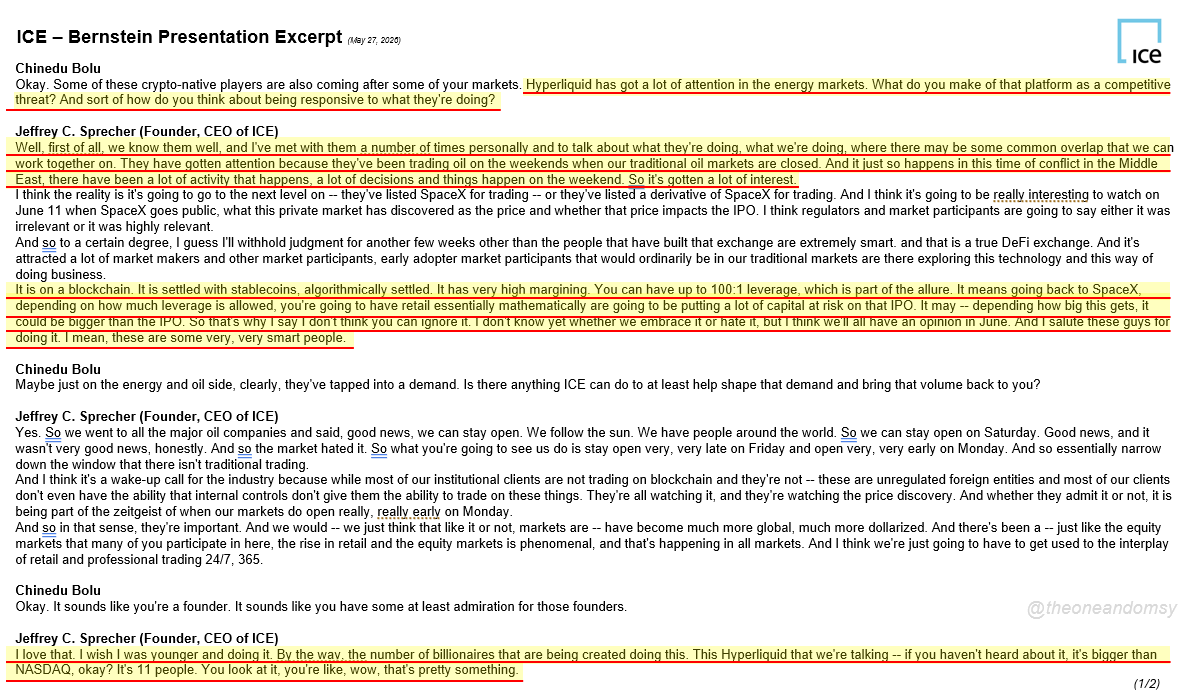
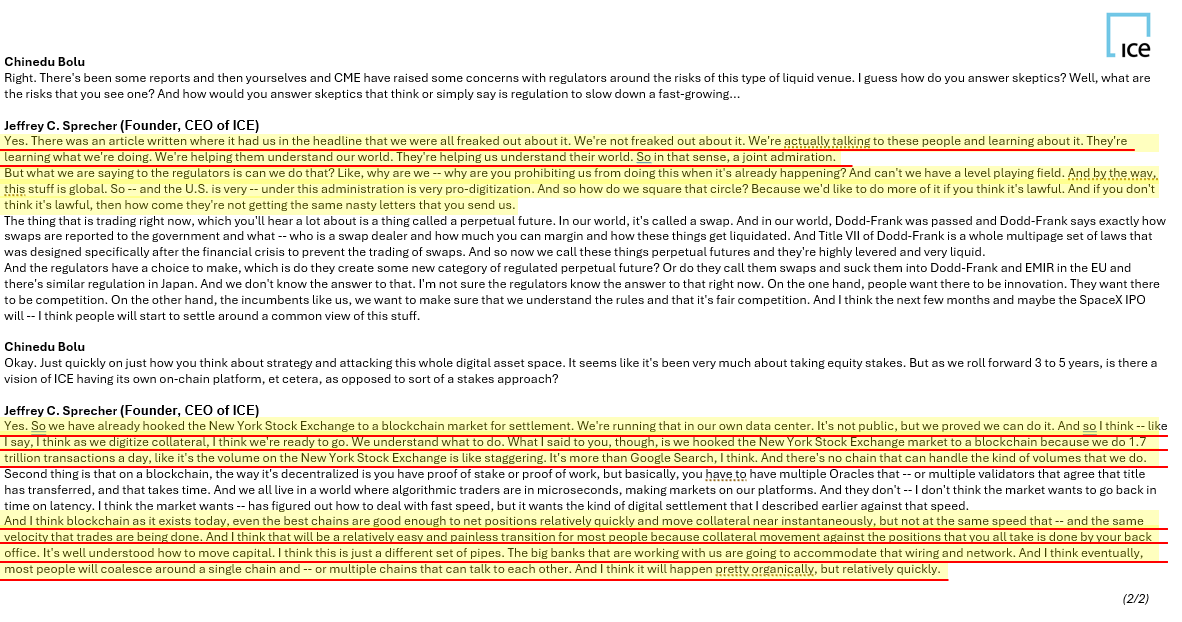
Jeff Sprecher, founder and CEO of $ICE (owns the NYSE) on Hyperliquid:
"This Hyperliquid that we're talking -- if you haven't heard about it, it's bigger than NASDAQ, okay? It's 11 people. You look at it, you're like, wow, that's pretty something."
If it wasn't clear before, hyperliquid:native has grown far beyond crypto. The incumbents have noticed, are paying close attention, and even spending time with the team
Bernstein excerpt below and worth the read imo:
67
162
910
245,953
Scott Friedman 🎗️ retweeted

May 25
The first novel Spoke implementation proposal for Aave V4 by the Babylon team introduces trustless BTC collateral on Aave V4 without Bitcoin ever leaving the Bitcoin network.
Babylon already has over $4B in BTC staked, which is expected to be used as collateral on Aave.
May 25

Today we published a temp check on the @aave governance forum: Babylon Trustless BTC Vault Integration on Aave v4.
The temp check proposes two new Aave v4 Spokes to onboard native BTC as collateral via Trustless Bitcoin Vaults and seeks community input.
governance.aave.com/t/temp-c…
31
49
332
36,648
Scott Friedman 🎗️ retweeted

May 22
If people want to understand what synthetics mean to me in this context, see the staff statement on tokenization, which distinguishes tokenized versions of issuer-sponsored stocks and of stocks that SEC-registered firms hold for their customers from synthetic instruments that provide exposure to stocks. sec.gov/newsroom/speeches-st…
May 21

I appreciate the interest in--but not the hyperbole about--the contemplated innovation exemption for the onchain trading of tokenized NMS stock. Keep in mind: I've always expected that it'd be limited in scope & would facilitate trading only of digital representations of the same underlying equity security that an investor could purchase in the secondary market today, not synthetics.
36
67
342
135,747
Scott Friedman 🎗️ retweeted

2
2
10
512
Scott Friedman 🎗️ retweeted

Apr 28
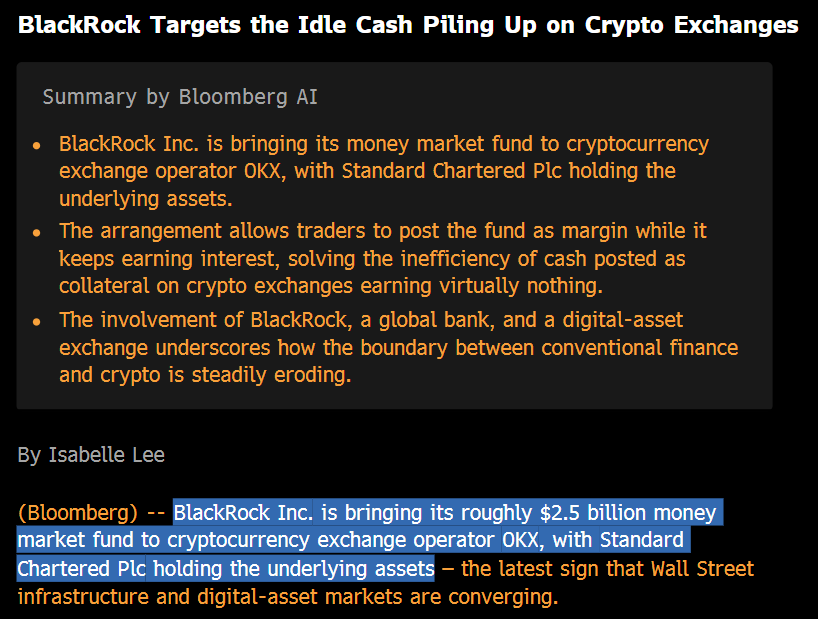
BlackRock is plugging BUIDL (its $2.5B money market fund) into @okx, with @StanChart as custodian.
Traders can now use BUIDL as collateral to trade and keep earning Treasury yield instead of letting cash sit idle.
1
14
679
Scott Friedman 🎗️ retweeted

Apr 22
JUST IN: 🇺🇸 US Admiral Paparo says the United States is running a Bitcoin node.
"We have a node on the Bitcoin network…We're doing a number of operational tests to secure and protect networks using the Bitcoin protocol."
655
1,842
12,308
1,668,441
Scott Friedman 🎗️ retweeted

Apr 21
OpenClaw is the fastest-growing open source project, but there are no stories of running it safely in production at scale. As we started deploying agents internally at @brexHQ, we couldn’t stop thinking about this question.
Agents work, but nobody wants to give them real credentials. Instead of waiting for a solution to emerge, we decided to try a novel approach: using LLMs to judge the network traffic of an AI agent.
Today we’re announcing CrabTrap, an open-source proxy that intercepts every outbound request and blocks risky activity using LLMs, before it ever hits an external API. The results are promising; we believe it’s a meaningful step forward in the security of agent harnesses in production environments.
Try it out today.
(As a side note, it was really fun to work personally on a real systems problem again. And btw, if you want to work at a place where the CEO is building proxies at night, we’re hiring!)

101
149
1,929
771,670
Scott Friedman 🎗️ retweeted

Apr 21
🚨 Do you understand what’s happening?!
> Lovable just got valued at $6.6 billion and a guy with a free account read another user's source code, database credentials, and AI chat history in 5 API calls.. Customers include Uber, Zendesk, Nvidia, Microsoft, Spotify.
> The Lovable researcher reported the bug 48 days ago through HackerOne. They marked it a "duplicate" and closed it. It still worked the day it leaked…
> Vercel got breached this week through a third-party AI tool an employee installed.. ShinyHunters listed the stolen API keys and source code on BreachForums for $2 million.
> Lovable's response was "we did not suffer a data breach." Then they admitted they patched the API in November and left every project from before that date exposed..
> When you vibe code an app you paste your Stripe key into the chat. You paste your database URL into the chat. You paste customer records into the chat. The endpoint that leaked.. returned chat histories.
> Anthropic built a model that scored 83.1% on finding real software vulnerabilities. Found a 27-year-old bug in OpenBSD and a 16-year-old flaw in FFmpeg. They named it Mythos and locked it behind a 50-company firewall because public release was too dangerous..
> Two of the world's biggest dev infrastructure platforms got breached in 48 hours and a $6.6B company's first instinct was to argue about the definition of the word "public..."
> Every founder who shipped an MVP on Lovable in early 2025 woke up today to find their database credentials are public records..
> The trust boundaries in the AI dev stack are drawn with marker. And it's raining.
If your stack ever touched a vibe coding platform, rotate everything tonight. Check the chat logs for what you forgot you typed.
AI is here. And we’re f*cked.
30
32
324
101,738

Not a single fintech CEO slept well last night.
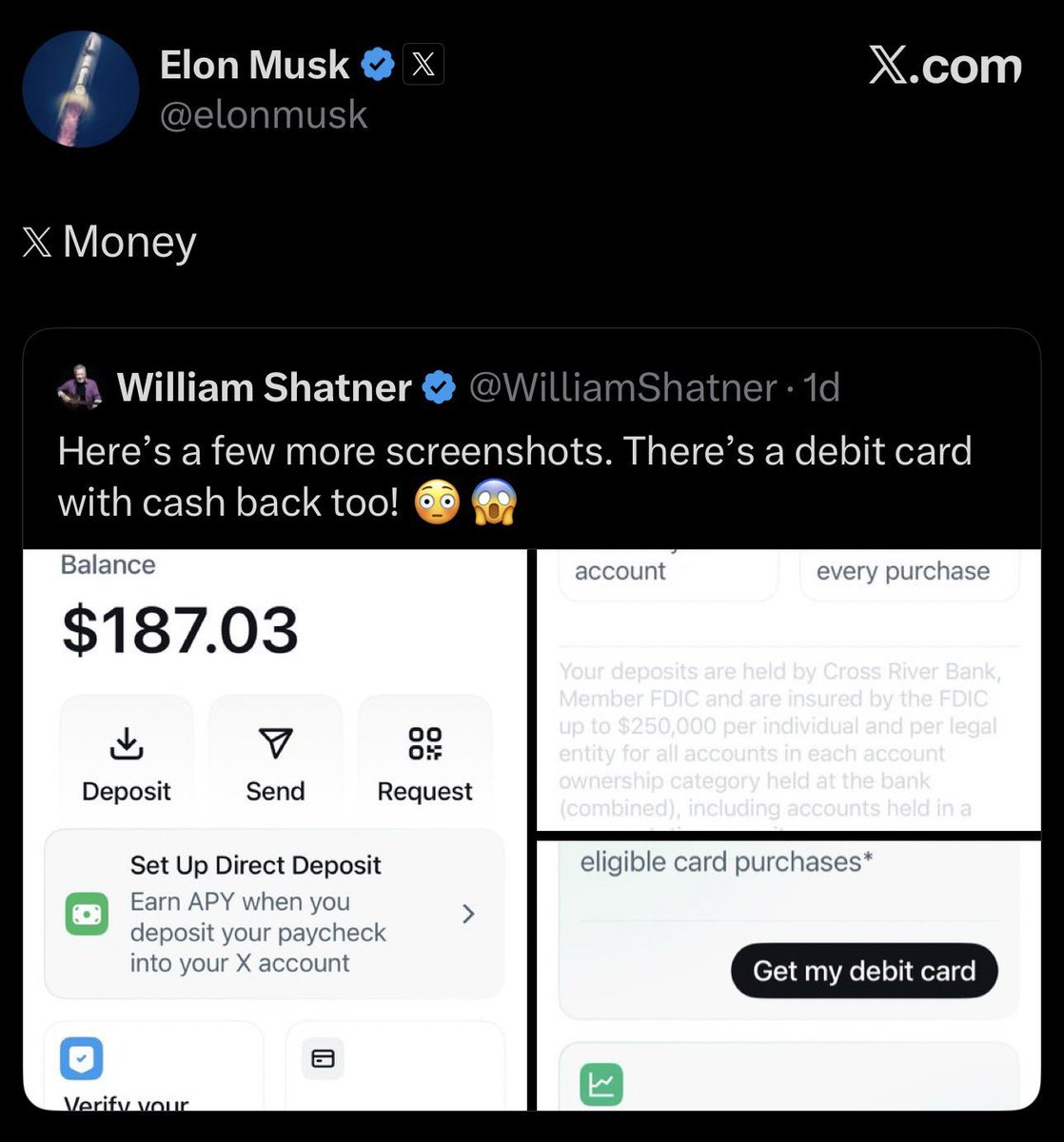
X just shipped a full financial stack in 48 hours. And most people didn't even notice.
Here's the sequence:
- Tuesday: Smart Cashtags go live. Any ticker, any contract address native price chart, right in the timeline. No redirect. No third-party app.
- Already in beta: X Money. Fiat wallet with 6% APY, metal Visa debit card with 3% cashback, P2P payments, direct deposit. FDIC-insured through Cross River Bank, the same bank behind Coinbase and Stripe.
- Already live: Brokerage routing via Wealthsimple. One tap from a post to a placed trade.
Three products. All shipped. All pointing the same direction:
Discovery → Chart → Trade → Pay.
Inside one timeline scroll.
Here's what that looks like for you and me:
Someone posts a $AAPL cashtag. I tap it. Chart loads. I see the conversation around it. I buy. Never left the app.
I send $50 to a friend. On X. I earn 6% on what's left. My debit card gives me 3% back on coffee.
Why would I open Robinhood? Why would I open Venmo? Why would I open CoinGecko?
And here's why they can't compete:
X has 550M monthly users. Robinhood has 24M funded accounts. Venmo has ~90M accounts. CoinGecko has ~30M monthly visits.
X doesn't need the best product. It needs a good-enough product inside the app people already live in.
Now zoom out.
X was an ad revenue company. ~$4.4B in 2023, almost all advertising.
The new revenue stack:
> Visa interchange on every card swipe
> Brokerage referral fees on every routed trade
> APY spread on held deposits
> Trading behavior data from 550M users
X didn't add a feature. X changed its entire business model.
"Is this good for X?"
Wrong question.
X just stopped being a social media company.
It's now a financial infrastructure company that happens to have 550 million users already scrolling.
Everyone else is competing against a distribution gap they can never close.
I wrote about this yesterday before any of it was announced. The sequence played out exactly as mapped.
The only piece left: which chain gets the default crypto trading slot.
That answer will move markets.
260
576
3,511
317,930
Apr 14

Can RWAs solve the on-chain yield crisis? x.com/i/broadcasts/1DGleEwjq…
2
1
87
Scott Friedman 🎗️ retweeted

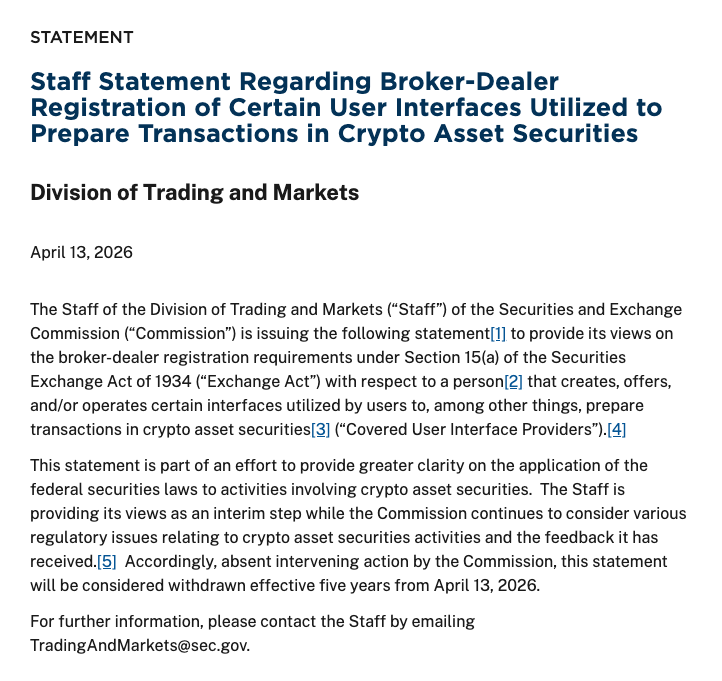
NEW 🚨: As part of Project Crypto, the Division of Trading and Markets issued a staff statement providing its views on broker-dealer registration requirements in connection with certain interfaces used to prepare transactions in crypto asset securities.
ow.ly/fiGs50YImGn
102
472
1,512
787,195

Scott Friedman 🎗️ retweeted

Apr 13
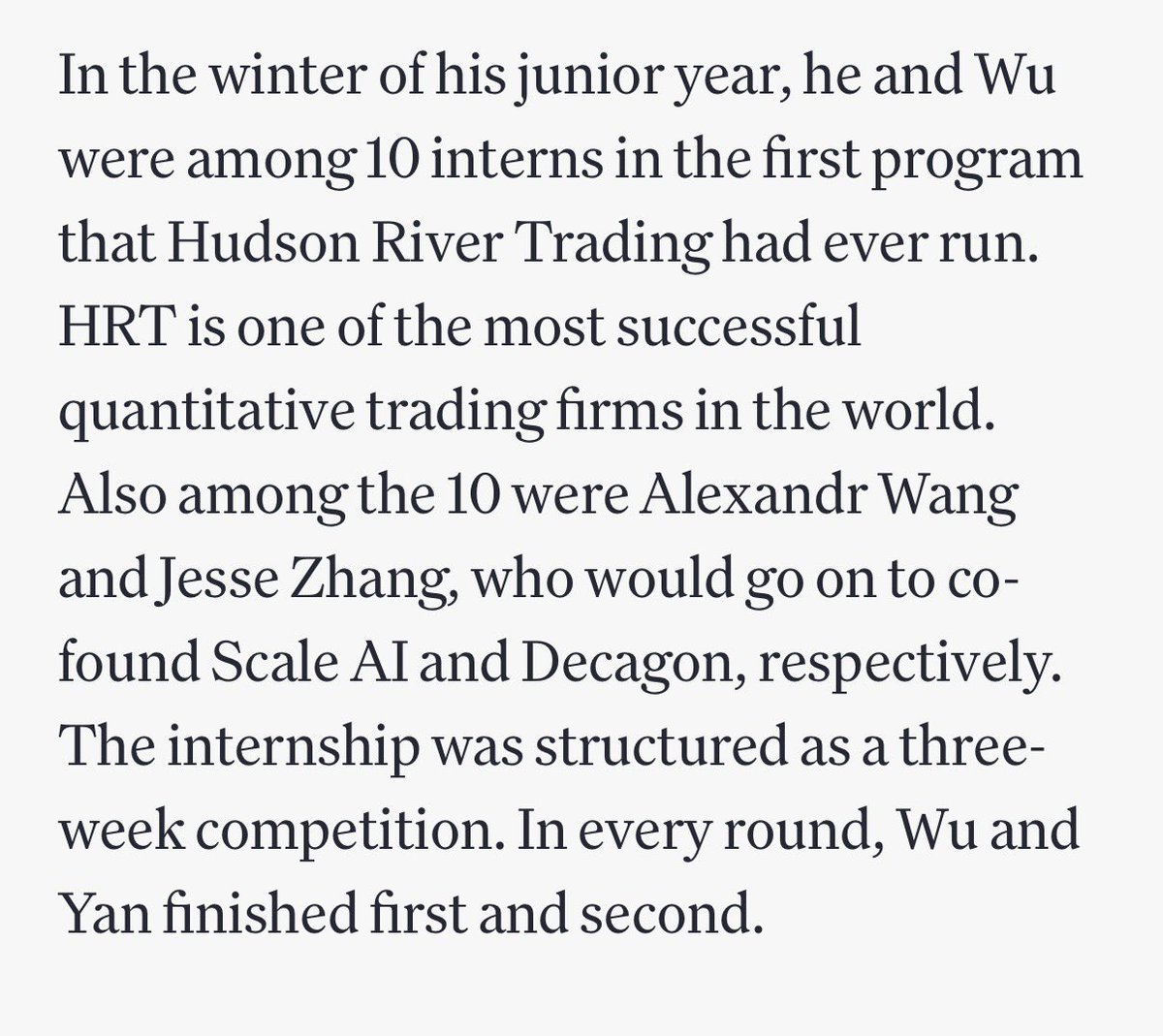
HRT’s 2015 winter internship might be the greatest intern class of all time.
4 of the 10 have gone on to build companies worth over $80B combined
Jeff Yan, Hyperliquid ($40B FDV)
Alexandr Wang, Scale AI ($29B)
Scott Wu, Cognition ($10.2B)
Jesse Zhang, Decagon ($4.5B)
36
106
1,686
398,211
Scott Friedman 🎗️ retweeted

Apr 12
Marc Andreessen highlights why the people who work for Elon Musk echo the exact same sentiment as those who worked for Steve Jobs. Even after difficult interactions or a sudden departure, they inevitably report that they did the best work of their entire lives because they were pushed to their absolute limits.
What drives this intense environment is a demand for truth-seeking at all costs. People who criticize Elon often miss this fundamental trait. He genuinely wants to know the ground truth and has zero tolerance for anything else. When confronting bad news, he is absolutely ruthless and relentless in making sure he understands exactly what is actually going on.
This level of radical transparency is shockingly rare in the business world. The typical startup founder operates on forced optimism, constantly putting on a brave face, telling everyone to have faith, and promising that everything will be great just to keep talent from leaving.
Elon completely flips that standard script. He operates with pure urgency by simply telling the unfiltered truth, even when that truth is that the company will go bankrupt and die if they fail. In almost any other corporate environment, that level of blunt, existential dread would cause the talent pool to immediately bleed out.
But for the teams working under him, that brutal honesty acts as the ultimate catalyst. It strips away the corporate fluff and forces them to rise to the occasion, leaving them with the undeniable realization that, much like the engineers who built the first iPhone, they just completed the greatest work of their careers.
413
1,502
12,492
12,411,544
Scott Friedman 🎗️ retweeted

Apr 9
94
163
2,091
1,133,703
Your ai history is court evidence!
The court quoted at length responses generated by a popular AI platform in response to queries made by the Buyer’s CEO about how to take control of the Target’s operations.
mayerbrown.com/en/insights/p…
1
42